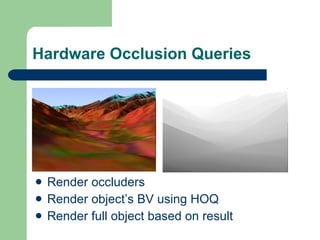
This document discusses techniques for visualizing massive 3D models. It covers culling methods like view frustum and occlusion culling to remove invisible geometry. Level of detail techniques generate lower detail versions of models to improve performance. Hierarchical LOD representations allow efficient refinement. Out-of-core techniques bring portions of models into memory as needed to handle models too large to fit entirely in memory. Compression, prefetching, and cache-coherent layouts further optimize rendering massive models. The goal is to keep processors busy and maintain performance as model complexity increases beyond memory limits.


![Example Massive Models Procedurally generated model of Pompeii: ~1.4 billion polygons. Image from [Mueller06]](https://image.slidesharecdn.com/introductiontomassivemodelvisualization-090829081728-phpapp01/85/Introduction-To-Massive-Model-Visualization-8-320.jpg)


![Trends No upper bound on model complexity Procedural generation Laser scans and aerial imagery Imagery Image from [Lakhia06]](https://image.slidesharecdn.com/introductiontomassivemodelvisualization-090829081728-phpapp01/85/Introduction-To-Massive-Model-Visualization-11-320.jpg)


![Occlusion Culling From-region or from-point Most are conservative Occluder Fusion Difficult for general scenes with arbitrary occluders. So make simplifying assumptions: [Wonka00] – urban environments [Ohlarik08] – planets and satellites](https://image.slidesharecdn.com/introductiontomassivemodelvisualization-090829081728-phpapp01/85/Introduction-To-Massive-Model-Visualization-19-320.jpg)



![Continuous LOD edge collapse vertex split Image from [Luebke01]](https://image.slidesharecdn.com/introductiontomassivemodelvisualization-090829081728-phpapp01/85/Introduction-To-Massive-Model-Visualization-29-320.jpg)


![Out-of-Core Prefetching Predict camera position [Correa03] v v’ f f’](https://image.slidesharecdn.com/introductiontomassivemodelvisualization-090829081728-phpapp01/85/Introduction-To-Massive-Model-Visualization-41-320.jpg)
![Out-of-Core Prefetching [Varadhan02] Coherence of Front Prefetch ascendants/descendants Prefetch with enlarged view frustum Prioritize 0 1 2 3 4 5 6 7](https://image.slidesharecdn.com/introductiontomassivemodelvisualization-090829081728-phpapp01/85/Introduction-To-Massive-Model-Visualization-42-320.jpg)


![Cache Coherent Layouts Minimize ACMR Average Cache Miss Ratio Cache Oblivious [Yoon05] Linear Time [Sander07]](https://image.slidesharecdn.com/introductiontomassivemodelvisualization-090829081728-phpapp01/85/Introduction-To-Massive-Model-Visualization-45-320.jpg)


![[unofficial] Pyramid Scene Parsing Network (CVPR 2017)](https://cdn.slidesharecdn.com/ss_thumbnails/pyramidsceneparsingnetwork-170815035025-thumbnail.jpg?width=640&height=640&fit=bounds)


