Prof. Pier Luca Lanzi
Data Exploration
Data Mining andText Mining (UIC 583 @ Politecnico di Milano)
Prof. Pier Luca Lanzi
Readings
• “Data Mining and Analysis” – Chapter 2 & 3
• Loading Data and Basic Formatting in R
http://flowingdata.com/2015/02/18/loading-data-and-basic-formatting-in-r/
2
Prof. Pier Luca Lanzi
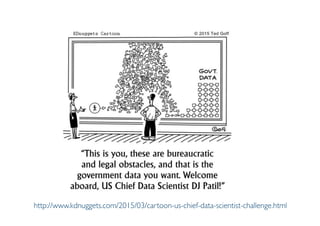
http://www.kdnuggets.com/2015/03/cartoon-us-chief-data-scientist-challenge.html
Prof. Pier Luca Lanzi
Before trying anything,
you should know your data!
Prof. Pier Luca Lanzi
What is Data Exploration?
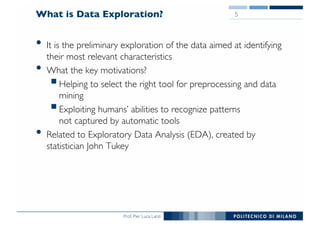
• It is the preliminary exploration of the data aimed at identifying
their most relevant characteristics
• What the key motivations?
§Helping to select the right tool for preprocessing and data
mining
§Exploiting humans’ abilities to recognize patterns
not captured by automatic tools
• Related to Exploratory Data Analysis (EDA), created by
statistician John Tukey
5
Prof. Pier Luca Lanzi
Exploratory Data Analysis
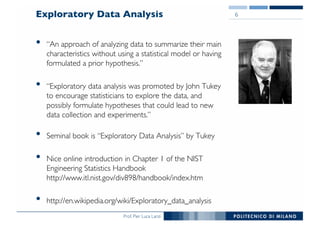
• “An approach of analyzing data to summarize their main
characteristics without using a statistical model or having
formulated a prior hypothesis.”
• “Exploratory data analysis was promoted by John Tukey
to encourage statisticians to explore the data, and
possibly formulate hypotheses that could lead to new
data collection and experiments.”
• Seminal book is “Exploratory Data Analysis” by Tukey
• Nice online introduction in Chapter 1 of the NIST
Engineering Statistics Handbook
http://www.itl.nist.gov/div898/handbook/index.htm
• http://en.wikipedia.org/wiki/Exploratory_data_analysis
6
Prof. Pier Luca Lanzi
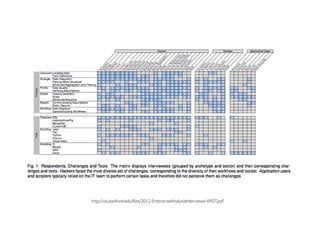
http://vis.stanford.edu/files/2012-EnterpriseAnalysisInterviews-VAST.pdf
Prof. Pier Luca Lanzi
What Data Exploration Techniques?
• Exploratory Data Analysis (as originally defined by Tukey),
was mainly focused on
§Visualization
§Clustering and anomaly detection
(viewed as exploratory techniques)
§In data mining, clustering and anomaly detection are major
areas of interest, and not thought of as just exploratory
• In this section, we focus on data exploration using
§Summary statistics
§Visualization
• We will come back later to data exploration when discussing
clustering
8
Prof. Pier Luca Lanzi
Numerical Attributes
9
Prof. Pier Luca Lanzi
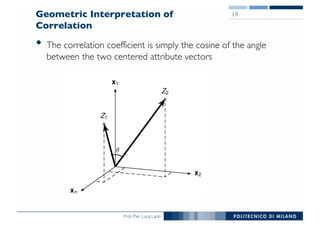
Geometric Interpretation of
Correlation
• The correlation coefficient is simply the cosine of the angle
between the two centered attribute vectors
19
Prof. Pier Luca Lanzi
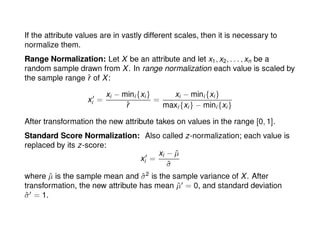
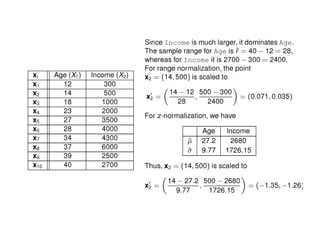
Normalization
20
Prof. Pier Luca Lanzi
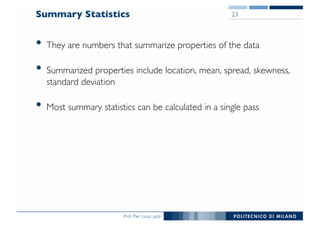
Summary Statistics
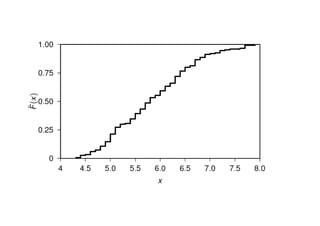
• They are numbers that summarize properties of the data
• Summarized properties include location, mean, spread, skewness,
standard deviation
• Most summary statistics can be calculated in a single pass
23
Prof. Pier Luca Lanzi
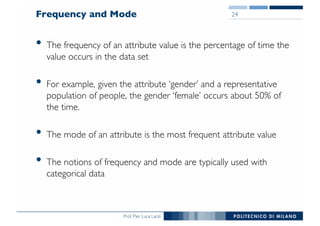
Frequency and Mode
• The frequency of an attribute value is the percentage of time the
value occurs in the data set
• For example, given the attribute ‘gender’ and a representative
population of people, the gender ‘female’ occurs about 50% of
the time.
• The mode of an attribute is the most frequent attribute value
• The notions of frequency and mode are typically used with
categorical data
24
Prof. Pier Luca Lanzi
Measures of Location:
Mean and Median
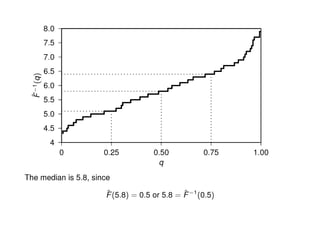
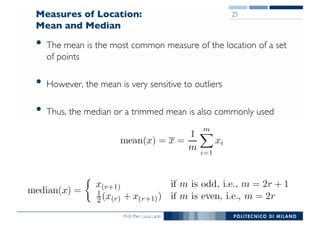
• The mean is the most common measure of the location of a set
of points
• However, the mean is very sensitive to outliers
• Thus, the median or a trimmed mean is also commonly used
25
Prof. Pier Luca Lanzi
Measures of Spread:
Range and Variance
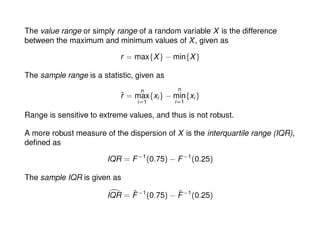
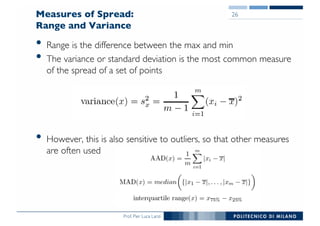
• Range is the difference between the max and min
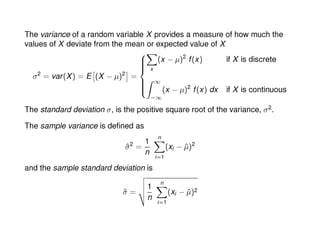
• The variance or standard deviation is the most common measure
of the spread of a set of points
• However, this is also sensitive to outliers, so that other measures
are often used
26
Prof. Pier Luca Lanzi
Percentiles
• For continuous data, the notion of a percentile is veryuseful
• Given an ordinal or continuous attribute x and a number p
between 0 and 100, the p-th percentile is a value xp of x such
that p% of the observed values of x are less than xp
• For instance, the 50th percentile is the value x50% such that 50%
of all values of x are less than x50%
27
Prof. Pier Luca Lanzi
Visualization
• Visualization is the conversion of data into a visual or tabular
format so that the characteristics of the data and the relationships
among data items or attributes can be analyzed or reported
• Data visualization is one of the most powerful and appealing
techniques for data exploration
§Humans have a well developed ability to analyze large
amounts of information that is presented visually
§Can detect general patterns and trends
§Can detect outliers and unusual patterns
28
Prof. Pier Luca Lanzi
Barplots
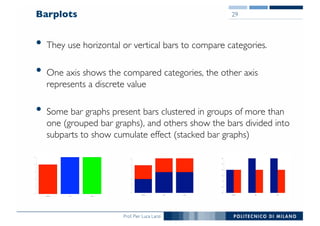
• They use horizontal or vertical bars to compare categories.
• One axis shows the compared categories, the other axis
represents a discrete value
• Some bar graphs present bars clustered in groups of more than
one (grouped bar graphs), and others show the bars divided into
subparts to show cumulate effect (stacked bar graphs)
29
Prof. Pier Luca Lanzi
Histograms
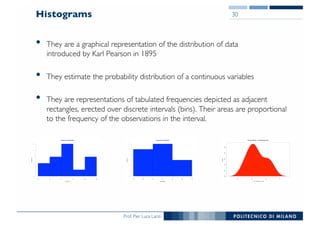
• They are a graphical representation of the distribution of data
introduced by Karl Pearson in 1895
• They estimate the probability distribution of a continuous variables
• They are representations of tabulated frequencies depicted as adjacent
rectangles, erected over discrete intervals (bins). Their areas are proportional
to the frequency of the observations in the interval.
30
Prof. Pier Luca Lanzi
Histograms
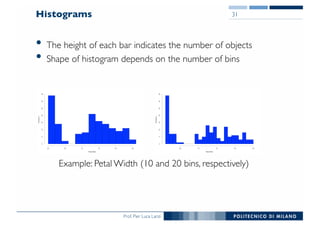
• The height of each bar indicates the number of objects
• Shape of histogram depends on the number of bins
31
Example: Petal Width (10 and 20 bins, respectively)
Prof. Pier Luca Lanzi
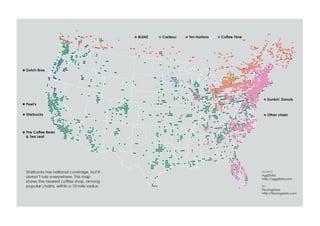
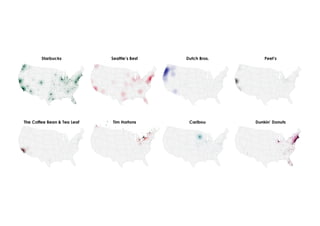
Maps
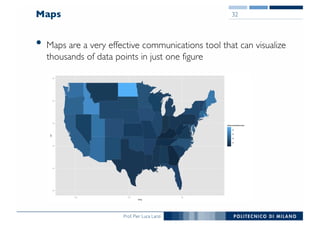
• Maps are a very effective communications tool that can visualize
thousands of data points in just one figure
32
Prof. Pier Luca Lanzi
Mapping Data for Visualization
• Data objects, their attributes, and the relationships among data
objects are translated into graphical elements such as points, lines,
shapes, and colors
• Objects are often represented as points
• Their attribute values can be represented as the position of the
points or the characteristics of the points, e.g., color, size, and
shape
• If position is used, then the relationships of points, i.e., whether
they form groups or a point is an outlier, is easily perceived.
33
Prof. Pier Luca Lanzi
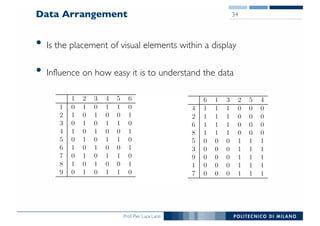
Data Arrangement
• Is the placement of visual elements within a display
• Influence on how easy it is to understand the data
34
Prof. Pier Luca Lanzi
Selection
• Is the elimination or the de-emphasis of
certain objects and attributes
• Selection may involve choosing a subset of attributes
§Dimensionality reduction is often used to reduce the number
of dimensions to two or three
§Alternatively, pairs of attributes can be considered
• Selection may also involve choosing a subset of objects
§ A region of the screen can only show so many points
§Can sample, but want to preserve points in sparse areas
35
Prof. Pier Luca Lanzi
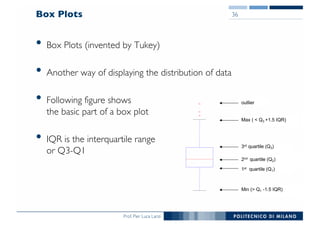
Box Plots
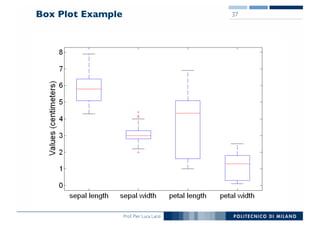
• Box Plots (invented by Tukey)
• Another way of displaying the distribution of data
• Following figure shows
the basic part of a box plot
• IQR is the interquartile range
or Q3-Q1
36
outlier
Min (> Q1 -1.5 IQR)
1st quartile (Q1)
3rd quartile (Q3)
2nd quartile (Q2)
Max ( < Q3 +1.5 IQR)
Prof. Pier Luca Lanzi
Box Plot Example 37
Prof. Pier Luca Lanzi
Scatter Plots
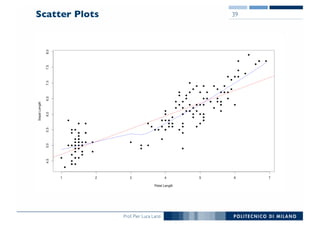
• Attributes values determine the position
• Two-dimensional scatter plots most common, but can have
three-dimensional scatter plots
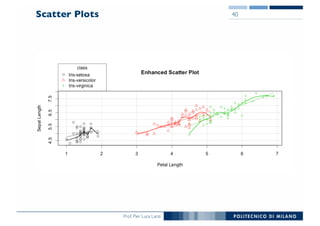
• Often additional attributes can be displayed by using the size,
shape, and color of the markers that represent the objects
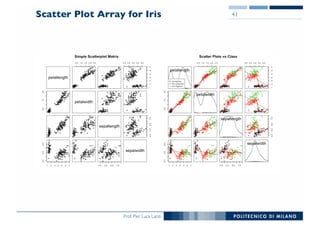
• It is useful to have arrays of scatter plots can compactly
summarize the relationships of several pairs of attributes
• Examples: http://www.statmethods.net/graphs/scatterplot.html
38
Prof. Pier Luca Lanzi
Scatter Plots 39
Prof. Pier Luca Lanzi
Scatter Plots 40
Prof. Pier Luca Lanzi
Scatter Plot Array for Iris 41
Prof. Pier Luca Lanzi
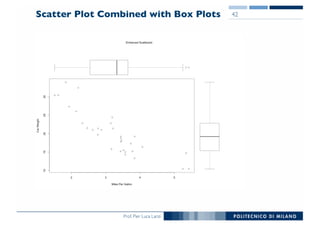
Scatter Plot Combined with Box Plots 42
Prof. Pier Luca Lanzi
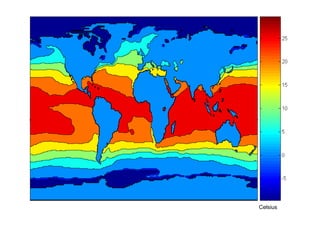
Contour Plots
• Useful for continuous attributes measured on a spatial grid
• They partition the plane into regions of similar values
• The contour lines that form the boundaries of these regions
connect points with equal values
• The most common example is contour maps of elevation
• Can also display temperature, rainfall, air pressure, etc.
43
Prof. Pier Luca Lanzi
Celsius
Prof. Pier Luca Lanzi
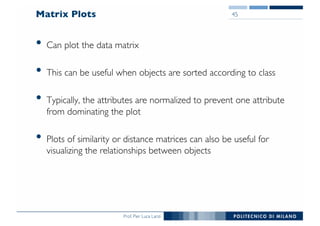
Matrix Plots
• Can plot the data matrix
• This can be useful when objects are sorted according to class
• Typically, the attributes are normalized to prevent one attribute
from dominating the plot
• Plots of similarity or distance matrices can also be useful for
visualizing the relationships between objects
45
Prof. Pier Luca Lanzi
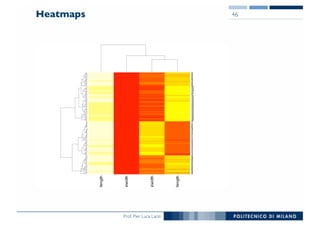
Heatmaps 46
Prof. Pier Luca Lanzi
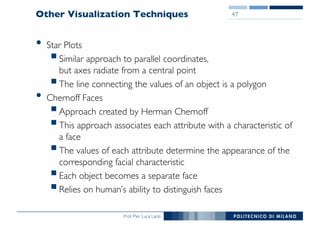
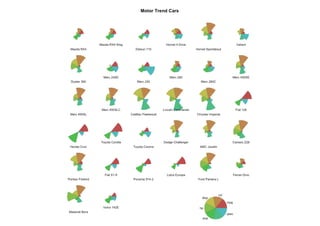
Other Visualization Techniques
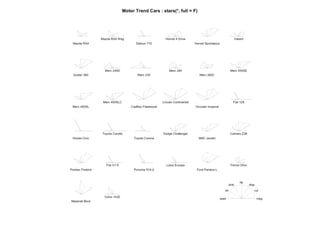
• Star Plots
§Similar approach to parallel coordinates,
but axes radiate from a central point
§The line connecting the values of an object is a polygon
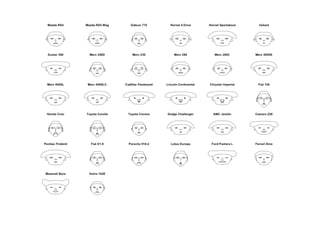
• Chernoff Faces
§Approach created by Herman Chernoff
§This approach associates each attribute with a characteristic of
a face
§The values of each attribute determine the appearance of the
corresponding facial characteristic
§Each object becomes a separate face
§Relies on human’s ability to distinguish faces
47
Prof. Pier Luca Lanzi
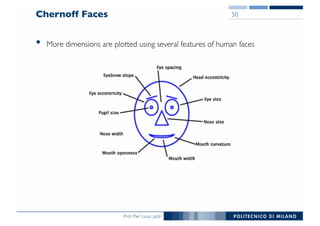
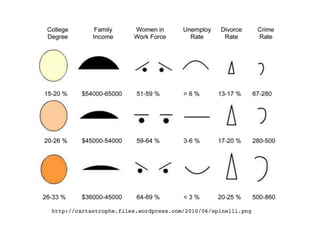
Chernoff Faces
• More dimensions are plotted using several features of human faces
50
Prof. Pier Luca Lanzi
http://cartastrophe.files.wordpress.com/2010/06/spinelli.png
Prof. Pier Luca Lanzi
Examples
Prof. Pier Luca Lanzi
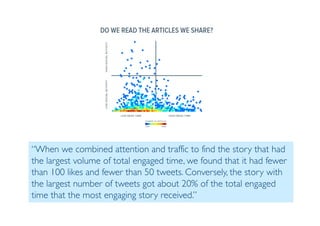
do we read the articles we share?
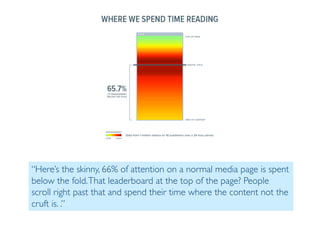
does my banner work?
Prof. Pier Luca Lanzi
“When we combined attention and traffic to find the story that had
the largest volume of total engaged time, we found that it had fewer
than 100 likes and fewer than 50 tweets. Conversely, the story with
the largest number of tweets got about 20% of the total engaged
time that the most engaging story received.”
Prof. Pier Luca Lanzi
“Here’s the skinny, 66% of attention on a normal media page is spent
below the fold.That leaderboard at the top of the page? People
scroll right past that and spend their time where the content not the
cruft is. .”
Prof. Pier Luca Lanzi
http://time.com/12933/what-you-think-you-know-about-the-web-is-wrong/?iid=biz-category-mostpop2
Prof. Pier Luca Lanzi
http://apps.startribune.com/news/20140313-beer-me-minnesota/
Prof. Pier Luca Lanzi
Run the Python notebooks
for this lecture

DMTM Lecture 19 Data exploration

  • 1.
    Prof. Pier LucaLanzi Data Exploration Data Mining andText Mining (UIC 583 @ Politecnico di Milano)
  • 2.
    Prof. Pier LucaLanzi Readings • “Data Mining and Analysis” – Chapter 2 & 3 • Loading Data and Basic Formatting in R http://flowingdata.com/2015/02/18/loading-data-and-basic-formatting-in-r/ 2
  • 3.
    Prof. Pier LucaLanzi http://www.kdnuggets.com/2015/03/cartoon-us-chief-data-scientist-challenge.html
  • 4.
    Prof. Pier LucaLanzi Before trying anything, you should know your data!
  • 5.
    Prof. Pier LucaLanzi What is Data Exploration? • It is the preliminary exploration of the data aimed at identifying their most relevant characteristics • What the key motivations? §Helping to select the right tool for preprocessing and data mining §Exploiting humans’ abilities to recognize patterns not captured by automatic tools • Related to Exploratory Data Analysis (EDA), created by statistician John Tukey 5
  • 6.
    Prof. Pier LucaLanzi Exploratory Data Analysis • “An approach of analyzing data to summarize their main characteristics without using a statistical model or having formulated a prior hypothesis.” • “Exploratory data analysis was promoted by John Tukey to encourage statisticians to explore the data, and possibly formulate hypotheses that could lead to new data collection and experiments.” • Seminal book is “Exploratory Data Analysis” by Tukey • Nice online introduction in Chapter 1 of the NIST Engineering Statistics Handbook http://www.itl.nist.gov/div898/handbook/index.htm • http://en.wikipedia.org/wiki/Exploratory_data_analysis 6
  • 7.
    Prof. Pier LucaLanzi http://vis.stanford.edu/files/2012-EnterpriseAnalysisInterviews-VAST.pdf
  • 8.
    Prof. Pier LucaLanzi What Data Exploration Techniques? • Exploratory Data Analysis (as originally defined by Tukey), was mainly focused on §Visualization §Clustering and anomaly detection (viewed as exploratory techniques) §In data mining, clustering and anomaly detection are major areas of interest, and not thought of as just exploratory • In this section, we focus on data exploration using §Summary statistics §Visualization • We will come back later to data exploration when discussing clustering 8
  • 9.
    Prof. Pier LucaLanzi Numerical Attributes 9
  • 10.
  • 11.
  • 12.
  • 13.
  • 14.
  • 15.
  • 16.
  • 17.
  • 18.
  • 19.
    Prof. Pier LucaLanzi Geometric Interpretation of Correlation • The correlation coefficient is simply the cosine of the angle between the two centered attribute vectors 19
  • 20.
    Prof. Pier LucaLanzi Normalization 20
  • 21.
  • 22.
  • 23.
    Prof. Pier LucaLanzi Summary Statistics • They are numbers that summarize properties of the data • Summarized properties include location, mean, spread, skewness, standard deviation • Most summary statistics can be calculated in a single pass 23
  • 24.
    Prof. Pier LucaLanzi Frequency and Mode • The frequency of an attribute value is the percentage of time the value occurs in the data set • For example, given the attribute ‘gender’ and a representative population of people, the gender ‘female’ occurs about 50% of the time. • The mode of an attribute is the most frequent attribute value • The notions of frequency and mode are typically used with categorical data 24
  • 25.
    Prof. Pier LucaLanzi Measures of Location: Mean and Median • The mean is the most common measure of the location of a set of points • However, the mean is very sensitive to outliers • Thus, the median or a trimmed mean is also commonly used 25
  • 26.
    Prof. Pier LucaLanzi Measures of Spread: Range and Variance • Range is the difference between the max and min • The variance or standard deviation is the most common measure of the spread of a set of points • However, this is also sensitive to outliers, so that other measures are often used 26
  • 27.
    Prof. Pier LucaLanzi Percentiles • For continuous data, the notion of a percentile is veryuseful • Given an ordinal or continuous attribute x and a number p between 0 and 100, the p-th percentile is a value xp of x such that p% of the observed values of x are less than xp • For instance, the 50th percentile is the value x50% such that 50% of all values of x are less than x50% 27
  • 28.
    Prof. Pier LucaLanzi Visualization • Visualization is the conversion of data into a visual or tabular format so that the characteristics of the data and the relationships among data items or attributes can be analyzed or reported • Data visualization is one of the most powerful and appealing techniques for data exploration §Humans have a well developed ability to analyze large amounts of information that is presented visually §Can detect general patterns and trends §Can detect outliers and unusual patterns 28
  • 29.
    Prof. Pier LucaLanzi Barplots • They use horizontal or vertical bars to compare categories. • One axis shows the compared categories, the other axis represents a discrete value • Some bar graphs present bars clustered in groups of more than one (grouped bar graphs), and others show the bars divided into subparts to show cumulate effect (stacked bar graphs) 29
  • 30.
    Prof. Pier LucaLanzi Histograms • They are a graphical representation of the distribution of data introduced by Karl Pearson in 1895 • They estimate the probability distribution of a continuous variables • They are representations of tabulated frequencies depicted as adjacent rectangles, erected over discrete intervals (bins). Their areas are proportional to the frequency of the observations in the interval. 30
  • 31.
    Prof. Pier LucaLanzi Histograms • The height of each bar indicates the number of objects • Shape of histogram depends on the number of bins 31 Example: Petal Width (10 and 20 bins, respectively)
  • 32.
    Prof. Pier LucaLanzi Maps • Maps are a very effective communications tool that can visualize thousands of data points in just one figure 32
  • 33.
    Prof. Pier LucaLanzi Mapping Data for Visualization • Data objects, their attributes, and the relationships among data objects are translated into graphical elements such as points, lines, shapes, and colors • Objects are often represented as points • Their attribute values can be represented as the position of the points or the characteristics of the points, e.g., color, size, and shape • If position is used, then the relationships of points, i.e., whether they form groups or a point is an outlier, is easily perceived. 33
  • 34.
    Prof. Pier LucaLanzi Data Arrangement • Is the placement of visual elements within a display • Influence on how easy it is to understand the data 34
  • 35.
    Prof. Pier LucaLanzi Selection • Is the elimination or the de-emphasis of certain objects and attributes • Selection may involve choosing a subset of attributes §Dimensionality reduction is often used to reduce the number of dimensions to two or three §Alternatively, pairs of attributes can be considered • Selection may also involve choosing a subset of objects § A region of the screen can only show so many points §Can sample, but want to preserve points in sparse areas 35
  • 36.
    Prof. Pier LucaLanzi Box Plots • Box Plots (invented by Tukey) • Another way of displaying the distribution of data • Following figure shows the basic part of a box plot • IQR is the interquartile range or Q3-Q1 36 outlier Min (> Q1 -1.5 IQR) 1st quartile (Q1) 3rd quartile (Q3) 2nd quartile (Q2) Max ( < Q3 +1.5 IQR)
  • 37.
    Prof. Pier LucaLanzi Box Plot Example 37
  • 38.
    Prof. Pier LucaLanzi Scatter Plots • Attributes values determine the position • Two-dimensional scatter plots most common, but can have three-dimensional scatter plots • Often additional attributes can be displayed by using the size, shape, and color of the markers that represent the objects • It is useful to have arrays of scatter plots can compactly summarize the relationships of several pairs of attributes • Examples: http://www.statmethods.net/graphs/scatterplot.html 38
  • 39.
    Prof. Pier LucaLanzi Scatter Plots 39
  • 40.
    Prof. Pier LucaLanzi Scatter Plots 40
  • 41.
    Prof. Pier LucaLanzi Scatter Plot Array for Iris 41
  • 42.
    Prof. Pier LucaLanzi Scatter Plot Combined with Box Plots 42
  • 43.
    Prof. Pier LucaLanzi Contour Plots • Useful for continuous attributes measured on a spatial grid • They partition the plane into regions of similar values • The contour lines that form the boundaries of these regions connect points with equal values • The most common example is contour maps of elevation • Can also display temperature, rainfall, air pressure, etc. 43
  • 44.
    Prof. Pier LucaLanzi Celsius
  • 45.
    Prof. Pier LucaLanzi Matrix Plots • Can plot the data matrix • This can be useful when objects are sorted according to class • Typically, the attributes are normalized to prevent one attribute from dominating the plot • Plots of similarity or distance matrices can also be useful for visualizing the relationships between objects 45
  • 46.
    Prof. Pier LucaLanzi Heatmaps 46
  • 47.
    Prof. Pier LucaLanzi Other Visualization Techniques • Star Plots §Similar approach to parallel coordinates, but axes radiate from a central point §The line connecting the values of an object is a polygon • Chernoff Faces §Approach created by Herman Chernoff §This approach associates each attribute with a characteristic of a face §The values of each attribute determine the appearance of the corresponding facial characteristic §Each object becomes a separate face §Relies on human’s ability to distinguish faces 47
  • 48.
  • 49.
  • 50.
    Prof. Pier LucaLanzi Chernoff Faces • More dimensions are plotted using several features of human faces 50
  • 51.
    Prof. Pier LucaLanzi http://cartastrophe.files.wordpress.com/2010/06/spinelli.png
  • 52.
  • 53.
    Prof. Pier LucaLanzi Examples
  • 54.
    Prof. Pier LucaLanzi do we read the articles we share? does my banner work?
  • 55.
    Prof. Pier LucaLanzi “When we combined attention and traffic to find the story that had the largest volume of total engaged time, we found that it had fewer than 100 likes and fewer than 50 tweets. Conversely, the story with the largest number of tweets got about 20% of the total engaged time that the most engaging story received.”
  • 56.
    Prof. Pier LucaLanzi “Here’s the skinny, 66% of attention on a normal media page is spent below the fold.That leaderboard at the top of the page? People scroll right past that and spend their time where the content not the cruft is. .”
  • 57.
    Prof. Pier LucaLanzi http://time.com/12933/what-you-think-you-know-about-the-web-is-wrong/?iid=biz-category-mostpop2
  • 58.
    Prof. Pier LucaLanzi http://apps.startribune.com/news/20140313-beer-me-minnesota/
  • 59.
  • 60.
  • 61.
  • 62.
    Prof. Pier LucaLanzi Run the Python notebooks for this lecture