Downloaded 153 times

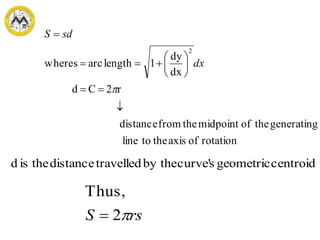
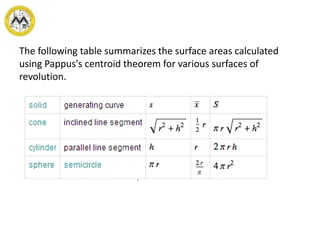
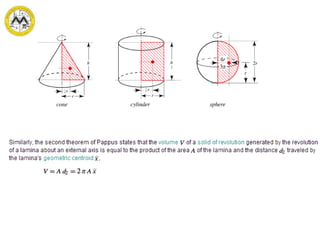
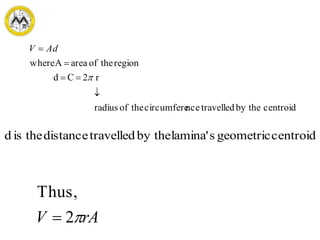
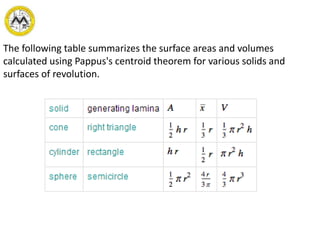
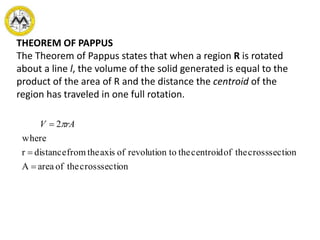
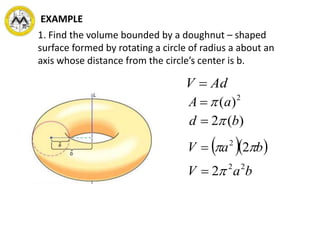
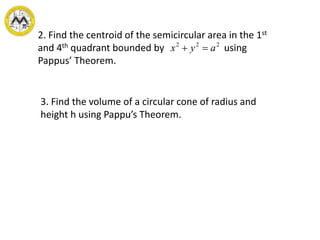
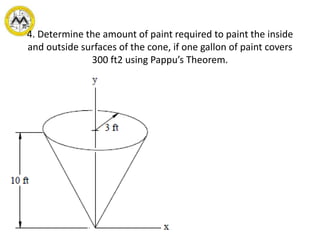
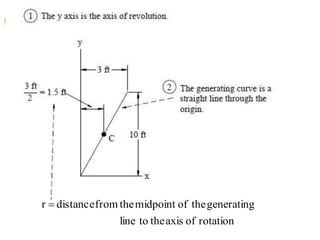


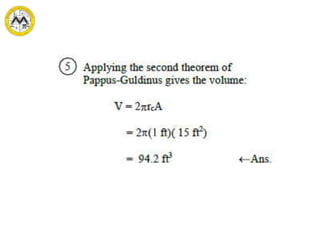
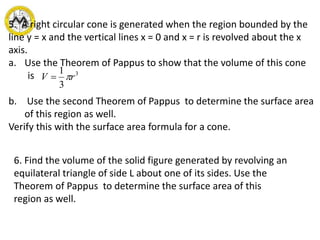
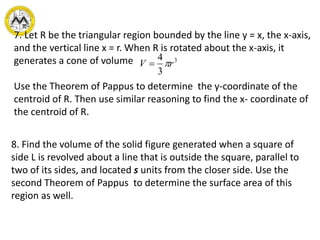


The document discusses Pappus's centroid theorem, which states that the volume of a solid generated by rotating a region R about a line l is equal to the product of the area of R and the distance traveled by R's centroid during one full rotation. The theorem can be used to calculate the volumes and surface areas of various solids of revolution. Examples are provided of applying the theorem to find volumes and surface areas of solids like cones, spheres, and others.


![Engineering Economics: Solved exam problems [ch1-ch4]](https://cdn.slidesharecdn.com/ss_thumbnails/solvedexamproblemsch1-ch4-200220070043-thumbnail.jpg?width=640&height=640&fit=bounds)


![MATH SLIDE_OK [11860].pdf](https://cdn.slidesharecdn.com/ss_thumbnails/math-20slide-ok-20-5b11860-5d-151216153516-thumbnail.jpg?width=640&height=640&fit=bounds)


