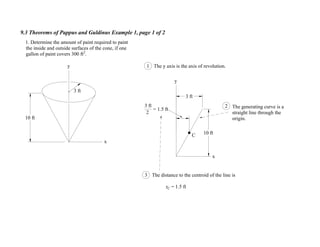
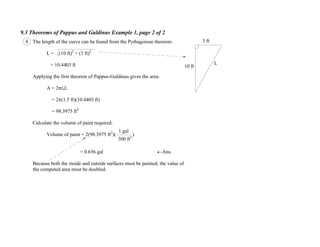
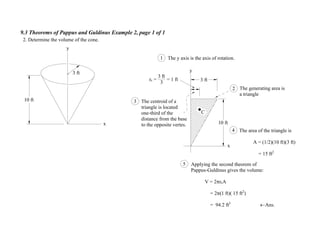
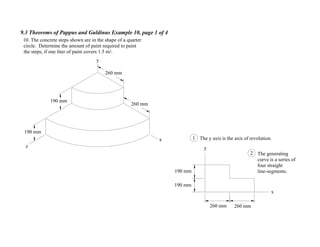
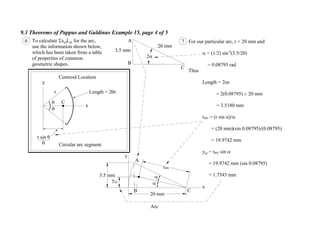
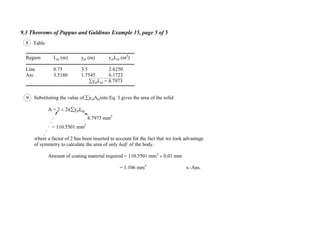
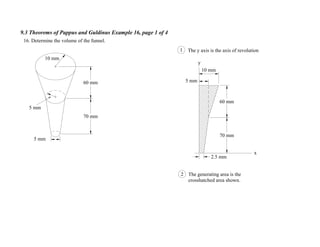
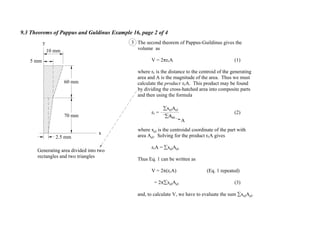
1. The document contains 10 examples demonstrating the use of Pappus and Guldinus theorems to calculate areas, volumes, and amounts of paint required for various solids of revolution.
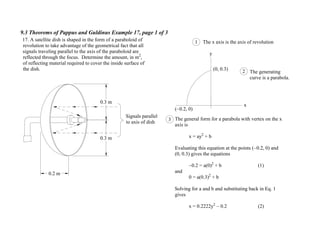
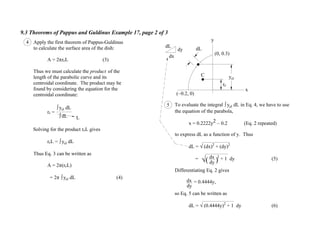
2. The theorems relate the area or volume of a solid of revolution to the generating curve/area and the distance to the centroid. Examples involve cones, tori, frusta and composite shapes.
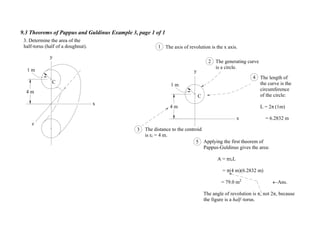
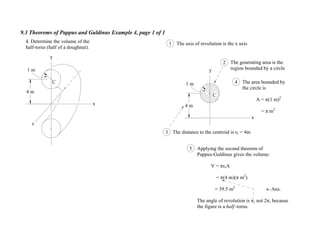
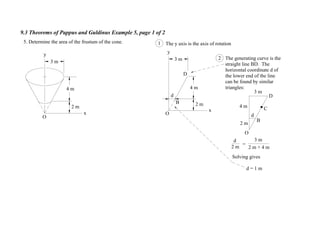
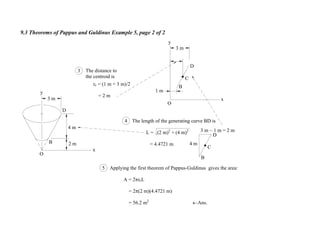
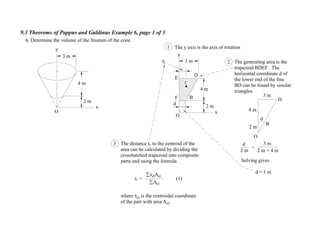
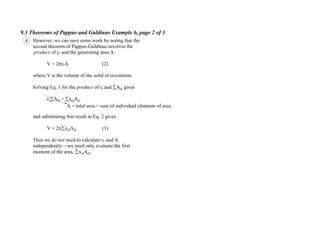
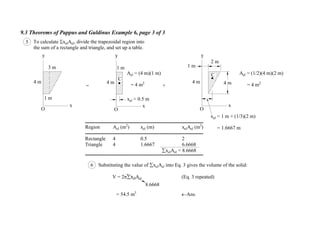
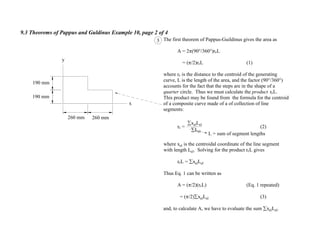
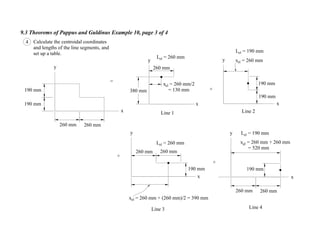
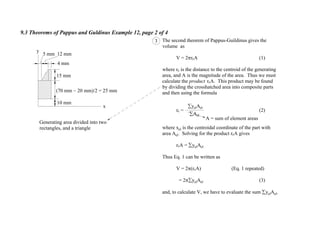
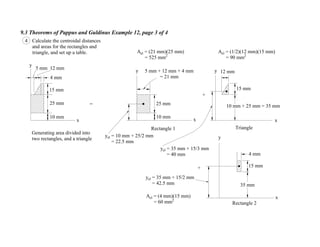
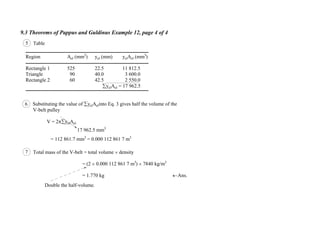
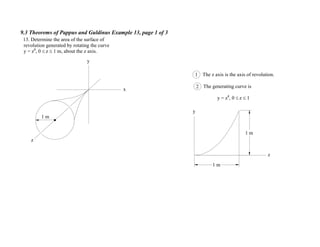
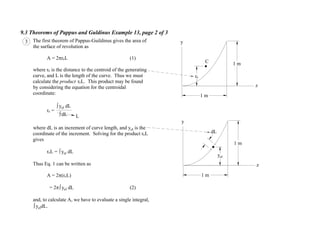
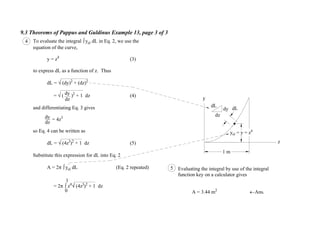
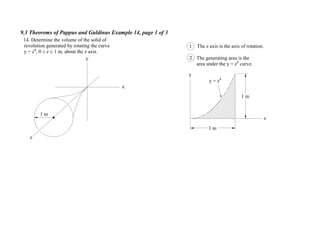
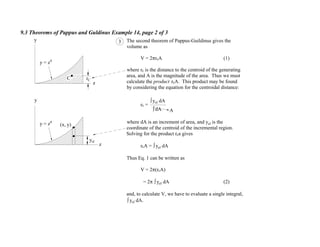
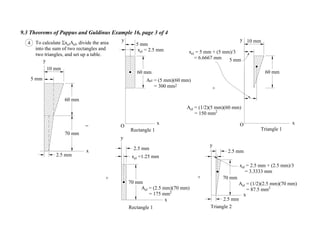
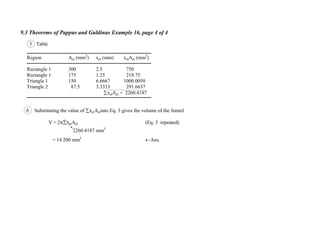
3. For each problem, the generating curve/area is identified and divided into components. The distance to the centroid of each component and their areas/lengths are calculated and summed to determine the final area or volume using the appropriate theorem of Pappus or Guldinus.
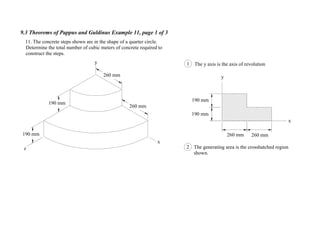
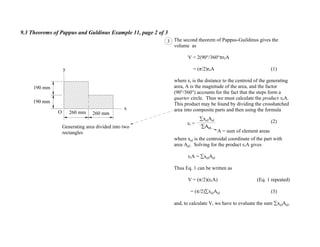
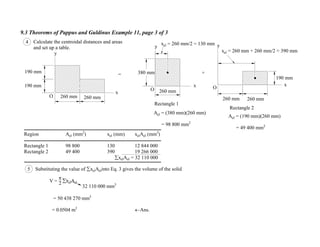
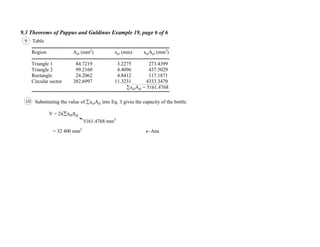
![9.3 Theorems of Pappus and Guldinus Example 10, page 4 of 4
6 Substituting the value of xelAelinto Eq. 3 gives the area of the steps
A = xelLel (Eq. 3 repeated)
= 445 164 mm2
283 400 mm2
7 Amount of paint required = 445 164 mm2
[1 m/(1000 mm)]2
[1 liter of paint/1.5 m2
of covered area]
= 0.297 liter Ans.
2
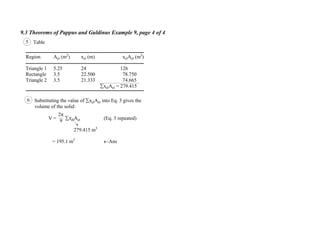
5 Table
Region Lel (mm) xel (mm) xelLel (mm2
)
Line 1 260 130 33 800
Line 2 190 260 49 400
Line 3 260 390 104 100
Line 4 190 520 98 800
xelLel = 283 400](https://image.slidesharecdn.com/theorempappus1-150212011241-conversion-gate01/85/Theorem-pappus-1-21-320.jpg)



![Trigonometry [QEE-R 2012]](https://cdn.slidesharecdn.com/ss_thumbnails/qeereviewproblemswithsoln-120412063344-phpapp02-thumbnail.jpg?width=640&height=640&fit=bounds)


![01 01 chapgere[1]](https://cdn.slidesharecdn.com/ss_thumbnails/01-01chapgere1-130611230425-phpapp02-thumbnail.jpg?width=640&height=640&fit=bounds)


![[W f stoecker]_refrigeration_and_a_ir_conditioning_(book_zz.org)](https://cdn.slidesharecdn.com/ss_thumbnails/wfstoeckerrefrigerationandairconditioningbookzz-161019162540-thumbnail.jpg?width=640&height=640&fit=bounds)


![Chapter 3 static forces on surfaces [compatibility mode]](https://cdn.slidesharecdn.com/ss_thumbnails/chapter-3-static-forces-on-surfaces-compatibility-mode-160214035852-thumbnail.jpg?width=640&height=640&fit=bounds)


