Cary Engleberg, MD, DTM&H, FIDSA
Professor of Internal Medicine
Division of Infectious Diseases,
and Department of Microbiology & Immunology
Uiversity of Michigan Medical School
Unless otherwise noted, this material is made available under the terms of the Creative Commons
Attribution 3.0 License: http://creativecommons.org/licenses/by/3.0/
1
• Problem-based learning (PBL):
– Usually refers to a curriculum style
– Questions for research based upon ‘‘real life’’
problems that may be clinical or nonclinical.
– Group activities
– Requires a “facilitator”
• Case-based learning (CBL)
– Can be an element of curriculum
– Based on issue(s) that arise in a clinical case
– Self-directed or structured
– Structure depends on the level of the learner. 2
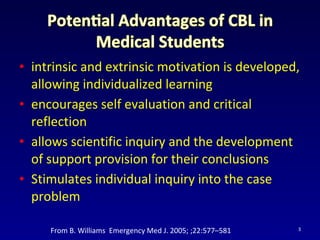
• intrinsic and extrinsic motivation is developed,
allowing individualized learning
• encourages self evaluation and critical
reflection
• allows scientific inquiry and the development
of support provision for their conclusions
• Stimulates individual inquiry into the case
problem
From B. Williams Emergency Med J. 2005; ;22:577–581 3
• Permits a simulated patient encounter with a
problem that they may never have
encountered; creates awareness
• Allows for re-evaluation of basic knowledge;
filling of knowledge gaps
• Allows a re-evaluation of problem-solving
skills.
• integration of knowledge and practice, and
development of learning skills
4
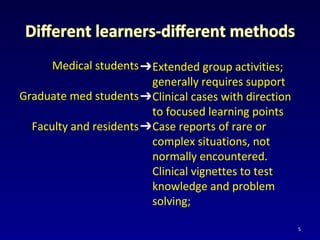
Medical students
Graduate med students
Faculty and residents
➔Extended group activities;
generally requires support
➔Clinical cases with direction
to focused learning points
➔Case reports of rare or
complex situations, not
normally encountered.
Clinical vignettes to test
knowledge and problem
solving;
5
• For specific case management (searchable)
– Case reports in journals
– Published case series
• For professional enrichment/learning:
– Grand Rounds; clinical conferences
– Clinical vignettes in journals with discussion (often,
Grand Round in print”)
– Photo quizzes
– Interactive case sessions at large meetings
– Interactive computer-based case problems
6
• Experimental lesson: How does a bicycle pump work?
• Narration alone, or
• Narration with simultaneous animation
• Transfer testing (essay)
• Suppose you push down on the handle and no air
comes out. What could have gone wrong?
• Why does air enter a pump? Why does it exit the
pump?
• What can be done to make sure that a pump will not
fail?
7
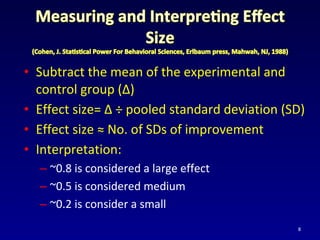
• Subtract the mean of the experimental and
control group (Δ)
• Effect size= Δ ÷ pooled standard deviation (SD)
• Effect size ≈ No. of SDs of improvement
• Interpretation:
– ~0.8 is considered a large effect
– ~0.5 is considered medium
– ~0.2 is consider a small
8
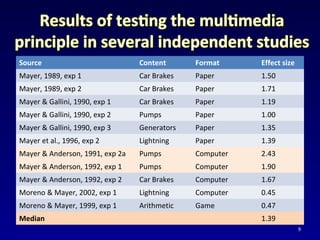
Source Content Format Effect size
Mayer, 1989, exp 1 Car Brakes Paper 1.50
Mayer, 1989, exp 2 Car Brakes Paper 1.71
Mayer & Gallini, 1990, exp 1 Car Brakes Paper 1.19
Mayer & Gallini, 1990, exp 2 Pumps Paper 1.00
Mayer & Gallini, 1990, exp 3 Generators Paper 1.35
Mayer et al., 1996, exp 2 Lightning Paper 1.39
Mayer & Anderson, 1991, exp 2a Pumps Computer 2.43
Mayer & Anderson, 1992, exp 1 Pumps Computer 1.90
Mayer & Anderson, 1992, exp 2 Car Brakes Computer 1.67
Moreno & Mayer, 2002, exp 1 Lightning Computer 0.45
Moreno & Mayer, 1999, exp 1 Arithmetic Game 0.47
Median 1.39
9
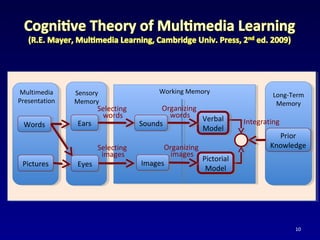
WordsWords
PicturesPictures
Multimedia
Presentation
Sensory
Memory
EarsEars
EyesEyes
Working Memory
SoundsSounds
ImagesImages
Selecting
words
Selecting
images
Long-Term
Memory
Prior
Knowledge
Prior
Knowledge
Integrating
Organizing
words
Organizing
images
Verbal
Model
Verbal
Model
Pictorial
Model
Pictorial
Model
10
11
12
13
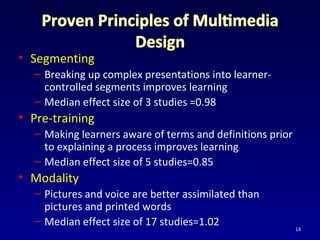
• Segmenting
– Breaking up complex presentations into learner-
controlled segments improves learning
– Median effect size of 3 studies =0.98
• Pre-training
– Making learners aware of terms and definitions prior
to explaining a process improves learning
– Median effect size of 5 studies=0.85
• Modality
– Pictures and voice are better assimilated than
pictures and printed words
– Median effect size of 17 studies=1.02 14
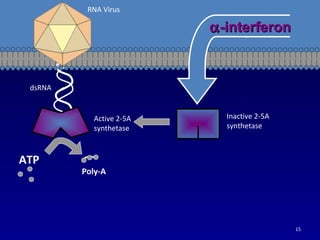
Poly-A
ATP
Active 2-5A
synthetase
Inactive 2-5A
synthetase
αα-interferon-interferon
RNA Virus
dsRNA
15
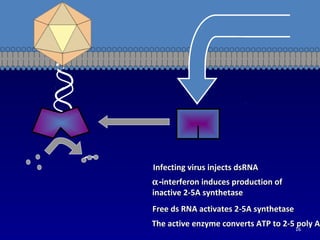
The active enzyme converts ATP to 2-5 poly AThe active enzyme converts ATP to 2-5 poly A
Free ds RNA activates 2-5A synthetaseFree ds RNA activates 2-5A synthetase
αα--interferon induces production ofinterferon induces production of
inactive 2-5A synthetaseinactive 2-5A synthetase
Infecting virus injects dsRNAInfecting virus injects dsRNA
16
17
• Personalization
– Narration should be directed personally at the
learner, using the pronouns “you” and “I” rather
than a passive voice.
– Median effect size of 11 studies =1.11
• Voice principle
– A human, familiar voice in narrations enhances
learning
– Median effect size of 3 studies=0.78
18
• Principles apply most directly to learners with
little or no prior knowledge of the subject
being taught
• Principles are more important in the following
situations:
– Subject-matter is complex
– Presentation is fast-paced
19
• Case histories are used in multiple ways for
different purposes
• Learning method (not just content) should be
different for professionals at different levels
of expertise
• Learning can be enhanced
20
unnecessary,
gratuitous
image
21

Tutorial: Case-based learning: Dr. Cary Engleberg

  • 1.
    Cary Engleberg, MD,DTM&H, FIDSA Professor of Internal Medicine Division of Infectious Diseases, and Department of Microbiology & Immunology Uiversity of Michigan Medical School Unless otherwise noted, this material is made available under the terms of the Creative Commons Attribution 3.0 License: http://creativecommons.org/licenses/by/3.0/ 1
  • 2.
    • Problem-based learning(PBL): – Usually refers to a curriculum style – Questions for research based upon ‘‘real life’’ problems that may be clinical or nonclinical. – Group activities – Requires a “facilitator” • Case-based learning (CBL) – Can be an element of curriculum – Based on issue(s) that arise in a clinical case – Self-directed or structured – Structure depends on the level of the learner. 2
  • 3.
    • intrinsic andextrinsic motivation is developed, allowing individualized learning • encourages self evaluation and critical reflection • allows scientific inquiry and the development of support provision for their conclusions • Stimulates individual inquiry into the case problem From B. Williams Emergency Med J. 2005; ;22:577–581 3
  • 4.
    • Permits asimulated patient encounter with a problem that they may never have encountered; creates awareness • Allows for re-evaluation of basic knowledge; filling of knowledge gaps • Allows a re-evaluation of problem-solving skills. • integration of knowledge and practice, and development of learning skills 4
  • 5.
    Medical students Graduate medstudents Faculty and residents ➔Extended group activities; generally requires support ➔Clinical cases with direction to focused learning points ➔Case reports of rare or complex situations, not normally encountered. Clinical vignettes to test knowledge and problem solving; 5
  • 6.
    • For specificcase management (searchable) – Case reports in journals – Published case series • For professional enrichment/learning: – Grand Rounds; clinical conferences – Clinical vignettes in journals with discussion (often, Grand Round in print”) – Photo quizzes – Interactive case sessions at large meetings – Interactive computer-based case problems 6
  • 7.
    • Experimental lesson:How does a bicycle pump work? • Narration alone, or • Narration with simultaneous animation • Transfer testing (essay) • Suppose you push down on the handle and no air comes out. What could have gone wrong? • Why does air enter a pump? Why does it exit the pump? • What can be done to make sure that a pump will not fail? 7
  • 8.
    • Subtract themean of the experimental and control group (Δ) • Effect size= Δ ÷ pooled standard deviation (SD) • Effect size ≈ No. of SDs of improvement • Interpretation: – ~0.8 is considered a large effect – ~0.5 is considered medium – ~0.2 is consider a small 8
  • 9.
    Source Content FormatEffect size Mayer, 1989, exp 1 Car Brakes Paper 1.50 Mayer, 1989, exp 2 Car Brakes Paper 1.71 Mayer & Gallini, 1990, exp 1 Car Brakes Paper 1.19 Mayer & Gallini, 1990, exp 2 Pumps Paper 1.00 Mayer & Gallini, 1990, exp 3 Generators Paper 1.35 Mayer et al., 1996, exp 2 Lightning Paper 1.39 Mayer & Anderson, 1991, exp 2a Pumps Computer 2.43 Mayer & Anderson, 1992, exp 1 Pumps Computer 1.90 Mayer & Anderson, 1992, exp 2 Car Brakes Computer 1.67 Moreno & Mayer, 2002, exp 1 Lightning Computer 0.45 Moreno & Mayer, 1999, exp 1 Arithmetic Game 0.47 Median 1.39 9
  • 10.
  • 11.
  • 12.
  • 13.
  • 14.
    • Segmenting – Breakingup complex presentations into learner- controlled segments improves learning – Median effect size of 3 studies =0.98 • Pre-training – Making learners aware of terms and definitions prior to explaining a process improves learning – Median effect size of 5 studies=0.85 • Modality – Pictures and voice are better assimilated than pictures and printed words – Median effect size of 17 studies=1.02 14
  • 15.
  • 16.
    The active enzymeconverts ATP to 2-5 poly AThe active enzyme converts ATP to 2-5 poly A Free ds RNA activates 2-5A synthetaseFree ds RNA activates 2-5A synthetase αα--interferon induces production ofinterferon induces production of inactive 2-5A synthetaseinactive 2-5A synthetase Infecting virus injects dsRNAInfecting virus injects dsRNA 16
  • 17.
  • 18.
    • Personalization – Narrationshould be directed personally at the learner, using the pronouns “you” and “I” rather than a passive voice. – Median effect size of 11 studies =1.11 • Voice principle – A human, familiar voice in narrations enhances learning – Median effect size of 3 studies=0.78 18
  • 19.
    • Principles applymost directly to learners with little or no prior knowledge of the subject being taught • Principles are more important in the following situations: – Subject-matter is complex – Presentation is fast-paced 19
  • 20.
    • Case historiesare used in multiple ways for different purposes • Learning method (not just content) should be different for professionals at different levels of expertise • Learning can be enhanced 20
  • 21.

Editor's Notes

  • #16 The 2-5A synthetase/RNaseL pathway • Interferon-α induces production of 2-5A synthetase • Free dsRNA produced during RNA virus replication activates 2-5A synthetase • ATP is converted to 2 ’ -5 ’ -linked adenosine (2-5A) • 2-5A dimerizes and activates RNaseL • RNaseL degrades single-stranded loops of RNA (including those on ribosomal RNAs) • Potent antiviral effect
  • #17 The 2-5A synthetase/RNaseL pathway • Interferon-α induces production of 2-5A synthetase • Free dsRNA produced during RNA virus replication activates 2-5A synthetase • ATP is converted to 2 ’ -5 ’ -linked adenosine (2-5A) • 2-5A dimerizes and activates RNaseL • RNaseL degrades single-stranded loops of RNA (including those on ribosomal RNAs) • Potent antiviral effect