Case Based Learning and
Teaching
By: Abeer Kassem
Demonstrator at Medical Education Department,
Tanta University
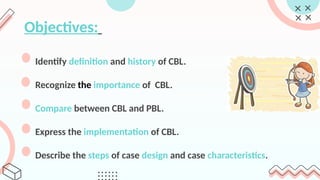
Objectives:
Identify definition and history of CBL.
Recognize the importance of CBL.
Compare between CBL and PBL.
Express the implementation of CBL.
Describe the steps of case design and case characteristics.
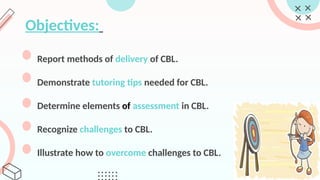
Objectives:
Report methods of delivery of CBL.
Demonstrate tutoring tips needed for CBL.
Determine elements of assessment in CBL.
Recognize challenges to CBL.
Illustrate how to overcome challenges to CBL.
Introduction:
Since the evolution of adult learning and realizing the
adults’ needs to be actively involved in their learning and
to see relevance of the material they are studying, there
has been a change in education.
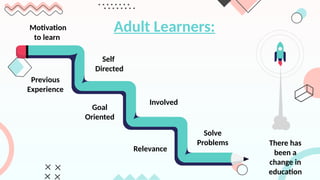
Adult Learners:
Motivation
to learn
There has
been a
change in
education
Previous
Experience
Self
Directed
Involved
Relevance
Goal
Oriented
Solve
Problems
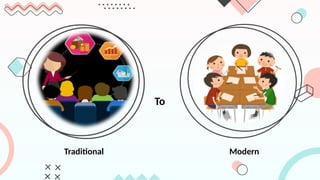
To
Traditional Modern
Introduction:
Medical schools have realized the importance of
integrating basic and clinical knowledge, where learning
points were explained with clinical cases which we can call
case based learning.
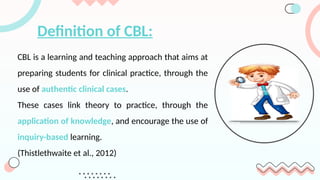
Definition of CBL:
CBL is a learning and teaching approach that aims at
preparing students for clinical practice, through the
use of authentic clinical cases.
These cases link theory to practice, through the
application of knowledge, and encourage the use of
inquiry-based learning.
(Thistlethwaite et al., 2012)
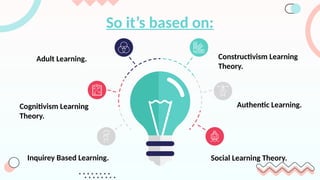
So it’s based on:
Adult Learning.
Authentic Learning.
Inquirey Based Learning.
Constructivism Learning
Theory.
Cognitivism Learning
Theory.
Social Learning Theory.
History:
Harvard
Edinburgh
At University of Edinburgh in
1912, Dr James Lorrain Smith
was the first to introduce CBL, it
also was introduced in the
curriculum of Harvard medical
school in 1920.
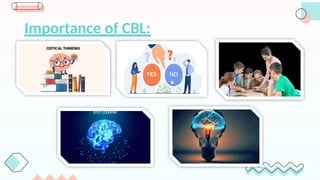
Importance of CBL:
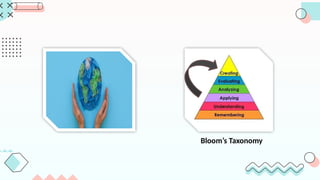
Bloom’s Taxonomy
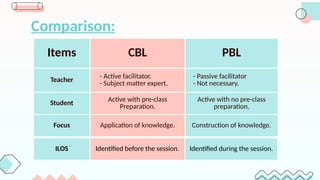
Comparison:
Items CBL PBL
Teacher
- Active facilitator.
- Subject matter expert.
- Passive facilitator
- Not necessary.
Student
Active with pre-class
Preparation.
Active with no pre-class
preparation.
Focus Application of knowledge. Construction of knowledge.
ILOS Identified before the session. Identified during the session.
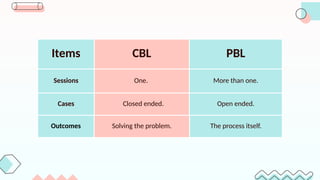
Items CBL PBL
Sessions One. More than one.
Cases Closed ended. Open ended.
Outcomes Solving the problem. The process itself.
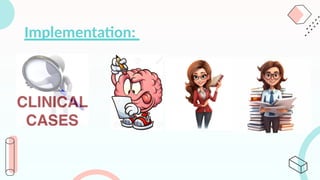
Implementation:
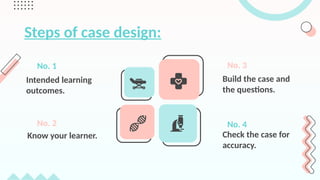
Steps of case design:
No. 1
Intended learning
outcomes.
No. 3
Build the case and
the questions.
No. 4
Check the case for
accuracy.
No. 2
Know your learner.
E
D
C
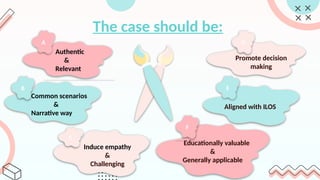
The case should be:
Induce empathy
&
Challenging
Promote decision
making
Aligned with ILOS
B
A
Common scenarios
&
Narrative way
Educationally valuable
&
Generally applicable
F
Authentic
&
Relevant
A
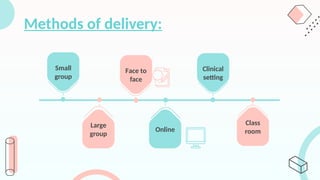
Methods of delivery:
Clinical
setting
Face to
face
Large
group
Class
room
Small
group
Online
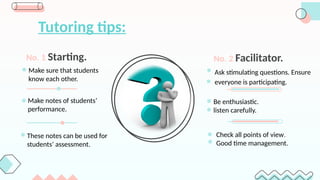
Tutoring tips:
Make sure that students
know each other.
No. 1 Starting.
Ask stimulating questions. Ensure
everyone is participating.
No. 2 Facilitator.
Check all points of view.
Good time management.
Be enthusiastic.
listen carefully.
Make notes of students’
performance.
These notes can be used for
students’ assessment.
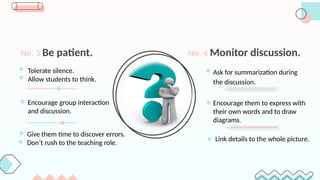
Tolerate silence.
Allow students to think.
No. 3 Be patient.
Ask for summarization during
the discussion.
No. 4 Monitor discussion.
Encourage them to express with
their own words and to draw
diagrams.
Link details to the whole picture.
Encourage group interaction
and discussion.
Give them time to discover errors.
Don’t rush to the teaching role.
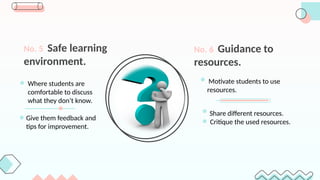
No. 5 Safe learning
environment.
No. 6 Guidance to
resources.
Share different resources.
Critique the used resources.
Motivate students to use
resources.
Where students are
comfortable to discuss
what they don’t know.
Give them feedback and
tips for improvement.
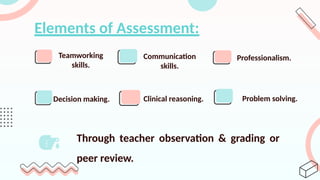
Teamworking
skills.
Professionalism.
Decision making. Problem solving.
Clinical reasoning.
Through teacher observation & grading or
peer review.
Elements of Assessment:
Communication
skills.
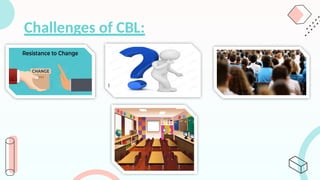
Challenges of CBL:
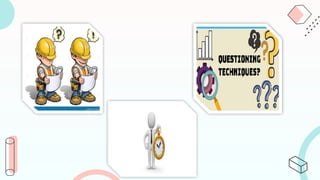
How to overcome:
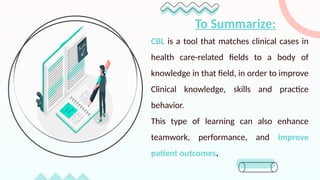
To Summarize:
CBL is a tool that matches clinical cases in
health care-related fields to a body of
knowledge in that field, in order to improve
Clinical knowledge, skills and practice
behavior.
This type of learning can also enhance
teamwork, performance, and improve
patient outcomes.
CREDITS: This presentation template was created by
Slidesgo, including icons by Flaticon, infographics &
images by Freepik
THANKS!
Do you have any questions?
abeer.kassem@med.tanta.edu.eg
1) Case based tutor training guide, Dalhousie University, Canada.
https://cdn.dal.ca/content/dam/dalhousie/pdf/faculty/medicine/departments/core- units/cpd/
FacDev/cbl_tutor_training_guide_part1.pdf
2) McLean S. F. (2016). Case-Based Learning and its Application in Medical and Health-Care Fields: A Review of
Worldwide Literature. Journal of medical education and curricular development, 3, JMECD.S20377.
https://doi.org/10.4137/JMECD.S20377
3) Thistlethwaite, J. E., Davies, D., Ekeocha, S., Kidd, J. M., MacDougall, C., Matthews, P., Purkis, J., & Clay, D.
(2012). The effectiveness of case-based learning in health professional education. A BEME systematic review:
BEME Guide No. 23. Medical teacher, 34(6), e421–e444. https://doi.org/10.3109/0142159X.2012.680939
4) Williams, B. (2005). Case based learning—a review of the literature: is there scope for this educational
paradigm in prehospital education?. Emergency Medicine Journal, 22(8), 577-581.
References:

Case based learning definition, imortance

  • 1.
    Case Based Learningand Teaching By: Abeer Kassem Demonstrator at Medical Education Department, Tanta University
  • 2.
    Objectives: Identify definition andhistory of CBL. Recognize the importance of CBL. Compare between CBL and PBL. Express the implementation of CBL. Describe the steps of case design and case characteristics.
  • 3.
    Objectives: Report methods ofdelivery of CBL. Demonstrate tutoring tips needed for CBL. Determine elements of assessment in CBL. Recognize challenges to CBL. Illustrate how to overcome challenges to CBL.
  • 4.
    Introduction: Since the evolutionof adult learning and realizing the adults’ needs to be actively involved in their learning and to see relevance of the material they are studying, there has been a change in education.
  • 5.
    Adult Learners: Motivation to learn Therehas been a change in education Previous Experience Self Directed Involved Relevance Goal Oriented Solve Problems
  • 6.
  • 7.
    Introduction: Medical schools haverealized the importance of integrating basic and clinical knowledge, where learning points were explained with clinical cases which we can call case based learning.
  • 8.
    Definition of CBL: CBLis a learning and teaching approach that aims at preparing students for clinical practice, through the use of authentic clinical cases. These cases link theory to practice, through the application of knowledge, and encourage the use of inquiry-based learning. (Thistlethwaite et al., 2012)
  • 9.
    So it’s basedon: Adult Learning. Authentic Learning. Inquirey Based Learning. Constructivism Learning Theory. Cognitivism Learning Theory. Social Learning Theory.
  • 10.
    History: Harvard Edinburgh At University ofEdinburgh in 1912, Dr James Lorrain Smith was the first to introduce CBL, it also was introduced in the curriculum of Harvard medical school in 1920.
  • 11.
  • 12.
  • 13.
    Comparison: Items CBL PBL Teacher -Active facilitator. - Subject matter expert. - Passive facilitator - Not necessary. Student Active with pre-class Preparation. Active with no pre-class preparation. Focus Application of knowledge. Construction of knowledge. ILOS Identified before the session. Identified during the session.
  • 14.
    Items CBL PBL SessionsOne. More than one. Cases Closed ended. Open ended. Outcomes Solving the problem. The process itself.
  • 15.
  • 16.
    Steps of casedesign: No. 1 Intended learning outcomes. No. 3 Build the case and the questions. No. 4 Check the case for accuracy. No. 2 Know your learner.
  • 17.
    E D C The case shouldbe: Induce empathy & Challenging Promote decision making Aligned with ILOS B A Common scenarios & Narrative way Educationally valuable & Generally applicable F Authentic & Relevant A
  • 18.
    Methods of delivery: Clinical setting Faceto face Large group Class room Small group Online
  • 19.
    Tutoring tips: Make surethat students know each other. No. 1 Starting. Ask stimulating questions. Ensure everyone is participating. No. 2 Facilitator. Check all points of view. Good time management. Be enthusiastic. listen carefully. Make notes of students’ performance. These notes can be used for students’ assessment.
  • 20.
    Tolerate silence. Allow studentsto think. No. 3 Be patient. Ask for summarization during the discussion. No. 4 Monitor discussion. Encourage them to express with their own words and to draw diagrams. Link details to the whole picture. Encourage group interaction and discussion. Give them time to discover errors. Don’t rush to the teaching role.
  • 21.
    No. 5 Safelearning environment. No. 6 Guidance to resources. Share different resources. Critique the used resources. Motivate students to use resources. Where students are comfortable to discuss what they don’t know. Give them feedback and tips for improvement.
  • 22.
    Teamworking skills. Professionalism. Decision making. Problemsolving. Clinical reasoning. Through teacher observation & grading or peer review. Elements of Assessment: Communication skills.
  • 23.
  • 25.
  • 26.
    To Summarize: CBL isa tool that matches clinical cases in health care-related fields to a body of knowledge in that field, in order to improve Clinical knowledge, skills and practice behavior. This type of learning can also enhance teamwork, performance, and improve patient outcomes.
  • 27.
    CREDITS: This presentationtemplate was created by Slidesgo, including icons by Flaticon, infographics & images by Freepik THANKS! Do you have any questions? abeer.kassem@med.tanta.edu.eg
  • 28.
    1) Case basedtutor training guide, Dalhousie University, Canada. https://cdn.dal.ca/content/dam/dalhousie/pdf/faculty/medicine/departments/core- units/cpd/ FacDev/cbl_tutor_training_guide_part1.pdf 2) McLean S. F. (2016). Case-Based Learning and its Application in Medical and Health-Care Fields: A Review of Worldwide Literature. Journal of medical education and curricular development, 3, JMECD.S20377. https://doi.org/10.4137/JMECD.S20377 3) Thistlethwaite, J. E., Davies, D., Ekeocha, S., Kidd, J. M., MacDougall, C., Matthews, P., Purkis, J., & Clay, D. (2012). The effectiveness of case-based learning in health professional education. A BEME systematic review: BEME Guide No. 23. Medical teacher, 34(6), e421–e444. https://doi.org/10.3109/0142159X.2012.680939 4) Williams, B. (2005). Case based learning—a review of the literature: is there scope for this educational paradigm in prehospital education?. Emergency Medicine Journal, 22(8), 577-581. References: