Group members names:
Presentation
Tissue Preparation
Introduction
“Tissue processing” describes the steps required to take animal or human
tissue from fixation to the state where it is completely infiltrated with a
suitable histological wax and can be embedded ready for section cutting on
the microtome.
Importance
Microscopic analysis of cells and tissues requires the preparation of
very thin, high quality sections (slices) mounted on glass slides and
appropriately stained to demonstrate normal and abnormal structures.
• It involves several steps that are following.
1. Obtaining a fresh specimen 4. Clearing
2. Fixation 5. Wax infiltration
3. Dehydration 6. Embedding or blocking out
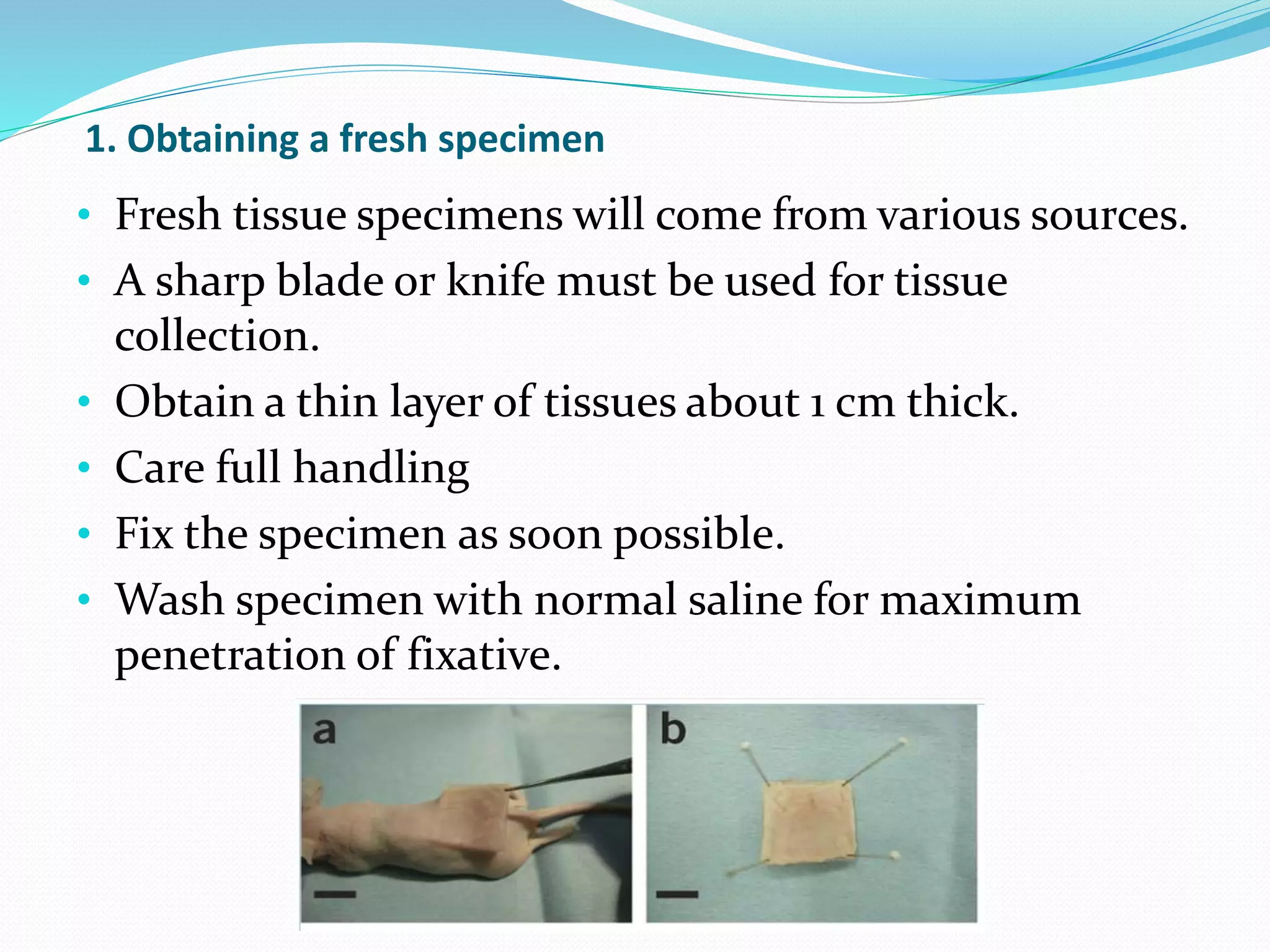
1. Obtaining a fresh specimen
• Fresh tissue specimens will come from various sources.
• A sharp blade or knife must be used for tissue
collection.
• Obtain a thin layer of tissues about 1 cm thick.
• Care full handling
• Fix the specimen as soon possible.
• Wash specimen with normal saline for maximum
penetration of fixative.
2. Fixation
 To maintain the natural state of specimen.
 Fixation facilitates proper staining of tissue.
 Fixative should be 20-25 times of volume of specimen.
 Characters of a good fixative:
* Penetrate quickly * Prevent tissue from shrinkage
• Good fixatives:
• Formaldehyde
• Alcohol
• Picric Acid
• Potassium Dichromate etc.
Washing
 For removal of fixative.
 6-8 hours.
 Under tap water.
3. Dehydration
 |Removal of water.
 Alcohols are most commonly used for dehydration.
 Water replacement with alcohol.
 Different % ages of alcohol are used for different time
periods.
 30%,50%,70% Alcohol for 2,2 hours.
 80%,95% for 1,1 hours.
 95% for 2 hours.
 100% for ½ hours two times.
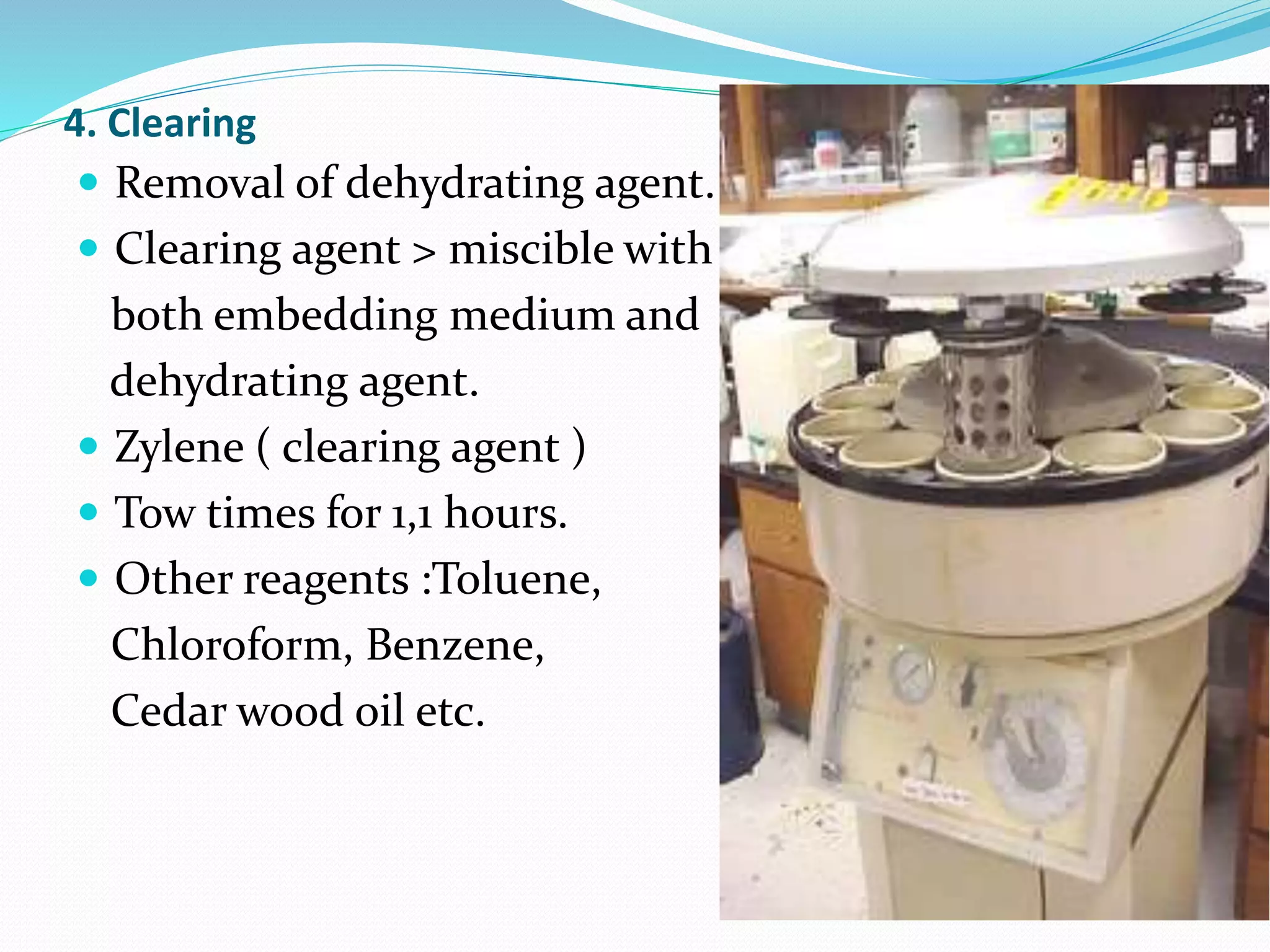
4. Clearing
 Removal of dehydrating agent.
 Clearing agent > miscible with
both embedding medium and
dehydrating agent.
 Zylene ( clearing agent )
 Tow times for 1,1 hours.
 Other reagents :Toluene,
Chloroform, Benzene,
Cedar wood oil etc.
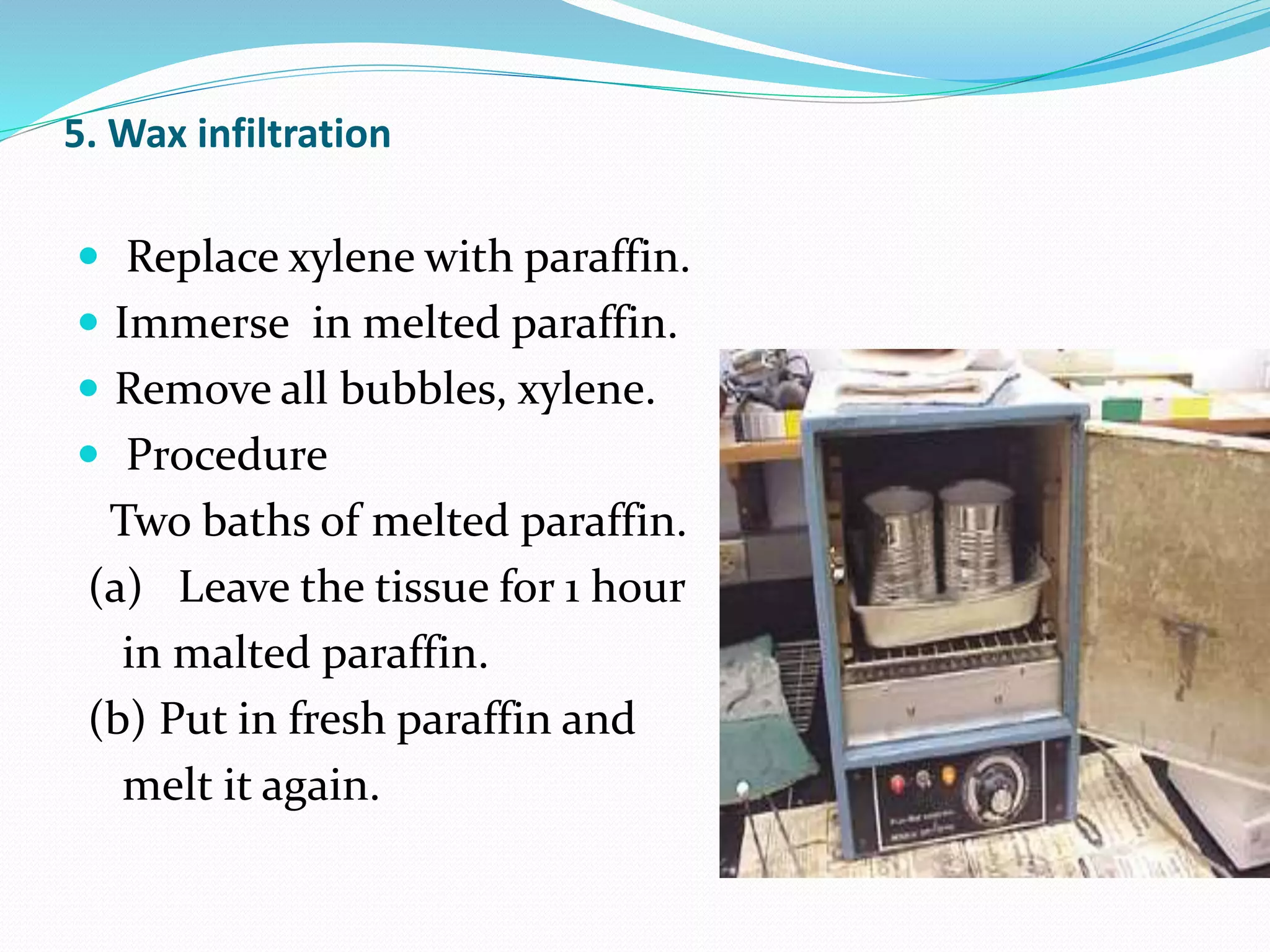
5. Wax infiltration
 Replace xylene with paraffin.
 Immerse in melted paraffin.
 Remove all bubbles, xylene.
 Procedure
Two baths of melted paraffin.
(a) Leave the tissue for 1 hour
in malted paraffin.
(b) Put in fresh paraffin and
melt it again.
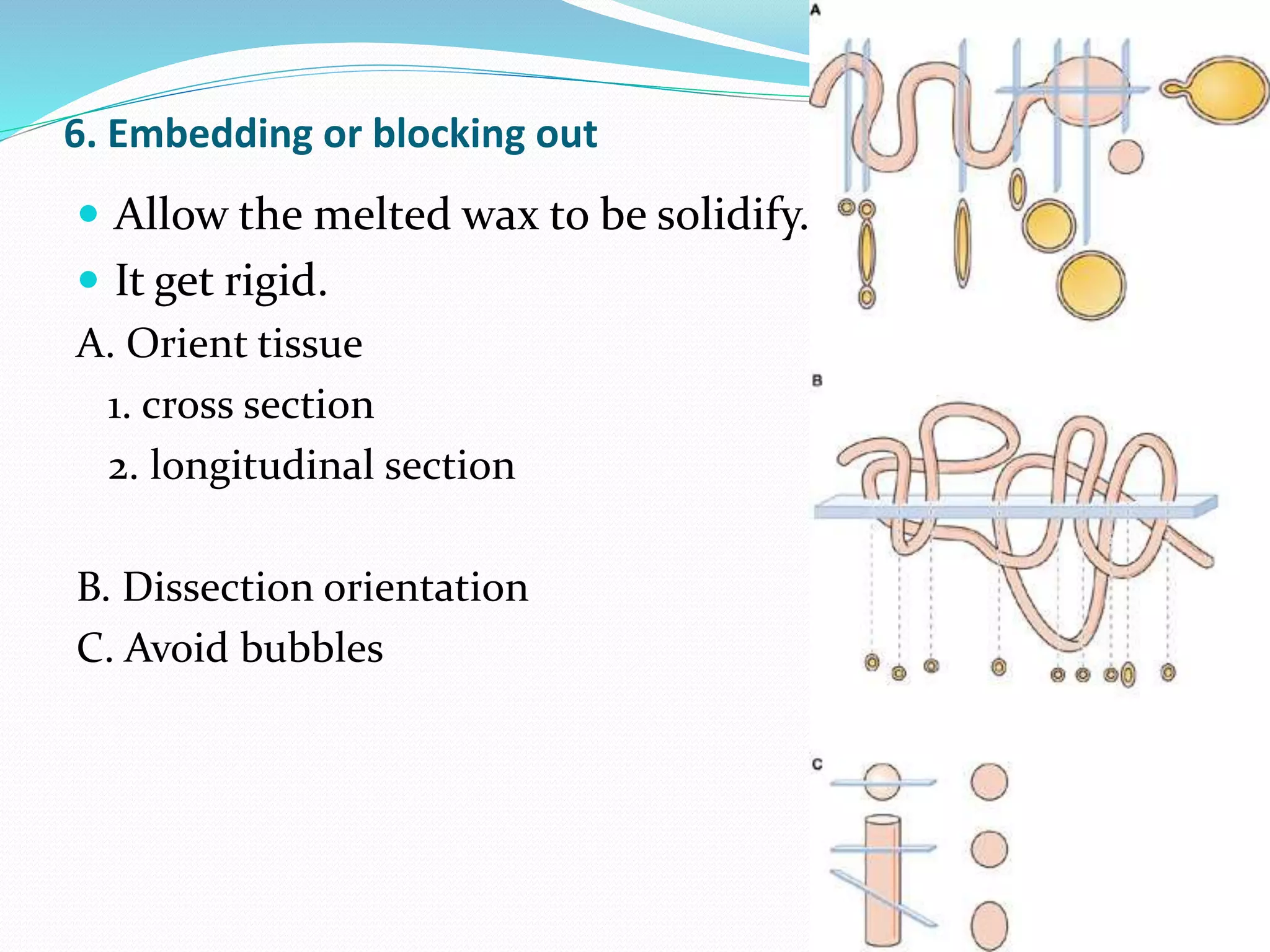
6. Embedding or blocking out
 Allow the melted wax to be solidify.
 It get rigid.
A. Orient tissue
1. cross section
2. longitudinal section
B. Dissection orientation
C. Avoid bubbles
Embedding
 Procedure
1. Place tissue cassette in
melted paraffin
2. Fill mold with paraffin
3. Place tissue in mold
4. Allow to cool
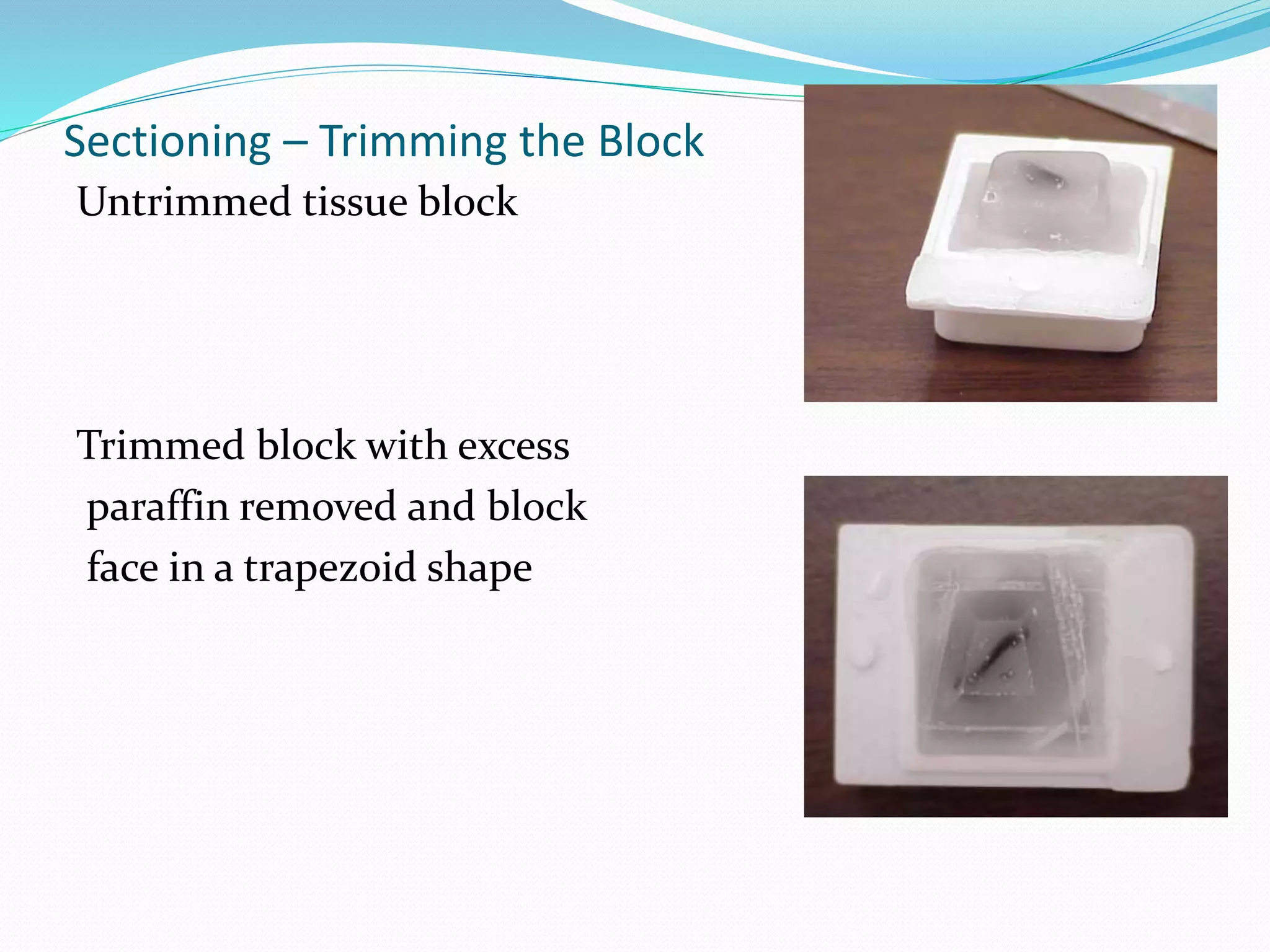
Sectioning – Trimming the Block
Untrimmed tissue block
Trimmed block with excess
paraffin removed and block
face in a trapezoid shape
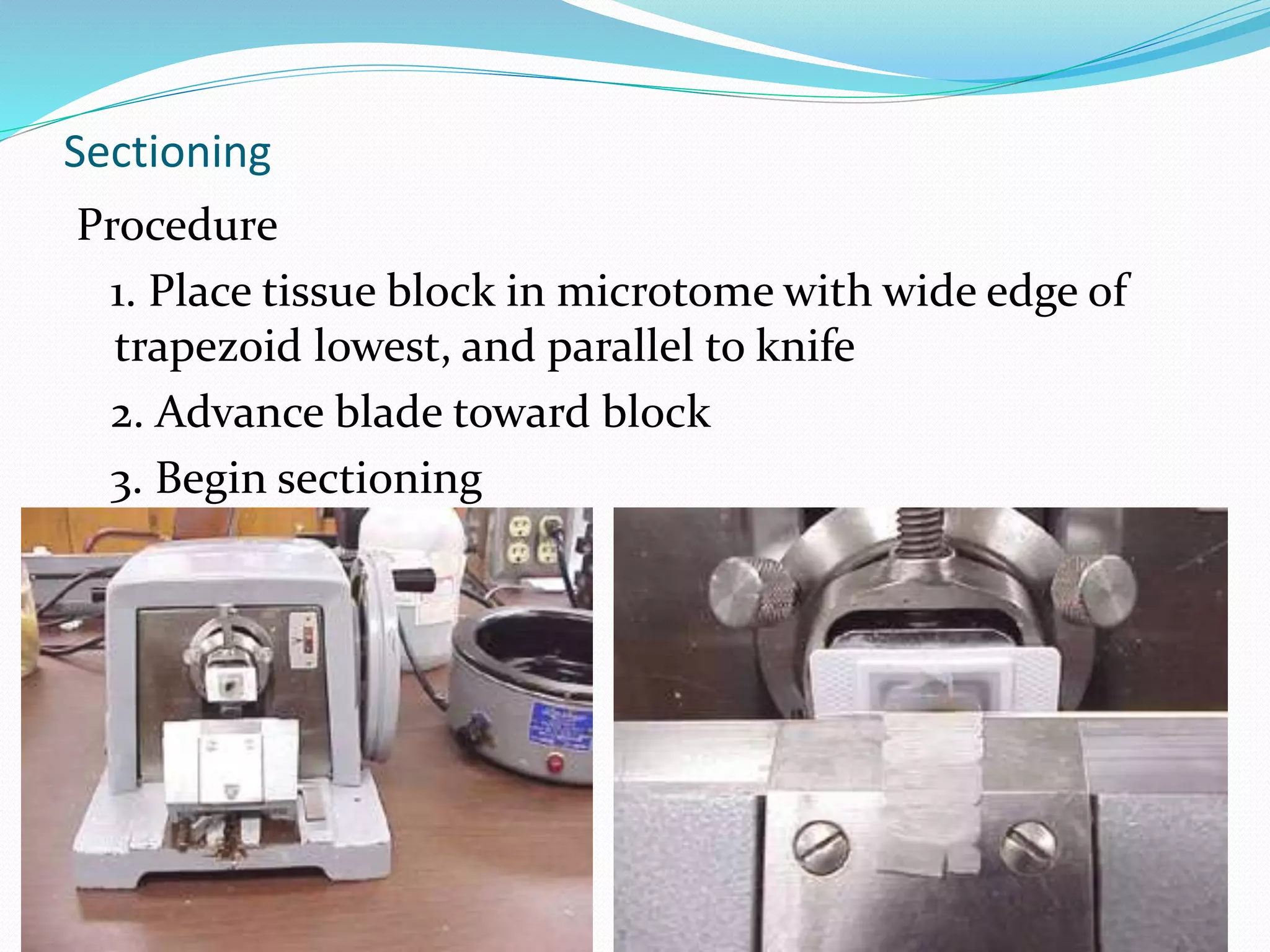
Sectioning
Procedure
1. Place tissue block in microtome with wide edge of
trapezoid lowest, and parallel to knife
2. Advance blade toward block
3. Begin sectioning
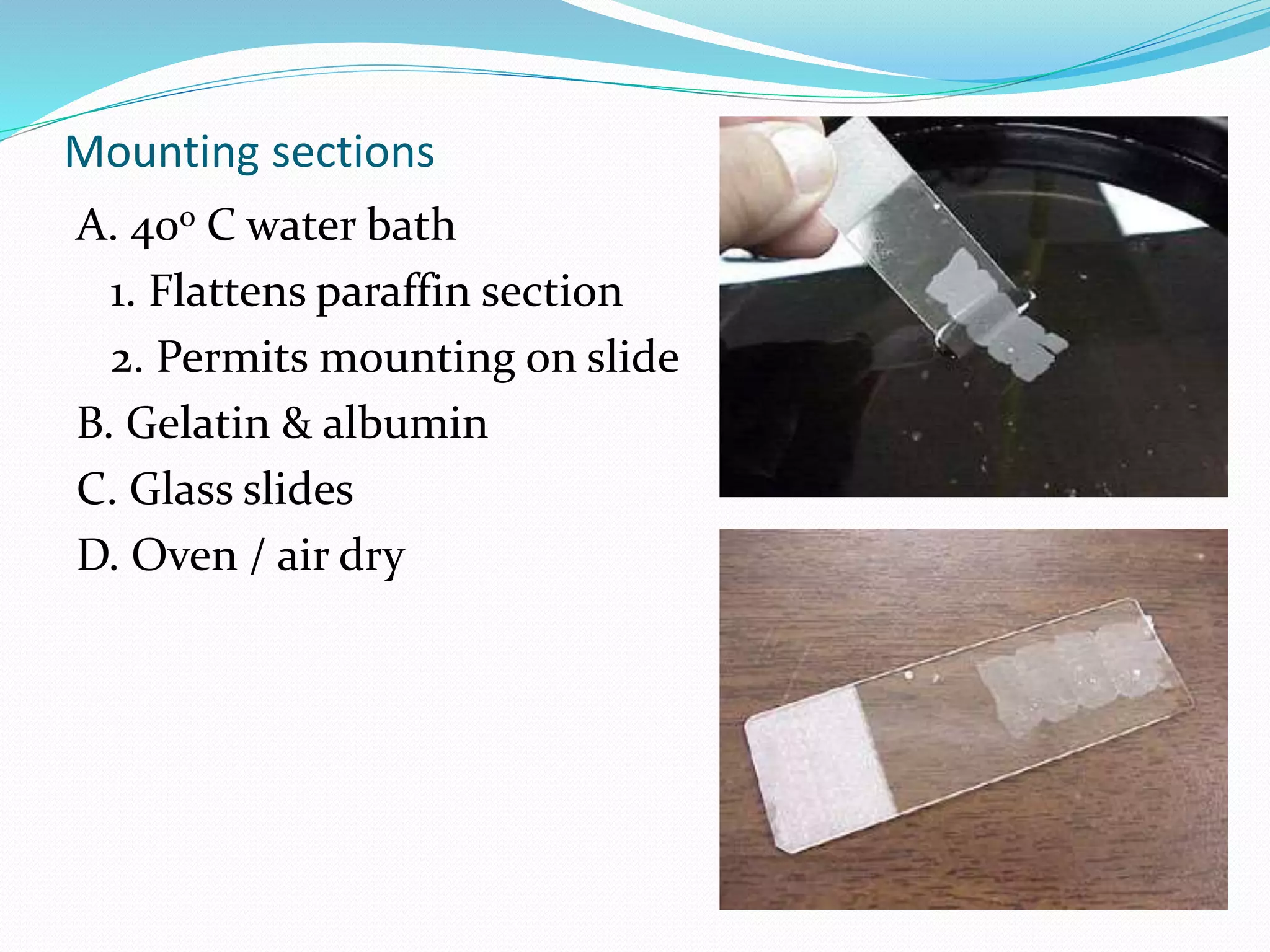
Mounting sections
A. 40o C water bath
1. Flattens paraffin section
2. Permits mounting on slide
B. Gelatin & albumin
C. Glass slides
D. Oven / air dry
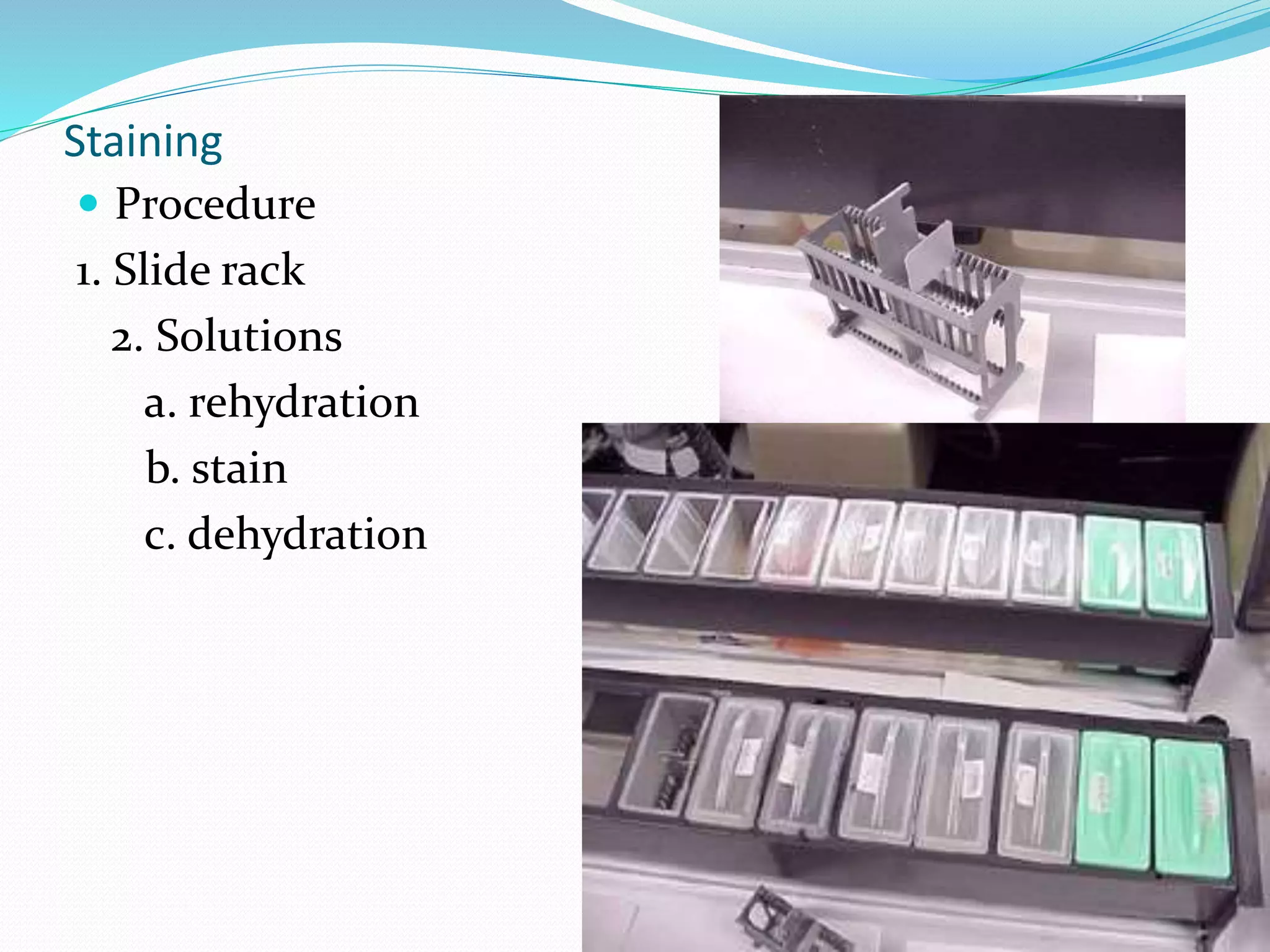
Staining
 Procedure
1. Slide rack
2. Solutions
a. rehydration
b. stain
c. dehydration
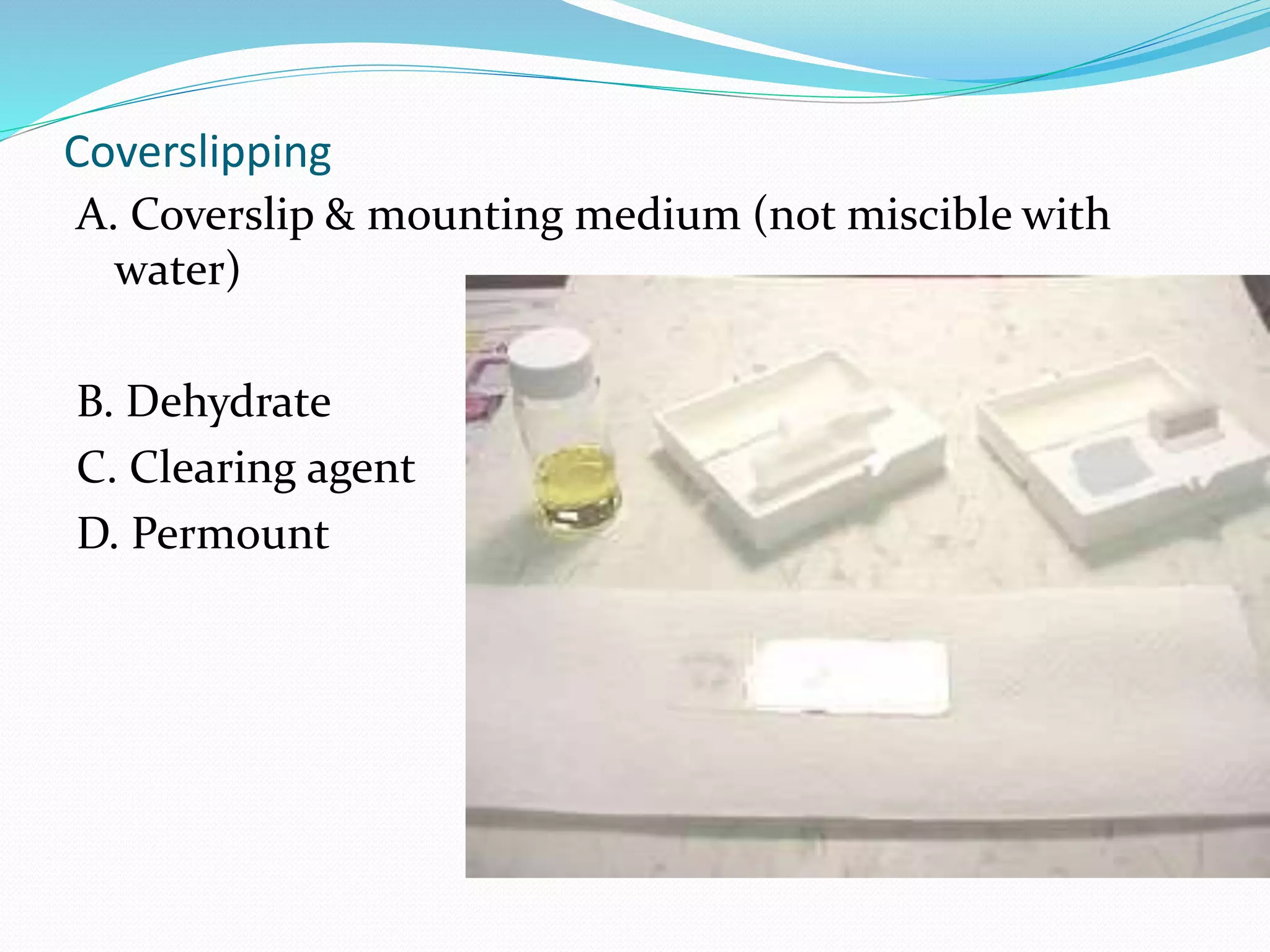
Coverslipping
A. Coverslip & mounting medium (not miscible with
water)
B. Dehydrate
C. Clearing agent
D. Permount
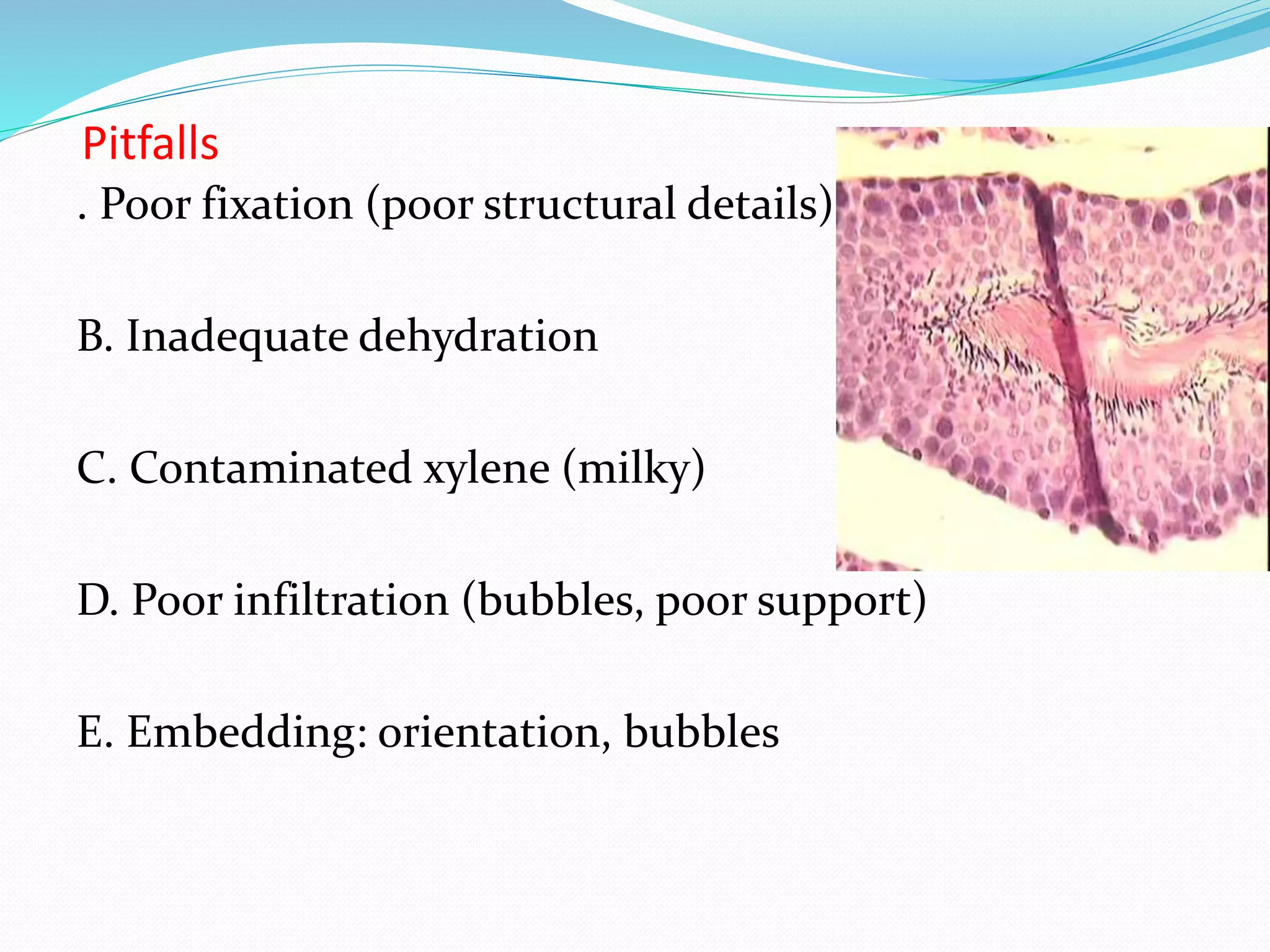
Pitfalls
. Poor fixation (poor structural details)
B. Inadequate dehydration
C. Contaminated xylene (milky)
D. Poor infiltration (bubbles, poor support)
E. Embedding: orientation, bubbles
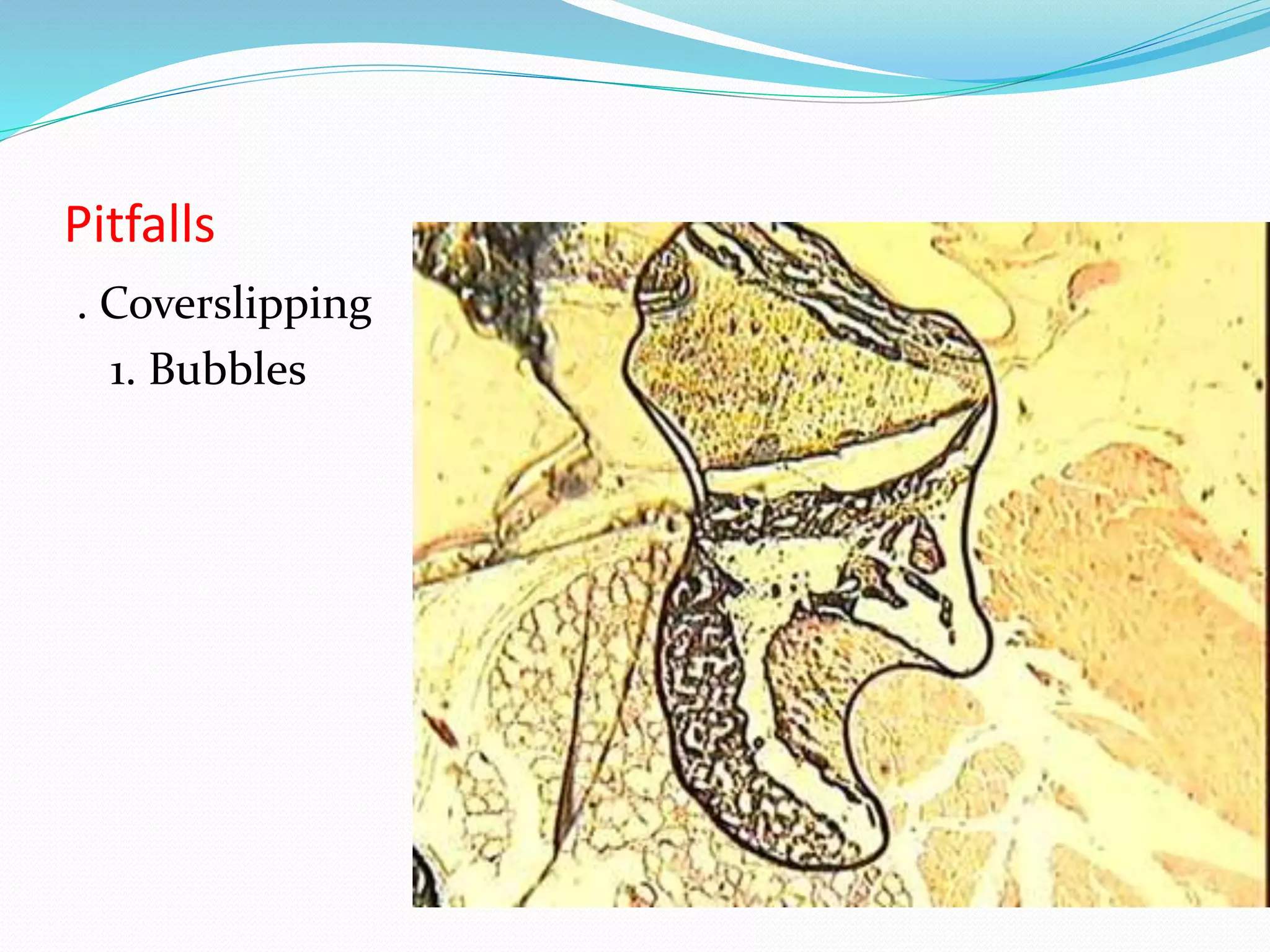
Pitfalls
. Coverslipping
1. Bubbles
By love serve one another
Thank You

Tissue Preparation Histology

  • 1.
  • 2.
  • 3.
    Tissue Preparation Introduction “Tissue processing”describes the steps required to take animal or human tissue from fixation to the state where it is completely infiltrated with a suitable histological wax and can be embedded ready for section cutting on the microtome. Importance Microscopic analysis of cells and tissues requires the preparation of very thin, high quality sections (slices) mounted on glass slides and appropriately stained to demonstrate normal and abnormal structures. • It involves several steps that are following. 1. Obtaining a fresh specimen 4. Clearing 2. Fixation 5. Wax infiltration 3. Dehydration 6. Embedding or blocking out
  • 4.
    1. Obtaining afresh specimen • Fresh tissue specimens will come from various sources. • A sharp blade or knife must be used for tissue collection. • Obtain a thin layer of tissues about 1 cm thick. • Care full handling • Fix the specimen as soon possible. • Wash specimen with normal saline for maximum penetration of fixative.
  • 5.
    2. Fixation  Tomaintain the natural state of specimen.  Fixation facilitates proper staining of tissue.  Fixative should be 20-25 times of volume of specimen.  Characters of a good fixative: * Penetrate quickly * Prevent tissue from shrinkage • Good fixatives: • Formaldehyde • Alcohol • Picric Acid • Potassium Dichromate etc.
  • 6.
    Washing  For removalof fixative.  6-8 hours.  Under tap water.
  • 7.
    3. Dehydration  |Removalof water.  Alcohols are most commonly used for dehydration.  Water replacement with alcohol.  Different % ages of alcohol are used for different time periods.  30%,50%,70% Alcohol for 2,2 hours.  80%,95% for 1,1 hours.  95% for 2 hours.  100% for ½ hours two times.
  • 8.
    4. Clearing  Removalof dehydrating agent.  Clearing agent > miscible with both embedding medium and dehydrating agent.  Zylene ( clearing agent )  Tow times for 1,1 hours.  Other reagents :Toluene, Chloroform, Benzene, Cedar wood oil etc.
  • 9.
    5. Wax infiltration Replace xylene with paraffin.  Immerse in melted paraffin.  Remove all bubbles, xylene.  Procedure Two baths of melted paraffin. (a) Leave the tissue for 1 hour in malted paraffin. (b) Put in fresh paraffin and melt it again.
  • 10.
    6. Embedding orblocking out  Allow the melted wax to be solidify.  It get rigid. A. Orient tissue 1. cross section 2. longitudinal section B. Dissection orientation C. Avoid bubbles
  • 11.
    Embedding  Procedure 1. Placetissue cassette in melted paraffin 2. Fill mold with paraffin 3. Place tissue in mold 4. Allow to cool
  • 12.
    Sectioning – Trimmingthe Block Untrimmed tissue block Trimmed block with excess paraffin removed and block face in a trapezoid shape
  • 13.
    Sectioning Procedure 1. Place tissueblock in microtome with wide edge of trapezoid lowest, and parallel to knife 2. Advance blade toward block 3. Begin sectioning
  • 14.
    Mounting sections A. 40oC water bath 1. Flattens paraffin section 2. Permits mounting on slide B. Gelatin & albumin C. Glass slides D. Oven / air dry
  • 15.
    Staining  Procedure 1. Sliderack 2. Solutions a. rehydration b. stain c. dehydration
  • 16.
    Coverslipping A. Coverslip &mounting medium (not miscible with water) B. Dehydrate C. Clearing agent D. Permount
  • 17.
    Pitfalls . Poor fixation(poor structural details) B. Inadequate dehydration C. Contaminated xylene (milky) D. Poor infiltration (bubbles, poor support) E. Embedding: orientation, bubbles
  • 18.
  • 19.
    By love serveone another
  • 20.