CHAPTER 6:
NUCLEAR ENERGY
6.3.
USES OF RADIOACTIVE
SUBSTANCES
5 main categories of the uses
radioactive substances
 In industry
 In food technology
 In archaeology
 In medicine
 In agriculture
6.3.1 Controlling the thickness of
substances
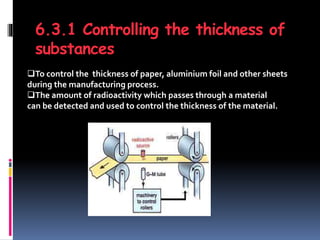
To control the thickness of paper, aluminium foil and other sheets
during the manufacturing process.
The amount of radioactivity which passes through a material
can be detected and used to control the thickness of the material.
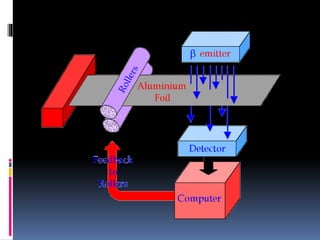
In paper mills, the thickness of the paper can be
controlled by measuring how much beta radiation
passes through the paper to a Geiger counter.
The radioactive source is a b emitter (beta emitter).
This has the right amount of penetration to be useful
for thickness control of aluminium foil.
The counter controls the pressure of the rollers to
give the correct thickness. With paper, or plastic, or
aluminium foil, beta rays are used, because it will not
go through the paper.
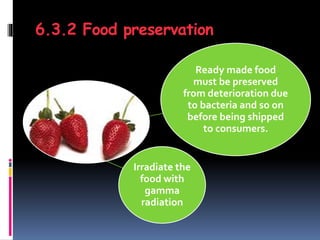
6.3.2 Food preservation
Ready made food
must be preserved
from deterioration due
to bacteria and so on
before being shipped
to consumers.
Irradiate the
food with
gamma
radiation
 Even after it has been packaged,
gamma rays can be used to kill
bacteria, mould and insects in food.
This process prolongs the shelf-life of
the food, but sometimes changes the
taste.
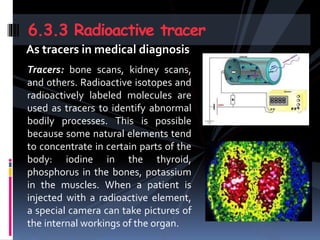
As tracers in medical diagnosis
6.3.3 Radioactive tracer
Tracers: bone scans, kidney scans,
and others. Radioactive isotopes and
radioactively labeled molecules are
used as tracers to identify abnormal
bodily processes. This is possible
because some natural elements tend
to concentrate in certain parts of the
body: iodine in the thyroid,
phosphorus in the bones, potassium
in the muscles. When a patient is
injected with a radioactive element,
a special camera can take pictures of
the internal workings of the organ.
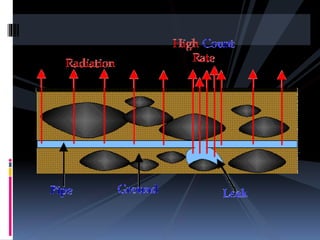
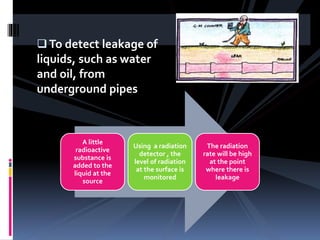
To detect leakage of
liquids, such as water
and oil, from
underground pipes
A little
radioactive
substance is
added to the
liquid at the
source
Using a radiation
detector , the
level of radiation
at the surface is
monitored
The radiation
rate will be high
at the point
where there is
leakage
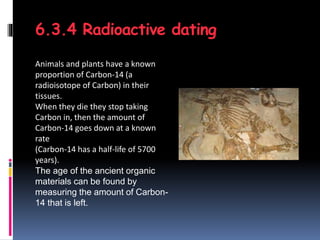
6.3.4 Radioactive dating
Animals and plants have a known
proportion of Carbon-14 (a
radioisotope of Carbon) in their
tissues.
When they die they stop taking
Carbon in, then the amount of
Carbon-14 goes down at a known
rate
(Carbon-14 has a half-life of 5700
years).
The age of the ancient organic
materials can be found by
measuring the amount of Carbon-
14 that is left.
 The radioactive source would be a g emitter (gamma
emitter).
 g radiation can penetrate through the ground (and
metal pipe)
and be detected at the surface.
 Alpha and beta radiation would not penetrate through
to the surface.
The g emitter would have a short half-life to minimize
the possible danger to living organisms near to the
pipe.
 A short half-life means that the amount of radioactivity
being emitted from the pipe would decrease quickly.
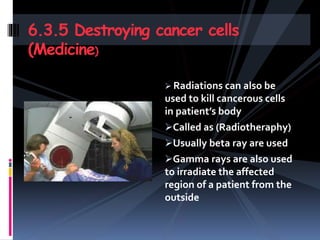
 Radiations can also be
used to kill cancerous cells
in patient’s body
Called as (Radiotheraphy)
Usually beta ray are used
Gamma rays are also used
to irradiate the affected
region of a patient from the
outside
6.3.5 Destroying cancer cells
(Medicine)
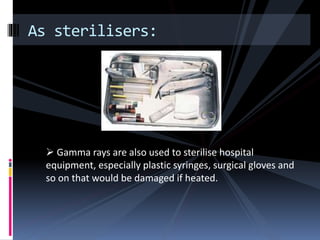
As sterilisers:
 Gamma rays are also used to sterilise hospital
equipment, especially plastic syringes, surgical gloves and
so on that would be damaged if heated.
6.3.6 Agriculture
 ASTRACERS:
 phosphorus-32 is a radioisotope that emits beta
particles
 This is used partially in the production of fertilisers
 The fertiliser will be absorbed by the plants and
then transported to various parts of the plants
 By detecting the radiation from this radioactive
phophorus from outside the plant, agriculturists
can determine how much phosphorus is needed
by various parts of the plant
 For genetic modification:
 Gamma radiation can cause modifications to
the gene of cells.
 This is known as mutation
 To produce better quality seeds which are more
resistant to pests, changes in weather and so on

SPM SCIENCE NUCLEAR ENERGY

  • 1.
    CHAPTER 6: NUCLEAR ENERGY 6.3. USESOF RADIOACTIVE SUBSTANCES
  • 2.
    5 main categoriesof the uses radioactive substances  In industry  In food technology  In archaeology  In medicine  In agriculture
  • 3.
    6.3.1 Controlling thethickness of substances To control the thickness of paper, aluminium foil and other sheets during the manufacturing process. The amount of radioactivity which passes through a material can be detected and used to control the thickness of the material.
  • 5.
    In paper mills,the thickness of the paper can be controlled by measuring how much beta radiation passes through the paper to a Geiger counter. The radioactive source is a b emitter (beta emitter). This has the right amount of penetration to be useful for thickness control of aluminium foil. The counter controls the pressure of the rollers to give the correct thickness. With paper, or plastic, or aluminium foil, beta rays are used, because it will not go through the paper.
  • 6.
    6.3.2 Food preservation Readymade food must be preserved from deterioration due to bacteria and so on before being shipped to consumers. Irradiate the food with gamma radiation
  • 7.
     Even afterit has been packaged, gamma rays can be used to kill bacteria, mould and insects in food. This process prolongs the shelf-life of the food, but sometimes changes the taste.
  • 8.
    As tracers inmedical diagnosis 6.3.3 Radioactive tracer Tracers: bone scans, kidney scans, and others. Radioactive isotopes and radioactively labeled molecules are used as tracers to identify abnormal bodily processes. This is possible because some natural elements tend to concentrate in certain parts of the body: iodine in the thyroid, phosphorus in the bones, potassium in the muscles. When a patient is injected with a radioactive element, a special camera can take pictures of the internal workings of the organ.
  • 10.
    To detect leakageof liquids, such as water and oil, from underground pipes A little radioactive substance is added to the liquid at the source Using a radiation detector , the level of radiation at the surface is monitored The radiation rate will be high at the point where there is leakage
  • 11.
    6.3.4 Radioactive dating Animalsand plants have a known proportion of Carbon-14 (a radioisotope of Carbon) in their tissues. When they die they stop taking Carbon in, then the amount of Carbon-14 goes down at a known rate (Carbon-14 has a half-life of 5700 years). The age of the ancient organic materials can be found by measuring the amount of Carbon- 14 that is left.
  • 12.
     The radioactivesource would be a g emitter (gamma emitter).  g radiation can penetrate through the ground (and metal pipe) and be detected at the surface.  Alpha and beta radiation would not penetrate through to the surface. The g emitter would have a short half-life to minimize the possible danger to living organisms near to the pipe.  A short half-life means that the amount of radioactivity being emitted from the pipe would decrease quickly.
  • 13.
     Radiations canalso be used to kill cancerous cells in patient’s body Called as (Radiotheraphy) Usually beta ray are used Gamma rays are also used to irradiate the affected region of a patient from the outside 6.3.5 Destroying cancer cells (Medicine)
  • 14.
    As sterilisers:  Gammarays are also used to sterilise hospital equipment, especially plastic syringes, surgical gloves and so on that would be damaged if heated.
  • 15.
    6.3.6 Agriculture  ASTRACERS: phosphorus-32 is a radioisotope that emits beta particles  This is used partially in the production of fertilisers  The fertiliser will be absorbed by the plants and then transported to various parts of the plants  By detecting the radiation from this radioactive phophorus from outside the plant, agriculturists can determine how much phosphorus is needed by various parts of the plant
  • 16.
     For geneticmodification:  Gamma radiation can cause modifications to the gene of cells.  This is known as mutation  To produce better quality seeds which are more resistant to pests, changes in weather and so on