Audience & Media Products 
The Music Industry
Target Audience 
• What does it mean? 
• A particular group of people, identified as 
the intended recipient of a media product.
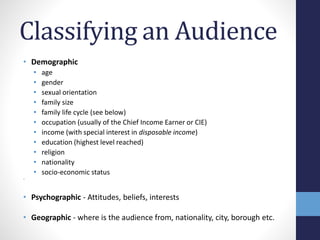
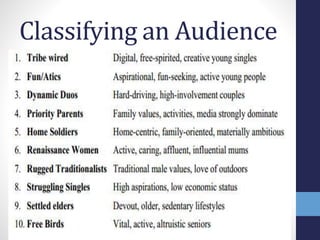
Classifying an Audience 
• Demographic 
• age 
• gender 
• sexual orientation 
• family size 
• family life cycle (see below) 
• occupation (usually of the Chief Income Earner or CIE) 
• income (with special interest in disposable income) 
• education (highest level reached) 
• religion 
• nationality 
• socio-economic status 
• 
• Psychographic - Attitudes, beliefs, interests 
• Geographic - where is the audience from, nationality, city, borough etc.
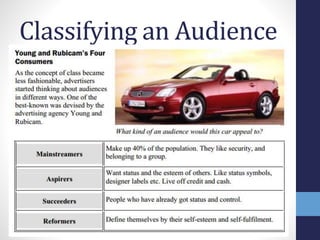
Classifying an Audience
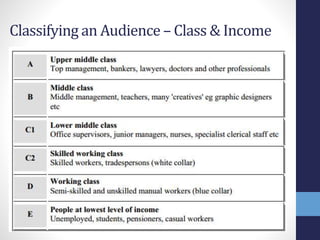
Classifying an Audience – Class & Income
Classifying an Audience
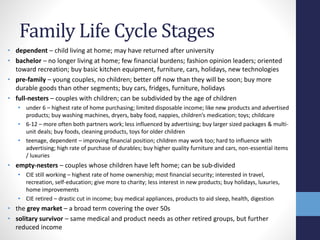
Family Life Cycle Stages 
• dependent – child living at home; may have returned after university 
• bachelor – no longer living at home; few financial burdens; fashion opinion leaders; oriented 
toward recreation; buy basic kitchen equipment, furniture, cars, holidays, new technologies 
• pre-family – young couples, no children; better off now than they will be soon; buy more 
durable goods than other segments; buy cars, fridges, furniture, holidays 
• full-nesters – couples with children; can be subdivided by the age of children 
• under 6 – highest rate of home purchasing; limited disposable income; like new products and advertised 
products; buy washing machines, dryers, baby food, nappies, children’s medication; toys; childcare 
• 6-12 – more often both partners work; less influenced by advertising; buy larger sized packages & multi-unit 
deals; buy foods, cleaning products, toys for older children 
• teenage, dependent – improving financial position; children may work too; hard to influence with 
advertising; high rate of purchase of durables; buy higher quality furniture and cars, non-essential items 
/ luxuries 
• empty-nesters – couples whose children have left home; can be sub-divided 
• CIE still working – highest rate of home ownership; most financial security; interested in travel, 
recreation, self-education; give more to charity; less interest in new products; buy holidays, luxuries, 
home improvements 
• CIE retired – drastic cut in income; buy medical appliances, products to aid sleep, health, digestion 
• the grey market – a broad term covering the over 50s 
• solitary survivor – same medical and product needs as other retired groups, but further 
reduced income
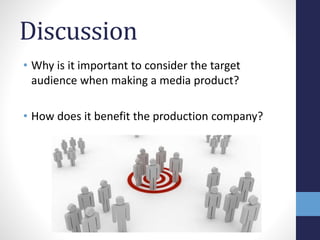
Discussion 
• Why is it important to consider the target 
audience when making a media product? 
• How does it benefit the production company?
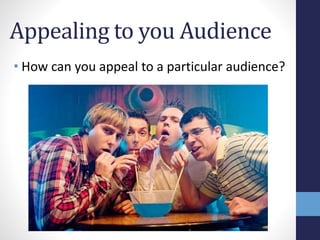
Appealing to you Audience 
• How can you appeal to a particular audience?
Appealing to you Audience 
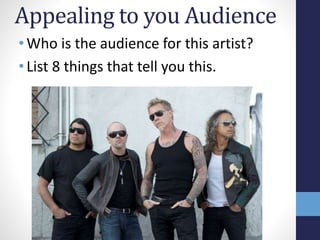
• Who is the audience for this artist? 
• List 8 things that tell you this.
Appealing to you Audience 
• Why is this important? 
• Tailor content to maximise impact (niche 
market). 
• The commercial consideration influences 
the content. (Film franchises)
Match the Audience to the Product 
1. 2. 3. 4. 
A. B. C. D. 
Give reasons for your decisions
Match the Audience to the Product 
1. 2. 3. 4. 
A. B. C. D. 
Give reasons for your decisions
Appealing to you Audience - Genre 
• Why is genre useful when targeting an 
audience? 
• Conventions 
• What you expect to see 
• Iconography – Genre indicators 
• For example a sheriffs badge = Western 
film
Appealing to you Audience - 
Genre 
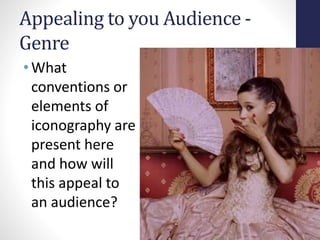
•What 
conventions or 
elements of 
iconography are 
present here 
and how will 
this appeal to 
an audience?
Audience – Industry Perspective 
• You work in a music company and you have been 
sent an idea for a new artist. How are you going to 
find out if its what the audience want? 
• Survey 
• Online Poll 
• Focus Group 
• Questionnaire 
• Exit Poll 
• Analysis of admissions

Demographics (Audience)

  • 1.
    Audience & MediaProducts The Music Industry
  • 2.
    Target Audience •What does it mean? • A particular group of people, identified as the intended recipient of a media product.
  • 3.
    Classifying an Audience • Demographic • age • gender • sexual orientation • family size • family life cycle (see below) • occupation (usually of the Chief Income Earner or CIE) • income (with special interest in disposable income) • education (highest level reached) • religion • nationality • socio-economic status • • Psychographic - Attitudes, beliefs, interests • Geographic - where is the audience from, nationality, city, borough etc.
  • 4.
  • 5.
    Classifying an Audience– Class & Income
  • 6.
  • 7.
    Family Life CycleStages • dependent – child living at home; may have returned after university • bachelor – no longer living at home; few financial burdens; fashion opinion leaders; oriented toward recreation; buy basic kitchen equipment, furniture, cars, holidays, new technologies • pre-family – young couples, no children; better off now than they will be soon; buy more durable goods than other segments; buy cars, fridges, furniture, holidays • full-nesters – couples with children; can be subdivided by the age of children • under 6 – highest rate of home purchasing; limited disposable income; like new products and advertised products; buy washing machines, dryers, baby food, nappies, children’s medication; toys; childcare • 6-12 – more often both partners work; less influenced by advertising; buy larger sized packages & multi-unit deals; buy foods, cleaning products, toys for older children • teenage, dependent – improving financial position; children may work too; hard to influence with advertising; high rate of purchase of durables; buy higher quality furniture and cars, non-essential items / luxuries • empty-nesters – couples whose children have left home; can be sub-divided • CIE still working – highest rate of home ownership; most financial security; interested in travel, recreation, self-education; give more to charity; less interest in new products; buy holidays, luxuries, home improvements • CIE retired – drastic cut in income; buy medical appliances, products to aid sleep, health, digestion • the grey market – a broad term covering the over 50s • solitary survivor – same medical and product needs as other retired groups, but further reduced income
  • 8.
    Discussion • Whyis it important to consider the target audience when making a media product? • How does it benefit the production company?
  • 9.
    Appealing to youAudience • How can you appeal to a particular audience?
  • 10.
    Appealing to youAudience • Who is the audience for this artist? • List 8 things that tell you this.
  • 11.
    Appealing to youAudience • Why is this important? • Tailor content to maximise impact (niche market). • The commercial consideration influences the content. (Film franchises)
  • 12.
    Match the Audienceto the Product 1. 2. 3. 4. A. B. C. D. Give reasons for your decisions
  • 13.
    Match the Audienceto the Product 1. 2. 3. 4. A. B. C. D. Give reasons for your decisions
  • 14.
    Appealing to youAudience - Genre • Why is genre useful when targeting an audience? • Conventions • What you expect to see • Iconography – Genre indicators • For example a sheriffs badge = Western film
  • 15.
    Appealing to youAudience - Genre •What conventions or elements of iconography are present here and how will this appeal to an audience?
  • 16.
    Audience – IndustryPerspective • You work in a music company and you have been sent an idea for a new artist. How are you going to find out if its what the audience want? • Survey • Online Poll • Focus Group • Questionnaire • Exit Poll • Analysis of admissions