





AUDIENCE,
CHARACTERISTICS
OF PRODUCTS AND
SERVICES &
REGULATION
HOW DO COMPANIES AND ADVERTISING
AGENCIES TRY TO ENSURE CONSUMERS BUY
THEIR PRODUCT?
CHARACTERISTICS OF
PRODUCTS AND
SERVICES
Benefits offered:
what can this product or service do that will enhance your existence / improve
your life?
For example, the British Gas adverts ‘sell’
the benefit that their engineers will call
ahead to let the homeowner know what
time they will arrive so you can “get on with
your day”.
CHARACTERISTICS OF
PRODUCTS AND
SERVICES
Advantages over other similar products:
why is this product better than the rest? What sets it apart?
E.g., Cillit Bang VS. Flash
CHARACTERISTICS OF
PRODUCTS AND
SERVICES
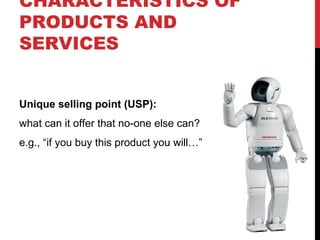
Unique selling point (USP):
what can it offer that no-one else can?
e.g., “if you buy this product you will…”
CHARACTERISTICS OF
PRODUCTS AND SERVICES
Brand identity:
relates to the way a company/ brand want the audience to perceive them. For
example, how do think the following brands want to be viewed by a consumer?
• Pepsi
• Phones4U
• Saab
• Harley Davidson
• Bisto
Brand identity also encompasses the use of a recognisable logo
e.g., the McDonalds ‘M’.
CHARACTERISTICS OF
PRODUCTS AND SERVICES

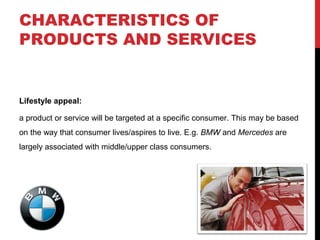
Lifestyle appeal:
a product or service will be targeted at a specific consumer. This may be based
on the way that consumer lives/aspires to live. E.g. BMW and Mercedes are
largely associated with middle/upper class consumers.
AUDIENCE
INFORMATION
HOW CAN COMPANIES AND ADVERTISING
AGENCIES GATHER AUDIENCE DATA?
AUDIENCE
INFORMATION
Audience Measurement Panels
“Viewing estimates are obtained from a panel of television owning
private homes representing the viewing behaviour of the 26 million TV
households within the UK. The panel is selected to be representative of
each ITV and BBC region, with pre-determined sample sizes. Each
home represents, on average, about 5,000 of the UK population”.
AUDIENCE
INFORMATION
All panel household residents and their guests register their presence when in a
room with a television set on. Each individual panel member does this by
pressing the button allocated to them on each meter handset.
An LED screen on the front of the meter reminds panel members periodically to
register their presence if they have not already done so. Whenever a panel
member leaves a room they de-register their presence.
The metering system monitors all registrations made by each individual for each
television in the home.
AUDIENCE
INFORMATION

How do audience measurement panels relate to advertising?
AUDIENCE
INFORMATION
Other methods include;
Face to face interviews
Questionnaires
Broadcasting Audience Research Board (BARB)
Television research agencies
Ratings
AUDIENCE
CLASSIFICATION
HOW DO WE CLASSIFY AUDIENCES?
AUDIENCE
CLASSIFICATION
S.O.C (Standard Occupational Classification)
This system is used to compare audience data based on the audience member’s occupation
or job.
“The Standard Occupational Classification (SOC) is a common classification of occupational
information for the United Kingdom.
Within the context of the classification jobs are classified in terms of their skill level and skill
content. It is used for career information to labour market entrants, job matching by
employment agencies and the development of government labour market policies”.
www.ons.gov.uk
AUDIENCE
CLASSIFICATION
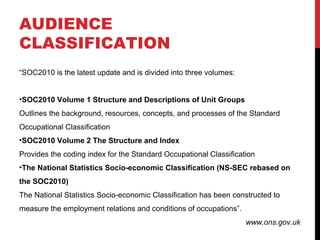
“SOC2010 is the latest update and is divided into three volumes:
•SOC2010 Volume 1 Structure and Descriptions of Unit Groups
Outlines the background, resources, concepts, and processes of the Standard
Occupational Classification
•SOC2010 Volume 2 The Structure and Index
Provides the coding index for the Standard Occupational Classification
•The National Statistics Socio-economic Classification (NS-SEC rebased on
the SOC2010)
The National Statistics Socio-economic Classification has been constructed to
measure the employment relations and conditions of occupations”.
www.ons.gov.uk
AUDIENCE
CLASSIFICATION
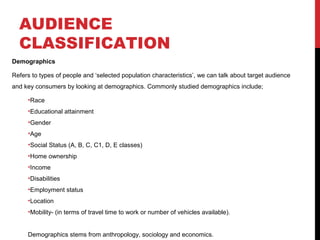
Demographics
Refers to types of people and ‘selected population characteristics’, we can talk about target audience
and key consumers by looking at demographics. Commonly studied demographics include;
•Race
•Educational attainment
•Gender
•Age
•Social Status (A, B, C, C1, D, E classes)
•Home ownership
•Income
•Disabilities
•Employment status
•Location
•Mobility- (in terms of travel time to work or number of vehicles available).
Demographics stems from anthropology, sociology and economics.
AUDIENCE
CLASSIFICATION
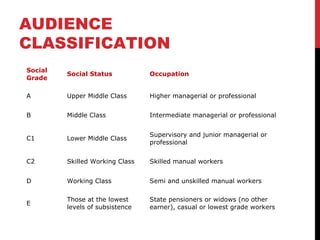
Social
Grade

Social Status

Occupation

A

Upper Middle Class

Higher managerial or professional

B

Middle Class

Intermediate managerial or professional

C1

Lower Middle Class

Supervisory and junior managerial or
professional

C2

Skilled Working Class

Skilled manual workers

D

Working Class

Semi and unskilled manual workers

E

Those at the lowest
levels of subsistence

State pensioners or widows (no other
earner), casual or lowest grade workers
AUDIENCE
CLASSIFICATION
Psychographics:

A term that describes consumers or audience members on the basis of psychological characteristics
initially determined by standardized tests. These characteristics are dictated by where a person is
living and the conditions of their habitat.

Some categories of psychographic factors used in market segmentation include:

• Social class
• Lifestyle
• Behaviour
• Opinions
• Values
AUDIENCE
CLASSIFICATION
Psychographic profiles (1960s)
Include:
Mainstreamers

(40% of the population – ‘the norm’)

Succeeders

(rich)

Aspirers

(want the luxury lifestyle)

Reformers

(want to improve the world)

Individuals

(hard to classify, often young)
AUDIENCE
CLASSIFICATION
Geo-demographics
The study of people due to their location.
For example, you may wish to compare a twenty year old male consumer
from Glasgow to another from London to see how their views, values and
characteristics differ.
When we talk about geo-demographics it is important to consider the time of
study for example, a comparison of the two males in the present day would
contrast hugely to a study of them in the 1950’s.
SOURCES OF
INFORMATION
WHERE CAN YOU GET INFORMATION ABOUT
ADVERTISING?
SOURCES OF
INFORMATION
Rates Cards:
Detailed lists of equipment for hire and how much it would cost if you
were outsourcing your equipment and staff.
Advertisers’ Information Packs:
Information and guidance from companies for those who are
interested in advertising their products. It may also be from
broadcasters detailing who could advertise on their channel(s).
Research agency websites:
Agencies that exist for those who cannot or decide not to research
consumers and audiences for themselves.
REGULATION
WHO REGULATES TELEVISION ADVERTISING?
REGULATION
Research
In what ways does Ofcom regulate television advertising?
•

What is their role?

•

What aspects of television advertising do they preside over?

In what ways does The

ASA regulate television advertising?

•

What is their role?

•

What aspects of television advertising do they preside over?

Adverts: Audience Characteristics

  • 1.
    AUDIENCE, CHARACTERISTICS OF PRODUCTS AND SERVICES& REGULATION HOW DO COMPANIES AND ADVERTISING AGENCIES TRY TO ENSURE CONSUMERS BUY THEIR PRODUCT?
  • 2.
    CHARACTERISTICS OF PRODUCTS AND SERVICES Benefitsoffered: what can this product or service do that will enhance your existence / improve your life? For example, the British Gas adverts ‘sell’ the benefit that their engineers will call ahead to let the homeowner know what time they will arrive so you can “get on with your day”.
  • 3.
    CHARACTERISTICS OF PRODUCTS AND SERVICES Advantagesover other similar products: why is this product better than the rest? What sets it apart? E.g., Cillit Bang VS. Flash
  • 4.
    CHARACTERISTICS OF PRODUCTS AND SERVICES Uniqueselling point (USP): what can it offer that no-one else can? e.g., “if you buy this product you will…”
  • 5.
    CHARACTERISTICS OF PRODUCTS ANDSERVICES Brand identity: relates to the way a company/ brand want the audience to perceive them. For example, how do think the following brands want to be viewed by a consumer? • Pepsi • Phones4U • Saab • Harley Davidson • Bisto Brand identity also encompasses the use of a recognisable logo e.g., the McDonalds ‘M’.
  • 6.
    CHARACTERISTICS OF PRODUCTS ANDSERVICES Lifestyle appeal: a product or service will be targeted at a specific consumer. This may be based on the way that consumer lives/aspires to live. E.g. BMW and Mercedes are largely associated with middle/upper class consumers.
  • 7.
    AUDIENCE INFORMATION HOW CAN COMPANIESAND ADVERTISING AGENCIES GATHER AUDIENCE DATA?
  • 8.
    AUDIENCE INFORMATION Audience Measurement Panels “Viewingestimates are obtained from a panel of television owning private homes representing the viewing behaviour of the 26 million TV households within the UK. The panel is selected to be representative of each ITV and BBC region, with pre-determined sample sizes. Each home represents, on average, about 5,000 of the UK population”.
  • 9.
    AUDIENCE INFORMATION All panel householdresidents and their guests register their presence when in a room with a television set on. Each individual panel member does this by pressing the button allocated to them on each meter handset. An LED screen on the front of the meter reminds panel members periodically to register their presence if they have not already done so. Whenever a panel member leaves a room they de-register their presence. The metering system monitors all registrations made by each individual for each television in the home.
  • 10.
    AUDIENCE INFORMATION How do audiencemeasurement panels relate to advertising?
  • 11.
    AUDIENCE INFORMATION Other methods include; Faceto face interviews Questionnaires Broadcasting Audience Research Board (BARB) Television research agencies Ratings
  • 12.
  • 13.
    AUDIENCE CLASSIFICATION S.O.C (Standard OccupationalClassification) This system is used to compare audience data based on the audience member’s occupation or job. “The Standard Occupational Classification (SOC) is a common classification of occupational information for the United Kingdom. Within the context of the classification jobs are classified in terms of their skill level and skill content. It is used for career information to labour market entrants, job matching by employment agencies and the development of government labour market policies”. www.ons.gov.uk
  • 14.
    AUDIENCE CLASSIFICATION “SOC2010 is thelatest update and is divided into three volumes: •SOC2010 Volume 1 Structure and Descriptions of Unit Groups Outlines the background, resources, concepts, and processes of the Standard Occupational Classification •SOC2010 Volume 2 The Structure and Index Provides the coding index for the Standard Occupational Classification •The National Statistics Socio-economic Classification (NS-SEC rebased on the SOC2010) The National Statistics Socio-economic Classification has been constructed to measure the employment relations and conditions of occupations”. www.ons.gov.uk
  • 15.
    AUDIENCE CLASSIFICATION Demographics Refers to typesof people and ‘selected population characteristics’, we can talk about target audience and key consumers by looking at demographics. Commonly studied demographics include; •Race •Educational attainment •Gender •Age •Social Status (A, B, C, C1, D, E classes) •Home ownership •Income •Disabilities •Employment status •Location •Mobility- (in terms of travel time to work or number of vehicles available). Demographics stems from anthropology, sociology and economics.
  • 16.
    AUDIENCE CLASSIFICATION Social Grade Social Status Occupation A Upper MiddleClass Higher managerial or professional B Middle Class Intermediate managerial or professional C1 Lower Middle Class Supervisory and junior managerial or professional C2 Skilled Working Class Skilled manual workers D Working Class Semi and unskilled manual workers E Those at the lowest levels of subsistence State pensioners or widows (no other earner), casual or lowest grade workers
  • 17.
    AUDIENCE CLASSIFICATION Psychographics: A term thatdescribes consumers or audience members on the basis of psychological characteristics initially determined by standardized tests. These characteristics are dictated by where a person is living and the conditions of their habitat. Some categories of psychographic factors used in market segmentation include: • Social class • Lifestyle • Behaviour • Opinions • Values
  • 18.
    AUDIENCE CLASSIFICATION Psychographic profiles (1960s) Include: Mainstreamers (40%of the population – ‘the norm’) Succeeders (rich) Aspirers (want the luxury lifestyle) Reformers (want to improve the world) Individuals (hard to classify, often young)
  • 19.
    AUDIENCE CLASSIFICATION Geo-demographics The study ofpeople due to their location. For example, you may wish to compare a twenty year old male consumer from Glasgow to another from London to see how their views, values and characteristics differ. When we talk about geo-demographics it is important to consider the time of study for example, a comparison of the two males in the present day would contrast hugely to a study of them in the 1950’s.
  • 20.
    SOURCES OF INFORMATION WHERE CANYOU GET INFORMATION ABOUT ADVERTISING?
  • 21.
    SOURCES OF INFORMATION Rates Cards: Detailedlists of equipment for hire and how much it would cost if you were outsourcing your equipment and staff. Advertisers’ Information Packs: Information and guidance from companies for those who are interested in advertising their products. It may also be from broadcasters detailing who could advertise on their channel(s). Research agency websites: Agencies that exist for those who cannot or decide not to research consumers and audiences for themselves.
  • 22.
  • 23.
    REGULATION Research In what waysdoes Ofcom regulate television advertising? • What is their role? • What aspects of television advertising do they preside over? In what ways does The ASA regulate television advertising? • What is their role? • What aspects of television advertising do they preside over?