TWAMP Explained
Measuring Performance in IP
Networks
September 2014
TWAMP Explained 2
What is TWAMP
• Two-Way Active Measurement Protocol (IETF RFC 5357)
• Uses active probe packets to measure two-way delay
between two end-points in IP networks
– Timestamps are applied for high accuracy
• Typically does not requires that both end-points
are time-synchronized
– One-way delay measurements require sync.
• Additional capabilities: packet loss ratio,
continuity check, one-way and two-way
packet delay variation
TWAMP Explained 3
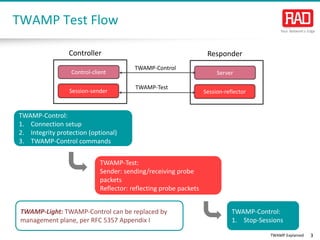
TWAMP Test Flow
TWAMP-Control:
1. Connection setup
2. Integrity protection (optional)
3. TWAMP-Control commands
TWAMP-Test:
Sender: sending/receiving probe
packets
Reflector: reflecting probe packets
TWAMP-Control:
1. Stop-Sessions
Server
Session-reflector
Control-client
Session-sender
TWAMP-Control
TWAMP-Test
Controller Responder
TWAMP-Light: TWAMP-Control can be replaced by
management plane, per RFC 5357 Appendix IT-Control
TWAMP Explained 4
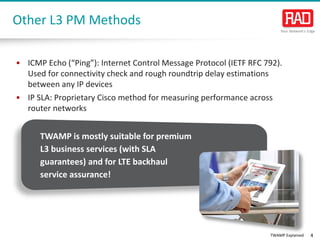
TWAMP is mostly suitable for premium
L3 business services (with SLA
guarantees) and for LTE backhaul
service assurance!
• ICMP Echo (“Ping”): Internet Control Message Protocol (IETF RFC 792).
Used for connectivity check and rough roundtrip delay estimations
between any IP devices
• IP SLA: Proprietary Cisco method for measuring performance across
router networks
Other L3 PM Methods
TWAMP Explained 5
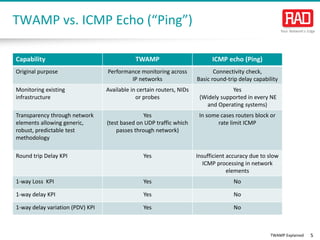
Capability TWAMP ICMP echo (Ping)
Original purpose Performance monitoring across
IP networks
Connectivity check,
Basic round-trip delay capability
Monitoring existing
infrastructure
Available in certain routers, NIDs
or probes
Yes
(Widely supported in every NE
and Operating systems)
Transparency through network
elements allowing generic,
robust, predictable test
methodology
Yes
(test based on UDP traffic which
passes through network)
In some cases routers block or
rate limit ICMP
Round trip Delay KPI Yes Insufficient accuracy due to slow
ICMP processing in network
elements
1-way Loss KPI Yes No
1-way delay KPI Yes No
1-way delay variation (PDV) KPI Yes No
TWAMP vs. ICMP Echo (“Ping”)
RAD’s TWAMP
Solution
TWAMP Explained 7
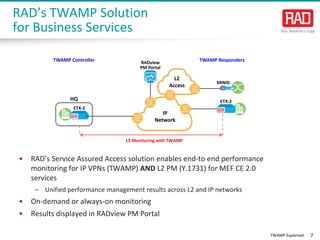
• RAD’s Service Assured Access solution enables end-to end performance
monitoring for IP VPNs (TWAMP) AND L2 PM (Y.1731) for MEF CE 2.0
services
– Unified performance management results across L2 and IP networks
• On-demand or always-on monitoring
• Results displayed in RADview PM Portal
RAD’s TWAMP Solution
for Business Services
IP
Network
L2
Access
L3 Monitoring with TWAMP
RADview
PM Portal
ETX-2
MiNID
HQ
ETX-2
TWAMP RespondersTWAMP Controller
TWAMP Explained 8
• Tight control of mobile backhaul transport networks for SLA assurance to
meet stringent performance requirements in a dynamic LTE environment
• On-demand or always-on monitoring, with presentation in RADview PM
Portal
RAD’s TWAMP Solution for
LTE Backhaul
IP
Network/
Backhaul
L2
Access
L3 Monitoring with TWAMP
RADview
PM Portal
Controller Site
GbE/
10 GbE
ETX-2
MiNID
ETX-2
TWAMP Responders
TWAMP Controllers
TWAMP Explained 9
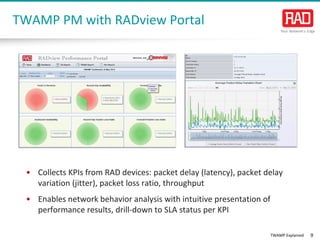
• Collects KPIs from RAD devices: packet delay (latency), packet delay
variation (jitter), packet loss ratio, throughput
• Enables network behavior analysis with intuitive presentation of
performance results, drill-down to SLA status per KPI
TWAMP PM with RADview Portal
TWAMP Explained 10
• TWAMP is an effective standard-based method for monitoring performance in
IP networks
• Performance guarantees in L3 are now expected for premium business
services and LTE backhaul
• TWAMP support is therefore a critical element in the PM toolbox of service
assurance NIDs
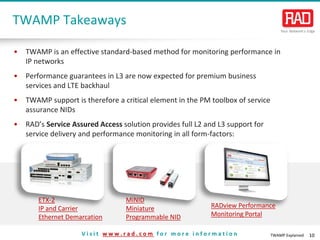
• RAD’s Service Assured Access solution provides full L2 and L3 support for
service delivery and performance monitoring in all form-factors:
TWAMP Takeaways
ETX-2
IP and Carrier
Ethernet Demarcation
MiNID
Miniature
Programmable NID
RADview Performance
Monitoring Portal
V i s i t w w w . r a d . c o m f o r m o r e i n f o r m a t i o n
w w w . r a d . c o m

What is-twamp

  • 1.
    TWAMP Explained Measuring Performancein IP Networks September 2014
  • 2.
    TWAMP Explained 2 Whatis TWAMP • Two-Way Active Measurement Protocol (IETF RFC 5357) • Uses active probe packets to measure two-way delay between two end-points in IP networks – Timestamps are applied for high accuracy • Typically does not requires that both end-points are time-synchronized – One-way delay measurements require sync. • Additional capabilities: packet loss ratio, continuity check, one-way and two-way packet delay variation
  • 3.
    TWAMP Explained 3 TWAMPTest Flow TWAMP-Control: 1. Connection setup 2. Integrity protection (optional) 3. TWAMP-Control commands TWAMP-Test: Sender: sending/receiving probe packets Reflector: reflecting probe packets TWAMP-Control: 1. Stop-Sessions Server Session-reflector Control-client Session-sender TWAMP-Control TWAMP-Test Controller Responder TWAMP-Light: TWAMP-Control can be replaced by management plane, per RFC 5357 Appendix IT-Control
  • 4.
    TWAMP Explained 4 TWAMPis mostly suitable for premium L3 business services (with SLA guarantees) and for LTE backhaul service assurance! • ICMP Echo (“Ping”): Internet Control Message Protocol (IETF RFC 792). Used for connectivity check and rough roundtrip delay estimations between any IP devices • IP SLA: Proprietary Cisco method for measuring performance across router networks Other L3 PM Methods
  • 5.
    TWAMP Explained 5 CapabilityTWAMP ICMP echo (Ping) Original purpose Performance monitoring across IP networks Connectivity check, Basic round-trip delay capability Monitoring existing infrastructure Available in certain routers, NIDs or probes Yes (Widely supported in every NE and Operating systems) Transparency through network elements allowing generic, robust, predictable test methodology Yes (test based on UDP traffic which passes through network) In some cases routers block or rate limit ICMP Round trip Delay KPI Yes Insufficient accuracy due to slow ICMP processing in network elements 1-way Loss KPI Yes No 1-way delay KPI Yes No 1-way delay variation (PDV) KPI Yes No TWAMP vs. ICMP Echo (“Ping”)
  • 6.
  • 7.
    TWAMP Explained 7 •RAD’s Service Assured Access solution enables end-to end performance monitoring for IP VPNs (TWAMP) AND L2 PM (Y.1731) for MEF CE 2.0 services – Unified performance management results across L2 and IP networks • On-demand or always-on monitoring • Results displayed in RADview PM Portal RAD’s TWAMP Solution for Business Services IP Network L2 Access L3 Monitoring with TWAMP RADview PM Portal ETX-2 MiNID HQ ETX-2 TWAMP RespondersTWAMP Controller
  • 8.
    TWAMP Explained 8 •Tight control of mobile backhaul transport networks for SLA assurance to meet stringent performance requirements in a dynamic LTE environment • On-demand or always-on monitoring, with presentation in RADview PM Portal RAD’s TWAMP Solution for LTE Backhaul IP Network/ Backhaul L2 Access L3 Monitoring with TWAMP RADview PM Portal Controller Site GbE/ 10 GbE ETX-2 MiNID ETX-2 TWAMP Responders TWAMP Controllers
  • 9.
    TWAMP Explained 9 •Collects KPIs from RAD devices: packet delay (latency), packet delay variation (jitter), packet loss ratio, throughput • Enables network behavior analysis with intuitive presentation of performance results, drill-down to SLA status per KPI TWAMP PM with RADview Portal
  • 10.
    TWAMP Explained 10 •TWAMP is an effective standard-based method for monitoring performance in IP networks • Performance guarantees in L3 are now expected for premium business services and LTE backhaul • TWAMP support is therefore a critical element in the PM toolbox of service assurance NIDs • RAD’s Service Assured Access solution provides full L2 and L3 support for service delivery and performance monitoring in all form-factors: TWAMP Takeaways ETX-2 IP and Carrier Ethernet Demarcation MiNID Miniature Programmable NID RADview Performance Monitoring Portal V i s i t w w w . r a d . c o m f o r m o r e i n f o r m a t i o n
  • 11.
    w w w. r a d . c o m