Carrier Ethernet vs MPLSin Power Utility Communications 
What to consider when migrating to next-gen operational networks 
October 2014
CE vs MPLS in Power Utility Communications 2 
• 
Technology is not suitable for new applications and required bandwidth 
• 
Equipment israpidly becoming obsolete 
– 
EoLby Sycamore, Coastcom, Carrier Access, Alcatel’s Mainstreet, Tellabs, Nokia, NSN 
• 
Maintenance is expensive due to lack of components 
• 
Finding staff with SDH/SONET expertise is becoming ever more difficult 
• 
RTUs and IEDs are becoming Ethernet-based, migration to IEC 61850 
• 
Cyber security is crucial for mission-critical networks 
SDH/SONET is Being Phased Out… 
Power utilities are therefore starting to migrate to future-proof packet networks
CE vs MPLS in Power Utility Communications 3 
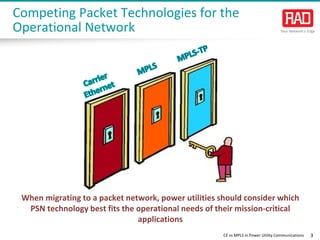
When migrating to a packet network, power utilities should consider which PSN technology best fits the operational needs of their mission-critical applications 
Competing Packet Technologies for the Operational Network
Comparing Carrier Ethernet, MPLS and MPLS-TP
CE vs MPLS in Power Utility Communications 5 
• 
Mature technology, widely deployed by carriers 
• 
Provisioning through management system (not routing protocols) 
• 
Deterministic and connection-oriented 
• 
Similar to SDH/SONET in terms of architecture and terminology 
• 
State-of-the-art security mechanisms available 
– 
Access authorization (802.1X) 
– 
Source authentication, integrity and optional encryption (MACSec) 
• 
Carrier-grade operations mechanisms: 
– 
Service activation testing (Y.1564) 
– 
Fault management (Y.1731) 
– 
Performance monitoring (Y.1731) 
– 
Automatic protection switching (G.8031, G.8032) 
Carrier Ethernet Highlights
CE vs MPLS in Power Utility Communications 6 
• 
Mature technology 
• 
Widely used to carry IP 
• 
Designed for IP core networks 
• 
Inherits rich IP control plane 
• 
Fast re-route for resiliency 
• 
No inherent security mechanisms 
• 
Architecturally different than SDH/SONET networks 
MPLS Highlights
CE vs MPLS in Power Utility Communications 7 
• 
“New kid in town” –initial installations worldwide 
• 
Adds OAM and protection switching to basic MPLS 
– 
OAM and APS are based on Carrier Ethernet mechanisms 
• 
Does not require IP control plane (but can exploit it) 
– 
Simplifies static setup of semi-permanent services 
• 
No inherent security mechanisms 
• 
Architecturally similar to SDH/SONET and Carrier Ethernet 
• 
Has two equivalent but non-compatible versions (IETF and ITU-T) 
MPLS-TP Highlights
CE vs MPLS in Power Utility Communications 8 
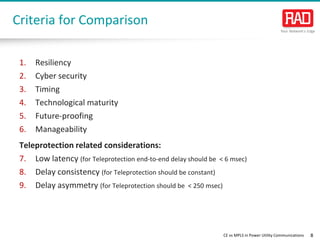
1. 
Resiliency 
2. 
Cyber security 
3. 
Timing 
4. 
Technological maturity 
5. 
Future-proofing 
6. 
Manageability 
Teleprotectionrelated considerations: 
7. 
Low latency (for Teleprotection end-to-end delay should be < 6 msec) 
8. 
Delay consistency (for Teleprotection should be constant) 
9. 
Delay asymmetry (for Teleprotection should be < 250 msec) 
Criteria for Comparison
CE vs MPLS in Power Utility Communications 9 
• 
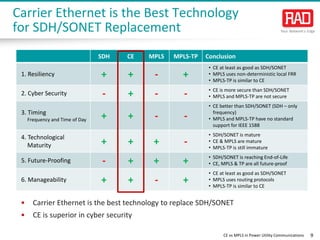
Carrier Ethernet is the best technology to replace SDH/SONET 
• 
CE is superior in cyber security 
Carrier Ethernet is the Best Technology for SDH/SONET Replacement 
SDH 
CE 
MPLS 
MPLS-TP 
Conclusion 
1. Resiliency 
+ 
+ 
- 
+ 
•CE at least as good as SDH/SONET 
•MPLSuses non-deterministic local FRR 
•MPLS-TPis similar to CE 
2. Cyber Security 
- 
+ 
- 
- 
•CE is more secure than SDH/SONET 
•MPLS and MPLS-TP are not secure 
3. TimingFrequency and Time of Day 
+ 
+ 
- 
- 
•CE better than SDH/SONET (SDH –only frequency) 
•MPLS and MPLS-TP have no standard support for IEEE 1588 
4. Technological Maturity 
+ 
+ 
+ 
- 
•SDH/SONETis mature 
•CE & MPLS are mature 
•MPLS-TPis still immature 
5. Future-Proofing 
- 
+ 
+ 
+ 
•SDH/SONETis reaching End-of-Life 
•CE,MPLS & TPare all future-proof 
6. Manageability 
+ 
+ 
- 
+ 
•CE at least as good as SDH/SONET 
•MPLS uses routing protocols 
•MPLS-TPis similar to CE
CE vs MPLS in Power Utility Communications 10 
• 
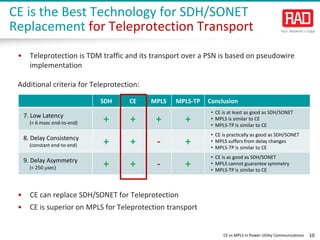
Teleprotection is TDM traffic and its transport over a PSN is based on pseudowire implementation 
Additional criteria for Teleprotection: 
• 
CE can replace SDH/SONET for Teleprotection 
• 
CE is superior on MPLS for Teleprotection transport 
CE is the Best Technology for SDH/SONET Replacement for Teleprotection Transport 
SDH 
CE 
MPLS 
MPLS-TP 
Conclusion 
7. Low Latency(< 6 msecend-to-end) 
+ 
+ 
+ 
+ 
•CEis at least as good as SDH/SONET 
•MPLS is similar to CE 
•MPLS-TP is similar to CE 
8. Delay Consistency (constant end-to-end) 
+ 
+ 
- 
+ 
•CE is practically as good as SDH/SONET 
•MPLSsuffers from delay changes 
•MPLS-TP is similar to CE 
9. Delay Asymmetry(< 250 μsec) 
+ 
+ 
- 
+ 
•CE is as good as SDH/SONET 
•MPLS cannot guarantee symmetry 
•MPLS-TP is similar to CE
CE vs MPLS in Power Utility Communications 11 
Summary 
• 
Power utilities are replacing their SDH/SONET-based operational networks 
• 
Carrier Ethernet, MPLS and MPLS-TP are future-proof packet-based technologies 
• 
Carrier Ethernet is superior to MPLS and MPLS-TP, which are less suitable for critical infrastructure: 
– 
MPLS and MPLS-TP lack cyber security mechanisms 
– 
MPLS is not deterministic and not a drop-in SDH/SONET replacement 
– 
MPLS-TP has two incompatible versions and has not reached maturity 
– 
Carrier Ethernet is a perfect replacement to 
SDH/SONET, even for Teleprotection!
www.rad.com

Carrier ethernet vs-mpls-power-utility-communications

  • 1.
    Carrier Ethernet vsMPLSin Power Utility Communications What to consider when migrating to next-gen operational networks October 2014
  • 2.
    CE vs MPLSin Power Utility Communications 2 • Technology is not suitable for new applications and required bandwidth • Equipment israpidly becoming obsolete – EoLby Sycamore, Coastcom, Carrier Access, Alcatel’s Mainstreet, Tellabs, Nokia, NSN • Maintenance is expensive due to lack of components • Finding staff with SDH/SONET expertise is becoming ever more difficult • RTUs and IEDs are becoming Ethernet-based, migration to IEC 61850 • Cyber security is crucial for mission-critical networks SDH/SONET is Being Phased Out… Power utilities are therefore starting to migrate to future-proof packet networks
  • 3.
    CE vs MPLSin Power Utility Communications 3 When migrating to a packet network, power utilities should consider which PSN technology best fits the operational needs of their mission-critical applications Competing Packet Technologies for the Operational Network
  • 4.
  • 5.
    CE vs MPLSin Power Utility Communications 5 • Mature technology, widely deployed by carriers • Provisioning through management system (not routing protocols) • Deterministic and connection-oriented • Similar to SDH/SONET in terms of architecture and terminology • State-of-the-art security mechanisms available – Access authorization (802.1X) – Source authentication, integrity and optional encryption (MACSec) • Carrier-grade operations mechanisms: – Service activation testing (Y.1564) – Fault management (Y.1731) – Performance monitoring (Y.1731) – Automatic protection switching (G.8031, G.8032) Carrier Ethernet Highlights
  • 6.
    CE vs MPLSin Power Utility Communications 6 • Mature technology • Widely used to carry IP • Designed for IP core networks • Inherits rich IP control plane • Fast re-route for resiliency • No inherent security mechanisms • Architecturally different than SDH/SONET networks MPLS Highlights
  • 7.
    CE vs MPLSin Power Utility Communications 7 • “New kid in town” –initial installations worldwide • Adds OAM and protection switching to basic MPLS – OAM and APS are based on Carrier Ethernet mechanisms • Does not require IP control plane (but can exploit it) – Simplifies static setup of semi-permanent services • No inherent security mechanisms • Architecturally similar to SDH/SONET and Carrier Ethernet • Has two equivalent but non-compatible versions (IETF and ITU-T) MPLS-TP Highlights
  • 8.
    CE vs MPLSin Power Utility Communications 8 1. Resiliency 2. Cyber security 3. Timing 4. Technological maturity 5. Future-proofing 6. Manageability Teleprotectionrelated considerations: 7. Low latency (for Teleprotection end-to-end delay should be < 6 msec) 8. Delay consistency (for Teleprotection should be constant) 9. Delay asymmetry (for Teleprotection should be < 250 msec) Criteria for Comparison
  • 9.
    CE vs MPLSin Power Utility Communications 9 • Carrier Ethernet is the best technology to replace SDH/SONET • CE is superior in cyber security Carrier Ethernet is the Best Technology for SDH/SONET Replacement SDH CE MPLS MPLS-TP Conclusion 1. Resiliency + + - + •CE at least as good as SDH/SONET •MPLSuses non-deterministic local FRR •MPLS-TPis similar to CE 2. Cyber Security - + - - •CE is more secure than SDH/SONET •MPLS and MPLS-TP are not secure 3. TimingFrequency and Time of Day + + - - •CE better than SDH/SONET (SDH –only frequency) •MPLS and MPLS-TP have no standard support for IEEE 1588 4. Technological Maturity + + + - •SDH/SONETis mature •CE & MPLS are mature •MPLS-TPis still immature 5. Future-Proofing - + + + •SDH/SONETis reaching End-of-Life •CE,MPLS & TPare all future-proof 6. Manageability + + - + •CE at least as good as SDH/SONET •MPLS uses routing protocols •MPLS-TPis similar to CE
  • 10.
    CE vs MPLSin Power Utility Communications 10 • Teleprotection is TDM traffic and its transport over a PSN is based on pseudowire implementation Additional criteria for Teleprotection: • CE can replace SDH/SONET for Teleprotection • CE is superior on MPLS for Teleprotection transport CE is the Best Technology for SDH/SONET Replacement for Teleprotection Transport SDH CE MPLS MPLS-TP Conclusion 7. Low Latency(< 6 msecend-to-end) + + + + •CEis at least as good as SDH/SONET •MPLS is similar to CE •MPLS-TP is similar to CE 8. Delay Consistency (constant end-to-end) + + - + •CE is practically as good as SDH/SONET •MPLSsuffers from delay changes •MPLS-TP is similar to CE 9. Delay Asymmetry(< 250 μsec) + + - + •CE is as good as SDH/SONET •MPLS cannot guarantee symmetry •MPLS-TP is similar to CE
  • 11.
    CE vs MPLSin Power Utility Communications 11 Summary • Power utilities are replacing their SDH/SONET-based operational networks • Carrier Ethernet, MPLS and MPLS-TP are future-proof packet-based technologies • Carrier Ethernet is superior to MPLS and MPLS-TP, which are less suitable for critical infrastructure: – MPLS and MPLS-TP lack cyber security mechanisms – MPLS is not deterministic and not a drop-in SDH/SONET replacement – MPLS-TP has two incompatible versions and has not reached maturity – Carrier Ethernet is a perfect replacement to SDH/SONET, even for Teleprotection!
  • 12.