Risk Management and Control
Dr. R. Muthukrishnaveni
Assistant Professor
Riskin
Insurance
 Risk is generally referred to in terms of business or investment,
but it is also applicable in macroeconomic situations. For
example, some kinds of risk examine how inflation, market
dynamics or developments and consumer preferences affect
investments, countries or companies.
 In insurance terms, risk is the chance something harmful or
unexpected could happen.
 This might involve the loss, theft, or damage of valuable
property and belongings, or it may involve someone being
injured.
Risk
Management
 The identification, analysis,
assessment, control, and avoidance,
minimization, or elimination of
unacceptable risks. An organization may
use risk assumption, risk avoidance, risk
retention, risk transfer, or any other
strategy (or combination of strategies) in
proper management of future events.
Risk
management
should-
 create value – resources expended to mitigate risk should be less than the
consequence of inaction
 be an integral part of organizational processes
 be part of decision making process
 explicitly address uncertainty and assumptions
 be a systematic and structured process
 be based on the best available information
 be tailorable
 take human factors into account
 be transparent and inclusive
 be dynamic, iterative and responsive to change
 be capable of continual improvement and enhancement
 be continually or periodically re-assessed
Risk Control
 Risk control is the set of methods by which
firms evaluate potential losses and take
action to reduce or eliminate such threats. It
is a technique that utilizes findings from
risk assessments, which involve identifying
potential risk factors in a company's
operations, such as technical and non-
technical aspects of the business, financial
policies and other issues that may affect the
well-being of the firm. Risk control also
implements proactive changes to reduce
risk in these areas.
Objectives of
Risk Control
 Modern businesses face a diverse
collection of obstacles, competitors, and
potential dangers. Risk control is a plan-
based business strategy that aims to
identify, assess, and prepare for any
dangers, hazards, and other potentials for
disaster—both physical and figurative—that
may interfere with an organization's
operations and objectives.
 Avoidance is the best method of loss control
Loss prevention accepts a risk but attempts to
minimize the loss rather than eliminate it.
Objectives of
Risk Control
 Loss reduction accepts the risk and seeks to
limit losses when a threat occurs.
 Separation involves dispersing key assets so
that catastrophic events at one location affect the
business only at that location.
 Duplication involves creating a backup plan,
often by using technology.
 Diversification allocates business resources for
creating multiple lines of business offering a variety
of products or services in different industries. A
significant revenue loss from one line will not result
in irreparable harm to the company’s bottom line.
Risk
Management
Information
System
(RMIS)
 A risk management information system (RMIS) is
an information system that assists in consolidating
property values, claims, policy, and exposure
information and providing the tracking and
management reporting capabilities to enable the user
to monitor and control the overall cost of risk
management.
Risk
Management
Information
System
(RMIS)
 The management of risk data and information is
key to the success of any risk management effort
regardless of an organization's size or industry sector.
Risk management information systems/services
(RMIS) are used to support expert advice and cost-
effective information management solutions around
key processes such as:
 Risk identification and assessment
 Risk control
 Risk financing
Risk
Management
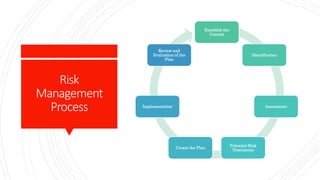
Process
Establish the
Context
Identification
Assessment
Potential Risk
Treatments
Create the Plan
Implementation
Review and
Evaluation of the
Plan
Risk
Management
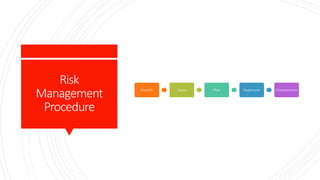
Procedure
Identify Assess Plan Implement Communicate
TimingofRisk
Management
Activities
 The Risk Register will be created on approval of this
Risk Management Strategy. It will be updated:
 On planning the next stage
 On authorizing a work package
 On any updates of the project plan
 Upon any updates of the Business Case
 On the production of any exception plan
 On review of any stage status
Riskmanagement
Planning
(Strategies)
 The primary objective of this step is to prepare
management responses using Risk Response
Categories for each of the identified threats and
opportunities in order to reduce or remove the threat
or to maximize the opportunity. This should leave the
project prepared with an action plan should any risk
materialize.
 Concentration should be on ‘red’ risks as these have the
greatest chance of arising and are likely to impact the
project most severely. Consideration should be given to
‘amber’ risks and ‘green’ risks in order to:
 Keep the risk at as low a level as is practical
 Be prepared to respond to the risk should its severity
level increase during the project
 Ensure that ‘green’ or ‘amber’ risks do not increase the
chance of a ‘red’ risk being encountered
RiskResponse
Categories
a)Avoid – typically change an aspect of the
project so the threat can no longer
happen
b)Reduce – Either reduce the chance of the
threat occurring or reduce the impact of
the threat should it occur
c) Fallback – Build a fallback plan for
actions which will reduce the threat
should the risk occur
d)Transfer – A third party takes on
responsibility for some of the financial
impact of the threat (via insurance or
contractual agreement) to reduce the
financial cost of the threat
e) e) Accept – accept that the threat may
be encountered, usually because it is
either unavoidable or financially
unviable to avoid the threat
 Share – work with third parties to share either the cost
loss or gain associated with the threat
 Exploit – seize an opportunity to ensure the
opportunity will happen and the beneficial outcome
will be realised
 Enhance – take actions to improve the probability of an
event occurring and to enhance the beneficial outcome
should it occur
 Reject – a conscious decision not to exploit an
opportunity as it is more economical to continue
without responding
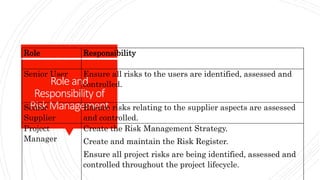
Roleand
Responsibility of
RiskManagement
Role Responsibility
Corporate
Management
Provide the corporate risk management policy and risk
management guide.
Executive Be accountable for all aspects of risk management and
ensure an approved project Risk Management Strategy
exists.
Ensure risks associated with the Business Case are
identified, assessed and controlled.
Escalate risks to corporate management as necessary.
Roleand
Responsibility of
RiskManagement
Role Responsibility
Senior User Ensure all risks to the users are identified, assessed and
controlled.
Senior
Supplier
Ensure risks relating to the supplier aspects are assessed
and controlled.
Project
Manager
Create the Risk Management Strategy.
Create and maintain the Risk Register.
Ensure all project risks are being identified, assessed and
controlled throughout the project lifecycle.
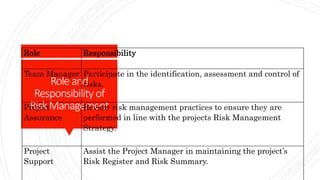
Roleand
Responsibility of
RiskManagement
Role Responsibility
Team Manager Participate in the identification, assessment and control of
risks.
Project
Assurance
Review risk management practices to ensure they are
performed in line with the projects Risk Management
Strategy.
Project
Support
Assist the Project Manager in maintaining the project’s
Risk Register and Risk Summary.
Personal Risk Management
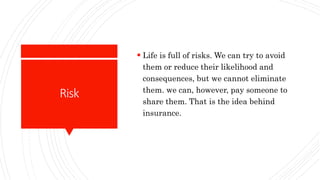
Risk
 Life is full of risks. We can try to avoid
them or reduce their likelihood and
consequences, but we cannot eliminate
them. we can, however, pay someone to
share them. That is the idea behind
insurance.
Risk
Management
 There are speculative risks—that is, risks that offer a
chance of loss or gain, such as developing a “killer app”
or business idea that may or may not sell, or investing
in a corporate stock that may or may not provide good
returns. Such risks can be avoided simply by not
participating. They are almost always uninsurable.
 There are pure risks—accidental or unintentional
events, such as a car accident or an illness. Pure risks
are insurable because their probabilities can be
calculated precisely enough for the risk to be
quantified, which means it can be priced, bought, and
sold.
 Risk shifting is the process of selling risk to someone
who then assumes the risk and its consequences. Why
would someone buy your risk? Because in a large
enough market, your risk can be diversified, which
minimizes its cost.
 Insurance can be purchased for your property and your
home, your health, your employment, and your life. In
each case, you weigh the cost of the consequence of a
risk that may never actually happen against the cost of
insuring against it. Deciding what and how to insure is
really a process of deciding what the costs of loss would
be and how willing you are to pay to get rid of those
risks.
 Risk management is the strategic trade-off of the costs of
reducing, assuming, and shifting risks. The costs of
insurance can also be lowered through risk avoidance or
reduction strategies.
 Risk avoidance is accomplished by completely avoiding
the risk through such measures as choosing not to smoke
or avoiding an activity that might cause injury.
 Risk reduction reduces the risk of injury, loss, or illness.
For example, installing an alarm system in your home
may reduce homeowner’s insurance premiums because
that reduces the risk of theft. Of course, installing an
alarm system has a cost too.
 Risk assumption is when one assumes responsibility for a
loss or injury instead of pursuing insurance. Risk
assumption is often embraced when the potential loss is
minimal, risk reduction strategies have been undertaken,
insurance is too expensive, and/or when protection is
difficult to obtain.
Factors
affecting
Individual's
Demand for
Insurance
 Age
 Gender
 Habits(Smoking/drinking)
 Medical history
 Health record
 Policy
 Profession
 Life style
Insurable Risk
InsurableRisk
 Insurable risks are risks that insurance companies will
cover. These include a wide range of losses, including
those from fire, theft, or lawsuits.
 When we buy commercial insurance, We pay premiums
to your insurance company. In return, the company
agrees to pay us in the event we suffer a covered loss.
 By pooling premiums from many policyholders at once,
insurers are able to pay the claims of the few who do
suffer losses, while providing protection to everyone
else in the pool in case they need it.
Elementsof
InsurableRisk
 Insurance companies normally only indemnify against
pure risks (in term of money financial risk, in term of
occurrences particular risk), otherwise known as event
risks.
 A pure risk includes any uncertain situation where the
opportunity for loss is present and the opportunity for
financial gain is absent.
 Financial risks are the risks where the outcome of an
event (i.e. event giving birth to a loss) can be measured
in monetary terms. The losses can be assessed and a
proper money value can be given to those losses.
 Particular risks are, there are risks which usually arise
from actions of individuals or even group of
individuals.
Risk Management through
Derivatives
Derivatives
 A derivative is a contract between two or more parties
whose value is based on an agreed-upon underlying
financial asset (like a security) or set of assets (like an
index). Common underlying instruments include
bonds, commodities, currencies, interest rates, market
indexes, and stocks.
 Derivatives are financial instruments whose value is
derived from other underlying assets. There are mainly
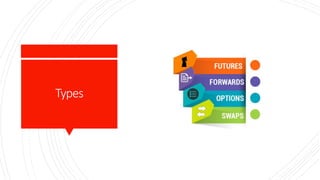
four types of derivative contracts such as futures,
forwards, options & swaps. However, Swaps are complex
instruments that are not traded in the Indian stock market.
Types
Types
 Futures are standardized contracts and they are traded
on the exchange. On the other hand, Forward contract is
an agreement between two parties and it is traded over-
the-counter (OTC).
 Option is the most important part of derivatives contract.
An Option contract gives the right but not an obligation to
buy/sell the underlying assets.
 A swap is a derivative contract made between two parties
to exchange cash flows in the future. Interest rate swaps
and currency swaps are the most popular swap contracts,
which are traded over the counters between financial
institutions.
RiskManagement
through
Derivatives
 Global derivatives trading volumes are rising speedily as
investors use derivatives as a technique to manage risk.
Investment strategies are becoming more complex with
investors trading in all over the world, frequently into
rising markets, and integrating various instrument types
to maximize returns. Hedging is risk avoiding strategy to
protect position values. Hedging strategies usually involve
the use of financial derivatives, which are securities whose
values depend on the values of other underlying
securities. The two most common derivative markets are
the futures market and the options market. Portfolio
managers, institutions and individual investors use
financial derivatives to construct trading strategies where
a loss in one investment is offset by a gain in a derivative
and vice versa. According to Chui (2012)60 “some
fundamental changes in global financial markets have
contributed to rapid growth in derivative markets
 First, the collapse of the Bretton Woods system of fixed
exchange rates in 1971 increased the demand for
hedging against exchange rate risk. Consequently,
trading in currency futures is allowed at the Chicago
mercantile Exchange in the following year. Second,
emerging market financial crises substantially
influence the demand for hedging against credit risk.
Third, innovation in financial theory and
advancements in options pricing research also
contribute to rapid development of the derivative
markets
 Lastly, rapid improvements in computer technology
enabled asset managers to design and develop
increasingly sophisticated derivatives as part of their
risk management tools.” Derivative Strategies are
specific game plans created by investors based on their
idea of how the market will move. Derivative
Strategies are generally combinations of various
products like futures, calls and puts and enable
investors to realize unlimited profits, limited profits,
unlimited losses or limited losses depending on
investors profit appetite and risk appetite. The
simplest starting point of a Strategy could be having a
clear view about the market. There could be strategies
of an advanced nature that are independent of views,
but it would be correct to say that most investors
create strategies based on views.

Risk Management and Control(Insurance).pptx

  • 1.
    Risk Management andControl Dr. R. Muthukrishnaveni Assistant Professor
  • 2.
    Riskin Insurance  Risk isgenerally referred to in terms of business or investment, but it is also applicable in macroeconomic situations. For example, some kinds of risk examine how inflation, market dynamics or developments and consumer preferences affect investments, countries or companies.  In insurance terms, risk is the chance something harmful or unexpected could happen.  This might involve the loss, theft, or damage of valuable property and belongings, or it may involve someone being injured.
  • 3.
    Risk Management  The identification,analysis, assessment, control, and avoidance, minimization, or elimination of unacceptable risks. An organization may use risk assumption, risk avoidance, risk retention, risk transfer, or any other strategy (or combination of strategies) in proper management of future events.
  • 4.
    Risk management should-  create value– resources expended to mitigate risk should be less than the consequence of inaction  be an integral part of organizational processes  be part of decision making process  explicitly address uncertainty and assumptions  be a systematic and structured process  be based on the best available information  be tailorable  take human factors into account  be transparent and inclusive  be dynamic, iterative and responsive to change  be capable of continual improvement and enhancement  be continually or periodically re-assessed
  • 5.
    Risk Control  Riskcontrol is the set of methods by which firms evaluate potential losses and take action to reduce or eliminate such threats. It is a technique that utilizes findings from risk assessments, which involve identifying potential risk factors in a company's operations, such as technical and non- technical aspects of the business, financial policies and other issues that may affect the well-being of the firm. Risk control also implements proactive changes to reduce risk in these areas.
  • 6.
    Objectives of Risk Control Modern businesses face a diverse collection of obstacles, competitors, and potential dangers. Risk control is a plan- based business strategy that aims to identify, assess, and prepare for any dangers, hazards, and other potentials for disaster—both physical and figurative—that may interfere with an organization's operations and objectives.  Avoidance is the best method of loss control Loss prevention accepts a risk but attempts to minimize the loss rather than eliminate it.
  • 7.
    Objectives of Risk Control Loss reduction accepts the risk and seeks to limit losses when a threat occurs.  Separation involves dispersing key assets so that catastrophic events at one location affect the business only at that location.  Duplication involves creating a backup plan, often by using technology.  Diversification allocates business resources for creating multiple lines of business offering a variety of products or services in different industries. A significant revenue loss from one line will not result in irreparable harm to the company’s bottom line.
  • 8.
    Risk Management Information System (RMIS)  A riskmanagement information system (RMIS) is an information system that assists in consolidating property values, claims, policy, and exposure information and providing the tracking and management reporting capabilities to enable the user to monitor and control the overall cost of risk management.
  • 9.
    Risk Management Information System (RMIS)  The managementof risk data and information is key to the success of any risk management effort regardless of an organization's size or industry sector. Risk management information systems/services (RMIS) are used to support expert advice and cost- effective information management solutions around key processes such as:  Risk identification and assessment  Risk control  Risk financing
  • 10.
  • 11.
  • 12.
    TimingofRisk Management Activities  The RiskRegister will be created on approval of this Risk Management Strategy. It will be updated:  On planning the next stage  On authorizing a work package  On any updates of the project plan  Upon any updates of the Business Case  On the production of any exception plan  On review of any stage status
  • 13.
    Riskmanagement Planning (Strategies)  The primaryobjective of this step is to prepare management responses using Risk Response Categories for each of the identified threats and opportunities in order to reduce or remove the threat or to maximize the opportunity. This should leave the project prepared with an action plan should any risk materialize.  Concentration should be on ‘red’ risks as these have the greatest chance of arising and are likely to impact the project most severely. Consideration should be given to ‘amber’ risks and ‘green’ risks in order to:  Keep the risk at as low a level as is practical  Be prepared to respond to the risk should its severity level increase during the project  Ensure that ‘green’ or ‘amber’ risks do not increase the chance of a ‘red’ risk being encountered
  • 14.
    RiskResponse Categories a)Avoid – typicallychange an aspect of the project so the threat can no longer happen b)Reduce – Either reduce the chance of the threat occurring or reduce the impact of the threat should it occur c) Fallback – Build a fallback plan for actions which will reduce the threat should the risk occur d)Transfer – A third party takes on responsibility for some of the financial impact of the threat (via insurance or contractual agreement) to reduce the financial cost of the threat e) e) Accept – accept that the threat may be encountered, usually because it is either unavoidable or financially unviable to avoid the threat
  • 15.
     Share –work with third parties to share either the cost loss or gain associated with the threat  Exploit – seize an opportunity to ensure the opportunity will happen and the beneficial outcome will be realised  Enhance – take actions to improve the probability of an event occurring and to enhance the beneficial outcome should it occur  Reject – a conscious decision not to exploit an opportunity as it is more economical to continue without responding
  • 16.
    Roleand Responsibility of RiskManagement Role Responsibility Corporate Management Providethe corporate risk management policy and risk management guide. Executive Be accountable for all aspects of risk management and ensure an approved project Risk Management Strategy exists. Ensure risks associated with the Business Case are identified, assessed and controlled. Escalate risks to corporate management as necessary.
  • 17.
    Roleand Responsibility of RiskManagement Role Responsibility SeniorUser Ensure all risks to the users are identified, assessed and controlled. Senior Supplier Ensure risks relating to the supplier aspects are assessed and controlled. Project Manager Create the Risk Management Strategy. Create and maintain the Risk Register. Ensure all project risks are being identified, assessed and controlled throughout the project lifecycle.
  • 18.
    Roleand Responsibility of RiskManagement Role Responsibility TeamManager Participate in the identification, assessment and control of risks. Project Assurance Review risk management practices to ensure they are performed in line with the projects Risk Management Strategy. Project Support Assist the Project Manager in maintaining the project’s Risk Register and Risk Summary.
  • 19.
  • 20.
    Risk  Life isfull of risks. We can try to avoid them or reduce their likelihood and consequences, but we cannot eliminate them. we can, however, pay someone to share them. That is the idea behind insurance.
  • 21.
    Risk Management  There arespeculative risks—that is, risks that offer a chance of loss or gain, such as developing a “killer app” or business idea that may or may not sell, or investing in a corporate stock that may or may not provide good returns. Such risks can be avoided simply by not participating. They are almost always uninsurable.  There are pure risks—accidental or unintentional events, such as a car accident or an illness. Pure risks are insurable because their probabilities can be calculated precisely enough for the risk to be quantified, which means it can be priced, bought, and sold.
  • 22.
     Risk shiftingis the process of selling risk to someone who then assumes the risk and its consequences. Why would someone buy your risk? Because in a large enough market, your risk can be diversified, which minimizes its cost.  Insurance can be purchased for your property and your home, your health, your employment, and your life. In each case, you weigh the cost of the consequence of a risk that may never actually happen against the cost of insuring against it. Deciding what and how to insure is really a process of deciding what the costs of loss would be and how willing you are to pay to get rid of those risks.
  • 23.
     Risk managementis the strategic trade-off of the costs of reducing, assuming, and shifting risks. The costs of insurance can also be lowered through risk avoidance or reduction strategies.  Risk avoidance is accomplished by completely avoiding the risk through such measures as choosing not to smoke or avoiding an activity that might cause injury.  Risk reduction reduces the risk of injury, loss, or illness. For example, installing an alarm system in your home may reduce homeowner’s insurance premiums because that reduces the risk of theft. Of course, installing an alarm system has a cost too.  Risk assumption is when one assumes responsibility for a loss or injury instead of pursuing insurance. Risk assumption is often embraced when the potential loss is minimal, risk reduction strategies have been undertaken, insurance is too expensive, and/or when protection is difficult to obtain.
  • 24.
    Factors affecting Individual's Demand for Insurance  Age Gender  Habits(Smoking/drinking)  Medical history  Health record  Policy  Profession  Life style
  • 25.
  • 26.
    InsurableRisk  Insurable risksare risks that insurance companies will cover. These include a wide range of losses, including those from fire, theft, or lawsuits.  When we buy commercial insurance, We pay premiums to your insurance company. In return, the company agrees to pay us in the event we suffer a covered loss.  By pooling premiums from many policyholders at once, insurers are able to pay the claims of the few who do suffer losses, while providing protection to everyone else in the pool in case they need it.
  • 27.
    Elementsof InsurableRisk  Insurance companiesnormally only indemnify against pure risks (in term of money financial risk, in term of occurrences particular risk), otherwise known as event risks.  A pure risk includes any uncertain situation where the opportunity for loss is present and the opportunity for financial gain is absent.  Financial risks are the risks where the outcome of an event (i.e. event giving birth to a loss) can be measured in monetary terms. The losses can be assessed and a proper money value can be given to those losses.  Particular risks are, there are risks which usually arise from actions of individuals or even group of individuals.
  • 28.
  • 29.
    Derivatives  A derivativeis a contract between two or more parties whose value is based on an agreed-upon underlying financial asset (like a security) or set of assets (like an index). Common underlying instruments include bonds, commodities, currencies, interest rates, market indexes, and stocks.  Derivatives are financial instruments whose value is derived from other underlying assets. There are mainly four types of derivative contracts such as futures, forwards, options & swaps. However, Swaps are complex instruments that are not traded in the Indian stock market.
  • 30.
  • 31.
    Types  Futures arestandardized contracts and they are traded on the exchange. On the other hand, Forward contract is an agreement between two parties and it is traded over- the-counter (OTC).  Option is the most important part of derivatives contract. An Option contract gives the right but not an obligation to buy/sell the underlying assets.  A swap is a derivative contract made between two parties to exchange cash flows in the future. Interest rate swaps and currency swaps are the most popular swap contracts, which are traded over the counters between financial institutions.
  • 32.
    RiskManagement through Derivatives  Global derivativestrading volumes are rising speedily as investors use derivatives as a technique to manage risk. Investment strategies are becoming more complex with investors trading in all over the world, frequently into rising markets, and integrating various instrument types to maximize returns. Hedging is risk avoiding strategy to protect position values. Hedging strategies usually involve the use of financial derivatives, which are securities whose values depend on the values of other underlying securities. The two most common derivative markets are the futures market and the options market. Portfolio managers, institutions and individual investors use financial derivatives to construct trading strategies where a loss in one investment is offset by a gain in a derivative and vice versa. According to Chui (2012)60 “some fundamental changes in global financial markets have contributed to rapid growth in derivative markets
  • 33.
     First, thecollapse of the Bretton Woods system of fixed exchange rates in 1971 increased the demand for hedging against exchange rate risk. Consequently, trading in currency futures is allowed at the Chicago mercantile Exchange in the following year. Second, emerging market financial crises substantially influence the demand for hedging against credit risk. Third, innovation in financial theory and advancements in options pricing research also contribute to rapid development of the derivative markets
  • 34.
     Lastly, rapidimprovements in computer technology enabled asset managers to design and develop increasingly sophisticated derivatives as part of their risk management tools.” Derivative Strategies are specific game plans created by investors based on their idea of how the market will move. Derivative Strategies are generally combinations of various products like futures, calls and puts and enable investors to realize unlimited profits, limited profits, unlimited losses or limited losses depending on investors profit appetite and risk appetite. The simplest starting point of a Strategy could be having a clear view about the market. There could be strategies of an advanced nature that are independent of views, but it would be correct to say that most investors create strategies based on views.