Multinational
Capital
Budgeting
March 31, 2015
Junaid Mirza
Introduction
2
Plan for the Workshop
• Basics of capital budgeting
• Issues in foreign investment analysis
• Growth options and project evaluation
• Case study
o Group work
o Group presentations
o Case study take-up
• Q&A
3
Basics of Capital Budgeting
4
Terms of Note
• Capital
• Capital budget
• Investment
• FDI
• Cash flows
• Operating cash flows
• Investing cash flows
• Financing cash flows
• Net present value
• Internal rate of return
• Discount rate
• Cost of capital
• WACC
• Risk free rate
• Market returns
• Terminal Value
• Cannibalization
• Opportunity cost
5
Capital Budgeting
• Basic principles
o Cash inflows and cash outflows associated with an investment
o Risk associated with the cash inflows/cash generation
6
NPV Example Y0 Y1 Y2 Y3 Y4 Y5 Y6 Y7 TV*
Cash Outflows -15
Cash Inflows 0 1 1.1 1.1 1.2 1.2 1.3 1.3 28.1
Net -15 1.0 1.1 1.1 1.2 1.2 1.3 1.3 28.1
Discounted (@ 10%) -15.00 0.91 0.87 0.83 0.79 0.75 0.72 0.69 14.44
NPV of Project 5.00
* Terminal Value assuming growth rate of 5%
The IRR of the above project is 11.67%
Capital Budgeting
• Basic principles (continued):
o Focus on cash flows with respect to shareholder wealth
o Focus on incremental cash flows
• Incremental cash flows
= global corporate cash flows with project
+ global corporate cash flows without project
• Take into account:
o Cannibalization
o Sales creation
o Opportunity cost
o Taxation
o Consider the intangible benefits
• Valuable learning experience
• Broader knowledge base
7
Issues in Foreign
Investment Analysis
8
Key Issues
• Goal is to maximize firm value
• Parent vs. project cash flows
o Cash flows generated by the project may differ from cash flows remitted to the
parent
o Consider impact of reinvestment, cannibalization, taxation
• Consider non-financial returns and investments
o A triple-bottom line approach / corporate social responsibility / overall societal
impact
• Adjust for increased managerial, economic and political
risk
o Managing foreign currency risk
o Shortening minimum payback period
o Raising required rate of return
o Adjusting cash flows
o Insure risks appropriately
9
Growth Options and
Project Evaluation
10
Nature of
Internationalization
Going
Global
Investment
Model
Joint
Venture
Subsidiary
Greenfield
Acquisition
Export
Model
Direct
11
Corporate Finance
Decisions
Corporate Finance
Decisions
Debt
Intercompany
Third party
Equity
12
Objective is to minimize cost of capital and maximize firm value
Corporate Finance
Decisions (Cont’d)
Debt
Short-term or
long-term
Currency Asset-backed Options
Equity
Public vs.
Private vs.
Partner
Ownership
and Control
13
Case Study
14
Capital Budgeting
Decisions
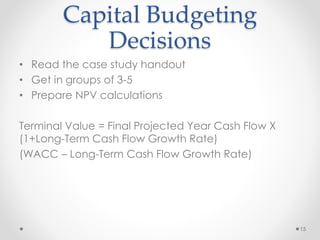
• Read the case study handout
• Get in groups of 3-5
• Prepare NPV calculations
Terminal Value = Final Projected Year Cash Flow X
(1+Long-Term Cash Flow Growth Rate)
(WACC – Long-Term Cash Flow Growth Rate)
15
Answer
O
O
O
O
O
O
O
O
O
16
NPV for Windsor
CAD Millions 0 1 2 3 4 5 TV
Initial investment -470
Grant 5 5 5 5 5
Revenues 40 80 107 107 107
COS -18 -36 -48 -48 -48
Opex -4 -8 -11 -11 -11
Tax -5 -9 -12 -12 -12
WHT 0 0 0 0 0
Net cash flows -470 19 32 41 41 41 742
NPV -470 17 27 33 30 28 505
Total NPV 170
17
NPV for Matamoros
MXN Millions 0 1 2 3 4 5 TV
Initial investment -4800
Grant 0 0 0 0 0
Revenues 333 667 1000 1333 1333
COS -80 -160 -240 -320 -320
Opex -33 -67 -100 -133 -133
Tax -66 -132 -198 -264 -264
WHT -8 -15 -23 -31 -31
Net cash flows -4800 146 293 439 585 585 10534
NPV -4800 128 225 296 346 304 5471
Total NPV 1971  CAD 158
18
Thank you
Junaid Mirza
jm@junaidmirza.com
ca.linkedin.com/in/junaidmirza
19

Multinational Capital Budgeting

  • 1.
  • 2.
  • 3.
    Plan for theWorkshop • Basics of capital budgeting • Issues in foreign investment analysis • Growth options and project evaluation • Case study o Group work o Group presentations o Case study take-up • Q&A 3
  • 4.
    Basics of CapitalBudgeting 4
  • 5.
    Terms of Note •Capital • Capital budget • Investment • FDI • Cash flows • Operating cash flows • Investing cash flows • Financing cash flows • Net present value • Internal rate of return • Discount rate • Cost of capital • WACC • Risk free rate • Market returns • Terminal Value • Cannibalization • Opportunity cost 5
  • 6.
    Capital Budgeting • Basicprinciples o Cash inflows and cash outflows associated with an investment o Risk associated with the cash inflows/cash generation 6 NPV Example Y0 Y1 Y2 Y3 Y4 Y5 Y6 Y7 TV* Cash Outflows -15 Cash Inflows 0 1 1.1 1.1 1.2 1.2 1.3 1.3 28.1 Net -15 1.0 1.1 1.1 1.2 1.2 1.3 1.3 28.1 Discounted (@ 10%) -15.00 0.91 0.87 0.83 0.79 0.75 0.72 0.69 14.44 NPV of Project 5.00 * Terminal Value assuming growth rate of 5% The IRR of the above project is 11.67%
  • 7.
    Capital Budgeting • Basicprinciples (continued): o Focus on cash flows with respect to shareholder wealth o Focus on incremental cash flows • Incremental cash flows = global corporate cash flows with project + global corporate cash flows without project • Take into account: o Cannibalization o Sales creation o Opportunity cost o Taxation o Consider the intangible benefits • Valuable learning experience • Broader knowledge base 7
  • 8.
  • 9.
    Key Issues • Goalis to maximize firm value • Parent vs. project cash flows o Cash flows generated by the project may differ from cash flows remitted to the parent o Consider impact of reinvestment, cannibalization, taxation • Consider non-financial returns and investments o A triple-bottom line approach / corporate social responsibility / overall societal impact • Adjust for increased managerial, economic and political risk o Managing foreign currency risk o Shortening minimum payback period o Raising required rate of return o Adjusting cash flows o Insure risks appropriately 9
  • 10.
  • 11.
  • 12.
    Corporate Finance Decisions Corporate Finance Decisions Debt Intercompany Thirdparty Equity 12 Objective is to minimize cost of capital and maximize firm value
  • 13.
    Corporate Finance Decisions (Cont’d) Debt Short-termor long-term Currency Asset-backed Options Equity Public vs. Private vs. Partner Ownership and Control 13
  • 14.
  • 15.
    Capital Budgeting Decisions • Readthe case study handout • Get in groups of 3-5 • Prepare NPV calculations Terminal Value = Final Projected Year Cash Flow X (1+Long-Term Cash Flow Growth Rate) (WACC – Long-Term Cash Flow Growth Rate) 15
  • 16.
  • 17.
    NPV for Windsor CADMillions 0 1 2 3 4 5 TV Initial investment -470 Grant 5 5 5 5 5 Revenues 40 80 107 107 107 COS -18 -36 -48 -48 -48 Opex -4 -8 -11 -11 -11 Tax -5 -9 -12 -12 -12 WHT 0 0 0 0 0 Net cash flows -470 19 32 41 41 41 742 NPV -470 17 27 33 30 28 505 Total NPV 170 17
  • 18.
    NPV for Matamoros MXNMillions 0 1 2 3 4 5 TV Initial investment -4800 Grant 0 0 0 0 0 Revenues 333 667 1000 1333 1333 COS -80 -160 -240 -320 -320 Opex -33 -67 -100 -133 -133 Tax -66 -132 -198 -264 -264 WHT -8 -15 -23 -31 -31 Net cash flows -4800 146 293 439 585 585 10534 NPV -4800 128 225 296 346 304 5471 Total NPV 1971  CAD 158 18
  • 19.