Introduction
to Risk
Management
CO1: To understand the types of risk and
importance of risk management
You will learn these
 Introduction to Risk – Meaning of Risk and Uncertainty
 Types of Risk- Sources of risk identification and Risk
Measurement.
 Objectives of risk management
 Risk Management Process
 Importance of risk management in business organization
 Overview of tools for risk management
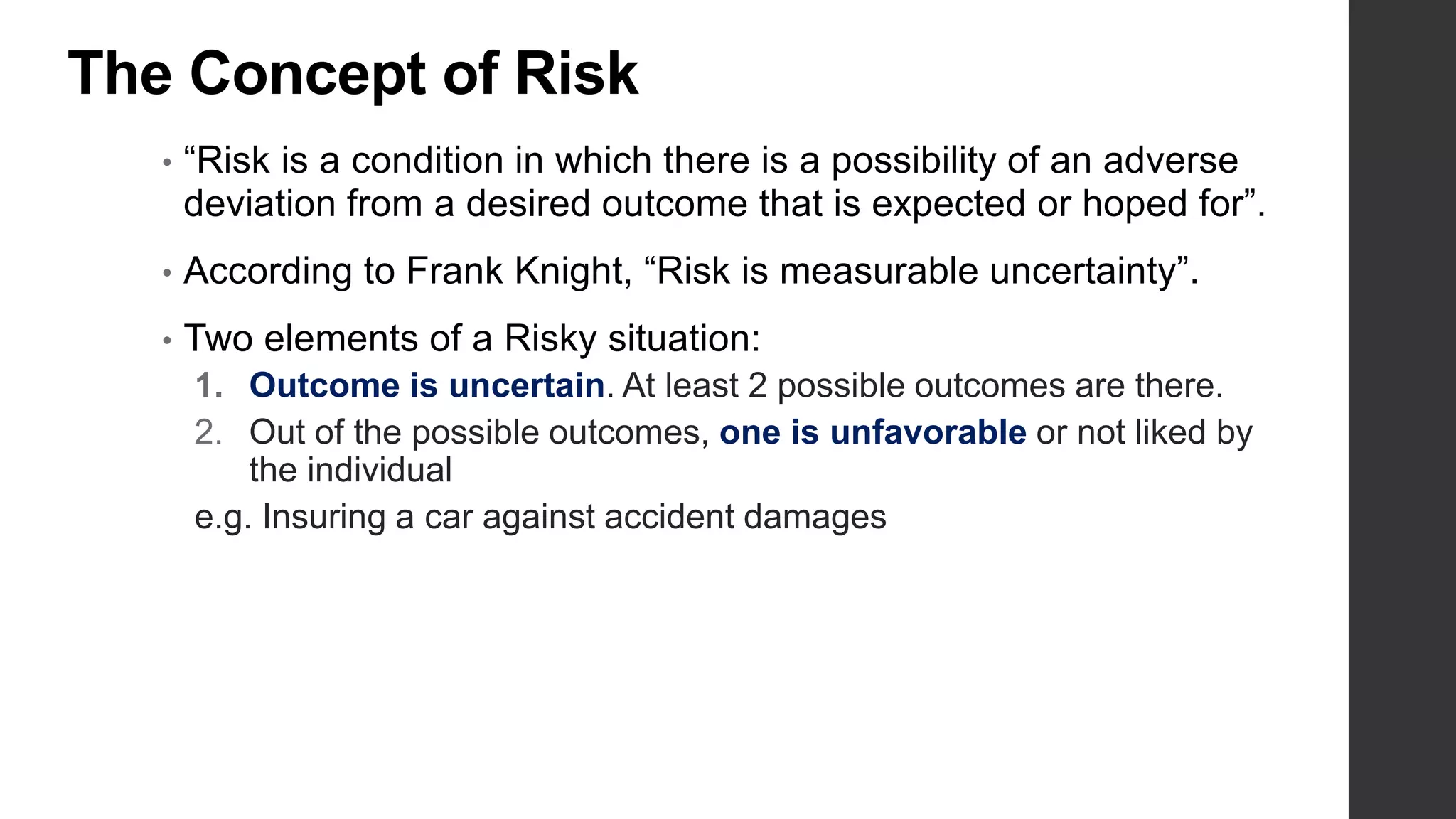
The Concept of Risk
• “Risk is a condition in which there is a possibility of an adverse
deviation from a desired outcome that is expected or hoped for”.
• According to Frank Knight, “Risk is measurable uncertainty”.
• Two elements of a Risky situation:
1. Outcome is uncertain. At least 2 possible outcomes are there.
2. Out of the possible outcomes, one is unfavorable or not liked by
the individual
e.g. Insuring a car against accident damages
Risk VS Uncertainty
E.g. Assume two famous teams consist of renowned players, and
they are going to play a football match the next day.
Can you tell me exactly which team is going to win?
No, you can’t; however, you can make an educated guess by reviewing and analyzing the past
performances of each player, the team, and the results of matches they played against each other.
Then you can come up with some numbers, like there is a 30% chance of Team A or Team B
winning, or there is a 70% possibility of Team A or Team B losing the match. = RISK
Let us say again that two teams are going to play a game, and no players are selected for either
team.
In this situation, if somebody asked you which team is going to win, what would your response
be?
You will be clueless because you don’t know which team consists of which players, and
you have no idea how the teams will perform.
No idea about any information on past performance, and cannot predict the outcome of the
event, even though the rules and the stadium are the same. =
UNCERTAINITY
Risk VS Uncertainty
• In risk we can predict the possibility of a future outcome, while in
uncertainty we cannot.
• Risks can be managed while uncertainty is uncontrollable.
• Risks can be measured and quantified while uncertainty cannot.
• We can assign a probability to risks events, while with uncertainty,
you can’t.
Classifications of Risk I
Types of
Risk
Systematic
Risk
Interest Rate
Risk
Market Risk
Inflationary
Risk
Unsystematic
Risk
Business
Risk
Financial
Risk
Operational
Risk
Systematic Risk
• They are uncontrollable by an organization
• They are macro in nature
• Macro economic problems in an economy of a country
• They are also called as undiversifiable Risk
• They are unpredictable and not easy to avoid
1. Interest Rate Risk:
• Due to variability in
interest Rates
• Debt & Loans get
affected
2. Market Risk:
• Arises as a part of
adverse market
conditions
• It includes absolute &
volatility risk
3. Purchasing Power
Risk:
• Demand inflation risk
• Cost Inflation risk
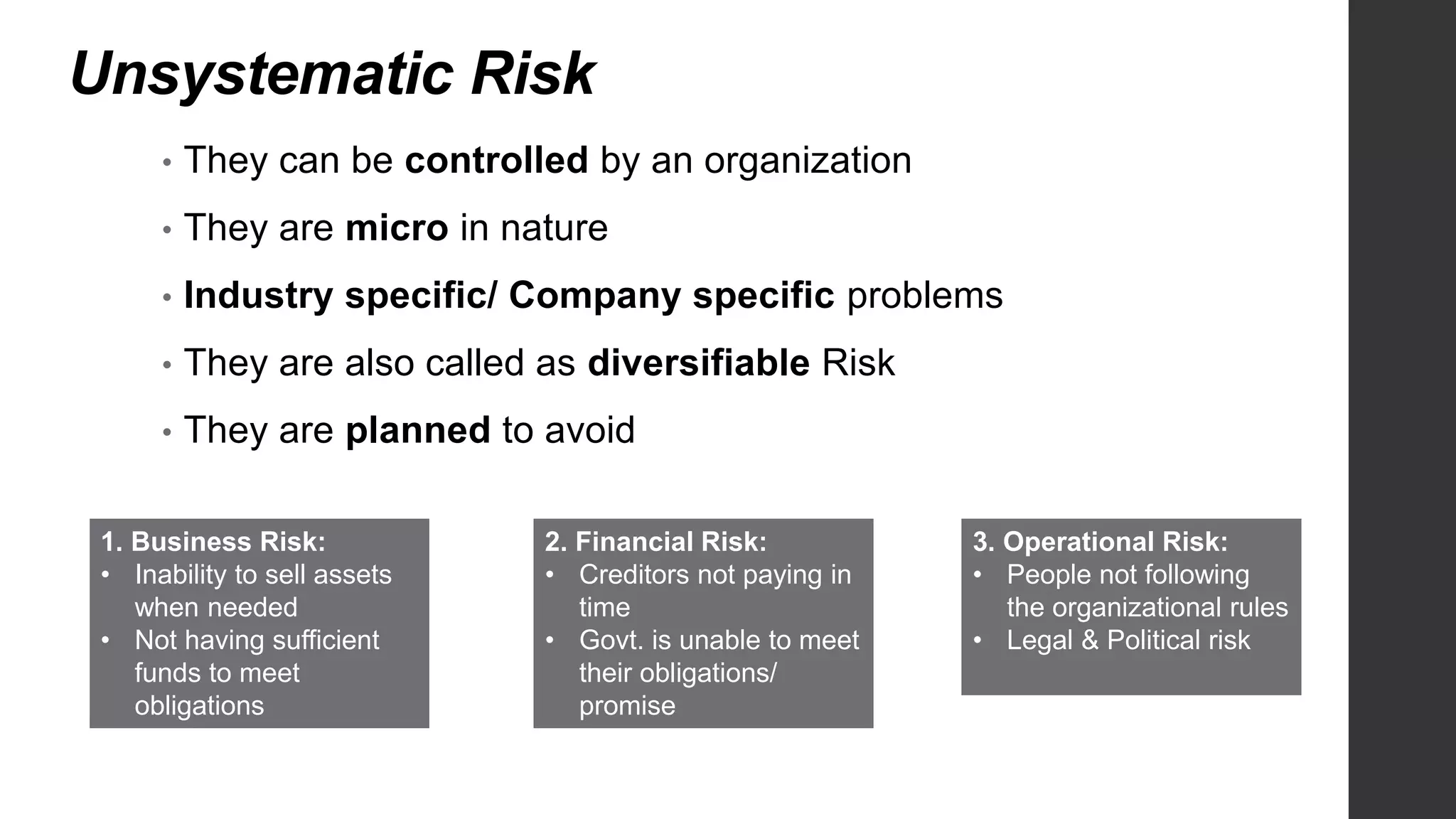
Unsystematic Risk
• They can be controlled by an organization
• They are micro in nature
• Industry specific/ Company specific problems
• They are also called as diversifiable Risk
• They are planned to avoid
1. Business Risk:
• Inability to sell assets
when needed
• Not having sufficient
funds to meet
obligations
2. Financial Risk:
• Creditors not paying in
time
• Govt. is unable to meet
their obligations/
promise
3. Operational Risk:
• People not following
the organizational rules
• Legal & Political risk
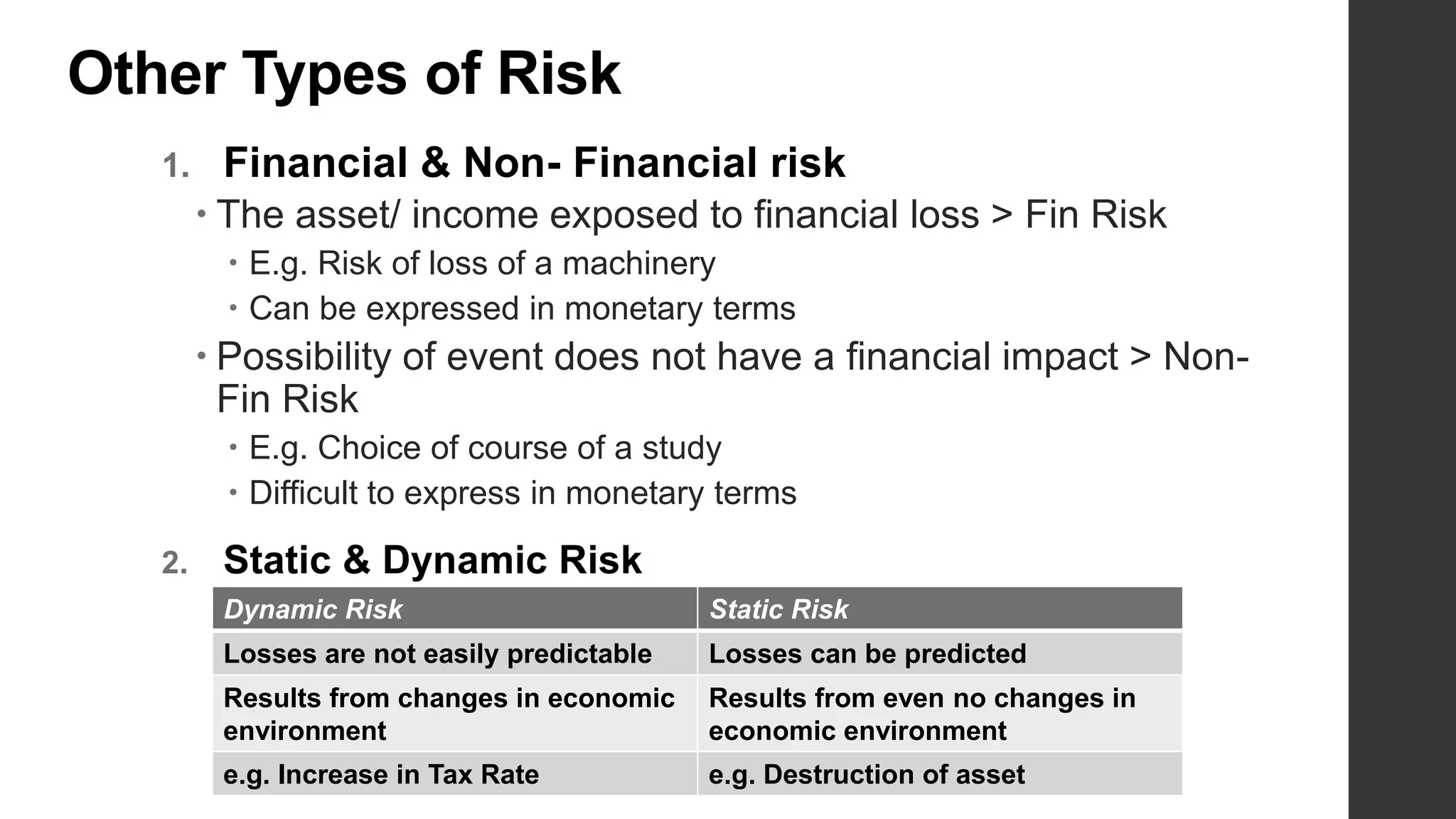
Other Types of Risk
1. Financial & Non- Financial risk
 The asset/ income exposed to financial loss > Fin Risk
 E.g. Risk of loss of a machinery
 Can be expressed in monetary terms
 Possibility of event does not have a financial impact > Non-
Fin Risk
 E.g. Choice of course of a study
 Difficult to express in monetary terms
2. Static & Dynamic Risk
Dynamic Risk Static Risk
Losses are not easily predictable Losses can be predicted
Results from changes in economic
environment
Results from even no changes in
economic environment
e.g. Increase in Tax Rate e.g. Destruction of asset
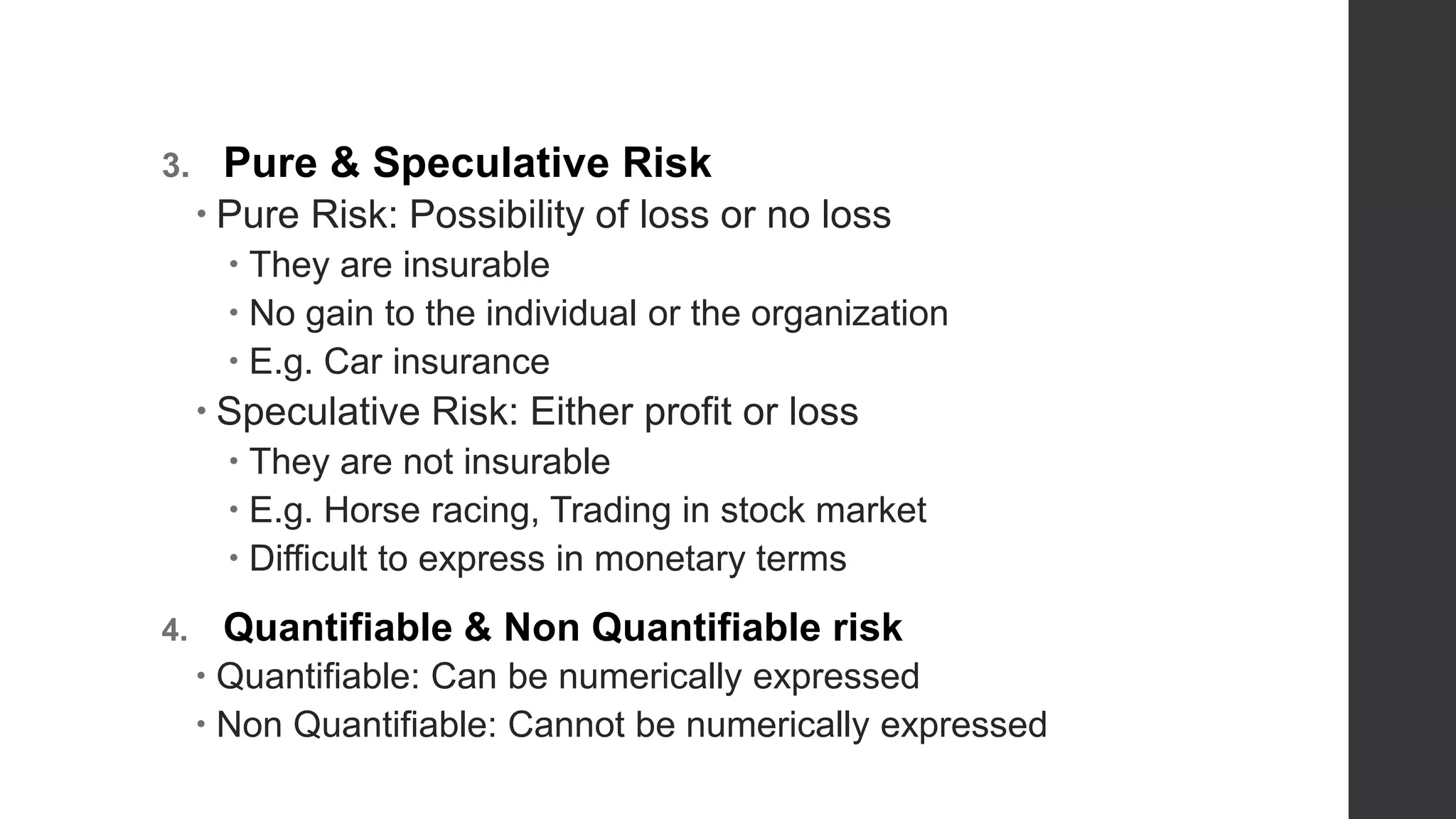
3. Pure & Speculative Risk
 Pure Risk: Possibility of loss or no loss
 They are insurable
 No gain to the individual or the organization
 E.g. Car insurance
 Speculative Risk: Either profit or loss
 They are not insurable
 E.g. Horse racing, Trading in stock market
 Difficult to express in monetary terms
4. Quantifiable & Non Quantifiable risk
 Quantifiable: Can be numerically expressed
 Non Quantifiable: Cannot be numerically expressed
Objectives/ Importance of Risk Management
• 1. To identify Risk: either before occurring or at the initial
stage only. Some categories of risk that can easily be
identified are financial, reputational, operational, strategic,
safety, etc.
• 2. To reduce scams and scandals: If any organization
performs risk management effectively then they can identify
the possible scandals and then they can find solutions
accordingly. Scams and scandals hamper the growth of any
organization.
• 3. To ensures the safety of any important information that
can be leaked: Data security is the most important thing for
an organization. Risk management helps in protecting the
data and prevents financial risks as well.
• 4. To identify opportunities: Strategic planning of risk
management might bring in great opportunities. These
opportunities always help in the growth of any business.
• 5. Eliminates Hindrances: Risk management helps to
work towards the projects that need major attention. It
not only helps in solving troubles but it also eliminates
the hindrances coming in the way.
• 6. Long Run Objectivity: Risk management helps in
securing an organization’s future and helps them in the
long run.
Objectives/ Importance of Risk Management
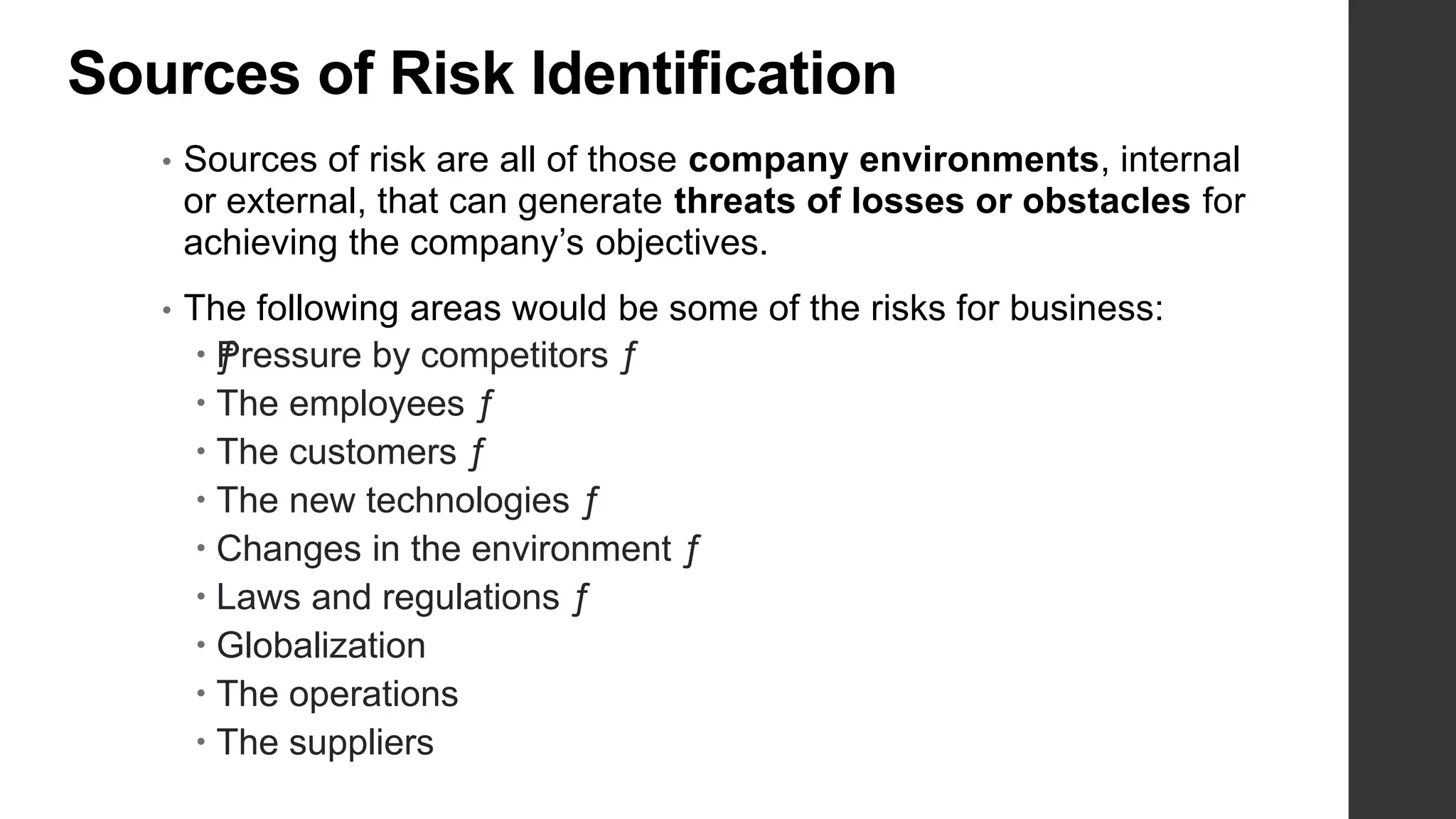
Sources of Risk Identification
• Sources of risk are all of those company environments, internal
or external, that can generate threats of losses or obstacles for
achieving the company’s objectives.
• The following areas would be some of the risks for business:
 ƒPressure by competitors ƒ
 The employees ƒ
 The customers ƒ
 The new technologies ƒ
 Changes in the environment ƒ
 Laws and regulations ƒ
 Globalization
 The operations
 The suppliers
Methods to Identify Risks
Methods of Risk identification
• Analysis of Processes:
 Used to measure operational risk
 E.g. Working of a machinery, Occupational hazard calculation
• Questionnaire:
 Can be administered to the employees to identify risk
 E.g. Operating environment issues, Work- life balance etc.
• Brainstorming:
 Group of employees & managers sit together to find out risks
 E.g. Market risk, Purchasing power risk identification
• Interviews:
 With various levels of management
• Benchmarking:
 Comparing our organization with others
 E.g. Samsung’s risk calculation comparing that to Apple’s
Risk Management
“Risk Management is an integrated process of:
 delineating specific areas or risk,
 Developing a comprehensive plan,
 integrating the plan and
 continuing ongoing evaluation”
• Risk management is positive>>> (Importance of RM)
 Creates a safe and secure work environment for all staff and
customers.
 Increases the stability of business operations
 Provides protection from events that are harmful to both the company
and the environment.
 Protects all involved people and assets from potential harm.
 Helps establish the organization's insurance needs in order to save on
unnecessary premiums.
RISK IDENTIFICATION
CREATING PLAN
IMPLEMENTING
FOLLOW UP
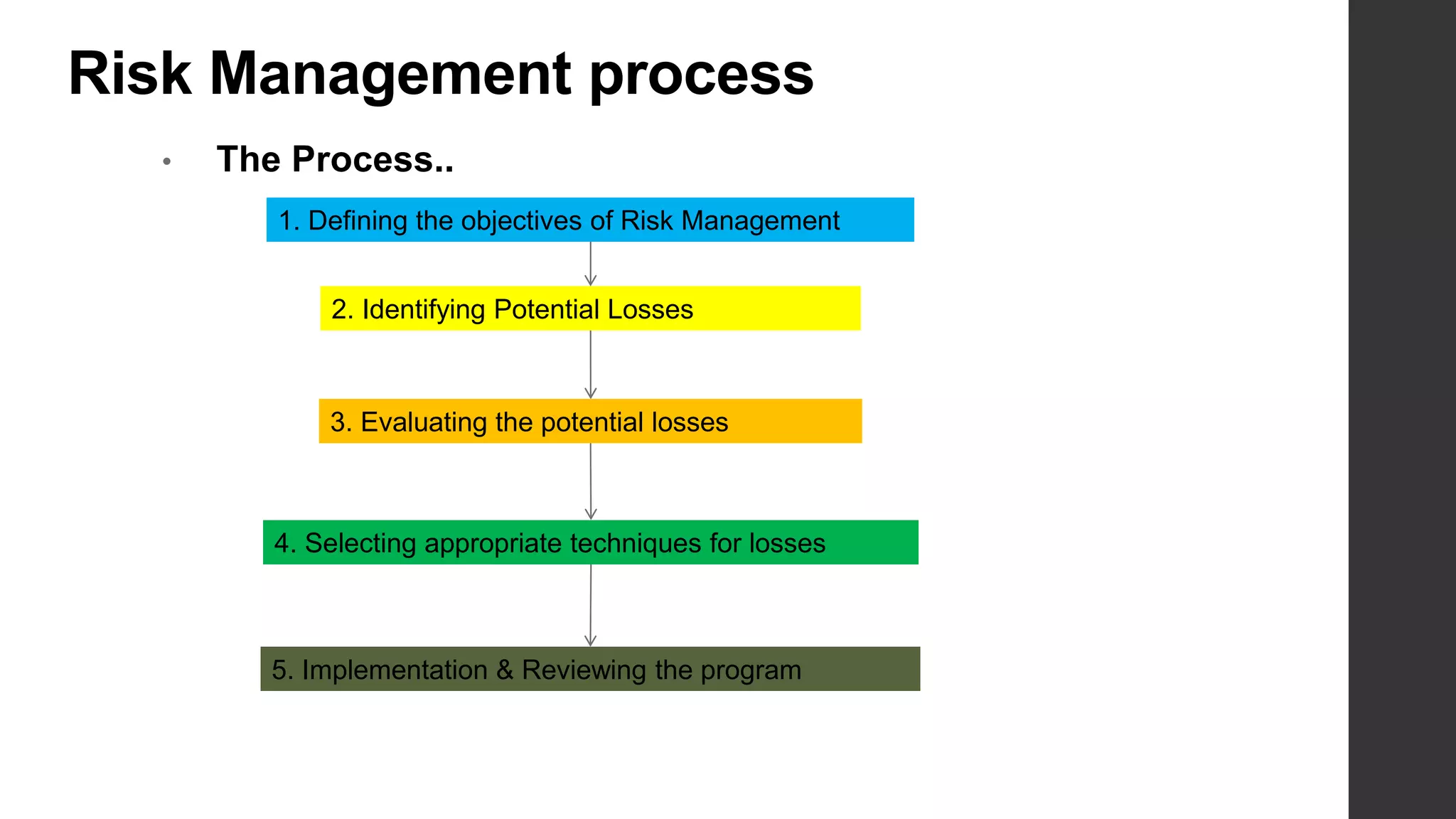
Risk Management process
• The Process..
1. Defining the objectives of Risk Management
2. Identifying Potential Losses
3. Evaluating the potential losses
5. Implementation & Reviewing the program
4. Selecting appropriate techniques for losses
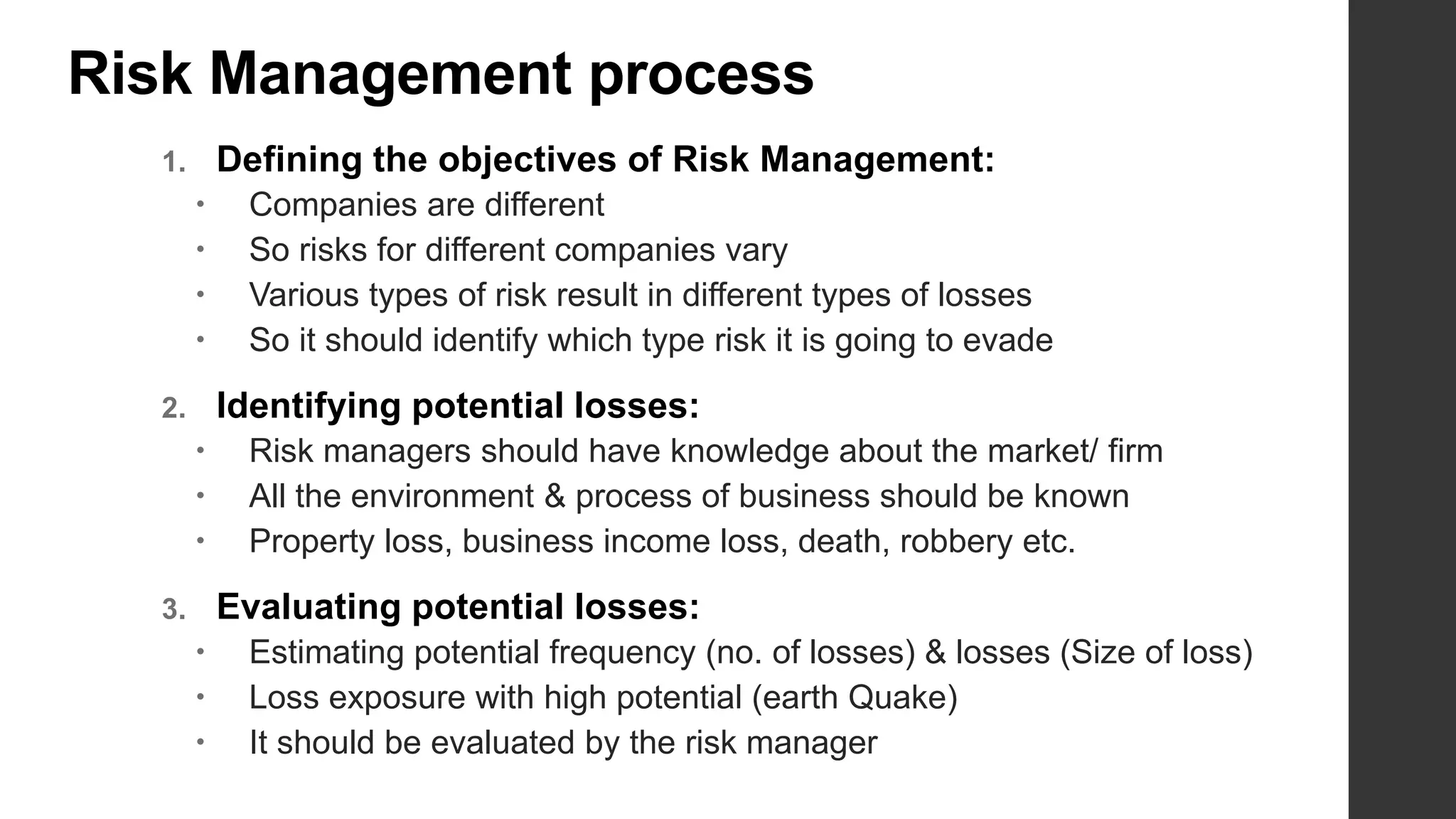
Risk Management process
1. Defining the objectives of Risk Management:
 Companies are different
 So risks for different companies vary
 Various types of risk result in different types of losses
 So it should identify which type risk it is going to evade
2. Identifying potential losses:
 Risk managers should have knowledge about the market/ firm
 All the environment & process of business should be known
 Property loss, business income loss, death, robbery etc.
3. Evaluating potential losses:
 Estimating potential frequency (no. of losses) & losses (Size of loss)
 Loss exposure with high potential (earth Quake)
 It should be evaluated by the risk manager
Risk Management process
4. Selecting Appropriate techniques for losses
 Risk Control: No monetary compensation is involved
1. Avoidance: e.g. constructing a fire proof building
2. Loss prevention: Reducing the probability of loss
3. Loss Reduction: e.g. Keeping first aid box
 Risk Financing: The implemented techniques need to be
financed
1. Risk Retention: Retains part/ full loss (e.g. Medical
expenses)
2. Non- Insurance transfer: Transferring risk to parties other
than insurers (e.g. Periodic medical check-up for workers)
3. Commercial Insurance: For mitigating corporate risks
Risk Management process
5. Implementing & Reviewing the program
 To have a policy statement on RM
 Outlines the objectives of RM & company policy for its
treatment
 It also has the procedure to follow in emergency
 Must be periodically audited to check its alignment
with objectives
ASSIGNMENT 01 - SUBMIT BY: 6.12.19
• “OVERVIEW OF TOOLS FOR RISK MANAGEMENT”
• Instructions
 Identify the tools for risk management
 Derivative Contract
 Insurance Contract
 SWOT Analysis
 Prepare a table like:
Basis Derivative
Contract
Insurance
Contract
SWOT Analysis
Meaning
Types
Risk which can be evaded
Regulating Authority
Features (At least 4)
THANK YOU

Introduction to risk management

  • 1.
    Introduction to Risk Management CO1: Tounderstand the types of risk and importance of risk management
  • 2.
    You will learnthese  Introduction to Risk – Meaning of Risk and Uncertainty  Types of Risk- Sources of risk identification and Risk Measurement.  Objectives of risk management  Risk Management Process  Importance of risk management in business organization  Overview of tools for risk management
  • 3.
    The Concept ofRisk • “Risk is a condition in which there is a possibility of an adverse deviation from a desired outcome that is expected or hoped for”. • According to Frank Knight, “Risk is measurable uncertainty”. • Two elements of a Risky situation: 1. Outcome is uncertain. At least 2 possible outcomes are there. 2. Out of the possible outcomes, one is unfavorable or not liked by the individual e.g. Insuring a car against accident damages
  • 4.
    Risk VS Uncertainty E.g.Assume two famous teams consist of renowned players, and they are going to play a football match the next day. Can you tell me exactly which team is going to win?
  • 5.
    No, you can’t;however, you can make an educated guess by reviewing and analyzing the past performances of each player, the team, and the results of matches they played against each other. Then you can come up with some numbers, like there is a 30% chance of Team A or Team B winning, or there is a 70% possibility of Team A or Team B losing the match. = RISK Let us say again that two teams are going to play a game, and no players are selected for either team. In this situation, if somebody asked you which team is going to win, what would your response be? You will be clueless because you don’t know which team consists of which players, and you have no idea how the teams will perform. No idea about any information on past performance, and cannot predict the outcome of the event, even though the rules and the stadium are the same. = UNCERTAINITY
  • 6.
    Risk VS Uncertainty •In risk we can predict the possibility of a future outcome, while in uncertainty we cannot. • Risks can be managed while uncertainty is uncontrollable. • Risks can be measured and quantified while uncertainty cannot. • We can assign a probability to risks events, while with uncertainty, you can’t.
  • 7.
    Classifications of RiskI Types of Risk Systematic Risk Interest Rate Risk Market Risk Inflationary Risk Unsystematic Risk Business Risk Financial Risk Operational Risk
  • 8.
    Systematic Risk • Theyare uncontrollable by an organization • They are macro in nature • Macro economic problems in an economy of a country • They are also called as undiversifiable Risk • They are unpredictable and not easy to avoid 1. Interest Rate Risk: • Due to variability in interest Rates • Debt & Loans get affected 2. Market Risk: • Arises as a part of adverse market conditions • It includes absolute & volatility risk 3. Purchasing Power Risk: • Demand inflation risk • Cost Inflation risk
  • 9.
    Unsystematic Risk • Theycan be controlled by an organization • They are micro in nature • Industry specific/ Company specific problems • They are also called as diversifiable Risk • They are planned to avoid 1. Business Risk: • Inability to sell assets when needed • Not having sufficient funds to meet obligations 2. Financial Risk: • Creditors not paying in time • Govt. is unable to meet their obligations/ promise 3. Operational Risk: • People not following the organizational rules • Legal & Political risk
  • 10.
    Other Types ofRisk 1. Financial & Non- Financial risk  The asset/ income exposed to financial loss > Fin Risk  E.g. Risk of loss of a machinery  Can be expressed in monetary terms  Possibility of event does not have a financial impact > Non- Fin Risk  E.g. Choice of course of a study  Difficult to express in monetary terms 2. Static & Dynamic Risk Dynamic Risk Static Risk Losses are not easily predictable Losses can be predicted Results from changes in economic environment Results from even no changes in economic environment e.g. Increase in Tax Rate e.g. Destruction of asset
  • 11.
    3. Pure &Speculative Risk  Pure Risk: Possibility of loss or no loss  They are insurable  No gain to the individual or the organization  E.g. Car insurance  Speculative Risk: Either profit or loss  They are not insurable  E.g. Horse racing, Trading in stock market  Difficult to express in monetary terms 4. Quantifiable & Non Quantifiable risk  Quantifiable: Can be numerically expressed  Non Quantifiable: Cannot be numerically expressed
  • 12.
    Objectives/ Importance ofRisk Management • 1. To identify Risk: either before occurring or at the initial stage only. Some categories of risk that can easily be identified are financial, reputational, operational, strategic, safety, etc. • 2. To reduce scams and scandals: If any organization performs risk management effectively then they can identify the possible scandals and then they can find solutions accordingly. Scams and scandals hamper the growth of any organization. • 3. To ensures the safety of any important information that can be leaked: Data security is the most important thing for an organization. Risk management helps in protecting the data and prevents financial risks as well.
  • 13.
    • 4. Toidentify opportunities: Strategic planning of risk management might bring in great opportunities. These opportunities always help in the growth of any business. • 5. Eliminates Hindrances: Risk management helps to work towards the projects that need major attention. It not only helps in solving troubles but it also eliminates the hindrances coming in the way. • 6. Long Run Objectivity: Risk management helps in securing an organization’s future and helps them in the long run. Objectives/ Importance of Risk Management
  • 14.
    Sources of RiskIdentification • Sources of risk are all of those company environments, internal or external, that can generate threats of losses or obstacles for achieving the company’s objectives. • The following areas would be some of the risks for business:  ƒPressure by competitors ƒ  The employees ƒ  The customers ƒ  The new technologies ƒ  Changes in the environment ƒ  Laws and regulations ƒ  Globalization  The operations  The suppliers
  • 15.
  • 16.
    Methods of Riskidentification • Analysis of Processes:  Used to measure operational risk  E.g. Working of a machinery, Occupational hazard calculation • Questionnaire:  Can be administered to the employees to identify risk  E.g. Operating environment issues, Work- life balance etc. • Brainstorming:  Group of employees & managers sit together to find out risks  E.g. Market risk, Purchasing power risk identification • Interviews:  With various levels of management • Benchmarking:  Comparing our organization with others  E.g. Samsung’s risk calculation comparing that to Apple’s
  • 17.
    Risk Management “Risk Managementis an integrated process of:  delineating specific areas or risk,  Developing a comprehensive plan,  integrating the plan and  continuing ongoing evaluation” • Risk management is positive>>> (Importance of RM)  Creates a safe and secure work environment for all staff and customers.  Increases the stability of business operations  Provides protection from events that are harmful to both the company and the environment.  Protects all involved people and assets from potential harm.  Helps establish the organization's insurance needs in order to save on unnecessary premiums. RISK IDENTIFICATION CREATING PLAN IMPLEMENTING FOLLOW UP
  • 18.
    Risk Management process •The Process.. 1. Defining the objectives of Risk Management 2. Identifying Potential Losses 3. Evaluating the potential losses 5. Implementation & Reviewing the program 4. Selecting appropriate techniques for losses
  • 19.
    Risk Management process 1.Defining the objectives of Risk Management:  Companies are different  So risks for different companies vary  Various types of risk result in different types of losses  So it should identify which type risk it is going to evade 2. Identifying potential losses:  Risk managers should have knowledge about the market/ firm  All the environment & process of business should be known  Property loss, business income loss, death, robbery etc. 3. Evaluating potential losses:  Estimating potential frequency (no. of losses) & losses (Size of loss)  Loss exposure with high potential (earth Quake)  It should be evaluated by the risk manager
  • 20.
    Risk Management process 4.Selecting Appropriate techniques for losses  Risk Control: No monetary compensation is involved 1. Avoidance: e.g. constructing a fire proof building 2. Loss prevention: Reducing the probability of loss 3. Loss Reduction: e.g. Keeping first aid box  Risk Financing: The implemented techniques need to be financed 1. Risk Retention: Retains part/ full loss (e.g. Medical expenses) 2. Non- Insurance transfer: Transferring risk to parties other than insurers (e.g. Periodic medical check-up for workers) 3. Commercial Insurance: For mitigating corporate risks
  • 21.
    Risk Management process 5.Implementing & Reviewing the program  To have a policy statement on RM  Outlines the objectives of RM & company policy for its treatment  It also has the procedure to follow in emergency  Must be periodically audited to check its alignment with objectives
  • 22.
    ASSIGNMENT 01 -SUBMIT BY: 6.12.19 • “OVERVIEW OF TOOLS FOR RISK MANAGEMENT” • Instructions  Identify the tools for risk management  Derivative Contract  Insurance Contract  SWOT Analysis  Prepare a table like: Basis Derivative Contract Insurance Contract SWOT Analysis Meaning Types Risk which can be evaded Regulating Authority Features (At least 4)
  • 23.