Validity
&
Reliability
Md. Musfiq-Al-Mahadi
B.Sc.Ag(Hons.)
Ms in Agext
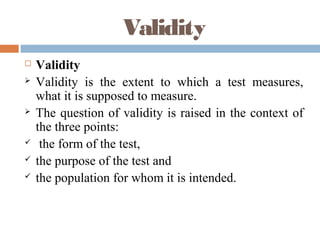
Validity
 Validity
 Validity is the extent to which a test measures,
what it is supposed to measure.
 The question of validity is raised in the context of
the three points:
 the form of the test,
 the purpose of the test and
 the population for whom it is intended.
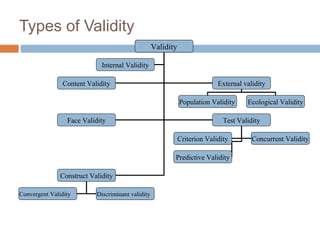
Types of Validity
Validity
Content Validity External validity
Face Validity Test Validity
Construct Validity
Internal Validity
Population Validity Ecological Validity
Criterion Validity Concurrent Validity
Convergent Validity Discriminant validity
Predictive Validity
Types of Validity
1. External Validity:
 External validity occurs when the causal relationship discovered can be generalized
to other people, time and contexts.
 Correct sampling will allow generalization and hence give external validity.
2. Internal validity:
 Internal validity occurs when it can be concluded that there is a causal relationship
between the variables being studied.
 It is related to the design of the experiment.
3. Content Validity:
 When we want to find out if the entire content of the behavior/construct/area is
represented in the test we compare the test task with the content of the behavior.
 This is a logical method, not an empirical one.
 Example, if we want to test knowledge on American Geography it is not fair to
have most questions limited to the geography of New England.
Types of Validity
4. Face Validity:
 Face validity occurs where something appears to be valid.
 This depends very much on the judgment of the observer.
5. Test Validity:
a) Criterion: Correlation with the standards.
b) Predictive: Predicts future values of criterion.
c) Concurrent: Correlates with other test.
6. Construct Validity:
Construct validity accurately represent reality.
a) convergent: Simultaneous measure of same construct correlate.
b) Discriminant: Doesn’t measure what it shouldn’t.
Reliability
Reliability
 Reliability is the degree to which a test consistently measures
whatever it measures.
 When a measurement procedure yields consistent scores when
the phenomenon being measured is not changing
 Degree to which scores are free of “Measurement Error
 Consistency of the measurement
Types of reliability
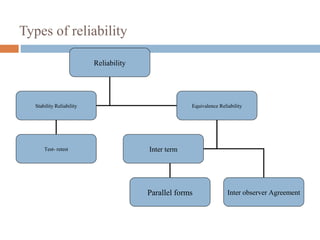
Reliability
Stability Reliability Equivalence Reliability
Test- retest Inter term
Parallel forms Inter observer Agreement
Types of Reliability
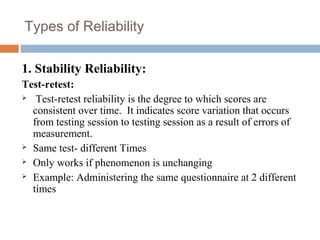
1. Stability Reliability:
Test-retest:
 Test-retest reliability is the degree to which scores are
consistent over time. It indicates score variation that occurs
from testing session to testing session as a result of errors of
measurement.
 Same test- different Times
 Only works if phenomenon is unchanging
 Example: Administering the same questionnaire at 2 different
times
Types of reliability
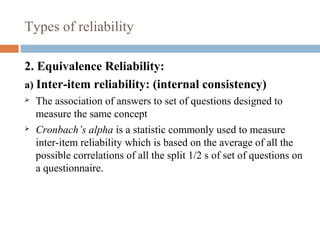
2. Equivalence Reliability:
a) Inter-item reliability: (internal consistency)
 The association of answers to set of questions designed to
measure the same concept
 Cronbach’s alpha is a statistic commonly used to measure
inter-item reliability which is based on the average of all the
possible correlations of all the split 1/2 s of set of questions on
a questionnaire.
Types of Reliability
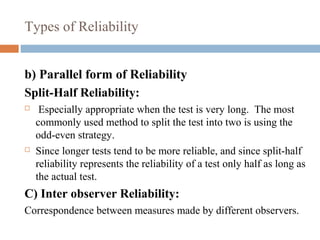
b) Parallel form of Reliability
Split-Half Reliability:
 Especially appropriate when the test is very long. The most
commonly used method to split the test into two is using the
odd-even strategy.
 Since longer tests tend to be more reliable, and since split-half
reliability represents the reliability of a test only half as long as
the actual test.
C) Inter observer Reliability:
Correspondence between measures made by different observers.
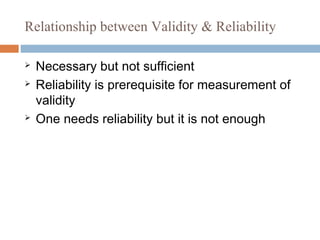
Relationship between Validity & Reliability
 Necessary but not sufficient
 Reliability is prerequisite for measurement of
validity
 One needs reliability but it is not enough
Thank You
Very Much

Validity and Reliability

  • 1.
  • 2.
    Validity  Validity  Validityis the extent to which a test measures, what it is supposed to measure.  The question of validity is raised in the context of the three points:  the form of the test,  the purpose of the test and  the population for whom it is intended.
  • 3.
    Types of Validity Validity ContentValidity External validity Face Validity Test Validity Construct Validity Internal Validity Population Validity Ecological Validity Criterion Validity Concurrent Validity Convergent Validity Discriminant validity Predictive Validity
  • 4.
    Types of Validity 1.External Validity:  External validity occurs when the causal relationship discovered can be generalized to other people, time and contexts.  Correct sampling will allow generalization and hence give external validity. 2. Internal validity:  Internal validity occurs when it can be concluded that there is a causal relationship between the variables being studied.  It is related to the design of the experiment. 3. Content Validity:  When we want to find out if the entire content of the behavior/construct/area is represented in the test we compare the test task with the content of the behavior.  This is a logical method, not an empirical one.  Example, if we want to test knowledge on American Geography it is not fair to have most questions limited to the geography of New England.
  • 5.
    Types of Validity 4.Face Validity:  Face validity occurs where something appears to be valid.  This depends very much on the judgment of the observer. 5. Test Validity: a) Criterion: Correlation with the standards. b) Predictive: Predicts future values of criterion. c) Concurrent: Correlates with other test. 6. Construct Validity: Construct validity accurately represent reality. a) convergent: Simultaneous measure of same construct correlate. b) Discriminant: Doesn’t measure what it shouldn’t.
  • 6.
    Reliability Reliability  Reliability isthe degree to which a test consistently measures whatever it measures.  When a measurement procedure yields consistent scores when the phenomenon being measured is not changing  Degree to which scores are free of “Measurement Error  Consistency of the measurement
  • 7.
    Types of reliability Reliability StabilityReliability Equivalence Reliability Test- retest Inter term Parallel forms Inter observer Agreement
  • 8.
    Types of Reliability 1.Stability Reliability: Test-retest:  Test-retest reliability is the degree to which scores are consistent over time. It indicates score variation that occurs from testing session to testing session as a result of errors of measurement.  Same test- different Times  Only works if phenomenon is unchanging  Example: Administering the same questionnaire at 2 different times
  • 9.
    Types of reliability 2.Equivalence Reliability: a) Inter-item reliability: (internal consistency)  The association of answers to set of questions designed to measure the same concept  Cronbach’s alpha is a statistic commonly used to measure inter-item reliability which is based on the average of all the possible correlations of all the split 1/2 s of set of questions on a questionnaire.
  • 10.
    Types of Reliability b)Parallel form of Reliability Split-Half Reliability:  Especially appropriate when the test is very long. The most commonly used method to split the test into two is using the odd-even strategy.  Since longer tests tend to be more reliable, and since split-half reliability represents the reliability of a test only half as long as the actual test. C) Inter observer Reliability: Correspondence between measures made by different observers.
  • 11.
    Relationship between Validity& Reliability  Necessary but not sufficient  Reliability is prerequisite for measurement of validity  One needs reliability but it is not enough
  • 12.