By-
Akshay Madan 40490201818
Gautam Guglani 40590201818
Akshay Chaudhary
40690201818
Pushkar Kansal 40790201818
Harshit Nassa 40890201818
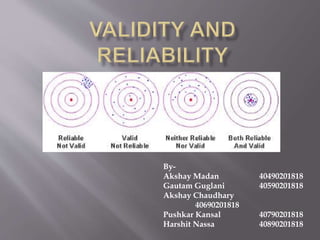
 Validity is a extent to which a test measures, what it is
supposed to measure.
 The questions of validity is raised in the context of
three points:
1. The form of the test
2. The purpose of the test
3. The population for whom it is intended
 External Validity:
1. External validity occurs when the casual relationship discovered can be
generalized to other people, time and contacts.
2. Correct sampling will allow generalized and hence give external validity.
 Internal Validity:
1. Internal validity occurs when it can be concluded that there is a casual
relationship between the variables being studied.
2. It is related to the design of the experiment.
 Content Validity:
1. When we want to find out if the entire content of the
behaviour/contruct/area is represented in the test we compare the test
task with the content of the behaviour.
2. This is a logical method, not an empirical one.
3. Example, if we to test knowledge of American Geography it is not fair to
have most questions linited to geography of New England.
 Face Validity:
1. Face validity occurs where something appears to be Valid.
2. This depends very much on the judgment of the observer.
 Test Validity:
1. Criterion: Correlation with the standards
2. Predictive: Predicts future value of criterion
3. Concurrent: Correlates with other test
 Construct Validity:
Construct validity accurately represents reality
1. Convergent: Simultaneous measure of same construct correlate
2. Discriminant: Dosen’t measure what it shouldn’t.
 Reliability is degree to which a test consistently
measures whatever it means.
 When a measurement procedure yields consistent
scores when the phenomenon being measured is not
changing.
 Degree to which scores are free of “Measuremnt Error”
 Consistency of the Measurement.
 Stability Reliability:
 Test-Retest:
1. Test-retest reliability is the degree to which scores are consistent over
time. It indicates score variation that occurs from testing sessions to testing
session of a result of errors of measurement.
2. Same test - different times.
3. Only works is phenomenon is unchanging.
4. Example: Administering the same questionnaire at 2 different times.
a) Equivalence Reliability:
 Inter-term Reliability: (internal consistency)
1. The association of answers to set of questions designed to measure the
same concept
2. Cronbach’s alpha is a statistic commonly used to measure inter-term
reliability which is based on the average of all the possible correlations of
all the split ½s of set of questions on the questionnaire
b. Parallel Form of Reliability:
Split-Half Reliability:
1. Especially appropriate when the test is very long. The most
commonly used method to split the test into two is using the odd-
even strategy.
2. Since longer tests tend to be more reliable, and since split-half
reliability represents the reliability of a test only half as long as the
actual test.
c. Inter Observer Reliability:
Correspondence between measures made by different observers.

Validity and reliability

  • 1.
    By- Akshay Madan 40490201818 GautamGuglani 40590201818 Akshay Chaudhary 40690201818 Pushkar Kansal 40790201818 Harshit Nassa 40890201818
  • 2.
     Validity isa extent to which a test measures, what it is supposed to measure.  The questions of validity is raised in the context of three points: 1. The form of the test 2. The purpose of the test 3. The population for whom it is intended
  • 4.
     External Validity: 1.External validity occurs when the casual relationship discovered can be generalized to other people, time and contacts. 2. Correct sampling will allow generalized and hence give external validity.  Internal Validity: 1. Internal validity occurs when it can be concluded that there is a casual relationship between the variables being studied. 2. It is related to the design of the experiment.  Content Validity: 1. When we want to find out if the entire content of the behaviour/contruct/area is represented in the test we compare the test task with the content of the behaviour. 2. This is a logical method, not an empirical one. 3. Example, if we to test knowledge of American Geography it is not fair to have most questions linited to geography of New England.
  • 5.
     Face Validity: 1.Face validity occurs where something appears to be Valid. 2. This depends very much on the judgment of the observer.  Test Validity: 1. Criterion: Correlation with the standards 2. Predictive: Predicts future value of criterion 3. Concurrent: Correlates with other test  Construct Validity: Construct validity accurately represents reality 1. Convergent: Simultaneous measure of same construct correlate 2. Discriminant: Dosen’t measure what it shouldn’t.
  • 6.
     Reliability isdegree to which a test consistently measures whatever it means.  When a measurement procedure yields consistent scores when the phenomenon being measured is not changing.  Degree to which scores are free of “Measuremnt Error”  Consistency of the Measurement.
  • 8.
     Stability Reliability: Test-Retest: 1. Test-retest reliability is the degree to which scores are consistent over time. It indicates score variation that occurs from testing sessions to testing session of a result of errors of measurement. 2. Same test - different times. 3. Only works is phenomenon is unchanging. 4. Example: Administering the same questionnaire at 2 different times.
  • 9.
    a) Equivalence Reliability: Inter-term Reliability: (internal consistency) 1. The association of answers to set of questions designed to measure the same concept 2. Cronbach’s alpha is a statistic commonly used to measure inter-term reliability which is based on the average of all the possible correlations of all the split ½s of set of questions on the questionnaire
  • 10.
    b. Parallel Formof Reliability: Split-Half Reliability: 1. Especially appropriate when the test is very long. The most commonly used method to split the test into two is using the odd- even strategy. 2. Since longer tests tend to be more reliable, and since split-half reliability represents the reliability of a test only half as long as the actual test. c. Inter Observer Reliability: Correspondence between measures made by different observers.