TRIAL AND ERROR LEARNIG THEORY
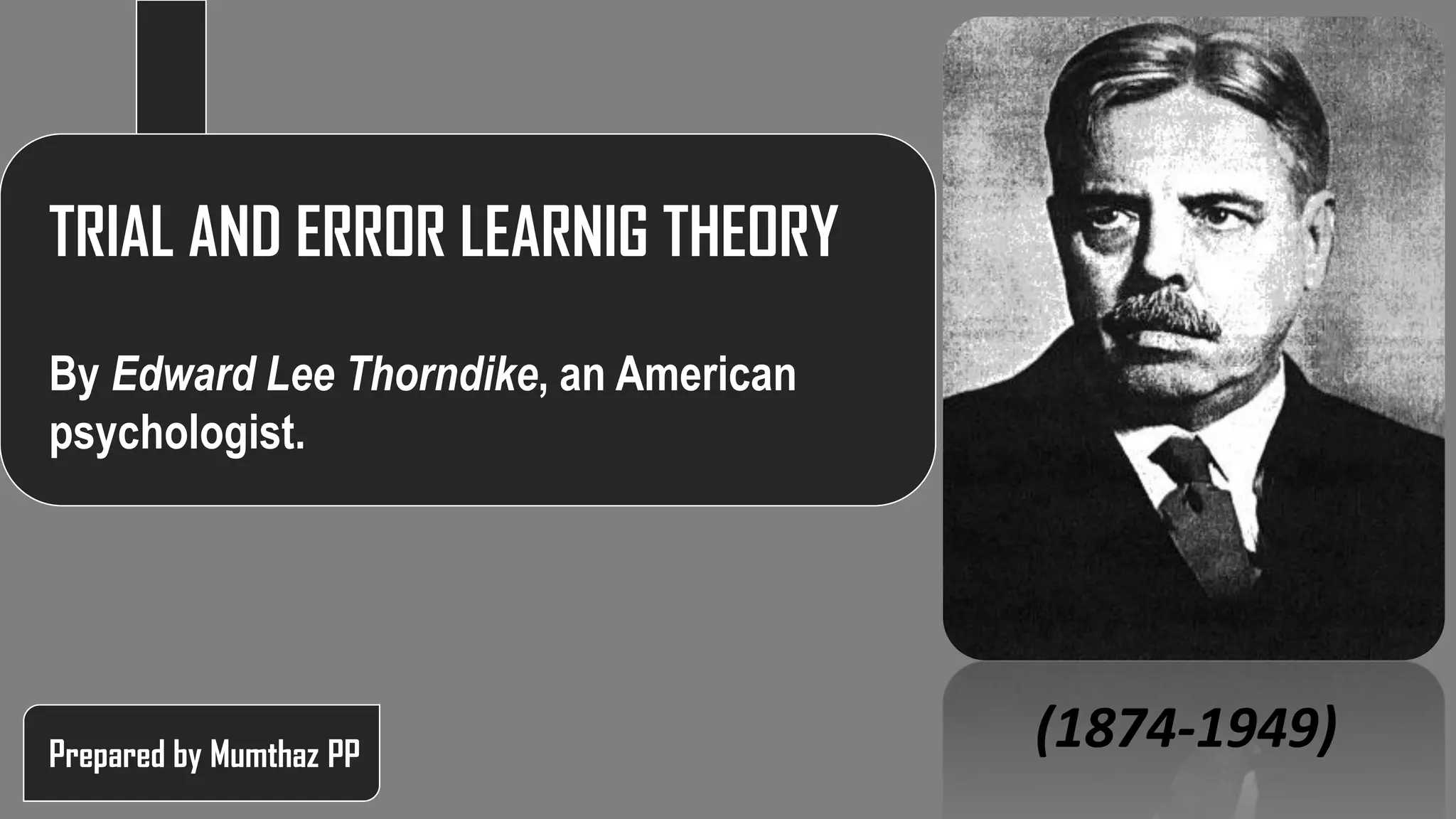
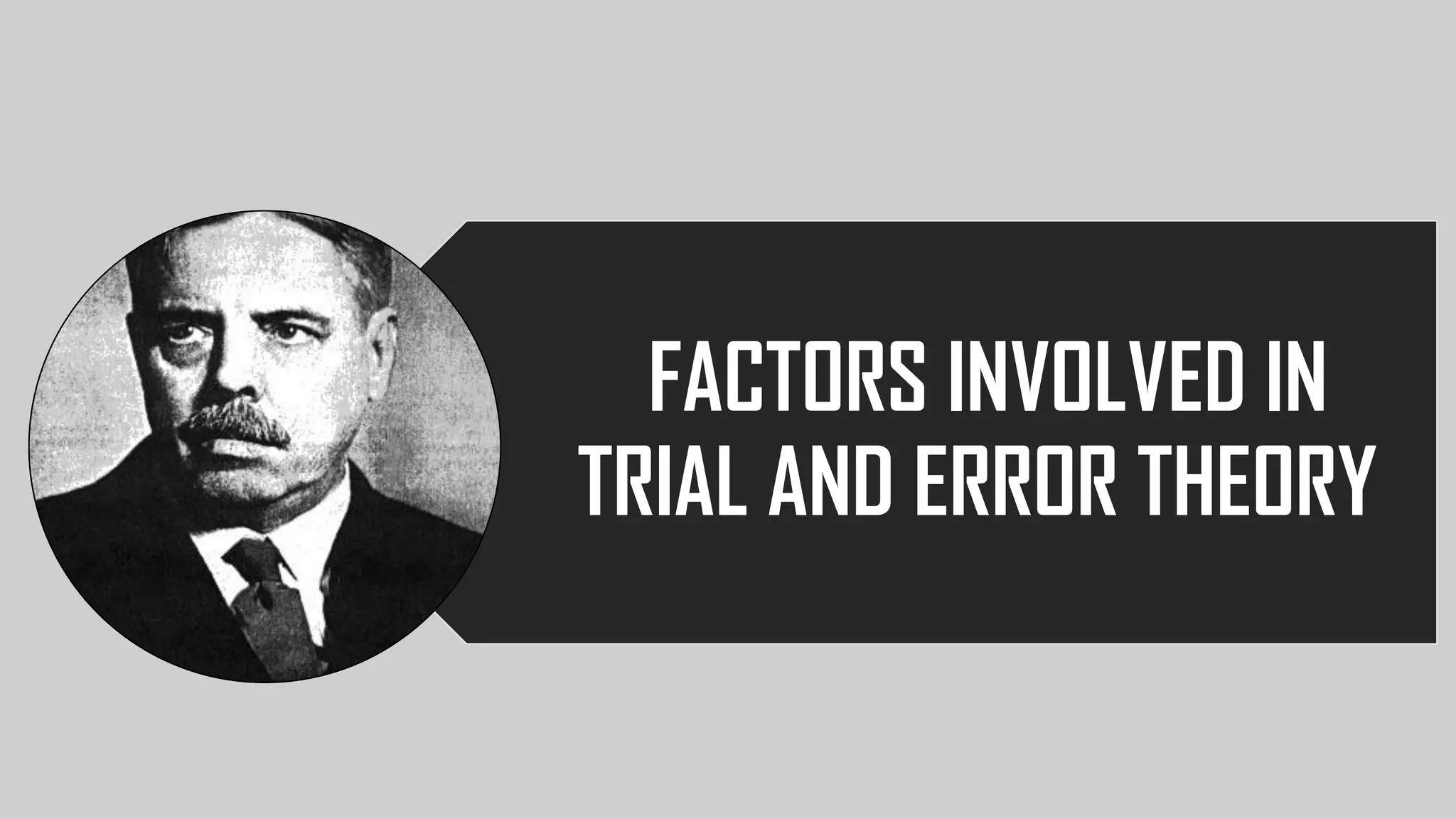
By Edward Lee Thorndike, an American
psychologist.
Prepared by Mumthaz PP
(1874-1949)
According to him learning takes place by trial and
error. In learning the learner selects a correct
response out of a large number of possible ones
and connects it with the appropriate stimulus.
Learning by this method is called trial and error
learning theory.
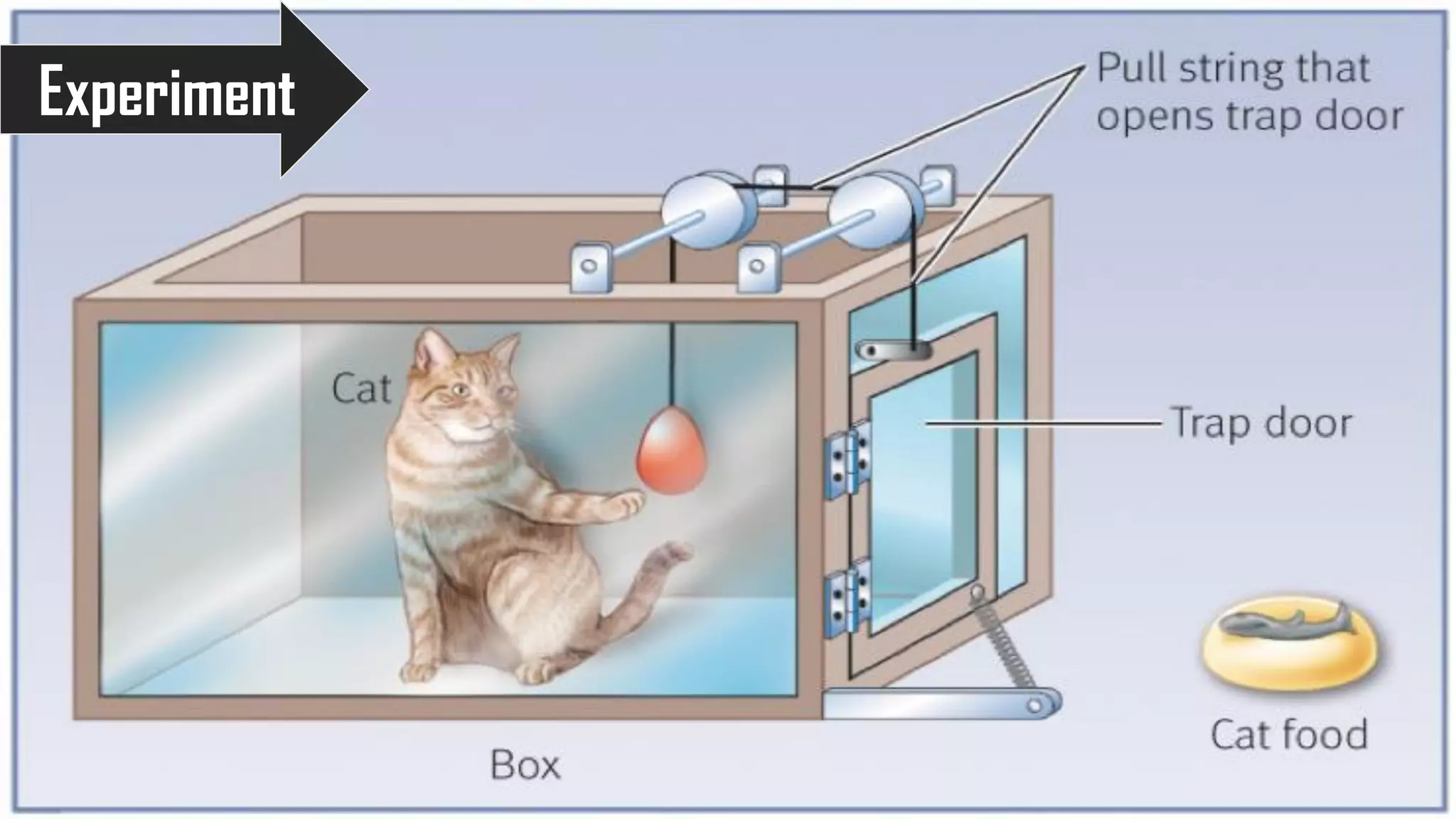
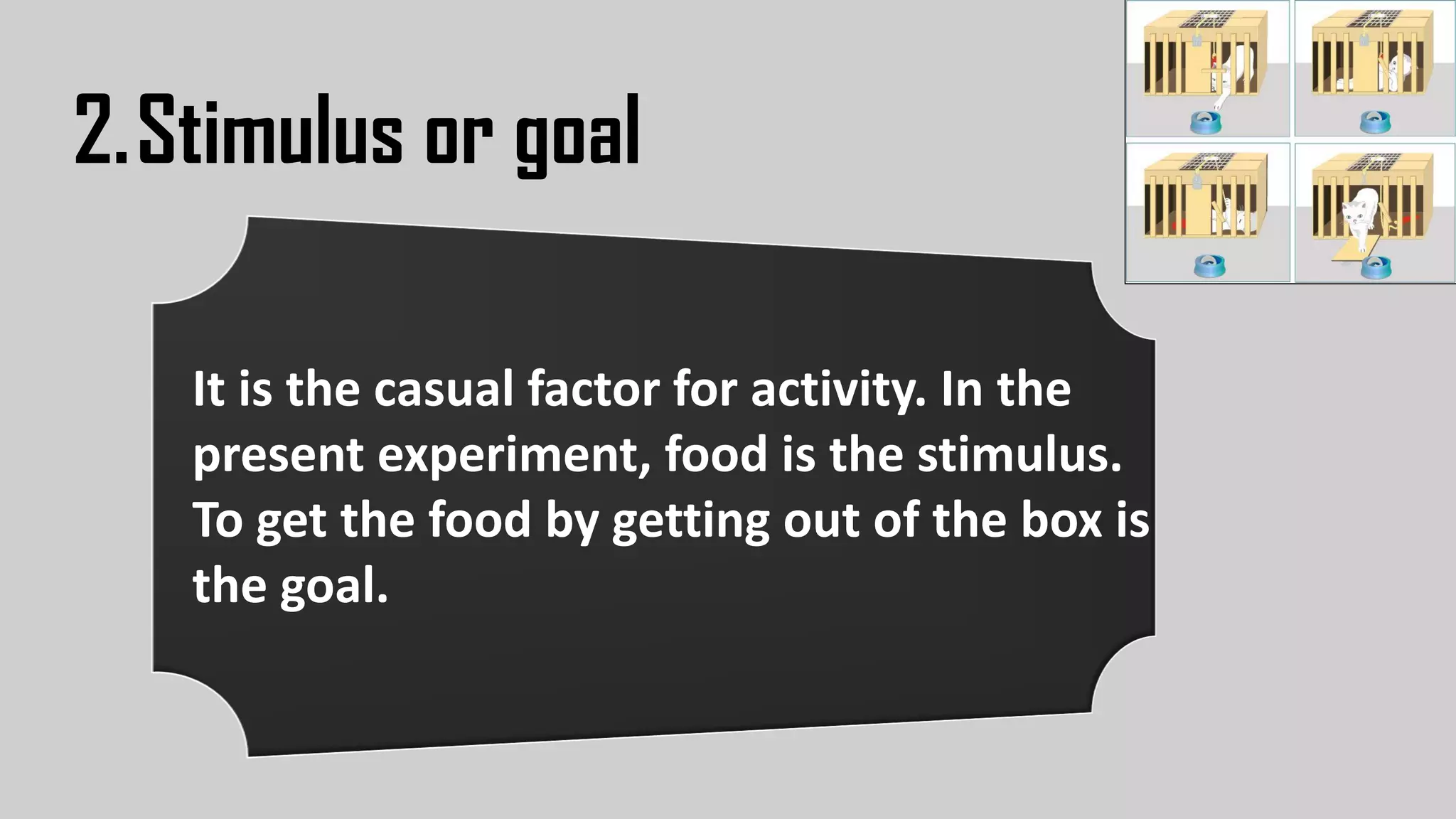
Thorndike formulated his theory, based on his
experiments conducted on his cat in the puzzle box.
The door of the box could be opened by pulling the
strings inside the box. A fish was kept outside. The cat
was tried to come out of the box by squeezing,
jumping, biting etc. As the experiment was repeated
for several times the wrong movements decreased and
in the end the cat was able to open the door in a single
trial.
Experiment
Experiment
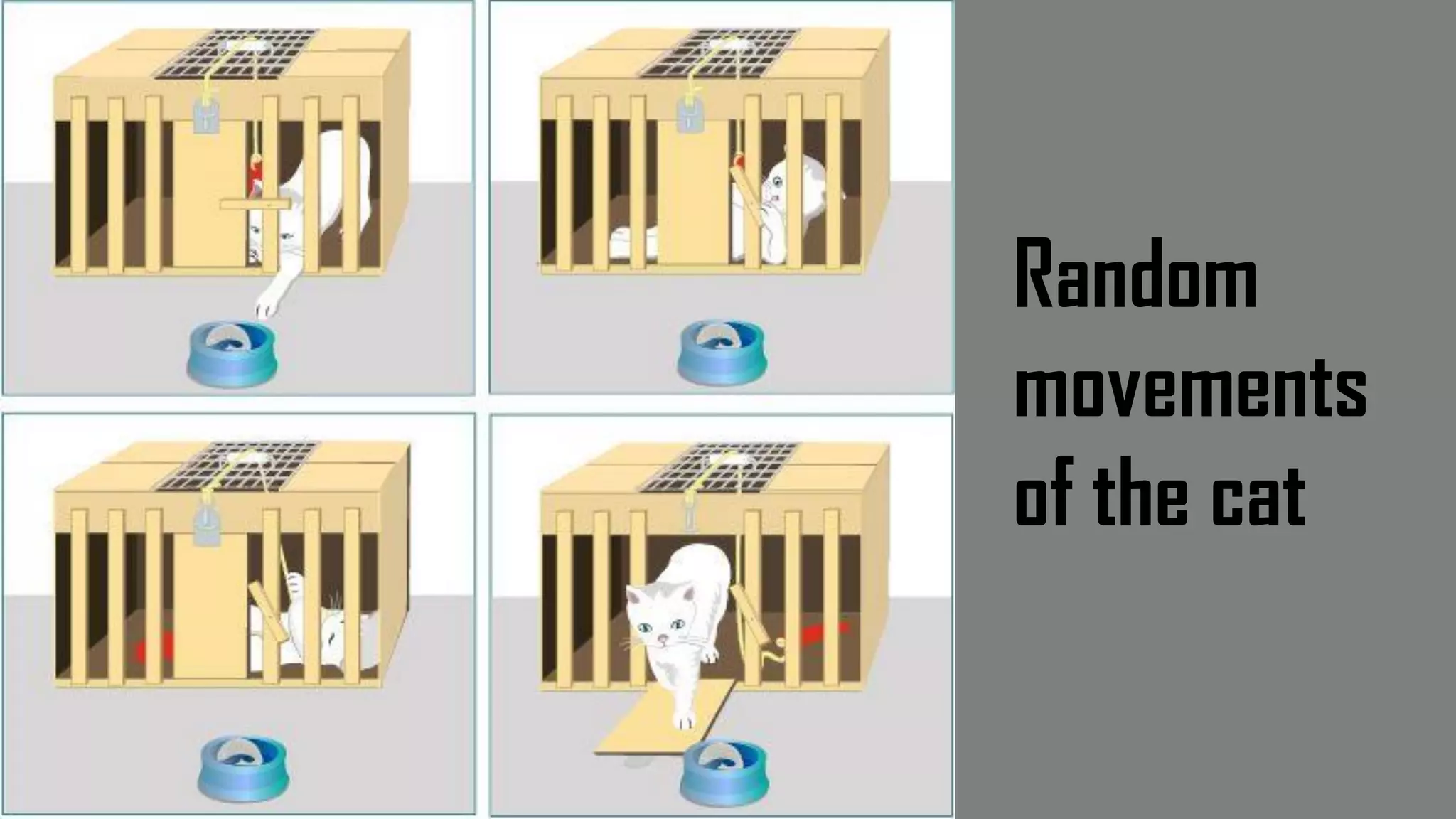
Random
movements
of the cat
FACTORS INVOLVED IN
TRIAL AND ERROR THEORY
1.Motive or drive
Drive is a tension state resulting from
needs. Where there is drive or motive
there is learning. In the present
experiment drive was hunger.
2.Stimulus or goal
It is the casual factor for activity. In the
present experiment, food is the stimulus.
To get the food by getting out of the box is
the goal.
3. Responses
The cat makes a number of varied types of
responses like scratching, pulling etc. The
responses which lead to the goal known as
satisfying responses. The responses which do
not lead to the goal is known as annoying
responses.
4. Block
The cat was confined in the box with
a closed door.
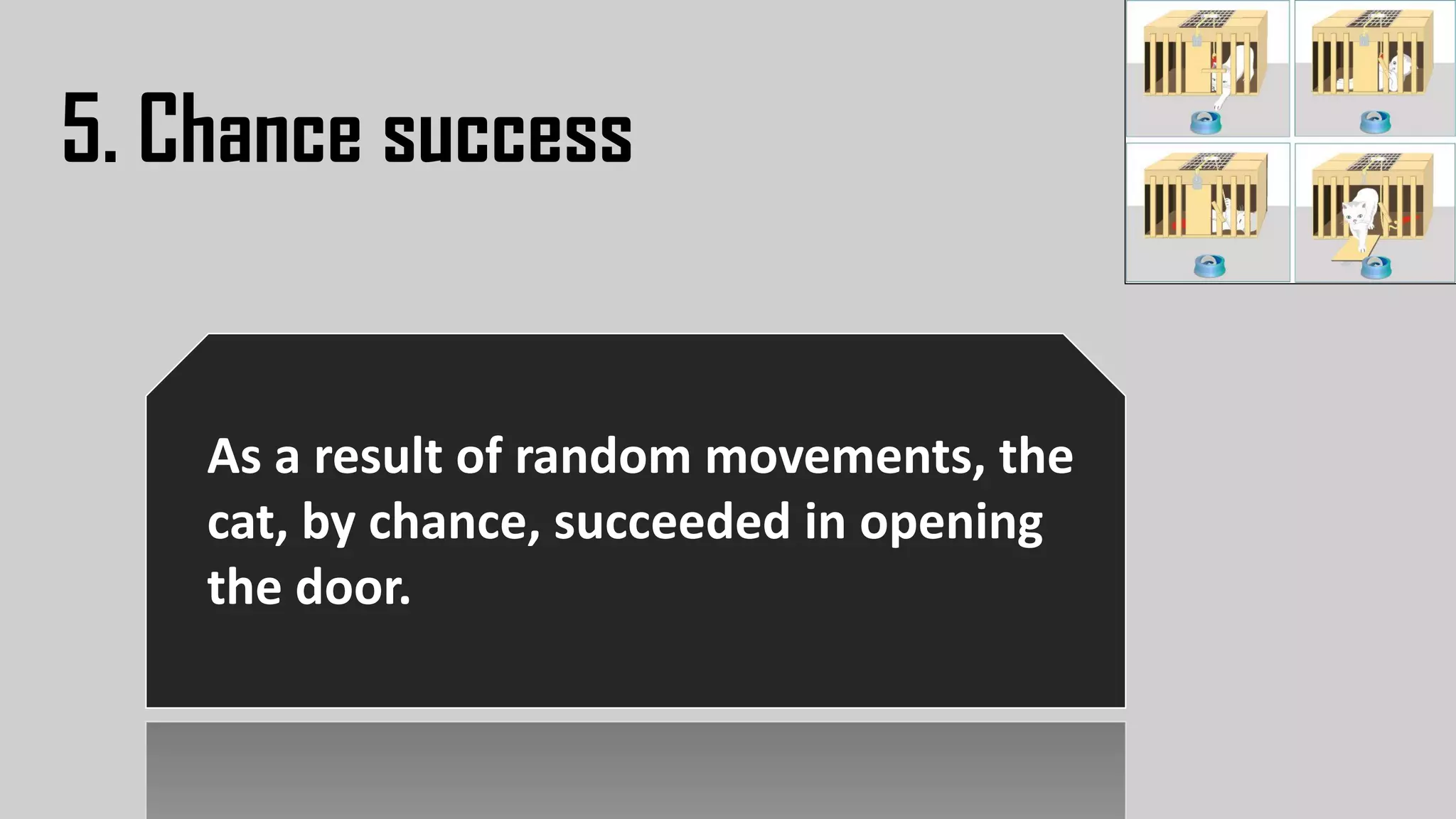
As a result of random movements, the
cat, by chance, succeeded in opening
the door.
5. Chance success
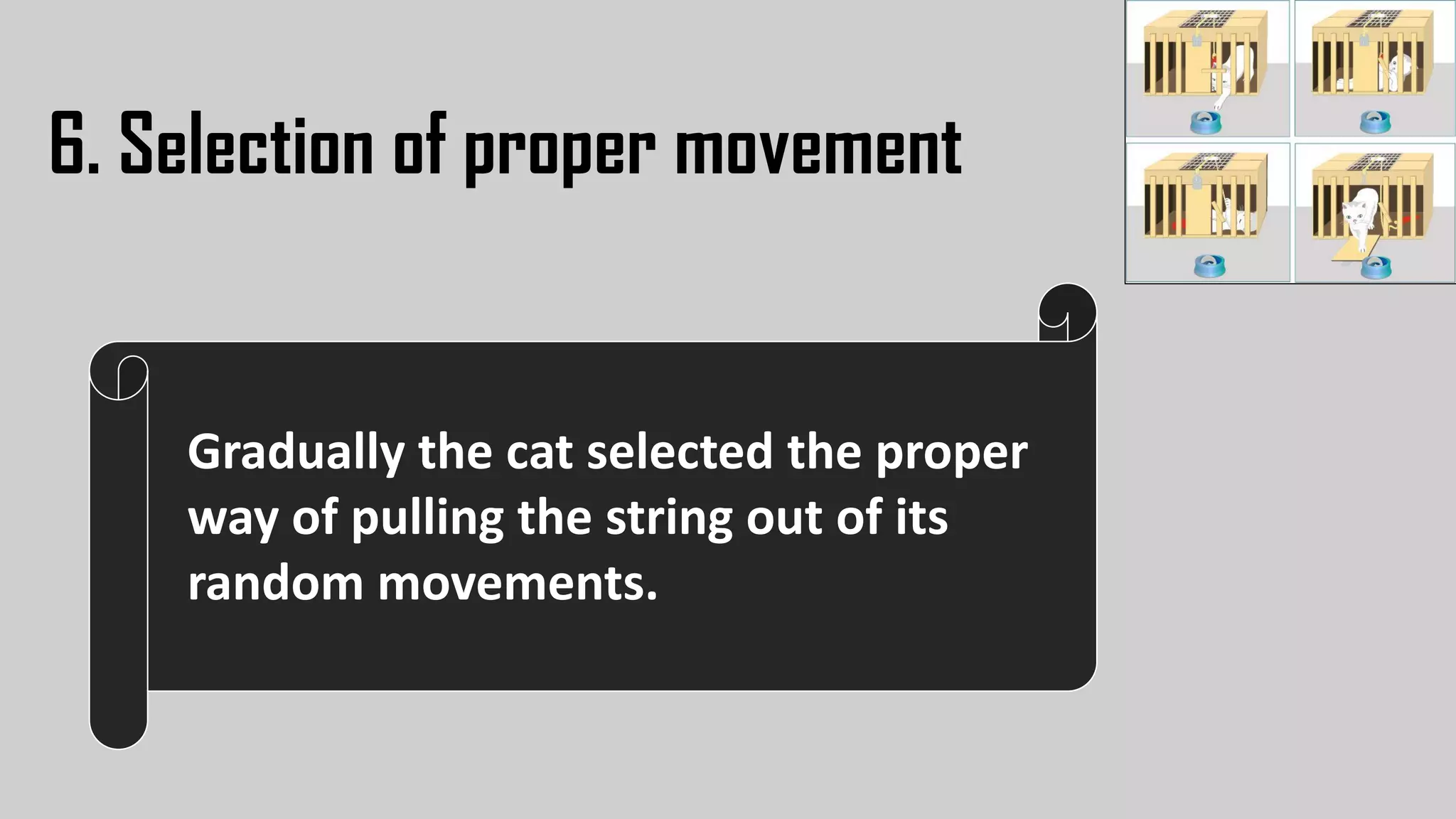
6. Selection of proper movement
Gradually the cat selected the proper
way of pulling the string out of its
random movements.
7. Fixation
At last, the cat learned the proper way of
opening the door by eliminating all the incorrect
responses and fixing only right response. Now
the cat was able to open the door without any
error.
LAWS OF LEARNING
PRIMARY LAWS
Law of readyness
The law states that “when any conduction unit is
ready to conduct, for it to conduct is satisfying.
When any conduction unit is not ready to
conduct, for it to conduct is annoying. When any
conduction unit is ready to conduct, for it not to
conduct is also annoying.”
Law of effect
The law stated that “any behavior that is followed
by pleasant consequences is likely to be repeated,
and any behavior followed by unpleasant
consequences is likely to be stopped.”
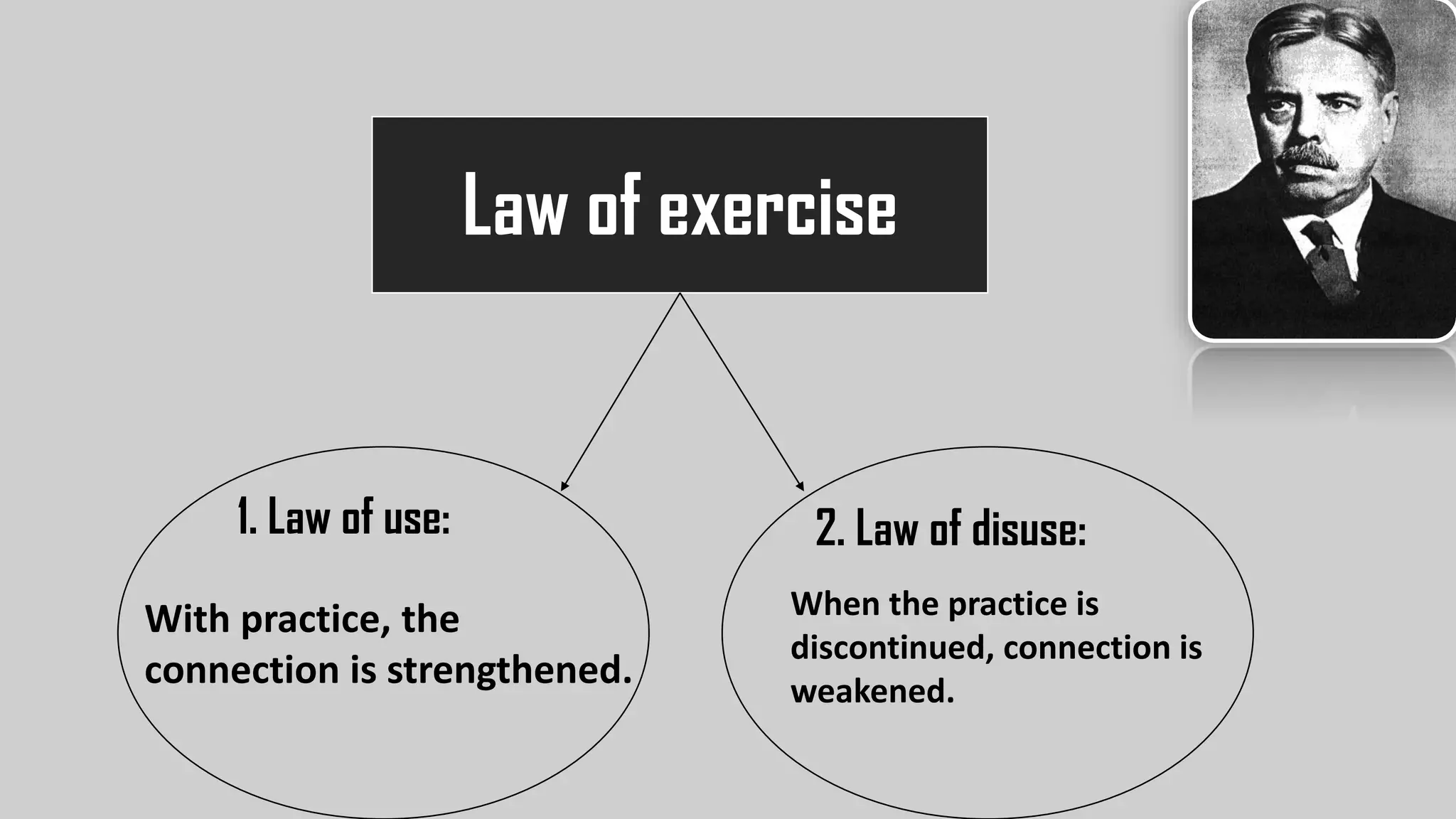
Law of exercise
The law states that repeated exercising of a
response strengthens its connection with the
stimulus. And connection is weakened through
failure of practice.
Law of exercise
1. Law of use: 2. Law of disuse:
With practice, the
connection is strengthened.
When the practice is
discontinued, connection is
weakened.
SECONDARY LAWS
Law of multiple response
The law implies that confronted with a new
situation, the organism response in a variety of
ways before arriving at the correct response.
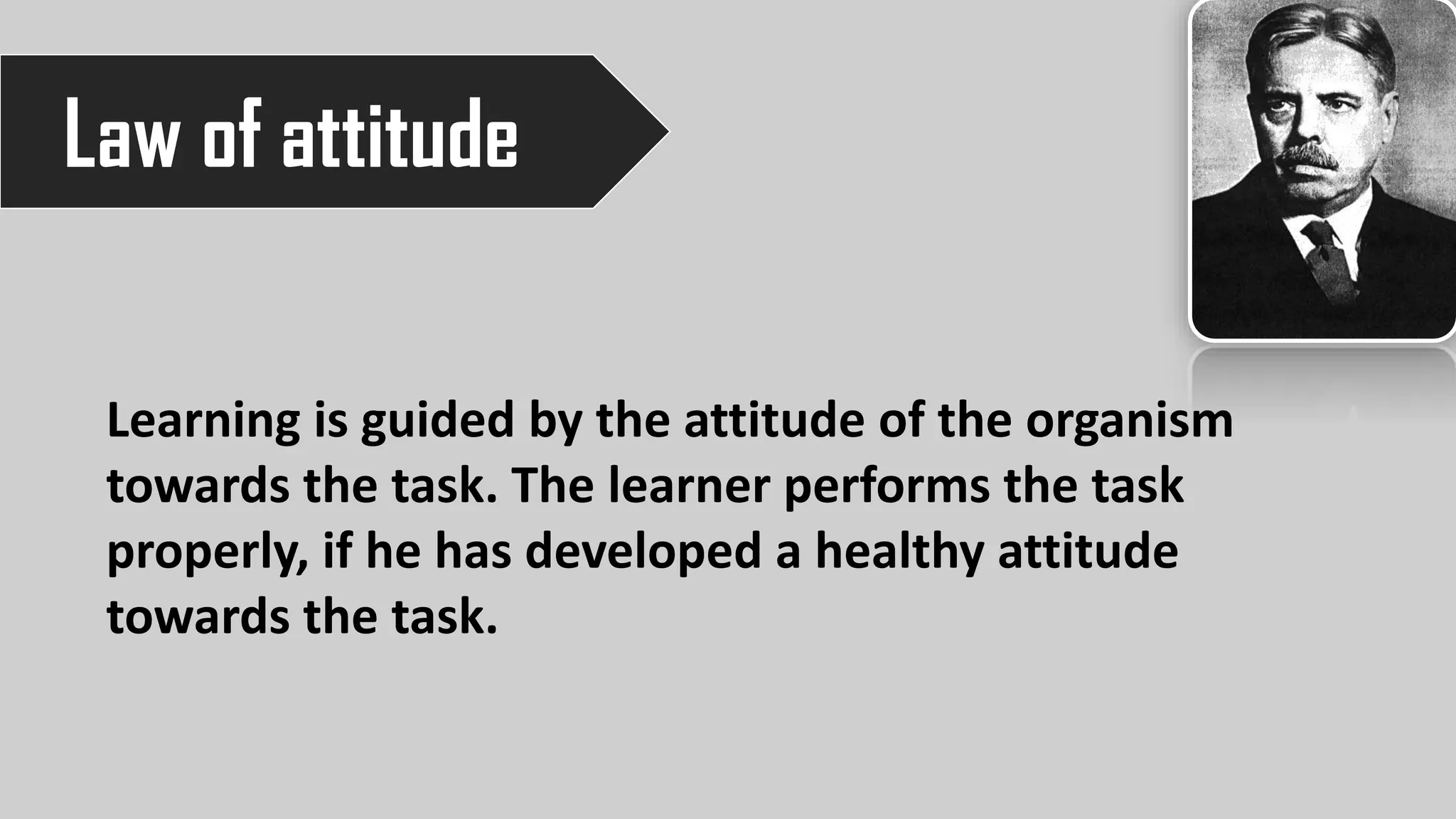
Law of attitude
Learning is guided by the attitude of the organism
towards the task. The learner performs the task
properly, if he has developed a healthy attitude
towards the task.
Law of analogy
An individual response to a new situation on the
basis of the responses made by him in similar
situation in the past, that is the organism makes
responses by analogy.
Law of associative shifting
The law states that “any response may elicited
from the learner in associated with any situation
to which he is sensitive.”
EDUCATIONAL
IMPLICATIONS
Motivation is
very important
in the teaching-
learning process.
Learning should
be made
purposeful and
goal directed.
Theory stresses the
importance of
mental readiness,
meaningful practice
and intensives in
learning process.
More opportunities
should be given to
the learners to use
and repeat the
knowledge they get
in the classroom.
The learner should be
encouraged to do his
task independently. He
must try various
solutions of the
problem before
arriving at the correct
one.
THANK YOU
Mumthaz PP
Student
Keyi Sahib Training College

Trial and error learning theory

  • 1.
    TRIAL AND ERRORLEARNIG THEORY By Edward Lee Thorndike, an American psychologist. Prepared by Mumthaz PP (1874-1949)
  • 2.
    According to himlearning takes place by trial and error. In learning the learner selects a correct response out of a large number of possible ones and connects it with the appropriate stimulus. Learning by this method is called trial and error learning theory.
  • 3.
    Thorndike formulated histheory, based on his experiments conducted on his cat in the puzzle box. The door of the box could be opened by pulling the strings inside the box. A fish was kept outside. The cat was tried to come out of the box by squeezing, jumping, biting etc. As the experiment was repeated for several times the wrong movements decreased and in the end the cat was able to open the door in a single trial. Experiment
  • 4.
  • 5.
  • 6.
    FACTORS INVOLVED IN TRIALAND ERROR THEORY
  • 7.
    1.Motive or drive Driveis a tension state resulting from needs. Where there is drive or motive there is learning. In the present experiment drive was hunger.
  • 8.
    2.Stimulus or goal Itis the casual factor for activity. In the present experiment, food is the stimulus. To get the food by getting out of the box is the goal.
  • 9.
    3. Responses The catmakes a number of varied types of responses like scratching, pulling etc. The responses which lead to the goal known as satisfying responses. The responses which do not lead to the goal is known as annoying responses.
  • 10.
    4. Block The catwas confined in the box with a closed door.
  • 11.
    As a resultof random movements, the cat, by chance, succeeded in opening the door. 5. Chance success
  • 12.
    6. Selection ofproper movement Gradually the cat selected the proper way of pulling the string out of its random movements.
  • 13.
    7. Fixation At last,the cat learned the proper way of opening the door by eliminating all the incorrect responses and fixing only right response. Now the cat was able to open the door without any error.
  • 14.
  • 15.
  • 16.
    Law of readyness Thelaw states that “when any conduction unit is ready to conduct, for it to conduct is satisfying. When any conduction unit is not ready to conduct, for it to conduct is annoying. When any conduction unit is ready to conduct, for it not to conduct is also annoying.”
  • 17.
    Law of effect Thelaw stated that “any behavior that is followed by pleasant consequences is likely to be repeated, and any behavior followed by unpleasant consequences is likely to be stopped.”
  • 18.
    Law of exercise Thelaw states that repeated exercising of a response strengthens its connection with the stimulus. And connection is weakened through failure of practice.
  • 19.
    Law of exercise 1.Law of use: 2. Law of disuse: With practice, the connection is strengthened. When the practice is discontinued, connection is weakened.
  • 20.
  • 21.
    Law of multipleresponse The law implies that confronted with a new situation, the organism response in a variety of ways before arriving at the correct response.
  • 22.
    Law of attitude Learningis guided by the attitude of the organism towards the task. The learner performs the task properly, if he has developed a healthy attitude towards the task.
  • 23.
    Law of analogy Anindividual response to a new situation on the basis of the responses made by him in similar situation in the past, that is the organism makes responses by analogy.
  • 24.
    Law of associativeshifting The law states that “any response may elicited from the learner in associated with any situation to which he is sensitive.”
  • 25.
  • 26.
    Motivation is very important inthe teaching- learning process.
  • 27.
  • 28.
    Theory stresses the importanceof mental readiness, meaningful practice and intensives in learning process.
  • 29.
    More opportunities should begiven to the learners to use and repeat the knowledge they get in the classroom.
  • 30.
    The learner shouldbe encouraged to do his task independently. He must try various solutions of the problem before arriving at the correct one.
  • 31.
    THANK YOU Mumthaz PP Student KeyiSahib Training College