BIOACCUMULATION
BIOACCUMULATION
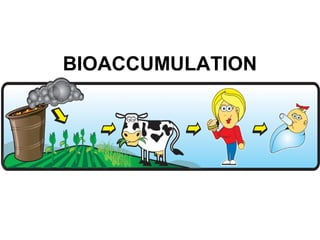
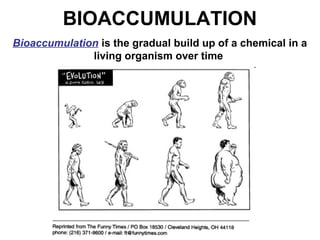
Bioaccumulation is the gradual build up of a chemical in a
living organism over time
BIOACCUMULATION
Uptake describes the entrance of a chemical into an
organism.
Uptake can occur during activities such as eating, drinking,
breathing, and touching/contact.
SNIFF
SNIFF
BIOACCUMULATION
Uptake occurs when a chemical passes from the environment
into an organism’s cells
Semipermeable
Chemicals tend to move, or diffuse, from areas of high
concentration to areas of low concentration
Uptake often depends on the relative concentration of the
chemical in the environment compared to the organism’s
cells
BIOACCUMULATION
Storage means the deposit of a chemical in body tissue or in
an organ.
BIOACCUMULATION
Storage
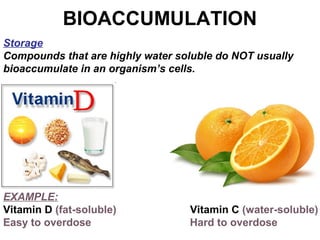
Compounds that are highly water soluble do NOT usually
bioaccumulate in an organism’s cells.
EXAMPLE:
Vitamin D (fat-soluble) Vitamin C (water-soluble)
Easy to overdose Hard to overdose
BIOACCUMULATION
Storage
But cobalt is highly water-soluble. Why is it easy to
accumulate this heavy metal?
Because cobalt binds tightly and specifically to sites in the
liver and accumulates
BIOACCUMULATION
Storage
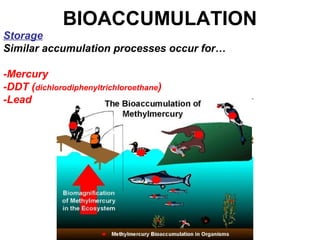
Similar accumulation processes occur for…
-Mercury
-DDT (dichlorodiphenyltrichloroethane)
-Lead
BIOACCUMULATION
BIOMAGNIFICATION is a process that results in the
accumulation of a chemical in an organism at higher levels
than are found in its food.
BIOACCUMULATION
BIOMAGNIFICATION can be beneficial or harmful
BIOACCUMULATION
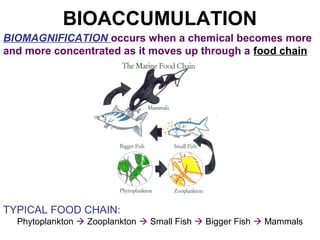
BIOMAGNIFICATION occurs when a chemical becomes more
and more concentrated as it moves up through a food chain
TYPICAL FOOD CHAIN:
Phytoplankton  Zooplankton  Small Fish  Bigger Fish  Mammals
BIOACCUMULATION
BIOMAGNIFICATION
BIOACCUMULATION
The process of bioaccumulation…
-Is a normal and essential process for the growth and nurturing of
organisms
-All animals, including humans, bioaccumulate vital nutrients such
as proteins, fats, carbohydrates, vitamins, and minerals
BIOACCUMULATION
Bioaccumulation is the net result of the interaction of uptake,
storage, and elimination of a chemical
Elimination is the removal of chemicals from the organism
through metabolism (all the chemical reactions in an
organism)
1) Chemicals that are easily
eliminated from an organism do
not bioaccumulate.
2) Chemicals that dissolve readily
in fat have a greater potential to
accumulate
BIOACCUMULATION
Other factors that affect bioaccumulation:
-Duration of exposure
-Concentration of chemicals in the environment
-Lifetime of organism
-Anatomy of organism (certain anatomies enable better
accumulation of specific chemicals)
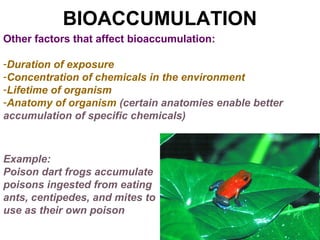
Example:
Poison dart frogs accumulate
poisons ingested from eating
ants, centipedes, and mites to
use as their own poison
BIOACCUMULATION
SUMMARY
Bioaccumulation is necessary for growth and the acquisition
of essential chemicals…
…but can be harmful at the same time.

06 bioaccumulation

Editor's Notes

  • #2 http://www.youtube.com/watch?v=ERLtyaugzw4 (DDT – start at 2:30)