Standards of Measurement The International System of Units (SI)
Units and Standards In order for a measurement to be useful, a measurement  standard  must be used. A  standard  is an exact quantity that people agree to use for comparison.
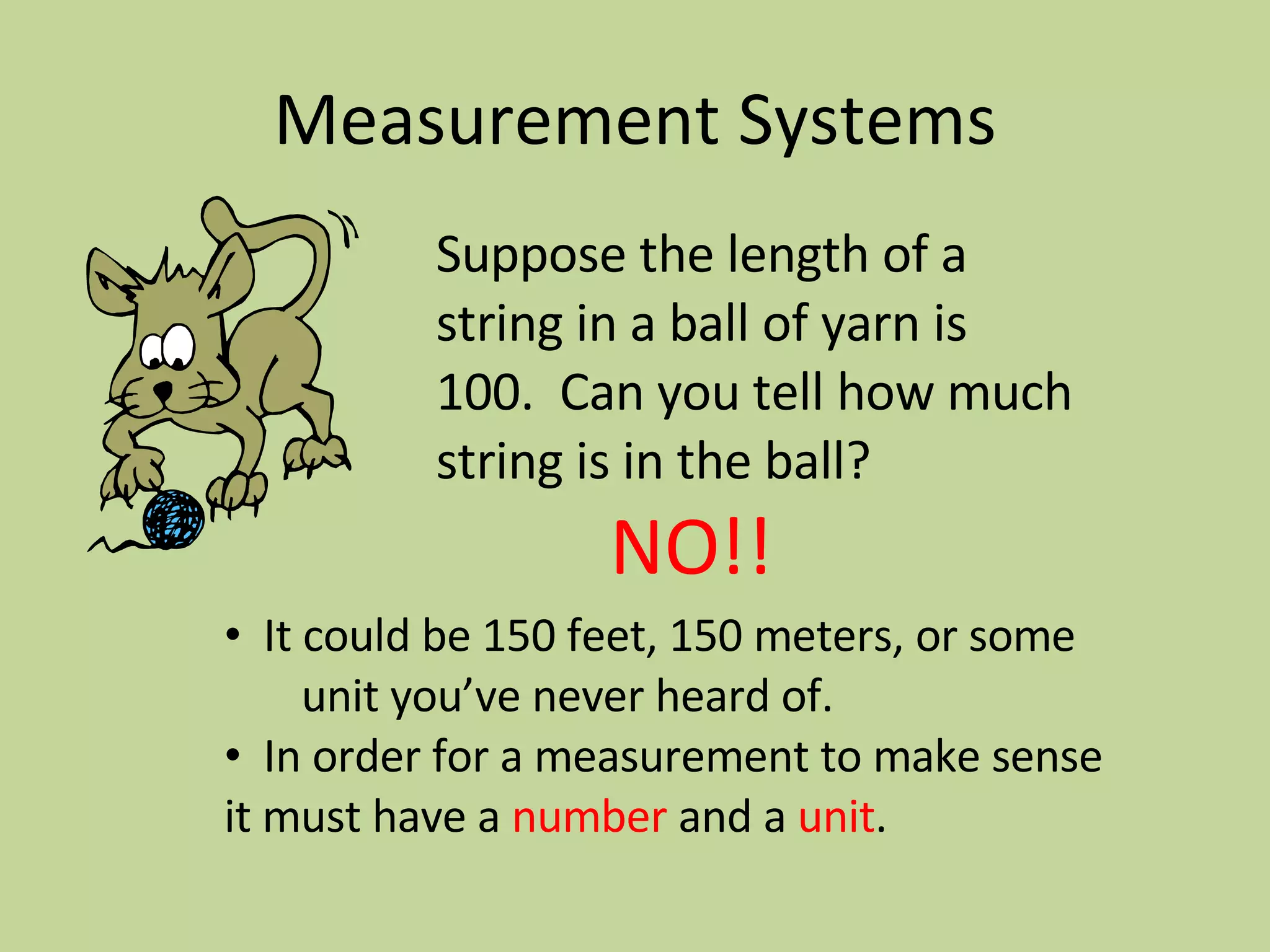
Measurement Systems Suppose the length of a string in a ball of yarn is 100.  Can you tell how much string is in the ball? NO!!  It could be 150 feet, 150 meters, or some  unit you’ve never heard of.  In order for a measurement to make sense  it must have a  number  and a  unit .
International System of Units In the U.S. we buy milk by the gallon, potatoes by the pound, and lumber by the foot.  These are a part of the English system of measurement. Most other nations use a system of measurement based on multiples of ten. This is known as the  International System of Units  or  SI .
Common SI Prefixes Prefix Symbol Multiplying Factor Kilo- k 1000 Deci- d 0.1 Centi- c 0.01 Milli- m 0.001 Micro- m 0.000001 Nano- n 0.000000001
Using SI Units Every type of quantity measured in SI has a base unit and a symbol for that unit.
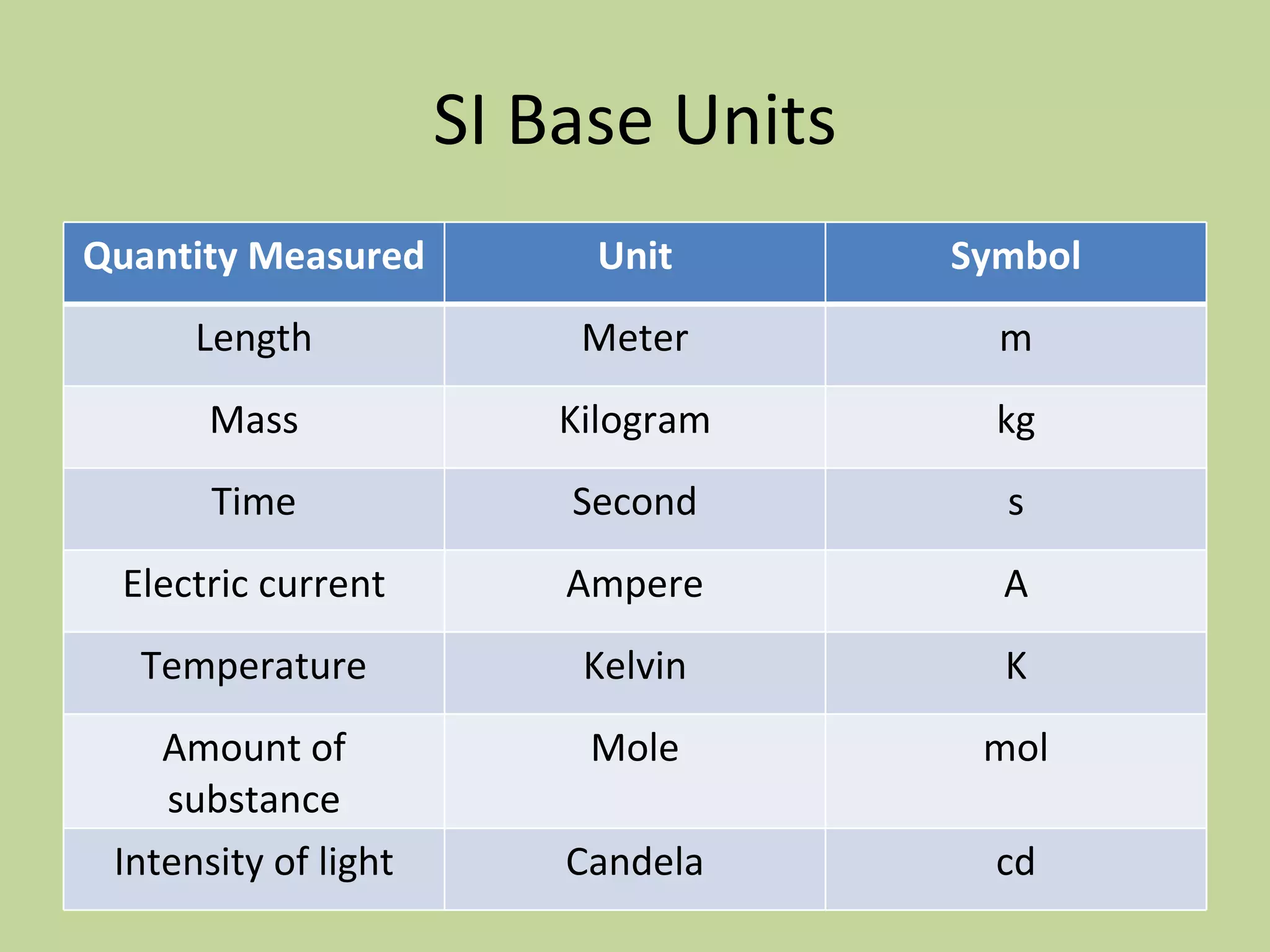
SI Base Units Quantity Measured Unit Symbol Length Meter m Mass Kilogram kg Time Second s Electric current Ampere A Temperature Kelvin K Amount of substance Mole mol Intensity of light Candela cd
Length The SI base unit for length is the meter (m). Remember: SI is based on powers of ten Therefore: 1m=10dm=100cm=1000mm Metric rulers and meter sticks are used to measure length.
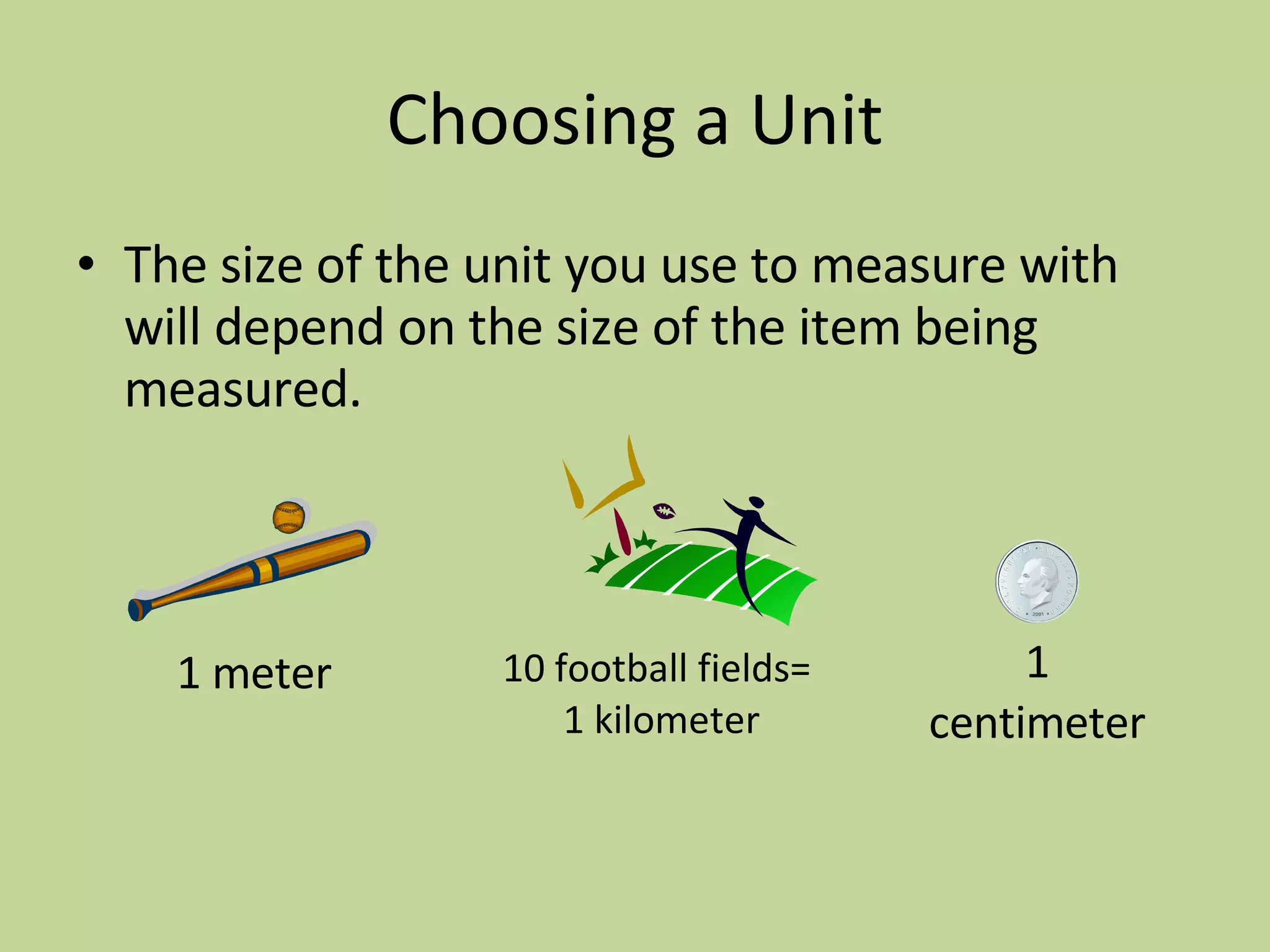
Choosing a Unit The size of the unit you use to measure with will depend on the size of the item being measured. 1 meter 1 centimeter 10 football fields=  1 kilometer
Volume The amount of space occupied by an object. Volume= length x width x height V= 3cm x 3cm x3cm V= 27cm 3 cm 3 cm 3cm 3
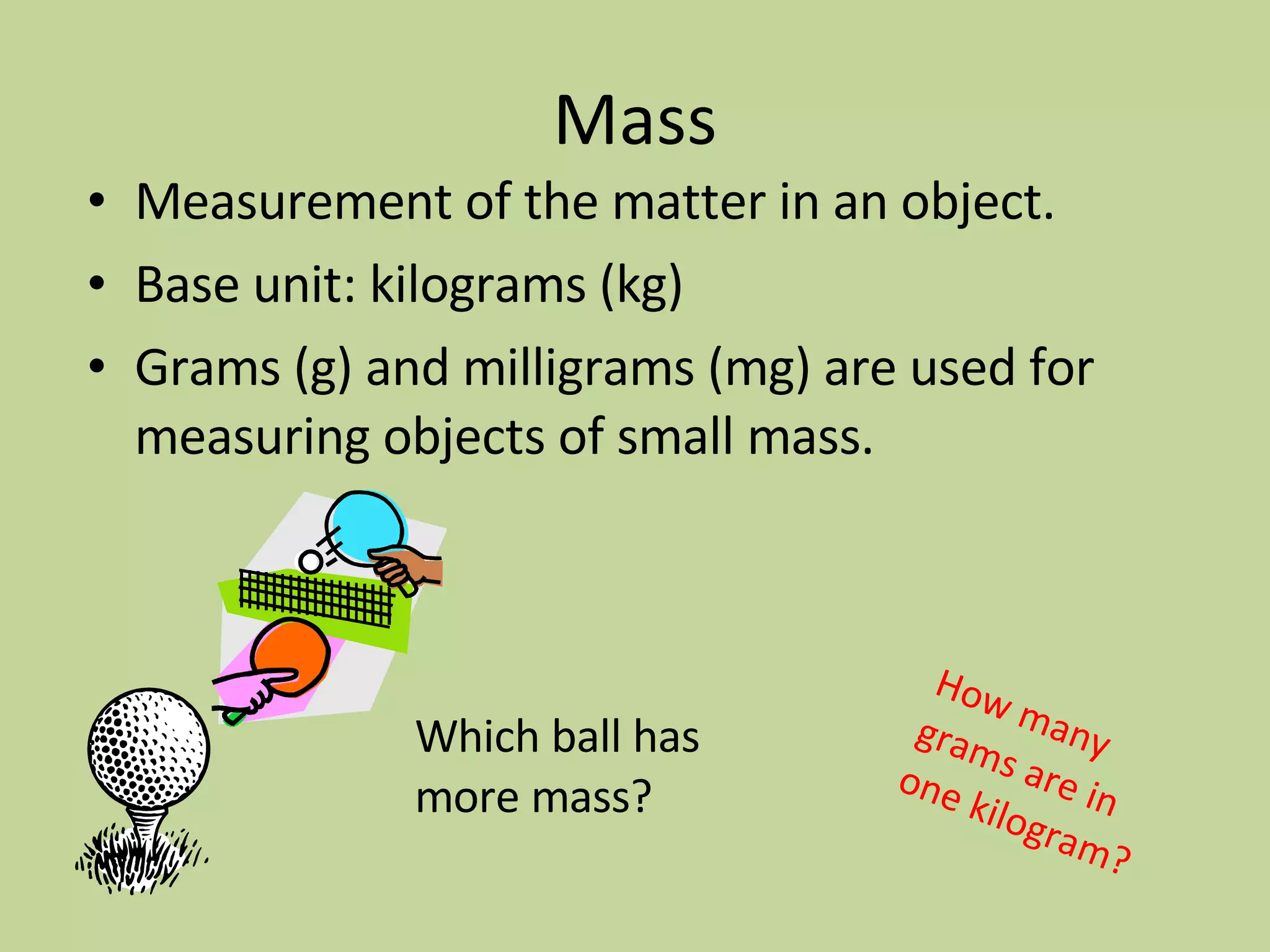
Mass Measurement of the matter in an object. Base unit: kilograms (kg) Grams (g) and milligrams (mg) are used for measuring objects of small mass. Which ball has more mass? How many grams are in one kilogram?
Density Density is the mass per unit of volume of a material.  (Expressed as grams per cubic cm) D=m/v A cube of silver would be more dense than a cube of aluminum, even if they were the same size!!
Time and Temperature The SI unit for time is the second (s). The SI unit for temperature is the Kelvin (K). 0 degrees K is the  COLDEST  possible temperature, also known as  absolute zero . That is -273 degrees Celsius, which is 273 degrees below freezing!!
Summary A  standard  is an exact quantity that people agree to use for comparison. In order for a measurement to make sense  it must have a  number  and a  unit . The  International System of Units  or  SI  is a system of measurement based on units of 10 and used by most nations around the world. Every type of quantity measured in SI has a base unit and a symbol for that unit. The SI base unit for length is the meter (m). The size of the unit you use to measure with will depend on the size of the item being measured. Volume= length x width x height Mass is the measurement of the matter in an object (kg). Density is the mass per unit of volume of a material.  (Expressed as grams per cubic cm) The SI unit for time is the second (s). The SI unit for temperature is the Kelvin (K).

Standards Of Measurement

  • 1.
    Standards of MeasurementThe International System of Units (SI)
  • 2.
    Units and StandardsIn order for a measurement to be useful, a measurement standard must be used. A standard is an exact quantity that people agree to use for comparison.
  • 3.
    Measurement Systems Supposethe length of a string in a ball of yarn is 100. Can you tell how much string is in the ball? NO!! It could be 150 feet, 150 meters, or some unit you’ve never heard of. In order for a measurement to make sense it must have a number and a unit .
  • 4.
    International System ofUnits In the U.S. we buy milk by the gallon, potatoes by the pound, and lumber by the foot. These are a part of the English system of measurement. Most other nations use a system of measurement based on multiples of ten. This is known as the International System of Units or SI .
  • 5.
    Common SI PrefixesPrefix Symbol Multiplying Factor Kilo- k 1000 Deci- d 0.1 Centi- c 0.01 Milli- m 0.001 Micro- m 0.000001 Nano- n 0.000000001
  • 6.
    Using SI UnitsEvery type of quantity measured in SI has a base unit and a symbol for that unit.
  • 7.
    SI Base UnitsQuantity Measured Unit Symbol Length Meter m Mass Kilogram kg Time Second s Electric current Ampere A Temperature Kelvin K Amount of substance Mole mol Intensity of light Candela cd
  • 8.
    Length The SIbase unit for length is the meter (m). Remember: SI is based on powers of ten Therefore: 1m=10dm=100cm=1000mm Metric rulers and meter sticks are used to measure length.
  • 9.
    Choosing a UnitThe size of the unit you use to measure with will depend on the size of the item being measured. 1 meter 1 centimeter 10 football fields= 1 kilometer
  • 10.
    Volume The amountof space occupied by an object. Volume= length x width x height V= 3cm x 3cm x3cm V= 27cm 3 cm 3 cm 3cm 3
  • 11.
    Mass Measurement ofthe matter in an object. Base unit: kilograms (kg) Grams (g) and milligrams (mg) are used for measuring objects of small mass. Which ball has more mass? How many grams are in one kilogram?
  • 12.
    Density Density isthe mass per unit of volume of a material. (Expressed as grams per cubic cm) D=m/v A cube of silver would be more dense than a cube of aluminum, even if they were the same size!!
  • 13.
    Time and TemperatureThe SI unit for time is the second (s). The SI unit for temperature is the Kelvin (K). 0 degrees K is the COLDEST possible temperature, also known as absolute zero . That is -273 degrees Celsius, which is 273 degrees below freezing!!
  • 14.
    Summary A standard is an exact quantity that people agree to use for comparison. In order for a measurement to make sense it must have a number and a unit . The International System of Units or SI is a system of measurement based on units of 10 and used by most nations around the world. Every type of quantity measured in SI has a base unit and a symbol for that unit. The SI base unit for length is the meter (m). The size of the unit you use to measure with will depend on the size of the item being measured. Volume= length x width x height Mass is the measurement of the matter in an object (kg). Density is the mass per unit of volume of a material. (Expressed as grams per cubic cm) The SI unit for time is the second (s). The SI unit for temperature is the Kelvin (K).