Outline
 Preface
 Introduction
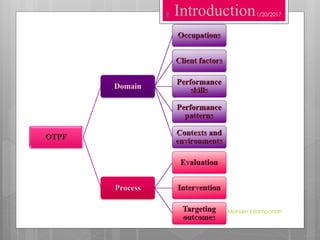
 Domain
 Process
 Conclusion
 Reference
1/20/2017
Mohsen Eslampanah
2
Preface
 The Therapeutic Use Of Everyday Life Activities
(Occupations) With Individuals Or Groups For The
Purpose Of Enhancing Or Enabling Participation In
Roles, Habits, And Routines In Home, School,
Workplace, Community, And Other Settings.
 Occupational Therapy Services Are Provided For
Habilitation, Rehabilitation, And Promotion Of Health
And Wellness For Clients With Disability- And Non–
disability-related Needs.
1/20/2017
Mohsen Eslampanah
4
Occupational therapy
Preface
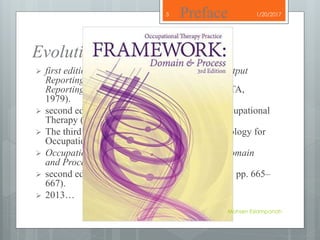
Evolution of This Document
 first edition: Occupational Therapy Product Output
Reporting System and Uniform Terminology for
Reporting Occupational Therapy Services (AOTA,
1979).
 second edition of Uniform Terminology for Occupational
Therapy (AOTA, 1989).
 The third and final revision of Uniform Terminology for
Occupational Therapy (AOTA, 1994)
 Occupational Therapy Practice Framework: Domain
and Process (AOTA, 2002b).
 second edition of the Framework (AOTA, 2008, pp. 665–
667).
 2013…
1/20/2017
Mohsen Eslampanah
5 Preface
Introduction
Purpose of framework
 The Occupational Therapy Practice Framework:
Domain and Process describes the central concepts
that ground occupational therapy practice and
builds a common understanding of the basic tenets
and vision of the profession.
1/20/2017
Mohsen Eslampanah
7 Introduction
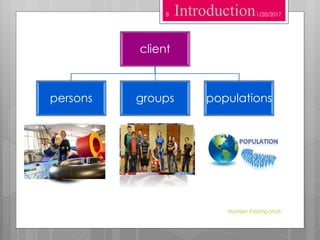
client
persons groups populations
1/20/2017
Mohsen Eslampanah
8 Introduction
1/20/2017
Mohsen Eslampanah
9 Introduction
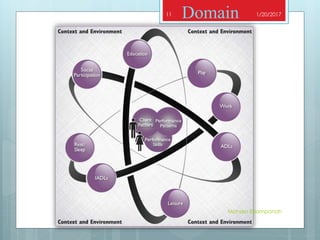
Domain
1/20/2017
Mohsen Eslampanah
11 Domain
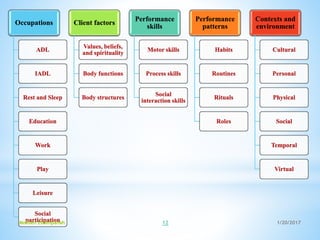
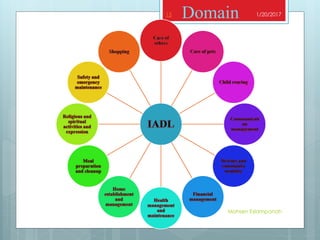
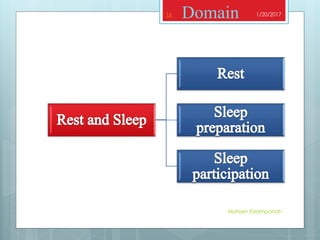
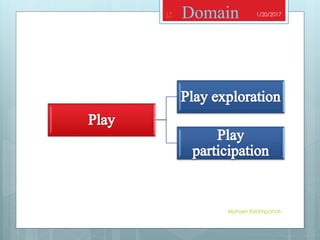
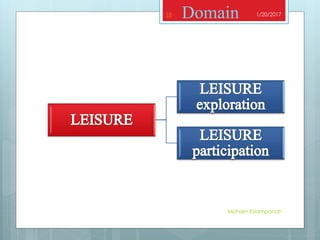
Occupations
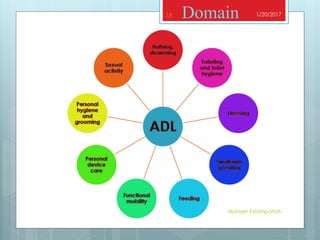
ADL
IADL
Rest and Sleep
Education
Work
Play
Leisure
Social
participation
Client factors
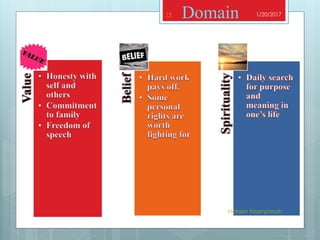
Values, beliefs,
and spirituality
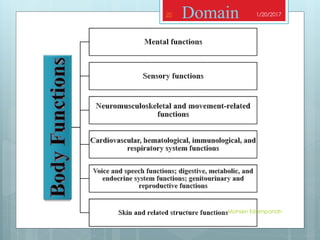
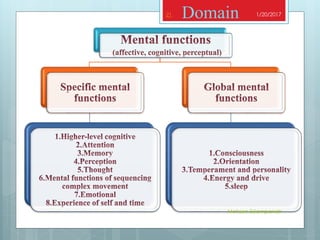
Body functions
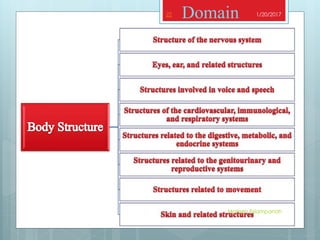
Body structures
Performance
skills
Motor skills
Process skills
Social
interaction skills
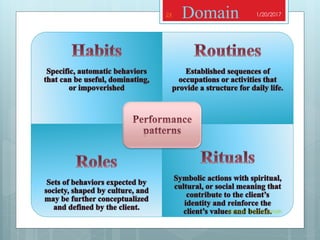
Performance
patterns
Habits
Routines
Rituals
Roles
Contexts and
environment
Cultural
Personal
Physical
Social
Temporal
Virtual
1/20/2017Mohsen Eslampanah 12
Occupation
 “In occupational therapy, occupations refer to
the everyday activities that people do as
individuals, in families and with communities to
occupy time and bring meaning and purpose to
life. Occupations include things people need to,
want to and are expected to do”
(World Federation of Occupational Therapists, 2012).
 Occupation and activity
 Co-occupation
1/20/2017
Mohsen Eslampanah
13 Domain
1/20/2017
Mohsen Eslampanah
14 Domain
1/20/2017
Mohsen Eslampanah
15 Domain
1/20/2017
Mohsen Eslampanah
16 Domain
1/20/2017
Mohsen Eslampanah
17 Domain
1/20/2017
Mohsen Eslampanah
18 Domain
1/20/2017
Mohsen Eslampanah
19 Domain
1/20/2017
Mohsen Eslampanah
20 Domain
1/20/2017
Mohsen Eslampanah
21 Domain
1/20/2017
Mohsen Eslampanah
22 Domain
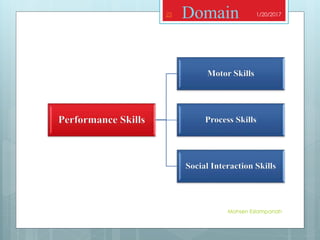
Performance Skills
Motor Skills
Process Skills
Social Interaction Skills
1/20/2017
Mohsen Eslampanah
23 Domain
1/20/2017
Mohsen Eslampanah
24 Domain
customs, beliefs, activity patterns, behavior standards,
and expectation accepted by the society
demographic feature of the individual such as age,
gender, socioeconomic status, and educational level
stage of life, time of day or year, duration, rhythm of
activity, or history.
interaction in simulated, real-time, or near time
situations absent of physical contact.
natural and built nonhuman environment and objects
in them.
relationships, and expectations of persons, groups, and
organizations
1/20/2017
Mohsen Eslampanah
25 Domain
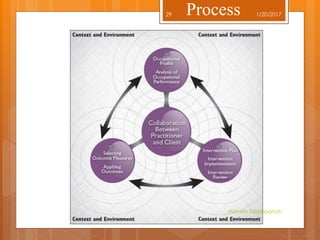
Process
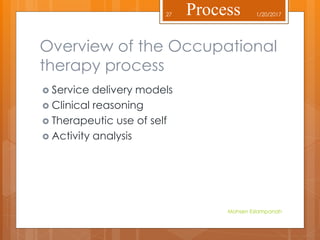
Overview of the Occupational
therapy process
 Service delivery models
 Clinical reasoning
 Therapeutic use of self
 Activity analysis
1/20/2017
Mohsen Eslampanah
27 Process
1/20/2017
Mohsen Eslampanah
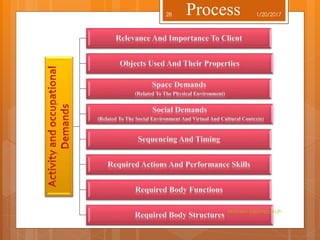
28 Process
1/20/2017
Mohsen Eslampanah
29 Process
1/20/2017
Mohsen Eslampanah
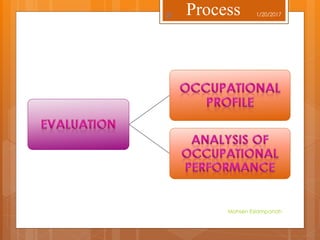
30 Process
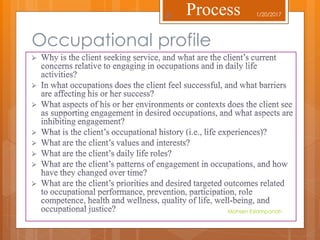
Occupational profile








1/20/2017
Mohsen Eslampanah
31 Process
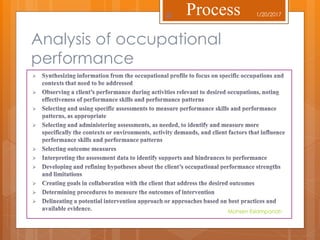
Analysis of occupational
performance










1/20/2017
Mohsen Eslampanah
32 Process
1/20/2017
Mohsen Eslampanah
33 Process
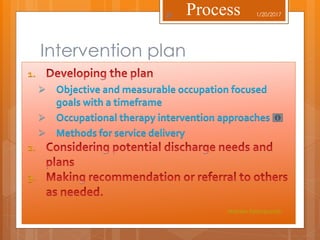
Intervention plan
1.
 Objective and measurable occupation focused
goals with a timeframe
 Occupational therapy intervention approaches
 Methods for service delivery
2.
3.
1/20/2017
Mohsen Eslampanah
34 Process
Create, promote (health promotion)
Establish, restore
(remediation, restoration)
Maintain
Modify (compensation, adaptation)
Prevent (disability prevention)
Occupational therapy
intervention approaches
1/20/2017
Mohsen Eslampanah
35 Process
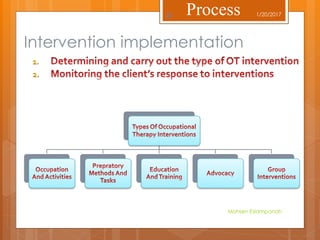
Intervention implementation
1.
2.
1/20/2017
Mohsen Eslampanah
36 Process
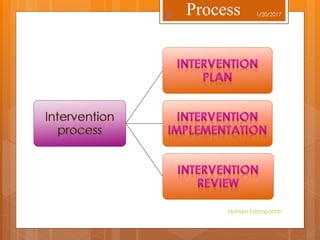
Intervention review
 Re-evaluating the plan
 Modify the plan
 Determining the need for continuation or discontinuation
of OT services and for referral to other services
1/20/2017
Mohsen Eslampanah
37 Process
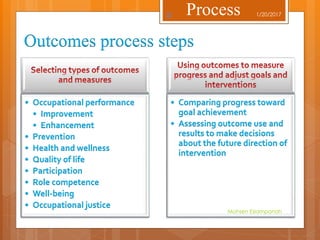
Outcomes process steps
• Occupational performance
• Improvement
• Enhancement
• Prevention
• Health and wellness
• Quality of life
• Participation
• Role competence
• Well-being
• Occupational justice
• Comparing progress toward
goal achievement
• Assessing outcome use and
results to make decisions
about the future direction of
intervention
1/20/2017
Mohsen Eslampanah
38 Process
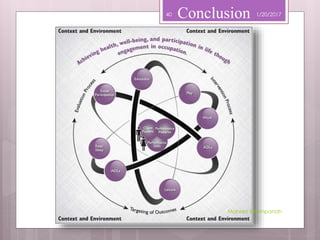
Conclusion
1/20/2017
Mohsen Eslampanah
40 Conclusion
Reference
 American Occupational Therapy Association.(2014). Occupational
therapy practice framework: Domain and process (3rd ed.).American
Journal of Occupational Therapy, 68(Suppl.1), S1
S48.http://dx.doi.org/10.5014/ajot.2014.682006
1/20/2017
Mohsen Eslampanah
41
1/20/2017MOHSEN ESLAMPANAH 42

Occupational Therapy Practice Framework :Domain & process 3rd Edition

Editor's Notes
  • #2 To view this presentation, first, turn up your volume and second, launch the self-running slide show.