
Stroke
10/4/2013 Mohsen Eslampanah OT18 , USWR 2
10/4/2013 Mohsen Eslampanah OT18 , USWR 3
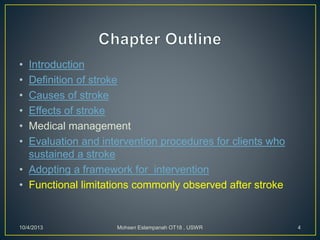
• Introduction
• Definition of stroke
• Causes of stroke
• Effects of stroke
• Medical management
• Evaluation and intervention procedures for clients who
sustained a stroke
• Adopting a framework for intervention
• Functional limitations commonly observed after stroke
10/4/2013 Mohsen Eslampanah OT18 , USWR 4
•
‫میر‬ ‫و‬ ‫مرگ‬ ‫علت‬ ‫سومین‬
•
‫هر‬
40
‫هر‬ ‫و‬ ‫شود‬ ‫می‬ ‫استروک‬ ‫به‬ ‫مبتال‬ ‫نفر‬ ‫یک‬ ‫ثانیه‬
4
‫نفر‬ ‫یک‬ ‫دقیقه‬
...
•
28
%
‫زیر‬ ‫مبتالیان‬
65
‫دارند‬ ‫سن‬ ‫سال‬
!
•
5
‫مرد‬
/
4
‫زن‬
•
‫مبتالیان‬ ‫بین‬ ‫در‬
:
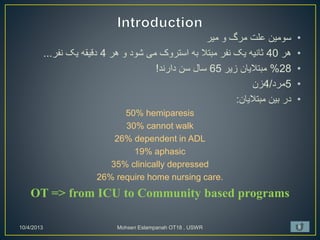
50% hemiparesis
30% cannot walk
26% dependent in ADL
19% aphasic
35% clinically depressed
26% require home nursing care.
OT => from ICU to Community based programs
10/4/2013 Mohsen Eslampanah OT18 , USWR 5
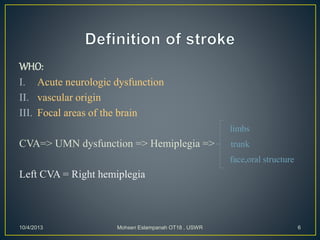
WHO:
I. Acute neurologic dysfunction
II. vascular origin
III. Focal areas of the brain
limbs
CVA=> UMN dysfunction => Hemiplegia => trunk
face,oral structure
Left CVA = Right hemiplegia
10/4/2013 Mohsen Eslampanah OT18 , USWR 6
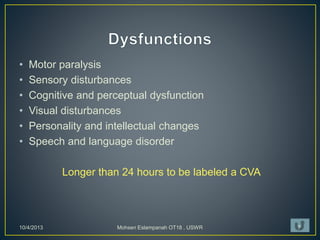
• Motor paralysis
• Sensory disturbances
• Cognitive and perceptual dysfunction
• Visual disturbances
• Personality and intellectual changes
• Speech and language disorder
Longer than 24 hours to be labeled a CVA
10/4/2013 Mohsen Eslampanah OT18 , USWR 7
• Ischemia
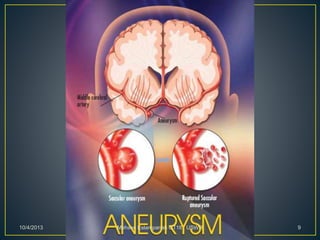
• Hemorrhage
• Related syndromes
• Transient ischemic attacks
10/4/2013 Mohsen Eslampanah OT18 , USWR 8
10/4/2013 Mohsen Eslampanah OT18 , USWR 9
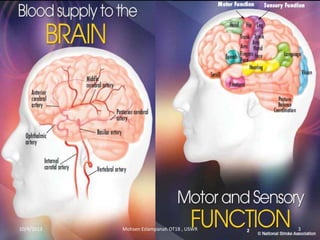
• ICA:
hemiplegia,hemianesthesia,homonymous
hemianopia
DH=> Aphasia,agraphia,acalculia,right-left
confusion,finger agnosia
NDH=>Visual perceptual dys,unilateral
neglect,anosognosia,dressing apraxia,attention
deficits,loss of topographic memory.
10/4/2013 Mohsen Eslampanah OT18 , USWR 10
• Most common cause
• Contralateral hemiplegia
• Sensory deficit
• Contralateral homonymous
hemianopia
DH=> aphasia
NDH=> perceptual deficit
10/4/2013 Mohsen Eslampanah OT18 , USWR 11
• Lower extremity
• Apraxia
• Mental changes
• Primative reflexes
• Bowel and bladder incontinence
10/4/2013 Mohsen Eslampanah OT18 , USWR 12
• Upper brainstem region
• Temporal and occipital lobes
Dysfunction:
1. Sensory and motor deficits
2. Involuntary movement disorder
3. Memory loss
4. Alexia
5. Astereognosis
6. Dysesthesia
7. Akinesthesia
8. Contraleteral homonymous hemianopia
9. Anomia
10. Topographic disorientation
11. Visual agnosia
10/4/2013 Mohsen Eslampanah OT18 , USWR 13
• Ipsilateral ataxia
• Contralateral loss of pain and temprature
sensitivity
• Ipsilateral analgesia
• Dysphagia
• Dysarthria
• Nystagmus
• Contralateral hemiparesis
10/4/2013 Mohsen Eslampanah OT18 , USWR 14
• Cerebellar dysfunction
• Loss of proprioception
• Hemiplegia
• Quadriplegia
• Sensory disturbances
• Unilateral or bilateral involvement of cranial
nerves III to XII
10/4/2013 Mohsen Eslampanah OT18 , USWR 15
• First step: which client factors are impaired
and affecting performance in area of
occupation
• Medically stabilized
• First 3 to 6 months after stroke
10/4/2013 Mohsen Eslampanah OT18 , USWR 16
• COPM
1. Identify areas of difficulty
2. Rate the importance of each area
3. Rate his or her satisfaction with current
performance
COPM
10/4/2013 Mohsen Eslampanah OT18 , USWR 17
• focused on the Roles that are important to the client
• Top-down approach to evaluation is in contrast to a
bottom-up approach
10/4/2013 Mohsen Eslampanah OT18 , USWR 18
• Activity analysis identify errors during
• Keen observation task performance
10/4/2013 Mohsen Eslampanah OT18 , USWR 19
• A-ONE
occupation based neurobehavioral evaluation(ADL)
• AMPS
performance skills and process skills(IADL)
• Barthel index
BADL 10 item
• TEMPA= UE performance,9 tasks , bilateral and
unilateral
• Jebson = hand function
10/4/2013 Mohsen Eslampanah OT18 , USWR 20
• In the past,sensorimotor approaches
• Rood,Bobath,Knott and Voss and brunnstrom
• Task-oreinted approaches
focus on the use of functional activities
10/4/2013 Mohsen Eslampanah OT18 , USWR 21
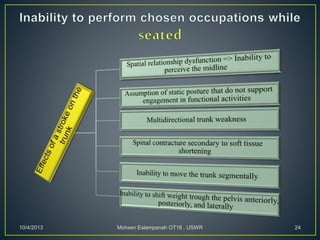
1. Inability to perform chosen occupations while seated
2. Inability to engage in chosen occupations while
standing
3. Inability to communicate secondary to language
dysfunction
4. Inability to perform chosen occupations secondary to
neurobehavioral/cognitive-perceptual impairment
5. Inability to perform chosen tasks secondary to upper
extremity dysfunction
6. Inability to perform chosen tasks secondary to visual
impairment
10/4/2013 Mohsen Eslampanah OT18 , USWR 22
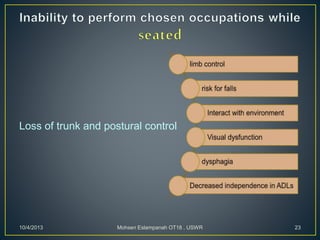
Loss of trunk and postural control
10/4/2013 Mohsen Eslampanah OT18 , USWR 23
10/4/2013 Mohsen Eslampanah OT18 , USWR 24
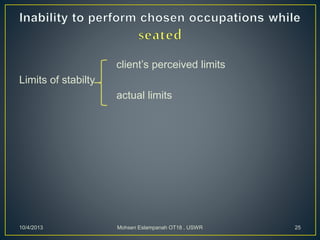
client’s perceived limits
Limits of stabilty
actual limits
10/4/2013 Mohsen Eslampanah OT18 , USWR 25
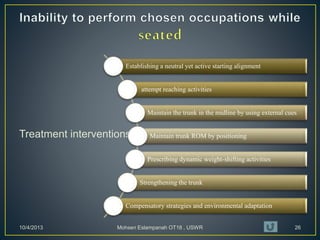
Treatment interventions
10/4/2013 Mohsen Eslampanah OT18 , USWR 26
Establishing a neutral yet active starting alignment
attempt reaching activities
Maintain the trunk in the midline by using external cues
Maintain trunk ROM by positioning
Prescribing dynamic weight-shifting activities
Strengthening the trunk
Compensatory strategies and environmental adaptation
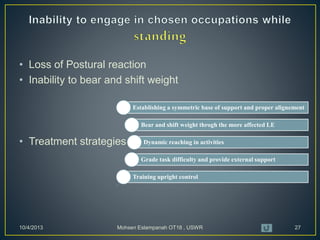
• Loss of Postural reaction
• Inability to bear and shift weight
• Treatment strategies
10/4/2013 Mohsen Eslampanah OT18 , USWR 27
Establishing a symmetric base of support and proper alignement
Bear and shift weight throgh the more affected LE
Dynamic reaching in activities
Grade task difficulty and provide external support
Training upright control
• Most frequently => left hemisphere of the brain
• Communication techniques
10/4/2013 Mohsen Eslampanah OT18 , USWR 28
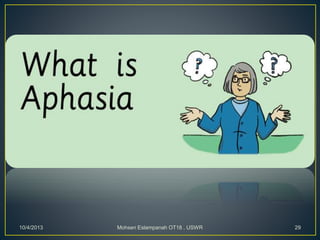
10/4/2013 Mohsen Eslampanah OT18 , USWR 29
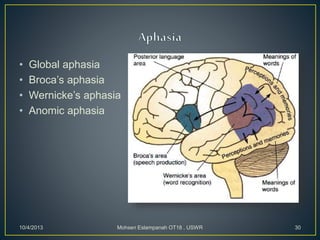
• Global aphasia
• Broca’s aphasia
• Wernicke’s aphasia
• Anomic aphasia
10/4/2013 Mohsen Eslampanah OT18 , USWR 30
10/4/2013 Mohsen Eslampanah OT18 , USWR 31
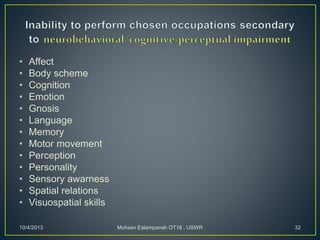
• Affect
• Body scheme
• Cognition
• Emotion
• Gnosis
• Language
• Memory
• Motor movement
• Perception
• Personality
• Sensory awarness
• Spatial relations
• Visuospatial skills
10/4/2013 Mohsen Eslampanah OT18 , USWR 32
• Near transfer => 1 or 2
• Intermediate => 3 to 6
• Far => conceptually similar
10/4/2013 Mohsen Eslampanah OT18 , USWR 33
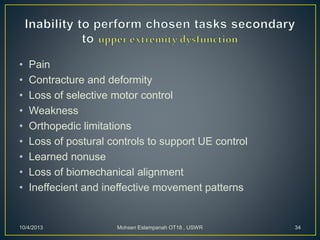
• Pain
• Contracture and deformity
• Loss of selective motor control
• Weakness
• Orthopedic limitations
• Loss of postural controls to support UE control
• Learned nonuse
• Loss of biomechanical alignment
• Ineffecient and ineffective movement patterns
10/4/2013 Mohsen Eslampanah OT18 , USWR 34
• Integration into function
• UE complications after stroke
• The nonfunctional UE
10/4/2013 Mohsen Eslampanah OT18 , USWR 35
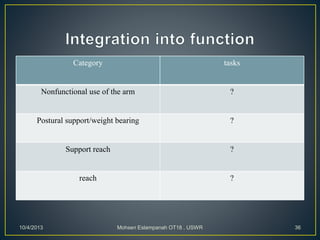
Category tasks
Nonfunctional use of the arm ?
Postural support/weight bearing ?
Support reach ?
reach ?
10/4/2013 Mohsen Eslampanah OT18 , USWR 36
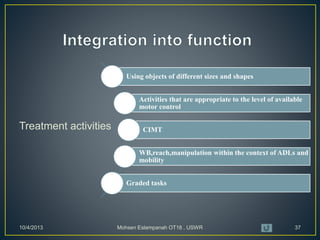
Treatment activities
10/4/2013 Mohsen Eslampanah OT18 , USWR 37
Using objects of different sizes and shapes
Activities that are appropriate to the level of available
motor control
CIMT
WB,reach,manipulation within the context of ADLs and
mobility
Graded tasks
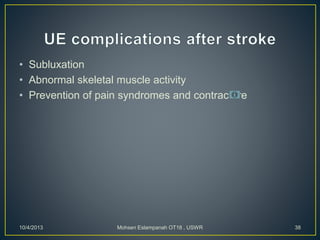
• Subluxation
• Abnormal skeletal muscle activity
• Prevention of pain syndromes and contracture
10/4/2013 Mohsen Eslampanah OT18 , USWR 38
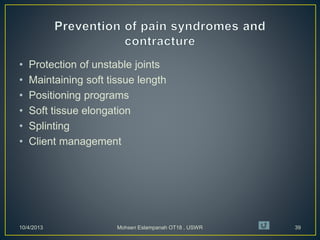
• Protection of unstable joints
• Maintaining soft tissue length
• Positioning programs
• Soft tissue elongation
• Splinting
• Client management
10/4/2013 Mohsen Eslampanah OT18 , USWR 39
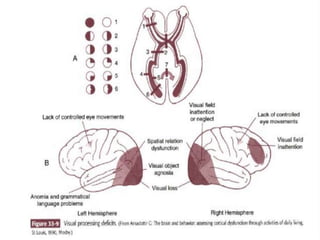
Right hemisphere Left hemisphere
Visual field inattention or neglect Visual object agnosia
Lack of controlled eye movement Lack of controlled eye movement
Spatial relation dysfunction Spatial relation dysfunction
Visual loss Visual loss
Anomia and grammatical language
problems
10/4/2013 Mohsen Eslampanah OT18 , USWR 40
10/4/2013 Mohsen Eslampanah OT18 , USWR 41
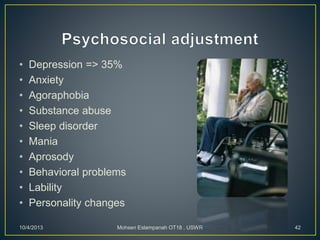
• Depression => 35%
• Anxiety
• Agoraphobia
• Substance abuse
• Sleep disorder
• Mania
• Aprosody
• Behavioral problems
• Lability
• Personality changes
10/4/2013 Mohsen Eslampanah OT18 , USWR 42
Pedretti’s , Occupational Therapy: practice skills for physical
dysfunction,
7th edition, chapter 33
10/4/2013 Mohsen Eslampanah OT18 , USWR 43
10/4/2013 Mohsen Eslampanah OT18 , USWR 44
10/4/2013 Mohsen Eslampanah OT18 , USWR 45

Occupational Therapy and Cerebrovascular accident

  • 1.
  • 2.
  • 3.
  • 4.
    • Introduction • Definitionof stroke • Causes of stroke • Effects of stroke • Medical management • Evaluation and intervention procedures for clients who sustained a stroke • Adopting a framework for intervention • Functional limitations commonly observed after stroke 10/4/2013 Mohsen Eslampanah OT18 , USWR 4
  • 5.
    • ‫میر‬ ‫و‬ ‫مرگ‬‫علت‬ ‫سومین‬ • ‫هر‬ 40 ‫هر‬ ‫و‬ ‫شود‬ ‫می‬ ‫استروک‬ ‫به‬ ‫مبتال‬ ‫نفر‬ ‫یک‬ ‫ثانیه‬ 4 ‫نفر‬ ‫یک‬ ‫دقیقه‬ ... • 28 % ‫زیر‬ ‫مبتالیان‬ 65 ‫دارند‬ ‫سن‬ ‫سال‬ ! • 5 ‫مرد‬ / 4 ‫زن‬ • ‫مبتالیان‬ ‫بین‬ ‫در‬ : 50% hemiparesis 30% cannot walk 26% dependent in ADL 19% aphasic 35% clinically depressed 26% require home nursing care. OT => from ICU to Community based programs 10/4/2013 Mohsen Eslampanah OT18 , USWR 5
  • 6.
    WHO: I. Acute neurologicdysfunction II. vascular origin III. Focal areas of the brain limbs CVA=> UMN dysfunction => Hemiplegia => trunk face,oral structure Left CVA = Right hemiplegia 10/4/2013 Mohsen Eslampanah OT18 , USWR 6
  • 7.
    • Motor paralysis •Sensory disturbances • Cognitive and perceptual dysfunction • Visual disturbances • Personality and intellectual changes • Speech and language disorder Longer than 24 hours to be labeled a CVA 10/4/2013 Mohsen Eslampanah OT18 , USWR 7
  • 8.
    • Ischemia • Hemorrhage •Related syndromes • Transient ischemic attacks 10/4/2013 Mohsen Eslampanah OT18 , USWR 8
  • 9.
  • 10.
    • ICA: hemiplegia,hemianesthesia,homonymous hemianopia DH=> Aphasia,agraphia,acalculia,right-left confusion,fingeragnosia NDH=>Visual perceptual dys,unilateral neglect,anosognosia,dressing apraxia,attention deficits,loss of topographic memory. 10/4/2013 Mohsen Eslampanah OT18 , USWR 10
  • 11.
    • Most commoncause • Contralateral hemiplegia • Sensory deficit • Contralateral homonymous hemianopia DH=> aphasia NDH=> perceptual deficit 10/4/2013 Mohsen Eslampanah OT18 , USWR 11
  • 12.
    • Lower extremity •Apraxia • Mental changes • Primative reflexes • Bowel and bladder incontinence 10/4/2013 Mohsen Eslampanah OT18 , USWR 12
  • 13.
    • Upper brainstemregion • Temporal and occipital lobes Dysfunction: 1. Sensory and motor deficits 2. Involuntary movement disorder 3. Memory loss 4. Alexia 5. Astereognosis 6. Dysesthesia 7. Akinesthesia 8. Contraleteral homonymous hemianopia 9. Anomia 10. Topographic disorientation 11. Visual agnosia 10/4/2013 Mohsen Eslampanah OT18 , USWR 13
  • 14.
    • Ipsilateral ataxia •Contralateral loss of pain and temprature sensitivity • Ipsilateral analgesia • Dysphagia • Dysarthria • Nystagmus • Contralateral hemiparesis 10/4/2013 Mohsen Eslampanah OT18 , USWR 14
  • 15.
    • Cerebellar dysfunction •Loss of proprioception • Hemiplegia • Quadriplegia • Sensory disturbances • Unilateral or bilateral involvement of cranial nerves III to XII 10/4/2013 Mohsen Eslampanah OT18 , USWR 15
  • 16.
    • First step:which client factors are impaired and affecting performance in area of occupation • Medically stabilized • First 3 to 6 months after stroke 10/4/2013 Mohsen Eslampanah OT18 , USWR 16
  • 17.
    • COPM 1. Identifyareas of difficulty 2. Rate the importance of each area 3. Rate his or her satisfaction with current performance COPM 10/4/2013 Mohsen Eslampanah OT18 , USWR 17
  • 18.
    • focused onthe Roles that are important to the client • Top-down approach to evaluation is in contrast to a bottom-up approach 10/4/2013 Mohsen Eslampanah OT18 , USWR 18
  • 19.
    • Activity analysisidentify errors during • Keen observation task performance 10/4/2013 Mohsen Eslampanah OT18 , USWR 19
  • 20.
    • A-ONE occupation basedneurobehavioral evaluation(ADL) • AMPS performance skills and process skills(IADL) • Barthel index BADL 10 item • TEMPA= UE performance,9 tasks , bilateral and unilateral • Jebson = hand function 10/4/2013 Mohsen Eslampanah OT18 , USWR 20
  • 21.
    • In thepast,sensorimotor approaches • Rood,Bobath,Knott and Voss and brunnstrom • Task-oreinted approaches focus on the use of functional activities 10/4/2013 Mohsen Eslampanah OT18 , USWR 21
  • 22.
    1. Inability toperform chosen occupations while seated 2. Inability to engage in chosen occupations while standing 3. Inability to communicate secondary to language dysfunction 4. Inability to perform chosen occupations secondary to neurobehavioral/cognitive-perceptual impairment 5. Inability to perform chosen tasks secondary to upper extremity dysfunction 6. Inability to perform chosen tasks secondary to visual impairment 10/4/2013 Mohsen Eslampanah OT18 , USWR 22
  • 23.
    Loss of trunkand postural control 10/4/2013 Mohsen Eslampanah OT18 , USWR 23
  • 24.
  • 25.
    client’s perceived limits Limitsof stabilty actual limits 10/4/2013 Mohsen Eslampanah OT18 , USWR 25
  • 26.
    Treatment interventions 10/4/2013 MohsenEslampanah OT18 , USWR 26 Establishing a neutral yet active starting alignment attempt reaching activities Maintain the trunk in the midline by using external cues Maintain trunk ROM by positioning Prescribing dynamic weight-shifting activities Strengthening the trunk Compensatory strategies and environmental adaptation
  • 27.
    • Loss ofPostural reaction • Inability to bear and shift weight • Treatment strategies 10/4/2013 Mohsen Eslampanah OT18 , USWR 27 Establishing a symmetric base of support and proper alignement Bear and shift weight throgh the more affected LE Dynamic reaching in activities Grade task difficulty and provide external support Training upright control
  • 28.
    • Most frequently=> left hemisphere of the brain • Communication techniques 10/4/2013 Mohsen Eslampanah OT18 , USWR 28
  • 29.
  • 30.
    • Global aphasia •Broca’s aphasia • Wernicke’s aphasia • Anomic aphasia 10/4/2013 Mohsen Eslampanah OT18 , USWR 30
  • 31.
  • 32.
    • Affect • Bodyscheme • Cognition • Emotion • Gnosis • Language • Memory • Motor movement • Perception • Personality • Sensory awarness • Spatial relations • Visuospatial skills 10/4/2013 Mohsen Eslampanah OT18 , USWR 32
  • 33.
    • Near transfer=> 1 or 2 • Intermediate => 3 to 6 • Far => conceptually similar 10/4/2013 Mohsen Eslampanah OT18 , USWR 33
  • 34.
    • Pain • Contractureand deformity • Loss of selective motor control • Weakness • Orthopedic limitations • Loss of postural controls to support UE control • Learned nonuse • Loss of biomechanical alignment • Ineffecient and ineffective movement patterns 10/4/2013 Mohsen Eslampanah OT18 , USWR 34
  • 35.
    • Integration intofunction • UE complications after stroke • The nonfunctional UE 10/4/2013 Mohsen Eslampanah OT18 , USWR 35
  • 36.
    Category tasks Nonfunctional useof the arm ? Postural support/weight bearing ? Support reach ? reach ? 10/4/2013 Mohsen Eslampanah OT18 , USWR 36
  • 37.
    Treatment activities 10/4/2013 MohsenEslampanah OT18 , USWR 37 Using objects of different sizes and shapes Activities that are appropriate to the level of available motor control CIMT WB,reach,manipulation within the context of ADLs and mobility Graded tasks
  • 38.
    • Subluxation • Abnormalskeletal muscle activity • Prevention of pain syndromes and contracture 10/4/2013 Mohsen Eslampanah OT18 , USWR 38
  • 39.
    • Protection ofunstable joints • Maintaining soft tissue length • Positioning programs • Soft tissue elongation • Splinting • Client management 10/4/2013 Mohsen Eslampanah OT18 , USWR 39
  • 40.
    Right hemisphere Lefthemisphere Visual field inattention or neglect Visual object agnosia Lack of controlled eye movement Lack of controlled eye movement Spatial relation dysfunction Spatial relation dysfunction Visual loss Visual loss Anomia and grammatical language problems 10/4/2013 Mohsen Eslampanah OT18 , USWR 40
  • 41.
  • 42.
    • Depression =>35% • Anxiety • Agoraphobia • Substance abuse • Sleep disorder • Mania • Aprosody • Behavioral problems • Lability • Personality changes 10/4/2013 Mohsen Eslampanah OT18 , USWR 42
  • 43.
    Pedretti’s , OccupationalTherapy: practice skills for physical dysfunction, 7th edition, chapter 33 10/4/2013 Mohsen Eslampanah OT18 , USWR 43
  • 44.
  • 45.