


THERAPEUTIC SKILLS IN
OCCUPATIONAL THERAPY
Shamima Akter
B. Sc (Honours) in Occupational Therapy
& M. Sc in Rehabilitation Science
Assistant Professor,
Department of Occupational Therapy
Bangladesh Health Professions Institute (BHPI)
Centre for the Rehabilitation of the Paralysed (CRP)
Chapain, Savar
– Instructor will say her name using an adjective started
with the first alphabet of her name
– Next participant will remember her name and also
say her own name according to previous rule.
– Continuing among all…
– Last participant will say all the name!!!
– Good luck!!!
TS1_Shamima_2018
Ground Rules of Class
• Pin point silent
• Eye contact with teacher
• Prepare daily task daily
• Keep confidentiality of classes
• Zero tolerance for
– Cheating
– Talking with others during lecture
– Absent in class without enough reason
TS1_OPM_Shamima_2018
OCCUPATION
Occupation is everyday life activities. It can be
defined as an activity or task with which one
occupies oneself.
According to the Canadian Association of
Occupational Therapists (cited in Radomski and
Latham, 2014), occupation is…
“Groups of activities and tasks of everyday
life, named, organized and given value and
meaning by individuals and a culture”.
TS1_Shamima_2018
OCCUPATION
OCCUPATIONAccording to Canadian Association of Occupational
Therapist,
“Occupations are everything people do to occupy
themselves, including looking after themselves (self-
care), enjoying life (leisure), and contributing to the
social and economic thread of their communities
(productivity)”.
(CAOT, 1997, pp. 31 & 181)
TS1_Shamima_2018
THERAPY
It can be defined as any form of treatment
for any illness or disorder.
For example,
Antacid is a form of therapy for acidity,
Rehabilitation is a form of therapy for drug
addiction,
Exercise is a form of therapy for obesity and
Occupational therapy is a form of therapy for
stroke patient.
TS1_Shamima_2018
OCCUPATIONAL THERAPY
According to World Federation of Occupational
Therapists (2012)
“Occupational therapy is a client-centred health
profession concerned with promoting health and well
being through occupation.
The primary goal of occupational therapy is to
enable people to participate in the activities of
everyday life.
Occupational therapists achieve this outcome by
working with people and communities to enhance their
ability to engage in the occupations they want to, need
to, or are expected to do, or by modifying the
occupation or the environment to better support their
occupational engagement”.
TS1_Shamima_2018
Occupational Science
According to University of British Columbia,
– Occupational Science is the study of human
participation/occupational engagement.
– Research in this area often focuses on specific
populations (such as children, the elderly, or those
with MS) and their unique challenges to engage in
meaningful activities.
– Occupational scientists study ways of measuring
participation, develop new and innovative
methods of intervention to help individuals engage
in activities, and examine the impact of participation
on an individual’s health and well-being.
TS1_Shamima_2018
Occupational Deprivation
• According to a position statement by the
Australian Occupational Therapy Association,
– “a state of preclusion from engagement in
occupations of necessity and/or meaning due to
factors that stand outside the immediate control
of the individual” (Whiteford, 2010, p. 201).
– Physical, social, attitudinal, discriminatory,
professional, institutional, racial, legislative, and
political impediments to participation in any
occupation that a person needs or wants to do
could potentially be regarded as occupationally
depriving.
TS1_Shamima_2018
Occupational Deprivation continue...
According to the Australian Occupational Therapy
Association (AOTA),
– individuals who are incarcerated
– refugees and asylum seekers who are placed in
detention and processing centres both in Australia
and offshore
– people with disability or mental illness
– Aboriginal and Torres Strait Islander peoples
– those living in geographically isolated environments
(for example, Australian rural locations categorized as
“remote”)
– those living on or below the minimum income
– people experiencing homelessness
– people experiencing long term unemployment.
TS1_Shamima_2018
Occupational Justice
• Occupational justice is a term that emphasizes
rights, responsibilities, and liberties that enable
the individual to experience health and quality of
life through engagement in occupations
(Townsend & Whiteford, 2005; Wilcock and
Townsend, 2000).
• In an occupationally just environment, individuals
have access to adequate supports and resources
to participate in occupations that are necessary
and meaningful to them (Townsend & Wilcock,
2004).
TS1_Shamima_2018
Occupational Therapy is practiced in-
A wide range of public, private and voluntary sector
settings, such as,
• the person’s home environment;
• schools;
• Workplaces;
• Health centers;
• Supported accommodation;
• Housing for seniors
• Rehabilitation centers;
• Hospitals; and
• Forensic servicesTS1_Shamima_2018
• Therapeutic: Therapeutic refers to healing,
such as a medicine or therapy that has healing
or curative capability for treatment of disease
or disability.
• For example: therapeutic effect of yoga,
therapeutic effect of exercise & therapeutic effect
of sensory integration therapy
TS1_Shamima_2018
• Skill: The ability, coming from one's
knowledge, practice, aptitude, etc., to do
something well.
• Competent in doing (Merriam-Webster Online, 2011,
cited in Radomski and Latham, 2014, 7th ed., p19).
• For example: grooming skill, writing skill
TS1_Shamima_2018
THERAPEUTIC SKILLS
This presents the use of self and the use of
occupation as therapeutic mediums to use in
assessment and therapy session with effective
therapeutic reasoning.
For example: Activity analysis skill, rapport
building skills, assessment skills and treatment
skills
TS1_Shamima_2018
Importance of studying therapeutic skills
• This subject presents the use of self and the use of
activity as therapeutic mediums.
• It also presents and discusses skills in analyzing,
adapting and grading activities to use in assessment
and therapy session.
• It also presents awareness of activity demands,
contexts and safe implementation of tasks by
activity analysis.
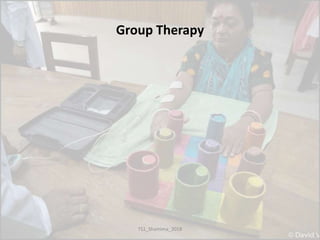
• It also represents individual and group treatment
session with effective therapeutic reasoning.
TS1_Shamima_2018
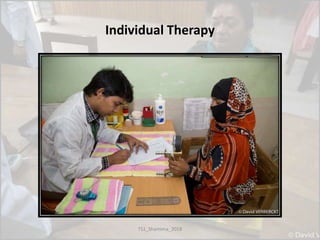
Individual Therapy
TS1_Shamima_2018
Group Therapy
TS1_Shamima_2018
THE LEGITIMATE TOOLS OF THERAPEUTIC SKILLS
• Therapeutic use of self
• Occupational therapy treatment process
• Occupational therapy treatment continuum
• Therapeutic use of activity
TS1_Shamima_2018
THE LEGITIMATE TOOLS OF THERAPEUTIC SKILLS
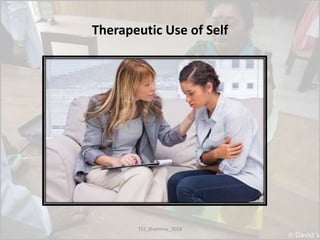
• Therapeutic use of self
- Therapeutic relationship/ Therapeutic rapport/Rapport building
through using unconditional acceptance, empathy, genuineness, attending
and listening, open-ended question and silence .
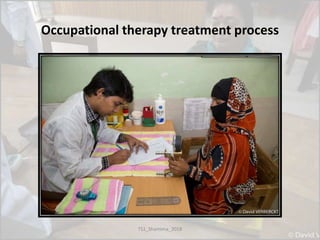
• Occupational therapy treatment process
- Assessment, planning, treatment implementation and evaluation
guidelines according to theoretical framework
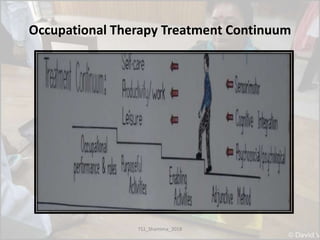
• Occupational therapy treatment continuum
- Different stages of treatment (Adjunctive method, Enabling activities,
Purposeful activity and Occupational performance & occupational roles)
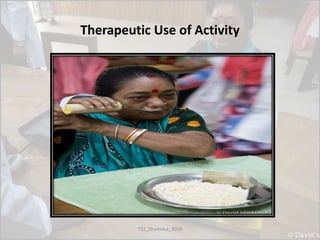
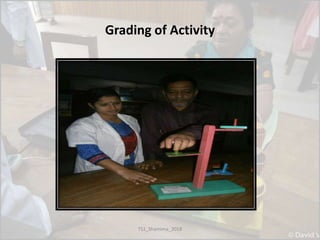
• Therapeutic use of activity
- Analysis, grading and adaptation of activity with an intention to use in
occupational therapy treatment process
TS1_Shamima_2018
Therapeutic Use of Self
TS1_Shamima_2018
Occupational therapy treatment process
TS1_Shamima_2018
Occupational Therapy Treatment Continuum
TS1_Shamima_2018
Therapeutic Use of Activity
TS1_Shamima_2018
Grading of Activity
TS1_Shamima_2018
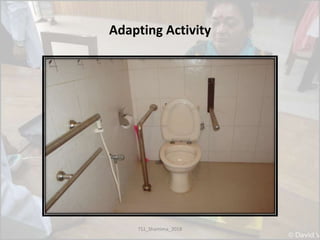
Adapting Activity
TS1_Shamima_2018
Terminology
• Legitimate- to make something legal or acceptable
• Unconditional- Complete & whole
• Preclusion- to prevent the presence, existence, or occurrence
of; make impossible
• Acceptance- Agreement that someone should be in group
• Empathy- the ability to share someone else's feelings or
experiences by imagining what it would be like to be in that
person's situation
• Genuineness- honest and sincere
• Attending and listening- to give attention to what someone is
saying
• Adapting- to change something to suit different conditions or
uses
TS1_Shamima_2018
Probable Questions
• Define occupational therapy. Why it is important to study
therapeutic skills in occupational therapy?
• What is therapeutic skills? Write down the legitimate
tools of therapeutic skills for practicing occupational
therapy?
• Define the following terminology:
– Skills
– Therapeutic
– Occupation
– Therapy
TS1_Shamima_2018
REFERENCE
• Trombly CA 1996, Occupational Therapy for
Physical Dysfunction, 5th ed, Mosby Company,
Philadelphia
• Radomski and Trombly-Latham 2008,
Occupational Therapy for Physical
Dysfunction (6th Ed). Philadelphia: Lippincott,
Williams and Wilkins.
• Radomski and Trombly-Latham 2014,
Occupational Therapy for Physical
Dysfunction (7th Ed). Philadelphia: Lippincott,
Williams and Wilkins.
TS1_Shamima_2018
THE MORE YOU
ASK THE MORE
YOU LEARN
EXAM ON THE NEXT CLASS!
TS1_Shamima_2018

Legitimate tools in occupational therapy

  • 2.
    THERAPEUTIC SKILLS IN OCCUPATIONALTHERAPY Shamima Akter B. Sc (Honours) in Occupational Therapy & M. Sc in Rehabilitation Science Assistant Professor, Department of Occupational Therapy Bangladesh Health Professions Institute (BHPI) Centre for the Rehabilitation of the Paralysed (CRP) Chapain, Savar
  • 3.
    – Instructor willsay her name using an adjective started with the first alphabet of her name – Next participant will remember her name and also say her own name according to previous rule. – Continuing among all… – Last participant will say all the name!!! – Good luck!!! TS1_Shamima_2018
  • 4.
    Ground Rules ofClass • Pin point silent • Eye contact with teacher • Prepare daily task daily • Keep confidentiality of classes • Zero tolerance for – Cheating – Talking with others during lecture – Absent in class without enough reason TS1_OPM_Shamima_2018
  • 6.
    OCCUPATION Occupation is everydaylife activities. It can be defined as an activity or task with which one occupies oneself. According to the Canadian Association of Occupational Therapists (cited in Radomski and Latham, 2014), occupation is… “Groups of activities and tasks of everyday life, named, organized and given value and meaning by individuals and a culture”. TS1_Shamima_2018
  • 7.
    OCCUPATION OCCUPATIONAccording to CanadianAssociation of Occupational Therapist, “Occupations are everything people do to occupy themselves, including looking after themselves (self- care), enjoying life (leisure), and contributing to the social and economic thread of their communities (productivity)”. (CAOT, 1997, pp. 31 & 181) TS1_Shamima_2018
  • 8.
    THERAPY It can bedefined as any form of treatment for any illness or disorder. For example, Antacid is a form of therapy for acidity, Rehabilitation is a form of therapy for drug addiction, Exercise is a form of therapy for obesity and Occupational therapy is a form of therapy for stroke patient. TS1_Shamima_2018
  • 9.
    OCCUPATIONAL THERAPY According toWorld Federation of Occupational Therapists (2012) “Occupational therapy is a client-centred health profession concerned with promoting health and well being through occupation. The primary goal of occupational therapy is to enable people to participate in the activities of everyday life. Occupational therapists achieve this outcome by working with people and communities to enhance their ability to engage in the occupations they want to, need to, or are expected to do, or by modifying the occupation or the environment to better support their occupational engagement”. TS1_Shamima_2018
  • 10.
    Occupational Science According toUniversity of British Columbia, – Occupational Science is the study of human participation/occupational engagement. – Research in this area often focuses on specific populations (such as children, the elderly, or those with MS) and their unique challenges to engage in meaningful activities. – Occupational scientists study ways of measuring participation, develop new and innovative methods of intervention to help individuals engage in activities, and examine the impact of participation on an individual’s health and well-being. TS1_Shamima_2018
  • 11.
    Occupational Deprivation • Accordingto a position statement by the Australian Occupational Therapy Association, – “a state of preclusion from engagement in occupations of necessity and/or meaning due to factors that stand outside the immediate control of the individual” (Whiteford, 2010, p. 201). – Physical, social, attitudinal, discriminatory, professional, institutional, racial, legislative, and political impediments to participation in any occupation that a person needs or wants to do could potentially be regarded as occupationally depriving. TS1_Shamima_2018
  • 12.
    Occupational Deprivation continue... Accordingto the Australian Occupational Therapy Association (AOTA), – individuals who are incarcerated – refugees and asylum seekers who are placed in detention and processing centres both in Australia and offshore – people with disability or mental illness – Aboriginal and Torres Strait Islander peoples – those living in geographically isolated environments (for example, Australian rural locations categorized as “remote”) – those living on or below the minimum income – people experiencing homelessness – people experiencing long term unemployment. TS1_Shamima_2018
  • 13.
    Occupational Justice • Occupationaljustice is a term that emphasizes rights, responsibilities, and liberties that enable the individual to experience health and quality of life through engagement in occupations (Townsend & Whiteford, 2005; Wilcock and Townsend, 2000). • In an occupationally just environment, individuals have access to adequate supports and resources to participate in occupations that are necessary and meaningful to them (Townsend & Wilcock, 2004). TS1_Shamima_2018
  • 14.
    Occupational Therapy ispracticed in- A wide range of public, private and voluntary sector settings, such as, • the person’s home environment; • schools; • Workplaces; • Health centers; • Supported accommodation; • Housing for seniors • Rehabilitation centers; • Hospitals; and • Forensic servicesTS1_Shamima_2018
  • 15.
    • Therapeutic: Therapeuticrefers to healing, such as a medicine or therapy that has healing or curative capability for treatment of disease or disability. • For example: therapeutic effect of yoga, therapeutic effect of exercise & therapeutic effect of sensory integration therapy TS1_Shamima_2018
  • 16.
    • Skill: Theability, coming from one's knowledge, practice, aptitude, etc., to do something well. • Competent in doing (Merriam-Webster Online, 2011, cited in Radomski and Latham, 2014, 7th ed., p19). • For example: grooming skill, writing skill TS1_Shamima_2018
  • 17.
    THERAPEUTIC SKILLS This presentsthe use of self and the use of occupation as therapeutic mediums to use in assessment and therapy session with effective therapeutic reasoning. For example: Activity analysis skill, rapport building skills, assessment skills and treatment skills TS1_Shamima_2018
  • 18.
    Importance of studyingtherapeutic skills • This subject presents the use of self and the use of activity as therapeutic mediums. • It also presents and discusses skills in analyzing, adapting and grading activities to use in assessment and therapy session. • It also presents awareness of activity demands, contexts and safe implementation of tasks by activity analysis. • It also represents individual and group treatment session with effective therapeutic reasoning. TS1_Shamima_2018
  • 19.
  • 20.
  • 21.
    THE LEGITIMATE TOOLSOF THERAPEUTIC SKILLS • Therapeutic use of self • Occupational therapy treatment process • Occupational therapy treatment continuum • Therapeutic use of activity TS1_Shamima_2018
  • 22.
    THE LEGITIMATE TOOLSOF THERAPEUTIC SKILLS • Therapeutic use of self - Therapeutic relationship/ Therapeutic rapport/Rapport building through using unconditional acceptance, empathy, genuineness, attending and listening, open-ended question and silence . • Occupational therapy treatment process - Assessment, planning, treatment implementation and evaluation guidelines according to theoretical framework • Occupational therapy treatment continuum - Different stages of treatment (Adjunctive method, Enabling activities, Purposeful activity and Occupational performance & occupational roles) • Therapeutic use of activity - Analysis, grading and adaptation of activity with an intention to use in occupational therapy treatment process TS1_Shamima_2018
  • 23.
    Therapeutic Use ofSelf TS1_Shamima_2018
  • 24.
    Occupational therapy treatmentprocess TS1_Shamima_2018
  • 25.
    Occupational Therapy TreatmentContinuum TS1_Shamima_2018
  • 26.
    Therapeutic Use ofActivity TS1_Shamima_2018
  • 27.
  • 28.
  • 29.
    Terminology • Legitimate- tomake something legal or acceptable • Unconditional- Complete & whole • Preclusion- to prevent the presence, existence, or occurrence of; make impossible • Acceptance- Agreement that someone should be in group • Empathy- the ability to share someone else's feelings or experiences by imagining what it would be like to be in that person's situation • Genuineness- honest and sincere • Attending and listening- to give attention to what someone is saying • Adapting- to change something to suit different conditions or uses TS1_Shamima_2018
  • 30.
    Probable Questions • Defineoccupational therapy. Why it is important to study therapeutic skills in occupational therapy? • What is therapeutic skills? Write down the legitimate tools of therapeutic skills for practicing occupational therapy? • Define the following terminology: – Skills – Therapeutic – Occupation – Therapy TS1_Shamima_2018
  • 31.
    REFERENCE • Trombly CA1996, Occupational Therapy for Physical Dysfunction, 5th ed, Mosby Company, Philadelphia • Radomski and Trombly-Latham 2008, Occupational Therapy for Physical Dysfunction (6th Ed). Philadelphia: Lippincott, Williams and Wilkins. • Radomski and Trombly-Latham 2014, Occupational Therapy for Physical Dysfunction (7th Ed). Philadelphia: Lippincott, Williams and Wilkins. TS1_Shamima_2018
  • 32.
    THE MORE YOU ASKTHE MORE YOU LEARN
  • 33.
    EXAM ON THENEXT CLASS! TS1_Shamima_2018