Humanities

   Dr. Mohammad Tawfik
  Aerospace Engineering
Department, Cairo University
The 7-Habbits of the
Highly Effective People
      Stephen Covey
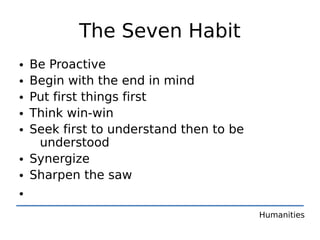
The Seven Habit
• Be Proactive
• Begin with the end in mind
• Put first things first
• Think win-win
• Seek first to understand then to be
   understood
• Synergize
• Sharpen the saw
•
                                        Humanities
Basic Needs of Life
•   Live
•   Love
•   Learn
•   Leave a legacy


                              Humanities
1- Be Proactive
Be Proactive
• Your life is a product of your values
    not your feelings
• Your life is a product of your
    decisions not your conditions
• You and I have the capacity to chose
    our response
•

                                  Humanities
Be Proactive
  You feel better when the weather is
    great 
  do better when you feel better 
  you carry your good weather within you
• Take initiative
• Be response-able
•

                                  Humanities
Freedom!
  Victor Frankel, psychologist
• The last human freedom “the power to
    chose my response to any condition”
• Between the stimulus and the response lies
    your freedom to chose the response
• We have control over our freedom not our
    liberty!
•

                                      Humanities
Circle of Influence
• Do not let the things you can do
   nothing about interfere with the
   things you can do a great deal about
•
• Focus on your circle of influence not
   your circle of concerns
•

                                 Humanities
I have to revenge!
• It is not the snake that hurts you, its chasing it that
    drives the poison to your heart
• It is not what people do to us that hurts us, it’s our
    chosen response that hurts us
• Reactive people think about how to get back on
    people who tried to hurt them
• “Nothing can make you feel inferior without your
    consent” Eleanor Roosevelt


                                                 Humanities
I am Response-able!
• Language of the proactive person: I
    chose to, I prefer to, yes, no, I will …
• Language of the reactive person: I
    have to, I must, If only, I can’t, I
    haven’t time
•
• You are the programmer

                                      Humanities
2- Begin with the end in
         mind
Begin with the end in mind
• What is the purpose of what you are
   doing?
• What is the purpose of our
   organization?
• What is the purpose of my life?
• What is it that I am about?
•

                                Humanities
Develop a mission
          statement
• Let it become your eye glasses 
    you see everything through it
• Let it be timeless
• It works Regardless of the situation
• It Deals with both ends and means


                                  Humanities
The 10 Natural Laws of
Successful Life and Time
     Management
      Hyrum Smith
. Managing Your Time
• Law 1: You control your life by controlling
    your time.
• Law 2: Your governing values are the
    foundation of personal fulfilment.
• Law 3: When your daily activities reflect
    your governing values, you experience
    inner peace.
• Law 4: To reach any significant goal, you
    must leave your comfort zone.
• Law 5: Daily planning leverages time
    through increased focus.
                                       Humanities
Managing Your Life
• Law 6: Your behaviour is a reflection of what
    you truly believe.
• Law 7: You satisfy needs when your beliefs are
    in line with reality.
• Law 8: Negative behaviours are overcome by
    changing incorrect beliefs.
• Law 9: Your self-esteem must ultimately come
    from within.
• Law 10: Give more and you’ll have more.


                                          Humanities
3- Put first things first
Put first things first
• Focus on relationships rather than
   schedules
• Focus on leadership not
   management
• Focus on your roles in life
•


                                 Humanities
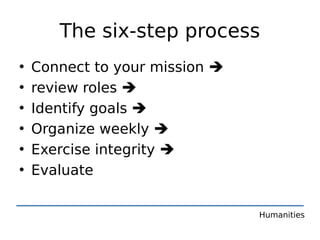
The six-step process
•   Connect to your mission 
•   review roles 
•   Identify goals 
•   Organize weekly 
•   Exercise integrity 
•   Evaluate


                                Humanities
4- Think Win-Win
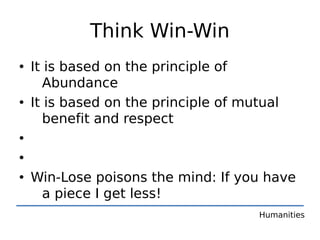
Think Win-Win
• It is based on the principle of
    Abundance
• It is based on the principle of mutual
    benefit and respect
•
•
• Win-Lose poisons the mind: If you have
    a piece I get less!
                                  Humanities
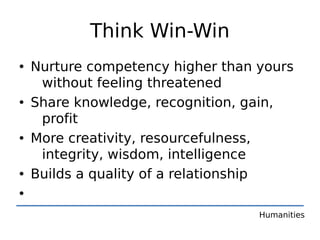
Think Win-Win
• Nurture competency higher than yours
   without feeling threatened
• Share knowledge, recognition, gain,
   profit
• More creativity, resourcefulness,
   integrity, wisdom, intelligence
• Builds a quality of a relationship
•
                                 Humanities
Think Win-Win
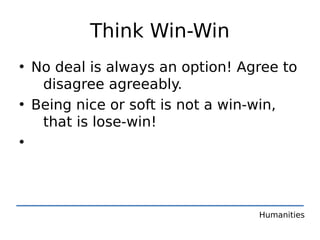
• No deal is always an option! Agree to
   disagree agreeably.
• Being nice or soft is not a win-win,
   that is lose-win!
•


                                 Humanities
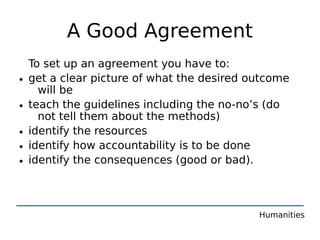
A Good Agreement
    To set up an agreement you have to:
•   get a clear picture of what the desired outcome
      will be
•   teach the guidelines including the no-no’s (do
      not tell them about the methods)
•   identify the resources
•   identify how accountability is to be done
•   identify the consequences (good or bad).


                                             Humanities
5- Seek first to understand
  then to be understood
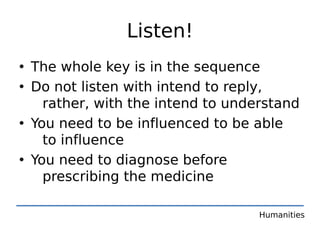
Listen!
• The whole key is in the sequence
• Do not listen with intend to reply,
    rather, with the intend to understand
• You need to be influenced to be able
    to influence
• You need to diagnose before
    prescribing the medicine

                                   Humanities
Understand!
• It requires patience and openness
• It requires a lot of time, but it saves a
    lot of time on the long run
• Understanding does not mean that
    you agree … it means that you
    accept the other
• Relationships are more important than
    efficiency
                                     Humanities
6- Synergize
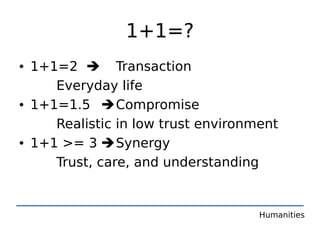
1+1=?
• 1+1=2  Transaction
     Everyday life
• 1+1=1.5  Compromise
     Realistic in low trust environment
• 1+1 >= 3  Synergy
     Trust, care, and understanding


                                    Humanities
Differences
•   Do not respect differences!
•   Do not accept differences!
•   Do not tolerate differences!
•
•   CELEBRATE differences!
•


                                   Humanities
Be Objective!
• The key to objectivity is to realize
    that we are subjective!
• You see the world as you are, not as
    it is
• You look through the eyeglasses of
    your experience!


                                 Humanities
The Fruit
• Think win-win is the root 
• Seek first to understand is the rout 
• Synergize is the fruit
•


                                  Humanities
7- Sharpen the Saw
Sharpen the Saw
• “I am busy sawing, stupid!”
•
• The habit of renewal
•
• Keep the balance between productivity
    and productive capability
•

                                  Humanities
Our four dimensions
    Body
•   Exercise, nutrition
    Mind
•   Reading, less television, writing, keep a journal
    Spirit
•   renew your value system, work on your mission
      statement, get out of home, pray,
    Relationships
•   Rebuild broken relationships, strengthen existing
      ones

                                              Humanities

Genn001 - The Seven Habbits

  • 1.
    Humanities Dr. Mohammad Tawfik Aerospace Engineering Department, Cairo University
  • 2.
    The 7-Habbits ofthe Highly Effective People Stephen Covey
  • 3.
    The Seven Habit •Be Proactive • Begin with the end in mind • Put first things first • Think win-win • Seek first to understand then to be understood • Synergize • Sharpen the saw • Humanities
  • 4.
    Basic Needs ofLife • Live • Love • Learn • Leave a legacy Humanities
  • 5.
  • 6.
    Be Proactive • Yourlife is a product of your values not your feelings • Your life is a product of your decisions not your conditions • You and I have the capacity to chose our response • Humanities
  • 7.
    Be Proactive You feel better when the weather is great  do better when you feel better  you carry your good weather within you • Take initiative • Be response-able • Humanities
  • 8.
    Freedom! VictorFrankel, psychologist • The last human freedom “the power to chose my response to any condition” • Between the stimulus and the response lies your freedom to chose the response • We have control over our freedom not our liberty! • Humanities
  • 9.
    Circle of Influence •Do not let the things you can do nothing about interfere with the things you can do a great deal about • • Focus on your circle of influence not your circle of concerns • Humanities
  • 10.
    I have torevenge! • It is not the snake that hurts you, its chasing it that drives the poison to your heart • It is not what people do to us that hurts us, it’s our chosen response that hurts us • Reactive people think about how to get back on people who tried to hurt them • “Nothing can make you feel inferior without your consent” Eleanor Roosevelt Humanities
  • 11.
    I am Response-able! •Language of the proactive person: I chose to, I prefer to, yes, no, I will … • Language of the reactive person: I have to, I must, If only, I can’t, I haven’t time • • You are the programmer Humanities
  • 12.
    2- Begin withthe end in mind
  • 13.
    Begin with theend in mind • What is the purpose of what you are doing? • What is the purpose of our organization? • What is the purpose of my life? • What is it that I am about? • Humanities
  • 14.
    Develop a mission statement • Let it become your eye glasses  you see everything through it • Let it be timeless • It works Regardless of the situation • It Deals with both ends and means Humanities
  • 15.
    The 10 NaturalLaws of Successful Life and Time Management Hyrum Smith
  • 16.
    . Managing YourTime • Law 1: You control your life by controlling your time. • Law 2: Your governing values are the foundation of personal fulfilment. • Law 3: When your daily activities reflect your governing values, you experience inner peace. • Law 4: To reach any significant goal, you must leave your comfort zone. • Law 5: Daily planning leverages time through increased focus. Humanities
  • 17.
    Managing Your Life •Law 6: Your behaviour is a reflection of what you truly believe. • Law 7: You satisfy needs when your beliefs are in line with reality. • Law 8: Negative behaviours are overcome by changing incorrect beliefs. • Law 9: Your self-esteem must ultimately come from within. • Law 10: Give more and you’ll have more. Humanities
  • 18.
    3- Put firstthings first
  • 19.
    Put first thingsfirst • Focus on relationships rather than schedules • Focus on leadership not management • Focus on your roles in life • Humanities
  • 20.
    The six-step process • Connect to your mission  • review roles  • Identify goals  • Organize weekly  • Exercise integrity  • Evaluate Humanities
  • 21.
  • 22.
    Think Win-Win • Itis based on the principle of Abundance • It is based on the principle of mutual benefit and respect • • • Win-Lose poisons the mind: If you have a piece I get less! Humanities
  • 23.
    Think Win-Win • Nurturecompetency higher than yours without feeling threatened • Share knowledge, recognition, gain, profit • More creativity, resourcefulness, integrity, wisdom, intelligence • Builds a quality of a relationship • Humanities
  • 24.
    Think Win-Win • Nodeal is always an option! Agree to disagree agreeably. • Being nice or soft is not a win-win, that is lose-win! • Humanities
  • 25.
    A Good Agreement To set up an agreement you have to: • get a clear picture of what the desired outcome will be • teach the guidelines including the no-no’s (do not tell them about the methods) • identify the resources • identify how accountability is to be done • identify the consequences (good or bad). Humanities
  • 26.
    5- Seek firstto understand then to be understood
  • 27.
    Listen! • The wholekey is in the sequence • Do not listen with intend to reply, rather, with the intend to understand • You need to be influenced to be able to influence • You need to diagnose before prescribing the medicine Humanities
  • 28.
    Understand! • It requirespatience and openness • It requires a lot of time, but it saves a lot of time on the long run • Understanding does not mean that you agree … it means that you accept the other • Relationships are more important than efficiency Humanities
  • 29.
  • 30.
    1+1=? • 1+1=2 Transaction Everyday life • 1+1=1.5  Compromise Realistic in low trust environment • 1+1 >= 3  Synergy Trust, care, and understanding Humanities
  • 31.
    Differences • Do not respect differences! • Do not accept differences! • Do not tolerate differences! • • CELEBRATE differences! • Humanities
  • 32.
    Be Objective! • Thekey to objectivity is to realize that we are subjective! • You see the world as you are, not as it is • You look through the eyeglasses of your experience! Humanities
  • 33.
    The Fruit • Thinkwin-win is the root  • Seek first to understand is the rout  • Synergize is the fruit • Humanities
  • 34.
  • 35.
    Sharpen the Saw •“I am busy sawing, stupid!” • • The habit of renewal • • Keep the balance between productivity and productive capability • Humanities
  • 36.
    Our four dimensions Body • Exercise, nutrition Mind • Reading, less television, writing, keep a journal Spirit • renew your value system, work on your mission statement, get out of home, pray, Relationships • Rebuild broken relationships, strengthen existing ones Humanities