Emotional Intelligence
Impact of organisation
change
•New organisational realities
mean that managers are being
judged by a new yardstick.
•To be successful you need to be
emotionally intelligent.
How others see it
For leadership positions, emotional
intelligence competencies account
for up to 85% of what sets
outstanding managers apart from
the average.
Daniel Goleman, Working with Emotional Intelligence,
1998.
Aims of this course
•Provide a framework for understanding
EI
•Illustrate ways in which to begin to
develop your EI capabilities
•Offer you an opportunity to assess
your EI
•Stimulate reflection
•Outline guidelines on how to use EI
This Course
It is designed as a route map,
with signposts for those who
want to pursue their EI journey
further.
What is emotional intelligence?
•Knowing how you and others feel and what
to do about it
•Knowing what feels good and what feels bad
and how to get from bad to good
•Possessing emotional awareness, sensitivity
and the skills that will help us to stay positive
Why is EI so popular?
•Changing nature of work
•Increasing complexity
•Rising competition
•Globalisation of markets
•Rapid pace of change
•Rising stress levels
•Redefining what it means to be a success
•Increasing emphasis on performance
•Increased talk about emotions
US Research:
The Centre for Creative Leadership
identified that the primary cause of
career derailment amongst top
executives was the lack of EI
Recent UK Research:
•Police officers who are able to identify and
manage emotions report lower levels of
stress (Goldsmiths College, London, 2000)
•Public Sector Housing Officers report greater
levels of cohesion, collaboration and sense of
identity following team EI intervention
(Chapman, 2004;2005)
Hard case for soft skills
•Two-thirds of stress-related problems
result from abusive, unsatisfying,
limiting or ill-defined relationships.
•In the EU 8% of employees have faced
bullying
Hard case for soft skills (continued)
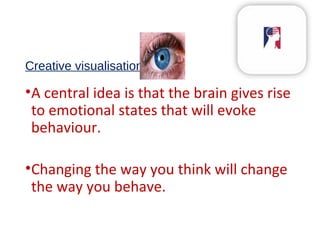
•Assertiveness, empathy and happiness, are
more predictive of sales success than sales
techniques
•Studies of 500 organisations worldwide
indicate that people who score highest on
EI measures rise to the top of organisations
Five Step Model to EI
Intrapersonal
•1.Self-awareness
•2.Emotional management
•3.Self-motivation
Interpersonal
•4.Relationship management
•5.Emotion coaching
Model Approach to become EI
You do this by focusing on the five
core capabilities, each one taking
you on a step closer towards EI.
Step 1: Self-Awareness
There is only one corner of the
universe that you can be certain of
improving: and that is your own
self.
Aldous Huxley
Be aware of our:
•Goals, immediate and long-term
•Beliefs, about ourselves and others
•Values, those things we hold clear
•Drivers that effect how we work
•Rules, that we live by
•Self-talk
Who am I as a manager? –
Internal Dimensions
•Self-talk
•Beliefs – about self and others
•Emotions – own and others
•Hot buttons (emotional triggers)
•Fears and anxieties
•Judgements
•Self-confidence
•Driver behaviour
•Rules
Who am I as a manager? –
External Dimensions
•Personal style
•Skills
•Physical presence
•Impact on others
•Energy levels
•Non-verbal behaviour
Self-Awareness Example
•You have been asked to carry out a particularly
difficult project usually given to more
experience colleagues.
•You achieve the task on time and within
budget.
•You feel relieved and proud.
•Your boss gives you no thanks or praise and
picks up a minor fault.
Self-Awareness Example
(continued)
•You then feel angry and decide that you
are never again going to put yourself
out.
•You think about leaving the company
How to identify your emotional
responses
•Tuning into your senses
•Getting in touch with your feelings
•Knowing your goals
Tuning into your senses
•This means paying attention to what
you see and hear and not what you
think you see and hear.
•Your beliefs, values, drivers and rules
act as filters, distorting and deleting
what otherwise might be important
information.
Tuning into your senses
- example
•For example, going back to the scenario with
your boss, did she actually pick up on a minor
error or was that just perception?
•The higher your level of self-awareness, the
greater your ability to recognise and
distinguish between what is fact and what is
the result of a filter.
Recognise your map
•The Map Is Not The Territory (Alfred
Korzybski, Science & Sanity, 1933)
•People act from their map as opposed to
reality.
•Recognise your map and you open up infinite
possibilities of seeing the world in new ways.
Gauging the mood - seeing
•Pay attention to how people look at one
another whilst they are speaking or listening.
•Does the speaker look at everyone or just
focus on one individual?
•Do listeners stay focused or do their eyes
wander?
•Do you see people smile, smirk, frown or
glare?
Gauging the mood - hearing
•Tune into the sounds in the room
•When a person speaks, is there quiet except for
the person’s voice or do you hear people
moving in their chairs?
•Do people speak stridently or hesitantly?
•Do you hear a lot of mumbled conversations
while someone is talking?
•Do people yell or whisper, moan or interrupt?
Assess information collected
•Was the team enthusiastic?
•Did they seem pleased that management was
willing to try some new ideas?
•Did they appear to want to work together as
a group to implement the changes?
•Did they all appear to grasp the importance
of making the changes?
Emotions
1. What we think
2. What we feel
3. How our bodies react
4. How we behave
Getting in touch with your feelings
•Although our feelings are internal, they
are often accompanied by outward
manifestations.
•By paying attention to theses external
signals, you can begin to understand
what these feelings mean for you.
Certain feelings drive particular behaviours
•Retrace the link between a physical
response, your interpretation and the feeling
•You can then identify your emotional
responses in any given situation.
•Record changes in your emotional state by
keeping a feeling diary.
Keep a feeling diary
•Date/Time
•Automatic thought(s)
•Emotion(s)
•Response
•Outcome(s)
Feeling diary example
Date/Time:
•Mon 18th
0900
Automatic thought(s):
•Presentation to the board on the new
product launch.
•I’ve really not had enough time to prepare
Feeling diary example
(continued)
Emotion(s):
•She (boss) should have done this presentation
•I’m going to blow it; I know the Finance Director has
it in for me
Response(s):
•Anxiety
Outcome(s):
•Just managed to get through
Consider these questions:
1.What is the evidence that the automatic thought is
true?
2.Could there be an alternative explanation?
3.What is the worst that could happen?
4.What’s the best that could happen?
Consider these questions:
(continued)
5.What should I do about it?
6.What is the effect of my believing the
automatic thoughts?
7.What could be the effect of changing my
thinking?
8.If you were in this situation, what would you
think/feel/do?
Let’s look at the example again
Date/Time: Mon 18th
0900
Automatic thought(s):
•Presentation to the board on the new product
launch.
•Short notice but done my best within time available
•Slight churning in stomach
Emotion(s):
•Team has worked hard and I really believe in our
approach
•Feel positive
Let’s look at the example again:
(continued)
Response(s):
•Adrenalin pumping, to be expected
•Feel anxious but I am going to knock them
dead
Outcome(s):
•Presentation went great
•Got the go-ahead to move to launch date
Knowing your goals
•Our goals are what spur us into action.
•This will help us develop the strategies
necessary to get what we really, really
want.
Knowing your goals - Example
•You receive a call from an associate who
asks you to stand in for him on a project
in a week’s time.
•You’ve recently freed up your diary so
you could physically do it.
Do you:
•Agree but feel guilty because you have
moved other commitments
•Say no because you have commitments
•You will see what you can do and then
get back to him (saying no)
What are the implications?
• In the first case, your underlying motives
might be the need to achieve approval
• In the second, you are prepared to be
assertive to achieve your goals
• In the third, you are engaging in avoidance
behaviour
Believe your behaviour
•Listen to the answer and observe your
behaviour.
•This might reveal your true intentions.
Trust your feelings
•When you feel happy, it is likely that
you are in alignment with your inner-
and outer-self.
•However, it could well be that your
original intention is in conflict with
some underlying goal.
Be honest with yourself
•Are you harbouring any hidden
agendas?
•Find out who you are, where you have
come from and why you are here.
Steps to setting exceptional goals
1. State your goal in the positive
2. Own it
3. Make it sensory specific
4. Check the ecology
5. Identify the resources you need
Remembered by POSIE
•Positive statement
•Owned by the initiator (you)
•Sensory-based
•Intention preserved
•Ecology check
Step 2: Emotion Management
There is nothing either good or bad but
thinking makes it so.
William Shakespeare, Hamlet
Step 2: Emotion Management
Managing our emotions effectively involves
controlling those unproductive behaviours.
Key EI Capability
•Understand the link between your
interpretation of an event and your
responses to it
•Then, you can choose an alternative way to
feel.
•This is a key EI capability.
The Dynamics of Emotion
Activating event:
•Real
•Imagined
Belief/Interpretation:
•Rational Response
•Irrational Response
Consequences/Reaction:
•Evokes Feelings
•Leads to Behaviour
Choose how you see a situation
•As the Greek philosopher Epictetus said,
‘People are disturbed not only by things, but
by the views they take of them’.
•What this means is that you can choose how you
see a situation.
Our Map of Reality
•Remember, our beliefs, values, drivers and
the rules we live by create our map of reality.
•Change the map and you change how you
see, hear, feel and behave in the world.
Worry Buster
Technique
•Where is the evidence for the way I am
thinking?
•What is the logic in my interpretation?
•What do I have to lose if I do/say this?
•What do I have to gain if I do/say this?
•What would be the worst that could happen
if I do/don’t say of do this?
•What can I learn from saying/doing this?
Applying the worry buster technique
1. Specify the situation/problem
2. What is the worst that can happen?
3. Will it kill me?
4. Write a statement resolving to accept the
worst should it occur
5. Consider what specific steps you will take
immediately
Learn to live with worries
•Live one day at a time
•Get the facts
•Practise the worry buster technique
•Adopt the six-second rule
5 step freeze-frame technique
1.Freeze-frame stressful feelings
2.Focus away from the disturbing emotion(s)
3.Recall a positive feeling that you have had
4.What’s a more effective response?
5.Listen and do what your heart says
Step 3: Self-Motivation
In order to achieve high levels of motivation
we need to be able to:
•manage our own internal states
•harness our emotions
•channel them to achieve our objectives.
Being self-motivated
Being self-motivated calls for four essential
actions:
•Adopt positive self-talk
•Build an effective support network (the ‘A’
team)
•Visualise an inspirational Mentor
•Create a conducive Environment
Adopt positive self-talk
To develop an excellent inner-voice
follow Janet’s example that follows.
Janet’s goal is to increase her
self-esteem so she writes:
•I, Janet, am more and more pleasing to myself
every day.
•You, Janet, are more and more pleasing to
yourself every day.
•She, Janet, is more and more pleasing to herself
every day.
Affirmations
•Our current views of ourselves are formed by
what we tell ourselves, what others tell us
and what others say about us.
•Affirmations are always written in the
positive sense.
Suggested statements for self-talk:
•I am beautiful and loveable
•I am talented, intelligent and creative
•I am growing cleverer every day
•I have much to offer, and others recognise
this
State of flow
Daniel Goleman describes flow as the
harnessing of our emotions to achieve
superior performance and learning.
Visualise an inspirational mentor
1. Think of someone inspirational
2. Create an image of that person in your mind’s
eye at their most inspiring
3. Imagine they are on a TV screen
4. Introduce a key word, a touch or gesture that
you can use as a trigger for this image
Visualise an inspirational mentor
(continued)
5. Repeat a number of times
6. Test out your visualisation
Developing your emotional intelligence
means accessing all of the psychic
resources you have available.
Creative visualisation
•A central idea is that the brain gives rise
to emotional states that will evoke
behaviour.
•Changing the way you think will change
the way you behave.
Create an EI environment
• 1.Healthy and helpful
• 2.Light
• 3.Contains motivators
• 4.Organised
Well-chosen music
Well-chosen music can lead to:
•Lower levels of stress
•Improvements in long-term memory
•Higher levels of creativity
•Enhanced learning
•Desired emotional states
www.americanmindcarereformcenterllc.com

Emotional Intelligence

  • 2.
  • 3.
    Impact of organisation change •Neworganisational realities mean that managers are being judged by a new yardstick. •To be successful you need to be emotionally intelligent.
  • 4.
    How others seeit For leadership positions, emotional intelligence competencies account for up to 85% of what sets outstanding managers apart from the average. Daniel Goleman, Working with Emotional Intelligence, 1998.
  • 5.
    Aims of thiscourse •Provide a framework for understanding EI •Illustrate ways in which to begin to develop your EI capabilities •Offer you an opportunity to assess your EI •Stimulate reflection •Outline guidelines on how to use EI
  • 6.
    This Course It isdesigned as a route map, with signposts for those who want to pursue their EI journey further.
  • 7.
    What is emotionalintelligence? •Knowing how you and others feel and what to do about it •Knowing what feels good and what feels bad and how to get from bad to good •Possessing emotional awareness, sensitivity and the skills that will help us to stay positive
  • 8.
    Why is EIso popular? •Changing nature of work •Increasing complexity •Rising competition •Globalisation of markets •Rapid pace of change •Rising stress levels •Redefining what it means to be a success •Increasing emphasis on performance •Increased talk about emotions
  • 9.
    US Research: The Centrefor Creative Leadership identified that the primary cause of career derailment amongst top executives was the lack of EI
  • 10.
    Recent UK Research: •Policeofficers who are able to identify and manage emotions report lower levels of stress (Goldsmiths College, London, 2000) •Public Sector Housing Officers report greater levels of cohesion, collaboration and sense of identity following team EI intervention (Chapman, 2004;2005)
  • 11.
    Hard case forsoft skills •Two-thirds of stress-related problems result from abusive, unsatisfying, limiting or ill-defined relationships. •In the EU 8% of employees have faced bullying
  • 12.
    Hard case forsoft skills (continued) •Assertiveness, empathy and happiness, are more predictive of sales success than sales techniques •Studies of 500 organisations worldwide indicate that people who score highest on EI measures rise to the top of organisations
  • 13.
    Five Step Modelto EI Intrapersonal •1.Self-awareness •2.Emotional management •3.Self-motivation Interpersonal •4.Relationship management •5.Emotion coaching
  • 14.
    Model Approach tobecome EI You do this by focusing on the five core capabilities, each one taking you on a step closer towards EI.
  • 15.
    Step 1: Self-Awareness Thereis only one corner of the universe that you can be certain of improving: and that is your own self. Aldous Huxley
  • 16.
    Be aware ofour: •Goals, immediate and long-term •Beliefs, about ourselves and others •Values, those things we hold clear •Drivers that effect how we work •Rules, that we live by •Self-talk
  • 17.
    Who am Ias a manager? – Internal Dimensions •Self-talk •Beliefs – about self and others •Emotions – own and others •Hot buttons (emotional triggers) •Fears and anxieties •Judgements •Self-confidence •Driver behaviour •Rules
  • 18.
    Who am Ias a manager? – External Dimensions •Personal style •Skills •Physical presence •Impact on others •Energy levels •Non-verbal behaviour
  • 19.
    Self-Awareness Example •You havebeen asked to carry out a particularly difficult project usually given to more experience colleagues. •You achieve the task on time and within budget. •You feel relieved and proud. •Your boss gives you no thanks or praise and picks up a minor fault.
  • 20.
    Self-Awareness Example (continued) •You thenfeel angry and decide that you are never again going to put yourself out. •You think about leaving the company
  • 21.
    How to identifyyour emotional responses •Tuning into your senses •Getting in touch with your feelings •Knowing your goals
  • 22.
    Tuning into yoursenses •This means paying attention to what you see and hear and not what you think you see and hear. •Your beliefs, values, drivers and rules act as filters, distorting and deleting what otherwise might be important information.
  • 23.
    Tuning into yoursenses - example •For example, going back to the scenario with your boss, did she actually pick up on a minor error or was that just perception? •The higher your level of self-awareness, the greater your ability to recognise and distinguish between what is fact and what is the result of a filter.
  • 24.
    Recognise your map •TheMap Is Not The Territory (Alfred Korzybski, Science & Sanity, 1933) •People act from their map as opposed to reality. •Recognise your map and you open up infinite possibilities of seeing the world in new ways.
  • 25.
    Gauging the mood- seeing •Pay attention to how people look at one another whilst they are speaking or listening. •Does the speaker look at everyone or just focus on one individual? •Do listeners stay focused or do their eyes wander? •Do you see people smile, smirk, frown or glare?
  • 26.
    Gauging the mood- hearing •Tune into the sounds in the room •When a person speaks, is there quiet except for the person’s voice or do you hear people moving in their chairs? •Do people speak stridently or hesitantly? •Do you hear a lot of mumbled conversations while someone is talking? •Do people yell or whisper, moan or interrupt?
  • 27.
    Assess information collected •Wasthe team enthusiastic? •Did they seem pleased that management was willing to try some new ideas? •Did they appear to want to work together as a group to implement the changes? •Did they all appear to grasp the importance of making the changes?
  • 28.
    Emotions 1. What wethink 2. What we feel 3. How our bodies react 4. How we behave
  • 29.
    Getting in touchwith your feelings •Although our feelings are internal, they are often accompanied by outward manifestations. •By paying attention to theses external signals, you can begin to understand what these feelings mean for you.
  • 30.
    Certain feelings driveparticular behaviours •Retrace the link between a physical response, your interpretation and the feeling •You can then identify your emotional responses in any given situation. •Record changes in your emotional state by keeping a feeling diary.
  • 31.
    Keep a feelingdiary •Date/Time •Automatic thought(s) •Emotion(s) •Response •Outcome(s)
  • 32.
    Feeling diary example Date/Time: •Mon18th 0900 Automatic thought(s): •Presentation to the board on the new product launch. •I’ve really not had enough time to prepare
  • 33.
    Feeling diary example (continued) Emotion(s): •She(boss) should have done this presentation •I’m going to blow it; I know the Finance Director has it in for me Response(s): •Anxiety Outcome(s): •Just managed to get through
  • 34.
    Consider these questions: 1.Whatis the evidence that the automatic thought is true? 2.Could there be an alternative explanation? 3.What is the worst that could happen? 4.What’s the best that could happen?
  • 35.
    Consider these questions: (continued) 5.Whatshould I do about it? 6.What is the effect of my believing the automatic thoughts? 7.What could be the effect of changing my thinking? 8.If you were in this situation, what would you think/feel/do?
  • 36.
    Let’s look atthe example again Date/Time: Mon 18th 0900 Automatic thought(s): •Presentation to the board on the new product launch. •Short notice but done my best within time available •Slight churning in stomach Emotion(s): •Team has worked hard and I really believe in our approach •Feel positive
  • 37.
    Let’s look atthe example again: (continued) Response(s): •Adrenalin pumping, to be expected •Feel anxious but I am going to knock them dead Outcome(s): •Presentation went great •Got the go-ahead to move to launch date
  • 38.
    Knowing your goals •Ourgoals are what spur us into action. •This will help us develop the strategies necessary to get what we really, really want.
  • 39.
    Knowing your goals- Example •You receive a call from an associate who asks you to stand in for him on a project in a week’s time. •You’ve recently freed up your diary so you could physically do it.
  • 40.
    Do you: •Agree butfeel guilty because you have moved other commitments •Say no because you have commitments •You will see what you can do and then get back to him (saying no)
  • 41.
    What are theimplications? • In the first case, your underlying motives might be the need to achieve approval • In the second, you are prepared to be assertive to achieve your goals • In the third, you are engaging in avoidance behaviour
  • 42.
    Believe your behaviour •Listento the answer and observe your behaviour. •This might reveal your true intentions.
  • 43.
    Trust your feelings •Whenyou feel happy, it is likely that you are in alignment with your inner- and outer-self. •However, it could well be that your original intention is in conflict with some underlying goal.
  • 44.
    Be honest withyourself •Are you harbouring any hidden agendas? •Find out who you are, where you have come from and why you are here.
  • 45.
    Steps to settingexceptional goals 1. State your goal in the positive 2. Own it 3. Make it sensory specific 4. Check the ecology 5. Identify the resources you need
  • 46.
    Remembered by POSIE •Positivestatement •Owned by the initiator (you) •Sensory-based •Intention preserved •Ecology check
  • 47.
    Step 2: EmotionManagement There is nothing either good or bad but thinking makes it so. William Shakespeare, Hamlet
  • 48.
    Step 2: EmotionManagement Managing our emotions effectively involves controlling those unproductive behaviours.
  • 49.
    Key EI Capability •Understandthe link between your interpretation of an event and your responses to it •Then, you can choose an alternative way to feel. •This is a key EI capability.
  • 50.
    The Dynamics ofEmotion Activating event: •Real •Imagined Belief/Interpretation: •Rational Response •Irrational Response Consequences/Reaction: •Evokes Feelings •Leads to Behaviour
  • 51.
    Choose how yousee a situation •As the Greek philosopher Epictetus said, ‘People are disturbed not only by things, but by the views they take of them’. •What this means is that you can choose how you see a situation.
  • 52.
    Our Map ofReality •Remember, our beliefs, values, drivers and the rules we live by create our map of reality. •Change the map and you change how you see, hear, feel and behave in the world.
  • 53.
    Worry Buster Technique •Where isthe evidence for the way I am thinking? •What is the logic in my interpretation? •What do I have to lose if I do/say this? •What do I have to gain if I do/say this? •What would be the worst that could happen if I do/don’t say of do this? •What can I learn from saying/doing this?
  • 54.
    Applying the worrybuster technique 1. Specify the situation/problem 2. What is the worst that can happen? 3. Will it kill me? 4. Write a statement resolving to accept the worst should it occur 5. Consider what specific steps you will take immediately
  • 55.
    Learn to livewith worries •Live one day at a time •Get the facts •Practise the worry buster technique •Adopt the six-second rule
  • 56.
    5 step freeze-frametechnique 1.Freeze-frame stressful feelings 2.Focus away from the disturbing emotion(s) 3.Recall a positive feeling that you have had 4.What’s a more effective response? 5.Listen and do what your heart says
  • 57.
    Step 3: Self-Motivation Inorder to achieve high levels of motivation we need to be able to: •manage our own internal states •harness our emotions •channel them to achieve our objectives.
  • 58.
    Being self-motivated Being self-motivatedcalls for four essential actions: •Adopt positive self-talk •Build an effective support network (the ‘A’ team) •Visualise an inspirational Mentor •Create a conducive Environment
  • 59.
    Adopt positive self-talk Todevelop an excellent inner-voice follow Janet’s example that follows.
  • 60.
    Janet’s goal isto increase her self-esteem so she writes: •I, Janet, am more and more pleasing to myself every day. •You, Janet, are more and more pleasing to yourself every day. •She, Janet, is more and more pleasing to herself every day.
  • 61.
    Affirmations •Our current viewsof ourselves are formed by what we tell ourselves, what others tell us and what others say about us. •Affirmations are always written in the positive sense.
  • 62.
    Suggested statements forself-talk: •I am beautiful and loveable •I am talented, intelligent and creative •I am growing cleverer every day •I have much to offer, and others recognise this
  • 63.
    State of flow DanielGoleman describes flow as the harnessing of our emotions to achieve superior performance and learning.
  • 64.
    Visualise an inspirationalmentor 1. Think of someone inspirational 2. Create an image of that person in your mind’s eye at their most inspiring 3. Imagine they are on a TV screen 4. Introduce a key word, a touch or gesture that you can use as a trigger for this image
  • 65.
    Visualise an inspirationalmentor (continued) 5. Repeat a number of times 6. Test out your visualisation
  • 66.
    Developing your emotionalintelligence Developing your emotional intelligence means accessing all of the psychic resources you have available.
  • 67.
    Creative visualisation •A centralidea is that the brain gives rise to emotional states that will evoke behaviour. •Changing the way you think will change the way you behave.
  • 68.
    Create an EIenvironment • 1.Healthy and helpful • 2.Light • 3.Contains motivators • 4.Organised
  • 69.
    Well-chosen music Well-chosen musiccan lead to: •Lower levels of stress •Improvements in long-term memory •Higher levels of creativity •Enhanced learning •Desired emotional states www.americanmindcarereformcenterllc.com

Editor's Notes

  • #4 Impact of organisation change It was Aristotle who spoke about a rare ability to be angry with the right person, to the right degree, at the right time, for the right purpose and in the right way. How prophetic his words. Everything we know about organisations has changed. Once, working life was stable but a whole new lexicon has developed that includes such euphemisms as downsizing, rightsizing, delayering and restructuring to describe the present state of chaos and complexity. These new organisational realities mean that managers are being judged by a new yardstick. To be successful you don’t just need to be intelligent, you need to be emotionally intelligent.
  • #5 How others see it For leadership positions emotional intelligence competencies account for up to 85% of what sets outstanding managers apart from the average. Daniel Goleman, Working with Emotional Intelligence, 1998.
  • #6 Aims of this course Introduce emotional intelligence (EI) by defining what it is and explaining why it is important. Provide a framework for understanding EI Illustrate ways in which to begin to develop your EI capabilities Offer you an opportunity to assess your EI Stimulate reflection on the changing nature of organisations and your role as a manager Outline guidelines on how to use EI as an organisational change management strategy.
  • #7 This Course This course is not a definitive guide to what is a rapidly growing field. It is designed as a route map, with signposts for those who want to pursue their EI journey further.
  • #8 What is emotional intelligence? The original theory of emotional intelligence was developed by two US psychologists. Peter Salovey and John Mayer in 1990 who defined this as a learned ability to perceive, understand and express our feelings accurately and to control our emotions so that they work for us, not against us. In other words, no matter whose definition you use, EI is about: Knowing how you and others feel and what to do about it Knowing what feels good and what feels bad and how to get from bad to good Possessing emotional awareness, sensitivity and the skills that will help us to stay positive and maximise our long-term happiness and well-being. Dr Hendrie Weisinger suggests this is simply using our emotions intelligently!
  • #9 Why is EI so popular? Whilst it was Salovey and Mayer who gave us the original theory of EI and coined the phrase emotional intelligence, it was the work of Daniel Goleman in 1996 and 1998 that really put ‘EQ’ on the organisational map. Some of the reasons for this popularity include: Changing nature of work: flatter structures, few tiers of management, greater responsibility Increasing complexity: impact of technology and reshaping of jobs Rising competition: shorter product life-cycles and more demanding customers Globalisation of markets: organisations now need to think global, yet act local Rapid pace of change: change is now a constant feature of organisational life Rising stress levels: the World Health Organisation predicts that depressions will be the second highest cause of death in the next 10 years (stress is a mild form of depression) Redefining what it means to be a success: not simply what we do, but who we are – what Goleman calls being judged by a new ‘yardstick’ Increasing emphasis on performance – particularly that of leaders. Increased talk about emotions
  • #10 The business case for emotional intelligence – US research: The Centre for Creative Leadership identified that the primary cause of career derailment amongst top executives was the lack of EI Partners in a multi-national consulting firm were assessed on EI; those high on EI secured $1.2 million more profit. Analysis of 300+ top executives showed certain EI competencies (influence, team leadership, organisational awareness, self-confidence) distinguished star performers National insurance company agents weak on EI sold average policies of $54,000; sales agents high on EI achieved $114,000 Of the sales representatives at a computer company hired on EI, 90% were more likely to finish training
  • #11 Recent UK research: Police officers who are able to identify and manage emotions report lower levels of stress (Goldsmiths College, London, 2000) Public Sector Housing Officers report greater levels of cohesion, collaboration and sense of identity following team EI intervention (Chapman, 2004;2005) A survey of managers in a UK supermarket chain revealed those with high EI experienced less stress, enjoyed better health, performed better and reported a better life/work balance (UMIST, 2001)
  • #12 Hard case for soft skills Two-thirds of stress-related problems result from abusive, unsatisfying, limiting or ill-defined relationships In the EU 8% of employees have faced bullying
  • #13 Hard case for soft skills (continued) Assertiveness, empathy and happiness are more predictive of sales success than sales techniques Studies of 500 organisations worldwide indicate that people who score highest on EI measures rise to the top of organisations
  • #14 Five Step Model (core capabilities) to EI Intrapersonal – this is the inner intelligence we use to know, understand and motivate ourselves. 1.Self-awareness 2.Emotional management 3.Self-motivation Interpersonal – this is the outer-intelligence we use to read, sense, understand and manage our relationships with other people. 4.Relationship management 5.Emotion coaching
  • #15 Model approach to become EI As the model shows, to become emotionally intelligent you have to develop both your intrapersonal and interpersonal intelligence. You do this by focusing on five core capabilities, each one taking you on a step closer towards EI.
  • #16 Step 1: Self-Awareness There is only one corner of the universe that you can be certain of improving: and that is your own self. Aldous Huxley
  • #17 Be aware of our: Goals, immediate and long-term Beliefs, about ourselves and others Values, those things we hold clear Drivers that effect how we work Rules, that we live by, the shoulds, musts and oughts Self-talk, the inner voice that tells us we can or cannot do something … and the ways in which these impact on what we do and contribute to our map of the world. Often, some of our inner drives are hidden from our consciousness. Emotional intelligence enables us to access this information by helping us to tune into our responses and identify our hot buttons – those core beliefs and values – which, if pressed, evoke the flight or flight response, trigger an emotion and propel us into action, for good or bad!
  • #18 Who am I as a manager? Internal Dimensions Self-talk – I’m not good at handling conflict Beliefs – about self and others Emotions – own and others Hot buttons Fears and anxieties Judgements – Individuals of difficult when they… A good team member is … Self-confidence Driver behaviour Rules – As a … I must … I should … I ought …
  • #19 Who am I as a manager? External Dimensions Personal style Skills Physical presence Impact on others Energy levels Non-verbal behaviour
  • #20 Self-Awareness Example Let’s look at an example: You have been asked to carry out a particularly difficult project usually given to more experience colleagues. You feel valued, trusted and excited. You are also a little anxious (your self-talk tells you that you are not good enough). Whilst working hard on the project your emotions swing from elation and joy to fear and frustration. You achieve the task on time and within budget. You feel relieved and proud. You tell your boss and show her your completed work. Your boss gives you no thanks or praise and picks up a minor fault.
  • #21 Self-Awareness Example (continued) You then feel angry and decide that you are never again going to put yourself out. You feel exploited (self-talk clicks in to reinforce your belief that you weren’t good enough). You think about leaving the company (one of your beliefs is that hard work should be valued and that has been challenged). You begin to feel disappointed and upset. You update your resume and begin to look at the vacancy section.
  • #22 How to identify your emotional responses How can you begin to identify the filters (hot buttons) that trigger your emotions, and use this information positively to change events and achieve a more positive outcome? You can identify your emotional responses by: Tuning into your senses Getting in touch with your feelings Knowing your goals
  • #23 Tuning into your senses This means paying attention to what you see and hear and not what you think you see and hear. Your beliefs, values, drivers and rules act as filters, distorting and deleting what otherwise might be important information. A lyric by Simon & Garfunkel in the song ‘The Boxer’ describes this process perfectly, We see what we want to see and discard the rest.
  • #24 Tuning into your senses - example For example, going back to the scenario with your boss, did she actually pick up on a minor error or was that just perception? What information did you use to make this appraisal: how she looked or something she did or said that you could have misinterpreted? Alternatively, perhaps some hot button was pushed that triggered what Daniel Goleman calls emotional hijacking, ie the bypassing of information from our higher thinking brain directly to our (older and less developed) emotional brain whose evolutionary purpose is survival. All too often our filters get in the way of information that hits our senses. The higher your level of self-awareness, the greater your ability to recognise and distinguish between what is fact and what is the result of a filter.
  • #25 Recognise your map The Map Is Not The Territory (Alfred Korzybski, Science & Sanity, 1933) People act from their map as opposed to reality. Different maps of the same reality are of equal value, depending on context. Recognise your map and you open up infinite possibilities of seeing the world in new ways.
  • #26 Gauging the mood - seeing Now let’s try something practical. When you are next in a meeting at work, assess the mood of the group by simply relying on sensory information – what you see and hear. Seeing: Pay attention to how people look at one another whilst they are speaking or listening. Do they look each other straight in the eye (which may indicate confidence)? Does the speaker look at everyone or just focus on one individual? (The former could reflect comfort with the group as a whole and a sense of the group being a team). Do listeners stay focused or do their eyes wander? (The former suggests interest in what is being said, the latter indicates lack of interest). Do you see people smile, smirk, frown or glare?
  • #27 Gauging the mood - hearing Tune into the sounds in the room, people’s voices When a person speaks, is there quiet except for the person’s voice or do you hear people moving in their chairs? (The former suggests interest, the latter perhaps boredom). Do people speak stridently (this might reflect anger or frustration) or hesitantly (this might reflect a lack of knowledge of the subject)? Do you hear a lot of mumbled conversations while someone is talking? (This could indicate enthusiasm with what the person has to stay and eagerness among individuals to comment further. Or, could it denote disapproval, with individuals expressing their disagreement to colleagues?) Do people yell or whisper, moan or interrupt?
  • #28 Assess information collected At the end of the meeting, look at all the information you have collected and see what you can deduce about the mood of the group, based solely on this information. Was the team enthusiastic? Did they seem pleased that management was willing to try some new ideas? Did they appear to want to work together as a group to implement the changes? Did they all appear to grasp the importance of making the changes? This exercise shows how sensory information can be used to influence your assessments. Being aware of how this happens enables you to rely more on your senses and therefore establish more accurate assessments. It helps you to move from what you think you see, to what you actually observe.
  • #29 Emotions Within psychology there has been a great deal of debate about the exact nature of an emotion. For our purposes, an emotion can be seen to consist of four elements: What we think- our interpretation of events that produces a particular emotional response or thought? What we feel- a label that we use to describe a particular state How our bodies react- eg racing heartbeat, feeling tense How we behave- eg running away, hitting out or hugging someone It is generally accepted that an emotion is not simply an automatic physical response to a situation, but our interpretation of bodily changes and information available to us.
  • #30 Getting in touch with your feelings Although our feelings are internal, they are often accompanied by outward (often physical) manifestations. By paying attention to theses external signals, you can begin to understand what these feelings mean for you, moment by moment. For example: Butterflies in the stomach may mean excitement of fear Glowing face may mean embarrassment Relaxing into a chair may mean that you are at ease
  • #31 Certain feelings drive particular behaviours Certain feelings drive particular behaviours. By retracing the link between a physical response, your interpretation and the feeling, you can begin to identify your emotional responses in any given situation. One way in which you can develop the capability is to record changes in your emotional state by keeping a feeling diary.
  • #32 Keep a feeling diary Keeping a feeling diary helps you identify your emotional responses. When you notice your mood change, ask yourself: What is going through my mind right now? And, as soon as possible, write down your mental image or thought in the Automatic thought(s) column. Date/Time Automatic thought(s). What did you think? Actual event, stream of thoughts Emotion(s). How did you feel? Thoughts that preceded the emotions Response. What did you do? Specify emotion Outcome(s). What were consequences? Detail what happened
  • #33 Feeling diary example Date/Time:Mon 18th 0900 Automatic thought(s): Presentation to the board on the new product launch. I’ve really not had enough time to prepare, boss dropped this on me at last minute, we are not ready Stomach churning pressure building at back of neck
  • #34 Feeling diary example (continued) Emotion(s): She (boss) should have done this presentation I’m going to blow it; I know the Finance Director has it in for me They are going to see it’s not clearly thought through; it will be my fault I’ll look a fool Response(s): Anxiety Fear Outcome(s): Just managed to get through Board not entirely convinced Asked to re-present in a month
  • #35 Consider these questions: What is the evidence that the automatic thought is true? Or not true? In our hectic business lives today, is there ever enough time or do we do the best that we can within the time available? Could there be an alternative explanation? What is the worst that could happen? Further work needed? (Is this so awful?) What’s the best that could happen? That the Board don’t throw out the ideas altogether.
  • #36 Consider these questions: (continued) 5.What should I do about it? Use it as a learning opportunity. 6.What is the effect of my believing the automatic thoughts? Negative thinking evokes an ‘emotional hijacking’ and undermines performance 7.What could be the effect of changing my thinking? You feel positive, knowing that you have done your best and believe in the work the team has done and what you’ve got to say. 8.If you were in this situation, what would you think/feel/do?
  • #37 Let’s look at the example again: Date/Time:Mon 18th 0900 Automatic thought(s): Presentation to the board on the new product launch. Ideally, boss should do it, but something urgent must have come up Short notice but done my best within time available Slight churning in stomach Emotion(s): Boss given some steer on key players Finance Director key stakeholder; need to focus on influencing him Team has worked hard and I really believe in our approach Feel positive
  • #38 Let’s look at the example again: (continued) Response(s): Adrenalin pumping, to be expected Feel anxious but I am going to knock them dead Outcome(s): Presentation went great Got the go-ahead to move to launch date (Finance Director particularly convinced by cost-benefit analysis)
  • #39 Knowing your goals Our goals are what spur us into action. These might be short-term (what we want to accomplish right now/next month) or longer-term (for example, what we would like to have done with our lives). As with our feelings, our desires or intentions are not always obvious to us. The value of becoming aware of our goals is that we can use this information to help us develop the strategies necessary to get what we really, really want.
  • #40 Knowing your goals - Example For example, suppose you receive a call from an associate who asks you to stand in for him on a project in a week’s time. You’ve recently freed up your diary to write a conference paper, so you could physically do it.
  • #41 Do you: Agree but feel guilty because you have moved other commitments out of your schedule to focus on your writing? Say no because you have commitments? Say possibly and leave it vague – you will see what you can do and then get back to him (saying no)
  • #42 What are the implications? If you decide that: You want to impress your associate with your ability to help out (despite obvious costs to yourself) you will say yes You recognise the importance of producing work that is going to contribute to increasing your profile – for long-term success – you will say no You want to demonstrate your concern, but really want to say no, maybe you will think how both your needs and his can be satisfied What are the implications? In the first case your underlying motives might be the need to achieve approval In the second, you have a clear sense of direction and know what your goals are, and you are prepared to assert your needs to achieve these In the third, you are engaging in avoidance behaviour What would you do?
  • #43 Believe your behaviour When we are enthusiastic about something, it is because we want to do it. If you are delaying getting starting or avoiding a task, ask yourself if this is something you really want to be doing. Listen to the answer and observe your behaviour. This might reveal your true intentions. For example, agreeing to stand in for your associate might give the impression that you are dependable and supportive, but at what costs to your own needs? (How long before you get back to him to say no?)
  • #44 Trust your feelings When you feel happy, satisfied or content in a certain situation, it is likely that you are in alignment with your inner- and outer-self, ie: you are doing what you want to be doing (referred to as being congruent). However, if you have agreed to undertake something and you feel resentment, it could well be that your original intention is in conflict with some underlying goal. For example, in the scenario with your associate, you may have agreed to help him out, but begin to feel angry at his demands. In this case, your real intention was to say no and focus on what you really wanted to do (ie: write your paper).
  • #45 Be honest with yourself Are you harbouring any hidden agendas? For example, securing a much sought after promotion may not be what you really want, but is simply an opportunity to impress your colleagues and friends. You might even be running parent-tapes – voices of authority from the past that prompt you to behave in certain ways. They may have served you well as a child, but are not always helpful or effective for you as an adult. (Like agreeing to stand in for your associate because of your need for external approval?) Finding out who you are, where you have come from and why you are here, can provide the map for finding your path with a heart – a journey that harnesses your passion and energies and yields that feel-good factor. Remember, if we don’t know where we are going, we may end up somewhere else!
  • #46 Steps to setting your exceptional goals Steps to setting exceptional goals and finding your path with a heart: State your goal in the positive (what you want rather than don’t want) Own it Make it sensory specific (What will it feel like when you have achieved your goal? What will it sound like? What will it look like?) Check the ecology (is it something you really, really want? What or who else might be affected when you have achieved your goal?) Identify the resources you need and go for it!
  • #47 Remembered by POSIE: Positive statement Owned by the initiator (you) Sensory-based Intention preserved (What will you gain or lose?) Ecology check (Remember, we exist in a system, family, friends, work: if you achieve your outcome, what or who else might be affected?)
  • #48 Step 2: Emotion Management There is nothing either good or bad but thinking makes it so. William Shakespeare, Hamlet
  • #49 Step 2: Emotion Management Managing our emotions effectively involves controlling those unproductive behaviours that really don’t get us anywhere. You might feel great at winning a shouting match with a difficult colleague or customer, but this is a short-term gain and transitory. You may have lost a potential major client and done nothing to build effective relationships. In addition, raising your adrenalin levels will do nothing for your longer-term health!
  • #50 Key EI Capability By understanding the link between your interpretation of an event and your responses to it, you can choose an alternative way to feel. This is a key EI capability. Using the feeling diary will help you to identify the interaction between your thoughts, feelings and actions.
  • #51 The Dynamics of Emotion Activating event: Real Imagined Belief/Interpretation: Rational Response Irrational Response Consequences/Reaction: Evokes Feelings Leads to Behaviour
  • #52 Choose how you see a situation As the Greek philosopher Epicletus said, People are disturbed not only by things, but by the views they take of them. What this means is that you can choose how you see a situation.
  • #53 Our map of reality Remember, our beliefs, values, drivers and the rules we live by create our map of reality. If we can begin to recognise the way in which we delete, distort and discount important information, and make decisions on the basis of little real evidence (simply our own perceptions) we can begin to see how much of our emotional life is influenced by our map of the world. Change the map and you change how you see, hear, feel and behave in the world. You can change your interpretation of what you see and you can change your responses to it. No one can make us feel anything.
  • #54 Worry Buster Technique When you find yourself becoming anxious or angry, or become worried about undertaking some task (eg a presentation) adopt the worry buster technique. Ask yourself the following questions: Where is the evidence for the way I am thinking? What is the logic in my interpretation? What do I have to lose if I do/say this? What do I have to gain if I do/say this? What would be the worst that could happen if I do/don’t say of do this? What can I learn from saying/doing this?
  • #55 Applying the worry buster technique Specify the situation/problem or worry (in specific terms – only facts) Ask yourself, what is the worst that can happen? Ask yourself: will it kill me? Write a statement resolving to accept the worst should it occur Consider what specific steps you will take to being immediately to improve upon this worst possible outcome
  • #56 Learn to live with worries Live one day at a time Get the facts Practise the worry buster technique Adopt the six-second rule The six-second rule is so called because six seconds is the time it takes to capture the flight or fight response (ie avoid the emotional hijacking). When someone has said or done something that triggers your hot button, take a deep breath and count six seconds before you respond. Just try it – what is the worst that can happen?
  • #57 5-Step Freeze-Frame Technique Another method of exceptional emotion management is the 5-step freeze-frame technique: Recognise stressful feelings and freeze-frame them. Take time out! Make a concerted effort to shift your focus away from the racing mind or disturbing emotion(s) Be calm and recall a positive, fun feeling that you have had and re-experience it. Ask your heart, What’s a more effective response to this stressful situation? Listen and do what your heart says.
  • #58 Step 3: Self-Motivation Motivation comes from the Latin to move. As human beings we are goal-oriented, and being self-motivated means pursuing our goals with commitment, passion, energy and persistence. In order to achieve high levels of motivation, overcome setbacks and perform at our best, we need to be able to manage our own internal states, harness our emotions and channel them in a direction that enables us to achieve our objectives.
  • #59 Being self-motivated Being self-motivated calls for four essential actions. You can remember them by using the acronym SAME: Adopt positive self-talk Build an effective support network (the ‘A’ team) Visualise an inspirational Mentor (real or fictitious) Create a conducive Environment (air, light, sound, visual images)
  • #60 Adopt positive self-talk To develop an excellent inner-voice (positive self-talk) follow Janet’s example:
  • #61 Janet’s goal is to increase her self-esteem so she writes: I, Janet, am more and more pleasing to myself every day. You, Janet, are more and more pleasing to yourself every day. She, Janet, is more and more pleasing to herself every day.
  • #62 Affirmations She writes out each affirmation three times, in the first, second and third persons. This is because our current views of ourselves are usually formed by a mixture of what we tell ourselves, what others tell us and what others say about us. Affirmations are always written in the positive sense, so there are no negatives – ‘no I am not tense any more but I am relaxed’.
  • #63 Suggested statements for self-talk: Here are some suggested statements with which you can practise positive self-talk: I am beautiful and loveable I am talented, intelligent and creative I am growing cleverer every day I have much to offer, and others recognise this I am getting slimmer every day I have a really beautiful nose I have a lovely sense of humour that others appreciate very much I am becoming happier every day Alternatively you could read your affirmations into a tape and play it in your car, while in bed at night, or in the morning to wake you up – what a splendid way to start the day!
  • #64 State of flow Sports psychologist help successful athletes to use visualisation to enable them to create the right internal (mental) state in which to engage in their sport. Whether this is an image of winning a gold medal or breaking a personal best the aim is to achieve a state of flow. This is an internal state that energises and aligns emotions with the task in hand. Two decades of research by the US based psychologist Czikszentmihalyi show that activities that both challenge and permit us to draw on existing knowledge are most likely to send us into a state of flow. Daniel Goleman describes flow as the harnessing of our emotions to achieve superior performance and learning.
  • #65 Visualise an inspirational mentor To visualise an inspirational figure (mentor): Think of someone (either real or imaginary) whom you consider to be inspirational (eg Martin Luther King) Create an image of that person in your mind’s eye at their most inspiring Imagine they are on a TV screen, turn up the colour and sound so that you are able to experience the feelings that the scene evokes When the feelings are at their peak, introduce a key word, a touch or gesture that you can use as a trigger to conjure up the image and inspirational feelings associated with it.
  • #66 Visualise an inspirational mentor (continued) 5.Repeat a number of times to ensure that you are able to fire off this anchor when you need to be inspired. 6.Test out your visualisation and ask the following question: If (name of mentor) were here now, what would she/he say or do?
  • #67 Developing your emotional intelligence For some time we have been aware of the different functions of the left brain (logic, reason, maths, reading, language and analysis) and the right brain (recognition, rhythm, visual imagery, creativity, synthesis, dreams, symbols and emotions). Developing your emotional intelligence means accessing all of the psychic resources you have available.
  • #68 Creative visualisation Creative visualisation, using imagination, is a normal feature of the nervous system, which has largely been ignored for being labelled unscientific. A central idea is that the brain when it creates an image (whether real or imaginary) gives rise to emotional states that will evoke behaviour. Changing the way you think will change the way you feel and, therefore, change the way you behave.
  • #69 Create an EI environment Think of a place where you were happiest. What did you see and hear? Was there plenty of light? Inspirational images? Identify what you need to have around you to make you feel motivated. To create an environment that is conducive to developing high EI, make sure your environment meets the following criteria: Healthy and helpful: Is the air clean? Can you hear helpful sounds? 2. Light: Is it a motivator? 3. Contains motivators that you can surround yourself with, such as: Pictures (Of your inspirational mentor, perhaps) People Phrases 4. Organised Clear your desk, clear your mind
  • #70 Well-chosen music Research shows that music enhances performance. As the accelerated learning guru Dr Georgi Lazanov notes: A well-executed concert can do about 60% of the presenting work in about 5% of the time. Well-chosen music can lead to: Lower levels of stress Improvements in long-term memory and retention Higher levels of creativity Enhanced learning Desired emotional states (relaxed, energised, focused, cleansed, creative, uplifted)