Ceramic industry
Source of information
1-SHREV’S CHEMICAL PROCESS INDUSTRIES
2-Internet (www. ceramic-research.com)
ceramic
Ceramics include all articles, which are
essentially silicates.
Those articles that are made of clay are
mainly known as ceramics.
ceramic
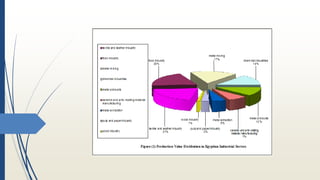
Ceramic and anti-melting materials
industries represents one of seven major
industries in the Egyptian market. It
represents 7% of the production value in
Egyptian Industrial sectors.
Properties of ceramic
• High corrosion resistance
• High resistance to rust
• Low temperature conductivity
• Low electrical conductivity
Uses of ceramic
• Personal use: glassware, Windows, pottery,
dinnerware, tiles and ceramics, lenses.
• Medical field: compensating devices for
bony joints, dental.
• Military industries: materials for vehicle
body ground, sea and air sensors
• Computer domain: insulation,
transportation and resistors capacitors.
Raw materials
The principal raw materials are sand,
feldspar, ball clay, china clay, kaolin, talc
and other materials that are used during the
manufacturing process, such as soda ash,
sodium silicate, calcium carbonate.
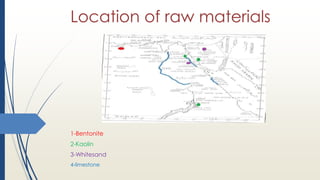
Location of raw materials
1-Bentonite
2-Kaolin
3-Whitesand
4-limestone
Function of raw materials
1-clay
a)Produces a light colouring during firing
b)Gives plasticity and binding characteristics
to the mass
c)Enhances mechanical characteristic in the
fired tiles
d)Produces good flow properties
e)Gives a good density level during firing due
to the individual characteristic of the clays.
Function of raw materials
2-feldspar
a)feldspars play an important role in achieving the
vitreous nature of the body and the high
mechanical resistance of the product at the end
of the firing stage.
b)Acting as a flux, feldspars also facilitate drying
and release of gas during firing like other non-
plastics.
Function of raw materials
3-silica
a)facilitate escape of gases during drying and
firing.
b)reduces drying shrinkage and increases the
whiteness of the fired body
Function of raw materials
4-talc
used in small quantities (2-6%) in the vitrified
tile body composition to enhance the
fluxing action of feldspathic materials.
Material testing
1-Chemical Analysis by X-Ray Fluorescence
Methodology
2-Thermal Testing
Chemical Analysis by X-Ray
Fluorescence Methodology
The basic principle of XRF involves irradiating a sample with
incident X-rays and measuring the secondary X-rays
emitted.
These secondary X-rays which are characteristic of each
element in the sample are detected and measured to
give a full analysis of the sample.
XRF is a method for measuring elemental contents of raw
materials and body formulations but not for identifying the
mineralogy.
Chemical Analysis by X-Ray
Fluorescence Methodology
Conducted for a wide range of purposes for material
identification and characterization to quality control
monitoring.
The types of materials that can be analyzed by XRF include
clay, sand feldspar, and limestone.
chemical analysis involves the determination of SiO2,
Al2O3, Fe2O3, TiO2, MgO, Na2O, K2O, and CaO together
with loss on ignition at about 1000°C.
Chemical Analysis by X-Ray
Fluorescence Methodology
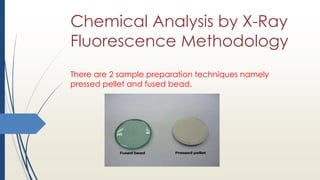
There are 2 sample preparation techniques namely
pressed pellet and fused bead.
Pressed pellet
Samples are grinded into powder form and pressed into discs.
More suitable for samples with a particular similar mineralogy
composition such as limestone.
May have identical chemical composition but may differ in
terms of mineralogical make-up and particle size.
Contamination increases with reduced particle size and an
increase in surface area.
Preparing the samples using the pressed pellet method is
convenient and relatively easy but would not be suitable if a
wide range of samples are to be analysed.
Fused bead
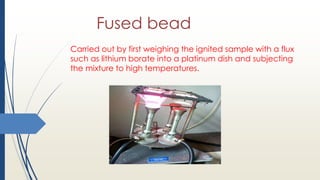
Carried out by first weighing the ignited sample with a flux
such as lithium borate into a platinum dish and subjecting
the mixture to high temperatures.
Fused bead
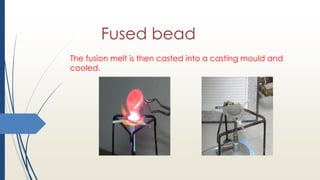
The fusion melt is then casted into a casting mould and
cooled.
X-Ray Fluorescence spectrometers
Two types of X-Ray Fluorescence spectrometers namely
the sequential spectrometer and simultaneous
spectrometer.
Simultaneous spectrometers are easier to operate as each
channel has its own separate crystal, collimator and
detector.
The range of elements that can be analysed is limited by
the number of pre-determined fixed channels.
For the sequential spectrometer, the equipment which is
relatively much costlier is able to analyze a very wide
range of elements.
Thermal Testing
Yield crucial information that is used to characterise the
suitability of new materials, troubleshoot defects and
monitor the quality of incoming raw materials.
Thermoanalytical methods such as dilatometry and
TG-DTA.
Thermal testing
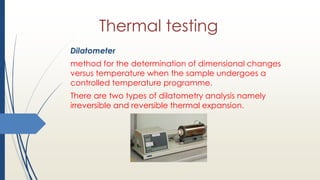
Dilatometer
method for the determination of dimensional changes
versus temperature when the sample undergoes a
controlled temperature programme.
There are two types of dilatometry analysis namely
irreversible and reversible thermal expansion.
Irreversible thermal expansion
This is expansion of a dry, unfired material as it is
subjected to a heating process.
Evaluation of the expansion during firing can
provide useful information such as identification of
the type of clay be it kaolin, illite...etc
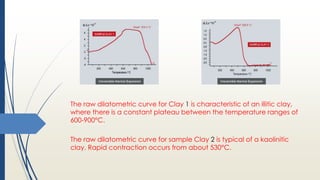
The raw dilatometric curve for Clay 1 is characteristic of an illitic clay,
where there is a constant plateau between the temperature ranges of
600-900°C.
The raw dilatometric curve for sample Clay 2 is typical of a kaolinitic
clay. Rapid contraction occurs from about 530°C.
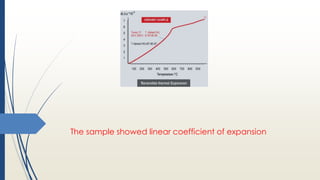
Reversible thermal expansion
Performed on fired ware samples such as fired clay, body
and glaze samples to measure the coefficient of thermal
expansion (COE).
This parameter determines to a certain extent the
compatibility of the ceramic body and glaze.
Incompatibility could lead to crazing of the glaze and also
affects its planarity
The sample showed linear coefficient of expansion
Simultaneous Thermal Analysis
Simultaneous Thermal Analyser (TG-DTA) simultaneously
carries out DTA (Differential thermal analysis) and TG
(Thermal gravimetric analysis).
The temperature range is from room temperature to
1080°C.
DTA is used to establish the temperatures at which
reactions may occur that involve thermal effects in the
material for e.g. emission of gases or vapours, reactions
with formation of new crystalline phases...etc.
The temperatures at which the endothermic or exothermic
reactions occur are used to identify the material.
Simultaneous Thermal Analysis
TG quantitatively evaluates increases or losses in weight of
the material caused by the corresponding oxidation
reactions, vapour or gas reactions.
Uses
Determine the amount of weight loss due to gaseous
decomposition of organic or carbonate content...etc and
their temperature ranges.
Monitor the changes of incoming raw materials (such as
clay deposits, raw material lots or different suppliers) to
predict the effect on the firing process and production
batches.
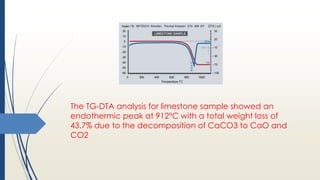
The TG-DTA analysis for limestone sample showed an
endothermic peak at 912°C with a total weight loss of
43.7% due to the decomposition of CaCO3 to CaO and
CO2
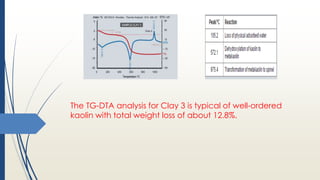
The TG-DTA analysis for Clay 3 is typical of well-ordered
kaolin with total weight loss of about 12.8%.
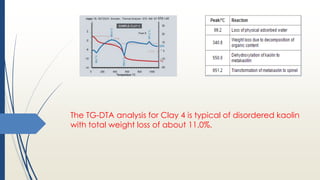
The TG-DTA analysis for Clay 4 is typical of disordered kaolin
with total weight loss of about 11.0%.
Physical Properties Testing
1-Particle Size Analysis
2-Fired Properties
a)Fired shrinkage
b)Water absorption
c)Fired Colour
1-Particle Size Analysis
Measurement range of 0.1 to 1000μm.
measure the quantities of particles in each size class in a
sample such as clay, limestone powder, ceramic body
formulation...etc.
Size distribution of the clay particles is important because
the spread of the distribution affects many properties of
the ceramic body slips, plastic forming bodies as well as
many dry and fired ceramic body properties.
2-Fired Properties
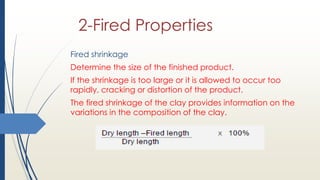
Fired shrinkage
Determine the size of the finished product.
If the shrinkage is too large or it is allowed to occur too
rapidly, cracking or distortion of the product.
The fired shrinkage of the clay provides information on the
variations in the composition of the clay.
2-Fired Properties
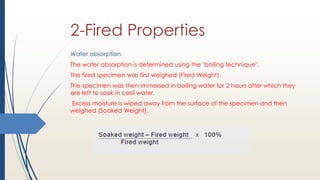
Water absorption
The water absorption is determined using the "boiling technique".
The fired specimen was first weighed (Fired Weight).
The specimen was then immersed in boiling water for 2 hours after which they
are left to soak in cool water.
Excess moisture is wiped away from the surface of the specimen and then
weighed (Soaked Weight).
2-Fired Properties
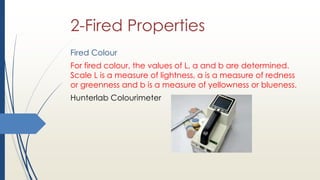
Fired Colour
For fired colour, the values of L, a and b are determined.
Scale L is a measure of lightness, a is a measure of redness
or greenness and b is a measure of yellowness or blueness.
Hunterlab Colourimeter
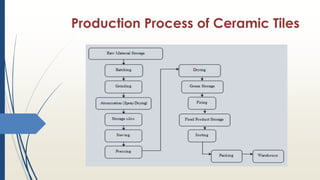
Production Process of Ceramic Tiles
Batching
The batching or proportioning may be done by volume or by mass.
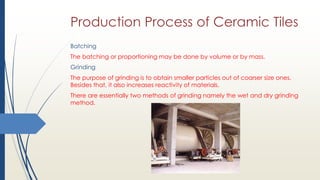
Grinding
The purpose of grinding is to obtain smaller particles out of coarser size ones.
Besides that, it also increases reactivity of materials.
There are essentially two methods of grinding namely the wet and dry grinding
method.
Production Process of Ceramic Tiles
Spray drying
the process that converts the body slip obtained from the
mill to a granulate with a size distribution and moisture
content suitable for pressing.
The two most important properties to be controlled are the
moisture content and the size distribution of the granulate
Production Process of Ceramic Tiles
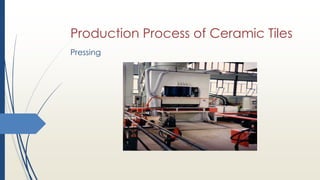
Pressing
Production Process of Ceramic Tiles
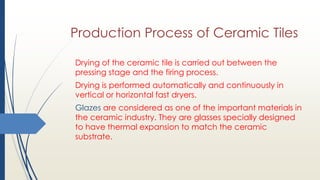
Drying of the ceramic tile is carried out between the
pressing stage and the firing process.
Drying is performed automatically and continuously in
vertical or horizontal fast dryers.
Glazes are considered as one of the important materials in
the ceramic industry. They are glasses specially designed
to have thermal expansion to match the ceramic
substrate.
Production Process of Ceramic Tiles
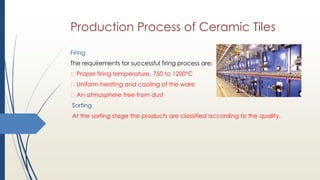
Firing
The requirements for successful firing process are:
Proper firing temperature, 750 to 1200°C
Uniform heating and cooling of the ware
An atmosphere free from dust
Sorting
At the sorting stage the products are classified according to the quality.
Finished Product Testing
1-Microscopy Analysis
2-Ceramic Tiles Technical Properties
a) Dimension
b) Water Absorption
c) Modulus of Rupture & Bending Strength
d) Surface Abrasion Test
e) Crazing Resistance
f) Chemical and Stain resistance
g) Slip Resistance
1-Microscopy Analysis
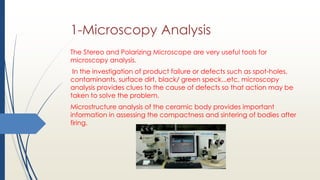
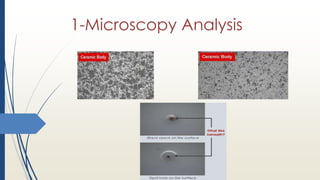
The Stereo and Polarizing Microscope are very useful tools for
microscopy analysis.
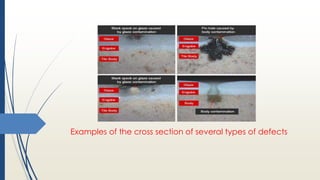
In the investigation of product failure or defects such as spot-holes,
contaminants, surface dirt, black/ green speck...etc, microscopy
analysis provides clues to the cause of defects so that action may be
taken to solve the problem.
Microstructure analysis of the ceramic body provides important
information in assessing the compactness and sintering of bodies after
firing.
1-Microscopy Analysis
Examples of the cross section of several types of defects
2-Ceramic Tiles Technical Properties
a) Dimension
A planarity tester is used to measure the key dimensional characteristics of the
ceramic tile.
b) Water Absorption
Water absorption is the amount of water that a ceramic tile can absorb under
certain experimental conditions expressed in terms of the percentage by
weight of the dry tile.
c) Modulus of Rupture & Bending Strength
Determines whether the tile is capable of bearing the static or dynamic loads
to which the floor or wall may be subjected to during use.
d) Surface Abrasion Test
The resistance of the surface of the tile to the movements of other materials
such as wheels, soles of shoes worn by people walking across the tile surface
or mud, sand...etc that come into contact with it.
e) Crazing Resistance
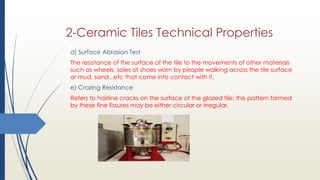
Refers to hairline cracks on the surface of the glazed tile; the pattern formed
by these fine fissures may be either circular or irregular.
2-Ceramic Tiles Technical Properties
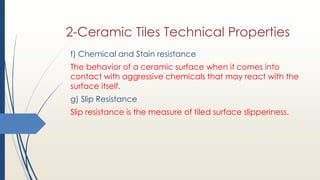
f) Chemical and Stain resistance
The behavior of a ceramic surface when it comes into
contact with aggressive chemicals that may react with the
surface itself.
g) Slip Resistance
Slip resistance is the measure of tiled surface slipperiness.
2-Ceramic Tiles Technical Properties
Pollution
1-Air emissions
2-Effluents
3-Solid wastes
4-Workplace
5-Hazardous waste
Impacts and effects
1-Impact of air emissions
a) Particulate matters
b) Sulfur Oxides
c) Nitrogen Oxides
d) Carbon dioxide
e) Dust
f) Silicon dioxide
g) Kaolin Clay
h) Bentonite Clay
i) Soda ash
2-Impact of Effluents
3-Impact of Solid Wastes
4-Impact on Workplace
Special thanks
DR. Shehata Ali Shehata
Thanks for your attention
Mohammed Mahmoud saad
2015
Chemistry &Geology

Ceramic industry

  • 1.
  • 2.
    Source of information 1-SHREV’SCHEMICAL PROCESS INDUSTRIES 2-Internet (www. ceramic-research.com)
  • 3.
    ceramic Ceramics include allarticles, which are essentially silicates. Those articles that are made of clay are mainly known as ceramics.
  • 4.
    ceramic Ceramic and anti-meltingmaterials industries represents one of seven major industries in the Egyptian market. It represents 7% of the production value in Egyptian Industrial sectors.
  • 6.
    Properties of ceramic •High corrosion resistance • High resistance to rust • Low temperature conductivity • Low electrical conductivity
  • 7.
    Uses of ceramic •Personal use: glassware, Windows, pottery, dinnerware, tiles and ceramics, lenses. • Medical field: compensating devices for bony joints, dental. • Military industries: materials for vehicle body ground, sea and air sensors • Computer domain: insulation, transportation and resistors capacitors.
  • 8.
    Raw materials The principalraw materials are sand, feldspar, ball clay, china clay, kaolin, talc and other materials that are used during the manufacturing process, such as soda ash, sodium silicate, calcium carbonate.
  • 9.
    Location of rawmaterials 1-Bentonite 2-Kaolin 3-Whitesand 4-limestone
  • 10.
    Function of rawmaterials 1-clay a)Produces a light colouring during firing b)Gives plasticity and binding characteristics to the mass c)Enhances mechanical characteristic in the fired tiles d)Produces good flow properties e)Gives a good density level during firing due to the individual characteristic of the clays.
  • 11.
    Function of rawmaterials 2-feldspar a)feldspars play an important role in achieving the vitreous nature of the body and the high mechanical resistance of the product at the end of the firing stage. b)Acting as a flux, feldspars also facilitate drying and release of gas during firing like other non- plastics.
  • 12.
    Function of rawmaterials 3-silica a)facilitate escape of gases during drying and firing. b)reduces drying shrinkage and increases the whiteness of the fired body
  • 13.
    Function of rawmaterials 4-talc used in small quantities (2-6%) in the vitrified tile body composition to enhance the fluxing action of feldspathic materials.
  • 14.
    Material testing 1-Chemical Analysisby X-Ray Fluorescence Methodology 2-Thermal Testing
  • 15.
    Chemical Analysis byX-Ray Fluorescence Methodology The basic principle of XRF involves irradiating a sample with incident X-rays and measuring the secondary X-rays emitted. These secondary X-rays which are characteristic of each element in the sample are detected and measured to give a full analysis of the sample. XRF is a method for measuring elemental contents of raw materials and body formulations but not for identifying the mineralogy.
  • 16.
    Chemical Analysis byX-Ray Fluorescence Methodology Conducted for a wide range of purposes for material identification and characterization to quality control monitoring. The types of materials that can be analyzed by XRF include clay, sand feldspar, and limestone. chemical analysis involves the determination of SiO2, Al2O3, Fe2O3, TiO2, MgO, Na2O, K2O, and CaO together with loss on ignition at about 1000°C.
  • 17.
    Chemical Analysis byX-Ray Fluorescence Methodology There are 2 sample preparation techniques namely pressed pellet and fused bead.
  • 18.
    Pressed pellet Samples aregrinded into powder form and pressed into discs. More suitable for samples with a particular similar mineralogy composition such as limestone. May have identical chemical composition but may differ in terms of mineralogical make-up and particle size. Contamination increases with reduced particle size and an increase in surface area. Preparing the samples using the pressed pellet method is convenient and relatively easy but would not be suitable if a wide range of samples are to be analysed.
  • 19.
    Fused bead Carried outby first weighing the ignited sample with a flux such as lithium borate into a platinum dish and subjecting the mixture to high temperatures.
  • 20.
    Fused bead The fusionmelt is then casted into a casting mould and cooled.
  • 21.
    X-Ray Fluorescence spectrometers Twotypes of X-Ray Fluorescence spectrometers namely the sequential spectrometer and simultaneous spectrometer. Simultaneous spectrometers are easier to operate as each channel has its own separate crystal, collimator and detector. The range of elements that can be analysed is limited by the number of pre-determined fixed channels. For the sequential spectrometer, the equipment which is relatively much costlier is able to analyze a very wide range of elements.
  • 22.
    Thermal Testing Yield crucialinformation that is used to characterise the suitability of new materials, troubleshoot defects and monitor the quality of incoming raw materials. Thermoanalytical methods such as dilatometry and TG-DTA.
  • 23.
    Thermal testing Dilatometer method forthe determination of dimensional changes versus temperature when the sample undergoes a controlled temperature programme. There are two types of dilatometry analysis namely irreversible and reversible thermal expansion.
  • 24.
    Irreversible thermal expansion Thisis expansion of a dry, unfired material as it is subjected to a heating process. Evaluation of the expansion during firing can provide useful information such as identification of the type of clay be it kaolin, illite...etc
  • 25.
    The raw dilatometriccurve for Clay 1 is characteristic of an illitic clay, where there is a constant plateau between the temperature ranges of 600-900°C. The raw dilatometric curve for sample Clay 2 is typical of a kaolinitic clay. Rapid contraction occurs from about 530°C.
  • 26.
    Reversible thermal expansion Performedon fired ware samples such as fired clay, body and glaze samples to measure the coefficient of thermal expansion (COE). This parameter determines to a certain extent the compatibility of the ceramic body and glaze. Incompatibility could lead to crazing of the glaze and also affects its planarity
  • 27.
    The sample showedlinear coefficient of expansion
  • 28.
    Simultaneous Thermal Analysis SimultaneousThermal Analyser (TG-DTA) simultaneously carries out DTA (Differential thermal analysis) and TG (Thermal gravimetric analysis). The temperature range is from room temperature to 1080°C. DTA is used to establish the temperatures at which reactions may occur that involve thermal effects in the material for e.g. emission of gases or vapours, reactions with formation of new crystalline phases...etc. The temperatures at which the endothermic or exothermic reactions occur are used to identify the material.
  • 29.
    Simultaneous Thermal Analysis TGquantitatively evaluates increases or losses in weight of the material caused by the corresponding oxidation reactions, vapour or gas reactions. Uses Determine the amount of weight loss due to gaseous decomposition of organic or carbonate content...etc and their temperature ranges. Monitor the changes of incoming raw materials (such as clay deposits, raw material lots or different suppliers) to predict the effect on the firing process and production batches.
  • 30.
    The TG-DTA analysisfor limestone sample showed an endothermic peak at 912°C with a total weight loss of 43.7% due to the decomposition of CaCO3 to CaO and CO2
  • 31.
    The TG-DTA analysisfor Clay 3 is typical of well-ordered kaolin with total weight loss of about 12.8%.
  • 32.
    The TG-DTA analysisfor Clay 4 is typical of disordered kaolin with total weight loss of about 11.0%.
  • 33.
    Physical Properties Testing 1-ParticleSize Analysis 2-Fired Properties a)Fired shrinkage b)Water absorption c)Fired Colour
  • 34.
    1-Particle Size Analysis Measurementrange of 0.1 to 1000μm. measure the quantities of particles in each size class in a sample such as clay, limestone powder, ceramic body formulation...etc. Size distribution of the clay particles is important because the spread of the distribution affects many properties of the ceramic body slips, plastic forming bodies as well as many dry and fired ceramic body properties.
  • 35.
    2-Fired Properties Fired shrinkage Determinethe size of the finished product. If the shrinkage is too large or it is allowed to occur too rapidly, cracking or distortion of the product. The fired shrinkage of the clay provides information on the variations in the composition of the clay.
  • 36.
    2-Fired Properties Water absorption Thewater absorption is determined using the "boiling technique". The fired specimen was first weighed (Fired Weight). The specimen was then immersed in boiling water for 2 hours after which they are left to soak in cool water. Excess moisture is wiped away from the surface of the specimen and then weighed (Soaked Weight).
  • 37.
    2-Fired Properties Fired Colour Forfired colour, the values of L, a and b are determined. Scale L is a measure of lightness, a is a measure of redness or greenness and b is a measure of yellowness or blueness. Hunterlab Colourimeter
  • 38.
    Production Process ofCeramic Tiles
  • 39.
    Production Process ofCeramic Tiles Batching The batching or proportioning may be done by volume or by mass. Grinding The purpose of grinding is to obtain smaller particles out of coarser size ones. Besides that, it also increases reactivity of materials. There are essentially two methods of grinding namely the wet and dry grinding method.
  • 40.
    Production Process ofCeramic Tiles Spray drying the process that converts the body slip obtained from the mill to a granulate with a size distribution and moisture content suitable for pressing. The two most important properties to be controlled are the moisture content and the size distribution of the granulate
  • 41.
    Production Process ofCeramic Tiles Pressing
  • 42.
    Production Process ofCeramic Tiles Drying of the ceramic tile is carried out between the pressing stage and the firing process. Drying is performed automatically and continuously in vertical or horizontal fast dryers. Glazes are considered as one of the important materials in the ceramic industry. They are glasses specially designed to have thermal expansion to match the ceramic substrate.
  • 43.
    Production Process ofCeramic Tiles Firing The requirements for successful firing process are: Proper firing temperature, 750 to 1200°C Uniform heating and cooling of the ware An atmosphere free from dust Sorting At the sorting stage the products are classified according to the quality.
  • 44.
    Finished Product Testing 1-MicroscopyAnalysis 2-Ceramic Tiles Technical Properties a) Dimension b) Water Absorption c) Modulus of Rupture & Bending Strength d) Surface Abrasion Test e) Crazing Resistance f) Chemical and Stain resistance g) Slip Resistance
  • 45.
    1-Microscopy Analysis The Stereoand Polarizing Microscope are very useful tools for microscopy analysis. In the investigation of product failure or defects such as spot-holes, contaminants, surface dirt, black/ green speck...etc, microscopy analysis provides clues to the cause of defects so that action may be taken to solve the problem. Microstructure analysis of the ceramic body provides important information in assessing the compactness and sintering of bodies after firing.
  • 46.
  • 47.
    Examples of thecross section of several types of defects
  • 48.
    2-Ceramic Tiles TechnicalProperties a) Dimension A planarity tester is used to measure the key dimensional characteristics of the ceramic tile. b) Water Absorption Water absorption is the amount of water that a ceramic tile can absorb under certain experimental conditions expressed in terms of the percentage by weight of the dry tile. c) Modulus of Rupture & Bending Strength Determines whether the tile is capable of bearing the static or dynamic loads to which the floor or wall may be subjected to during use.
  • 49.
    d) Surface AbrasionTest The resistance of the surface of the tile to the movements of other materials such as wheels, soles of shoes worn by people walking across the tile surface or mud, sand...etc that come into contact with it. e) Crazing Resistance Refers to hairline cracks on the surface of the glazed tile; the pattern formed by these fine fissures may be either circular or irregular. 2-Ceramic Tiles Technical Properties
  • 50.
    f) Chemical andStain resistance The behavior of a ceramic surface when it comes into contact with aggressive chemicals that may react with the surface itself. g) Slip Resistance Slip resistance is the measure of tiled surface slipperiness. 2-Ceramic Tiles Technical Properties
  • 51.
  • 52.
    Impacts and effects 1-Impactof air emissions a) Particulate matters b) Sulfur Oxides c) Nitrogen Oxides d) Carbon dioxide e) Dust f) Silicon dioxide g) Kaolin Clay h) Bentonite Clay i) Soda ash 2-Impact of Effluents 3-Impact of Solid Wastes 4-Impact on Workplace
  • 53.
  • 54.
    Thanks for yourattention Mohammed Mahmoud saad 2015 Chemistry &Geology