TYPES OF REFRACTORIES
Patel Roma
Sem :3
Roll no. 14
Department of materials science
TYPES OF REFRACTORIES
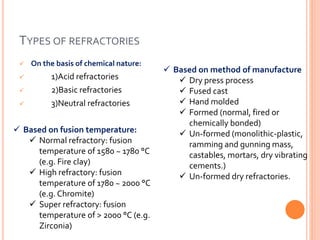
 On the basis of chemical nature:
 1)Acid refractories
 2)Basic refractories
 3)Neutral refractories
 Based on fusion temperature:
 Normal refractory: fusion
temperature of 1580 ~ 1780 °C
(e.g. Fire clay)
 High refractory: fusion
temperature of 1780 ~ 2000 °C
(e.g. Chromite)
 Super refractory: fusion
temperature of > 2000 °C (e.g.
Zirconia)
 Based on method of manufacture
 Dry press process
 Fused cast
 Hand molded
 Formed (normal, fired or
chemically bonded)
 Un-formed (monolithic-plastic,
ramming and gunning mass,
castables, mortars, dry vibrating
cements.)
 Un-formed dry refractories.
CLASSIFICATION OF
REFRACTORIES BASED ON
CHEMICAL NATURE
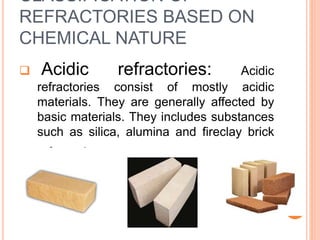
 Acidic refractories: Acidic
refractories consist of mostly acidic
materials. They are generally affected by
basic materials. They includes substances
such as silica, alumina and fireclay brick
refractories.
CONTINUED…..
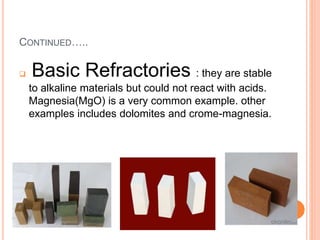
 Basic Refractories : they are stable
to alkaline materials but could not react with acids.
Magnesia(MgO) is a very common example. other
examples includes dolomites and crome-magnesia.
CONTINUED…….
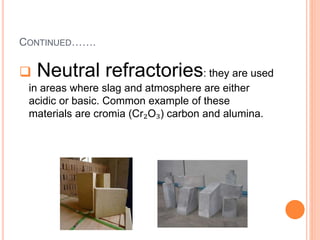
 Neutral refractories: they are used
in areas where slag and atmosphere are either
acidic or basic. Common example of these
materials are cromia (Cr₂O₃) carbon and alumina.
FIRE CLAY BRICK REFRACTORIES
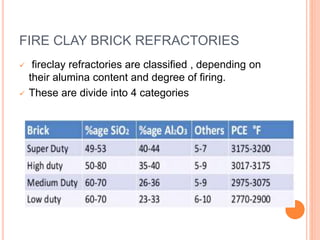
 fireclay refractories are classified , depending on
their alumina content and degree of firing.
 These are divide into 4 categories
PROPERTY AND APPLICATIONS
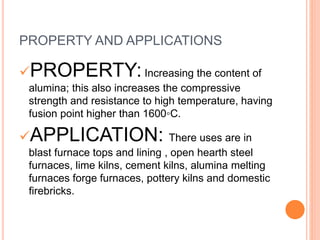
PROPERTY:Increasing the content of
alumina; this also increases the compressive
strength and resistance to high temperature, having
fusion point higher than 1600◦C.
APPLICATION: There uses are in
blast furnace tops and lining , open hearth steel
furnaces, lime kilns, cement kilns, alumina melting
furnaces forge furnaces, pottery kilns and domestic
firebricks.
SILICA BRICK REFRACTORIES
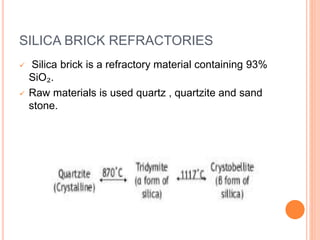
 Silica brick is a refractory material containing 93%
SiO₂.
 Raw materials is used quartz , quartzite and sand
stone.
PROPERTIES AND APPLICATIONS
PROPERTY : Do not shrink at high
temperature , are resistant to thermal shocks from
600◦C up to melting point, and are highly resistant
to attack by iron oxide and acid slag .
APPLICATIONS: Their special importance
in steel industries. They are also widely used in gas
retorts , coke ovens and glass melting tank
furnaces. Superduty silica bricks can be used at
temperature up to 1700◦C.
MAGNESITE BRICKS REFRACTORIES
 Magnesite refrectories are chemically basic
materials, containing at least 85% magnesium
oxide. These are made from naturally occurring
magnesite (MgCO₃) and silica (SiO₂).
 There are two types of magnesite bricks:
(A) Burned magnesite bricks
(B) Fused magnesite bricks
PROPERTIES AND APPLICATIONS
 PROPERTY : Good high temperature
performance, strong slag resistance
APPLICATIONS : Used in
construction of basic open hearth furnaces, steel
converter, lime kilns, glass tank regenerators, lining
furnaces in which copper, lead, tin are refind.
MULLITE REFRACTORIES
 Mullite refractories usually have a mullite content of
80% or more.
 They are mainly made by calcining sillimanite , so
that the terms mullite refractory and sillimanite
refractory are often interchangeable.
PROPERTIES
 In refractories of high mullite content the ceramic
bond of regular fireclay refractories is replaced by a
crystalline bond, thus increasing their
refractoriesness under load.
 Sillimanite refractories have a refractoriness
ranging from 1950-1920◦C and refractoriness under
load ranging from 1590-1700◦C.
 High temperature properties with improved thermal
shock and thermal stress resistance owing to the
low thermal expansion, good strength and
interlocking gain structure.
APPLICATIONS
 There are used in hot zones of cement kilns and in
certain ceramic kilns.
 important sillimanite products include pyrometer
tubes and crucibles for making optical glass.
CROME AND CROME MAGNESITE
REFRACTORIES
 Crome magnesite refractories in which crome
predominates are neutral, and those in which
magnesite predominates are basic.
 crome magnesite refractories made from a mixture
of cromite and roasted magnesite.
 The refractoriness of such products is about
2000◦C. and higher, depending on the purity of the
raw material.
PROPERTIES AND APPLICATIONS
PROPERTY: Stronger thermal resistance,
higher bulk density, good performance under high
temperature
APPLICATION: In furnaces where more
than one type of refractories are used, neutral
bricks play vital role of keeping acid and basic
refractories out of direct contact with each other
and also used in furnaces handing copper ,
aluminium and lead. In cement rotary kilns , glass
kilns regenerators, electric arc furnaces, non
ferrous metal furnaces.
CARBIDE REFRACTORIES
 The more important of the refractory carbide are carbides
of silicon and boron.
 SiC refractories are produced from crystalline SiC,
carborundum, which is graded to required size fractions,
mixed with suitable bonding agent, and then shaped,
dried and fired.
 Four major types of bonding have been used,
1) nitride
2) silicon Self bonding
3) Bonding with refractory clay
4) Silicon
CONTINUED………
 silicon carbide have superior refractoriness under
load, high density, abrasion resistance, high
chemical resistance.
 slowly oxidize to silica when heated in air at
temperature 1000◦C.
 Boron carbide are made from high purity boron
carbide powders. the method used is either hot
pressing followed by firing to produced a self
bonded material, or mixing with sodium silicate,
boric oxide, and other silicates as a bonding agent
and then firing to produce a ceramic bond.
PROPERTIES AND APPLICATION
 PROPERTY: high refractoriness, low thermal
expansion, good resistance to thermal shock, ability
to conduct electricity to a certain extent,
outstanding hardness , loose abrasive
 APPLICATION: used as refractory ingredient for
many kinds of refractories bodies.
HEAT INSULATING REFRACTORIES
 To optimize the energy use and to prevent its
escape into the embience , special materials called
insulating refractories necessary.
 The function of insulating refractory is to reduce
the rate of heat flow through the walls of furnaces.
 Insulation is affected by providing a layer of
material having low heat conductivity , which means
heat does not readily pass through them.
APPLICATIONS
 Refractories to be used mainly as heat insulators
are produced as lightweight highly porous bodies
having a large number of extremely small pores
most of which are sealed.
 they are used as an insulating backing to more
slag and abrasion resistant bricks.
 refractories are used to store and transfer heat, as
in exchangers, they are made as dense as possible
to obtain high heat capacity.
REFERENCES
 Science of engineering materials(vol.2)
by
MANAS CHANDA
 WIKIPEDIA
Types of refractories

Types of refractories

  • 1.
    TYPES OF REFRACTORIES PatelRoma Sem :3 Roll no. 14 Department of materials science
  • 2.
    TYPES OF REFRACTORIES On the basis of chemical nature:  1)Acid refractories  2)Basic refractories  3)Neutral refractories  Based on fusion temperature:  Normal refractory: fusion temperature of 1580 ~ 1780 °C (e.g. Fire clay)  High refractory: fusion temperature of 1780 ~ 2000 °C (e.g. Chromite)  Super refractory: fusion temperature of > 2000 °C (e.g. Zirconia)  Based on method of manufacture  Dry press process  Fused cast  Hand molded  Formed (normal, fired or chemically bonded)  Un-formed (monolithic-plastic, ramming and gunning mass, castables, mortars, dry vibrating cements.)  Un-formed dry refractories.
  • 3.
    CLASSIFICATION OF REFRACTORIES BASEDON CHEMICAL NATURE  Acidic refractories: Acidic refractories consist of mostly acidic materials. They are generally affected by basic materials. They includes substances such as silica, alumina and fireclay brick refractories.
  • 4.
    CONTINUED…..  Basic Refractories: they are stable to alkaline materials but could not react with acids. Magnesia(MgO) is a very common example. other examples includes dolomites and crome-magnesia.
  • 5.
    CONTINUED…….  Neutral refractories:they are used in areas where slag and atmosphere are either acidic or basic. Common example of these materials are cromia (Cr₂O₃) carbon and alumina.
  • 6.
    FIRE CLAY BRICKREFRACTORIES  fireclay refractories are classified , depending on their alumina content and degree of firing.  These are divide into 4 categories
  • 7.
    PROPERTY AND APPLICATIONS PROPERTY:Increasingthe content of alumina; this also increases the compressive strength and resistance to high temperature, having fusion point higher than 1600◦C. APPLICATION: There uses are in blast furnace tops and lining , open hearth steel furnaces, lime kilns, cement kilns, alumina melting furnaces forge furnaces, pottery kilns and domestic firebricks.
  • 8.
    SILICA BRICK REFRACTORIES Silica brick is a refractory material containing 93% SiO₂.  Raw materials is used quartz , quartzite and sand stone.
  • 9.
    PROPERTIES AND APPLICATIONS PROPERTY: Do not shrink at high temperature , are resistant to thermal shocks from 600◦C up to melting point, and are highly resistant to attack by iron oxide and acid slag . APPLICATIONS: Their special importance in steel industries. They are also widely used in gas retorts , coke ovens and glass melting tank furnaces. Superduty silica bricks can be used at temperature up to 1700◦C.
  • 10.
    MAGNESITE BRICKS REFRACTORIES Magnesite refrectories are chemically basic materials, containing at least 85% magnesium oxide. These are made from naturally occurring magnesite (MgCO₃) and silica (SiO₂).  There are two types of magnesite bricks: (A) Burned magnesite bricks (B) Fused magnesite bricks
  • 11.
    PROPERTIES AND APPLICATIONS PROPERTY : Good high temperature performance, strong slag resistance APPLICATIONS : Used in construction of basic open hearth furnaces, steel converter, lime kilns, glass tank regenerators, lining furnaces in which copper, lead, tin are refind.
  • 12.
    MULLITE REFRACTORIES  Mulliterefractories usually have a mullite content of 80% or more.  They are mainly made by calcining sillimanite , so that the terms mullite refractory and sillimanite refractory are often interchangeable.
  • 13.
    PROPERTIES  In refractoriesof high mullite content the ceramic bond of regular fireclay refractories is replaced by a crystalline bond, thus increasing their refractoriesness under load.  Sillimanite refractories have a refractoriness ranging from 1950-1920◦C and refractoriness under load ranging from 1590-1700◦C.  High temperature properties with improved thermal shock and thermal stress resistance owing to the low thermal expansion, good strength and interlocking gain structure.
  • 14.
    APPLICATIONS  There areused in hot zones of cement kilns and in certain ceramic kilns.  important sillimanite products include pyrometer tubes and crucibles for making optical glass.
  • 15.
    CROME AND CROMEMAGNESITE REFRACTORIES  Crome magnesite refractories in which crome predominates are neutral, and those in which magnesite predominates are basic.  crome magnesite refractories made from a mixture of cromite and roasted magnesite.  The refractoriness of such products is about 2000◦C. and higher, depending on the purity of the raw material.
  • 16.
    PROPERTIES AND APPLICATIONS PROPERTY:Stronger thermal resistance, higher bulk density, good performance under high temperature APPLICATION: In furnaces where more than one type of refractories are used, neutral bricks play vital role of keeping acid and basic refractories out of direct contact with each other and also used in furnaces handing copper , aluminium and lead. In cement rotary kilns , glass kilns regenerators, electric arc furnaces, non ferrous metal furnaces.
  • 17.
    CARBIDE REFRACTORIES  Themore important of the refractory carbide are carbides of silicon and boron.  SiC refractories are produced from crystalline SiC, carborundum, which is graded to required size fractions, mixed with suitable bonding agent, and then shaped, dried and fired.  Four major types of bonding have been used, 1) nitride 2) silicon Self bonding 3) Bonding with refractory clay 4) Silicon
  • 18.
    CONTINUED………  silicon carbidehave superior refractoriness under load, high density, abrasion resistance, high chemical resistance.  slowly oxidize to silica when heated in air at temperature 1000◦C.  Boron carbide are made from high purity boron carbide powders. the method used is either hot pressing followed by firing to produced a self bonded material, or mixing with sodium silicate, boric oxide, and other silicates as a bonding agent and then firing to produce a ceramic bond.
  • 19.
    PROPERTIES AND APPLICATION PROPERTY: high refractoriness, low thermal expansion, good resistance to thermal shock, ability to conduct electricity to a certain extent, outstanding hardness , loose abrasive  APPLICATION: used as refractory ingredient for many kinds of refractories bodies.
  • 20.
    HEAT INSULATING REFRACTORIES To optimize the energy use and to prevent its escape into the embience , special materials called insulating refractories necessary.  The function of insulating refractory is to reduce the rate of heat flow through the walls of furnaces.  Insulation is affected by providing a layer of material having low heat conductivity , which means heat does not readily pass through them.
  • 21.
    APPLICATIONS  Refractories tobe used mainly as heat insulators are produced as lightweight highly porous bodies having a large number of extremely small pores most of which are sealed.  they are used as an insulating backing to more slag and abrasion resistant bricks.  refractories are used to store and transfer heat, as in exchangers, they are made as dense as possible to obtain high heat capacity.
  • 22.
    REFERENCES  Science ofengineering materials(vol.2) by MANAS CHANDA  WIKIPEDIA