


MANUFACTURING PROCESS OF
PROCELAIN TILES
NISHANT SINHA
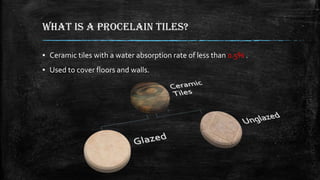
WHAT IS A PROCELAIN TILES?
▪ Ceramic tiles with a water absorption rate of less than 0.5% .
▪ Used to cover floors and walls.
OVERALL MANUFACTURING PROCESS
▪ Preparation of raw materials.
▪ Pressing and drying.
▪ Firing process with or without glaze.
▪ Additional refinements.
▪ Packaging process.
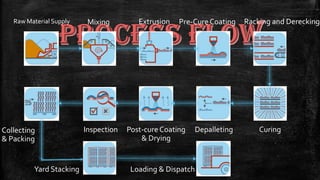
Raw Material Supply Mixing Extrusion Pre-CureCoating Racking and Derecking
CuringDepalletingPost-cure Coating
& Drying
Inspection
Yard Stacking Loading & Dispatch
Collecting
& Packing
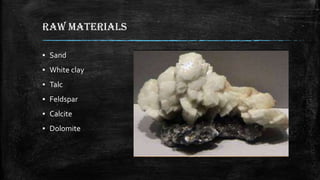
RAW MATERIALS
▪ Sand
▪ White clay
▪ Talc
▪ Feldspar
▪ Calcite
▪ Dolomite
MIXING
▪ All the Raw Materials are crushed in an uniform size.
▪ Sometimes, water is added and the ingredients are wet milled or
ground in a ball mill.
▪ Excess water is removed using filter pressing followed by spray
drying.
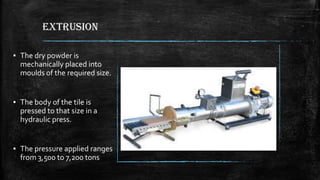
EXTRUSION
▪ The dry powder is
mechanically placed into
moulds of the required size.
▪ The body of the tile is
pressed to that size in a
hydraulic press.
▪ The pressure applied ranges
from 3,500 to 7,200 tons
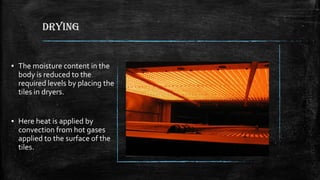
DRYING
▪ The moisture content in the
body is reduced to the
required levels by placing the
tiles in dryers.
▪ Here heat is applied by
convection from hot gases
applied to the surface of the
tiles.
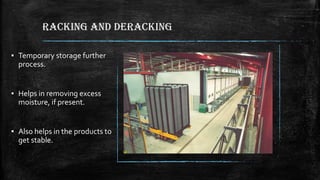
RACKING AND DERACKING
▪ Temporary storage further
process.
▪ Helps in removing excess
moisture, if present.
▪ Also helps in the products to
get stable.
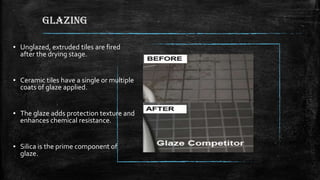
GLAZING
▪ Unglazed, extruded tiles are fired
after the drying stage.
▪ Ceramic tiles have a single or multiple
coats of glaze applied.
▪ The glaze adds protection texture and
enhances chemical resistance.
▪ Silica is the prime component of
glaze.
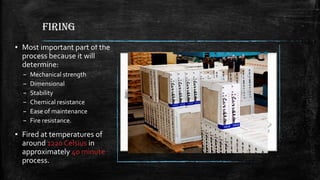
FIRING
▪ Most important part of the
process because it will
determine:
– Mechanical strength
– Dimensional
– Stability
– Chemical resistance
– Ease of maintenance
– Fire resistance.
▪ Fired at temperatures of
around 1220 Celsius in
approximately 40 minute
process.
BYPRODUCTS
▪ A variety of pollutants are generated during the various manufacturing steps, such as:
– Fluorine
– Lead compounds.
▪ Lead compounds have been significantly reduced with the recent development of no-lead or
low-lead glazes.
▪ Fluorine emissions can be controlled with scrubbers, devices that basically spray the gases with
water to remove harmful pollutants.
▪ The tile industry is also developing processes to recycle wastewater and sludge produced during
milling, glazing, and spray-drying.
QUALITY CONTROL
▪ Most tile manufacturers now use statistical process control (SPC) for each step of the
manufacturing process.
▪ Statistical process control consists of charts that are used to monitor various
processing parameters, such as :
– particle size
– milling time
– drying temperature and time
– compaction pressure
– dimensions after pressing
– Density
– firing temperature and time
▪ These charts identify problems with equipment, out of spec conditions, and help to
improve yields before the final product is finished.
▪ Work closely with their raw material suppliers to ensure that specifications are met
before the material is used.
Manufacturing process of  tiles

Manufacturing process of tiles

  • 1.
  • 2.
    WHAT IS APROCELAIN TILES? ▪ Ceramic tiles with a water absorption rate of less than 0.5% . ▪ Used to cover floors and walls.
  • 3.
    OVERALL MANUFACTURING PROCESS ▪Preparation of raw materials. ▪ Pressing and drying. ▪ Firing process with or without glaze. ▪ Additional refinements. ▪ Packaging process.
  • 4.
    Raw Material SupplyMixing Extrusion Pre-CureCoating Racking and Derecking CuringDepalletingPost-cure Coating & Drying Inspection Yard Stacking Loading & Dispatch Collecting & Packing
  • 5.
    RAW MATERIALS ▪ Sand ▪White clay ▪ Talc ▪ Feldspar ▪ Calcite ▪ Dolomite
  • 6.
    MIXING ▪ All theRaw Materials are crushed in an uniform size. ▪ Sometimes, water is added and the ingredients are wet milled or ground in a ball mill. ▪ Excess water is removed using filter pressing followed by spray drying.
  • 7.
    EXTRUSION ▪ The drypowder is mechanically placed into moulds of the required size. ▪ The body of the tile is pressed to that size in a hydraulic press. ▪ The pressure applied ranges from 3,500 to 7,200 tons
  • 8.
    DRYING ▪ The moisturecontent in the body is reduced to the required levels by placing the tiles in dryers. ▪ Here heat is applied by convection from hot gases applied to the surface of the tiles.
  • 9.
    RACKING AND DERACKING ▪Temporary storage further process. ▪ Helps in removing excess moisture, if present. ▪ Also helps in the products to get stable.
  • 10.
    GLAZING ▪ Unglazed, extrudedtiles are fired after the drying stage. ▪ Ceramic tiles have a single or multiple coats of glaze applied. ▪ The glaze adds protection texture and enhances chemical resistance. ▪ Silica is the prime component of glaze.
  • 11.
    FIRING ▪ Most importantpart of the process because it will determine: – Mechanical strength – Dimensional – Stability – Chemical resistance – Ease of maintenance – Fire resistance. ▪ Fired at temperatures of around 1220 Celsius in approximately 40 minute process.
  • 12.
    BYPRODUCTS ▪ A varietyof pollutants are generated during the various manufacturing steps, such as: – Fluorine – Lead compounds. ▪ Lead compounds have been significantly reduced with the recent development of no-lead or low-lead glazes. ▪ Fluorine emissions can be controlled with scrubbers, devices that basically spray the gases with water to remove harmful pollutants. ▪ The tile industry is also developing processes to recycle wastewater and sludge produced during milling, glazing, and spray-drying.
  • 13.
    QUALITY CONTROL ▪ Mosttile manufacturers now use statistical process control (SPC) for each step of the manufacturing process. ▪ Statistical process control consists of charts that are used to monitor various processing parameters, such as : – particle size – milling time – drying temperature and time – compaction pressure – dimensions after pressing – Density – firing temperature and time ▪ These charts identify problems with equipment, out of spec conditions, and help to improve yields before the final product is finished. ▪ Work closely with their raw material suppliers to ensure that specifications are met before the material is used.