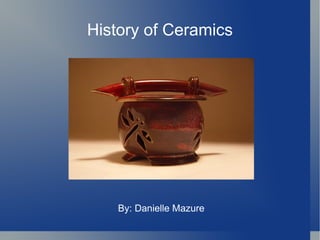
History of Ceramics By: Danielle Mazure
The start of Ceramics The earliest recorded date for a piece of ceramic is around 6000 B.C.
First bowl/basket was an accident.
Filled basket with clay to keep water in. Once the basket was worn out they threw it in the fire.
Found out that the clay was more dense and less fragile.
Threw pots away when finished and time to travel.
Clay Clay comes from the Earth that is decomposed from rocks and other materials from the Earth for many years.
There will never be a shortage of clay because the Earth is always making more.
Clay feels like a plastic material that can easily be formed to many shapes when it is wet.
Key Terms Clay:  naturally occuring substance which is a heavy and damp plastic material that ‘sets‘ upon drying and can be changed by heat into a hard, generally dense, material. Bisque  - Unglazed ceramic peice purposely fired to an immature temperature. Glaze  - A layer of glass fused into place on a ceramic piece. Glazes can be both decorative and as a texture. Ceramic:  clay products made permenant by heat (1112F or greater)
Key Terms High-fire:  clay and glazes which mature at or above 2192F. Low-fire:  clay and glazes maturing at or below cone 04 (~1922F) Electric kiln  - Any kiln heated using electrostatic elements. Because no fuel is introduced, electric kilns fire in oxidation. Gas kiln  - A kiln which uses natural gas as its fuel. Gas kilns are commonly found in contemporary ceramic studios and factories.
Woodfiring Woodfiring is very different from the other ways of firing clay. It's the only technique that the person is interacting with the process of firing clay. It's demanding, and there always needs to be at least two people maintaing the fire and making sure that nothing goes wrong. With electric and gas kilns there is no need to keep watch on it every minute.
Continued Woodfiring is another way to glaze/fire ceramic ware.
Ceramics are placed in an outdoor kiln made up of bricks (or other material) equipped with a chimney. Wood is placed inside the kiln with the ceramic wares.
There is a steady flow of wood placed in the kiln at about 10 minute intervals.
Ash from the wood will glaze the ceramics. The colors depend on the type of wood used.

Ceramic power point

  • 1.
    History of CeramicsBy: Danielle Mazure
  • 2.
    The start ofCeramics The earliest recorded date for a piece of ceramic is around 6000 B.C.
  • 3.
  • 4.
    Filled basket withclay to keep water in. Once the basket was worn out they threw it in the fire.
  • 5.
    Found out thatthe clay was more dense and less fragile.
  • 6.
    Threw pots awaywhen finished and time to travel.
  • 7.
    Clay Clay comesfrom the Earth that is decomposed from rocks and other materials from the Earth for many years.
  • 8.
    There will neverbe a shortage of clay because the Earth is always making more.
  • 9.
    Clay feels likea plastic material that can easily be formed to many shapes when it is wet.
  • 10.
    Key Terms Clay: naturally occuring substance which is a heavy and damp plastic material that ‘sets‘ upon drying and can be changed by heat into a hard, generally dense, material. Bisque - Unglazed ceramic peice purposely fired to an immature temperature. Glaze - A layer of glass fused into place on a ceramic piece. Glazes can be both decorative and as a texture. Ceramic: clay products made permenant by heat (1112F or greater)
  • 11.
    Key Terms High-fire: clay and glazes which mature at or above 2192F. Low-fire: clay and glazes maturing at or below cone 04 (~1922F) Electric kiln - Any kiln heated using electrostatic elements. Because no fuel is introduced, electric kilns fire in oxidation. Gas kiln - A kiln which uses natural gas as its fuel. Gas kilns are commonly found in contemporary ceramic studios and factories.
  • 12.
    Woodfiring Woodfiring isvery different from the other ways of firing clay. It's the only technique that the person is interacting with the process of firing clay. It's demanding, and there always needs to be at least two people maintaing the fire and making sure that nothing goes wrong. With electric and gas kilns there is no need to keep watch on it every minute.
  • 13.
    Continued Woodfiring isanother way to glaze/fire ceramic ware.
  • 14.
    Ceramics are placedin an outdoor kiln made up of bricks (or other material) equipped with a chimney. Wood is placed inside the kiln with the ceramic wares.
  • 15.
    There is asteady flow of wood placed in the kiln at about 10 minute intervals.
  • 16.
    Ash from thewood will glaze the ceramics. The colors depend on the type of wood used.