1
Raw Mix Design for clinker
manufacturing
Prepared for
Cement Technology Course
AKS University, Satna (M.P.)
2
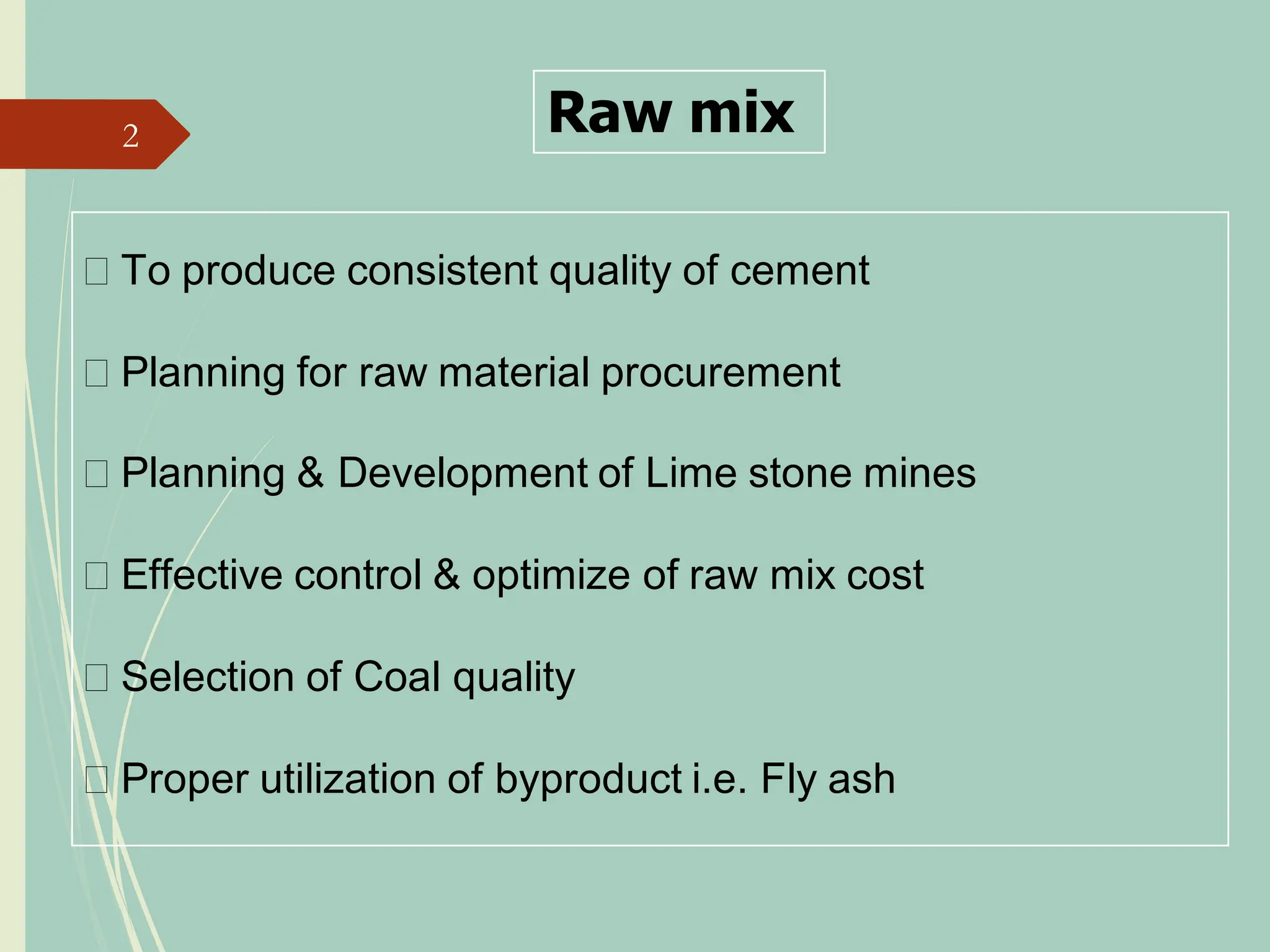
 To produce consistent quality of cement
 Planning for raw material procurement
 Planning & Development of Lime stone mines
 Effective control & optimize of raw mix cost
 Selection of Coal quality
 Proper utilization of byproduct i.e. Fly ash
Raw mix
3
First calcarious / silicious raw material and
additive in required proportions are pulverized
to get desired raw meal. This raw meal is fed
to kiln system where it undergoes various
chemical changes and potential components
responsible for cementing properties and formed
here. This clinker is cooled in cooler. Various
burning process in kiln system is summarized
below .
Cement Manufacturing Process
4
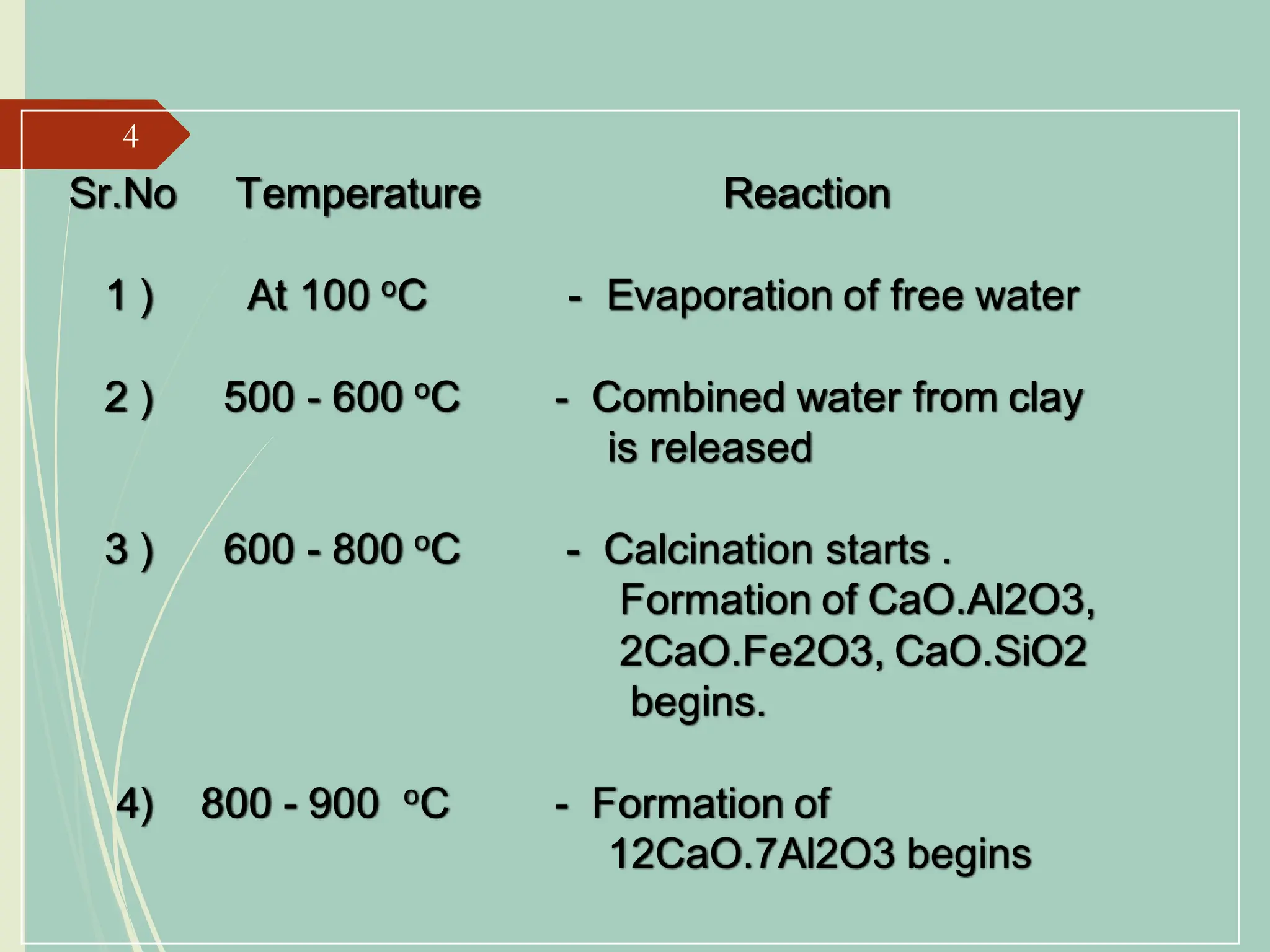
Sr.No Temperature Reaction
1 ) At 100 oC - Evaporation of free water
2 ) 500 - 600 oC - Combined water from clay
is released
3 ) 600 - 800 oC - Calcination starts .
Formation of CaO.Al2O3,
2CaO.Fe2O3, CaO.SiO2
begins.
4) 800 - 900 oC - Formation of
12CaO.7Al2O3 begins
5
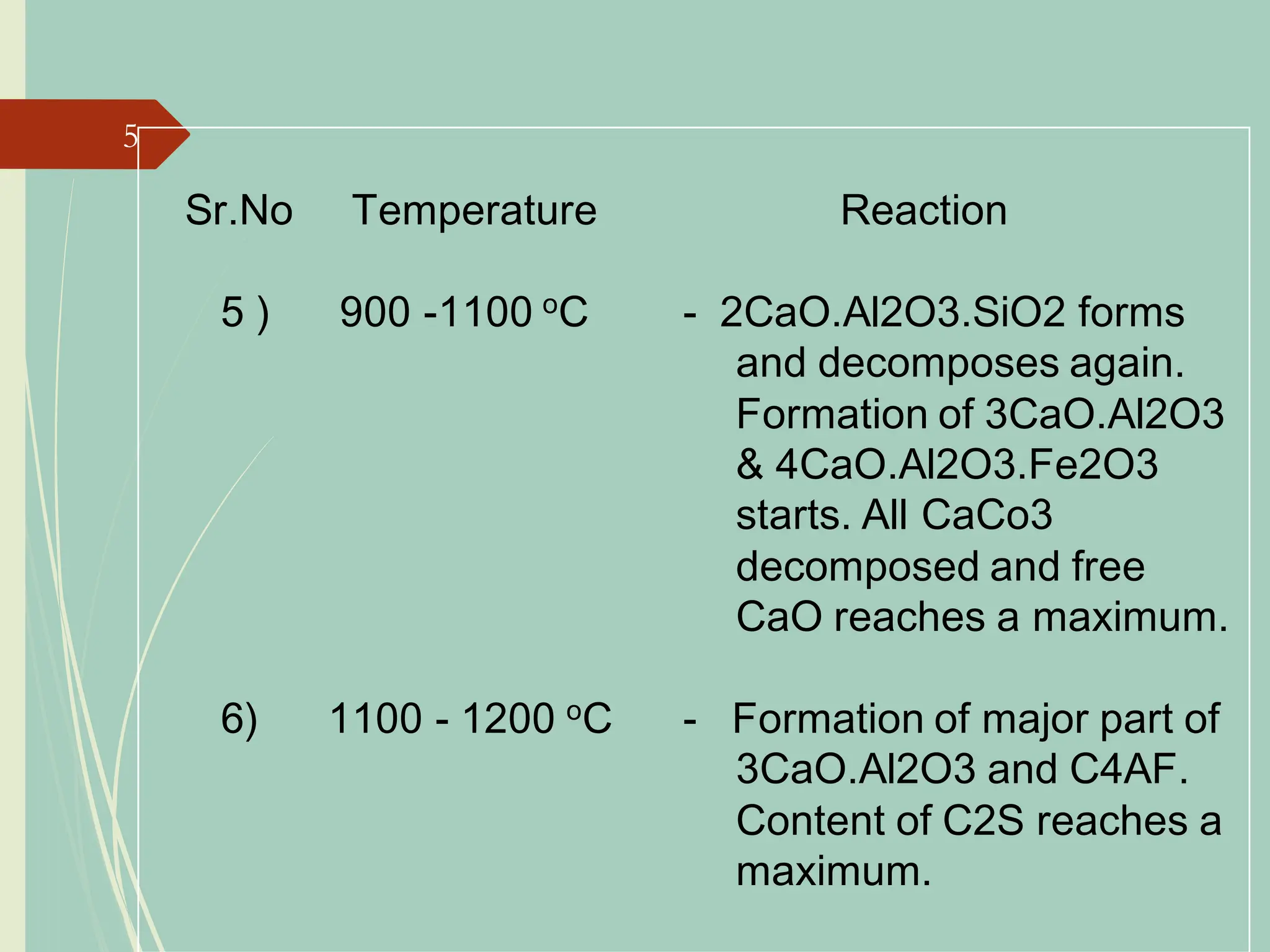
Sr.No Temperature Reaction
5 ) 900 -1100 oC - 2CaO.Al2O3.SiO2 forms
and decomposes again.
Formation of 3CaO.Al2O3
& 4CaO.Al2O3.Fe2O3
starts. All CaCo3
decomposed and free
CaO reaches a maximum.
6) 1100 - 1200 oC - Formation of major part of
3CaO.Al2O3 and C4AF.
Content of C2S reaches a
maximum.
6
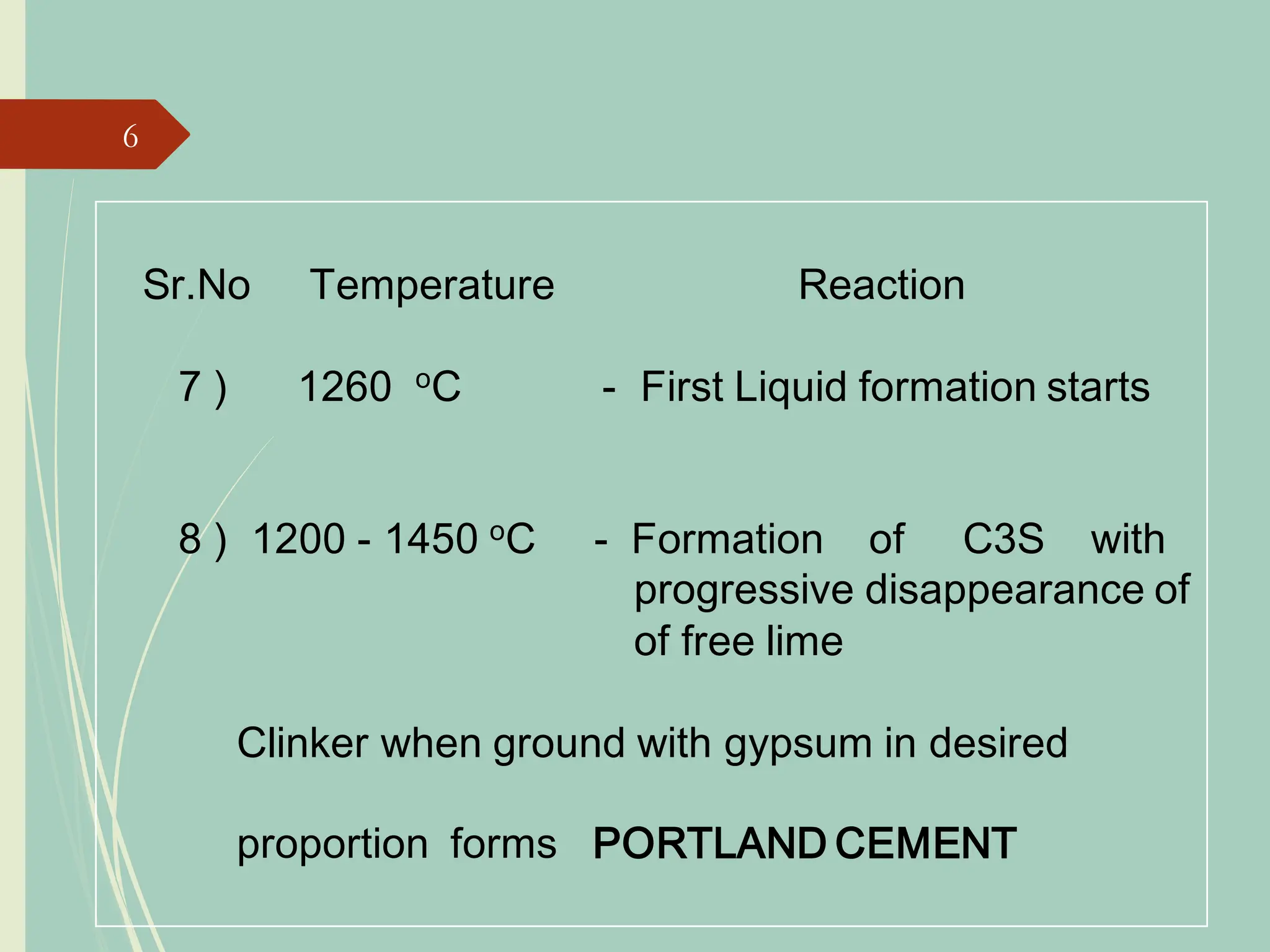
Sr.No Temperature Reaction
7 ) 1260 oC - First Liquid formation starts
8 ) 1200 - 1450 oC - Formation of C3S with
progressive disappearance of
of free lime
Clinker when ground with gypsum in desired
proportion forms PORTLAND CEMENT
RAW MIX DESIGN
OBJECTIVE :-
1) Comprehend the Quality requirement of raw material.
2) Determine the quantitative proportions of raw material.
3) In order to obtain desired clinker quality – Determine chemical
composition and burnability of raw meal.
4) Determine the quantitative proportions of various coal like – IMP
COAL , IND COAL etc.
7
Introduction
 The lime stone is main raw material for manufacturing of the
clinker , Bauxite, Heamatite , Sand stone , Fly ash, Laterite,
Clay etc are also used as a corrective material to maintain
desired quality of clinker.
Cement manufacturing process involves –
1) Preparation of raw mix by crushing , grinding & blending of
raw material in definite proportion.
2) Burning of raw material at 1450 oC in the kiln.
3) Grinding the clinker to fine powder with a certain amount of
gypsum to regulate the setting of cement.
In order to obtain a product of desired quality the various steps
Involved in the process need careful control and in this direction
design of raw mix form an extremely important input.
8
Mineral composition :-
Mineralogical composition of the raw material like L/stone,
Bxt, Heamatite , Laterite etc are very important for raw mix
designing point of view. Important characteristics are –
 Physical amenability to crushing , Grinding &
homogenization .
 Individual dissociation or Breakdown character.
Therefore knowledge of mineralogical composition of all
raw material is very essential to understand their behavior
during the manufacturing process. The oxides occur in the
form of minerals compounds.
9
OXIDE MINERAL
1) CaO Calcite, Argonite, Dolomite, Paper
Sludge & Gypsum .
2) SiO2 Quartz, Clay , Mica based mineral , Fly
Ash
3) Al2O3 Bauxite , Clay , Field Spar etc.
4) Fe2O3 Heamatite , Laterite , Magnetite etc.
5) S Gypsum , Pyrite etc.
10
Physico – Mechanical Characteristics
Important Physical – mechanical Properties
of raw material :-
1) Crushability
2) Grind ability
3) Natural Moisture content
4) Plasticity
11
Raw material composition
 Three important properties or composition of raw
material
1 ) Chemical composition
2 ) Mineral composition
3 ) Physico – Mechanical composition
12
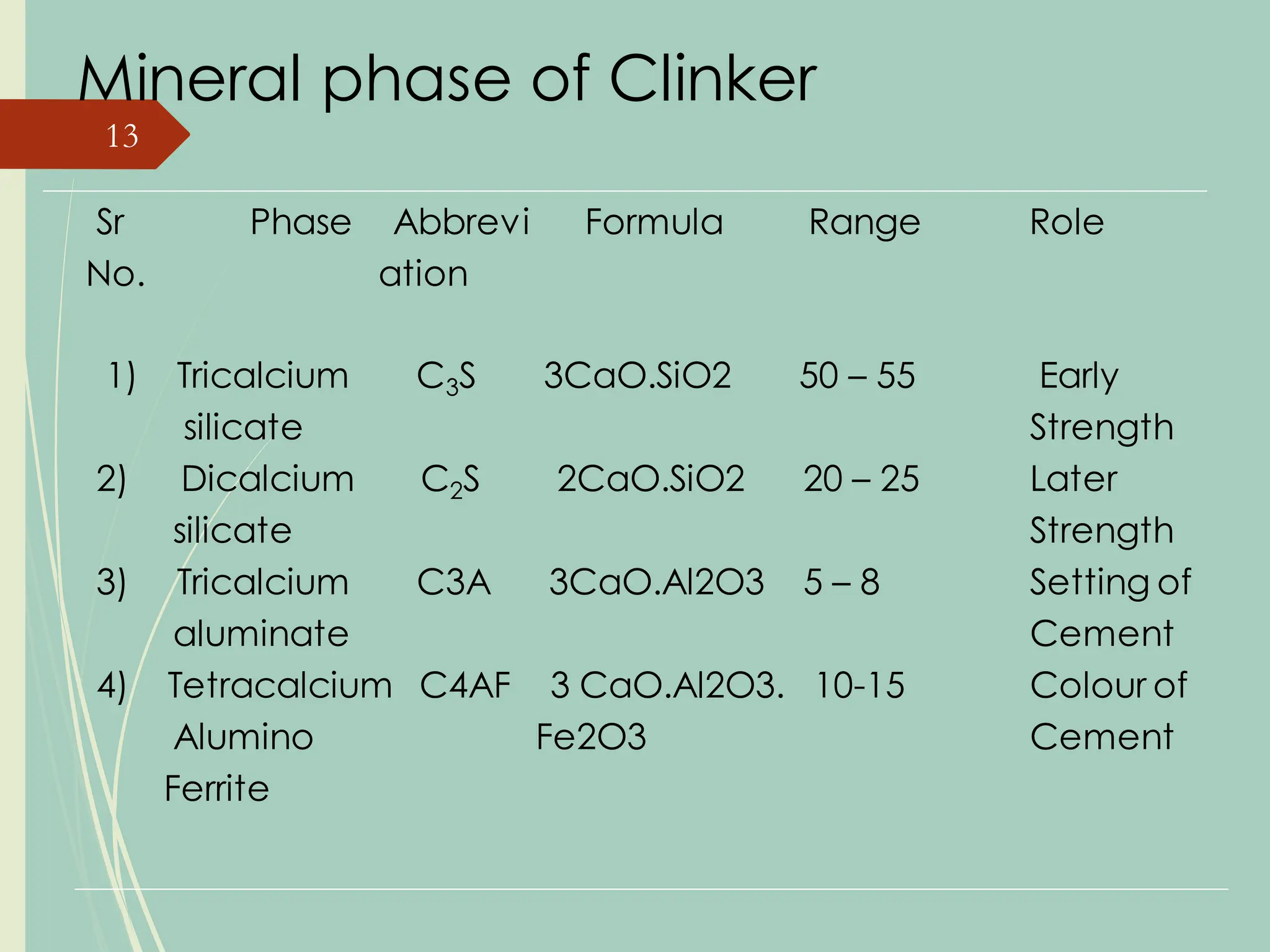
Mineral phase of Clinker
Sr Phase Abbrevi Formula Range Role
No. ation
1) Tricalcium C3S 3CaO.SiO2 50 – 55 Early
silicate Strength
2) Dicalcium C2S 2CaO.SiO2 20 – 25 Later
silicate Strength
3) Tricalcium C3A 3CaO.Al2O3 5 – 8 Setting of
aluminate Cement
4) Tetracalcium C4AF 3 CaO.Al2O3. 10-15 Colour of
Alumino Fe2O3 Cement
Ferrite
13
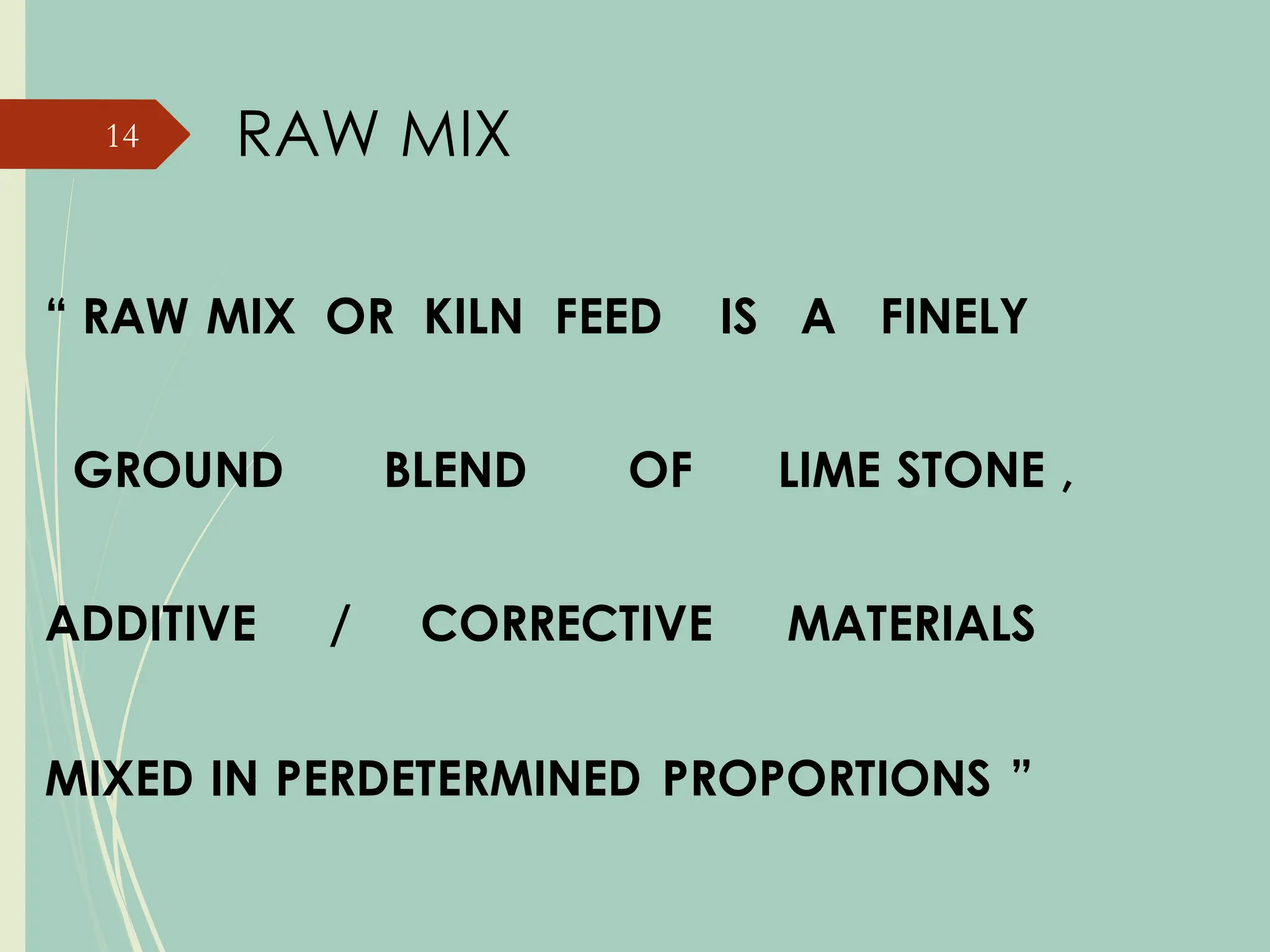
RAW MIX
“ RAW MIX OR KILN FEED IS A FINELY
GROUND BLEND OF LIME STONE ,
ADDITIVE / CORRECTIVE MATERIALS
MIXED IN PERDETERMINED PROPORTIONS ”
14
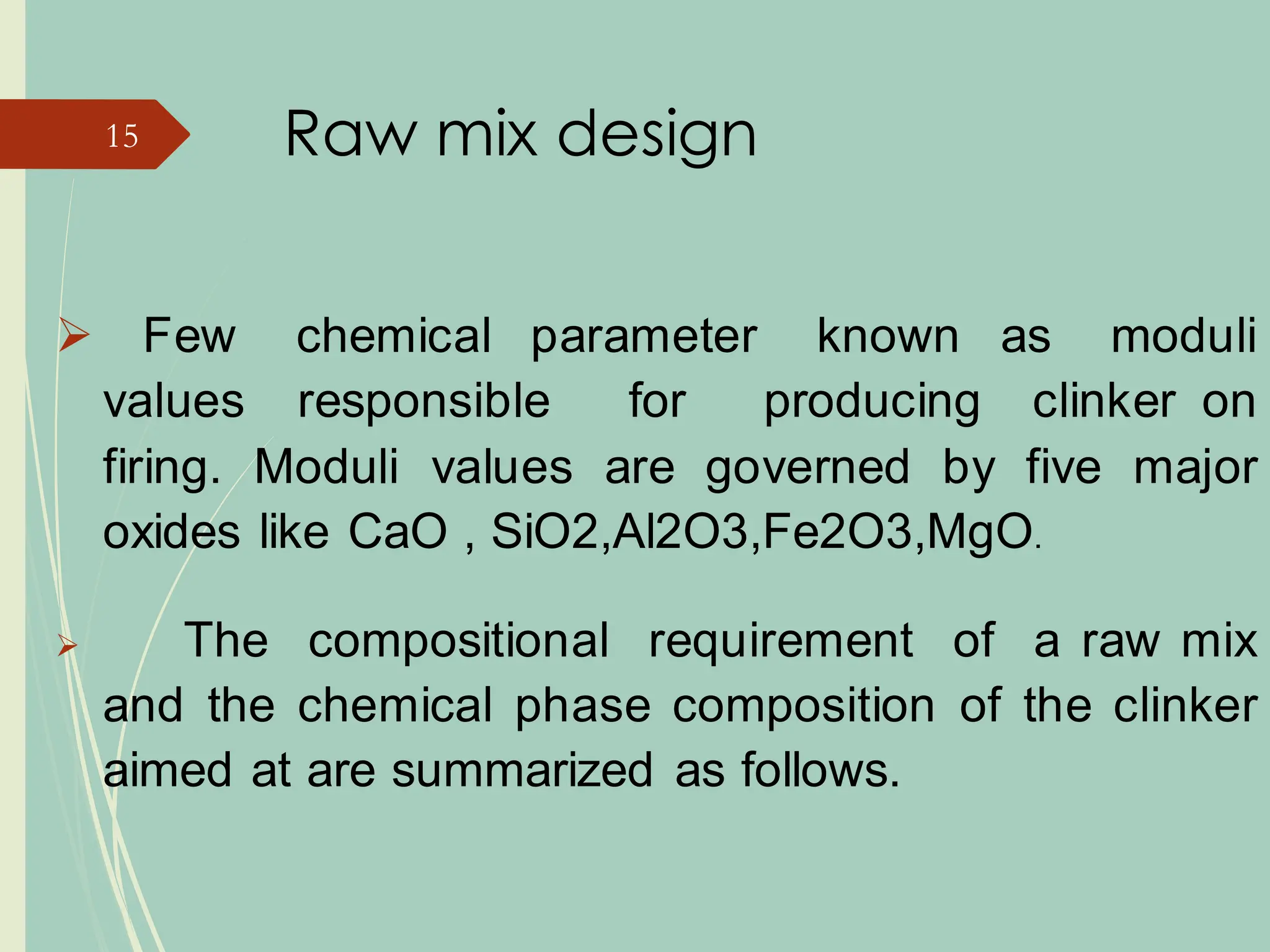
Raw mix design
➢ Few chemical parameter known as moduli
values responsible for producing clinker on
firing. Moduli values are governed by five major
oxides like CaO , SiO2,Al2O3,Fe2O3,MgO.
➢ The compositional requirement of a raw mix
and the chemical phase composition of the clinker
aimed at are summarized as follows.
15
16
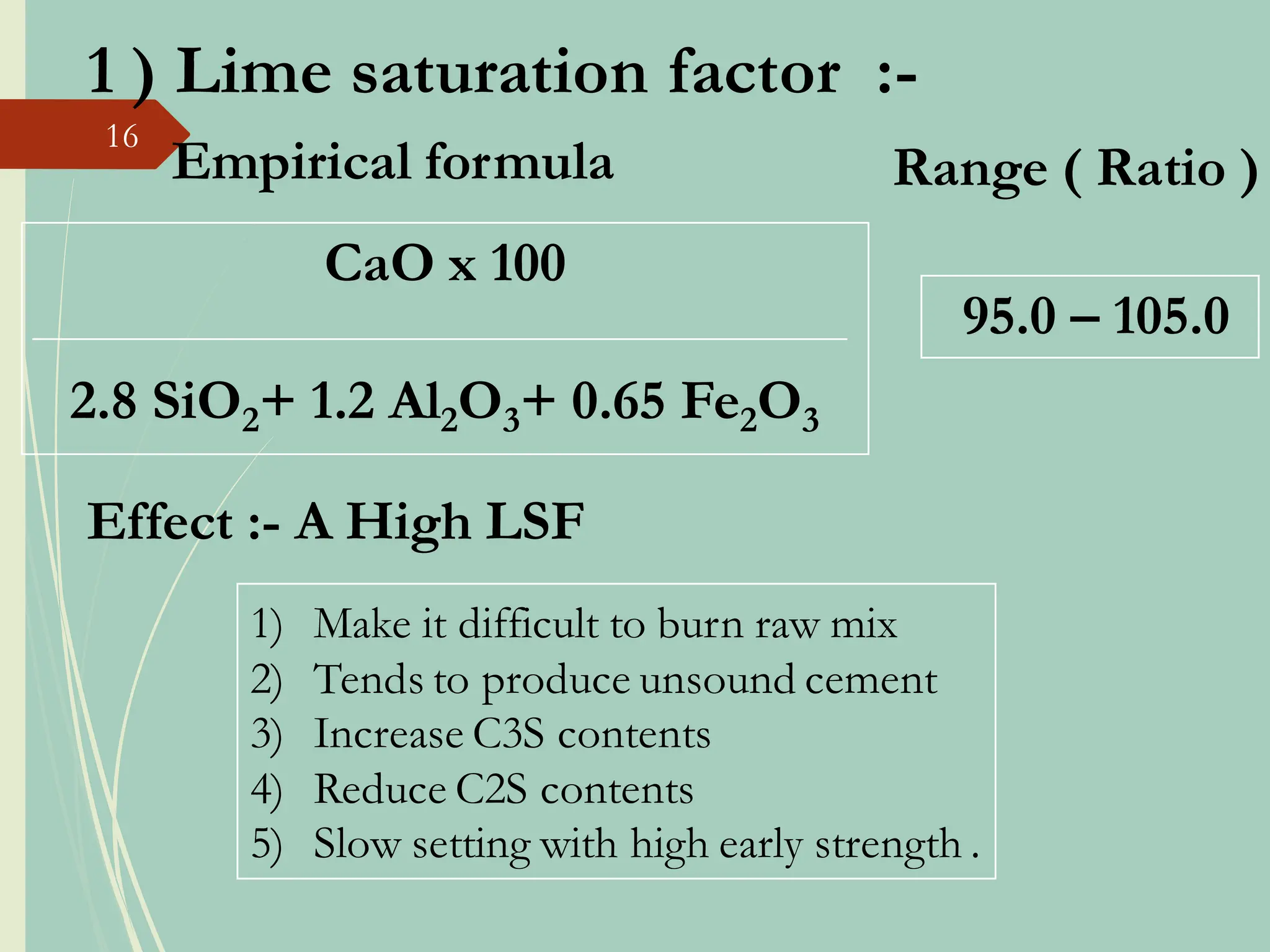
1 ) Lime saturation factor :-
Empirical formula
CaO x 100
2.8 SiO2+ 1.2 Al2O3+ 0.65 Fe2O3
Range ( Ratio )
95.0 – 105.0
Effect :- A High LSF
1) Make it difficult to burn raw mix
2) Tends to produce unsound cement
3) Increase C3S contents
4) Reduce C2S contents
5) Slow setting with high early strength .
17
2 ) Silica modules :-
Empirical formula
SiO2
Al2O3 + Fe2O3
Range ( Ratio )
2.0 – 3.0
Effect :- A High SM
1) Results in harder burning and high fuel consumption
2) Causes difficulty in coating formation and hence the
radiation from shell is high.
4) Deteriorates the kiln linings
5) Increase unsoundness ( High CaO )
6) Results in slow setting & Harding cement
18
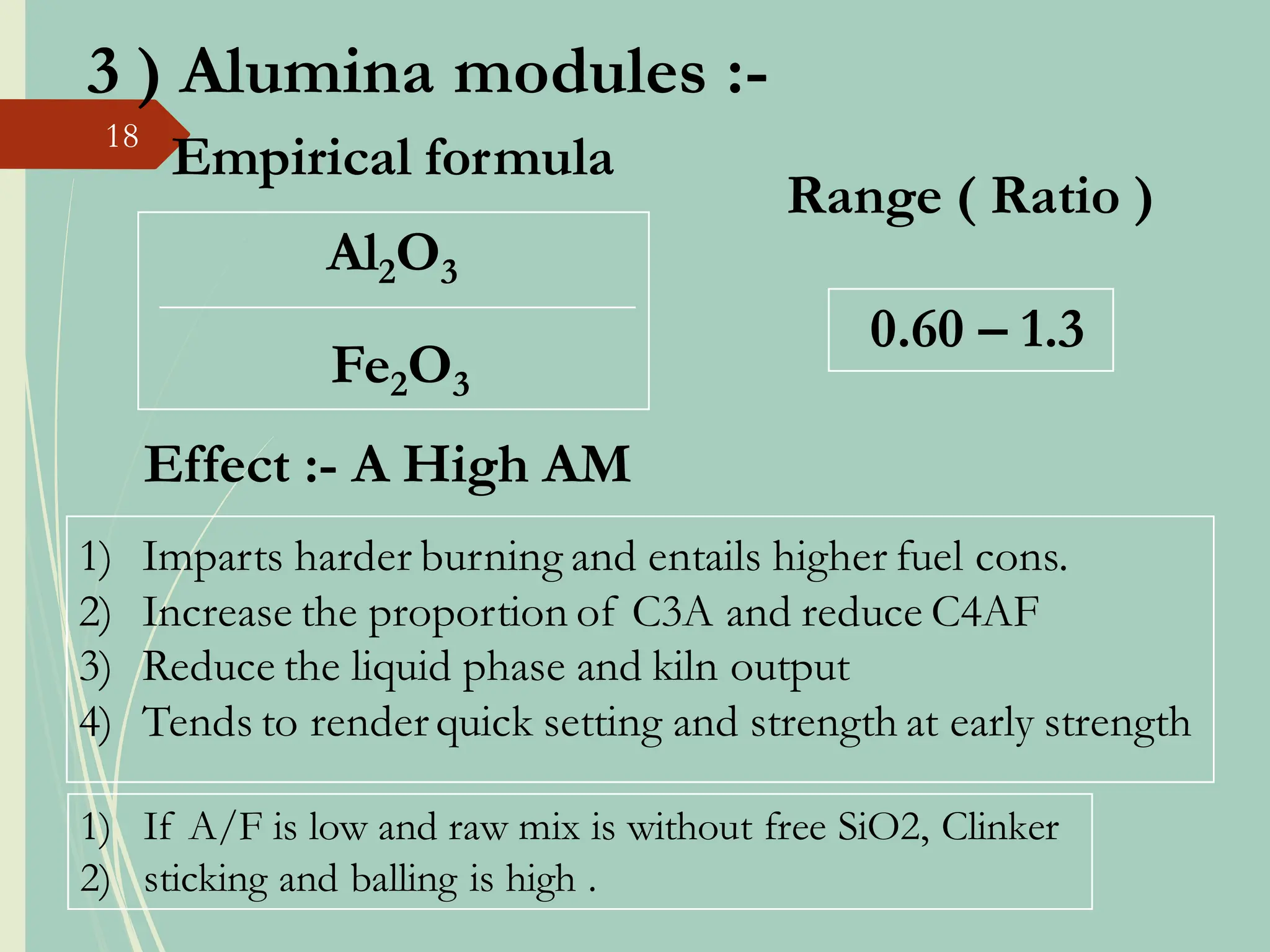
3 ) Alumina modules :-
Empirical formula
Al2O3
Fe2O3
Range ( Ratio )
0.60 – 1.3
Effect :- A High AM
1) Imparts harder burning and entails higher fuel cons.
2) Increase the proportion of C3A and reduce C4AF
3) Reduce the liquid phase and kiln output
4) Tends to render quick setting and strength at early strength
1) If A/F is low and raw mix is without free SiO2, Clinker
2) sticking and balling is high .
19
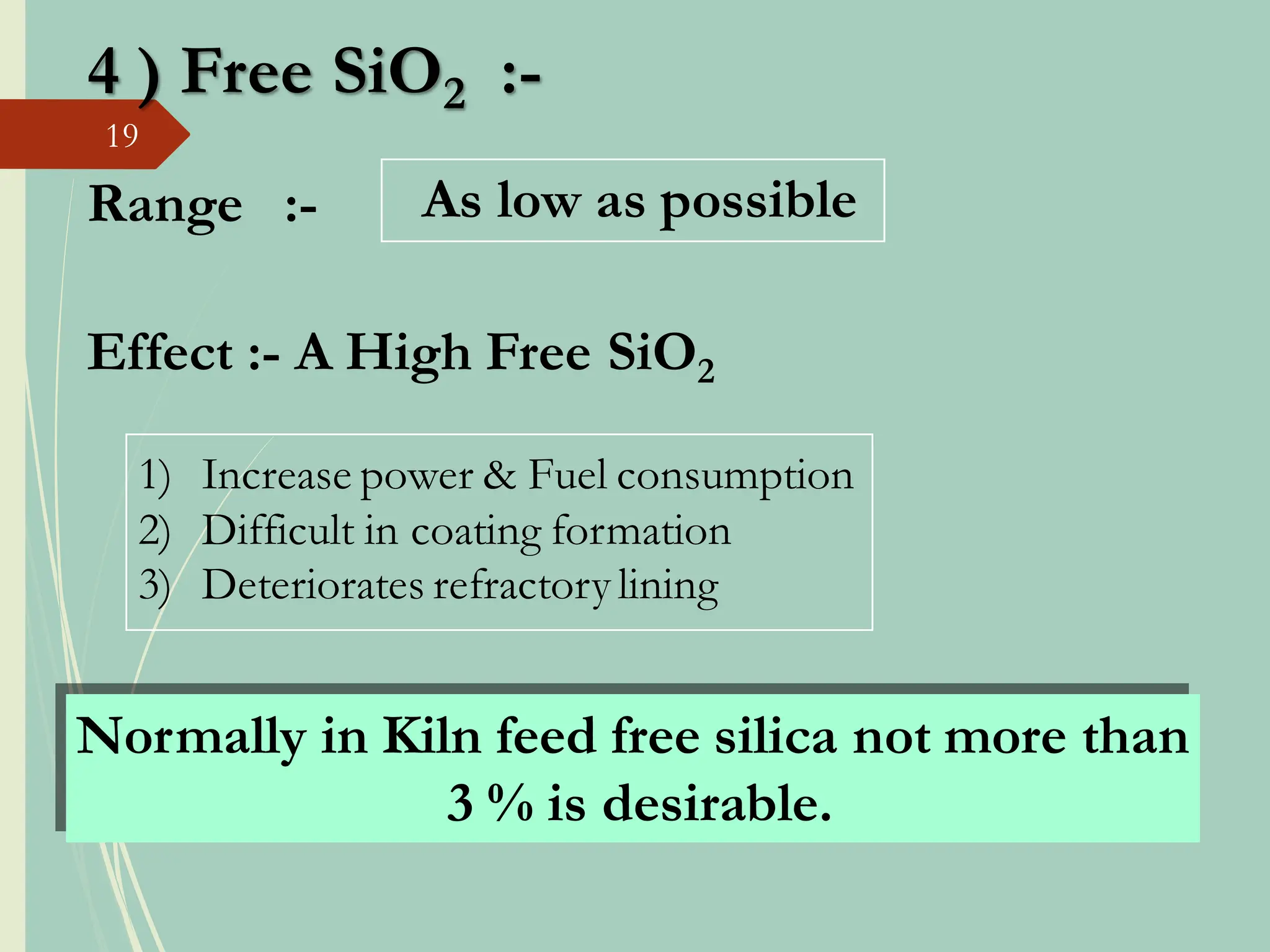
4 ) Free SiO2 :-
Range :- As low as possible
Effect :- A High Free SiO2
1) Increase power & Fuel consumption
2) Difficult in coating formation
3) Deteriorates refractory lining
Normally in Kiln feed free silica not more than
3 % is desirable.
20
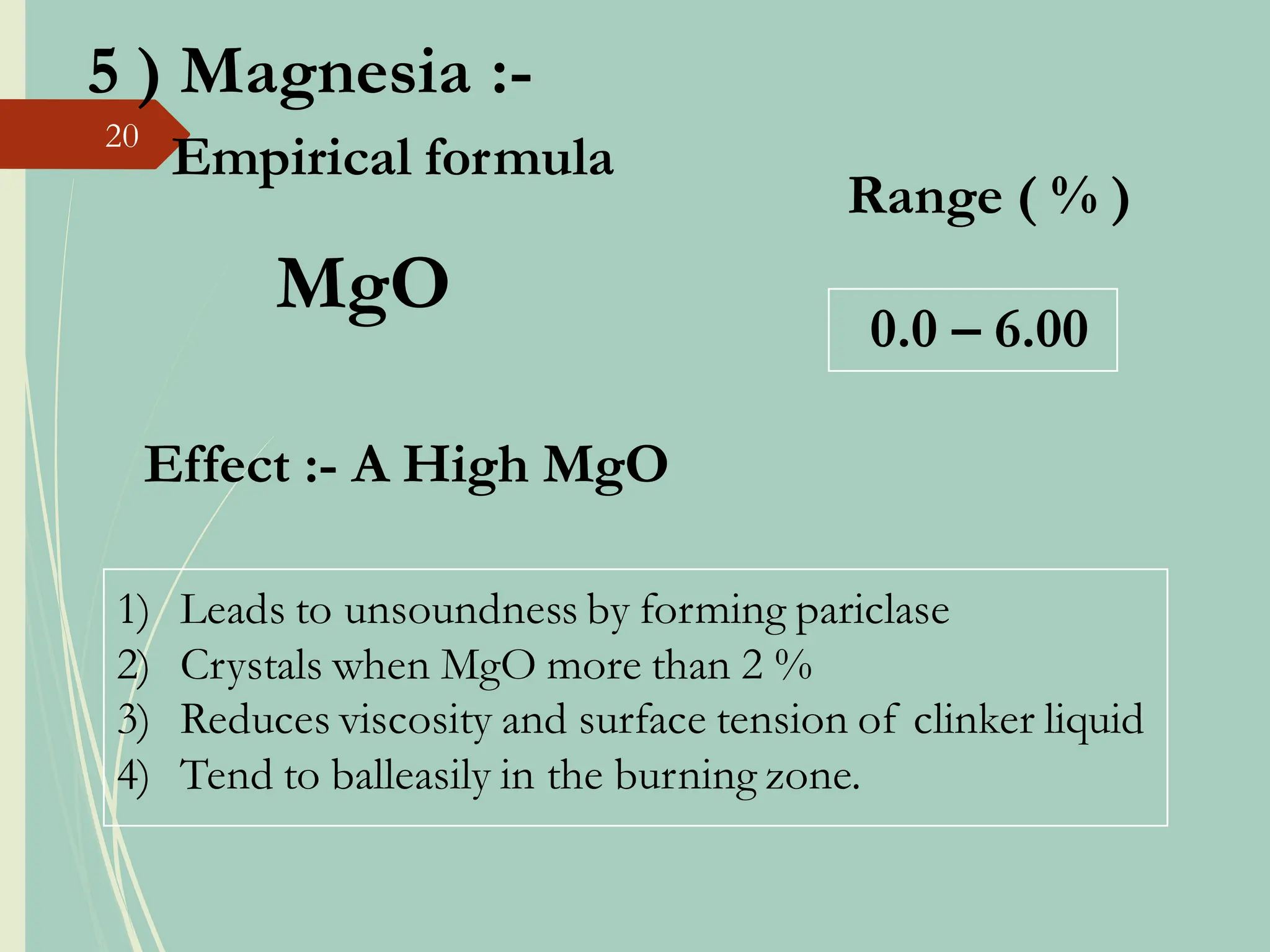
5 ) Magnesia :-
Empirical formula
0.0 – 6.00
Effect :- A High MgO
1) Leads to unsoundness by forming pariclase
2) Crystals when MgO more than 2 %
3) Reduces viscosity and surface tension of clinker liquid
4) Tend to balleasily in the burning zone.
MgO
Range ( % )
21
6 ) Alkali :-
Empirical formula
0.20 – 0.30
Effect :- A High Alkali
1) Improve burnability
2) Increase liquid %
3) Easy coating formation
4) External & Internal alkali cycle formation
Na2O + K2O
Range ( % )
22
7 ) Sulphur :-
Empirical formula
0.50 – 1.00
Effect :- A High Sulphur
1) More than 2.5 – 4.0 % cause sulphate expansion.
2) Chocking of the preheater & formation
of kiln coating
S
Range ( % )
23
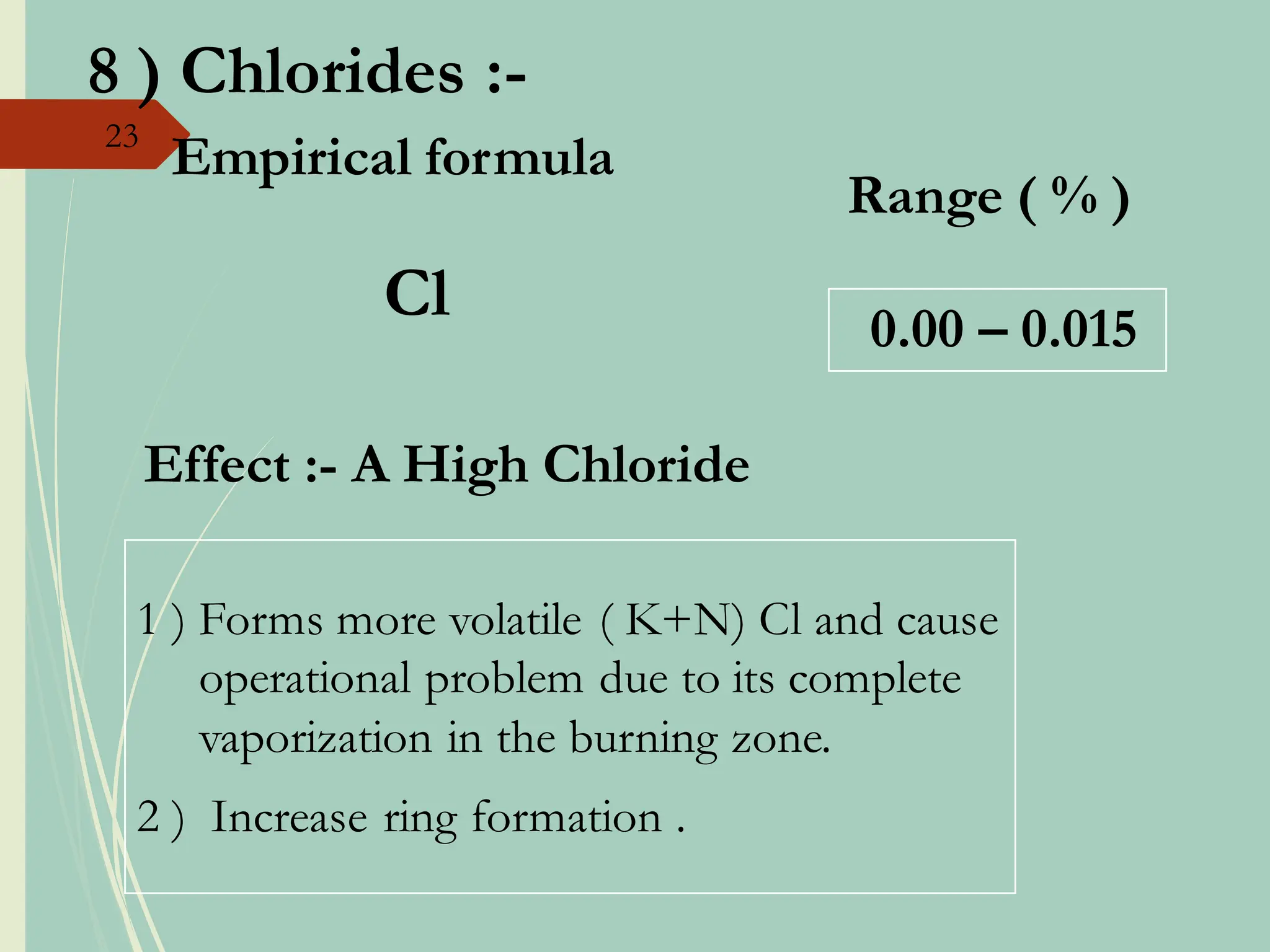
8 ) Chlorides :-
Empirical formula
Range ( % )
0.00 – 0.015
Effect :- A High Chloride
1 ) Forms more volatile ( K+N) Cl and cause
operational problem due to its complete
vaporization in the burning zone.
2 ) Increase ring formation .
Cl
24
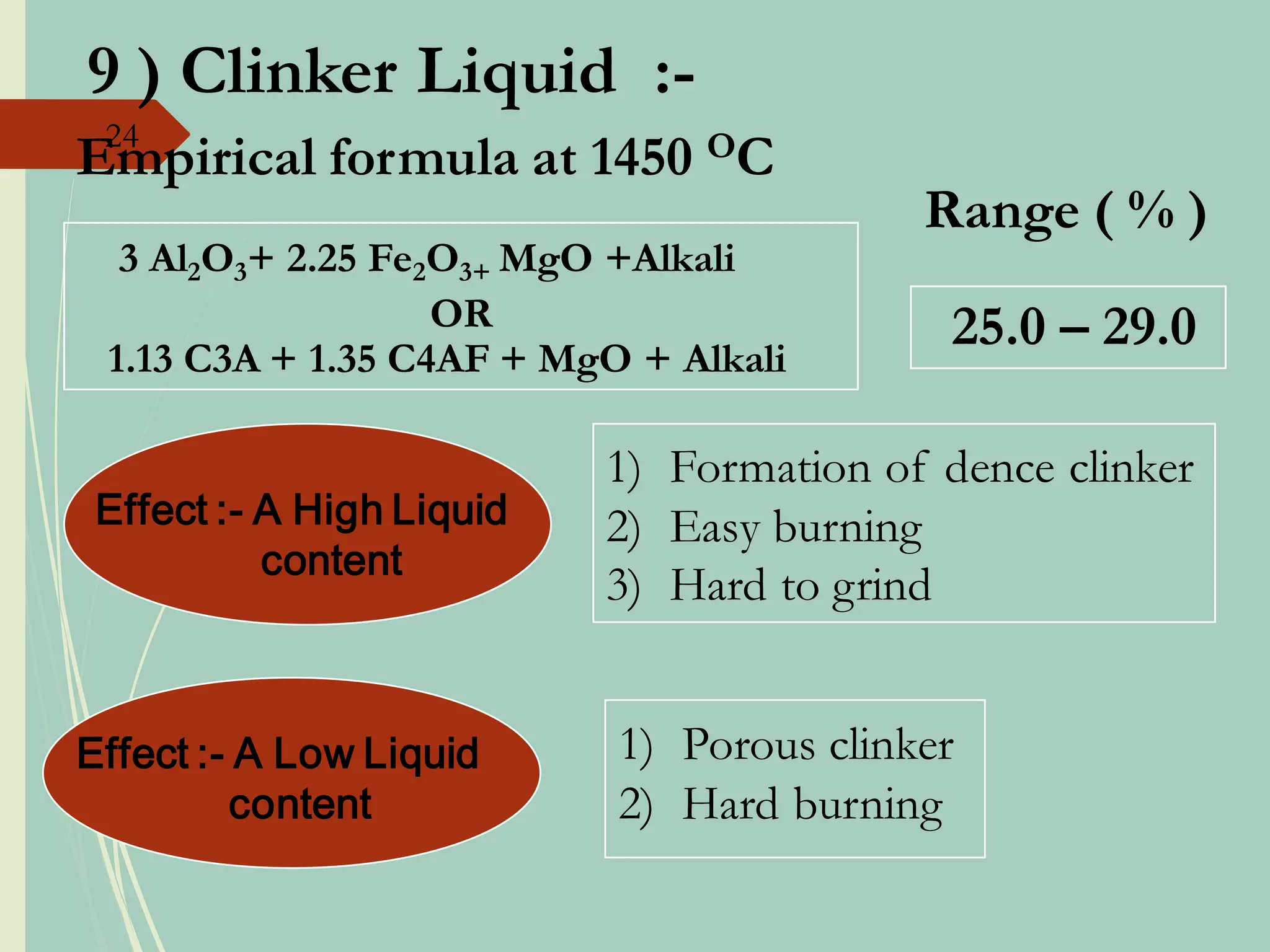
9 ) Clinker Liquid :-
Empirical formula at 1450 OC
3 Al2O3+ 2.25 Fe2O3+ MgO +Alkali
OR
1.13 C3A + 1.35 C4AF + MgO + Alkali
Range ( % )
25.0 – 29.0
Effect :- A High Liquid
content
1) Formation of dence clinker
2) Easy burning
3) Hard to grind
Effect :- A Low Liquid
content
1) Porous clinker
2) Hard burning
25
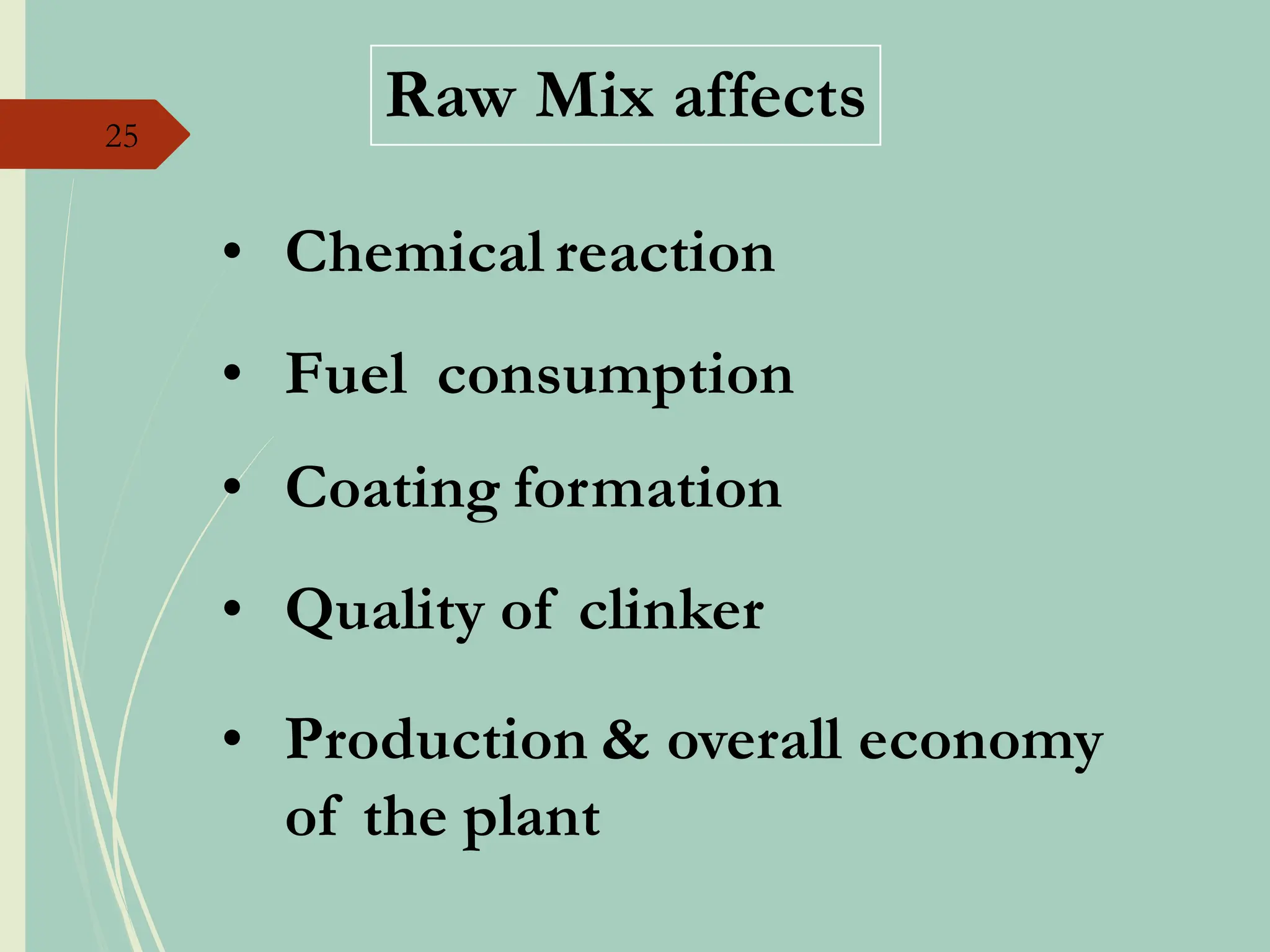
Raw Mix affects
• Chemical reaction
• Fuel consumption
• Coating formation
• Quality of clinker
• Production & overall economy
of the plant
26
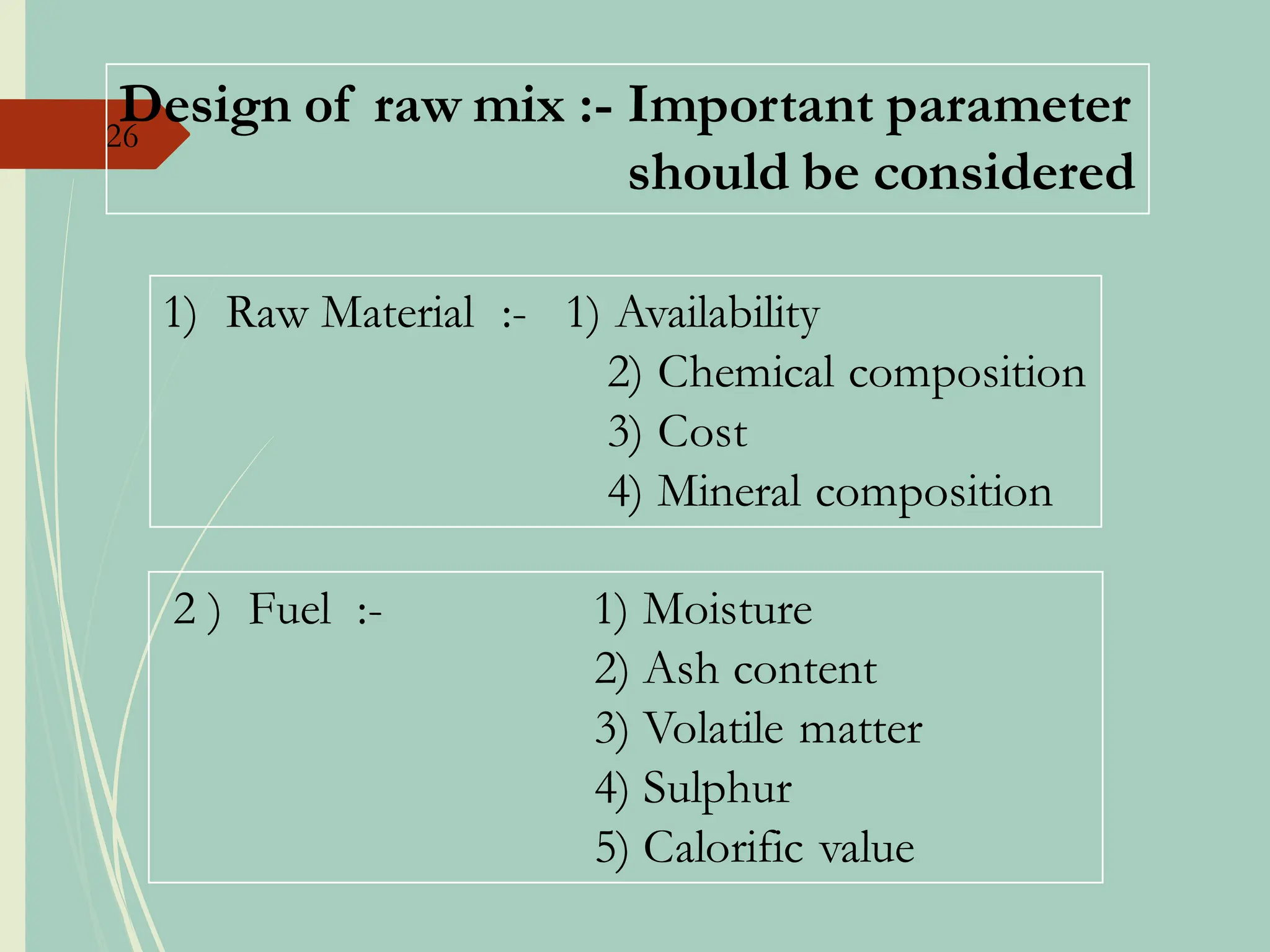
Design of raw mix :- Important parameter
should be considered
1) Raw Material :- 1) Availability
2) Chemical composition
3) Cost
4) Mineral composition
2 ) Fuel :- 1) Moisture
2) Ash content
3) Volatile matter
4) Sulphur
5) Calorific value
27
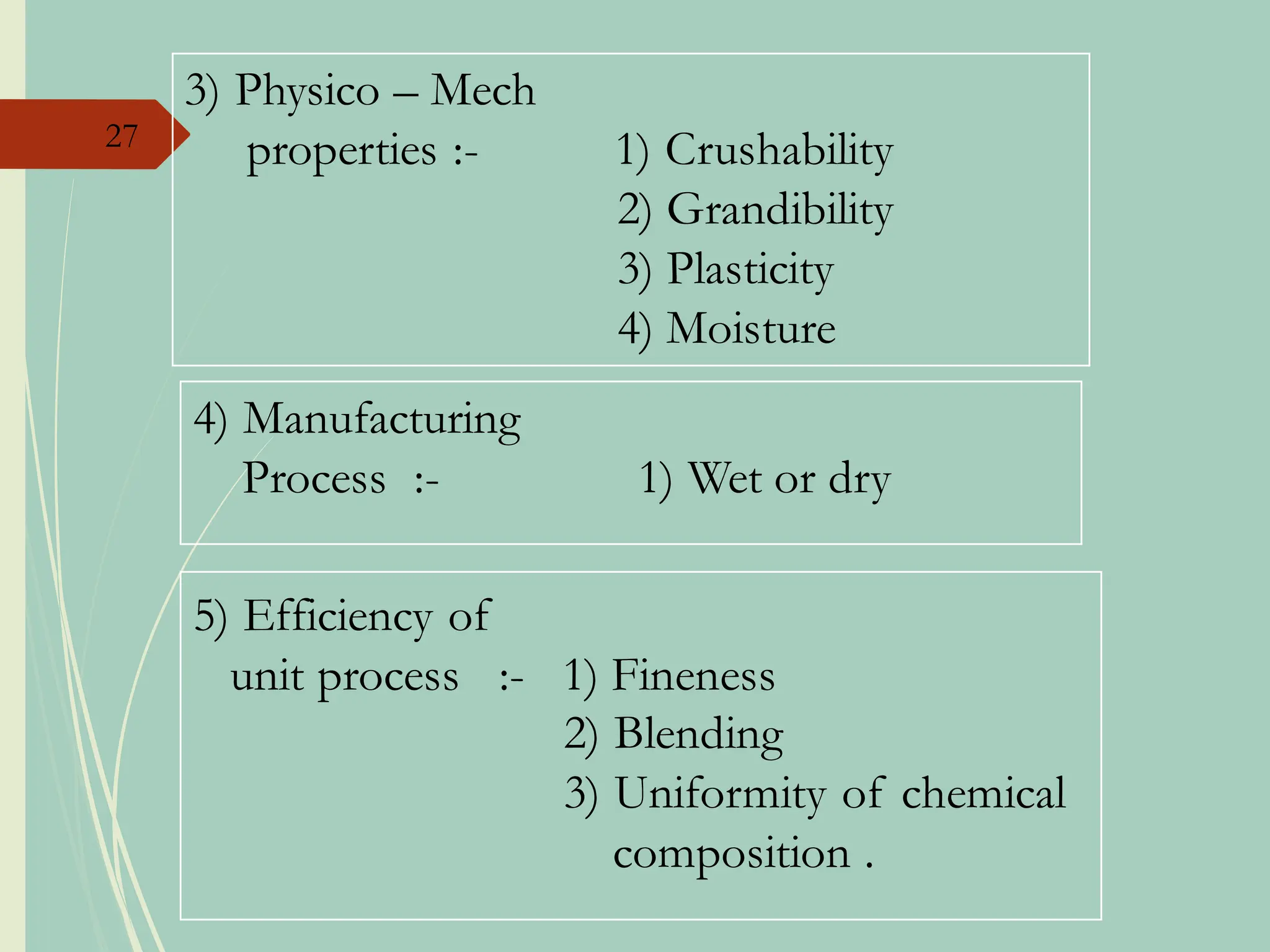
4) Manufacturing
Process :- 1) Wet or dry
3) Physico – Mech
properties :- 1) Crushability
2) Grandibility
3) Plasticity
4) Moisture
5) Efficiency of
unit process :- 1) Fineness
2) Blending
3) Uniformity of chemical
composition .
28
7 ) Design Quality :- 1) Desirable
2) Acceptable
3) Marketable
6 ) Standard
specification :- 1) Insoluble Residue
2) Magnesia
3) Loss on Ignition
4) Module value like LSF , A/F
8 ) Economics of :- 1) Ensuring total company
design productivity
2) Material conservation
3) Waste reduction & Improve
resource utilization
4) Market
29
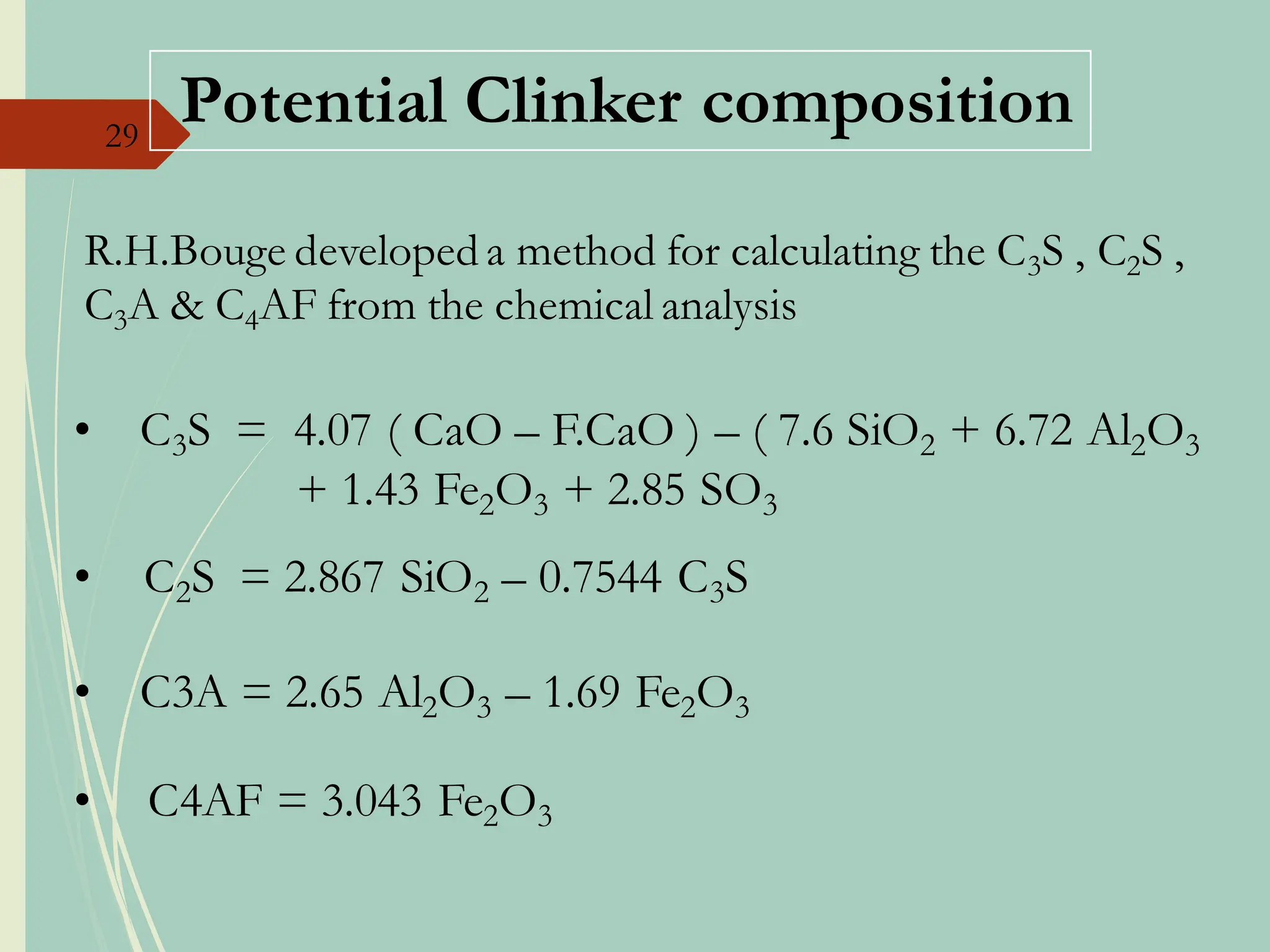
Potential Clinker composition
R.H.Bouge developed a method for calculating the C3S , C2S ,
C3A & C4AF from the chemical analysis
• C3S = 4.07 ( CaO – F.CaO ) – ( 7.6 SiO2 + 6.72 Al2O3
+ 1.43 Fe2O3 + 2.85 SO3
• C2S = 2.867 SiO2 – 0.7544 C3S
• C3A = 2.65 Al2O3 – 1.69 Fe2O3
• C4AF = 3.043 Fe2O3
30
Burnability of raw mix has been define
as a measure of relative ease or difficulty
with which a kiln feed is Converted into
clinker in a kiln .
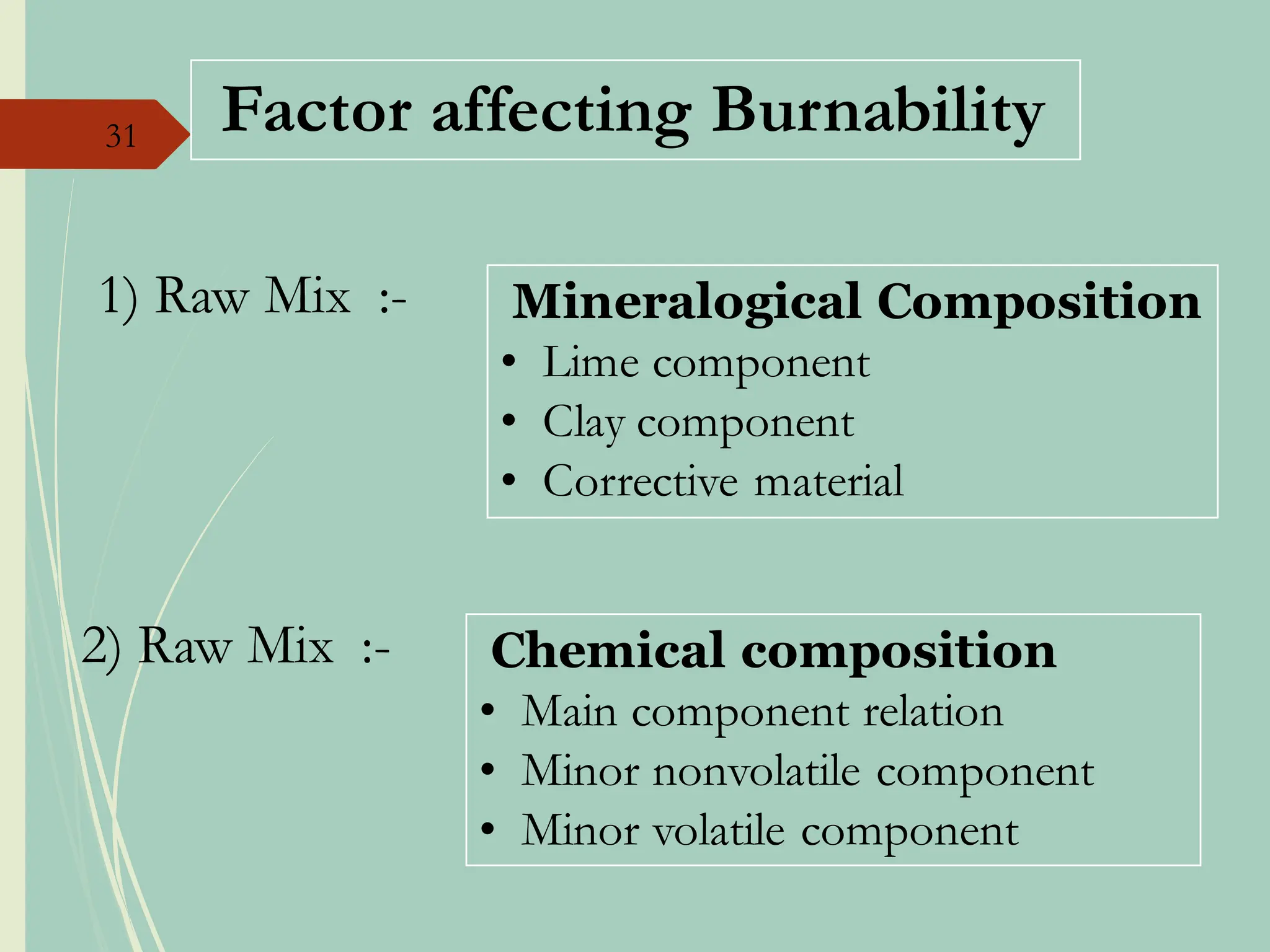
31 Factor affecting Burnability
1) Raw Mix :- Mineralogical Composition
• Lime component
• Clay component
• Corrective material
2) Raw Mix :- Chemical composition
• Main component relation
• Minor nonvolatile component
• Minor volatile component
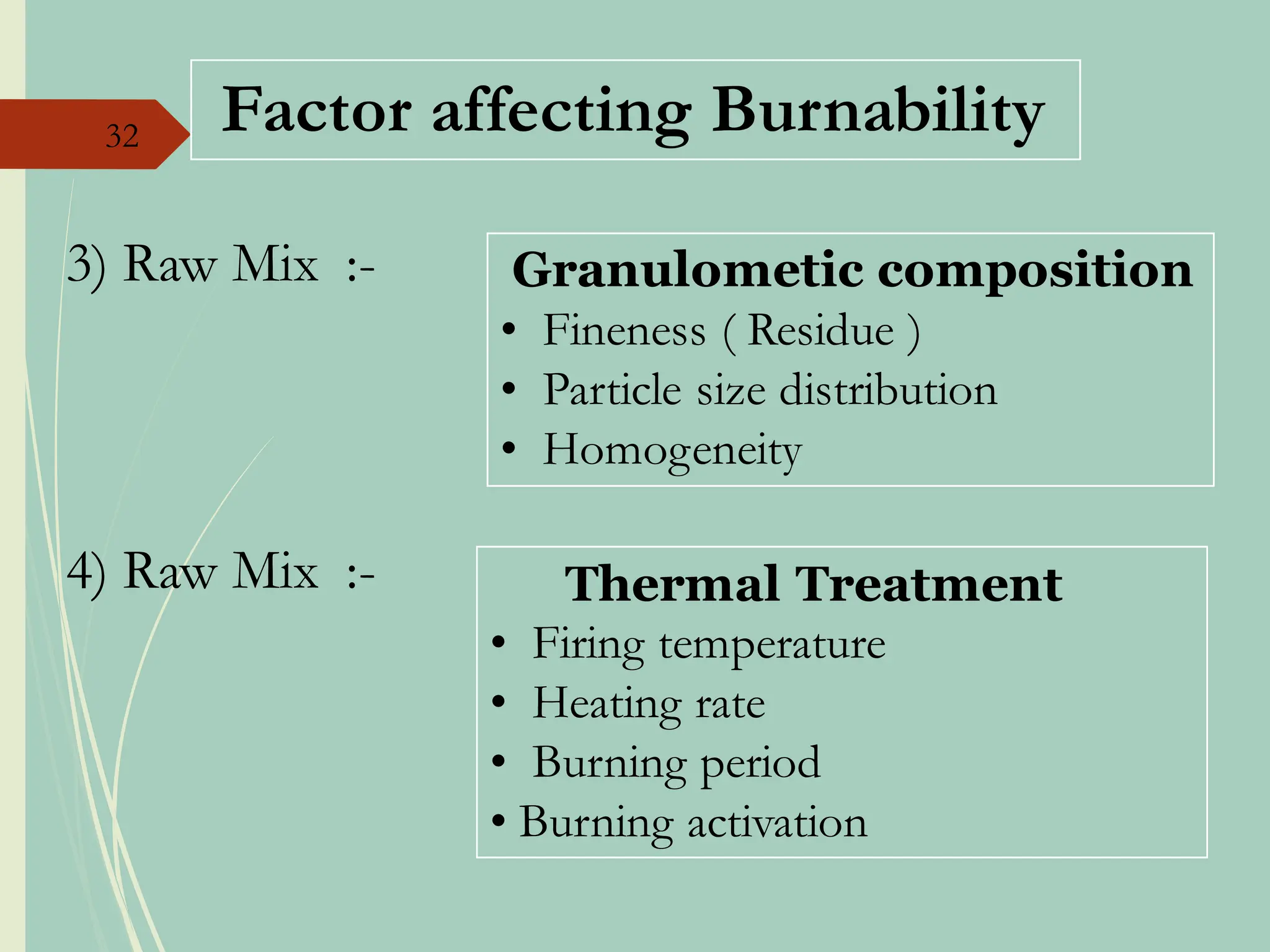
32 Factor affecting Burnability
3) Raw Mix :- Granulometic composition
• Fineness ( Residue )
• Particle size distribution
• Homogeneity
4) Raw Mix :- Thermal Treatment
• Firing temperature
• Heating rate
• Burning period
• Burning activation
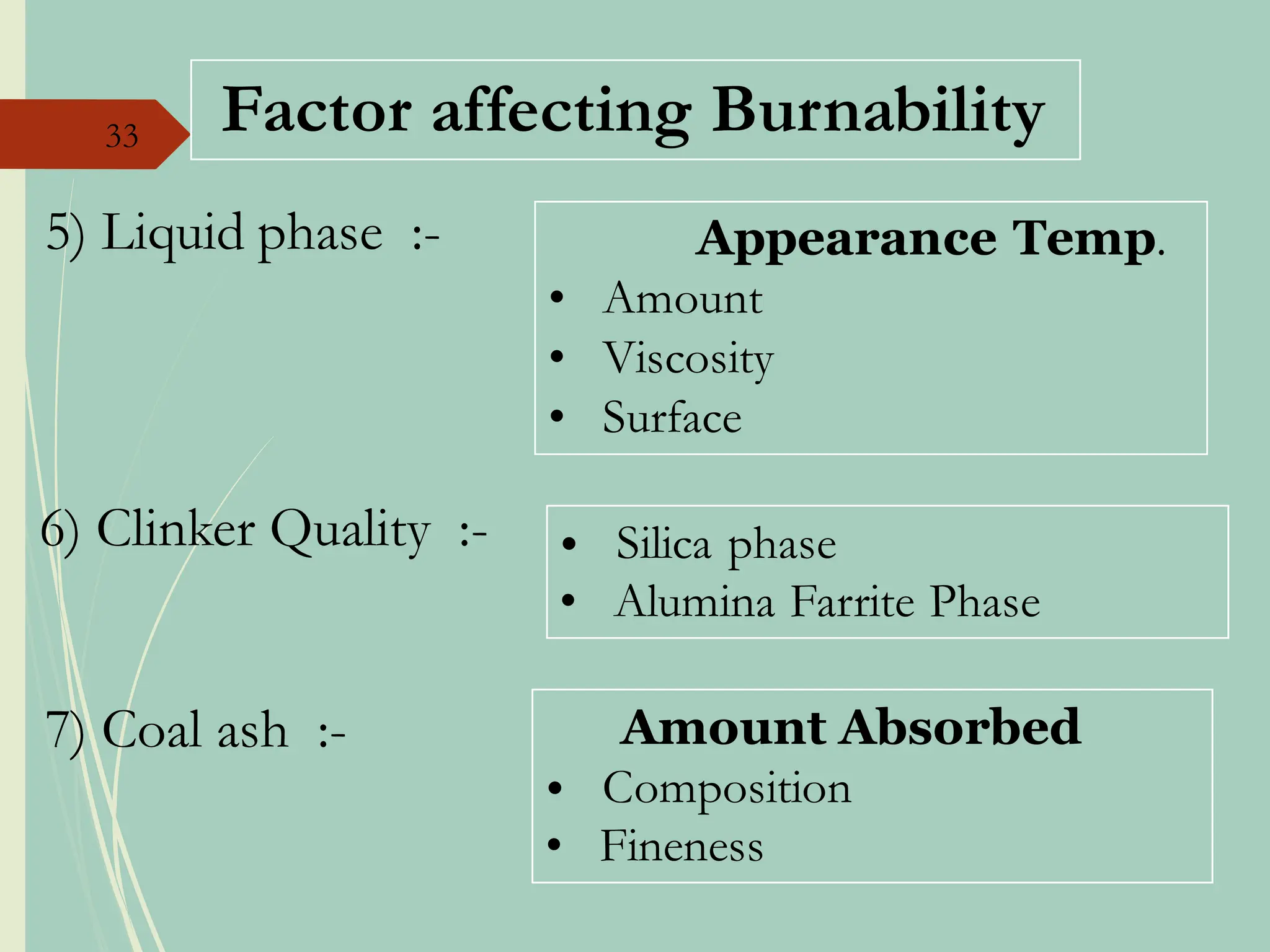
33 Factor affecting Burnability
5) Liquid phase :- Appearance Temp.
• Amount
• Viscosity
• Surface
6) Clinker Quality :- • Silica phase
• Alumina Farrite Phase
7) Coal ash :- Amount Absorbed
• Composition
• Fineness
34 Factor affecting Burnability
8) Kiln Atmosphere :-
• Oxidation
• Reduction
9) Coal Ash
Influence :- • LSF decrease & SM
Increases
• The composition of Silica
phase change
• Liquid content increase
with reduced viscosity
35 Factor affecting Burnability
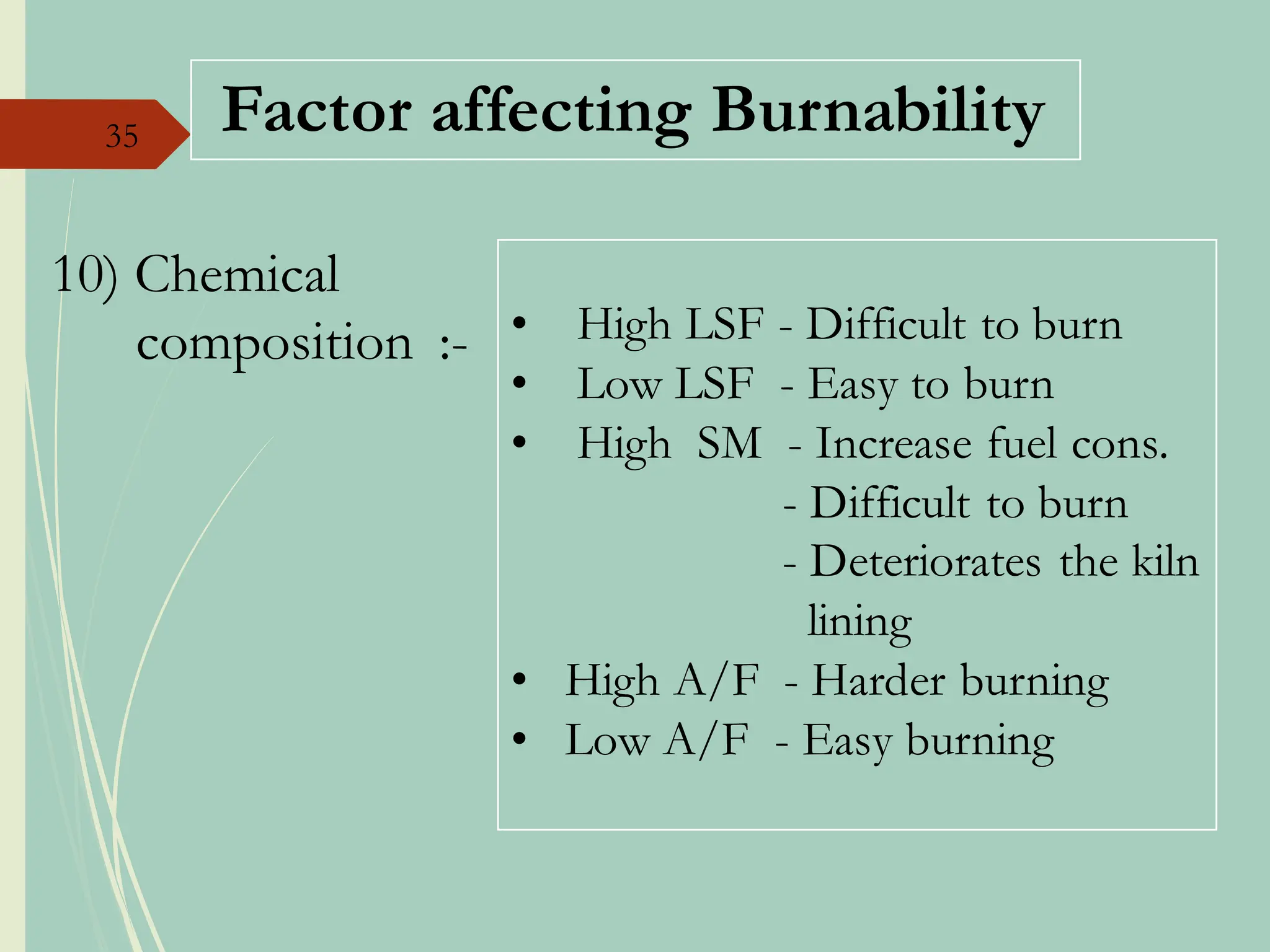
10) Chemical
composition :- • High LSF - Difficult to burn
• Low LSF - Easy to burn
• High SM - Increase fuel cons.
- Difficult to burn
- Deteriorates the kiln
lining
• High A/F - Harder burning
• Low A/F - Easy burning
36
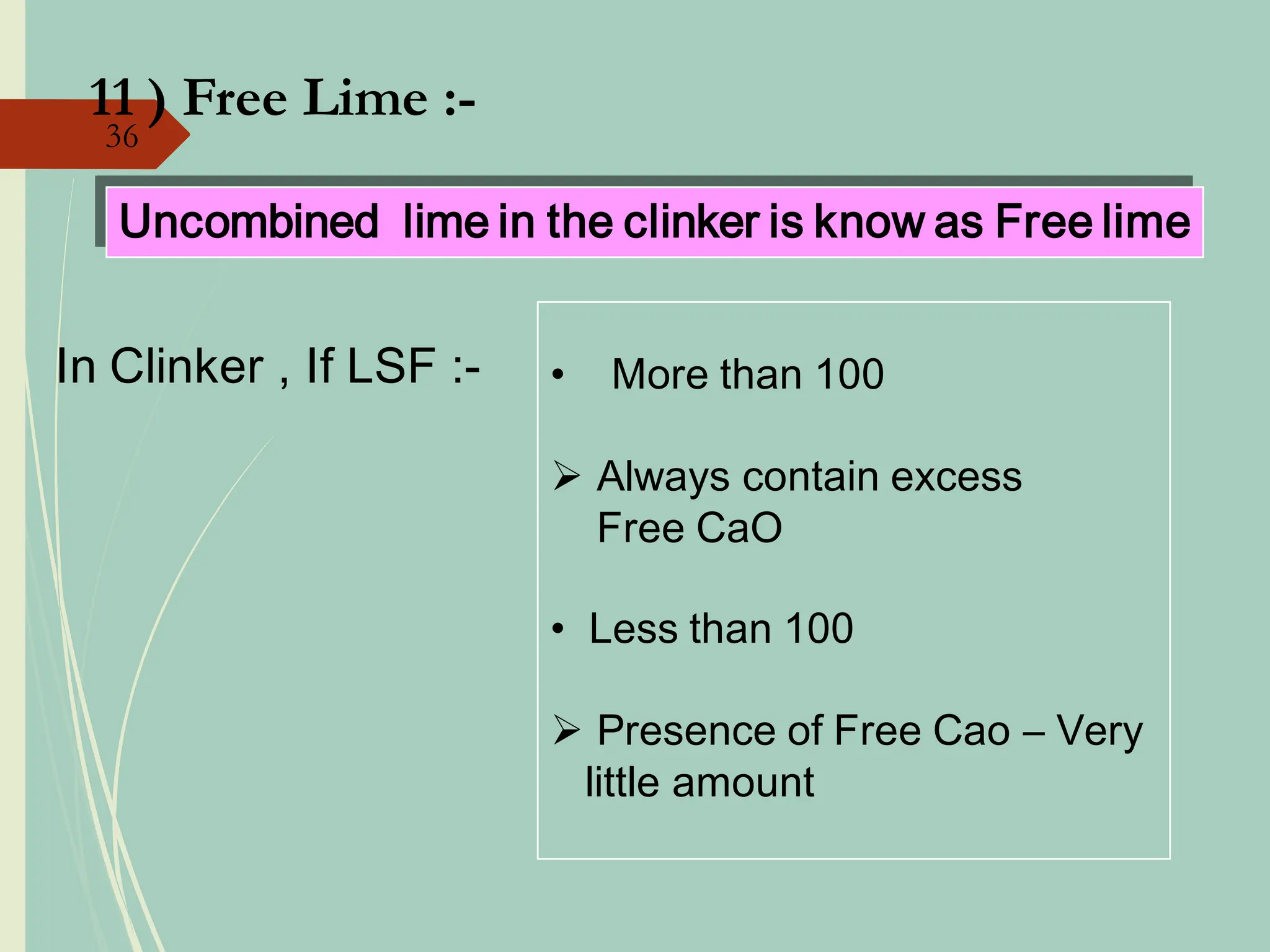
11 ) Free Lime :-
Uncombined lime in the clinker is know as Free lime
In Clinker , If LSF :- • More than 100
➢ Always contain excess
Free CaO
• Less than 100
➢ Presence of Free Cao – Very
little amount
37
The kiln feed sample fired for a restricted period as in
a burnability test with 30 minutes at 1400 oC a definite
content of free lime usually remains after burning even
LSF less than 100.This happen because of two factor
1) Microinhomogenities – Uneven distribution of SiO2
and CaO in the raw mix
2) Macroinhogeneities – Coarser particle of raw meal
especially that calcite and
quartz also contributes
towards Free CaO in clinker.
38
PROXIMATE ANALYSIS
✓ MOISTURE
✓ ASH CONTENT
✓ VOLATILE MATTER
✓ FIXED CARBON
39 1 ) COAL MOISTURE :-
RANGE ( % )
1 ) RAW COAL -
2 ) FINE COAL -
5.0 - 12.0
0.50 – 2.00
40 2 ) COAL ASH CONTENT :-
RANGE ( % )
2 ) ASH - 15.0 - 25.0
OR
Depend on the quality of
Raw material
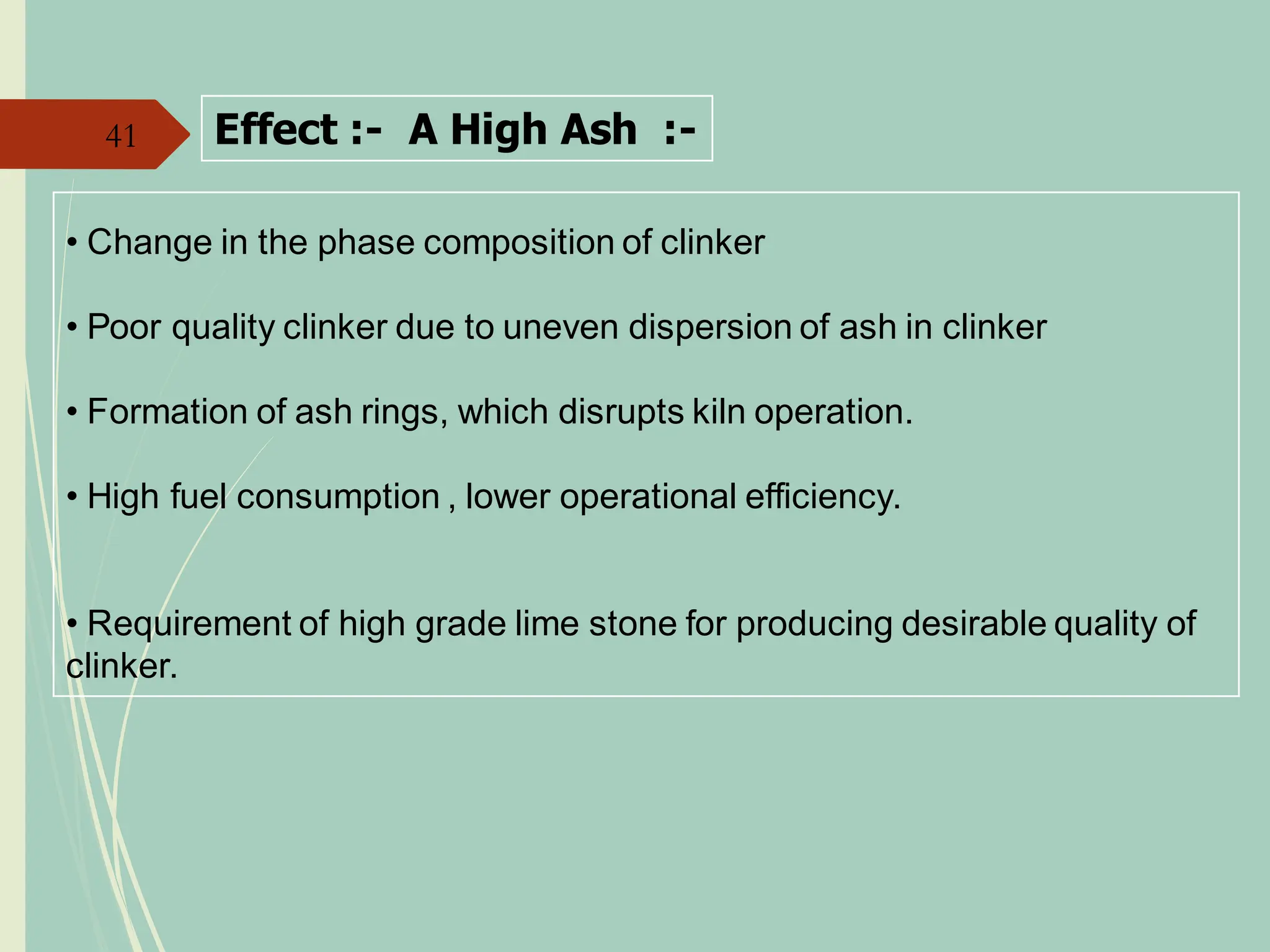
41 Effect :- A High Ash :-
• Change in the phase composition of clinker
• Poor quality clinker due to uneven dispersion of ash in clinker
• Formation of ash rings, which disrupts kiln operation.
• High fuel consumption , lower operational efficiency.
• Requirement of high grade lime stone for producing desirable quality of
clinker.
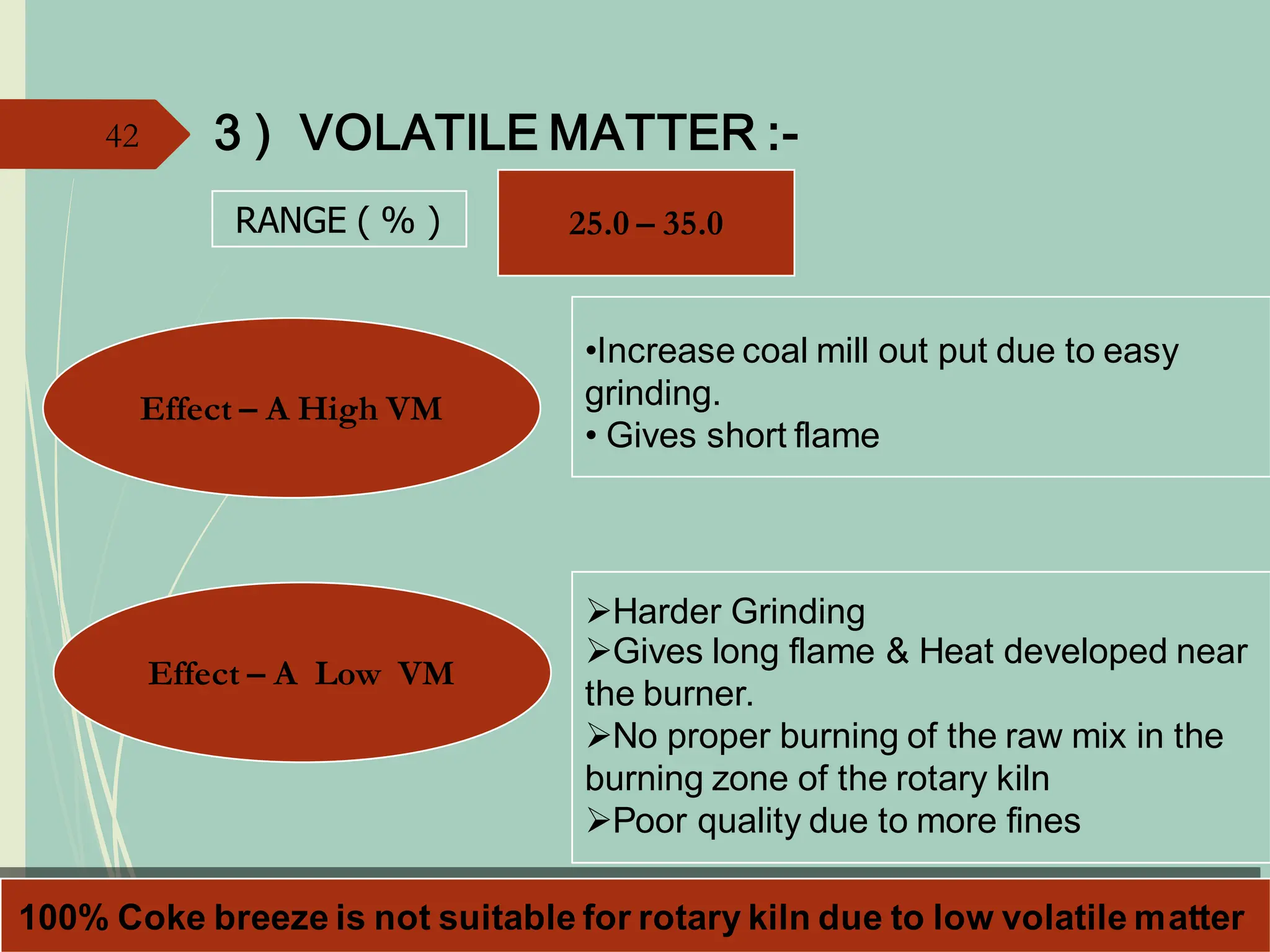
42 3 ) VOLATILE MATTER :-
RANGE ( % ) 25.0 – 35.0
Effect – A High VM
•Increase coal mill out put due to easy
grinding.
• Gives short flame
Effect – A Low VM
➢Harder Grinding
➢Gives long flame & Heat developed near
the burner.
➢No proper burning of the raw mix in the
burning zone of the rotary kiln
➢Poor quality due to more fines
100% Coke breeze is not suitable for rotary kiln due to low volatile matter
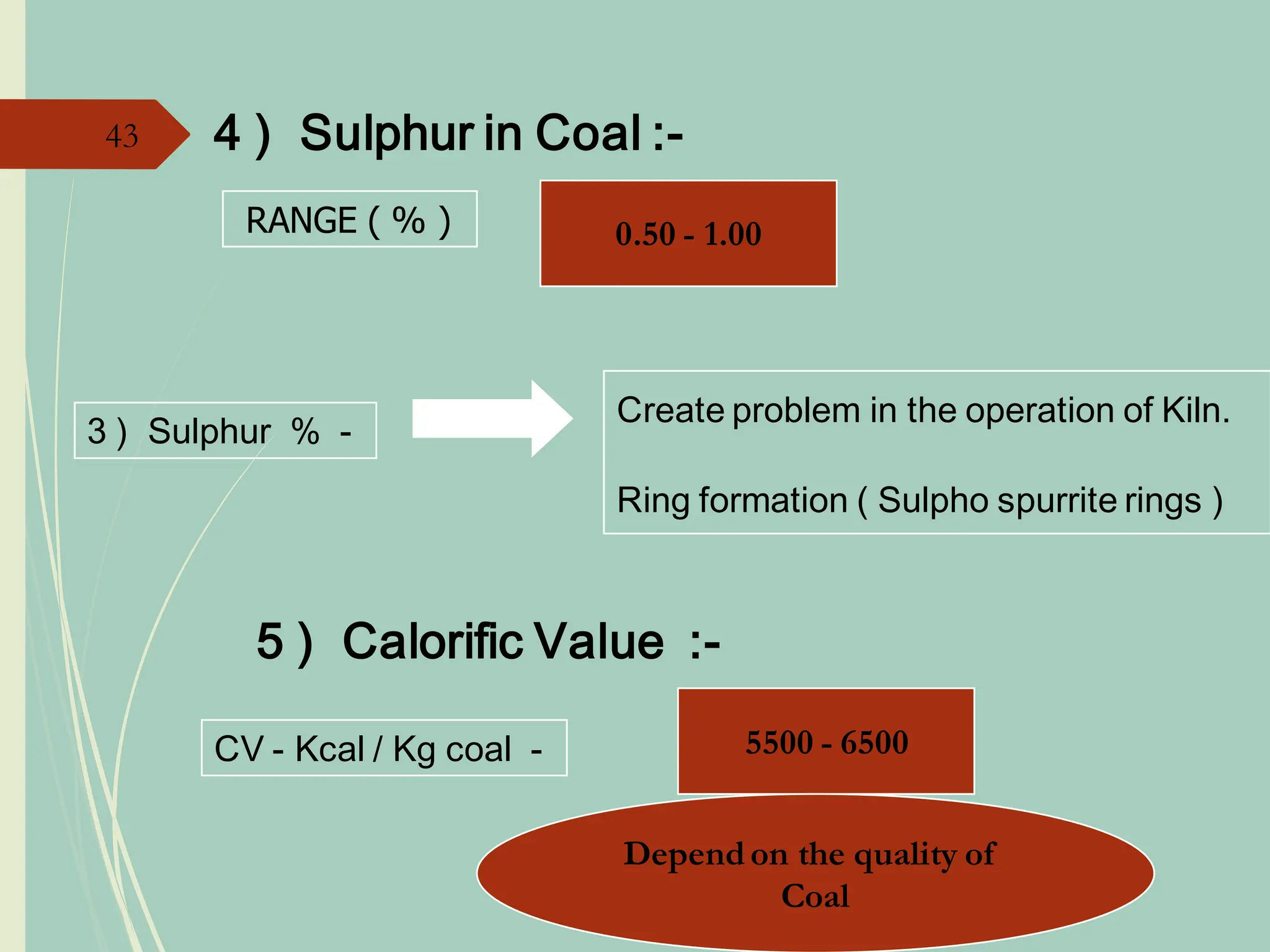
43 4 ) Sulphur in Coal :-
RANGE ( % )
3 ) Sulphur % -
0.50 - 1.00
Create problem in the operation of Kiln.
Ring formation ( Sulpho spurrite rings )
5 ) Calorific Value :-
CV - Kcal / Kg coal - 5500 - 6500
Depend on the quality of
Coal
44 7 ) Grindability of coal :-
RANGE ( KW/ SHT )
Hard Grove Index 55.0 – 65.0
Higher - Easy Grinding
Lower - Harder Grinding
45
Sr.No Characteristic Unit IND Coal IMP Coal Pet Coke
1) Moisture % 1.85 2.55 1.10
2) Ash % 25.00 13.50 1.60
3) Volatile Matter % 27.50 26.50 10.95
4) Fixed Carbon % 46.65 57.45 86.35
5) Calorific Value
a) Gross Kcal/ Kg 5647 6927 8452
b) Net Kcal/ Kg 5370 6650 8175
PROXIMATE ANALAYSIS
46
Raw mix design – Two component
1) Aligation Alternate Method :-
This is the simplest method for solving blending problem. The method
allows the determination of the proportion of two raw material components
with lime content as per set point.
-:Exercise:-
What mixing proportion is required for Imp coal with 17.0 % ash &
Indigenous coal with 35.0 % ash , to get a fine coal ash 20.0 % ash
content.
47
Ash %
Imp coal 17.0
Ind coal 35.0
( 35 - 20 ) 15.0 part Imp coal
( 20 - 17 ) 3.0 part Ind coal
20.0
48 Converting the parts proportion to weigh percentage
% Imported coal
% Indigenous coal
=
15.0 x 100
( 15.0 + 3.0 )
=
3.0 x 100
( 15.0 + 3.0 )
= 83.33 %
= 16.67 %
49 Sample raw material data ( Ignited ) incorporating
1.80 % Coal ash
L/stone + F/ash
97.00 % + 3.00%
Laterite Hematite
LOI 36.46 22.0 2.80
CaO 69.89 2.34 0.28
SiO2 23.07 12.33 3.72
Al2O3 3.65 49.70 3.23
Fe2O3 1.09 34.05 89.98
MgO 1.03 0.47 0.48
50
Calculation of proportion of three components for target
values of LSF = 0.91 , AM = 1.40
a1 = 0.91 ( 2.8 x 23.07 + 1.18 x 3.65 + 0.65 x 1.09 ) - 69.89 -- EQ 1
b1 = 0.91 ( 2.8 x 12.33 + 1.18 x 49.70 + 0.65 x 34.05 ) - 2.34 --- EQ 2
c1 = 0.28 – 0.91 ( 2.80 x 3.72 + 1.18 x 3.23 + 0.65 x 89.98 ) ---- EQ 3
a2 = 1.40 ( 1.09 ) – 3.65 ------------------------- EQ 4
b2 = 1.40 ( 34.05 ) – 49.70 ------------------------ EQ 5
c2 = 3.23 – ( 89.98 ) x 1.40 -------------------------- EQ 6
51
a1 = - 6.54 a2 = - 2.12
b1= 102.58 b2 = -2.03
c1 = -65.89 c2 = - 122.74
( - 65.89 ) x ( - 2.03 ) – ( - 122.74 ) x ( 102 . 58 )
X =
( - 6.54 ) x ( - 2.03 ) – ( - 2.12 ) x ( 102.58 )
= 55.145
( - 6.54 ) x ( - 122.74 ) – ( - 2.12 ) x ( -65.89 )
Y =
( - 6.54 ) x ( - 2.03 ) – ( - 2.12 ) x ( 102.58 )
= 2.87
52
55.145 x 100 2.87 x 100 1 x 100
= : :
( 100 – 36.46 ) ( 100 – 22 ) ( 100 – 2.80 )
= 86.78 : 3.68 : 1.03
Therefore the proportions on ignited basis = 55.145 : 2.87 : 1
Now the proportions on the raw basis will be as below
53
86.78 x 100
Lime stone = = 94.85 %
( 86.78 + 3.68 + 1.03 )
Percentage of Raw mix will be as under
3.68 x 100
Al. Laterite = = 4.02 %
( 86.78 + 3.68 + 1.03 )
1.03 x 100
Heamatite = = 1.13 %
( 86.78 + 3.68 + 1.03 )
Thanks
54

Raw Mix Design for Clinker Manufacturing .pdf

  • 1.
    1 Raw Mix Designfor clinker manufacturing Prepared for Cement Technology Course AKS University, Satna (M.P.)
  • 2.
    2  To produceconsistent quality of cement  Planning for raw material procurement  Planning & Development of Lime stone mines  Effective control & optimize of raw mix cost  Selection of Coal quality  Proper utilization of byproduct i.e. Fly ash Raw mix
  • 3.
    3 First calcarious /silicious raw material and additive in required proportions are pulverized to get desired raw meal. This raw meal is fed to kiln system where it undergoes various chemical changes and potential components responsible for cementing properties and formed here. This clinker is cooled in cooler. Various burning process in kiln system is summarized below . Cement Manufacturing Process
  • 4.
    4 Sr.No Temperature Reaction 1) At 100 oC - Evaporation of free water 2 ) 500 - 600 oC - Combined water from clay is released 3 ) 600 - 800 oC - Calcination starts . Formation of CaO.Al2O3, 2CaO.Fe2O3, CaO.SiO2 begins. 4) 800 - 900 oC - Formation of 12CaO.7Al2O3 begins
  • 5.
    5 Sr.No Temperature Reaction 5) 900 -1100 oC - 2CaO.Al2O3.SiO2 forms and decomposes again. Formation of 3CaO.Al2O3 & 4CaO.Al2O3.Fe2O3 starts. All CaCo3 decomposed and free CaO reaches a maximum. 6) 1100 - 1200 oC - Formation of major part of 3CaO.Al2O3 and C4AF. Content of C2S reaches a maximum.
  • 6.
    6 Sr.No Temperature Reaction 7) 1260 oC - First Liquid formation starts 8 ) 1200 - 1450 oC - Formation of C3S with progressive disappearance of of free lime Clinker when ground with gypsum in desired proportion forms PORTLAND CEMENT
  • 7.
    RAW MIX DESIGN OBJECTIVE:- 1) Comprehend the Quality requirement of raw material. 2) Determine the quantitative proportions of raw material. 3) In order to obtain desired clinker quality – Determine chemical composition and burnability of raw meal. 4) Determine the quantitative proportions of various coal like – IMP COAL , IND COAL etc. 7
  • 8.
    Introduction  The limestone is main raw material for manufacturing of the clinker , Bauxite, Heamatite , Sand stone , Fly ash, Laterite, Clay etc are also used as a corrective material to maintain desired quality of clinker. Cement manufacturing process involves – 1) Preparation of raw mix by crushing , grinding & blending of raw material in definite proportion. 2) Burning of raw material at 1450 oC in the kiln. 3) Grinding the clinker to fine powder with a certain amount of gypsum to regulate the setting of cement. In order to obtain a product of desired quality the various steps Involved in the process need careful control and in this direction design of raw mix form an extremely important input. 8
  • 9.
    Mineral composition :- Mineralogicalcomposition of the raw material like L/stone, Bxt, Heamatite , Laterite etc are very important for raw mix designing point of view. Important characteristics are –  Physical amenability to crushing , Grinding & homogenization .  Individual dissociation or Breakdown character. Therefore knowledge of mineralogical composition of all raw material is very essential to understand their behavior during the manufacturing process. The oxides occur in the form of minerals compounds. 9
  • 10.
    OXIDE MINERAL 1) CaOCalcite, Argonite, Dolomite, Paper Sludge & Gypsum . 2) SiO2 Quartz, Clay , Mica based mineral , Fly Ash 3) Al2O3 Bauxite , Clay , Field Spar etc. 4) Fe2O3 Heamatite , Laterite , Magnetite etc. 5) S Gypsum , Pyrite etc. 10
  • 11.
    Physico – MechanicalCharacteristics Important Physical – mechanical Properties of raw material :- 1) Crushability 2) Grind ability 3) Natural Moisture content 4) Plasticity 11
  • 12.
    Raw material composition Three important properties or composition of raw material 1 ) Chemical composition 2 ) Mineral composition 3 ) Physico – Mechanical composition 12
  • 13.
    Mineral phase ofClinker Sr Phase Abbrevi Formula Range Role No. ation 1) Tricalcium C3S 3CaO.SiO2 50 – 55 Early silicate Strength 2) Dicalcium C2S 2CaO.SiO2 20 – 25 Later silicate Strength 3) Tricalcium C3A 3CaO.Al2O3 5 – 8 Setting of aluminate Cement 4) Tetracalcium C4AF 3 CaO.Al2O3. 10-15 Colour of Alumino Fe2O3 Cement Ferrite 13
  • 14.
    RAW MIX “ RAWMIX OR KILN FEED IS A FINELY GROUND BLEND OF LIME STONE , ADDITIVE / CORRECTIVE MATERIALS MIXED IN PERDETERMINED PROPORTIONS ” 14
  • 15.
    Raw mix design ➢Few chemical parameter known as moduli values responsible for producing clinker on firing. Moduli values are governed by five major oxides like CaO , SiO2,Al2O3,Fe2O3,MgO. ➢ The compositional requirement of a raw mix and the chemical phase composition of the clinker aimed at are summarized as follows. 15
  • 16.
    16 1 ) Limesaturation factor :- Empirical formula CaO x 100 2.8 SiO2+ 1.2 Al2O3+ 0.65 Fe2O3 Range ( Ratio ) 95.0 – 105.0 Effect :- A High LSF 1) Make it difficult to burn raw mix 2) Tends to produce unsound cement 3) Increase C3S contents 4) Reduce C2S contents 5) Slow setting with high early strength .
  • 17.
    17 2 ) Silicamodules :- Empirical formula SiO2 Al2O3 + Fe2O3 Range ( Ratio ) 2.0 – 3.0 Effect :- A High SM 1) Results in harder burning and high fuel consumption 2) Causes difficulty in coating formation and hence the radiation from shell is high. 4) Deteriorates the kiln linings 5) Increase unsoundness ( High CaO ) 6) Results in slow setting & Harding cement
  • 18.
    18 3 ) Aluminamodules :- Empirical formula Al2O3 Fe2O3 Range ( Ratio ) 0.60 – 1.3 Effect :- A High AM 1) Imparts harder burning and entails higher fuel cons. 2) Increase the proportion of C3A and reduce C4AF 3) Reduce the liquid phase and kiln output 4) Tends to render quick setting and strength at early strength 1) If A/F is low and raw mix is without free SiO2, Clinker 2) sticking and balling is high .
  • 19.
    19 4 ) FreeSiO2 :- Range :- As low as possible Effect :- A High Free SiO2 1) Increase power & Fuel consumption 2) Difficult in coating formation 3) Deteriorates refractory lining Normally in Kiln feed free silica not more than 3 % is desirable.
  • 20.
    20 5 ) Magnesia:- Empirical formula 0.0 – 6.00 Effect :- A High MgO 1) Leads to unsoundness by forming pariclase 2) Crystals when MgO more than 2 % 3) Reduces viscosity and surface tension of clinker liquid 4) Tend to balleasily in the burning zone. MgO Range ( % )
  • 21.
    21 6 ) Alkali:- Empirical formula 0.20 – 0.30 Effect :- A High Alkali 1) Improve burnability 2) Increase liquid % 3) Easy coating formation 4) External & Internal alkali cycle formation Na2O + K2O Range ( % )
  • 22.
    22 7 ) Sulphur:- Empirical formula 0.50 – 1.00 Effect :- A High Sulphur 1) More than 2.5 – 4.0 % cause sulphate expansion. 2) Chocking of the preheater & formation of kiln coating S Range ( % )
  • 23.
    23 8 ) Chlorides:- Empirical formula Range ( % ) 0.00 – 0.015 Effect :- A High Chloride 1 ) Forms more volatile ( K+N) Cl and cause operational problem due to its complete vaporization in the burning zone. 2 ) Increase ring formation . Cl
  • 24.
    24 9 ) ClinkerLiquid :- Empirical formula at 1450 OC 3 Al2O3+ 2.25 Fe2O3+ MgO +Alkali OR 1.13 C3A + 1.35 C4AF + MgO + Alkali Range ( % ) 25.0 – 29.0 Effect :- A High Liquid content 1) Formation of dence clinker 2) Easy burning 3) Hard to grind Effect :- A Low Liquid content 1) Porous clinker 2) Hard burning
  • 25.
    25 Raw Mix affects •Chemical reaction • Fuel consumption • Coating formation • Quality of clinker • Production & overall economy of the plant
  • 26.
    26 Design of rawmix :- Important parameter should be considered 1) Raw Material :- 1) Availability 2) Chemical composition 3) Cost 4) Mineral composition 2 ) Fuel :- 1) Moisture 2) Ash content 3) Volatile matter 4) Sulphur 5) Calorific value
  • 27.
    27 4) Manufacturing Process :-1) Wet or dry 3) Physico – Mech properties :- 1) Crushability 2) Grandibility 3) Plasticity 4) Moisture 5) Efficiency of unit process :- 1) Fineness 2) Blending 3) Uniformity of chemical composition .
  • 28.
    28 7 ) DesignQuality :- 1) Desirable 2) Acceptable 3) Marketable 6 ) Standard specification :- 1) Insoluble Residue 2) Magnesia 3) Loss on Ignition 4) Module value like LSF , A/F 8 ) Economics of :- 1) Ensuring total company design productivity 2) Material conservation 3) Waste reduction & Improve resource utilization 4) Market
  • 29.
    29 Potential Clinker composition R.H.Bougedeveloped a method for calculating the C3S , C2S , C3A & C4AF from the chemical analysis • C3S = 4.07 ( CaO – F.CaO ) – ( 7.6 SiO2 + 6.72 Al2O3 + 1.43 Fe2O3 + 2.85 SO3 • C2S = 2.867 SiO2 – 0.7544 C3S • C3A = 2.65 Al2O3 – 1.69 Fe2O3 • C4AF = 3.043 Fe2O3
  • 30.
    30 Burnability of rawmix has been define as a measure of relative ease or difficulty with which a kiln feed is Converted into clinker in a kiln .
  • 31.
    31 Factor affectingBurnability 1) Raw Mix :- Mineralogical Composition • Lime component • Clay component • Corrective material 2) Raw Mix :- Chemical composition • Main component relation • Minor nonvolatile component • Minor volatile component
  • 32.
    32 Factor affectingBurnability 3) Raw Mix :- Granulometic composition • Fineness ( Residue ) • Particle size distribution • Homogeneity 4) Raw Mix :- Thermal Treatment • Firing temperature • Heating rate • Burning period • Burning activation
  • 33.
    33 Factor affectingBurnability 5) Liquid phase :- Appearance Temp. • Amount • Viscosity • Surface 6) Clinker Quality :- • Silica phase • Alumina Farrite Phase 7) Coal ash :- Amount Absorbed • Composition • Fineness
  • 34.
    34 Factor affectingBurnability 8) Kiln Atmosphere :- • Oxidation • Reduction 9) Coal Ash Influence :- • LSF decrease & SM Increases • The composition of Silica phase change • Liquid content increase with reduced viscosity
  • 35.
    35 Factor affectingBurnability 10) Chemical composition :- • High LSF - Difficult to burn • Low LSF - Easy to burn • High SM - Increase fuel cons. - Difficult to burn - Deteriorates the kiln lining • High A/F - Harder burning • Low A/F - Easy burning
  • 36.
    36 11 ) FreeLime :- Uncombined lime in the clinker is know as Free lime In Clinker , If LSF :- • More than 100 ➢ Always contain excess Free CaO • Less than 100 ➢ Presence of Free Cao – Very little amount
  • 37.
    37 The kiln feedsample fired for a restricted period as in a burnability test with 30 minutes at 1400 oC a definite content of free lime usually remains after burning even LSF less than 100.This happen because of two factor 1) Microinhomogenities – Uneven distribution of SiO2 and CaO in the raw mix 2) Macroinhogeneities – Coarser particle of raw meal especially that calcite and quartz also contributes towards Free CaO in clinker.
  • 38.
    38 PROXIMATE ANALYSIS ✓ MOISTURE ✓ASH CONTENT ✓ VOLATILE MATTER ✓ FIXED CARBON
  • 39.
    39 1 )COAL MOISTURE :- RANGE ( % ) 1 ) RAW COAL - 2 ) FINE COAL - 5.0 - 12.0 0.50 – 2.00
  • 40.
    40 2 )COAL ASH CONTENT :- RANGE ( % ) 2 ) ASH - 15.0 - 25.0 OR Depend on the quality of Raw material
  • 41.
    41 Effect :-A High Ash :- • Change in the phase composition of clinker • Poor quality clinker due to uneven dispersion of ash in clinker • Formation of ash rings, which disrupts kiln operation. • High fuel consumption , lower operational efficiency. • Requirement of high grade lime stone for producing desirable quality of clinker.
  • 42.
    42 3 )VOLATILE MATTER :- RANGE ( % ) 25.0 – 35.0 Effect – A High VM •Increase coal mill out put due to easy grinding. • Gives short flame Effect – A Low VM ➢Harder Grinding ➢Gives long flame & Heat developed near the burner. ➢No proper burning of the raw mix in the burning zone of the rotary kiln ➢Poor quality due to more fines 100% Coke breeze is not suitable for rotary kiln due to low volatile matter
  • 43.
    43 4 )Sulphur in Coal :- RANGE ( % ) 3 ) Sulphur % - 0.50 - 1.00 Create problem in the operation of Kiln. Ring formation ( Sulpho spurrite rings ) 5 ) Calorific Value :- CV - Kcal / Kg coal - 5500 - 6500 Depend on the quality of Coal
  • 44.
    44 7 )Grindability of coal :- RANGE ( KW/ SHT ) Hard Grove Index 55.0 – 65.0 Higher - Easy Grinding Lower - Harder Grinding
  • 45.
    45 Sr.No Characteristic UnitIND Coal IMP Coal Pet Coke 1) Moisture % 1.85 2.55 1.10 2) Ash % 25.00 13.50 1.60 3) Volatile Matter % 27.50 26.50 10.95 4) Fixed Carbon % 46.65 57.45 86.35 5) Calorific Value a) Gross Kcal/ Kg 5647 6927 8452 b) Net Kcal/ Kg 5370 6650 8175 PROXIMATE ANALAYSIS
  • 46.
    46 Raw mix design– Two component 1) Aligation Alternate Method :- This is the simplest method for solving blending problem. The method allows the determination of the proportion of two raw material components with lime content as per set point. -:Exercise:- What mixing proportion is required for Imp coal with 17.0 % ash & Indigenous coal with 35.0 % ash , to get a fine coal ash 20.0 % ash content.
  • 47.
    47 Ash % Imp coal17.0 Ind coal 35.0 ( 35 - 20 ) 15.0 part Imp coal ( 20 - 17 ) 3.0 part Ind coal 20.0
  • 48.
    48 Converting theparts proportion to weigh percentage % Imported coal % Indigenous coal = 15.0 x 100 ( 15.0 + 3.0 ) = 3.0 x 100 ( 15.0 + 3.0 ) = 83.33 % = 16.67 %
  • 49.
    49 Sample rawmaterial data ( Ignited ) incorporating 1.80 % Coal ash L/stone + F/ash 97.00 % + 3.00% Laterite Hematite LOI 36.46 22.0 2.80 CaO 69.89 2.34 0.28 SiO2 23.07 12.33 3.72 Al2O3 3.65 49.70 3.23 Fe2O3 1.09 34.05 89.98 MgO 1.03 0.47 0.48
  • 50.
    50 Calculation of proportionof three components for target values of LSF = 0.91 , AM = 1.40 a1 = 0.91 ( 2.8 x 23.07 + 1.18 x 3.65 + 0.65 x 1.09 ) - 69.89 -- EQ 1 b1 = 0.91 ( 2.8 x 12.33 + 1.18 x 49.70 + 0.65 x 34.05 ) - 2.34 --- EQ 2 c1 = 0.28 – 0.91 ( 2.80 x 3.72 + 1.18 x 3.23 + 0.65 x 89.98 ) ---- EQ 3 a2 = 1.40 ( 1.09 ) – 3.65 ------------------------- EQ 4 b2 = 1.40 ( 34.05 ) – 49.70 ------------------------ EQ 5 c2 = 3.23 – ( 89.98 ) x 1.40 -------------------------- EQ 6
  • 51.
    51 a1 = -6.54 a2 = - 2.12 b1= 102.58 b2 = -2.03 c1 = -65.89 c2 = - 122.74 ( - 65.89 ) x ( - 2.03 ) – ( - 122.74 ) x ( 102 . 58 ) X = ( - 6.54 ) x ( - 2.03 ) – ( - 2.12 ) x ( 102.58 ) = 55.145 ( - 6.54 ) x ( - 122.74 ) – ( - 2.12 ) x ( -65.89 ) Y = ( - 6.54 ) x ( - 2.03 ) – ( - 2.12 ) x ( 102.58 ) = 2.87
  • 52.
    52 55.145 x 1002.87 x 100 1 x 100 = : : ( 100 – 36.46 ) ( 100 – 22 ) ( 100 – 2.80 ) = 86.78 : 3.68 : 1.03 Therefore the proportions on ignited basis = 55.145 : 2.87 : 1 Now the proportions on the raw basis will be as below
  • 53.
    53 86.78 x 100 Limestone = = 94.85 % ( 86.78 + 3.68 + 1.03 ) Percentage of Raw mix will be as under 3.68 x 100 Al. Laterite = = 4.02 % ( 86.78 + 3.68 + 1.03 ) 1.03 x 100 Heamatite = = 1.13 % ( 86.78 + 3.68 + 1.03 )
  • 54.