Benjamin Bloom (1948)
developed classifications of
intellectual behavior and learning
in order to identify and measure
progressively sophisticated
learning. College faculty are hired
because of their discipline
expertise and are sometimes
unfamiliar with important
pedagogical theories that
contribute to effective learning.
Bloom's taxonomy is especially
important in higher education
where outcomes need to address
the student ability to use
information, not just recall and
regurgitate concepts. Lower levels
of learning are easier to assess but
do not adequately display what the
student can DO with the
knowledge.
Cognitive domain defining knowledge classification. Each level
has examples of verbs that could be used in writing an SLO at this
level. These verbs are not magic or mandatory, our faculty found
them helpful, so we used a variety of models and created our own.
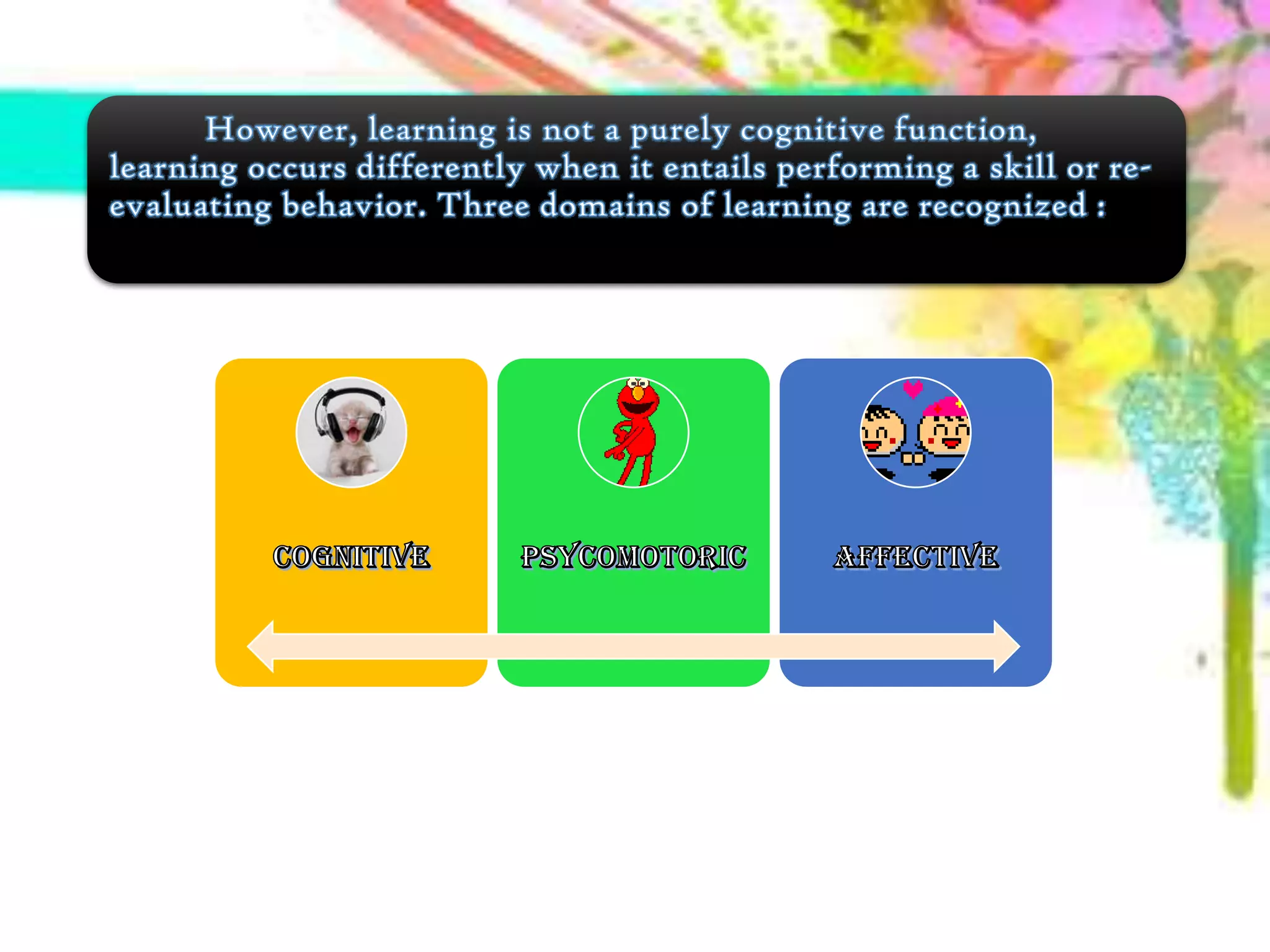
Domains of
Learning
Psychomotor domain (Gronlund, 1970; Harrow,
1972; Simpson, 1972) defining physical skills or tasks
classification.
Domains of
Learning
Affective domain (Krathwhol, Bloom, and Masia, 1964)
defining behaviors that correspond to attitudes and values.
Affective outcomes tend to be the hardest to articulate
initially and often appear difficult to assess at first glance.
However, cognitive outcomes often represent the outcomes
most closely related to deeper thinking and life-long
learning, as well as the outcomes we value most.
Domains of
Learning
NOTE:
Teacher learning outcomes should address relevant
outcomes for each of these domains but must be
appropriate to the course.
To evaluate, think about possible means of assessing
the outcomes. The essence of student learning
outcomes lies in focusing on the results of learning
process.
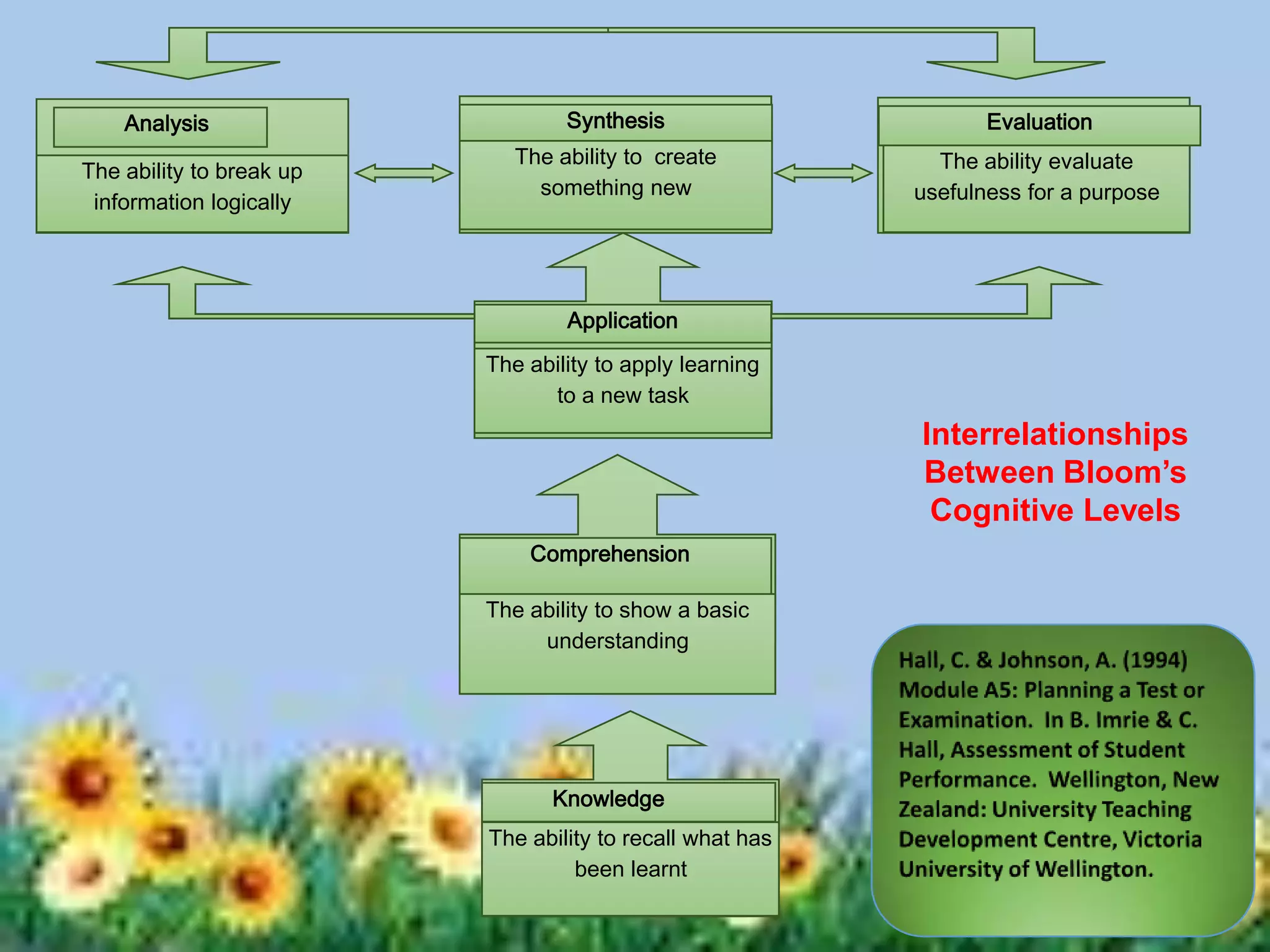
Knowledge
The ability to recall what has
been learnt
Comprehension
The ability to show a basic
understanding
Application
The ability to apply learning
to a new task
Analysis
The ability to break up
information logically
Synthesis
The ability to create
something new
Evaluation
The ability evaluate
usefulness for a purpose
Interrelationships
Between Bloom’s
Cognitive Levels
Knowledge
Comprehension
Application
Analysis Synthesis
Interrelationships
Between Bloom’s
Cognitive Levels
Evaluation
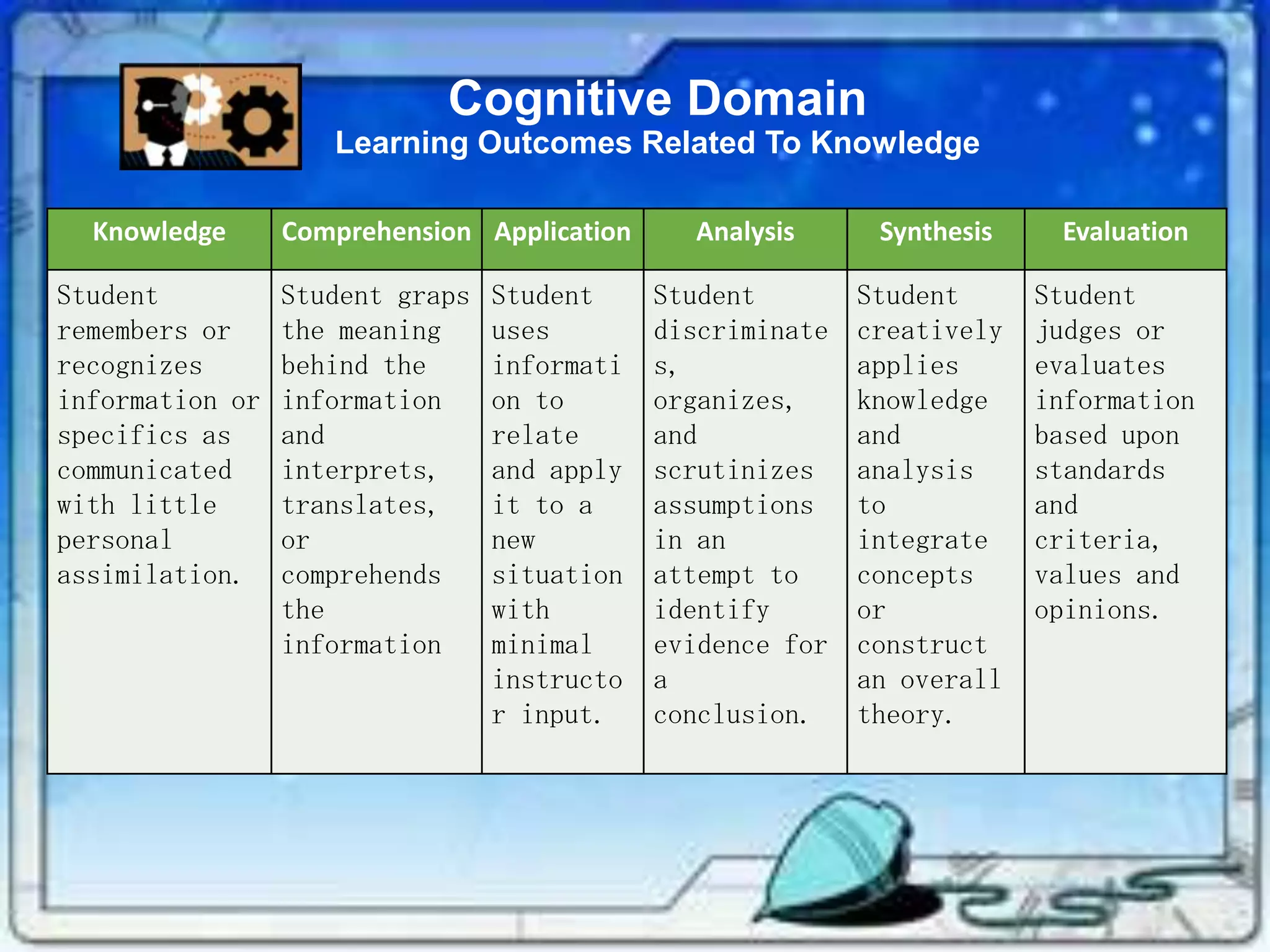
Cognitive Domain
Learning Outcomes Related To Knowledge
Knowledge Comprehension Application Analysis Synthesis Evaluation
Student
remembers or
recognizes
information or
specifics as
communicated
with little
personal
assimilation.
Student graps
the meaning
behind the
information
and
interprets,
translates,
or
comprehends
the
information
Student
uses
informati
on to
relate
and apply
it to a
new
situation
with
minimal
instructo
r input.
Student
discriminate
s,
organizes,
and
scrutinizes
assumptions
in an
attempt to
identify
evidence for
a
conclusion.
Student
creatively
applies
knowledge
and
analysis
to
integrate
concepts
or
construct
an overall
theory.
Student
judges or
evaluates
information
based upon
standards
and
criteria,
values and
opinions.
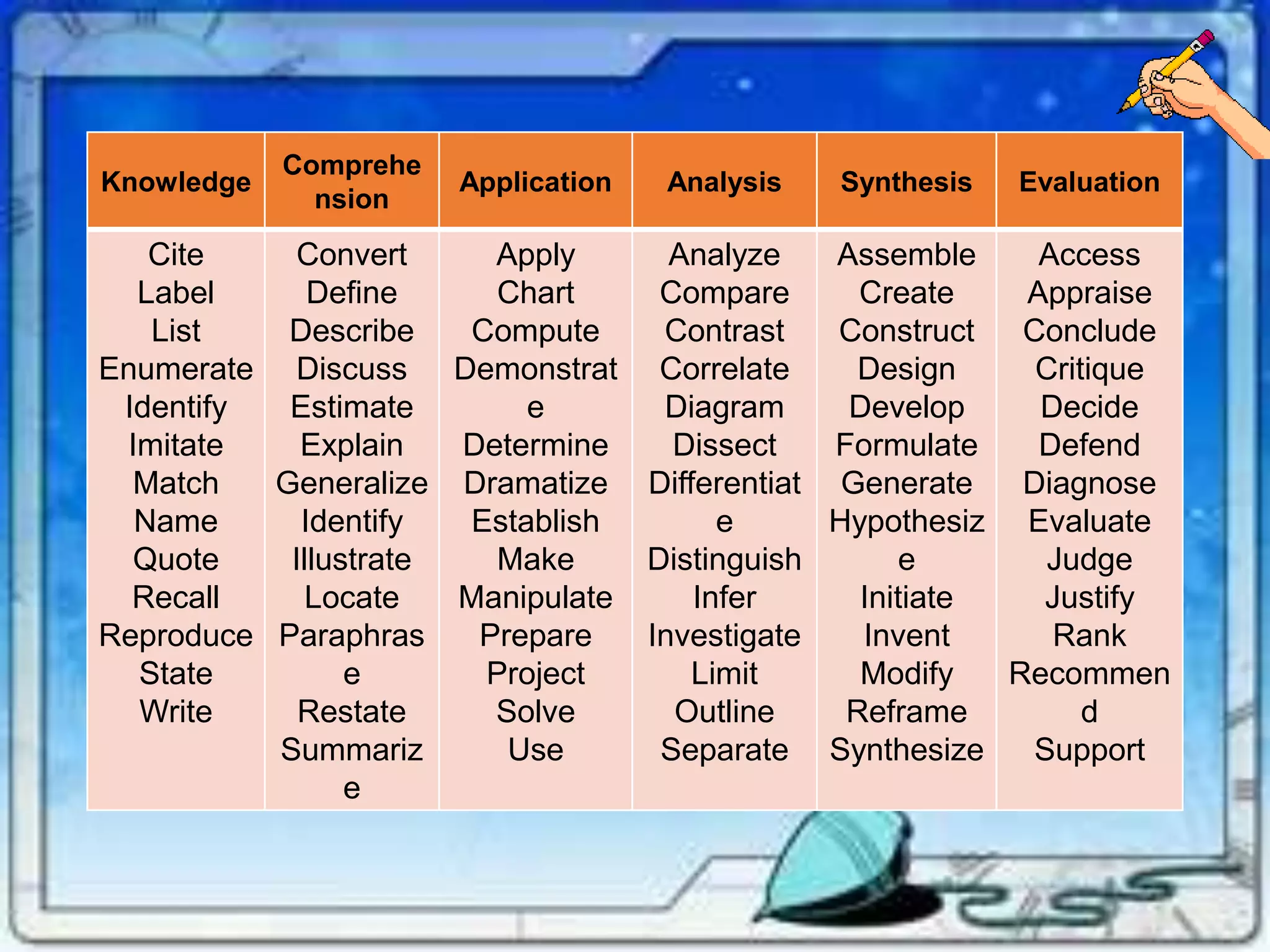
Knowledge
Comprehe
nsion
Application Analysis Synthesis Evaluation
Cite
Label
List
Enumerate
Identify
Imitate
Match
Name
Quote
Recall
Reproduce
State
Write
Convert
Define
Describe
Discuss
Estimate
Explain
Generalize
Identify
Illustrate
Locate
Paraphras
e
Restate
Summariz
e
Apply
Chart
Compute
Demonstrat
e
Determine
Dramatize
Establish
Make
Manipulate
Prepare
Project
Solve
Use
Analyze
Compare
Contrast
Correlate
Diagram
Dissect
Differentiat
e
Distinguish
Infer
Investigate
Limit
Outline
Separate
Assemble
Create
Construct
Design
Develop
Formulate
Generate
Hypothesiz
e
Initiate
Invent
Modify
Reframe
Synthesize
Access
Appraise
Conclude
Critique
Decide
Defend
Diagnose
Evaluate
Judge
Justify
Rank
Recommen
d
Support
C O G N I T I V E D O M A I N
Basic Knowledge More Sophisticated
Higher Level Thinking
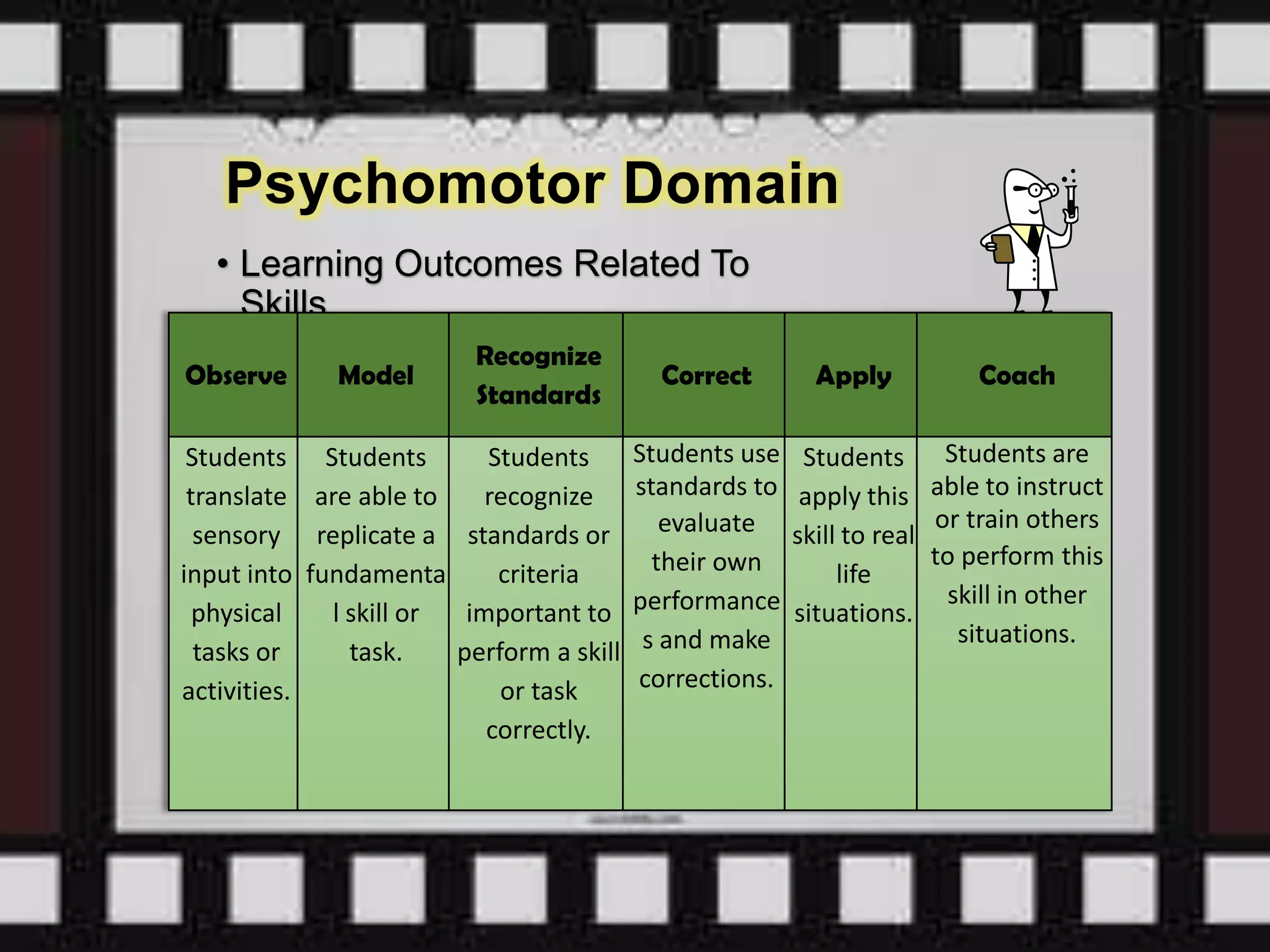
Psychomotor Domain
• Learning Outcomes Related To
Skills
Observe Model
Recognize
Standards
Correct Apply Coach
Students
translate
sensory
input into
physical
tasks or
activities.
Students
are able to
replicate a
fundamenta
l skill or
task.
Students
recognize
standards or
criteria
important to
perform a skill
or task
correctly.
Students use
standards to
evaluate
their own
performance
s and make
corrections.
Students
apply this
skill to real
life
situations.
Students are
able to instruct
or train others
to perform this
skill in other
situations.
Observe Model
Recognize
Standards
Correct Apply Coach
Hear
Identify
Observe
See
Smell Taste
Touch
Watch
*Usually no
outcomes
or objectives
written at
this level
Attempt
Copy
Follow
Imitate
Mimic
Model
Reenact
Repeat
Reproduce
Show
Try
Check
Detect
Discriminate
Differentiate
Distinguish
Notice
Perceive
Recognize
Select
Adapt
Adjust
Alter
Change
Correct
Customize
Develop
Improve
Manipulate
Modify
Practice
Revise
Build
Compose
Construct
Create
Design
Originate
Produce
Demonstrate
Exhibit
Illustrate
Instruct
Teach
Train
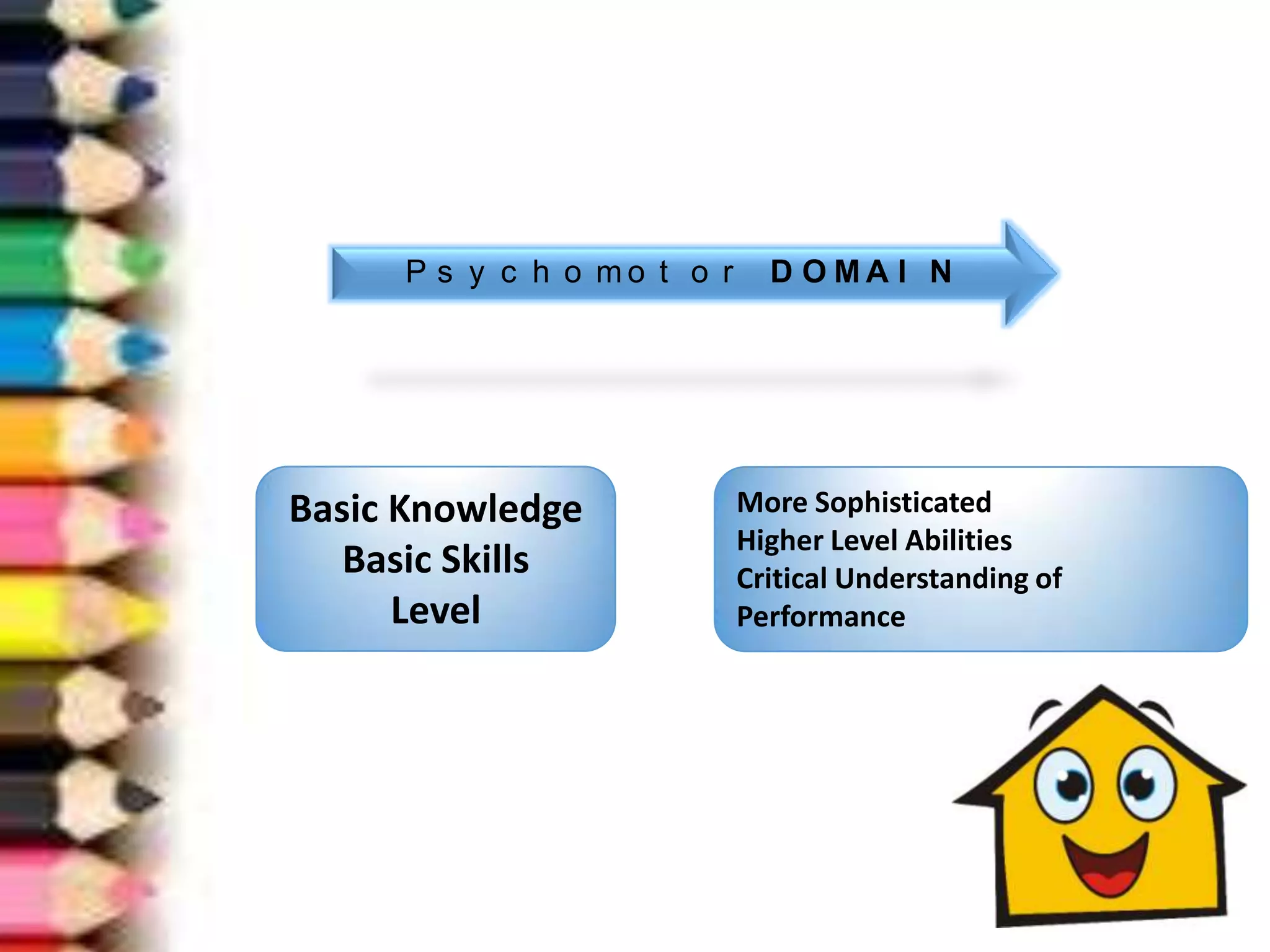
P s y c h o m o t o r D O M A I N
Basic Knowledge
Basic Skills
Level
More Sophisticated
Higher Level Abilities
Critical Understanding of
Performance
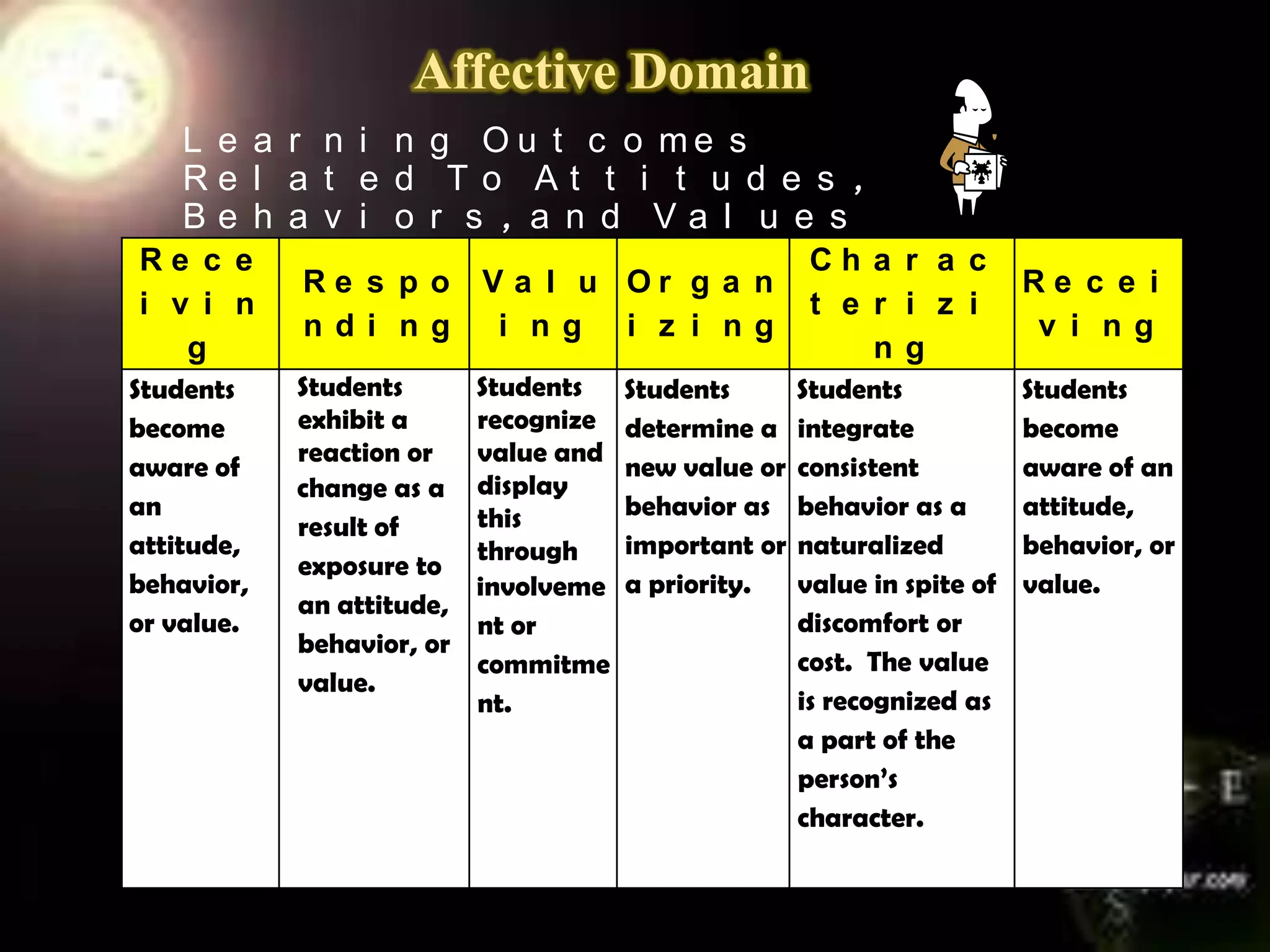
Affective Domain
L e a r n i n g O u t c o m e s
R e l a t e d T o A t t i t u d e s ,
B e h a v i o r s , a n d V a l u e s
R e c e
i v i n
g
R e s p o
n d i n g
V a l u
i n g
O r g a n
i z i n g
C h a r a c
t e r i z i
n g
R e c e i
v i n g
Students
become
aware of
an
attitude,
behavior,
or value.
Students
exhibit a
reaction or
change as a
result of
exposure to
an attitude,
behavior, or
value.
Students
recognize
value and
display
this
through
involveme
nt or
commitme
nt.
Students
determine a
new value or
behavior as
important or
a priority.
Students
integrate
consistent
behavior as a
naturalized
value in spite of
discomfort or
cost. The value
is recognized as
a part of the
person’s
character.
Students
become
aware of an
attitude,
behavior, or
value.
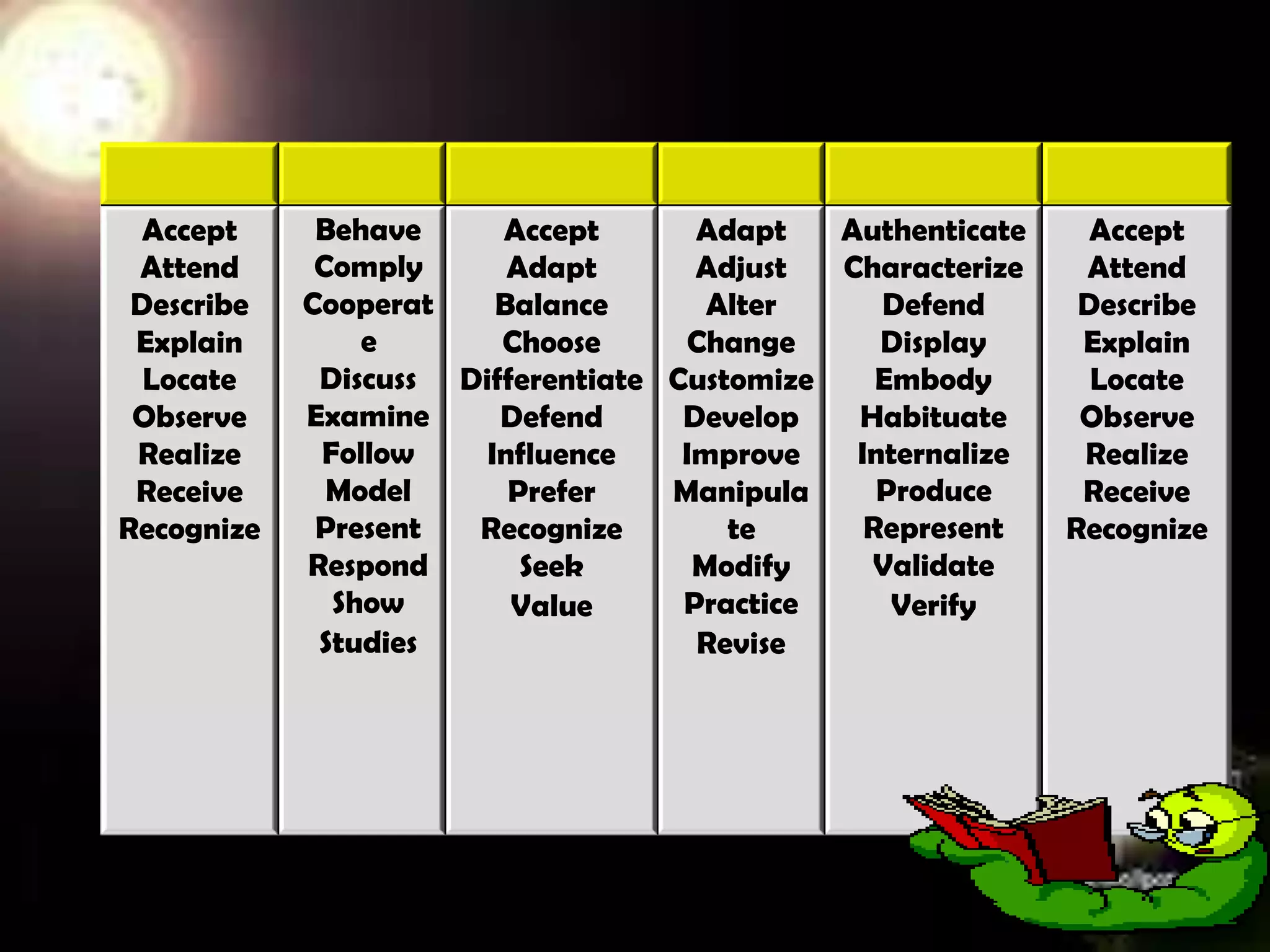
Accept
Attend
Describe
Explain
Locate
Observe
Realize
Receive
Recognize
Behave
Comply
Cooperat
e
Discuss
Examine
Follow
Model
Present
Respond
Show
Studies
Accept
Adapt
Balance
Choose
Differentiate
Defend
Influence
Prefer
Recognize
Seek
Value
Adapt
Adjust
Alter
Change
Customize
Develop
Improve
Manipula
te
Modify
Practice
Revise
Authenticate
Characterize
Defend
Display
Embody
Habituate
Internalize
Produce
Represent
Validate
Verify
Accept
Attend
Describe
Explain
Locate
Observe
Realize
Receive
Recognize
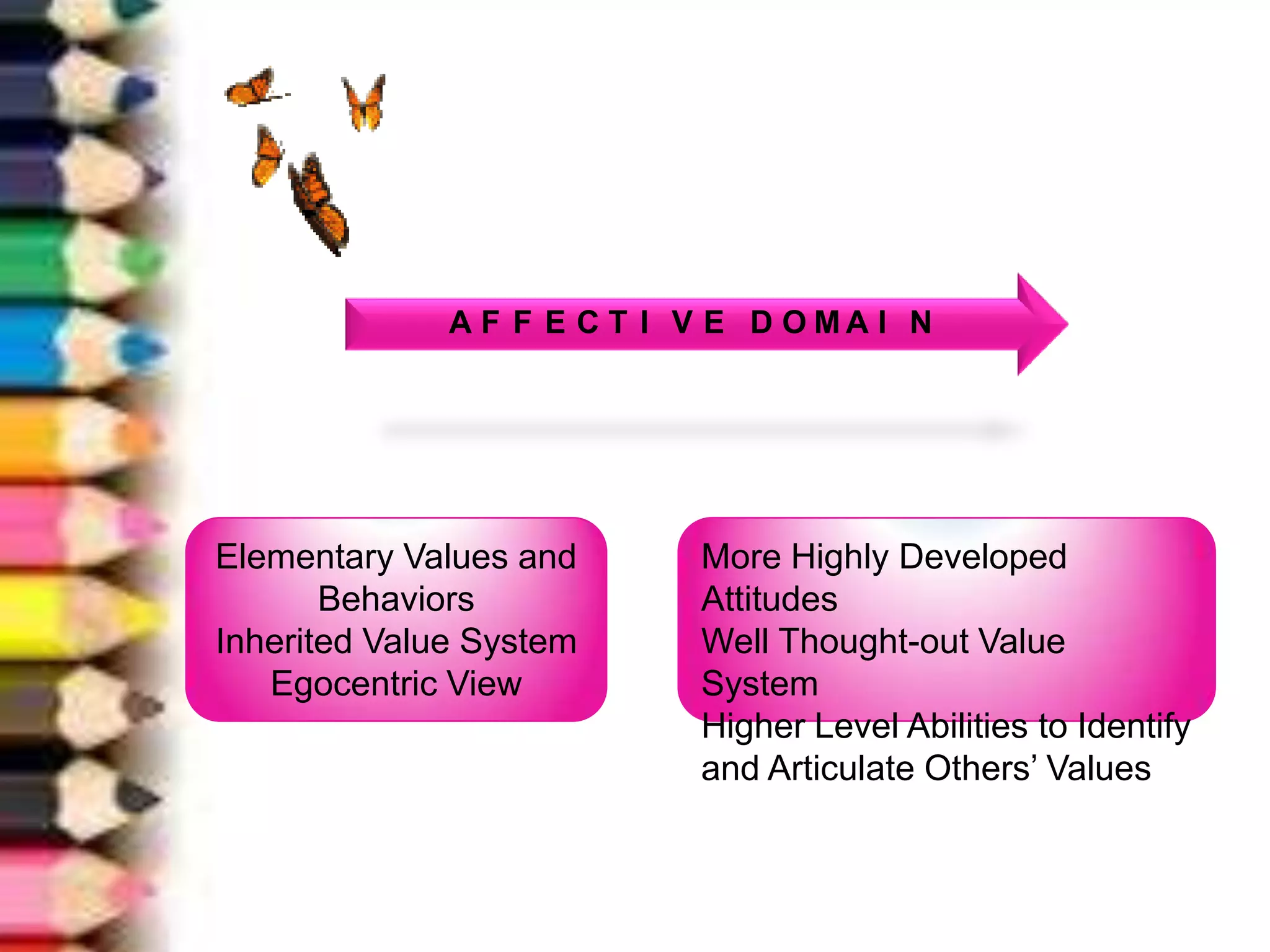
A F F E C T I V E D O M A I N
Elementary Values and
Behaviors
Inherited Value System
Egocentric View
More Highly Developed
Attitudes
Well Thought-out Value
System
Higher Level Abilities to Identify
and Articulate Others’ Values
Bloom’s taxonomy, cognitive, psychomotor,  and Affective

Bloom’s taxonomy, cognitive, psychomotor, and Affective

  • 2.
    Benjamin Bloom (1948) developedclassifications of intellectual behavior and learning in order to identify and measure progressively sophisticated learning. College faculty are hired because of their discipline expertise and are sometimes unfamiliar with important pedagogical theories that contribute to effective learning.
  • 3.
    Bloom's taxonomy isespecially important in higher education where outcomes need to address the student ability to use information, not just recall and regurgitate concepts. Lower levels of learning are easier to assess but do not adequately display what the student can DO with the knowledge.
  • 5.
    Cognitive domain definingknowledge classification. Each level has examples of verbs that could be used in writing an SLO at this level. These verbs are not magic or mandatory, our faculty found them helpful, so we used a variety of models and created our own. Domains of Learning
  • 6.
    Psychomotor domain (Gronlund,1970; Harrow, 1972; Simpson, 1972) defining physical skills or tasks classification. Domains of Learning
  • 7.
    Affective domain (Krathwhol,Bloom, and Masia, 1964) defining behaviors that correspond to attitudes and values. Affective outcomes tend to be the hardest to articulate initially and often appear difficult to assess at first glance. However, cognitive outcomes often represent the outcomes most closely related to deeper thinking and life-long learning, as well as the outcomes we value most. Domains of Learning
  • 8.
    NOTE: Teacher learning outcomesshould address relevant outcomes for each of these domains but must be appropriate to the course. To evaluate, think about possible means of assessing the outcomes. The essence of student learning outcomes lies in focusing on the results of learning process.
  • 9.
    Knowledge The ability torecall what has been learnt Comprehension The ability to show a basic understanding Application The ability to apply learning to a new task Analysis The ability to break up information logically Synthesis The ability to create something new Evaluation The ability evaluate usefulness for a purpose Interrelationships Between Bloom’s Cognitive Levels
  • 10.
  • 11.
    Cognitive Domain Learning OutcomesRelated To Knowledge Knowledge Comprehension Application Analysis Synthesis Evaluation Student remembers or recognizes information or specifics as communicated with little personal assimilation. Student graps the meaning behind the information and interprets, translates, or comprehends the information Student uses informati on to relate and apply it to a new situation with minimal instructo r input. Student discriminate s, organizes, and scrutinizes assumptions in an attempt to identify evidence for a conclusion. Student creatively applies knowledge and analysis to integrate concepts or construct an overall theory. Student judges or evaluates information based upon standards and criteria, values and opinions.
  • 12.
    Knowledge Comprehe nsion Application Analysis SynthesisEvaluation Cite Label List Enumerate Identify Imitate Match Name Quote Recall Reproduce State Write Convert Define Describe Discuss Estimate Explain Generalize Identify Illustrate Locate Paraphras e Restate Summariz e Apply Chart Compute Demonstrat e Determine Dramatize Establish Make Manipulate Prepare Project Solve Use Analyze Compare Contrast Correlate Diagram Dissect Differentiat e Distinguish Infer Investigate Limit Outline Separate Assemble Create Construct Design Develop Formulate Generate Hypothesiz e Initiate Invent Modify Reframe Synthesize Access Appraise Conclude Critique Decide Defend Diagnose Evaluate Judge Justify Rank Recommen d Support
  • 13.
    C O GN I T I V E D O M A I N Basic Knowledge More Sophisticated Higher Level Thinking
  • 14.
    Psychomotor Domain • LearningOutcomes Related To Skills Observe Model Recognize Standards Correct Apply Coach Students translate sensory input into physical tasks or activities. Students are able to replicate a fundamenta l skill or task. Students recognize standards or criteria important to perform a skill or task correctly. Students use standards to evaluate their own performance s and make corrections. Students apply this skill to real life situations. Students are able to instruct or train others to perform this skill in other situations.
  • 15.
    Observe Model Recognize Standards Correct ApplyCoach Hear Identify Observe See Smell Taste Touch Watch *Usually no outcomes or objectives written at this level Attempt Copy Follow Imitate Mimic Model Reenact Repeat Reproduce Show Try Check Detect Discriminate Differentiate Distinguish Notice Perceive Recognize Select Adapt Adjust Alter Change Correct Customize Develop Improve Manipulate Modify Practice Revise Build Compose Construct Create Design Originate Produce Demonstrate Exhibit Illustrate Instruct Teach Train
  • 16.
    P s yc h o m o t o r D O M A I N Basic Knowledge Basic Skills Level More Sophisticated Higher Level Abilities Critical Understanding of Performance
  • 17.
    Affective Domain L ea r n i n g O u t c o m e s R e l a t e d T o A t t i t u d e s , B e h a v i o r s , a n d V a l u e s R e c e i v i n g R e s p o n d i n g V a l u i n g O r g a n i z i n g C h a r a c t e r i z i n g R e c e i v i n g Students become aware of an attitude, behavior, or value. Students exhibit a reaction or change as a result of exposure to an attitude, behavior, or value. Students recognize value and display this through involveme nt or commitme nt. Students determine a new value or behavior as important or a priority. Students integrate consistent behavior as a naturalized value in spite of discomfort or cost. The value is recognized as a part of the person’s character. Students become aware of an attitude, behavior, or value.
  • 18.
  • 19.
    A F FE C T I V E D O M A I N Elementary Values and Behaviors Inherited Value System Egocentric View More Highly Developed Attitudes Well Thought-out Value System Higher Level Abilities to Identify and Articulate Others’ Values