

Welcome to my presentation
On
Data Compression
3/2/2019
2
Presented To:
Dr. Md. Maniruzzaman
Professor
ECE Discipline
Khulna University, Khulna-9208
Email: m_m_zaman@hotmail.com
Presented by:
Md. Golam Rousul
Student ID: MSc-190903
ECE Discipline
Khulna University, Khulna-9208
Email: rousul.ku@gmail.com
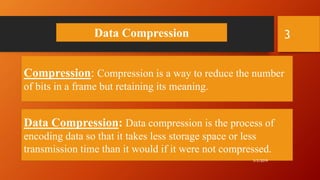
Compression: Compression is a way to reduce the number
of bits in a frame but retaining its meaning.
Data Compression: Data compression is the process of
encoding data so that it takes less storage space or less
transmission time than it would if it were not compressed.
Data Compression
3/2/2019
3
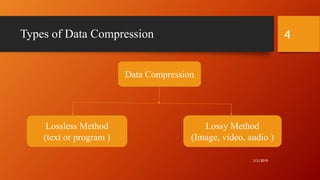
Types of Data Compression
3/2/2019
4
Data Compression
Lossless Method
(text or program )
Lossy Method
(Image, video, audio )
3/2/2019
5
Lossy compression:
A lossy data compression technique is one where
compressing data and its decompression retrieves data that
may will be different from the original.
Lossless compression:
The lossless data compression method can be seen in the
Part of the input data is used to predict the incoming data by
neural network predictor.
3/2/2019
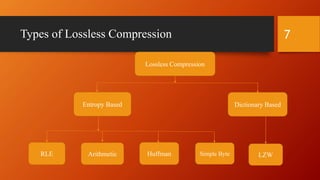
6
99%
75%
Use of Compression in BMS Processing
3/2/2019
7
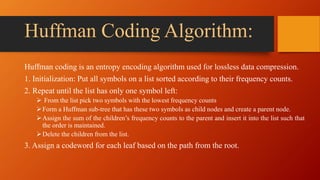
Lossless Compression
Entropy Based Dictionary Based
RLE Arithmetic Huffman Simple Byte LZW
Types of Lossless Compression
Huffman Coding Algorithm:
Huffman coding is an entropy encoding algorithm used for lossless data compression.
1. Initialization: Put all symbols on a list sorted according to their frequency counts.
2. Repeat until the list has only one symbol left:
 From the list pick two symbols with the lowest frequency counts
Form a Huffman sub-tree that has these two symbols as child nodes and create a parent node.
Assign the sum of the children’s frequency counts to the parent and insert it into the list such that
the order is maintained.
Delete the children from the list.
3. Assign a codeword for each leaf based on the path from the root.
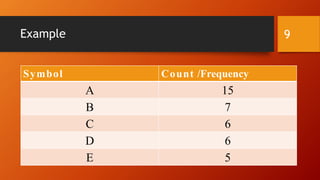
Example
3/2/2019
9
Symbol Count /Frequency
A 15
B 7
C 6
D 6
E 5
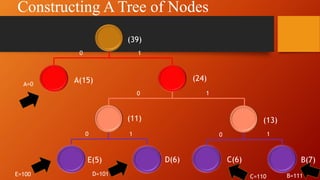
Constructing A Tree of Nodes
B(7)C(6)D(6)E(5)
(13)(11)
(24)A(15)
(39)
0 1
10
10 0 1
A=0
E=100 D=101 C=110 B=111
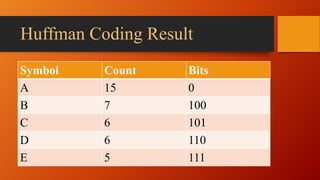
Huffman Coding Result
Symbol Count Bits
A 15 0
B 7 100
C 6 101
D 6 110
E 5 111
About LZW Compression
• LZW is the first letter of the names of the scientists
Abraham Lempel, Jakob Ziv, and Terry Welch, who
developed this algorithm.
• It is an improved version of LZ78 algorithm.
• Published in 1984.
• Is a lossless compression algorithm.
• It is simple and dictionary based.
12
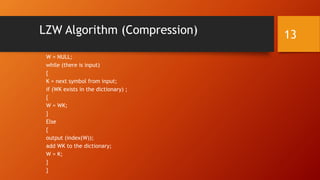
LZW Algorithm (Compression)
W = NULL;
while (there is input)
{
K = next symbol from input;
if (WK exists in the dictionary) ;
{
W = WK;
}
Else
{
output (index(W));
add WK to the dictionary;
W = K;
}
}
13
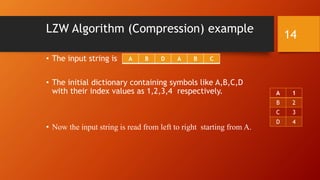
LZW Algorithm (Compression) example
• The input string is
• The initial dictionary containing symbols like A,B,C,D
with their index values as 1,2,3,4 respectively.
• Now the input string is read from left to right starting from A.
14
A B D A B C
A 1
B 2
C 3
D 4
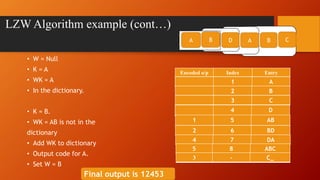
LZW Algorithm example (cont…)
• W = Null
• K = A
• WK = A
• In the dictionary.
• K = B.
• WK = AB is not in the
dictionary
• Add WK to dictionary
• Output code for A.
• Set W = B
15
Encoded o/p Index Entry
1 A
2 B
3 C
4 D
1 5 AB
2 6 BD
4 7 DA
5 8 ABC
Final output is 12453
A B D A B C
3 - C_
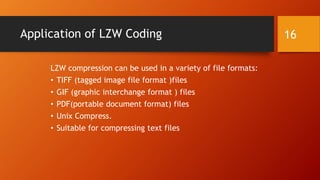
Application of LZW Coding
LZW compression can be used in a variety of file formats:
• TIFF (tagged image file format )files
• GIF (graphic interchange format ) files
• PDF(portable document format) files
• Unix Compress.
• Suitable for compressing text files
16
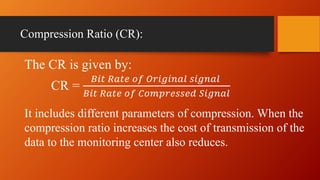
The CR is given by:
CR =
𝐵𝑖𝑡 𝑅𝑎𝑡𝑒 𝑜𝑓 𝑂𝑟𝑖𝑔𝑖𝑛𝑎𝑙 𝑠𝑖𝑔𝑛𝑎𝑙
𝐵𝑖𝑡 𝑅𝑎𝑡𝑒 𝑜𝑓 𝐶𝑜𝑚𝑝𝑟𝑒𝑠𝑠𝑒𝑑 𝑆𝑖𝑔𝑛𝑎𝑙
It includes different parameters of compression. When the
compression ratio increases the cost of transmission of the
data to the monitoring center also reduces.
Compression Ratio (CR):
3/2/2019
18

Data compression & Classification

  • 1.
    Welcome to mypresentation On Data Compression
  • 2.
    3/2/2019 2 Presented To: Dr. Md.Maniruzzaman Professor ECE Discipline Khulna University, Khulna-9208 Email: m_m_zaman@hotmail.com Presented by: Md. Golam Rousul Student ID: MSc-190903 ECE Discipline Khulna University, Khulna-9208 Email: rousul.ku@gmail.com
  • 3.
    Compression: Compression isa way to reduce the number of bits in a frame but retaining its meaning. Data Compression: Data compression is the process of encoding data so that it takes less storage space or less transmission time than it would if it were not compressed. Data Compression 3/2/2019 3
  • 4.
    Types of DataCompression 3/2/2019 4 Data Compression Lossless Method (text or program ) Lossy Method (Image, video, audio )
  • 5.
    3/2/2019 5 Lossy compression: A lossydata compression technique is one where compressing data and its decompression retrieves data that may will be different from the original. Lossless compression: The lossless data compression method can be seen in the Part of the input data is used to predict the incoming data by neural network predictor.
  • 6.
  • 7.
    3/2/2019 7 Lossless Compression Entropy BasedDictionary Based RLE Arithmetic Huffman Simple Byte LZW Types of Lossless Compression
  • 8.
    Huffman Coding Algorithm: Huffmancoding is an entropy encoding algorithm used for lossless data compression. 1. Initialization: Put all symbols on a list sorted according to their frequency counts. 2. Repeat until the list has only one symbol left:  From the list pick two symbols with the lowest frequency counts Form a Huffman sub-tree that has these two symbols as child nodes and create a parent node. Assign the sum of the children’s frequency counts to the parent and insert it into the list such that the order is maintained. Delete the children from the list. 3. Assign a codeword for each leaf based on the path from the root.
  • 9.
  • 10.
    Constructing A Treeof Nodes B(7)C(6)D(6)E(5) (13)(11) (24)A(15) (39) 0 1 10 10 0 1 A=0 E=100 D=101 C=110 B=111
  • 11.
    Huffman Coding Result SymbolCount Bits A 15 0 B 7 100 C 6 101 D 6 110 E 5 111
  • 12.
    About LZW Compression •LZW is the first letter of the names of the scientists Abraham Lempel, Jakob Ziv, and Terry Welch, who developed this algorithm. • It is an improved version of LZ78 algorithm. • Published in 1984. • Is a lossless compression algorithm. • It is simple and dictionary based. 12
  • 13.
    LZW Algorithm (Compression) W= NULL; while (there is input) { K = next symbol from input; if (WK exists in the dictionary) ; { W = WK; } Else { output (index(W)); add WK to the dictionary; W = K; } } 13
  • 14.
    LZW Algorithm (Compression)example • The input string is • The initial dictionary containing symbols like A,B,C,D with their index values as 1,2,3,4 respectively. • Now the input string is read from left to right starting from A. 14 A B D A B C A 1 B 2 C 3 D 4
  • 15.
    LZW Algorithm example(cont…) • W = Null • K = A • WK = A • In the dictionary. • K = B. • WK = AB is not in the dictionary • Add WK to dictionary • Output code for A. • Set W = B 15 Encoded o/p Index Entry 1 A 2 B 3 C 4 D 1 5 AB 2 6 BD 4 7 DA 5 8 ABC Final output is 12453 A B D A B C 3 - C_
  • 16.
    Application of LZWCoding LZW compression can be used in a variety of file formats: • TIFF (tagged image file format )files • GIF (graphic interchange format ) files • PDF(portable document format) files • Unix Compress. • Suitable for compressing text files 16
  • 17.
    The CR isgiven by: CR = 𝐵𝑖𝑡 𝑅𝑎𝑡𝑒 𝑜𝑓 𝑂𝑟𝑖𝑔𝑖𝑛𝑎𝑙 𝑠𝑖𝑔𝑛𝑎𝑙 𝐵𝑖𝑡 𝑅𝑎𝑡𝑒 𝑜𝑓 𝐶𝑜𝑚𝑝𝑟𝑒𝑠𝑠𝑒𝑑 𝑆𝑖𝑔𝑛𝑎𝑙 It includes different parameters of compression. When the compression ratio increases the cost of transmission of the data to the monitoring center also reduces. Compression Ratio (CR):
  • 18.