ClinicalTrials
Dr Menaal Kaushal
JR II
Department of S.P.M.
S. N. Medical College
Agra
16-05-2014
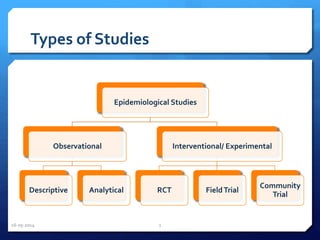
Types of Studies
Epidemiological Studies
Observational
Descriptive Analytical
Interventional/ Experimental
RCT FieldTrial
Community
Trial
16-05-2014 2
Why ClinicalTrials?
 Gold standard with aTotality of Evidence:
 Lab Study- High Precision
 Epidemiological Study- High Relevance
 Designed to elucidate Most Appropriate Treatment for the
FUTURE PATIENTS
 Should be done only in existence of CLINICAL EQUIPOISE
 So, during enrollment the researcher must ensure Absence of
THERAPEUTIC MISCONCEPTION among the participants.
 Also ensure the non-existence of Oxymoron: THERAPEUTIC
RESEARCH
16-05-2014 3
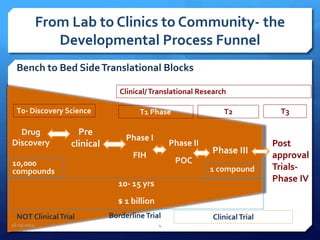
From Lab to Clinics to Community- the
Developmental Process Funnel
Drug
Discovery
Pre
clinical
Phase I
FIH
Phase II
POC
Phase III
Post
approval
Trials-
Phase IV
10,000
compounds
10- 15 yrs
$ 1 billion
1 compound
Bench to Bed SideTranslational Blocks
T0- Discovery Science T1 Phase
Clinical/Translational Research
NOT ClinicalTrial BorderlineTrial ClinicalTrial
T2 T3
16-05-2014 4
Pre Clinical Phase
 Safety Testing- Toxicity and Physiological Response to the
new Compound is assessed
 Organs targeted include:
 Cardio- vascular
 Neuro- muscular
 Respiratory
 + Other Organs and systems depending on the compound’s action
 Dose Dependence
 Potential for Reversibility16-05-2014 5
Toxicity studies
 AcuteToxicity: determine overdose effects
 Repeated Dose Toxicity: maximum duration of
clinical trial
16-05-2014 7
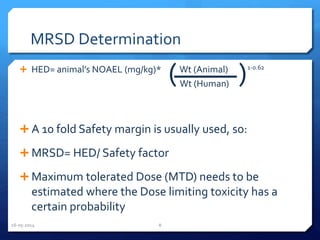
MRSD Determination
 HED= animal’s NOAEL (mg/kg)* Wt (Animal) 1-0.62
 A 10 fold Safety margin is usually used, so:
 MRSD= HED/ Safety factor
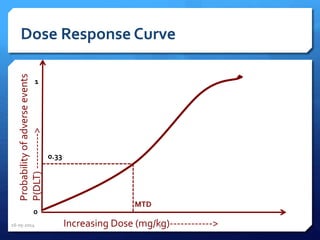
 Maximum tolerated Dose (MTD) needs to be
estimated where the Dose limiting toxicity has a
certain probability
( )Wt (Human)
16-05-2014 8
Dose Response Curve
Increasing Dose (mg/kg)------------>
Probabilityofadverseevents
P(DLT)---------->
0
1
0.33
MTD
16-05-2014 9
Phase I- FIHTrial
 Healthy volunteers are given a single dose in a
controlled environment (In- patient settings)
 Volunteers usually paid
 Risks are kept to be minimum
 What needs to be assessed is:
 Safety
 Pharmacokinetics
 Pharmacodynamics
 Route and Rate of administration
 Fixing up the end points
 Physiologic effects in humans16-05-2014 10
POC Study
 Patients having the disease of interest, are enrolled
 Volunteers not paid
 Moderate (or even serious) risks are acceptable
 Done to assess:
 The Dose response
 Safety
 Pathophysiology
 Limited observation about efficacy
16-05-2014 11
Steps in Conducting a Phase III Clinical
Trial
 Design Phase
 Research Question- FINER Criteria, PICOT style
 Study Designs
 Ethical Considerations& GCP Guidelines
 Registering with CTRI
 Latest DGCA Guidelines-Video Record Every Consent
 Sample Size, Clearly defined Inclusion- Exclusion
criteria
16-05-2014 12
Steps in Conducting a Phase III Clinical
Trial
 Implementation Phase
 Randomization v/s Random Allocation
 Blinding
 Control- StandardTreatment v/s Placebo
 Monitoring& DSMB- InterimAnalysis
 Analytical Phase
 ITT v/s Per protocol analysis
 CONSORT Guidelines
16-05-2014 13
Research Question
 FINER; PICOT
 Following need to be considered:
 Effect Size
 Composite endpoints
 Surrogate End Points
 Study duration
 Secondary Questions
 Sub group Hypothesis
 Natural History Studies
16-05-2014 14
Study Designs
 Two group parallel design-The Look ahead trial (T2DM obese
pts on Diabetes support& education v/s active, intensive
lifestyle modification)
 Multi group parallel design-The Re-ly trial (Atr Fib pts on
warfarin v/s dabigatran 110mg v/s dabigatran 150 mg)
 Factorial design-The SUPPORTTrial (very premature neonates
were randomized into Early surfactant v/s early CPAP and O2
Saturation 85% v/s 95%)
 Cross over design- Pts can be compared on themselves. E.g.
Hemophilia trial. No carry over between the two treatment
periods- Rest period is needed16-05-2014 15
The History Behind Ethics
Nuremberg Code- 1946
Declaration of Helsinki- 1964
Council for International Organizations of
Medical SciencesCIOMS- 1982
International Conference on Harmonization
– Good clinical practice (ICH-GCP)- 1996
16-05-2014 16
Historical Perspectives
 Council for International Organizations of Medical
Sciences (CIOMS) and WHO (1982) – International
ethical guidelines for biomedical research involving
human subjects
 Revised – 1993, 2002
 International Conference of Harmonization – Good
clinical practice (ICH-GCP)-1996)
 International ethical and scientific quality standard for
designing, conducting, recording and reporting trials involving
human subjects.
16-05-2014 18
13 Principles of GCP
1. Ethics (Declaration of Helsinki)
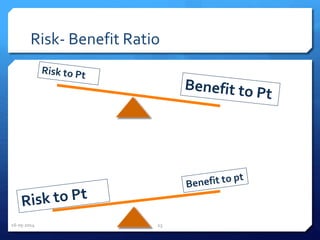
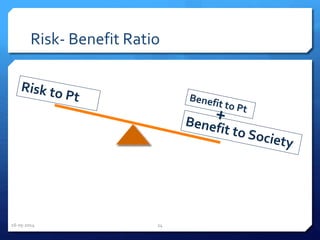
2. Risk Benefit analysis
3. Trial subjects (rights and safety)
4. Investigational product (Information support
study)
5. Scientifically sound
6. Compliance (IRB review)16-05-2014 19
7. Qualified physician to provide medical care
8. Trial staff (trained in protocol)
9. Informed consent
10. Data (reporting, interpretation, verification)
11. Confidentiality
12. Good manufacturing practice of the
investigational product
13. QualityAssurance of all aspects of protocol
16-05-2014 20
7 Components of the Ethics:
1. Social or Scientific value
2. ScientificValidity
3. Fair Subject Selection
4. Favorable risk- benefit ratio
5. Independent review
6. Informed Consent
7. Respect for potential and enrolled subjects
16-05-2014 21
Ethics in Trials
 During Phase I Trials, 95% of the times,
participating patients do not benefit from theTrial
 The probability (chance) of having any benefit 5%
 Risk of fatal complication 5%
 While there may be a significant chance of benefit in
Phase IIITrial
16-05-2014 22
Risk- Benefit Ratio
16-05-2014 23
Risk- Benefit Ratio
16-05-2014 24
Informed Consent - Elements
 Information
 Patient/subject information sheet
 Comprehension
 Simple and understandable language
 Local language translations
 Voluntariness
 Consent
16-05-2014 27
Informed Consent
 Community studies – Consent needed from
 Community – group consent
 Individuals
 Children
 Parent/guardian
 Assent of child to his/her capability
 Mentally Ill
 Close biological relative
 Legally authorized person
 Certificate from psychiatrist
16-05-2014 28
Importance Of Clinical Trials Registration
 To ensure transparency , accountability and to
increase public trust in the conduct of clinical
research.
 Clinical trial registration and results reporting
would help ensure unbiased public records on
safety and efficacy of drugs.
 All clinical trials should be registered before the
enrolment of the first patient and all results made
publicly available.
16-05-2014 29
Registration of Trials Globally
 At the 58th WHA held on 25th May 2005 WHO had set up of an
International Clinical Trial Registry Platform (ICTRP), a one-stop
search portal for searching registers worldwide.
 The ICTRP recommended 20 key points as Trial Registration
data Set that need to be publicly declared before the enrolment
of the first patient.
 In the 59th General Assembly of the World Medical Association,
2008, in its revision of the Declaration of Helsinki among other
modifications, specifies that:
 “Every clinical trial must be registered in a publicly accessible
database before recruitment of the first subject.”
16-05-2014 30
CTR- I
 Till 2006, there was no national registry of clinical trials in
India
 On July 20, 2007, ICMR through its National Institute of
Medical Statistics (NIMS) formed Clinical Trials Registry –
India (CTRI) www.ctri.nic.in with financial support from DST
andWHO.
 The CTRI has additional data points over the ICTRP’s
recommended 20 point data set:
 Later these additional points were borrowed from CTR- I and
were inculcated in the WHO’s ICTRP.
16-05-2014 31
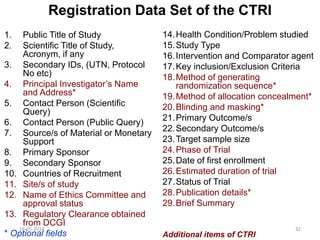
Registration Data Set of the CTRI
1. Public Title of Study
2. Scientific Title of Study,
Acronym, if any
3. Secondary IDs, (UTN, Protocol
No etc)
4. Principal Investigator’s Name
and Address*
5. Contact Person (Scientific
Query)
6. Contact Person (Public Query)
7. Source/s of Material or Monetary
Support
8. Primary Sponsor
9. Secondary Sponsor
10. Countries of Recruitment
11. Site/s of study
12. Name of Ethics Committee and
approval status
13. Regulatory Clearance obtained
from DCGI
* Optional fields
14.Health Condition/Problem studied
15.Study Type
16.Intervention and Comparator agent
17.Key inclusion/Exclusion Criteria
18.Method of generating
randomization sequence*
19.Method of allocation concealment*
20.Blinding and masking*
21.Primary Outcome/s
22.Secondary Outcome/s
23.Target sample size
24.Phase of Trial
25.Date of first enrollment
26.Estimated duration of trial
27.Status of Trial
28.Publication details*
29.Brief Summary
Additional items of CTRI
16-05-2014 32
ClinicalTrial Registry-India
16-05-2014
33
 It is housed at the National Institute of Medical
Statistics, ICMR, New Delhi.
 Trial registration is purely online, paperless
process and free of charge
 The CTRI software application was modified and
implemented on 15th March 2011.
Clinical Trials Registry – India
16-05-2014 34
Objectives of CTRI
 To establish a public record system by registering all
clinical trials on health products including:
 Drugs
 Devices
 Vaccines
 Herbal drugs
 It makes the information available to both public and
healthcare professionals in an unbiased, scientific and timely
manner.
 To create a complete, authentic and readily available
data of all ongoing and completed clinical trials.
16-05-2014 35
Objectives of CTRI
 To provide a corrective system against “positive results
bias” and “selective reporting” of research results to peer
review publication.
 To increase awareness and accountability of all the
participants of the clinical trials and also for public access:
 Trial registration empowers the public and offer patients the choice
of enrolling in a clinical trial to gain access to latest breakthrough
treatment options.
 To promote training, assistance and advocacy for clinical
trials by creating database and modules of study for
various aspects of clinical trials and its registration.
16-05-2014 36
Registration of clinical trials under
CTR- I is recommended by:
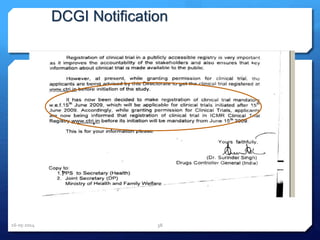
1. Drugs Controller General (India): Made
mandatory since June 2009
2. Editors of Indian Biomedical Journals;
3. Ethics Committees of various institutions,
AIIMS, CMC, Sir Ganga Ram Hospital etc.
16-05-2014 37
DCGI Notification
16-05-2014 38
 CTRI currently accepts registration of:
 Prospective trials
 Ongoing
 Completed trials
 Terminated trials
 Registered trials are flagged as:
 Trial registered prospectively
 Trial registered retrospectively
 Terminated trial registered
16-05-2014 41
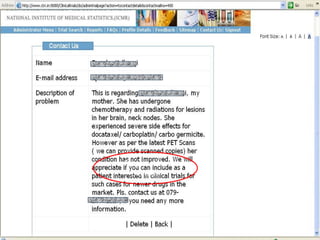
16-05-2014
Empowering
patients
42
Registering Trials during PG Thesis
CTRI encourages registration of trials
being conducted as part of post-
graduation thesis work
 This would help
 Ensure ethical standards
 Prevent unnecessary duplicate research
 Raise the standard of research
 Enable better exchange of data and ideas
16-05-2014 47
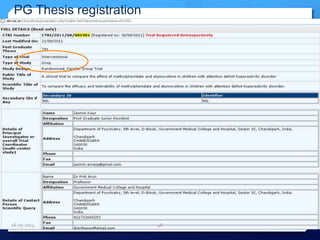
PG Thesis registration
16-05-2014 48
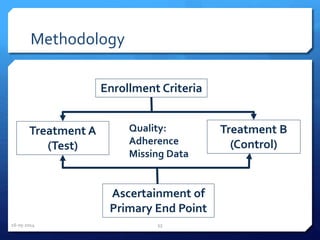
Methodology
Enrollment Criteria
Ascertainment of
Primary End Point
Treatment A
(Test)
Treatment B
(Control)
Quality:
Adherence
Missing Data
16-05-2014 53
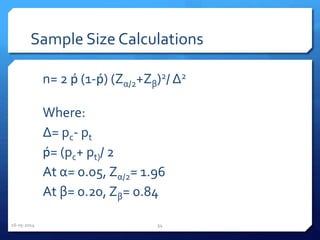
Sample Size Calculations
n= 2 ṕ (1-ṕ) (Zα/2+Zβ)2/ Δ2
Where:
Δ= pc- pt
ṕ= (pc+ pt)/ 2
At α= 0.05, Zα/2= 1.96
At β= 0.20, Zβ= 0.84
16-05-2014 54
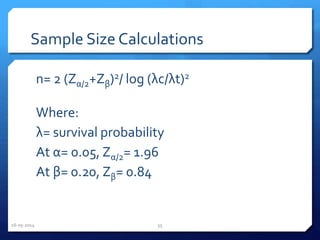
Sample Size Calculations
n= 2 (Zα/2+Zβ)2/ log (λc/λt)2
Where:
λ= survival probability
At α= 0.05, Zα/2= 1.96
At β= 0.20, Zβ= 0.84
16-05-2014 55
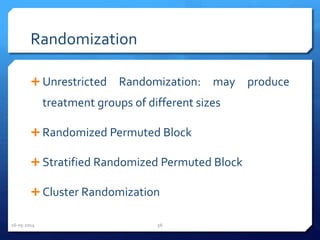
Randomization
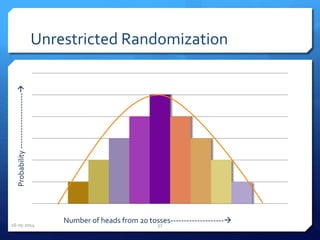
 Unrestricted Randomization: may produce
treatment groups of different sizes
 Randomized Permuted Block
 Stratified Randomized Permuted Block
 Cluster Randomization
16-05-2014 56
Unrestricted Randomization
Probability---------------------
Number of heads from 20 tosses--------------------16-05-2014 57
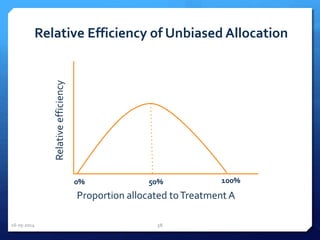
Relativeefficiency
Proportion allocated toTreatment A
50%0% 100%
Relative Efficiency of Unbiased Allocation
16-05-2014 58
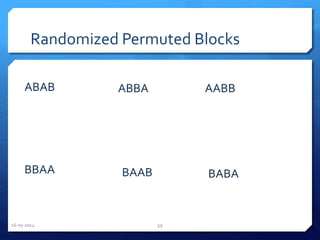
Randomized Permuted Blocks
ABAB AABB
BBAA BABA
ABBA
BAAB
16-05-2014 59
Blinding
Single BlindTrial
Double BlindTrial
Triple BlindTrial
16-05-2014 60
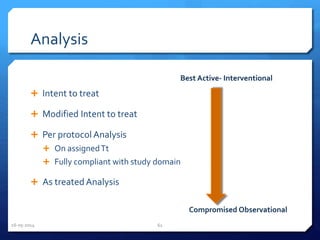
Analysis
 Intent to treat
 Modified Intent to treat
 Per protocol Analysis
 On assignedTt
 Fully compliant with study domain
 As treated Analysis
Best Active- Interventional
Compromised Observational
16-05-2014 61
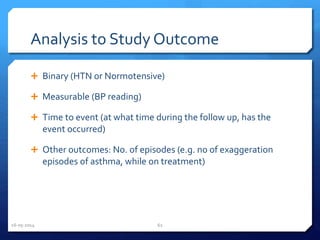
Analysis to Study Outcome
 Binary (HTN or Normotensive)
 Measurable (BP reading)
 Time to event (at what time during the follow up, has the
event occurred)
 Other outcomes: No. of episodes (e.g. no of exaggeration
episodes of asthma, while on treatment)
16-05-2014 62
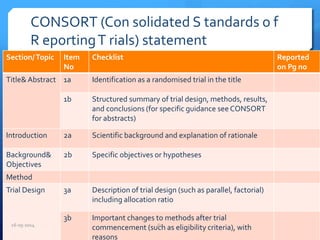
CONSORT (Con solidated S tandards o f
R eportingT rials) statement
Section/Topic Item
No
Checklist Reported
on Pg no
Title& Abstract 1a Identification as a randomised trial in the title
1b Structured summary of trial design, methods, results,
and conclusions (for specific guidance see CONSORT
for abstracts)
Introduction 2a Scientific background and explanation of rationale
Background&
Objectives
2b Specific objectives or hypotheses
Method
Trial Design 3a Description of trial design (such as parallel, factorial)
including allocation ratio
3b Important changes to methods after trial
commencement (such as eligibility criteria), with
reasons
16-05-2014 63
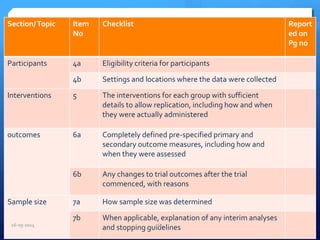
Section/Topic Item
No
Checklist Report
ed on
Pg no
Participants 4a Eligibility criteria for participants
4b Settings and locations where the data were collected
Interventions 5 The interventions for each group with sufficient
details to allow replication, including how and when
they were actually administered
outcomes 6a Completely defined pre-specified primary and
secondary outcome measures, including how and
when they were assessed
6b Any changes to trial outcomes after the trial
commenced, with reasons
Sample size 7a How sample size was determined
7b When applicable, explanation of any interim analyses
and stopping guidelines16-05-2014 64
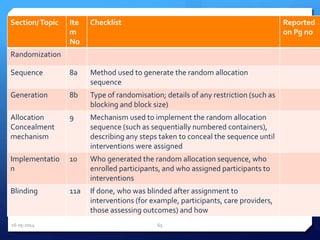
Section/Topic Ite
m
No
Checklist Reported
on Pg no
Randomization
Sequence 8a Method used to generate the random allocation
sequence
Generation 8b Type of randomisation; details of any restriction (such as
blocking and block size)
Allocation
Concealment
mechanism
9 Mechanism used to implement the random allocation
sequence (such as sequentially numbered containers),
describing any steps taken to conceal the sequence until
interventions were assigned
Implementatio
n
10 Who generated the random allocation sequence, who
enrolled participants, and who assigned participants to
interventions
Blinding 11a If done, who was blinded after assignment to
interventions (for example, participants, care providers,
those assessing outcomes) and how
16-05-2014 65
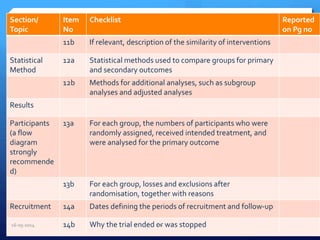
Section/
Topic
Item
No
Checklist Reported
on Pg no
11b If relevant, description of the similarity of interventions
Statistical
Method
12a Statistical methods used to compare groups for primary
and secondary outcomes
12b Methods for additional analyses, such as subgroup
analyses and adjusted analyses
Results
Participants
(a flow
diagram
strongly
recommende
d)
13a For each group, the numbers of participants who were
randomly assigned, received intended treatment, and
were analysed for the primary outcome
13b For each group, losses and exclusions after
randomisation, together with reasons
Recruitment 14a Dates defining the periods of recruitment and follow-up
14b Why the trial ended or was stopped16-05-2014 66
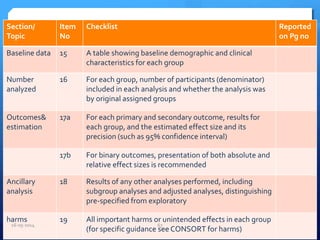
Section/
Topic
Item
No
Checklist Reported
on Pg no
Baseline data 15 A table showing baseline demographic and clinical
characteristics for each group
Number
analyzed
16 For each group, number of participants (denominator)
included in each analysis and whether the analysis was
by original assigned groups
Outcomes&
estimation
17a For each primary and secondary outcome, results for
each group, and the estimated effect size and its
precision (such as 95% confidence interval)
17b For binary outcomes, presentation of both absolute and
relative effect sizes is recommended
Ancillary
analysis
18 Results of any other analyses performed, including
subgroup analyses and adjusted analyses, distinguishing
pre-specified from exploratory
harms 19 All important harms or unintended effects in each group
(for specific guidance see CONSORT for harms)
16-05-2014 67
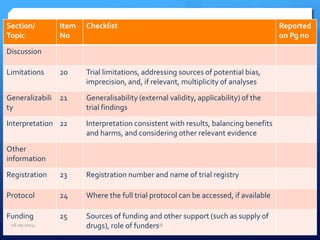
Section/
Topic
Item
No
Checklist Reported
on Pg no
Discussion
Limitations 20 Trial limitations, addressing sources of potential bias,
imprecision, and, if relevant, multiplicity of analyses
Generalizabili
ty
21 Generalisability (external validity, applicability) of the
trial findings
Interpretation 22 Interpretation consistent with results, balancing benefits
and harms, and considering other relevant evidence
Other
information
Registration 23 Registration number and name of trial registry
Protocol 24 Where the full trial protocol can be accessed, if available
Funding 25 Sources of funding and other support (such as supply of
drugs), role of funders16-05-2014 68
 Flow chart
16-05-2014 69
References:
 Textbook of Preventive and Social Medicine by K. Park
 ctri.nic.in
 ClinicalTrials by Stuart J Pocock
 edx.org/ harvard
16-05-2014 70
16-05-2014 71
ThankYou

Clinical Trials

  • 1.
    ClinicalTrials Dr Menaal Kaushal JRII Department of S.P.M. S. N. Medical College Agra 16-05-2014
  • 2.
    Types of Studies EpidemiologicalStudies Observational Descriptive Analytical Interventional/ Experimental RCT FieldTrial Community Trial 16-05-2014 2
  • 3.
    Why ClinicalTrials?  Goldstandard with aTotality of Evidence:  Lab Study- High Precision  Epidemiological Study- High Relevance  Designed to elucidate Most Appropriate Treatment for the FUTURE PATIENTS  Should be done only in existence of CLINICAL EQUIPOISE  So, during enrollment the researcher must ensure Absence of THERAPEUTIC MISCONCEPTION among the participants.  Also ensure the non-existence of Oxymoron: THERAPEUTIC RESEARCH 16-05-2014 3
  • 4.
    From Lab toClinics to Community- the Developmental Process Funnel Drug Discovery Pre clinical Phase I FIH Phase II POC Phase III Post approval Trials- Phase IV 10,000 compounds 10- 15 yrs $ 1 billion 1 compound Bench to Bed SideTranslational Blocks T0- Discovery Science T1 Phase Clinical/Translational Research NOT ClinicalTrial BorderlineTrial ClinicalTrial T2 T3 16-05-2014 4
  • 5.
    Pre Clinical Phase Safety Testing- Toxicity and Physiological Response to the new Compound is assessed  Organs targeted include:  Cardio- vascular  Neuro- muscular  Respiratory  + Other Organs and systems depending on the compound’s action  Dose Dependence  Potential for Reversibility16-05-2014 5
  • 6.
    Toxicity studies  AcuteToxicity:determine overdose effects  Repeated Dose Toxicity: maximum duration of clinical trial 16-05-2014 7
  • 7.
    MRSD Determination  HED=animal’s NOAEL (mg/kg)* Wt (Animal) 1-0.62  A 10 fold Safety margin is usually used, so:  MRSD= HED/ Safety factor  Maximum tolerated Dose (MTD) needs to be estimated where the Dose limiting toxicity has a certain probability ( )Wt (Human) 16-05-2014 8
  • 8.
    Dose Response Curve IncreasingDose (mg/kg)------------> Probabilityofadverseevents P(DLT)----------> 0 1 0.33 MTD 16-05-2014 9
  • 9.
    Phase I- FIHTrial Healthy volunteers are given a single dose in a controlled environment (In- patient settings)  Volunteers usually paid  Risks are kept to be minimum  What needs to be assessed is:  Safety  Pharmacokinetics  Pharmacodynamics  Route and Rate of administration  Fixing up the end points  Physiologic effects in humans16-05-2014 10
  • 10.
    POC Study  Patientshaving the disease of interest, are enrolled  Volunteers not paid  Moderate (or even serious) risks are acceptable  Done to assess:  The Dose response  Safety  Pathophysiology  Limited observation about efficacy 16-05-2014 11
  • 11.
    Steps in Conductinga Phase III Clinical Trial  Design Phase  Research Question- FINER Criteria, PICOT style  Study Designs  Ethical Considerations& GCP Guidelines  Registering with CTRI  Latest DGCA Guidelines-Video Record Every Consent  Sample Size, Clearly defined Inclusion- Exclusion criteria 16-05-2014 12
  • 12.
    Steps in Conductinga Phase III Clinical Trial  Implementation Phase  Randomization v/s Random Allocation  Blinding  Control- StandardTreatment v/s Placebo  Monitoring& DSMB- InterimAnalysis  Analytical Phase  ITT v/s Per protocol analysis  CONSORT Guidelines 16-05-2014 13
  • 13.
    Research Question  FINER;PICOT  Following need to be considered:  Effect Size  Composite endpoints  Surrogate End Points  Study duration  Secondary Questions  Sub group Hypothesis  Natural History Studies 16-05-2014 14
  • 14.
    Study Designs  Twogroup parallel design-The Look ahead trial (T2DM obese pts on Diabetes support& education v/s active, intensive lifestyle modification)  Multi group parallel design-The Re-ly trial (Atr Fib pts on warfarin v/s dabigatran 110mg v/s dabigatran 150 mg)  Factorial design-The SUPPORTTrial (very premature neonates were randomized into Early surfactant v/s early CPAP and O2 Saturation 85% v/s 95%)  Cross over design- Pts can be compared on themselves. E.g. Hemophilia trial. No carry over between the two treatment periods- Rest period is needed16-05-2014 15
  • 15.
    The History BehindEthics Nuremberg Code- 1946 Declaration of Helsinki- 1964 Council for International Organizations of Medical SciencesCIOMS- 1982 International Conference on Harmonization – Good clinical practice (ICH-GCP)- 1996 16-05-2014 16
  • 16.
    Historical Perspectives  Councilfor International Organizations of Medical Sciences (CIOMS) and WHO (1982) – International ethical guidelines for biomedical research involving human subjects  Revised – 1993, 2002  International Conference of Harmonization – Good clinical practice (ICH-GCP)-1996)  International ethical and scientific quality standard for designing, conducting, recording and reporting trials involving human subjects. 16-05-2014 18
  • 17.
    13 Principles ofGCP 1. Ethics (Declaration of Helsinki) 2. Risk Benefit analysis 3. Trial subjects (rights and safety) 4. Investigational product (Information support study) 5. Scientifically sound 6. Compliance (IRB review)16-05-2014 19
  • 18.
    7. Qualified physicianto provide medical care 8. Trial staff (trained in protocol) 9. Informed consent 10. Data (reporting, interpretation, verification) 11. Confidentiality 12. Good manufacturing practice of the investigational product 13. QualityAssurance of all aspects of protocol 16-05-2014 20
  • 19.
    7 Components ofthe Ethics: 1. Social or Scientific value 2. ScientificValidity 3. Fair Subject Selection 4. Favorable risk- benefit ratio 5. Independent review 6. Informed Consent 7. Respect for potential and enrolled subjects 16-05-2014 21
  • 20.
    Ethics in Trials During Phase I Trials, 95% of the times, participating patients do not benefit from theTrial  The probability (chance) of having any benefit 5%  Risk of fatal complication 5%  While there may be a significant chance of benefit in Phase IIITrial 16-05-2014 22
  • 21.
  • 22.
  • 23.
    Informed Consent -Elements  Information  Patient/subject information sheet  Comprehension  Simple and understandable language  Local language translations  Voluntariness  Consent 16-05-2014 27
  • 24.
    Informed Consent  Communitystudies – Consent needed from  Community – group consent  Individuals  Children  Parent/guardian  Assent of child to his/her capability  Mentally Ill  Close biological relative  Legally authorized person  Certificate from psychiatrist 16-05-2014 28
  • 25.
    Importance Of ClinicalTrials Registration  To ensure transparency , accountability and to increase public trust in the conduct of clinical research.  Clinical trial registration and results reporting would help ensure unbiased public records on safety and efficacy of drugs.  All clinical trials should be registered before the enrolment of the first patient and all results made publicly available. 16-05-2014 29
  • 26.
    Registration of TrialsGlobally  At the 58th WHA held on 25th May 2005 WHO had set up of an International Clinical Trial Registry Platform (ICTRP), a one-stop search portal for searching registers worldwide.  The ICTRP recommended 20 key points as Trial Registration data Set that need to be publicly declared before the enrolment of the first patient.  In the 59th General Assembly of the World Medical Association, 2008, in its revision of the Declaration of Helsinki among other modifications, specifies that:  “Every clinical trial must be registered in a publicly accessible database before recruitment of the first subject.” 16-05-2014 30
  • 27.
    CTR- I  Till2006, there was no national registry of clinical trials in India  On July 20, 2007, ICMR through its National Institute of Medical Statistics (NIMS) formed Clinical Trials Registry – India (CTRI) www.ctri.nic.in with financial support from DST andWHO.  The CTRI has additional data points over the ICTRP’s recommended 20 point data set:  Later these additional points were borrowed from CTR- I and were inculcated in the WHO’s ICTRP. 16-05-2014 31
  • 28.
    Registration Data Setof the CTRI 1. Public Title of Study 2. Scientific Title of Study, Acronym, if any 3. Secondary IDs, (UTN, Protocol No etc) 4. Principal Investigator’s Name and Address* 5. Contact Person (Scientific Query) 6. Contact Person (Public Query) 7. Source/s of Material or Monetary Support 8. Primary Sponsor 9. Secondary Sponsor 10. Countries of Recruitment 11. Site/s of study 12. Name of Ethics Committee and approval status 13. Regulatory Clearance obtained from DCGI * Optional fields 14.Health Condition/Problem studied 15.Study Type 16.Intervention and Comparator agent 17.Key inclusion/Exclusion Criteria 18.Method of generating randomization sequence* 19.Method of allocation concealment* 20.Blinding and masking* 21.Primary Outcome/s 22.Secondary Outcome/s 23.Target sample size 24.Phase of Trial 25.Date of first enrollment 26.Estimated duration of trial 27.Status of Trial 28.Publication details* 29.Brief Summary Additional items of CTRI 16-05-2014 32
  • 29.
  • 30.
     It ishoused at the National Institute of Medical Statistics, ICMR, New Delhi.  Trial registration is purely online, paperless process and free of charge  The CTRI software application was modified and implemented on 15th March 2011. Clinical Trials Registry – India 16-05-2014 34
  • 31.
    Objectives of CTRI To establish a public record system by registering all clinical trials on health products including:  Drugs  Devices  Vaccines  Herbal drugs  It makes the information available to both public and healthcare professionals in an unbiased, scientific and timely manner.  To create a complete, authentic and readily available data of all ongoing and completed clinical trials. 16-05-2014 35
  • 32.
    Objectives of CTRI To provide a corrective system against “positive results bias” and “selective reporting” of research results to peer review publication.  To increase awareness and accountability of all the participants of the clinical trials and also for public access:  Trial registration empowers the public and offer patients the choice of enrolling in a clinical trial to gain access to latest breakthrough treatment options.  To promote training, assistance and advocacy for clinical trials by creating database and modules of study for various aspects of clinical trials and its registration. 16-05-2014 36
  • 33.
    Registration of clinicaltrials under CTR- I is recommended by: 1. Drugs Controller General (India): Made mandatory since June 2009 2. Editors of Indian Biomedical Journals; 3. Ethics Committees of various institutions, AIIMS, CMC, Sir Ganga Ram Hospital etc. 16-05-2014 37
  • 34.
  • 35.
     CTRI currentlyaccepts registration of:  Prospective trials  Ongoing  Completed trials  Terminated trials  Registered trials are flagged as:  Trial registered prospectively  Trial registered retrospectively  Terminated trial registered 16-05-2014 41
  • 36.
  • 37.
    Registering Trials duringPG Thesis CTRI encourages registration of trials being conducted as part of post- graduation thesis work  This would help  Ensure ethical standards  Prevent unnecessary duplicate research  Raise the standard of research  Enable better exchange of data and ideas 16-05-2014 47
  • 38.
  • 39.
    Methodology Enrollment Criteria Ascertainment of PrimaryEnd Point Treatment A (Test) Treatment B (Control) Quality: Adherence Missing Data 16-05-2014 53
  • 40.
    Sample Size Calculations n=2 ṕ (1-ṕ) (Zα/2+Zβ)2/ Δ2 Where: Δ= pc- pt ṕ= (pc+ pt)/ 2 At α= 0.05, Zα/2= 1.96 At β= 0.20, Zβ= 0.84 16-05-2014 54
  • 41.
    Sample Size Calculations n=2 (Zα/2+Zβ)2/ log (λc/λt)2 Where: λ= survival probability At α= 0.05, Zα/2= 1.96 At β= 0.20, Zβ= 0.84 16-05-2014 55
  • 42.
    Randomization  Unrestricted Randomization:may produce treatment groups of different sizes  Randomized Permuted Block  Stratified Randomized Permuted Block  Cluster Randomization 16-05-2014 56
  • 43.
    Unrestricted Randomization Probability--------------------- Number ofheads from 20 tosses--------------------16-05-2014 57
  • 44.
    Relativeefficiency Proportion allocated toTreatmentA 50%0% 100% Relative Efficiency of Unbiased Allocation 16-05-2014 58
  • 45.
    Randomized Permuted Blocks ABABAABB BBAA BABA ABBA BAAB 16-05-2014 59
  • 46.
  • 47.
    Analysis  Intent totreat  Modified Intent to treat  Per protocol Analysis  On assignedTt  Fully compliant with study domain  As treated Analysis Best Active- Interventional Compromised Observational 16-05-2014 61
  • 48.
    Analysis to StudyOutcome  Binary (HTN or Normotensive)  Measurable (BP reading)  Time to event (at what time during the follow up, has the event occurred)  Other outcomes: No. of episodes (e.g. no of exaggeration episodes of asthma, while on treatment) 16-05-2014 62
  • 49.
    CONSORT (Con solidatedS tandards o f R eportingT rials) statement Section/Topic Item No Checklist Reported on Pg no Title& Abstract 1a Identification as a randomised trial in the title 1b Structured summary of trial design, methods, results, and conclusions (for specific guidance see CONSORT for abstracts) Introduction 2a Scientific background and explanation of rationale Background& Objectives 2b Specific objectives or hypotheses Method Trial Design 3a Description of trial design (such as parallel, factorial) including allocation ratio 3b Important changes to methods after trial commencement (such as eligibility criteria), with reasons 16-05-2014 63
  • 50.
    Section/Topic Item No Checklist Report edon Pg no Participants 4a Eligibility criteria for participants 4b Settings and locations where the data were collected Interventions 5 The interventions for each group with sufficient details to allow replication, including how and when they were actually administered outcomes 6a Completely defined pre-specified primary and secondary outcome measures, including how and when they were assessed 6b Any changes to trial outcomes after the trial commenced, with reasons Sample size 7a How sample size was determined 7b When applicable, explanation of any interim analyses and stopping guidelines16-05-2014 64
  • 51.
    Section/Topic Ite m No Checklist Reported onPg no Randomization Sequence 8a Method used to generate the random allocation sequence Generation 8b Type of randomisation; details of any restriction (such as blocking and block size) Allocation Concealment mechanism 9 Mechanism used to implement the random allocation sequence (such as sequentially numbered containers), describing any steps taken to conceal the sequence until interventions were assigned Implementatio n 10 Who generated the random allocation sequence, who enrolled participants, and who assigned participants to interventions Blinding 11a If done, who was blinded after assignment to interventions (for example, participants, care providers, those assessing outcomes) and how 16-05-2014 65
  • 52.
    Section/ Topic Item No Checklist Reported on Pgno 11b If relevant, description of the similarity of interventions Statistical Method 12a Statistical methods used to compare groups for primary and secondary outcomes 12b Methods for additional analyses, such as subgroup analyses and adjusted analyses Results Participants (a flow diagram strongly recommende d) 13a For each group, the numbers of participants who were randomly assigned, received intended treatment, and were analysed for the primary outcome 13b For each group, losses and exclusions after randomisation, together with reasons Recruitment 14a Dates defining the periods of recruitment and follow-up 14b Why the trial ended or was stopped16-05-2014 66
  • 53.
    Section/ Topic Item No Checklist Reported on Pgno Baseline data 15 A table showing baseline demographic and clinical characteristics for each group Number analyzed 16 For each group, number of participants (denominator) included in each analysis and whether the analysis was by original assigned groups Outcomes& estimation 17a For each primary and secondary outcome, results for each group, and the estimated effect size and its precision (such as 95% confidence interval) 17b For binary outcomes, presentation of both absolute and relative effect sizes is recommended Ancillary analysis 18 Results of any other analyses performed, including subgroup analyses and adjusted analyses, distinguishing pre-specified from exploratory harms 19 All important harms or unintended effects in each group (for specific guidance see CONSORT for harms) 16-05-2014 67
  • 54.
    Section/ Topic Item No Checklist Reported on Pgno Discussion Limitations 20 Trial limitations, addressing sources of potential bias, imprecision, and, if relevant, multiplicity of analyses Generalizabili ty 21 Generalisability (external validity, applicability) of the trial findings Interpretation 22 Interpretation consistent with results, balancing benefits and harms, and considering other relevant evidence Other information Registration 23 Registration number and name of trial registry Protocol 24 Where the full trial protocol can be accessed, if available Funding 25 Sources of funding and other support (such as supply of drugs), role of funders16-05-2014 68
  • 55.
  • 56.
    References:  Textbook ofPreventive and Social Medicine by K. Park  ctri.nic.in  ClinicalTrials by Stuart J Pocock  edx.org/ harvard 16-05-2014 70
  • 57.