1
UNDERSTANDING CLINICAL RESEARCH
AND CLINICAL TRIAL
WHAT IS CLINICAL RESEARCH
 Clinical research is scientific study that involves people. Individuals
volunteer to participate in carefully conducted studies which ultimately
uncover improved methods and knowledge on screening, diagnoses,
treatment and prevention of disease and on the promotion of health
and health care.
 Clinical research can be observational (e.g. health economic research)
or interventional (e.g. clinical trials).
 Improving standard care is one of the aims of clinical research
4
WHAT IS A CLINICAL TRIAL
 Clinical trial” means a systematic study of new drug(s) in human
subject(s) to generate data for discovering and / or verifying the clinical,
pharmacological (including pharmacodynamic and pharmacokinetic)
and /or adverse effects with the objective of determining safety and / or
efficacy of the new drug.
 Generally considered to be biomedical or health-related research
studies in human beings that follow a pre-defined protocol
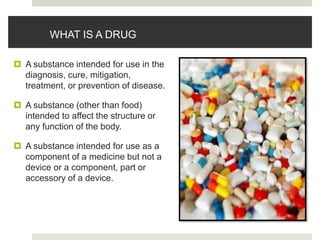
WHAT IS A DRUG
 A substance intended for use in the
diagnosis, cure, mitigation,
treatment, or prevention of disease.
 A substance (other than food)
intended to affect the structure or
any function of the body.
 A substance intended for use as a
component of a medicine but not a
device or a component, part or
accessory of a device.
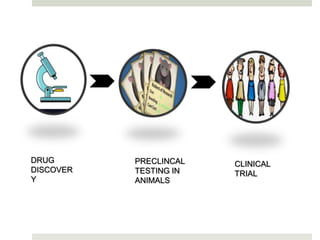
DRUG
DISCOVER
Y
PRECLINCAL
TESTING IN
ANIMALS
CLINICAL
TRIAL
HOW DOES CLINICAL RESEARCH DIFFER
FROM FROM STANDARD CARE
 The difference between clinical research and standard care is
that clinical research:
 involves human volunteers, these may be patients or can all be
healthy individuals who are not suffering from an illness or
condition.
 Is carried out with the ultimate aim of improving standard care.
The research may be testing an intervention (e.g. a product or
procedure) or collecting data through interviews or
observations about a topic such as patient experience, disease
management etc.
9
WHO CAN PARTICIPATE IN A CLINICAL TRIAL
 Before joining a clinical trial, a participant must qualify for the
study
 Some research studies seek participants with illnesses or
conditions to be studied in the clinical trial, while others need
healthy participants
 It is important to note that inclusion and exclusion criteria are not
used to reject people personally. Instead, the criteria are used to
identify appropriate participants and keep them safe.
 The criteria help ensure that researchers will be able to answer
the questions they plan to study
10
WHAT HAPPENS DURING A CLINICAL TRIAL
 The clinical trial process depends on the kind of trial being
conducted
 The clinical trial team includes doctors and nurses as well as
social workers and other health care professionals who check
the health of the participant at the beginning of the trial, give
specific instructions for participating in the trial, monitor the
participant carefully during the trial, and stay in touch after the
trial is completed
11
 Some clinical trials involve more tests & doctor visits than the
participant would normally have for an illness or condition
 Clinical trial participation is most successful when the protocol
is carefully followed and there is frequent contact with the
research staff
12
HOW IS THE SAFETY OF THE PARTICIPANT
PROTECTED
 Most clinical research is federally regulated with built in
safeguards to protect the participants
 The trial follows a carefully controlled protocol, a study
plan which details what researchers will do in the study
 As a clinical trial progresses, researchers report the
results of the trial at scientific meetings, to medical
journals, and to various government agencies
 Individual participants' names will remain secret and will
not be mentioned in these reports
13
WHAT SHOULD PEOPLE CONSIDER BEFORE
PARTICIPATING IN A TRIAL
 What is the purpose of the study?
 Who is going to be in the study?
 Why do researchers believe the experimental treatment being
tested may be effective? Has it been tested before?
 What kinds of tests and experimental treatments are involved?
 How do the possible risks, side effects, and benefits in the
study compare with my current treatment?
 How might this trial affect my daily life?
14
 How long will the trial last?
 Will hospitalization be required?
 Who will pay for the experimental treatment?
 Will I be reimbursed for other expenses?
 What type of long-term follow up care is part of this study?
 How will I know that the experimental treatment is working?
Will results of the trials be provided to me?
 Who will be in charge of my care?
15
WHERE DO THE IDEAS FOR TRIALS COME
FROM
 Ideas for clinical trials usually come from researchers
 After researchers test new therapies or procedures in the
laboratory and in animal studies, the experimental treatments
with the most promising laboratory results are moved into
clinical trials
 During a trial, more and more information is gained about an
experimental treatment, its risks and how well it may or may
not work
16
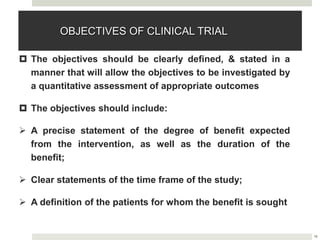
OBJECTIVES OF CLINICAL TRIAL
 The objectives should be clearly defined, & stated in a
manner that will allow the objectives to be investigated by
a quantitative assessment of appropriate outcomes
 The objectives should include:
 A precise statement of the degree of benefit expected
from the intervention, as well as the duration of the
benefit;
 Clear statements of the time frame of the study;
 A definition of the patients for whom the benefit is sought
17
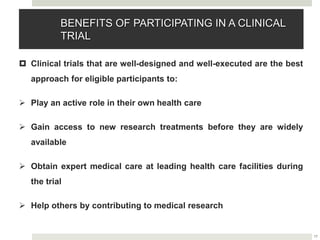
BENEFITS OF PARTICIPATING IN A CLINICAL
TRIAL
 Clinical trials that are well-designed and well-executed are the best
approach for eligible participants to:
 Play an active role in their own health care
 Gain access to new research treatments before they are widely
available
 Obtain expert medical care at leading health care facilities during
the trial
 Help others by contributing to medical research
18
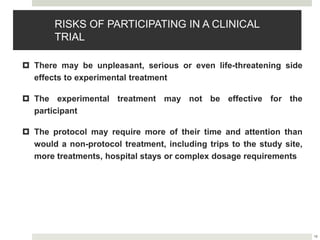
RISKS OF PARTICIPATING IN A CLINICAL
TRIAL
 There may be unpleasant, serious or even life-threatening side
effects to experimental treatment
 The experimental treatment may not be effective for the
participant
 The protocol may require more of their time and attention than
would a non-protocol treatment, including trips to the study site,
more treatments, hospital stays or complex dosage requirements
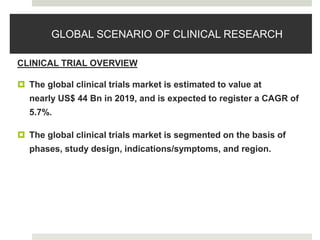
GLOBAL SCENARIO OF CLINICAL RESEARCH
CLINICAL TRIAL OVERVIEW
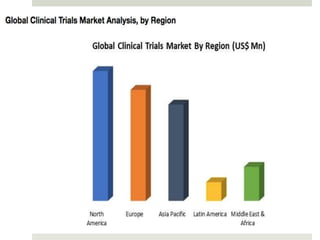
 The global clinical trials market is estimated to value at
nearly US$ 44 Bn in 2019, and is expected to register a CAGR of
5.7%.
 The global clinical trials market is segmented on the basis of
phases, study design, indications/symptoms, and region.
GLOBAL CLINICAL TRIAL MARKET: DYNAMICS
 Increasing demand for new medical equipments and medicines
among end users, coupled with growing investment for research
and development activities for development of effective medicines
are major factors driving growth of the global clinical trials market.
 In addition, increasing number of individuals suffering from chronic
diseases as well as changing conditions and nature of certain types
of chronic diseases is another factor anticipated to support growth
of the global clinical trials market to significant extent.
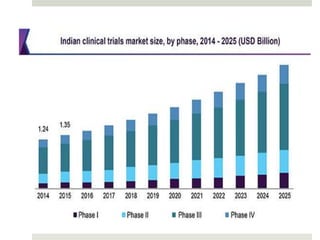
INDIAN SCENARIO OF CLINICAL RESEARCH
• India has long been identified as a major resource center for
conducting clinical trials and data management services. Plus points
include its large patient population, well-trained, enthusiastic and
foreign-educated investigators, and significantly lower cost.
• The average cost of Phase I/II/III trials in the US is over $20/50/100
million, respectively. But in India, one may do it at half (50%-60%) the
said cost and 75% faster. Lowest per patient trial cost coupled with an
extensive gene pool and extremely lower cost of technical services is
doing the job here.
• What makes India a hot spot for researchers is the presence of
treatment-naive patients with a wide spectrum of diseases spanning
from Multidrug-resistant pneumonia, Hepatitis B, Diabetes, to rare
cancers than in the West.
• Volunteer enrollment is also high, as people believe that participation
in research trials could offer them access to quality health care and
medicines, which otherwise would not be affordable
CAREER OPPORTUNITIES IN CLINICAL
RESEARCH
 Clinical research is an attractive industry which foresees tremendous
growth and job opportunities not only for trained medical,
pharmaceutical and paramedical professionals, but also for regulatory
authorities, government and the society at large.
 With the inflow of multinational players in research, the industry is
poised to grow exponentially and open up new vistas of employment
for a large number of people.
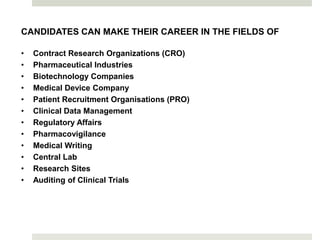
CANDIDATES CAN MAKE THEIR CAREER IN THE FIELDS OF
• Contract Research Organizations (CRO)
• Pharmaceutical Industries
• Biotechnology Companies
• Medical Device Company
• Patient Recruitment Organisations (PRO)
• Clinical Data Management
• Regulatory Affairs
• Pharmacovigilance
• Medical Writing
• Central Lab
• Research Sites
• Auditing of Clinical Trials
Visit website for more details on
course :
www.finenessinstitute.com

Understanding clinical research

  • 1.
  • 2.
    WHAT IS CLINICALRESEARCH  Clinical research is scientific study that involves people. Individuals volunteer to participate in carefully conducted studies which ultimately uncover improved methods and knowledge on screening, diagnoses, treatment and prevention of disease and on the promotion of health and health care.  Clinical research can be observational (e.g. health economic research) or interventional (e.g. clinical trials).  Improving standard care is one of the aims of clinical research
  • 4.
    4 WHAT IS ACLINICAL TRIAL  Clinical trial” means a systematic study of new drug(s) in human subject(s) to generate data for discovering and / or verifying the clinical, pharmacological (including pharmacodynamic and pharmacokinetic) and /or adverse effects with the objective of determining safety and / or efficacy of the new drug.  Generally considered to be biomedical or health-related research studies in human beings that follow a pre-defined protocol
  • 5.
    WHAT IS ADRUG  A substance intended for use in the diagnosis, cure, mitigation, treatment, or prevention of disease.  A substance (other than food) intended to affect the structure or any function of the body.  A substance intended for use as a component of a medicine but not a device or a component, part or accessory of a device.
  • 6.
  • 7.
    HOW DOES CLINICALRESEARCH DIFFER FROM FROM STANDARD CARE  The difference between clinical research and standard care is that clinical research:  involves human volunteers, these may be patients or can all be healthy individuals who are not suffering from an illness or condition.  Is carried out with the ultimate aim of improving standard care. The research may be testing an intervention (e.g. a product or procedure) or collecting data through interviews or observations about a topic such as patient experience, disease management etc.
  • 9.
    9 WHO CAN PARTICIPATEIN A CLINICAL TRIAL  Before joining a clinical trial, a participant must qualify for the study  Some research studies seek participants with illnesses or conditions to be studied in the clinical trial, while others need healthy participants  It is important to note that inclusion and exclusion criteria are not used to reject people personally. Instead, the criteria are used to identify appropriate participants and keep them safe.  The criteria help ensure that researchers will be able to answer the questions they plan to study
  • 10.
    10 WHAT HAPPENS DURINGA CLINICAL TRIAL  The clinical trial process depends on the kind of trial being conducted  The clinical trial team includes doctors and nurses as well as social workers and other health care professionals who check the health of the participant at the beginning of the trial, give specific instructions for participating in the trial, monitor the participant carefully during the trial, and stay in touch after the trial is completed
  • 11.
    11  Some clinicaltrials involve more tests & doctor visits than the participant would normally have for an illness or condition  Clinical trial participation is most successful when the protocol is carefully followed and there is frequent contact with the research staff
  • 12.
    12 HOW IS THESAFETY OF THE PARTICIPANT PROTECTED  Most clinical research is federally regulated with built in safeguards to protect the participants  The trial follows a carefully controlled protocol, a study plan which details what researchers will do in the study  As a clinical trial progresses, researchers report the results of the trial at scientific meetings, to medical journals, and to various government agencies  Individual participants' names will remain secret and will not be mentioned in these reports
  • 13.
    13 WHAT SHOULD PEOPLECONSIDER BEFORE PARTICIPATING IN A TRIAL  What is the purpose of the study?  Who is going to be in the study?  Why do researchers believe the experimental treatment being tested may be effective? Has it been tested before?  What kinds of tests and experimental treatments are involved?  How do the possible risks, side effects, and benefits in the study compare with my current treatment?  How might this trial affect my daily life?
  • 14.
    14  How longwill the trial last?  Will hospitalization be required?  Who will pay for the experimental treatment?  Will I be reimbursed for other expenses?  What type of long-term follow up care is part of this study?  How will I know that the experimental treatment is working? Will results of the trials be provided to me?  Who will be in charge of my care?
  • 15.
    15 WHERE DO THEIDEAS FOR TRIALS COME FROM  Ideas for clinical trials usually come from researchers  After researchers test new therapies or procedures in the laboratory and in animal studies, the experimental treatments with the most promising laboratory results are moved into clinical trials  During a trial, more and more information is gained about an experimental treatment, its risks and how well it may or may not work
  • 16.
    16 OBJECTIVES OF CLINICALTRIAL  The objectives should be clearly defined, & stated in a manner that will allow the objectives to be investigated by a quantitative assessment of appropriate outcomes  The objectives should include:  A precise statement of the degree of benefit expected from the intervention, as well as the duration of the benefit;  Clear statements of the time frame of the study;  A definition of the patients for whom the benefit is sought
  • 17.
    17 BENEFITS OF PARTICIPATINGIN A CLINICAL TRIAL  Clinical trials that are well-designed and well-executed are the best approach for eligible participants to:  Play an active role in their own health care  Gain access to new research treatments before they are widely available  Obtain expert medical care at leading health care facilities during the trial  Help others by contributing to medical research
  • 18.
    18 RISKS OF PARTICIPATINGIN A CLINICAL TRIAL  There may be unpleasant, serious or even life-threatening side effects to experimental treatment  The experimental treatment may not be effective for the participant  The protocol may require more of their time and attention than would a non-protocol treatment, including trips to the study site, more treatments, hospital stays or complex dosage requirements
  • 19.
    GLOBAL SCENARIO OFCLINICAL RESEARCH CLINICAL TRIAL OVERVIEW  The global clinical trials market is estimated to value at nearly US$ 44 Bn in 2019, and is expected to register a CAGR of 5.7%.  The global clinical trials market is segmented on the basis of phases, study design, indications/symptoms, and region.
  • 20.
    GLOBAL CLINICAL TRIALMARKET: DYNAMICS  Increasing demand for new medical equipments and medicines among end users, coupled with growing investment for research and development activities for development of effective medicines are major factors driving growth of the global clinical trials market.  In addition, increasing number of individuals suffering from chronic diseases as well as changing conditions and nature of certain types of chronic diseases is another factor anticipated to support growth of the global clinical trials market to significant extent.
  • 22.
    INDIAN SCENARIO OFCLINICAL RESEARCH • India has long been identified as a major resource center for conducting clinical trials and data management services. Plus points include its large patient population, well-trained, enthusiastic and foreign-educated investigators, and significantly lower cost. • The average cost of Phase I/II/III trials in the US is over $20/50/100 million, respectively. But in India, one may do it at half (50%-60%) the said cost and 75% faster. Lowest per patient trial cost coupled with an extensive gene pool and extremely lower cost of technical services is doing the job here.
  • 23.
    • What makesIndia a hot spot for researchers is the presence of treatment-naive patients with a wide spectrum of diseases spanning from Multidrug-resistant pneumonia, Hepatitis B, Diabetes, to rare cancers than in the West. • Volunteer enrollment is also high, as people believe that participation in research trials could offer them access to quality health care and medicines, which otherwise would not be affordable
  • 25.
    CAREER OPPORTUNITIES INCLINICAL RESEARCH  Clinical research is an attractive industry which foresees tremendous growth and job opportunities not only for trained medical, pharmaceutical and paramedical professionals, but also for regulatory authorities, government and the society at large.  With the inflow of multinational players in research, the industry is poised to grow exponentially and open up new vistas of employment for a large number of people.
  • 26.
    CANDIDATES CAN MAKETHEIR CAREER IN THE FIELDS OF • Contract Research Organizations (CRO) • Pharmaceutical Industries • Biotechnology Companies • Medical Device Company • Patient Recruitment Organisations (PRO) • Clinical Data Management • Regulatory Affairs • Pharmacovigilance • Medical Writing • Central Lab • Research Sites • Auditing of Clinical Trials
  • 28.
    Visit website formore details on course : www.finenessinstitute.com