Introduction to OFDM Fire Tom Wada Professor, Information Engineering, Univ. of the Ryukyus Chief Scientist at Magna Design Net, Inc [email_address] http://www.ie.u-ryukyu.ac.jp/~wada/ 06/07/09 System Arch 2007  (Fire Tom Wada)
What is OFDM? OFDM =Orthogonal Frequency Division Multiplexing Many orthogonal sub-carriers are multiplexed in one symbol What is the orthogonal? How multiplexed? What is the merit of OFDM? What kinds of application? 06/07/09 System Arch 2007  (Fire Tom Wada)
Outline Background, history, application Review of digital modulation FDMA vs. Multi-carrier modulation Theory of OFDM Multi-path Summary 06/07/09 System Arch 2007  (Fire Tom Wada)
Why OFDM is getting popular ? State-of-the-art high bandwidth digital communication start using OFDM  Terrestrial Video Broadcasting in Japan and Europe ADSL High Speed Modem WLAN such as IEEE 802.11a/g/n WiMAX as IEEE 802.16d/e Economical OFDM implementation become possible because of advancement in the LSI technology 06/07/09 System Arch 2007  (Fire Tom Wada)
Japan Terrestrial Video  Broadcasting service ISDB-T (Integrated Services Digital Broadcasting for Terrestrial Television Broadcasting) Service starts on 2003/December at three major cities (Tokyo, Nagoya, Osaka) Full service area coverage on 2006 5.6MHz BW is divided into 13 segments (~430KHz BW) HDTV: 12 segments Mobile TV : 1 segment SDTV: 4 segment  Analog Service will end 2011 06/07/09 System Arch 2007  (Fire Tom Wada)
Brief history of OFDM First proposal in 1950 ’ s Theory completed in 1960 ’ s DFT implementation proposed in 1970 ’ s Europe adopted OFDM for digital radio broadcasting in 1987 OFDM for Terrestrial Video broadcasting in Europe and Japan ADSL, WLAN(802.11a) 06/07/09 System Arch 2007  (Fire Tom Wada)
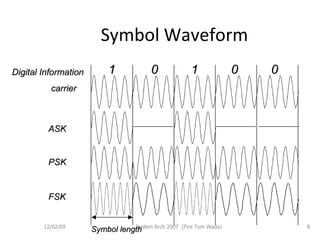
Digital modulation basics Digital modulation modulates three parameters of sinusoidal signal.  A, θ k  fc,  Three type digital modulation:  ASK : Amplitude Shift Keying  PSK : Phase Shift Keying  FSK : Frequency Shift Keying 06/07/09 System Arch 2007  (Fire Tom Wada) OFDM uses combination of ASK and PSK such as QAM, PSK
Symbol Waveform  06/07/09 System Arch 2007  (Fire Tom Wada) 1 0 1 0 0 Digital Information carrier ASK PSK FSK Symbol length
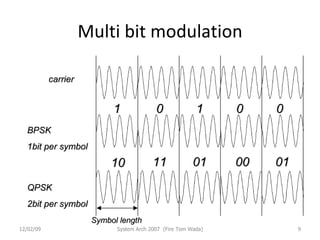
Multi bit modulation 06/07/09 System Arch 2007  (Fire Tom Wada) 1 0 1 0 0 carrier BPSK 1bit per symbol QPSK 2bit per symbol 10 11 01 00 01 Symbol length
Mathematical expression  of digital modulation Transmission signal can be expressed as follows s(t) can be expressed by complex base-band signal           06/07/09 System Arch 2007  (Fire Tom Wada) Indicates carrier sinusoidal Digital modulation Digital modulation can be expressed by the complex number
Constellation map  (a k  + jb k ) is plotted on I(real)-Q(imaginary) plane 06/07/09 System Arch 2007  (Fire Tom Wada) QPSK I Q data a k b k 00 π/4 01 3π /4 11 5π /4 10 7π /4
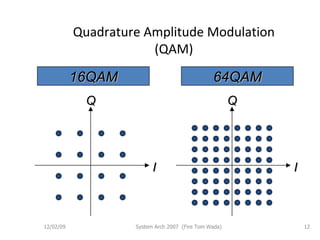
Quadrature Amplitude Modulation (QAM) 06/07/09 System Arch 2007  (Fire Tom Wada) I Q I Q 16QAM 64QAM
Summary of digital modulation Type of modulation: ASK,PSK,FSK,QAM OFDM uses ASK,PSK,QAM Digital modulation is mathematically characterized by the coefficient of complex base-band signal Plot of the coefficients gives  the constellation map 06/07/09 System Arch 2007  (Fire Tom Wada) I Q
Frequency Division Multiple Access (FDMA) Old conventional method (Analog TV, Radio etc.) Use separate carrier frequency for individual transmission 06/07/09 System Arch 2007  (Fire Tom Wada) Radio frequency f c1 f c 2 f c 3 f c N Carrier frequency Occupied BW Channel separation Guard band
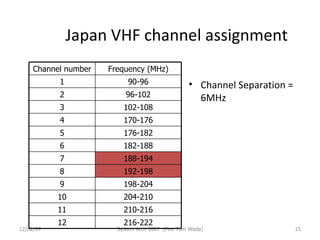
Japan VHF channel assignment Channel Separation = 6MHz 06/07/09 System Arch 2007  (Fire Tom Wada) Channel number Frequency (MHz) 1 90-96 2 96-102 3 102-108 4 170-176 5 176-182 6 182-188 7 188-194 8 192-198 9 198-204 10 204-210 11 210-216 12 216-222
Multi-carrier modulation Use multiple channel (carrier frequency) for one data transmission 06/07/09 System Arch 2007  (Fire Tom Wada) data LPF LPF LPF data DEMULTIPLEX MULTIPLEX
Spectrum comparison for same data rate transmission 06/07/09 System Arch 2007  (Fire Tom Wada) frequency Single carrier frequency OFDM frequency Multi carrier
OFDM vs. Multi carrier OFDM is multi carrier modulation OFDM sub-carrier spectrum is overlapping In FDMA, band-pass filter separates each transmission In OFDM, each sub-carrier is separated by DFT because carriers are orthogonal Condition of the orthogonality will be explained later Each sub-carrier is modulated by PSK, QAM 06/07/09 System Arch 2007  (Fire Tom Wada) Thousands of PSK/QAM symbol can be  simultaneously transmitted in one OFDM symbol
OFDM carriers OFDM carrier frequency is n ・ 1/T 06/07/09 System Arch 2007  (Fire Tom Wada) Symbol period T
Sinusoidal Orthogonality m,n: integer, T=1/f 0   06/07/09 System Arch 2007  (Fire Tom Wada) Orthogonal Orthogonal Orthogonal
A sub-carrier of f=nf 0 Amplitude and Phase will be digitally modulated 06/07/09 System Arch 2007  (Fire Tom Wada) n cycles t=0 t=T Time
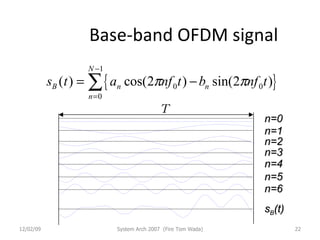
Base-band OFDM signal 06/07/09 System Arch 2007  (Fire Tom Wada) T n=0 n=1 n=2 n=3 n=4 n=5 n=6 s B (t)
How a n ,b n  are calculated from s B (t) - Demodulation Procedure - According to the sinusoidal orthogonality, a n ,b n  can be extracted. In actual implementation, DFT(FFT) is used N is roughly 64 for WLAN, thoudand for Terrestrial Video Broadcasting 06/07/09 System Arch 2007  (Fire Tom Wada)
Pass-band OFDM signal S B (t) is upcoverted to pass-band signal  S(t) f c  frequency shift 06/07/09 System Arch 2007  (Fire Tom Wada)
Actual OFDM spectrum 06/07/09 System Arch 2007  (Fire Tom Wada) f c +kf 0 f c + ( k -1) f 0 f c + ( k +1) f 0
OFDM power spectrum Total Power spectrum is almost square shape 06/07/09 System Arch 2007  (Fire Tom Wada)
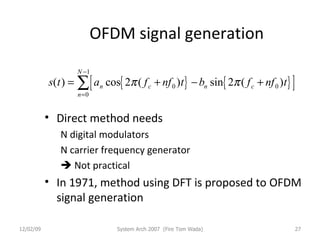
OFDM signal generation Direct method needs N digital modulators N carrier frequency generator    Not practical In 1971, method using DFT is proposed to OFDM signal generation 06/07/09 System Arch 2007  (Fire Tom Wada)
OFDM signal generation in digital domain Define complex base-band signal u(t) as follows Perform N times sampling in period T 06/07/09 System Arch 2007  (Fire Tom Wada) u(k) = IFFT (d n ) = IFFT(a n  + jb n )
OFDM modulator 06/07/09 System Arch 2007  (Fire Tom Wada) M A P S / P I-DFT P / S Real BPF generated 0 ~d N-1 AIR Bit stream Imag
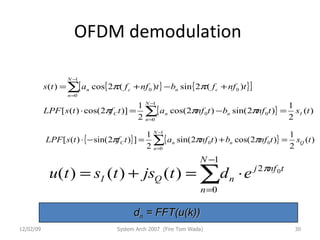
OFDM demodulation  06/07/09 System Arch 2007  (Fire Tom Wada) d n  = FFT(u(k))
OFDM demodulator (Too simple) 06/07/09 System Arch 2007  (Fire Tom Wada) T u n e r S / P DFT P / S A / D LPF Channel π/2 LPF D E M A P Bit Stream
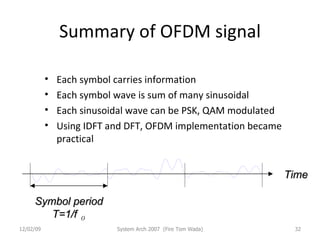
Summary of OFDM signal Each symbol carries information Each symbol wave is sum of many sinusoidal Each sinusoidal wave can be PSK, QAM modulated Using IDFT and DFT, OFDM implementation became practical 06/07/09 System Arch 2007  (Fire Tom Wada) Time Symbol period T=1/f 0
Multi-path Delayed wave causes interference 06/07/09 System Arch 2007  (Fire Tom Wada)
Multi-pass effect Inter symbol interference (ISI) happens in Multi-path condition 06/07/09 System Arch 2007  (Fire Tom Wada) T=1/f 0 Symbol k Symbol k-1 Symbol k+1 Sampling Period No multi-path Sampling Period Multi-path Direct  Delayed
Guard Interval T g By adding the Gurard Interval Period, ISI can be avoided 06/07/09 System Arch 2007  (Fire Tom Wada) OFDM symbol(1/f 0 ) Copy signal T g T g Direct Delayed OFDM symbol (1/f 0 ) T g Sampling Period
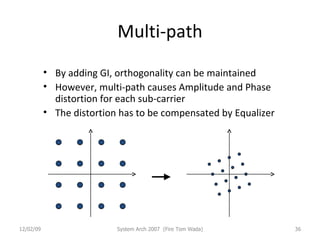
Multi-path By adding GI, orthogonality can be maintained However, multi-path causes Amplitude and Phase distortion for each sub-carrier The distortion has to be compensated by Equalizer 06/07/09 System Arch 2007  (Fire Tom Wada)
Multiple Frequency Network Frequency utilization is low 06/07/09 System Arch 2007  (Fire Tom Wada) Area 1 Area 2 Area 3 Area 4 f 1 f2 f3 f1
Single Frequency Network If multi-path problem is solved, SFN is possible 06/07/09 System Arch 2007  (Fire Tom Wada) Area 1 Area 2 Area 3 Area 4 f 1 f 1 f 1 f1
That ’ s all for introduction Feature of OFDM High Frequency utilization by the square spectrum shape Multi-path problem is solved by GI Multiple services in one OFDM by sharing sub-carriers (3 services in ISDB-T) SFN Implementation was complicated but NOW possible because of LSI technology progress 06/07/09 System Arch 2007  (Fire Tom Wada)

(Ofdm)

  • 1.
    Introduction to OFDMFire Tom Wada Professor, Information Engineering, Univ. of the Ryukyus Chief Scientist at Magna Design Net, Inc [email_address] http://www.ie.u-ryukyu.ac.jp/~wada/ 06/07/09 System Arch 2007 (Fire Tom Wada)
  • 2.
    What is OFDM?OFDM =Orthogonal Frequency Division Multiplexing Many orthogonal sub-carriers are multiplexed in one symbol What is the orthogonal? How multiplexed? What is the merit of OFDM? What kinds of application? 06/07/09 System Arch 2007 (Fire Tom Wada)
  • 3.
    Outline Background, history,application Review of digital modulation FDMA vs. Multi-carrier modulation Theory of OFDM Multi-path Summary 06/07/09 System Arch 2007 (Fire Tom Wada)
  • 4.
    Why OFDM isgetting popular ? State-of-the-art high bandwidth digital communication start using OFDM Terrestrial Video Broadcasting in Japan and Europe ADSL High Speed Modem WLAN such as IEEE 802.11a/g/n WiMAX as IEEE 802.16d/e Economical OFDM implementation become possible because of advancement in the LSI technology 06/07/09 System Arch 2007 (Fire Tom Wada)
  • 5.
    Japan Terrestrial Video Broadcasting service ISDB-T (Integrated Services Digital Broadcasting for Terrestrial Television Broadcasting) Service starts on 2003/December at three major cities (Tokyo, Nagoya, Osaka) Full service area coverage on 2006 5.6MHz BW is divided into 13 segments (~430KHz BW) HDTV: 12 segments Mobile TV : 1 segment SDTV: 4 segment Analog Service will end 2011 06/07/09 System Arch 2007 (Fire Tom Wada)
  • 6.
    Brief history ofOFDM First proposal in 1950 ’ s Theory completed in 1960 ’ s DFT implementation proposed in 1970 ’ s Europe adopted OFDM for digital radio broadcasting in 1987 OFDM for Terrestrial Video broadcasting in Europe and Japan ADSL, WLAN(802.11a) 06/07/09 System Arch 2007 (Fire Tom Wada)
  • 7.
    Digital modulation basicsDigital modulation modulates three parameters of sinusoidal signal. A, θ k fc, Three type digital modulation: ASK : Amplitude Shift Keying PSK : Phase Shift Keying FSK : Frequency Shift Keying 06/07/09 System Arch 2007 (Fire Tom Wada) OFDM uses combination of ASK and PSK such as QAM, PSK
  • 8.
    Symbol Waveform 06/07/09 System Arch 2007 (Fire Tom Wada) 1 0 1 0 0 Digital Information carrier ASK PSK FSK Symbol length
  • 9.
    Multi bit modulation06/07/09 System Arch 2007 (Fire Tom Wada) 1 0 1 0 0 carrier BPSK 1bit per symbol QPSK 2bit per symbol 10 11 01 00 01 Symbol length
  • 10.
    Mathematical expression of digital modulation Transmission signal can be expressed as follows s(t) can be expressed by complex base-band signal           06/07/09 System Arch 2007 (Fire Tom Wada) Indicates carrier sinusoidal Digital modulation Digital modulation can be expressed by the complex number
  • 11.
    Constellation map (a k + jb k ) is plotted on I(real)-Q(imaginary) plane 06/07/09 System Arch 2007 (Fire Tom Wada) QPSK I Q data a k b k 00 π/4 01 3π /4 11 5π /4 10 7π /4
  • 12.
    Quadrature Amplitude Modulation(QAM) 06/07/09 System Arch 2007 (Fire Tom Wada) I Q I Q 16QAM 64QAM
  • 13.
    Summary of digitalmodulation Type of modulation: ASK,PSK,FSK,QAM OFDM uses ASK,PSK,QAM Digital modulation is mathematically characterized by the coefficient of complex base-band signal Plot of the coefficients gives the constellation map 06/07/09 System Arch 2007 (Fire Tom Wada) I Q
  • 14.
    Frequency Division MultipleAccess (FDMA) Old conventional method (Analog TV, Radio etc.) Use separate carrier frequency for individual transmission 06/07/09 System Arch 2007 (Fire Tom Wada) Radio frequency f c1 f c 2 f c 3 f c N Carrier frequency Occupied BW Channel separation Guard band
  • 15.
    Japan VHF channelassignment Channel Separation = 6MHz 06/07/09 System Arch 2007 (Fire Tom Wada) Channel number Frequency (MHz) 1 90-96 2 96-102 3 102-108 4 170-176 5 176-182 6 182-188 7 188-194 8 192-198 9 198-204 10 204-210 11 210-216 12 216-222
  • 16.
    Multi-carrier modulation Usemultiple channel (carrier frequency) for one data transmission 06/07/09 System Arch 2007 (Fire Tom Wada) data LPF LPF LPF data DEMULTIPLEX MULTIPLEX
  • 17.
    Spectrum comparison forsame data rate transmission 06/07/09 System Arch 2007 (Fire Tom Wada) frequency Single carrier frequency OFDM frequency Multi carrier
  • 18.
    OFDM vs. Multicarrier OFDM is multi carrier modulation OFDM sub-carrier spectrum is overlapping In FDMA, band-pass filter separates each transmission In OFDM, each sub-carrier is separated by DFT because carriers are orthogonal Condition of the orthogonality will be explained later Each sub-carrier is modulated by PSK, QAM 06/07/09 System Arch 2007 (Fire Tom Wada) Thousands of PSK/QAM symbol can be simultaneously transmitted in one OFDM symbol
  • 19.
    OFDM carriers OFDMcarrier frequency is n ・ 1/T 06/07/09 System Arch 2007 (Fire Tom Wada) Symbol period T
  • 20.
    Sinusoidal Orthogonality m,n:integer, T=1/f 0 06/07/09 System Arch 2007 (Fire Tom Wada) Orthogonal Orthogonal Orthogonal
  • 21.
    A sub-carrier off=nf 0 Amplitude and Phase will be digitally modulated 06/07/09 System Arch 2007 (Fire Tom Wada) n cycles t=0 t=T Time
  • 22.
    Base-band OFDM signal06/07/09 System Arch 2007 (Fire Tom Wada) T n=0 n=1 n=2 n=3 n=4 n=5 n=6 s B (t)
  • 23.
    How a n,b n are calculated from s B (t) - Demodulation Procedure - According to the sinusoidal orthogonality, a n ,b n can be extracted. In actual implementation, DFT(FFT) is used N is roughly 64 for WLAN, thoudand for Terrestrial Video Broadcasting 06/07/09 System Arch 2007 (Fire Tom Wada)
  • 24.
    Pass-band OFDM signalS B (t) is upcoverted to pass-band signal S(t) f c frequency shift 06/07/09 System Arch 2007 (Fire Tom Wada)
  • 25.
    Actual OFDM spectrum06/07/09 System Arch 2007 (Fire Tom Wada) f c +kf 0 f c + ( k -1) f 0 f c + ( k +1) f 0
  • 26.
    OFDM power spectrumTotal Power spectrum is almost square shape 06/07/09 System Arch 2007 (Fire Tom Wada)
  • 27.
    OFDM signal generationDirect method needs N digital modulators N carrier frequency generator  Not practical In 1971, method using DFT is proposed to OFDM signal generation 06/07/09 System Arch 2007 (Fire Tom Wada)
  • 28.
    OFDM signal generationin digital domain Define complex base-band signal u(t) as follows Perform N times sampling in period T 06/07/09 System Arch 2007 (Fire Tom Wada) u(k) = IFFT (d n ) = IFFT(a n + jb n )
  • 29.
    OFDM modulator 06/07/09System Arch 2007 (Fire Tom Wada) M A P S / P I-DFT P / S Real BPF generated 0 ~d N-1 AIR Bit stream Imag
  • 30.
    OFDM demodulation 06/07/09 System Arch 2007 (Fire Tom Wada) d n = FFT(u(k))
  • 31.
    OFDM demodulator (Toosimple) 06/07/09 System Arch 2007 (Fire Tom Wada) T u n e r S / P DFT P / S A / D LPF Channel π/2 LPF D E M A P Bit Stream
  • 32.
    Summary of OFDMsignal Each symbol carries information Each symbol wave is sum of many sinusoidal Each sinusoidal wave can be PSK, QAM modulated Using IDFT and DFT, OFDM implementation became practical 06/07/09 System Arch 2007 (Fire Tom Wada) Time Symbol period T=1/f 0
  • 33.
    Multi-path Delayed wavecauses interference 06/07/09 System Arch 2007 (Fire Tom Wada)
  • 34.
    Multi-pass effect Intersymbol interference (ISI) happens in Multi-path condition 06/07/09 System Arch 2007 (Fire Tom Wada) T=1/f 0 Symbol k Symbol k-1 Symbol k+1 Sampling Period No multi-path Sampling Period Multi-path Direct Delayed
  • 35.
    Guard Interval Tg By adding the Gurard Interval Period, ISI can be avoided 06/07/09 System Arch 2007 (Fire Tom Wada) OFDM symbol(1/f 0 ) Copy signal T g T g Direct Delayed OFDM symbol (1/f 0 ) T g Sampling Period
  • 36.
    Multi-path By addingGI, orthogonality can be maintained However, multi-path causes Amplitude and Phase distortion for each sub-carrier The distortion has to be compensated by Equalizer 06/07/09 System Arch 2007 (Fire Tom Wada)
  • 37.
    Multiple Frequency NetworkFrequency utilization is low 06/07/09 System Arch 2007 (Fire Tom Wada) Area 1 Area 2 Area 3 Area 4 f 1 f2 f3 f1
  • 38.
    Single Frequency NetworkIf multi-path problem is solved, SFN is possible 06/07/09 System Arch 2007 (Fire Tom Wada) Area 1 Area 2 Area 3 Area 4 f 1 f 1 f 1 f1
  • 39.
    That ’ sall for introduction Feature of OFDM High Frequency utilization by the square spectrum shape Multi-path problem is solved by GI Multiple services in one OFDM by sharing sub-carriers (3 services in ISDB-T) SFN Implementation was complicated but NOW possible because of LSI technology progress 06/07/09 System Arch 2007 (Fire Tom Wada)