UHF TV White Space --A New Challenge for Spectrum Managers Annual Meeting, National Spectrum Managers Association Arlington, VA May 20-21, 2008 Paul Henry AT&T Labs – Research Middletown, NJ [email_address]
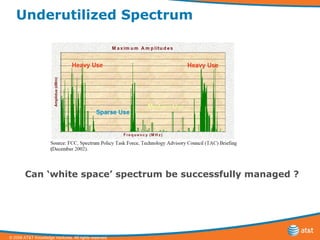
Underutilized Spectrum Can ‘white space’ spectrum be successfully managed ?
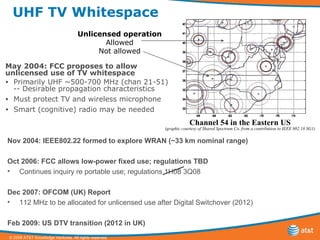
UHF TV Whitespace May 2004: FCC proposes to allow unlicensed use of TV whitespace Primarily UHF ~500-700 MHz (chan 21-51) -- Desirable propagation characteristics Must protect TV and wireless microphone Smart (cognitive) radio may be needed  Channel 54 in the Eastern US (graphic courtesy of Shared Spectrum Co. from a contribution to IEEE 802.18 SG1) Unlicensed operation Allowed Not allowed Nov 2004: IEEE802.22 formed to explore WRAN (~33 km nominal range) Oct 2006: FCC allows low-power fixed use; regulations TBD Continues inquiry re portable use; regulations 1H08 3Q08 Dec 2007: OFCOM (UK) Report 112 MHz to be allocated for unlicensed use after Digital Switchover (2012)   Feb 2009: US DTV transition (2012 in UK)
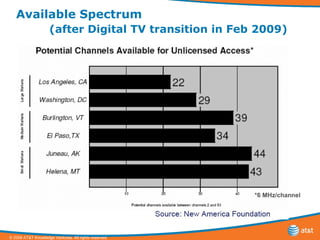
Available Spectrum (after Digital TV transition in Feb 2009) *6 MHz/channel
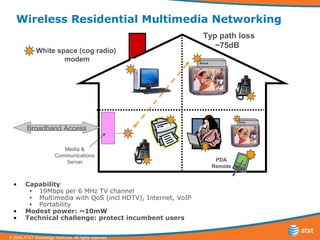
Wireless Residential Multimedia Networking Broadband Access Media & Communications Server White space (cog radio)  modem PDA Remote Capability 19Mbps per 6 MHz TV channel Multimedia with QoS (incl HDTV), Internet, VoIP Portability Modest power: ~10mW  Technical challenge: protect incumbent users Typ path loss ~75dB
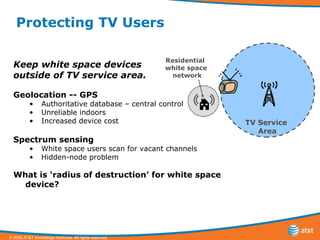
Protecting TV Users Keep white space devices  outside of TV service area. Geolocation -- GPS   Authoritative database – central control Unreliable indoors Increased device cost Spectrum sensing White space users scan for vacant channels Hidden-node problem What is ‘radius of destruction’ for white space device? TV Service  Area Residential  white space network
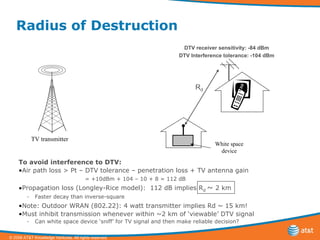
Radius of Destruction To avoid interference to DTV: Air path loss > Pt – DTV tolerance – penetration loss + TV antenna gain = +10dBm + 104 – 10 + 8 = 112 dB Propagation loss (Longley-Rice model):  112 dB implies R d  ~  2 km  Faster decay than inverse-square Note: Outdoor WRAN (802.22): 4 watt transmitter implies Rd ~ 15 km! Must inhibit transmission whenever within ~2 km of ‘viewable’ DTV signal Can white space device ‘sniff’ for TV signal and then make reliable decision?  TV transmitter White space device DTV receiver sensitivity: -84 dBm DTV Interference tolerance: -104 dBm R d
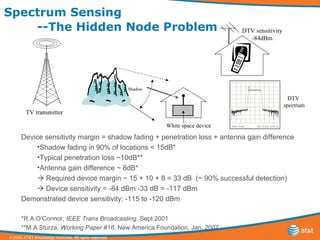
Spectrum Sensing --The Hidden Node Problem TV transmitter DTV sensitivity -84dBm White space device Shadow Device sensitivity margin = shadow fading + penetration loss + antenna gain difference Shadow fading in 90% of locations < 15dB* Typical penetration loss ~10dB** Antenna gain difference ~ 8dB*    Required device margin ~ 15 + 10 + 8 = 33 dB  (~ 90% successful detection)      Device sensitivity = -84 dBm -33 dB = -117 dBm Demonstrated device sensitivity: -115 to -120 dBm *R.A.O’Connor,  IEEE Trans Broadcasting , Sept 2001 **M.A.Sturza,  Working Paper #16 , New America Foundation, Jan. 2007  DTV  spectrum
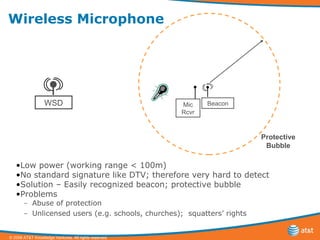
Wireless Microphone Low power (working range < 100m) No standard signature like DTV; therefore very hard to detect Solution – Easily recognized beacon; protective bubble Problems Abuse of protection Unlicensed users (e.g. schools, churches);  squatters’ rights WSD Mic Rcvr Protective Bubble Beacon
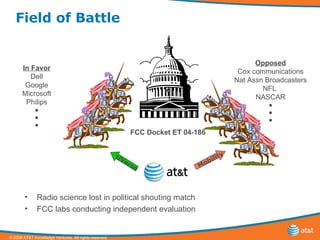
Field of Battle Opposed Cox communications Nat Assn Broadcasters NFL  NASCAR ● ● ● In Favor Dell Google Microsoft Philips ● ● ● FCC Docket ET 04-186 Radio science lost in political shouting match FCC labs conducting independent evaluation Mobility UVerse
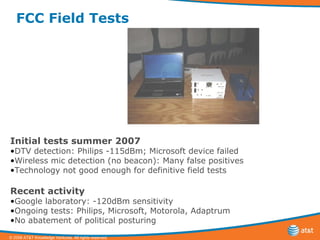
FCC Field Tests Initial tests summer 2007 DTV detection: Philips -115dBm; Microsoft device failed Wireless mic detection (no beacon): Many false positives Technology not good enough for definitive field tests  Recent activity Google laboratory: -120dBm sensitivity Ongoing tests: Philips, Microsoft, Motorola, Adaptrum No abatement of political posturing
Breaking the Logjam  --Motorola and Google Proposals Goal: Get past the squabbles over spectrum sensing Dec. ’07: In FCC filing Motorola proposes 2 classes of white space devices <10mW (e.g. WLAN): spectrum sensing only >10mW (e.g. 802.22 WRAN): Geolocation with spectrum sensing backup Minimal public reaction March ’08: Google proposes geolocation for all white space operation Calls press conference “ WiFi on steroids” “ Gigabit rates” Lots of headlines – Mission Accomplished Probably consistent with Google’s aspirations,  but unacceptable to proponents of bluetooth-like applications  Intense lobbying continues
Takeaways UHF TV white space Opportunity to use sparsely occupied, attractive spectrum Must protect digital TV and wireless microphone Technologies: Spectrum sensing, geolocation, beacon Protection achievable in lab setting; field tests to come Intense political posturing; logjam at FCC DTV transition Feb 2009 less than a year away; stay tuned…..
Thank you!

1 1040 Henry Nsma May 2008 V3

  • 1.
    UHF TV WhiteSpace --A New Challenge for Spectrum Managers Annual Meeting, National Spectrum Managers Association Arlington, VA May 20-21, 2008 Paul Henry AT&T Labs – Research Middletown, NJ [email_address]
  • 2.
    Underutilized Spectrum Can‘white space’ spectrum be successfully managed ?
  • 3.
    UHF TV WhitespaceMay 2004: FCC proposes to allow unlicensed use of TV whitespace Primarily UHF ~500-700 MHz (chan 21-51) -- Desirable propagation characteristics Must protect TV and wireless microphone Smart (cognitive) radio may be needed Channel 54 in the Eastern US (graphic courtesy of Shared Spectrum Co. from a contribution to IEEE 802.18 SG1) Unlicensed operation Allowed Not allowed Nov 2004: IEEE802.22 formed to explore WRAN (~33 km nominal range) Oct 2006: FCC allows low-power fixed use; regulations TBD Continues inquiry re portable use; regulations 1H08 3Q08 Dec 2007: OFCOM (UK) Report 112 MHz to be allocated for unlicensed use after Digital Switchover (2012) Feb 2009: US DTV transition (2012 in UK)
  • 4.
    Available Spectrum (afterDigital TV transition in Feb 2009) *6 MHz/channel
  • 5.
    Wireless Residential MultimediaNetworking Broadband Access Media & Communications Server White space (cog radio) modem PDA Remote Capability 19Mbps per 6 MHz TV channel Multimedia with QoS (incl HDTV), Internet, VoIP Portability Modest power: ~10mW Technical challenge: protect incumbent users Typ path loss ~75dB
  • 6.
    Protecting TV UsersKeep white space devices outside of TV service area. Geolocation -- GPS Authoritative database – central control Unreliable indoors Increased device cost Spectrum sensing White space users scan for vacant channels Hidden-node problem What is ‘radius of destruction’ for white space device? TV Service Area Residential white space network
  • 7.
    Radius of DestructionTo avoid interference to DTV: Air path loss > Pt – DTV tolerance – penetration loss + TV antenna gain = +10dBm + 104 – 10 + 8 = 112 dB Propagation loss (Longley-Rice model): 112 dB implies R d ~ 2 km Faster decay than inverse-square Note: Outdoor WRAN (802.22): 4 watt transmitter implies Rd ~ 15 km! Must inhibit transmission whenever within ~2 km of ‘viewable’ DTV signal Can white space device ‘sniff’ for TV signal and then make reliable decision? TV transmitter White space device DTV receiver sensitivity: -84 dBm DTV Interference tolerance: -104 dBm R d
  • 8.
    Spectrum Sensing --TheHidden Node Problem TV transmitter DTV sensitivity -84dBm White space device Shadow Device sensitivity margin = shadow fading + penetration loss + antenna gain difference Shadow fading in 90% of locations < 15dB* Typical penetration loss ~10dB** Antenna gain difference ~ 8dB*  Required device margin ~ 15 + 10 + 8 = 33 dB (~ 90% successful detection)  Device sensitivity = -84 dBm -33 dB = -117 dBm Demonstrated device sensitivity: -115 to -120 dBm *R.A.O’Connor, IEEE Trans Broadcasting , Sept 2001 **M.A.Sturza, Working Paper #16 , New America Foundation, Jan. 2007 DTV spectrum
  • 9.
    Wireless Microphone Lowpower (working range < 100m) No standard signature like DTV; therefore very hard to detect Solution – Easily recognized beacon; protective bubble Problems Abuse of protection Unlicensed users (e.g. schools, churches); squatters’ rights WSD Mic Rcvr Protective Bubble Beacon
  • 10.
    Field of BattleOpposed Cox communications Nat Assn Broadcasters NFL NASCAR ● ● ● In Favor Dell Google Microsoft Philips ● ● ● FCC Docket ET 04-186 Radio science lost in political shouting match FCC labs conducting independent evaluation Mobility UVerse
  • 11.
    FCC Field TestsInitial tests summer 2007 DTV detection: Philips -115dBm; Microsoft device failed Wireless mic detection (no beacon): Many false positives Technology not good enough for definitive field tests Recent activity Google laboratory: -120dBm sensitivity Ongoing tests: Philips, Microsoft, Motorola, Adaptrum No abatement of political posturing
  • 12.
    Breaking the Logjam --Motorola and Google Proposals Goal: Get past the squabbles over spectrum sensing Dec. ’07: In FCC filing Motorola proposes 2 classes of white space devices <10mW (e.g. WLAN): spectrum sensing only >10mW (e.g. 802.22 WRAN): Geolocation with spectrum sensing backup Minimal public reaction March ’08: Google proposes geolocation for all white space operation Calls press conference “ WiFi on steroids” “ Gigabit rates” Lots of headlines – Mission Accomplished Probably consistent with Google’s aspirations, but unacceptable to proponents of bluetooth-like applications Intense lobbying continues
  • 13.
    Takeaways UHF TVwhite space Opportunity to use sparsely occupied, attractive spectrum Must protect digital TV and wireless microphone Technologies: Spectrum sensing, geolocation, beacon Protection achievable in lab setting; field tests to come Intense political posturing; logjam at FCC DTV transition Feb 2009 less than a year away; stay tuned…..
  • 14.