Advanced Device self Management  through Autonomics and Reconfigurability Bernd Steinke, Klaus Strohmenger Nokia Research Center, Germany   16 th  IST Mobile and Wireless Communications Summit July 2007 Date : Nov. 21 2007 Chang-Keun Park [email_address] DP&NM Lab., Dept. of CSE, POSTECH
Content E2R II Project Introduction Problem of existing DM method NG-AUTONOMIC MOBILE DEVICES  The proposed DM method smart policy based  scheduling Configuration Control Framework Configuration Management Module (CMM) Configuration Control Module (CCM) Configurable Execution Module (CEM)  Conclusion
E2R II Project End-to-End Reconfigurability - Phase 2 Funding 6th Framework Programme of the European Commission second phase of the project started on Jan. 01, 2006  Objective “ Mobile and wireless systems and platforms beyond 3G” To devise, develop, trial and showcase architectural design of reconfigurable devices Key Challenges of Phase 2 Enabling sustainable business development of reconfigurable systems in a multi-access/multi-owner environment Enabling end-to-end reconfiguration management and control architecture   and devising optimal split of intelligence between network elements and end-user equipment Enabling efficiency enhancements for radio resource and spectrum management Enabling unified stable, secure and reliable reconfigurable connectivity in a multi-access/multi-owner situation  Building the European reference prototyping environment for end-to-end reconfigurable systems and solutions
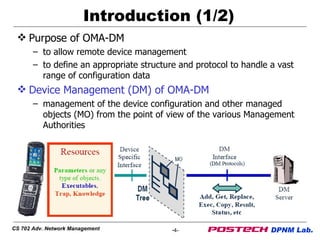
Introduction (1/2) Purpose of OMA-DM to allow remote device management to define an appropriate structure and protocol to handle a vast range of configuration data Device Management (DM) of OMA-DM management of the device configuration and other managed objects (MO) from the point of view of the various Management Authorities
Introduction (2/2) The complexity of technical systems, especially embedded systems within mobile communication devices, is constantly increasing   the parameters, which need to be defined to configure such a device, are tremendously growing  Today’s approach of DM characterized by an off-line approach device is configured at short sessions during which it is connected to a DM server most of the time the device is disconnected from the server mobile device operate with the provided DM Server settings Operator and device manufacturer centric
Problem of existing DM method Assumption of today’s approach server can predict all possible condition of device’s environment so that provided configuration handles properly devices Operator and device manufacturer centric approach is relatively inflexible in unforeseen situation unforeseen situations might occur more frequently in heterogeneous environment it has to be doubted that the assumption of today’s approach is true and will be true in future
It appears beneficial to create an improvement to the existing server-tied DM by utilizing autonomic behavior in the device Key target of autonomic self-optimization approach to reach at least a good local optimum or maybe even the actual best possible compromise between contradicting requirements of mobile equipment configuration Intuitive presentation of instantaneously available services instead of user guided search Cost-optimized network access Utilization of the available network bandwidth for fast data communication with low latencies Power reduction to gain more active run time and standby time NG-AUTONOMIC MOBILE DEVICES
Proposed  DM method smart policy based  scheduling   to achieve self-management and configuration capabilities allows the client to perform sequential management actions requested by a DM server without being in a session with that DM server a special terminal resident method for the client to perform management actions requested by the server or user at given times or certain conditions the server does not need to monitor the status of the device because smart policies, traps and schedules have the capability to alert the device autonomously about certain conditions Under a some given condition, reconfiguration is triggered be implemented in a hierarchical way the system may take corrective actions if it can solve the issue. If not, it calls for support from the next upper hierarchy layer or finally from the human operators
Configuration Control Framework The definition of a set of collaborating instances or modules that are logically located between the DM server and the device’s functional components is needed to implement autonomous device self-DM inside a mobile device These modules need to take over tasks of communication, observation, data logging and decision making The configuration control framework for the reconfigurable equipment architecture consists of three types of modules Configuration Management Module (CMM) Configuration Control Module (CCM) Configurable Execution Module (CEM)
CMM reconfiguration related communication between services and CMM Configuration Profile Repository discovering available network & monitoring context information downloads device management components security functions required during the reconfiguration support context and policy management procedures provide the means for configuration representation and configuration deployment  provides a reporting interface to the CCM Negotiate and Select network offers among available networks
CCM primary interface between the CMM and the CCM which sets up a new configuration in terms of overall RATs interface between the CMM and the CCM to supply  a set of functions unique to the selected RAT provide information, which configuration the underlying layer is able to surpport provides access to databases
Conclusion Contribution outlined the key-functionality of the Advanced Device self Managing framework By using the self configuration and management capabilities in addition to OMA DM, proposed reconfiguration architecture may either send to the reconfigurable terminal "Knowledge" on how to behave in certain conditions, or analyze some conditions Future work The policy driven autonomic self-configuration extends the DM server based approach

Cs702 Anm A Ds M

  • 1.
    Advanced Device selfManagement through Autonomics and Reconfigurability Bernd Steinke, Klaus Strohmenger Nokia Research Center, Germany 16 th IST Mobile and Wireless Communications Summit July 2007 Date : Nov. 21 2007 Chang-Keun Park [email_address] DP&NM Lab., Dept. of CSE, POSTECH
  • 2.
    Content E2R IIProject Introduction Problem of existing DM method NG-AUTONOMIC MOBILE DEVICES The proposed DM method smart policy based scheduling Configuration Control Framework Configuration Management Module (CMM) Configuration Control Module (CCM) Configurable Execution Module (CEM) Conclusion
  • 3.
    E2R II ProjectEnd-to-End Reconfigurability - Phase 2 Funding 6th Framework Programme of the European Commission second phase of the project started on Jan. 01, 2006 Objective “ Mobile and wireless systems and platforms beyond 3G” To devise, develop, trial and showcase architectural design of reconfigurable devices Key Challenges of Phase 2 Enabling sustainable business development of reconfigurable systems in a multi-access/multi-owner environment Enabling end-to-end reconfiguration management and control architecture and devising optimal split of intelligence between network elements and end-user equipment Enabling efficiency enhancements for radio resource and spectrum management Enabling unified stable, secure and reliable reconfigurable connectivity in a multi-access/multi-owner situation Building the European reference prototyping environment for end-to-end reconfigurable systems and solutions
  • 4.
    Introduction (1/2) Purposeof OMA-DM to allow remote device management to define an appropriate structure and protocol to handle a vast range of configuration data Device Management (DM) of OMA-DM management of the device configuration and other managed objects (MO) from the point of view of the various Management Authorities
  • 5.
    Introduction (2/2) Thecomplexity of technical systems, especially embedded systems within mobile communication devices, is constantly increasing  the parameters, which need to be defined to configure such a device, are tremendously growing Today’s approach of DM characterized by an off-line approach device is configured at short sessions during which it is connected to a DM server most of the time the device is disconnected from the server mobile device operate with the provided DM Server settings Operator and device manufacturer centric
  • 6.
    Problem of existingDM method Assumption of today’s approach server can predict all possible condition of device’s environment so that provided configuration handles properly devices Operator and device manufacturer centric approach is relatively inflexible in unforeseen situation unforeseen situations might occur more frequently in heterogeneous environment it has to be doubted that the assumption of today’s approach is true and will be true in future
  • 7.
    It appears beneficialto create an improvement to the existing server-tied DM by utilizing autonomic behavior in the device Key target of autonomic self-optimization approach to reach at least a good local optimum or maybe even the actual best possible compromise between contradicting requirements of mobile equipment configuration Intuitive presentation of instantaneously available services instead of user guided search Cost-optimized network access Utilization of the available network bandwidth for fast data communication with low latencies Power reduction to gain more active run time and standby time NG-AUTONOMIC MOBILE DEVICES
  • 8.
    Proposed DMmethod smart policy based scheduling to achieve self-management and configuration capabilities allows the client to perform sequential management actions requested by a DM server without being in a session with that DM server a special terminal resident method for the client to perform management actions requested by the server or user at given times or certain conditions the server does not need to monitor the status of the device because smart policies, traps and schedules have the capability to alert the device autonomously about certain conditions Under a some given condition, reconfiguration is triggered be implemented in a hierarchical way the system may take corrective actions if it can solve the issue. If not, it calls for support from the next upper hierarchy layer or finally from the human operators
  • 9.
    Configuration Control FrameworkThe definition of a set of collaborating instances or modules that are logically located between the DM server and the device’s functional components is needed to implement autonomous device self-DM inside a mobile device These modules need to take over tasks of communication, observation, data logging and decision making The configuration control framework for the reconfigurable equipment architecture consists of three types of modules Configuration Management Module (CMM) Configuration Control Module (CCM) Configurable Execution Module (CEM)
  • 10.
    CMM reconfiguration relatedcommunication between services and CMM Configuration Profile Repository discovering available network & monitoring context information downloads device management components security functions required during the reconfiguration support context and policy management procedures provide the means for configuration representation and configuration deployment provides a reporting interface to the CCM Negotiate and Select network offers among available networks
  • 11.
    CCM primary interfacebetween the CMM and the CCM which sets up a new configuration in terms of overall RATs interface between the CMM and the CCM to supply a set of functions unique to the selected RAT provide information, which configuration the underlying layer is able to surpport provides access to databases
  • 12.
    Conclusion Contribution outlinedthe key-functionality of the Advanced Device self Managing framework By using the self configuration and management capabilities in addition to OMA DM, proposed reconfiguration architecture may either send to the reconfigurable terminal "Knowledge" on how to behave in certain conditions, or analyze some conditions Future work The policy driven autonomic self-configuration extends the DM server based approach

Editor's Notes

  • #2 Good afternoon, Today I will talk about Advanced Device self Management. The proposed idea is enabling to self management of mobile terminals by replacing centralized DM Server Architecture with device centric distributed structure ** Reconfigurability denotes the Reconfigurable Computing capability of a system, so that its behaviour can be changed by reconfiguration