Course Name: Statistics and Probability
Course Code: STA 133
Daffodil International University
Department of CSE
1
@NAMHIN
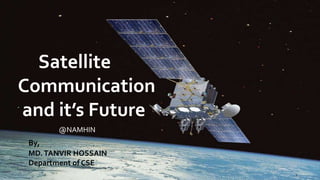
Satellite
Communication
and it’s Future
2
By,
MD.TANVIR HOSSAIN
Department of CSE
Agenda
 Introduction
 Background
 How it works
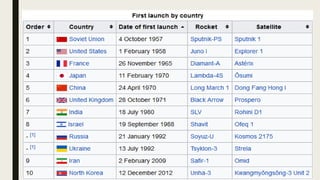
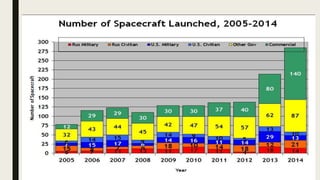
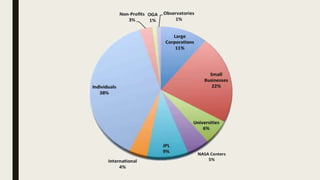
 Some statistics about satellite
 Satellite applications
 Advantage
 Disadvantages
 Satellite in Bangladesh
 The future of satellite communication
 Conclusion
Satellite Communication
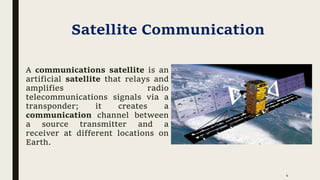
A communications satellite is an
artificial satellite that relays and
amplifies radio
telecommunications signals via a
transponder; it creates a
communication channel between
a source transmitter and a
receiver at different locations on
Earth.
4
Background:
 The concept of the geostationary
communications satellite was first proposed by
Arthur C. Clarke, building on work by
Konstantin Tsiolkovsky.
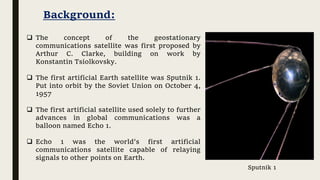
 The first artificial Earth satellite was Sputnik 1.
Put into orbit by the Soviet Union on October 4,
1957
 The first artificial satellite used solely to further
advances in global communications was a
balloon named Echo 1.
 Echo 1 was the world's first artificial
communications satellite capable of relaying
signals to other points on Earth.
Sputnik 1
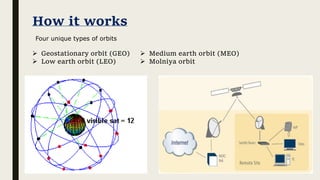
How it works
 Geostationary orbit (GEO)
 Low earth orbit (LEO)
 Medium earth orbit (MEO)
 Molniya orbit
Four unique types of orbits
9
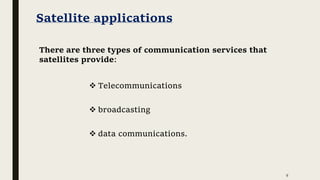
Satellite applications
There are three types of communication services that
satellites provide:
 Telecommunications
 broadcasting
 data communications.
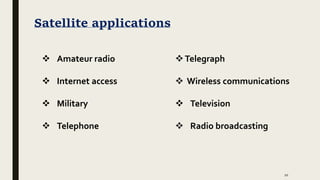
Satellite applications
10
 Amateur radio
 Internet access
 Military
 Telephone
Telegraph
 Wireless communications
 Television
 Radio broadcasting
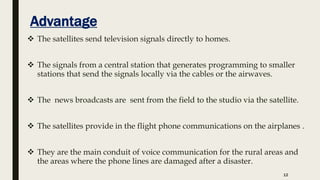
Advantage
 The satellites send television signals directly to homes.
 The signals from a central station that generates programming to smaller
stations that send the signals locally via the cables or the airwaves.
 The news broadcasts are sent from the field to the studio via the satellite.
 The satellites provide in the flight phone communications on the airplanes .
 They are the main conduit of voice communication for the rural areas and
the areas where the phone lines are damaged after a disaster.
12
Disadvantages of Satellite Communication
■ The launching of the satellite is very expensive.
■ It requires expensive ground stations.
■ It has limited frequency spectrum and orbital space.
■ It requires constant monitoring from the ground.
13
Satellite in Bangladesh:
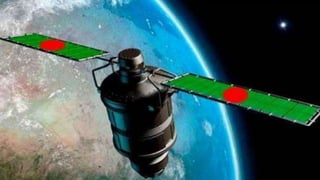
 The Bangabandhu-1 (BD-1), will be the first Bangladeshi geostationary
communications satellite operated by Bangladesh Telecommunication Regulatory
Commission (BTRC) which is scheduled to launch in 2017.
 It is expected to be located at 119° East longitude geostationary slot. It is named
after the father of the nation Bangabandhu Sheikh Mujibur Rahman.
 It will be built by Thales Alenia Space. The total cost of the satellite is 248 million
US dollars (Tk 19.51 billion). Bangabandhu-1 carries a total of 40 Ku and C-band
transponders with a capacity of 1600 megahertz and a predicted life span of 15
years.
 Bangabandhu-1 is scheduled to be launched in December 2017 on a Falcon 9
rocket.[1]
Bangabandhu-1
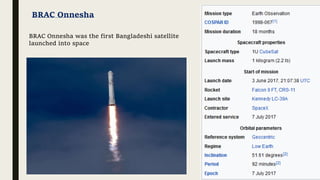
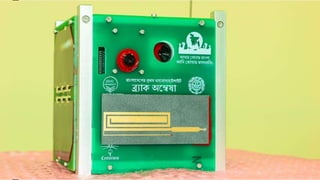
BRAC Onnesha
BRAC Onnesha was the first Bangladeshi satellite
launched into space
The future of satellite communication
■ Future communication satellites will have more onboard processing
capabilities, more power, and larger-aperture antennas that will
enable satellites to handle more bandwidth.
■ Further improvements in satellites’ propulsion and power systems
will increase their service life to 20–30 years from the current 10–15
years.
■ With increasing video, voice, and data traffic requiring larger
amounts of bandwidth, there is no dearth of emerging applications
that will drive demand for the satellite services in the years to come.
.
18
The future of satellite communication
■ The communications satellites have the ability to rapidly communicate
between a number of widely dispersed locations.
■ big manufacturing companies and the department stores to perform
inventory management , like as banking services to even small towns.
■ GPS locators are increasingly included in the car direction services .
GPS based systems are used by the civilians and the military for
navigation on land , the sea , and the air.
19
Conclusion:
Satellite Communication is very important for our
modern world. In one word we cant imagine one
second with out it. In every sphere of life we use it,
and the future use of satellite is more glorious.
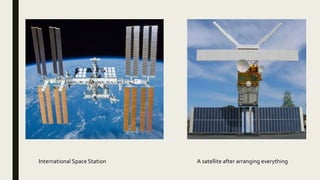
International Space Station A satellite after arranging everything
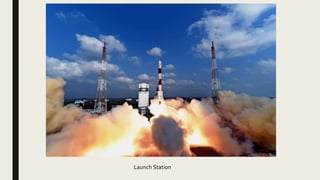
Launch Station
Reference:
https://en.wikipedia.org/wiki/Satellit
https://phys.org/news/2016-06-satellite-future.html
https://www.fraunhofer.de/en/press/research-news/2016/June/satellite-
communication-of-the-future.html
http://www.bracu.ac.bd/news/brac-university-receives-brac-onnesha-first-nano-
satellite-made-university-bangladesh
Thank
You !
24

Satellite communication and it's future

  • 1.
    Course Name: Statisticsand Probability Course Code: STA 133 Daffodil International University Department of CSE 1
  • 2.
  • 3.
    Agenda  Introduction  Background How it works  Some statistics about satellite  Satellite applications  Advantage  Disadvantages  Satellite in Bangladesh  The future of satellite communication  Conclusion
  • 4.
    Satellite Communication A communicationssatellite is an artificial satellite that relays and amplifies radio telecommunications signals via a transponder; it creates a communication channel between a source transmitter and a receiver at different locations on Earth. 4
  • 5.
    Background:  The conceptof the geostationary communications satellite was first proposed by Arthur C. Clarke, building on work by Konstantin Tsiolkovsky.  The first artificial Earth satellite was Sputnik 1. Put into orbit by the Soviet Union on October 4, 1957  The first artificial satellite used solely to further advances in global communications was a balloon named Echo 1.  Echo 1 was the world's first artificial communications satellite capable of relaying signals to other points on Earth. Sputnik 1
  • 6.
    How it works Geostationary orbit (GEO)  Low earth orbit (LEO)  Medium earth orbit (MEO)  Molniya orbit Four unique types of orbits
  • 9.
    9 Satellite applications There arethree types of communication services that satellites provide:  Telecommunications  broadcasting  data communications.
  • 10.
    Satellite applications 10  Amateurradio  Internet access  Military  Telephone Telegraph  Wireless communications  Television  Radio broadcasting
  • 12.
    Advantage  The satellitessend television signals directly to homes.  The signals from a central station that generates programming to smaller stations that send the signals locally via the cables or the airwaves.  The news broadcasts are sent from the field to the studio via the satellite.  The satellites provide in the flight phone communications on the airplanes .  They are the main conduit of voice communication for the rural areas and the areas where the phone lines are damaged after a disaster. 12
  • 13.
    Disadvantages of SatelliteCommunication ■ The launching of the satellite is very expensive. ■ It requires expensive ground stations. ■ It has limited frequency spectrum and orbital space. ■ It requires constant monitoring from the ground. 13
  • 14.
    Satellite in Bangladesh: The Bangabandhu-1 (BD-1), will be the first Bangladeshi geostationary communications satellite operated by Bangladesh Telecommunication Regulatory Commission (BTRC) which is scheduled to launch in 2017.  It is expected to be located at 119° East longitude geostationary slot. It is named after the father of the nation Bangabandhu Sheikh Mujibur Rahman.  It will be built by Thales Alenia Space. The total cost of the satellite is 248 million US dollars (Tk 19.51 billion). Bangabandhu-1 carries a total of 40 Ku and C-band transponders with a capacity of 1600 megahertz and a predicted life span of 15 years.  Bangabandhu-1 is scheduled to be launched in December 2017 on a Falcon 9 rocket.[1] Bangabandhu-1
  • 16.
    BRAC Onnesha BRAC Onneshawas the first Bangladeshi satellite launched into space
  • 18.
    The future ofsatellite communication ■ Future communication satellites will have more onboard processing capabilities, more power, and larger-aperture antennas that will enable satellites to handle more bandwidth. ■ Further improvements in satellites’ propulsion and power systems will increase their service life to 20–30 years from the current 10–15 years. ■ With increasing video, voice, and data traffic requiring larger amounts of bandwidth, there is no dearth of emerging applications that will drive demand for the satellite services in the years to come. . 18
  • 19.
    The future ofsatellite communication ■ The communications satellites have the ability to rapidly communicate between a number of widely dispersed locations. ■ big manufacturing companies and the department stores to perform inventory management , like as banking services to even small towns. ■ GPS locators are increasingly included in the car direction services . GPS based systems are used by the civilians and the military for navigation on land , the sea , and the air. 19
  • 20.
    Conclusion: Satellite Communication isvery important for our modern world. In one word we cant imagine one second with out it. In every sphere of life we use it, and the future use of satellite is more glorious.
  • 21.
    International Space StationA satellite after arranging everything
  • 22.
  • 23.
  • 24.