satellite communication
 What is satellite?
 What is satellite communication?
 Satellite Architecture.
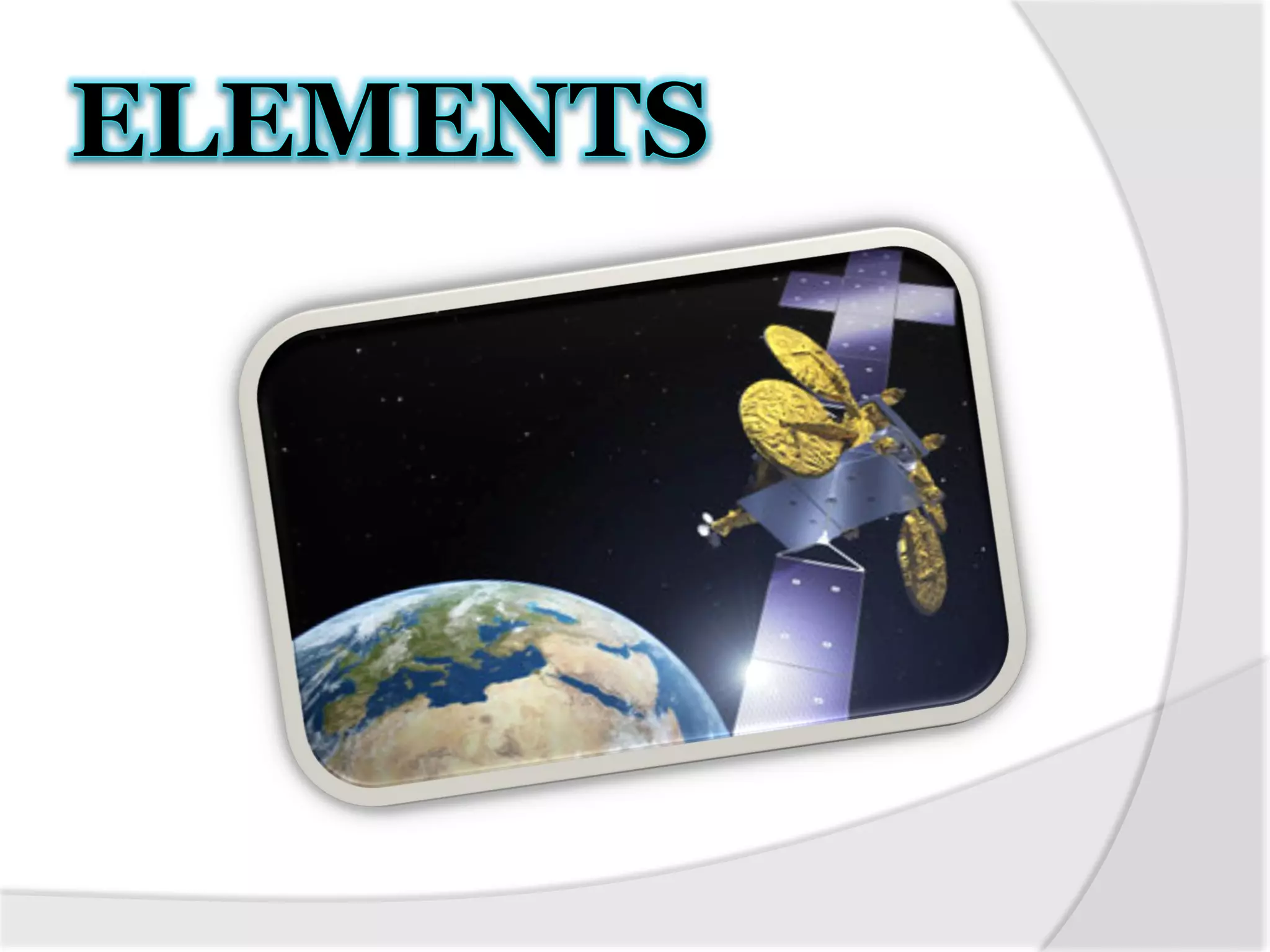
 Elements for satellite communication.
 Orbits for satellite communication.
 Evolution of satellite communication.
 Advantages of satellite communication.
 Frequency Bands and Beams.
 Applications of satellite communication.
 Services of satellite communication.
 The future of satellite communication.
 Conclusion
 An artificial body placed in orbit around the
earth to collect information or for
communication.
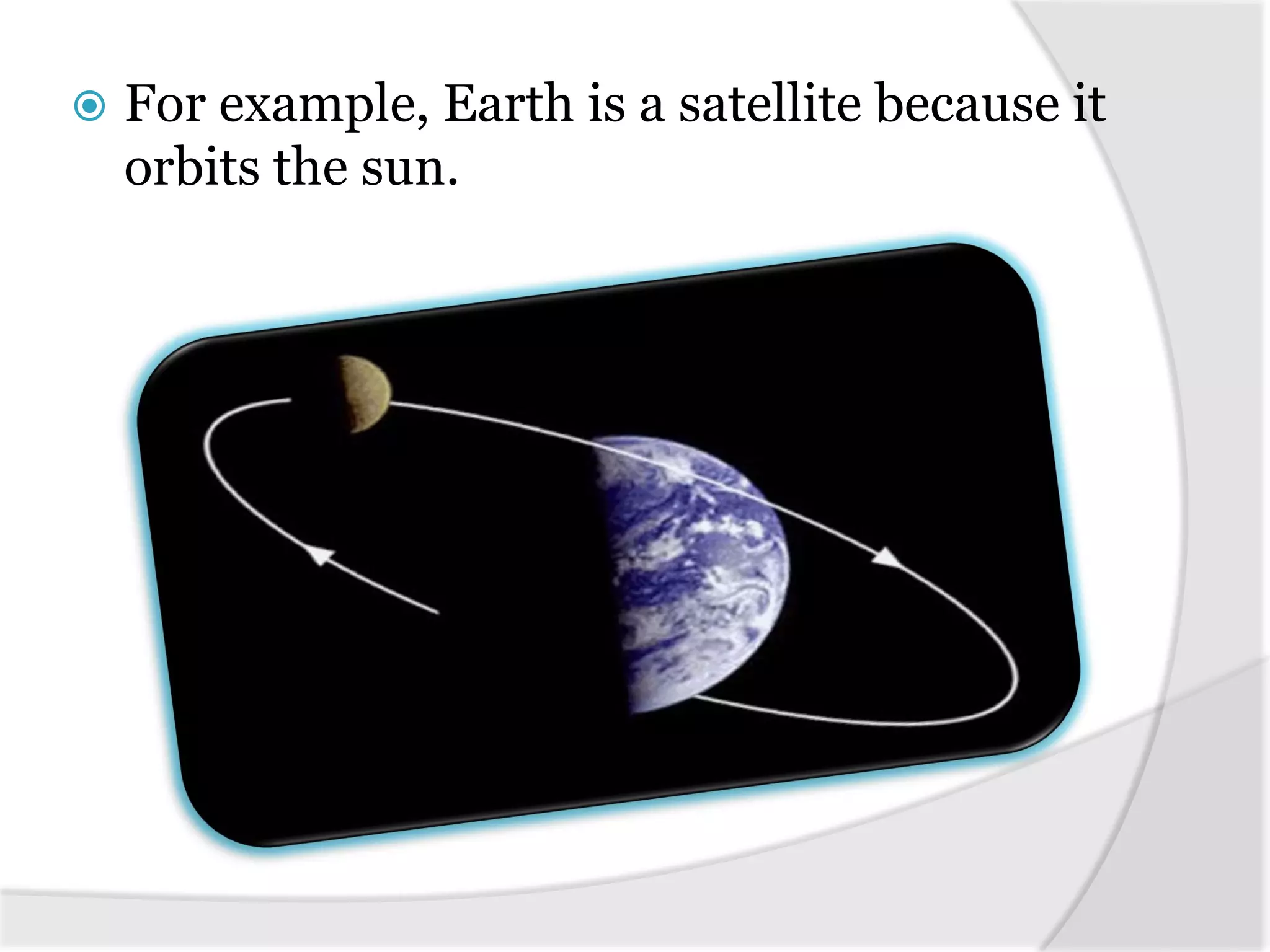
 For example, Earth is a satellite because it
orbits the sun.
 A communications satellite is a radio relay
station in orbit above the earth.
 It receives, amplifies, and redirects analog and
digital signals carried on a specific radio
frequency.
 Satellite communications play a vital role in
the global telecommunications system.
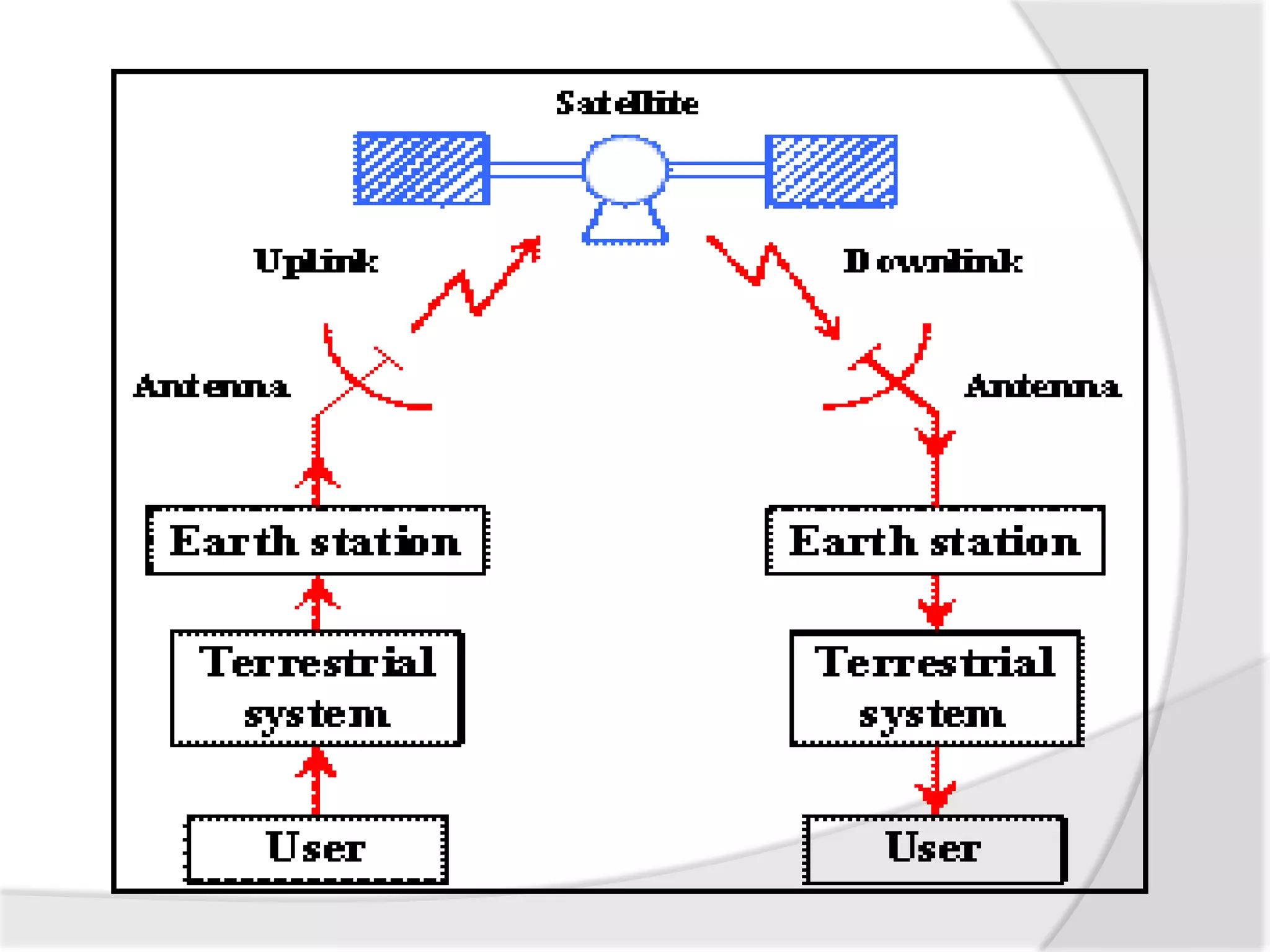
 Two major elements of Satellite Communications
Systems are:
 Space Segment
 Ground Segment
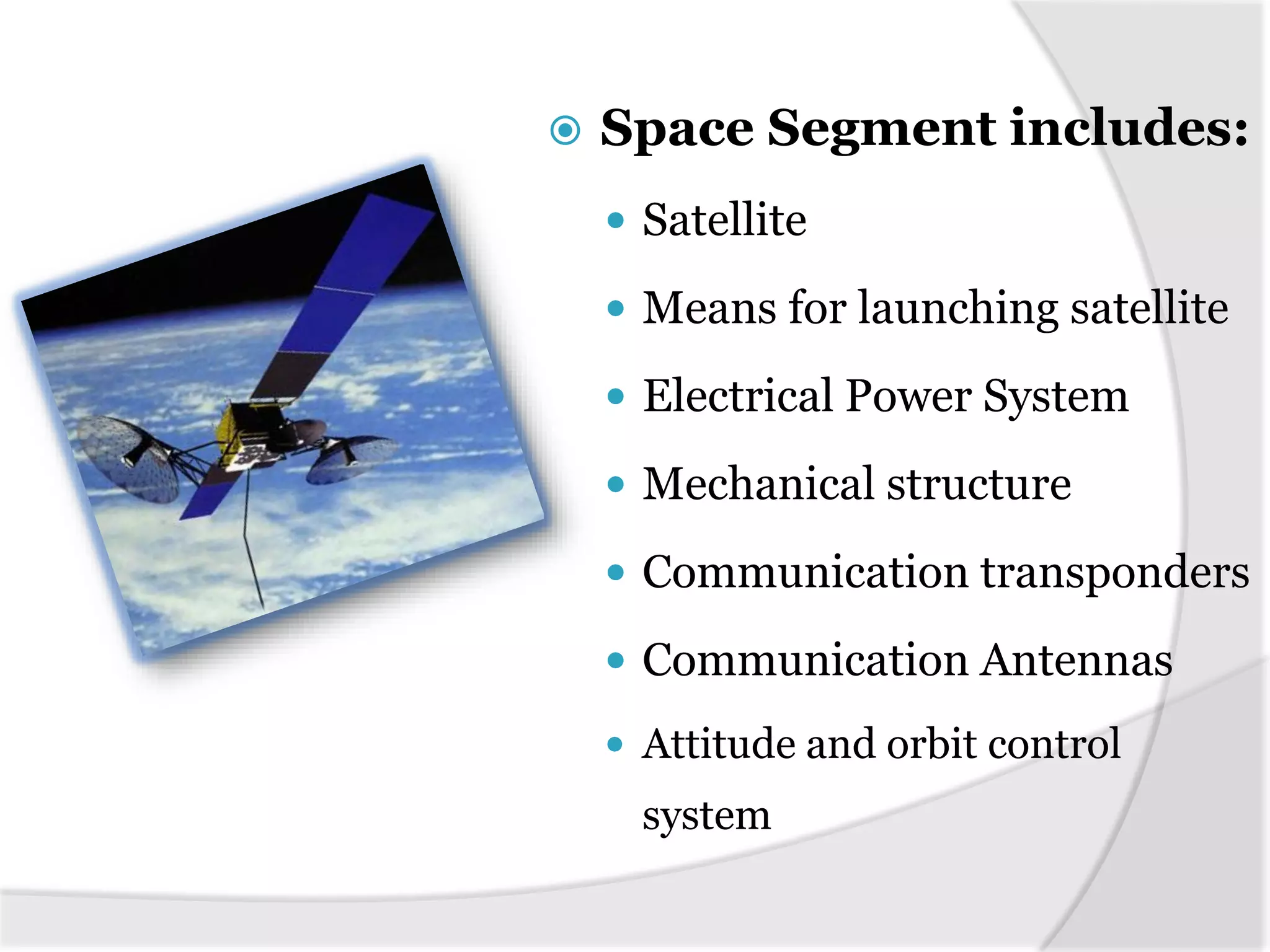
 Space Segment includes:
 Satellite
 Means for launching satellite
 Electrical Power System
 Mechanical structure
 Communication transponders
 Communication Antennas
 Attitude and orbit control
system
 Satellite Control Centre function:
 Tracking of the satellite
 Receiving data
 Eclipse management of satellite
Conti…..
 Commanding the Satellite for station keeping.
 Determining Orbital parameters from Tracking
and Ranging data
 Switching ON/OFF of different subsystems as per
the operational requirements
 The ground segment consists of
 Earth Stations
 User terminals and interfaces
 Network control centre.
 Transmit equipment.
 Receive equipment.
 Antenna system.
 The path a Satellite follows around a planet is
defined as an orbit.
 Satellite Orbits are classified in two broad
categories :
 Non-Geostationary Orbit (NGSO)
 Geo Stationary Orbit (GSO)
( )
 Early ventures with satellite communications used
satellites in Non-geostationary low earth orbits due to the
technical limitations of the launch vehicles in placing
satellites in higher orbits.
 Classification of NGSOs as per the orbital plane
are:
 Polar Orbit: In polar orbit the satellite moves from pole to pole
and the inclination is equal to 90 degrees.
 Equatorial Orbit: In equatorial orbit the orbital plane lies in the
equatorial plane of the earth and the inclination is zero or very
small.
 Inclined Orbit: All orbits other than polar orbit and equatorial
orbit are called inclined orbit.
Advantages of NGSO
 Less booster power required
 Less delay in transmission path
 Reduced problem of echo in voice communications
 Suitability for providing service at higher latitude
 Lower cost to build and launch satellites at NGSO
Disadvantages of NGSO
 Complex problem of transferring signal from one
satellite to another.
 Less expected life of satellites at NGSO
 Requires frequent replacement of satellites
compared to satellite in GSO.
Conti…..
 Problem of increasing space trash in the outer space.
 Requirement of a large number of orbiting satellites for
global coverage.
 As each low earth orbit satellite covers a small portion of
the earth’s surface for a short time.
 There is only one geostationary orbit
possible around the earth
 Lying on the earth’s equatorial plane.
 The satellite orbiting at the same speed as the
rotational speed of the earth on its axis.
 Advantages:
 Simple ground station tracking.
 Nearly constant range
 Very small frequency shift
 Disadvantages:
 Transmission delay of the order of 250 msec.
 Large free space loss
 No polar coverage
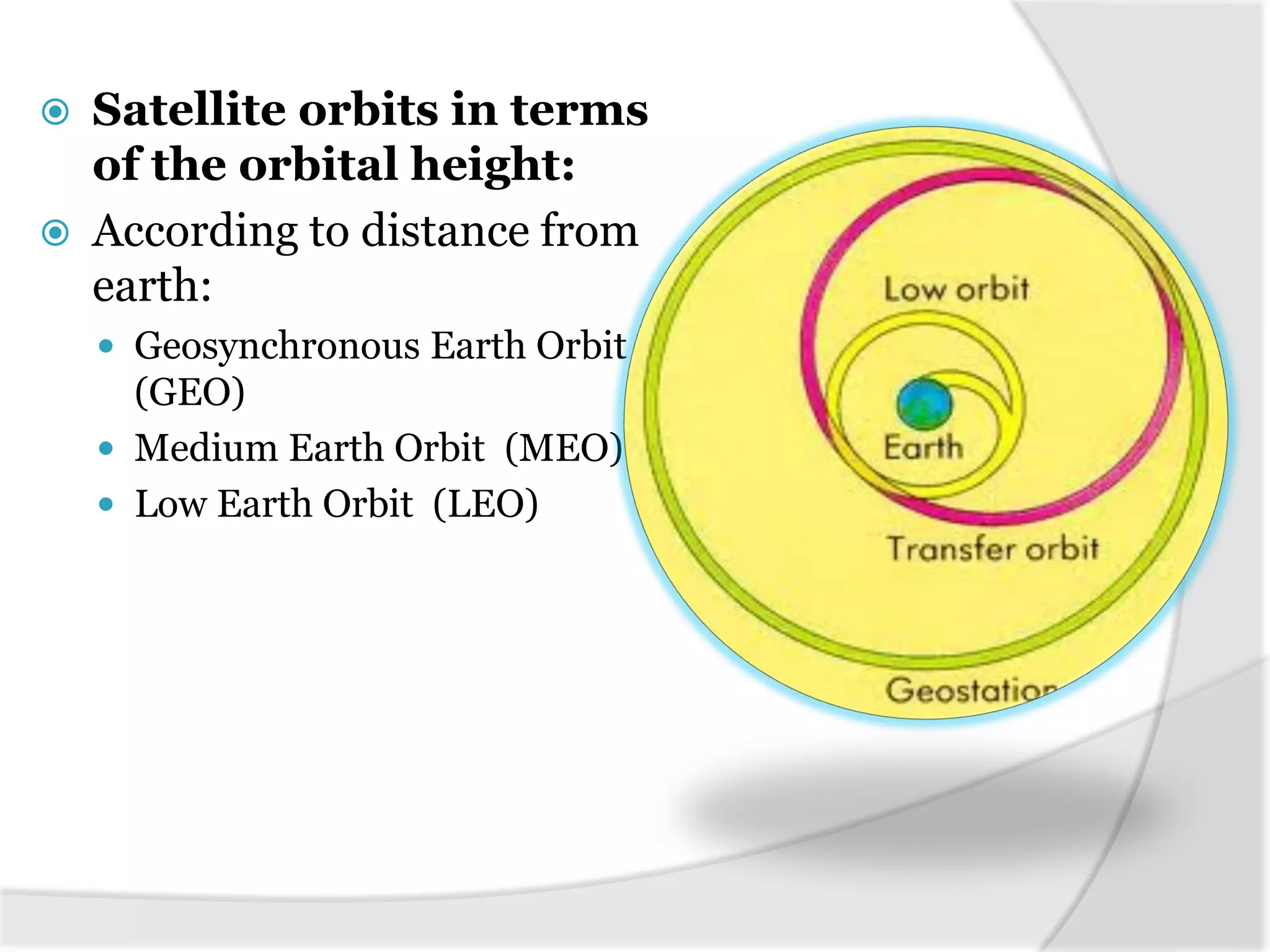
 Satellite orbits in terms
of the orbital height:
 According to distance from
earth:
 Geosynchronous Earth Orbit
(GEO)
 Medium Earth Orbit (MEO)
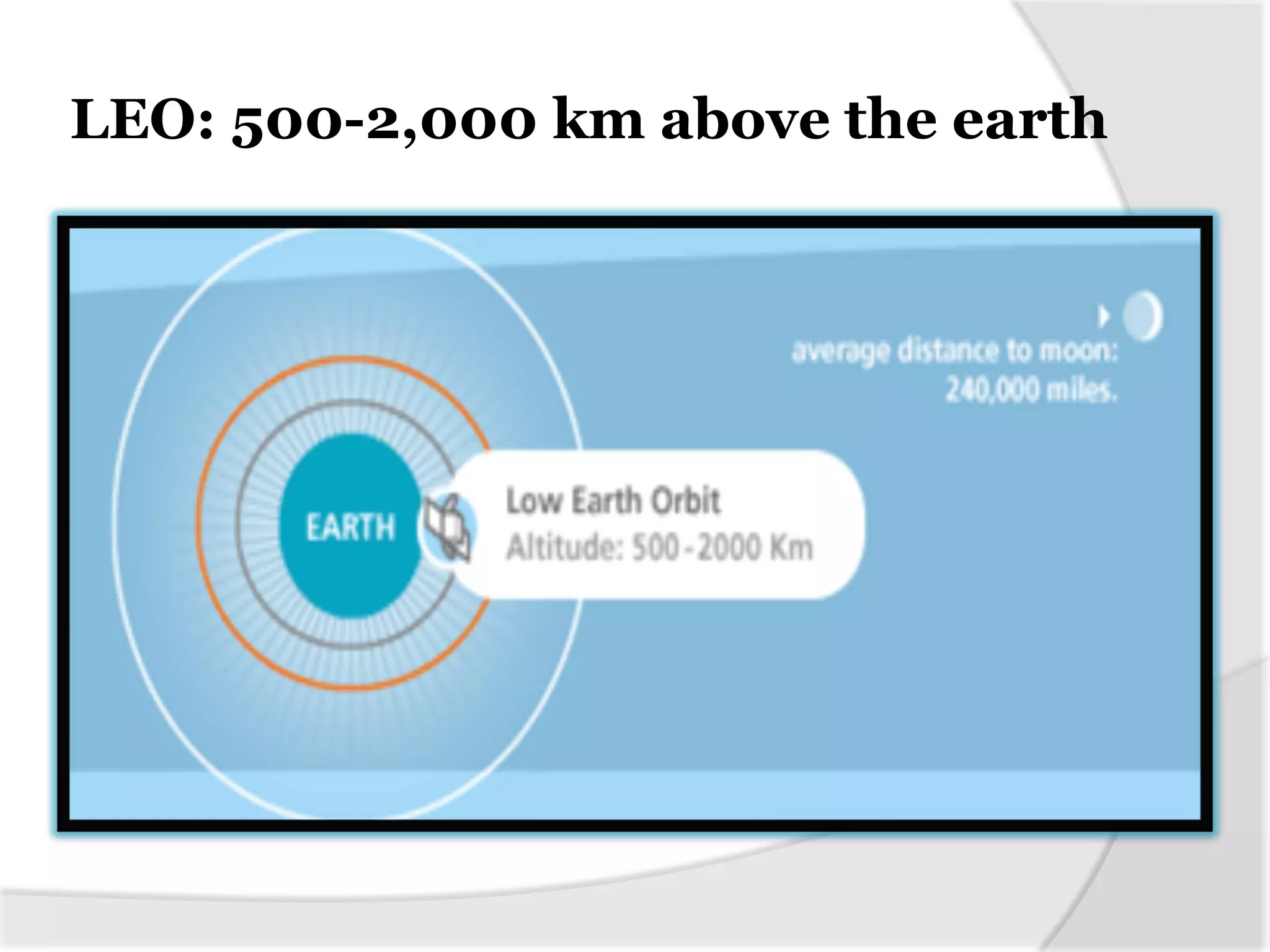
 Low Earth Orbit (LEO)
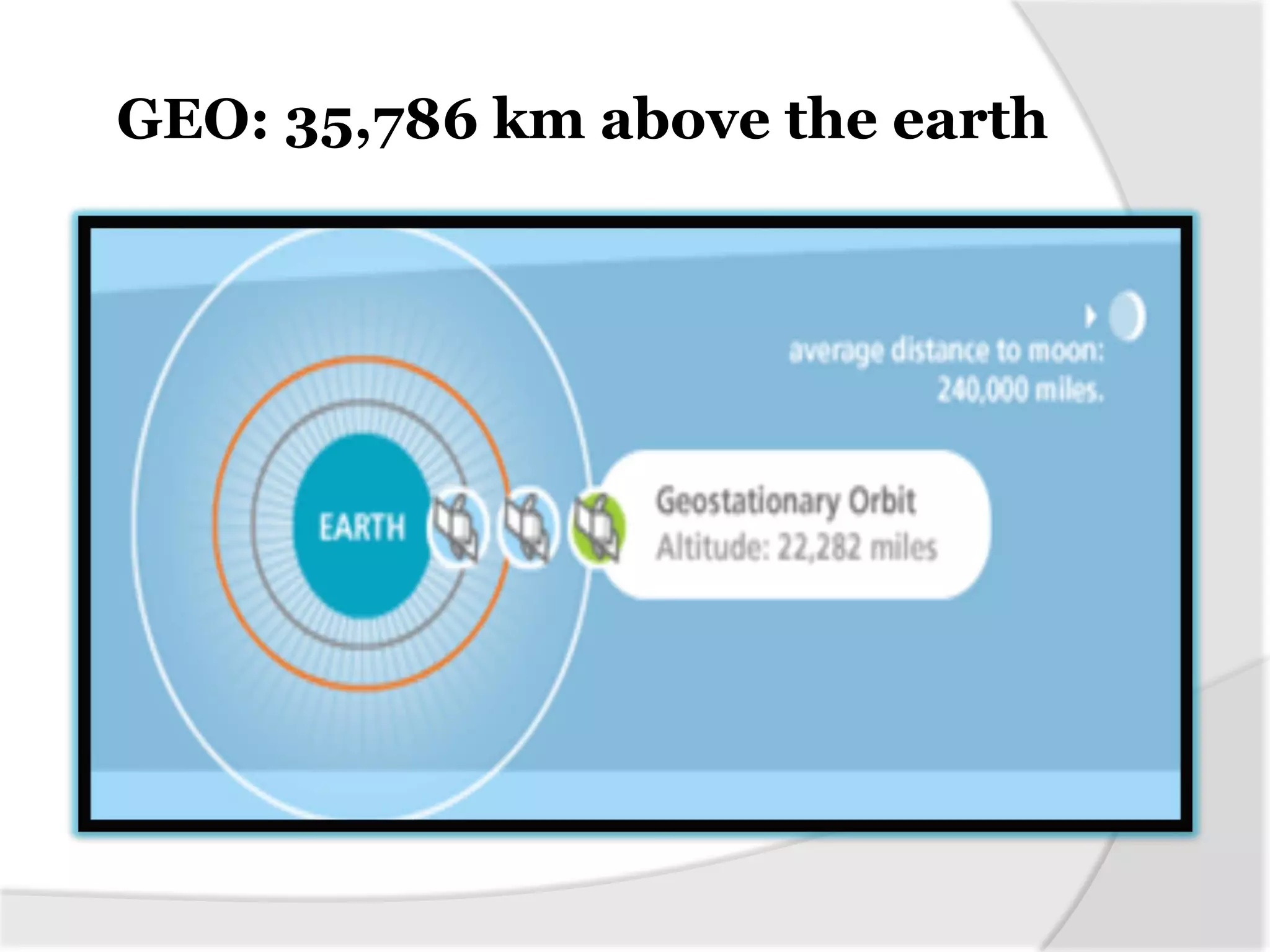
GEO: 35,786 km above the earth
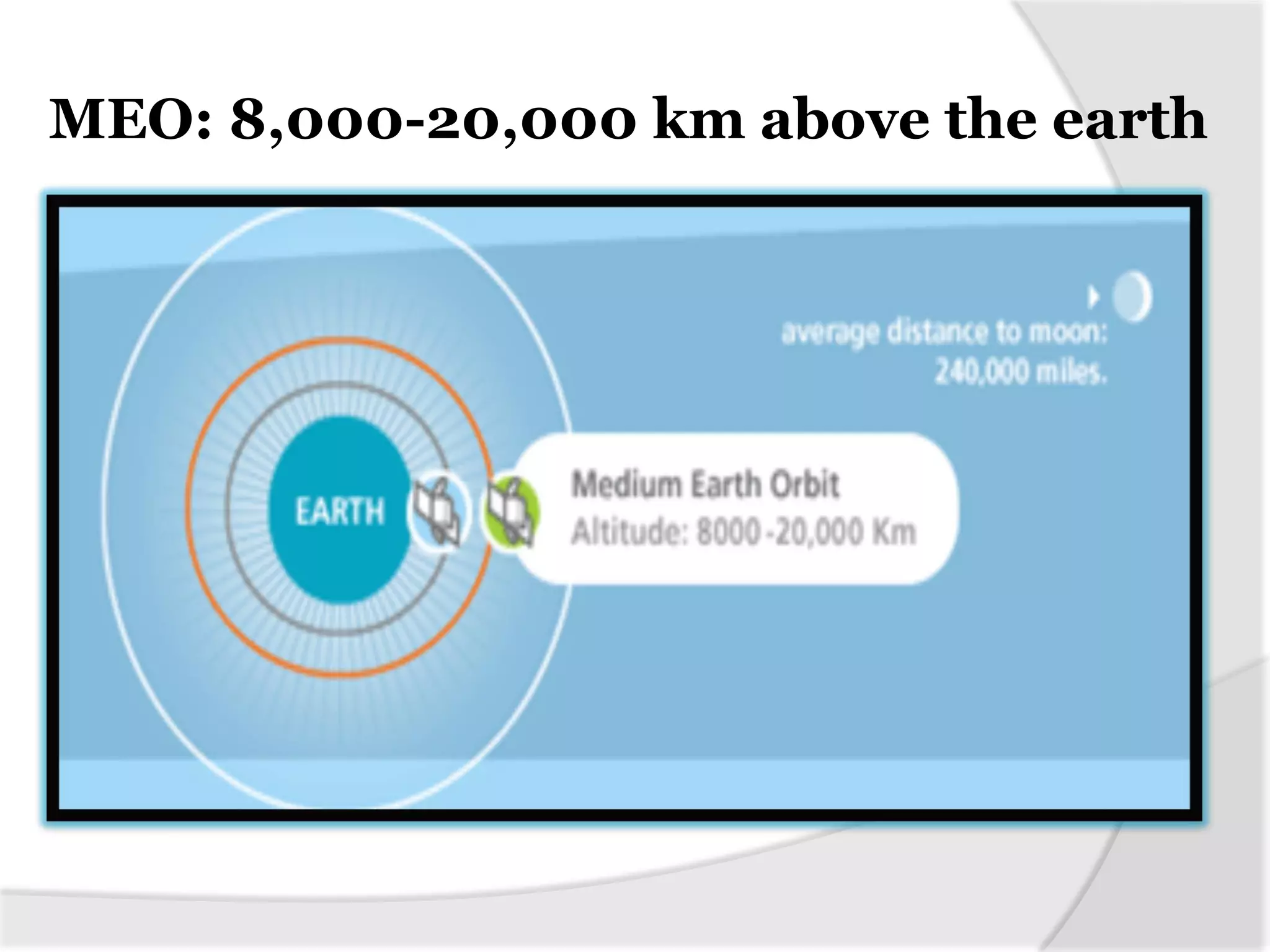
MEO: 8,000-20,000 km above the earth
LEO: 500-2,000 km above the earth
Evolution OF SATELLITE
COMMUNICATION
 During early 1950s, both passive and active satellites
were considered for the purpose of communications over
a large distance.
 Passive satellites though successfully used in the early
years of satellite communications, with the advancement
in technology active satellites have completely replaced
the passive satellites.
Passive Satellites
 A satellite that only reflects signals from one Earth
station to another, or from several Earth stations to
several others.
 It reflect the incident electromagnetic radiation without
any modification or amplification.
 It can't generate power, they simply reflect the incident
power.
Passive Satellites
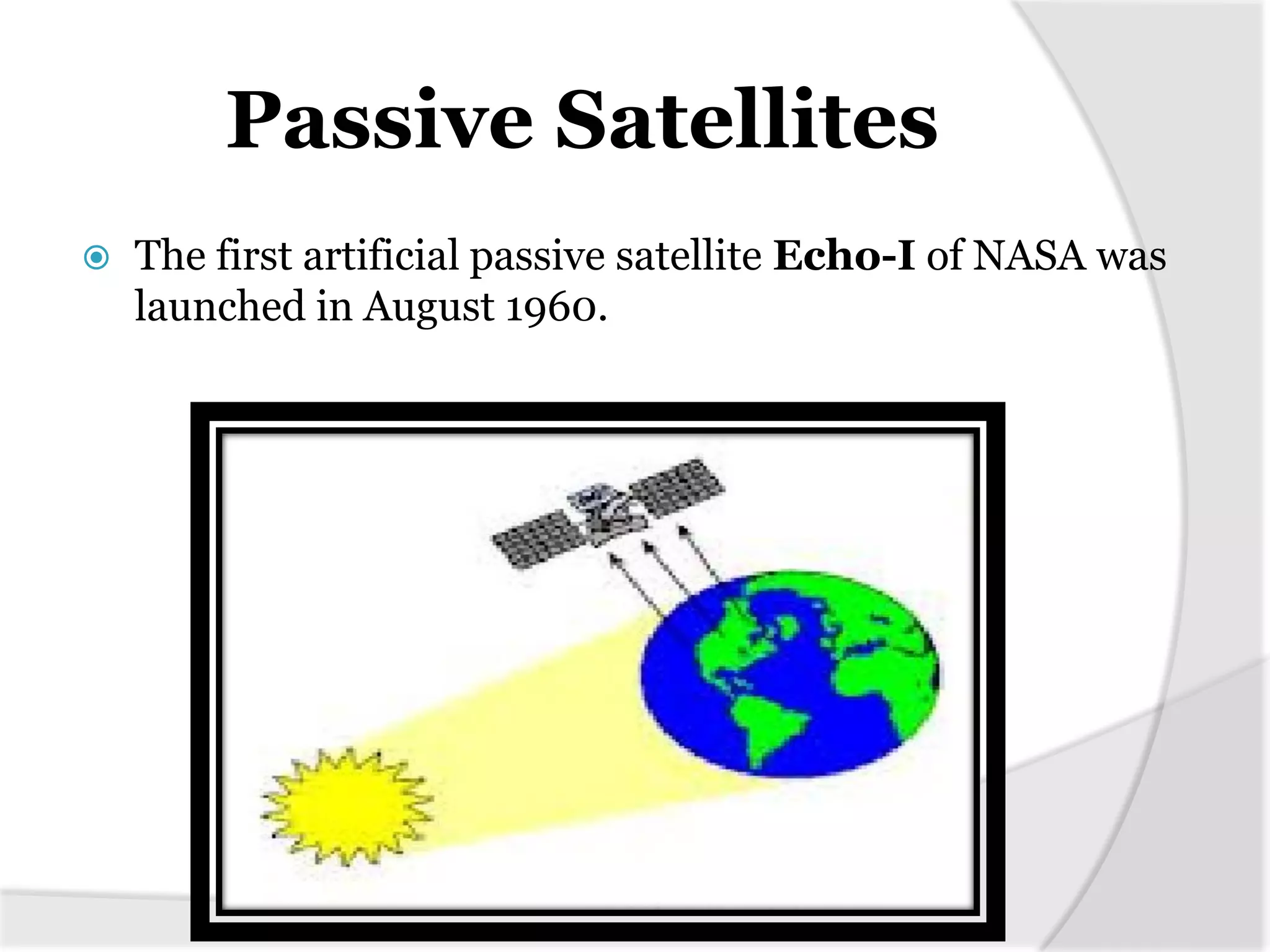
 The first artificial passive satellite Echo-I of NASA was
launched in August 1960.
Disadvantages
 Earth Stations required high power to transmit signals.
 Large Earth Stations with tracking facilities were expensive.
 A global system would have required a large number of passive
satellites accessed randomly by different users.
 Control of satellites not possible from ground.
 The large attenuation of the signal while traveling the large
distance between the transmitter and the receiver via the
satellite was one of the most serious problems.
Active Satellites
 In active satellites, it amplify or modify and retransmit the
signal from the earth.
 Satellites which can transmit power are called active satellite.
 Have several advantages over the passive satellites.
 Require lower power earth station.
 Less costly.
 Not open to random use.
 Directly controlled by operators from ground.
Active Satellites
 World’s first active satellite was SCORE (Satellite
Communication by Orbiting Relay Equipment)
 Launched by US Air force in 1958.
 At orbital height of 110 to 900 miles.
 The first fully active satellite was Courier
 Launched into an orbit of 600 - 700 mile,
 By Department of Defense in 1960.
Disadvantages
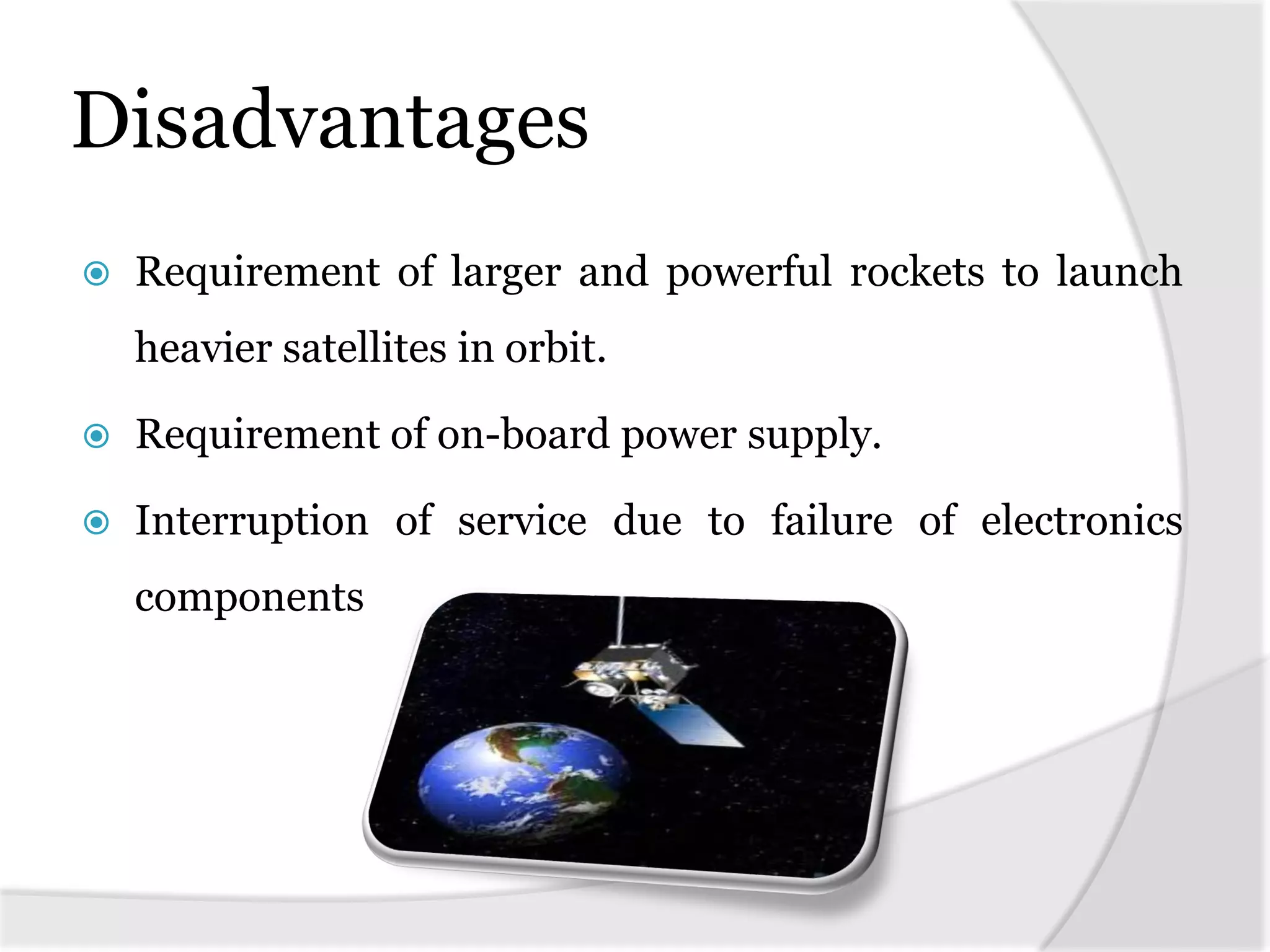
 Requirement of larger and powerful rockets to launch
heavier satellites in orbit.
 Requirement of on-board power supply.
 Interruption of service due to failure of electronics
components
 One-way satellite services are:
 Broadcast Satellite Service: Radio, TV, Data
broadcasting.
 Safety services : Search & Rescue, Disaster Warning
 Radio Determination Satellite Service(Position location)
 Standard frequency and time signal satellite service
 Space Research Service.
 Space operations service.
 Earth Exploration Satellite Service.
 Two-way satellite services are:
 Fixed Satellite Service: Telephone, fax, high bit rate
data etc.
 Mobile Satellite Service: Land mobile, Marine time
mobile, Aero-mobile, personal communications.
 Satellite News Gathering.
 Inter Satellite Service.
Advantages of satellite
communication
 Universal: Satellite communications are
available virtually everywhere.
 Versatile: Satellites can support all of today's
communications needs .
Conti…..
 RELIABLE: Satellite is a proven medium for
supporting a company's communications needs.
 SEAMLESS: Satellite's inherent strength as a
broadcast medium makes it perfect.
 FAST: Since satellite networks can be set up quickly,
companies can be fast-to-market with new services.
Conti…..
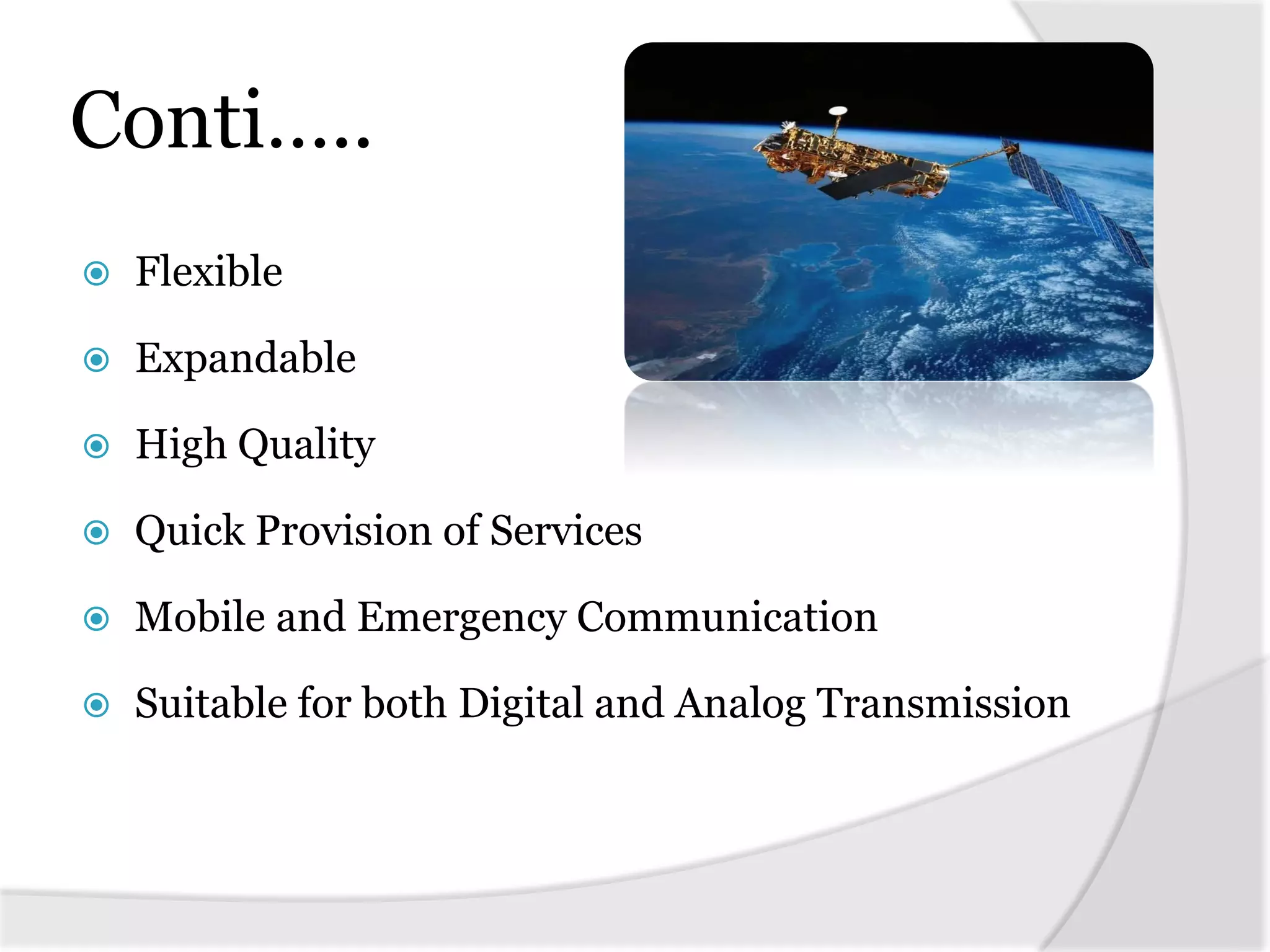
 Flexible
 Expandable
 High Quality
 Quick Provision of Services
 Mobile and Emergency Communication
 Suitable for both Digital and Analog Transmission
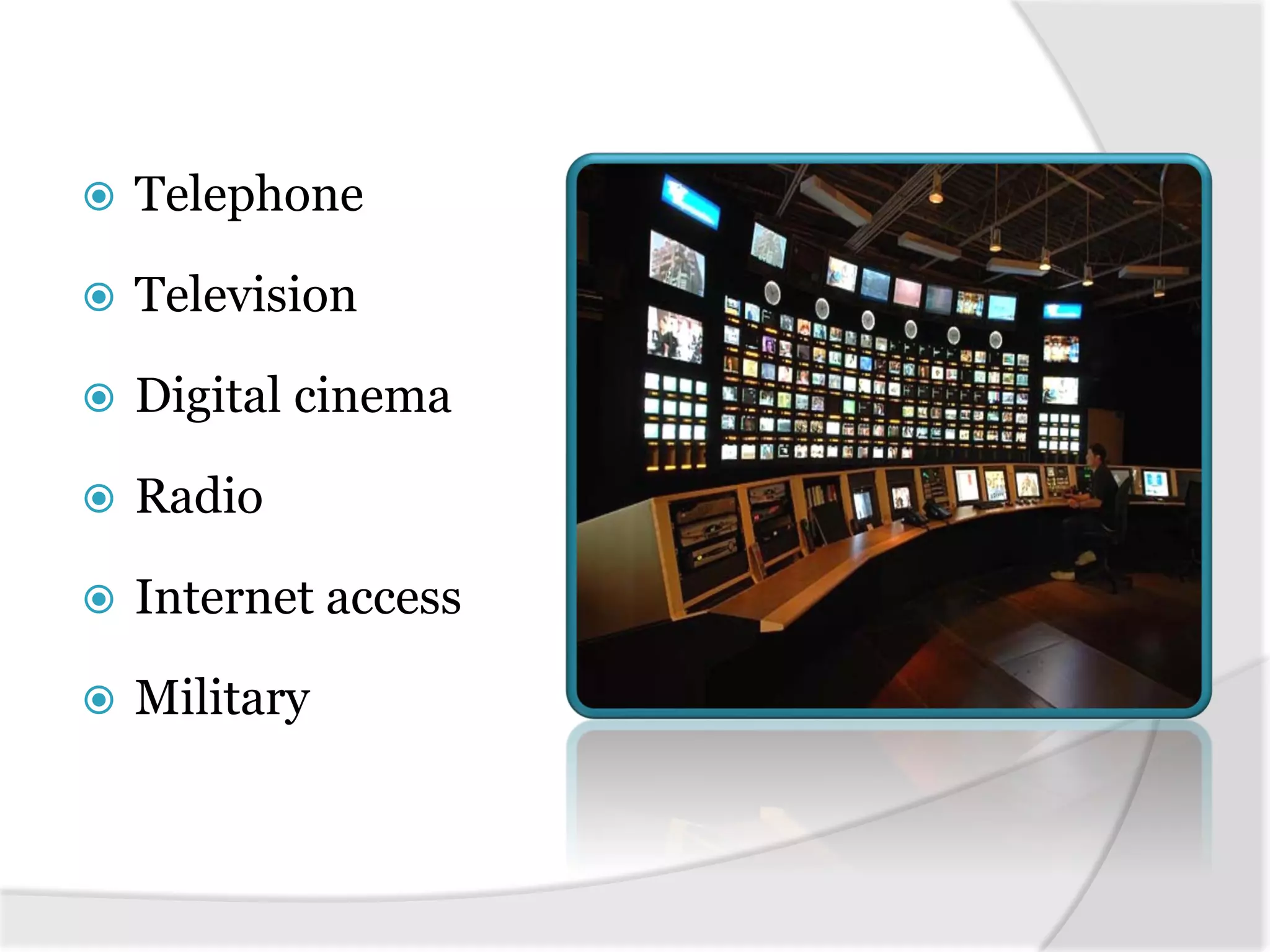
 Telephone
 Television
 Digital cinema
 Radio
 Internet access
 Military
 Future communication satellites will have
 more onboard processing capabilities,
 more power, and
 larger-aperture antennas
that will enable satellites to handle more bandwidth.
 The demand for more bandwidth will ensure the long-
term viability of the commercial satellite industry well
into the 21st century.
Applications of satellite
communication
 In addition, other technical innovations such as low-cost
reusable launch vehicles are in development.
 Further improvements in satellites’ propulsion and power systems
will increase their service life to 20–30 years from the current 10–15
years.
 By going through the above slides we came to
know that satellite is mostly responsible for:
 Telecommunication transmission
 Reception of television signals
 Whether forecasting
 Which is very important in our daily life.
Thank
you
H.T
Satellite communication and
Terrestrial communication
Difference
Diagram
Satellite_Communications.pdf

Satellite_Communications.pdf

  • 1.
  • 2.
     What issatellite?  What is satellite communication?  Satellite Architecture.  Elements for satellite communication.  Orbits for satellite communication.  Evolution of satellite communication.
  • 3.
     Advantages ofsatellite communication.  Frequency Bands and Beams.  Applications of satellite communication.  Services of satellite communication.  The future of satellite communication.  Conclusion
  • 4.
     An artificialbody placed in orbit around the earth to collect information or for communication.
  • 5.
     For example,Earth is a satellite because it orbits the sun.
  • 6.
     A communicationssatellite is a radio relay station in orbit above the earth.  It receives, amplifies, and redirects analog and digital signals carried on a specific radio frequency.
  • 7.
     Satellite communicationsplay a vital role in the global telecommunications system.
  • 9.
     Two majorelements of Satellite Communications Systems are:  Space Segment  Ground Segment
  • 11.
     Space Segmentincludes:  Satellite  Means for launching satellite  Electrical Power System  Mechanical structure  Communication transponders  Communication Antennas  Attitude and orbit control system
  • 12.
     Satellite ControlCentre function:  Tracking of the satellite  Receiving data  Eclipse management of satellite
  • 13.
    Conti…..  Commanding theSatellite for station keeping.  Determining Orbital parameters from Tracking and Ranging data  Switching ON/OFF of different subsystems as per the operational requirements
  • 14.
     The groundsegment consists of  Earth Stations  User terminals and interfaces  Network control centre.  Transmit equipment.  Receive equipment.  Antenna system.
  • 16.
     The patha Satellite follows around a planet is defined as an orbit.  Satellite Orbits are classified in two broad categories :  Non-Geostationary Orbit (NGSO)  Geo Stationary Orbit (GSO)
  • 17.
    ( )  Earlyventures with satellite communications used satellites in Non-geostationary low earth orbits due to the technical limitations of the launch vehicles in placing satellites in higher orbits.
  • 18.
     Classification ofNGSOs as per the orbital plane are:  Polar Orbit: In polar orbit the satellite moves from pole to pole and the inclination is equal to 90 degrees.  Equatorial Orbit: In equatorial orbit the orbital plane lies in the equatorial plane of the earth and the inclination is zero or very small.  Inclined Orbit: All orbits other than polar orbit and equatorial orbit are called inclined orbit.
  • 19.
    Advantages of NGSO Less booster power required  Less delay in transmission path  Reduced problem of echo in voice communications  Suitability for providing service at higher latitude  Lower cost to build and launch satellites at NGSO
  • 20.
    Disadvantages of NGSO Complex problem of transferring signal from one satellite to another.  Less expected life of satellites at NGSO  Requires frequent replacement of satellites compared to satellite in GSO.
  • 21.
    Conti…..  Problem ofincreasing space trash in the outer space.  Requirement of a large number of orbiting satellites for global coverage.  As each low earth orbit satellite covers a small portion of the earth’s surface for a short time.
  • 22.
     There isonly one geostationary orbit possible around the earth  Lying on the earth’s equatorial plane.  The satellite orbiting at the same speed as the rotational speed of the earth on its axis.
  • 23.
     Advantages:  Simpleground station tracking.  Nearly constant range  Very small frequency shift  Disadvantages:  Transmission delay of the order of 250 msec.  Large free space loss  No polar coverage
  • 24.
     Satellite orbitsin terms of the orbital height:  According to distance from earth:  Geosynchronous Earth Orbit (GEO)  Medium Earth Orbit (MEO)  Low Earth Orbit (LEO)
  • 25.
    GEO: 35,786 kmabove the earth
  • 26.
    MEO: 8,000-20,000 kmabove the earth
  • 27.
    LEO: 500-2,000 kmabove the earth
  • 28.
  • 29.
     During early1950s, both passive and active satellites were considered for the purpose of communications over a large distance.  Passive satellites though successfully used in the early years of satellite communications, with the advancement in technology active satellites have completely replaced the passive satellites.
  • 30.
    Passive Satellites  Asatellite that only reflects signals from one Earth station to another, or from several Earth stations to several others.  It reflect the incident electromagnetic radiation without any modification or amplification.  It can't generate power, they simply reflect the incident power.
  • 31.
    Passive Satellites  Thefirst artificial passive satellite Echo-I of NASA was launched in August 1960.
  • 32.
    Disadvantages  Earth Stationsrequired high power to transmit signals.  Large Earth Stations with tracking facilities were expensive.  A global system would have required a large number of passive satellites accessed randomly by different users.  Control of satellites not possible from ground.  The large attenuation of the signal while traveling the large distance between the transmitter and the receiver via the satellite was one of the most serious problems.
  • 33.
    Active Satellites  Inactive satellites, it amplify or modify and retransmit the signal from the earth.  Satellites which can transmit power are called active satellite.  Have several advantages over the passive satellites.  Require lower power earth station.  Less costly.  Not open to random use.  Directly controlled by operators from ground.
  • 34.
  • 35.
     World’s firstactive satellite was SCORE (Satellite Communication by Orbiting Relay Equipment)  Launched by US Air force in 1958.  At orbital height of 110 to 900 miles.  The first fully active satellite was Courier  Launched into an orbit of 600 - 700 mile,  By Department of Defense in 1960.
  • 36.
    Disadvantages  Requirement oflarger and powerful rockets to launch heavier satellites in orbit.  Requirement of on-board power supply.  Interruption of service due to failure of electronics components
  • 39.
     One-way satelliteservices are:  Broadcast Satellite Service: Radio, TV, Data broadcasting.  Safety services : Search & Rescue, Disaster Warning  Radio Determination Satellite Service(Position location)  Standard frequency and time signal satellite service  Space Research Service.  Space operations service.  Earth Exploration Satellite Service.
  • 40.
     Two-way satelliteservices are:  Fixed Satellite Service: Telephone, fax, high bit rate data etc.  Mobile Satellite Service: Land mobile, Marine time mobile, Aero-mobile, personal communications.  Satellite News Gathering.  Inter Satellite Service.
  • 41.
  • 42.
     Universal: Satellitecommunications are available virtually everywhere.  Versatile: Satellites can support all of today's communications needs .
  • 43.
    Conti…..  RELIABLE: Satelliteis a proven medium for supporting a company's communications needs.  SEAMLESS: Satellite's inherent strength as a broadcast medium makes it perfect.  FAST: Since satellite networks can be set up quickly, companies can be fast-to-market with new services.
  • 44.
    Conti…..  Flexible  Expandable High Quality  Quick Provision of Services  Mobile and Emergency Communication  Suitable for both Digital and Analog Transmission
  • 45.
     Telephone  Television Digital cinema  Radio  Internet access  Military
  • 46.
     Future communicationsatellites will have  more onboard processing capabilities,  more power, and  larger-aperture antennas that will enable satellites to handle more bandwidth.  The demand for more bandwidth will ensure the long- term viability of the commercial satellite industry well into the 21st century.
  • 47.
  • 48.
     In addition,other technical innovations such as low-cost reusable launch vehicles are in development.  Further improvements in satellites’ propulsion and power systems will increase their service life to 20–30 years from the current 10–15 years.
  • 49.
     By goingthrough the above slides we came to know that satellite is mostly responsible for:  Telecommunication transmission  Reception of television signals  Whether forecasting  Which is very important in our daily life.
  • 50.
  • 51.
    H.T Satellite communication and Terrestrialcommunication Difference Diagram