Animal SystemsScience 6Mrs. Marlene Torres
Animals need to obtain or ingest food from their environmentsIn order to release the energy stored in food, all animals perform:Digestion
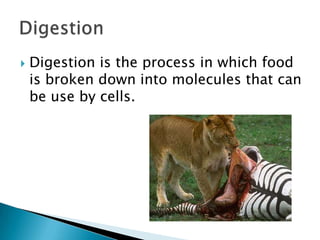
RespirationDigestion is the process in which food is broken down into molecules that can be use by cells.Digestion
Invertebrates have simple digestive systems. They can either:Filter foodHave one opening    -(to move food in and wastes out)Have 2 openings (“tube within a tube”)  -one to move food in, other to move wastes outDigestion in Invertebrates
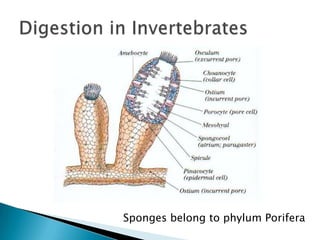
Digestion in InvertebratesSponges belong to phylum Porifera
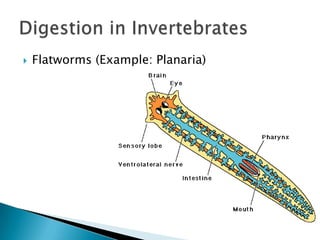
Flatworms (Example: Planaria)Digestion in Invertebrates
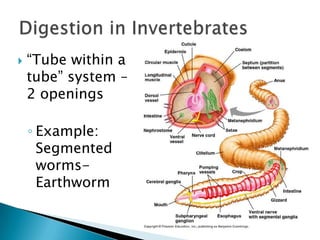
“Tube within a tube” system – 2 openingsExample: Segmented worms-EarthwormDigestion in Invertebrates
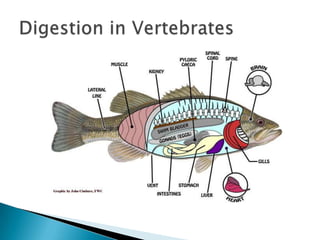
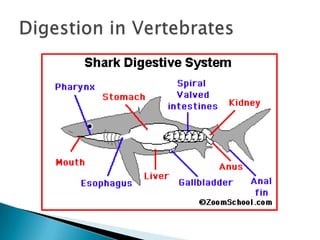
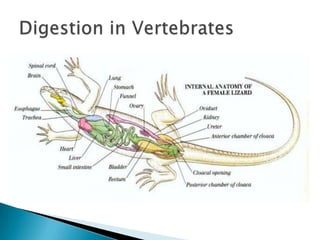
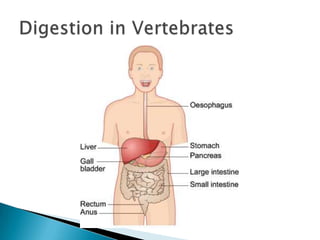
Digestion in VertebratesVertebrates have complex digestive systems.They have many organs with different functions like crush, digest, absorb nutrients and water to obtain the energy from food.
Digestion in Vertebrates
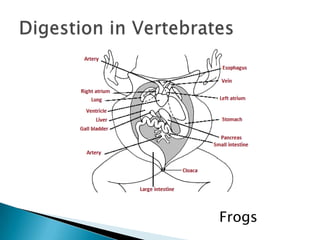
Digestion in VertebratesFrogs
Digestion in Vertebrates
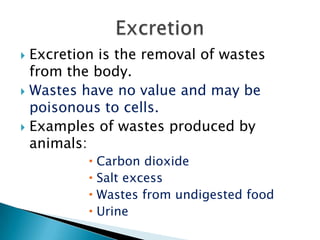
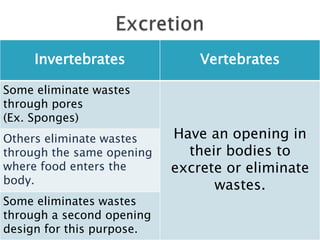
Excretion is the removal of wastes from the body. Wastes have no value and may be poisonous to cells.Examples of wastes produced by animals:Carbon dioxideSalt excessWastes from undigested foodUrineExcretion
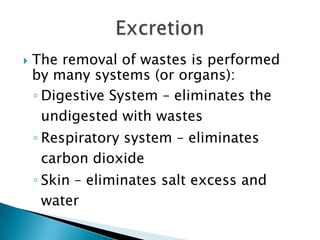
The removal of wastes is performed by many systems (or organs):Digestive System – eliminates the undigested with wastesRespiratory system – eliminates carbon dioxideSkin – eliminates salt excess and waterExcretion
Excretion
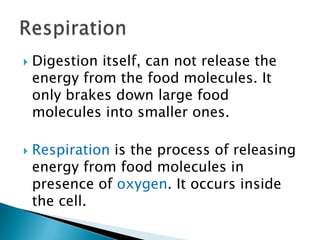
Digestion itself, can not release the energy from the food molecules. It only brakes down large food molecules into smaller ones.Respiration is the process of releasing energy from food molecules in presence of oxygen. It occurs inside the cell.Respiration
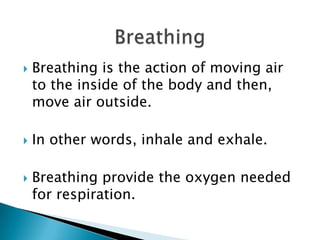
BreathingBreathing is the action of moving air to the inside of the body and then, move air outside.In other words, inhale and exhale. Breathing provide the oxygen needed for respiration.
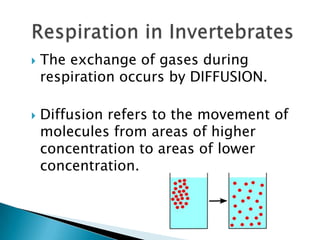
Respiration in Invertebrates The exchange of gases during respiration occurs by DIFFUSION.Diffusion refers to the movement of molecules from areas of higher concentration to areas of lower concentration.
DiffusionIf more oxygen can be found outside of an organism, it will move to the inside of the organism, where oxygen is found in lower concentration.
The same situation occurs inside of the body around the cells.Respiration in Invertebrates
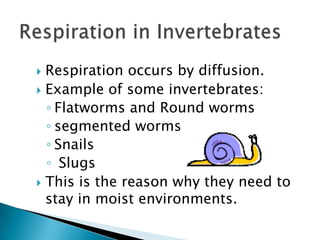
Respiration in InvertebratesRespiration occurs by diffusion.Example of some invertebrates:Flatworms and Round wormssegmented wormsSnails SlugsThis is the reason why they need to stay in moist environments.Respiration in InvertebratesInvertebrates like mollusk, crustaceans and some worms, also have gills with blood vessels near the surface.Other invertebrates have “book lungs”, a structure very similar to gills. Can be found in most arachnids.A trachea can be found in insects and most spiders to provide oxygen-rich air to the insect’s cells.
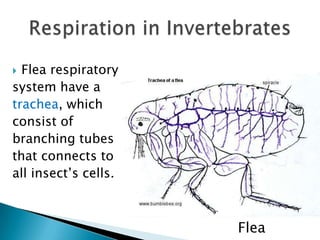
Flea respiratorysystem have atrachea, whichconsist ofbranching tubesthat connects to all insect’s cells.Respiration in InvertebratesFlea
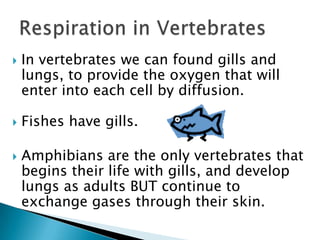
In vertebrates we can found gills and lungs, to provide the oxygen that will enter into each cell by diffusion.Fishes have gills.Amphibians are the only vertebrates that begins their life with gills, and develop lungs as adults BUT continue to exchange gases through their skin.Respiration in Vertebrates
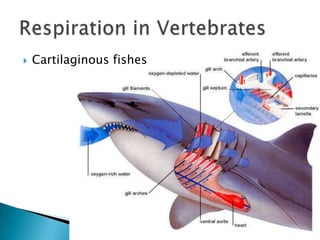
Cartilaginous fishesRespiration in Vertebrates
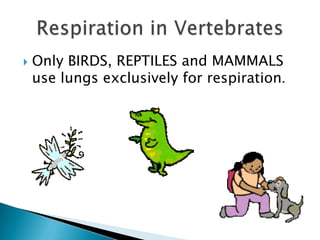
Only BIRDS, REPTILES and MAMMALS use lungs exclusively for respiration. Respiration in Vertebrates
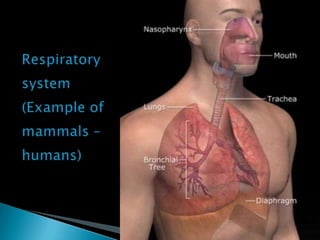
Respiratory system(Example of mammals – humans)
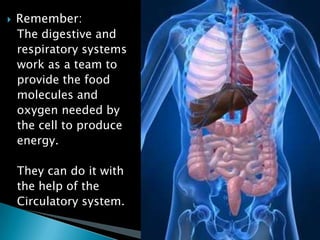
Remember:The digestive andrespiratory systemswork as a team toprovide the foodmolecules andoxygen needed bythe cell to produceenergy.They can do it withthe help of the Circulatory system.
CirculationThe movement of important materials such as oxygen, glucose, and wastes throughout the body.REMEMBER: Glucose is the simplest form of sugar, and the “food” need by the cell to carry out respiration.
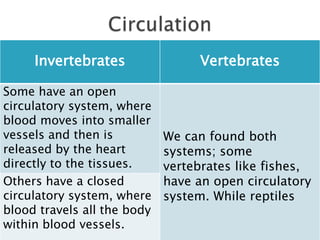
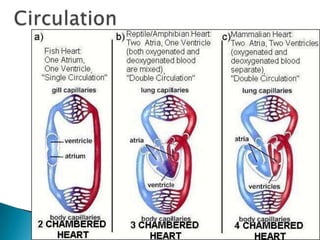
Circulation
Circulation
Body TemperatureCold-blooded animalsThe body temperature in cold-blooded animals changes with its environment.Examples:AmphibiansReptilesMost fishes
Body TemperatureWarm-blooded animalsThe body temperature in warm-blooded animals stays the same, no matter what happens with the temperature of the air. If the temperature become to hot, warm-blooded animals give off the excess heat perspiring or sweating.In cold climates, we found thick layers of blubber to keep heat from escaping the body. Ex. Whales
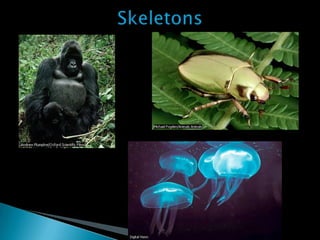
Support and MovementThere are three basic design that provide support and movement to animals:Hydrostatic skeleton (hydroskeleton) Exoskeleton Endoskeleton
Skeletons.

Animal Systems

  • 1.
  • 2.
    Animals need toobtain or ingest food from their environmentsIn order to release the energy stored in food, all animals perform:Digestion
  • 3.
    RespirationDigestion is theprocess in which food is broken down into molecules that can be use by cells.Digestion
  • 4.
    Invertebrates have simpledigestive systems. They can either:Filter foodHave one opening -(to move food in and wastes out)Have 2 openings (“tube within a tube”) -one to move food in, other to move wastes outDigestion in Invertebrates
  • 5.
    Digestion in InvertebratesSpongesbelong to phylum Porifera
  • 6.
  • 7.
    “Tube within atube” system – 2 openingsExample: Segmented worms-EarthwormDigestion in Invertebrates
  • 8.
    Digestion in VertebratesVertebrateshave complex digestive systems.They have many organs with different functions like crush, digest, absorb nutrients and water to obtain the energy from food.
  • 9.
  • 10.
  • 11.
  • 12.
  • 13.
  • 14.
    Excretion is theremoval of wastes from the body. Wastes have no value and may be poisonous to cells.Examples of wastes produced by animals:Carbon dioxideSalt excessWastes from undigested foodUrineExcretion
  • 15.
    The removal ofwastes is performed by many systems (or organs):Digestive System – eliminates the undigested with wastesRespiratory system – eliminates carbon dioxideSkin – eliminates salt excess and waterExcretion
  • 16.
  • 17.
    Digestion itself, cannot release the energy from the food molecules. It only brakes down large food molecules into smaller ones.Respiration is the process of releasing energy from food molecules in presence of oxygen. It occurs inside the cell.Respiration
  • 18.
    BreathingBreathing is theaction of moving air to the inside of the body and then, move air outside.In other words, inhale and exhale. Breathing provide the oxygen needed for respiration.
  • 19.
    Respiration in InvertebratesThe exchange of gases during respiration occurs by DIFFUSION.Diffusion refers to the movement of molecules from areas of higher concentration to areas of lower concentration.
  • 20.
    DiffusionIf more oxygencan be found outside of an organism, it will move to the inside of the organism, where oxygen is found in lower concentration.
  • 21.
    The same situationoccurs inside of the body around the cells.Respiration in Invertebrates
  • 22.
    Respiration in InvertebratesRespirationoccurs by diffusion.Example of some invertebrates:Flatworms and Round wormssegmented wormsSnails SlugsThis is the reason why they need to stay in moist environments.Respiration in InvertebratesInvertebrates like mollusk, crustaceans and some worms, also have gills with blood vessels near the surface.Other invertebrates have “book lungs”, a structure very similar to gills. Can be found in most arachnids.A trachea can be found in insects and most spiders to provide oxygen-rich air to the insect’s cells.
  • 23.
    Flea respiratorysystem haveatrachea, whichconsist ofbranching tubesthat connects to all insect’s cells.Respiration in InvertebratesFlea
  • 24.
    In vertebrates wecan found gills and lungs, to provide the oxygen that will enter into each cell by diffusion.Fishes have gills.Amphibians are the only vertebrates that begins their life with gills, and develop lungs as adults BUT continue to exchange gases through their skin.Respiration in Vertebrates
  • 25.
  • 26.
    Only BIRDS, REPTILESand MAMMALS use lungs exclusively for respiration. Respiration in Vertebrates
  • 27.
    Respiratory system(Example ofmammals – humans)
  • 28.
    Remember:The digestive andrespiratorysystemswork as a team toprovide the foodmolecules andoxygen needed bythe cell to produceenergy.They can do it withthe help of the Circulatory system.
  • 29.
    CirculationThe movement ofimportant materials such as oxygen, glucose, and wastes throughout the body.REMEMBER: Glucose is the simplest form of sugar, and the “food” need by the cell to carry out respiration.
  • 30.
  • 31.
  • 32.
    Body TemperatureCold-blooded animalsThebody temperature in cold-blooded animals changes with its environment.Examples:AmphibiansReptilesMost fishes
  • 33.
    Body TemperatureWarm-blooded animalsThebody temperature in warm-blooded animals stays the same, no matter what happens with the temperature of the air. If the temperature become to hot, warm-blooded animals give off the excess heat perspiring or sweating.In cold climates, we found thick layers of blubber to keep heat from escaping the body. Ex. Whales
  • 34.
    Support and MovementThereare three basic design that provide support and movement to animals:Hydrostatic skeleton (hydroskeleton) Exoskeleton Endoskeleton
  • 35.