Digestive System Types of Digestion Structural Variation in  Invertebrates
Digestive System series of connected organs whose purpose is to break down, or digest, the food we eat.  Food is made up of large, complex molecules, which the digestive system breaks down into smaller, simple molecules that can be absorbed into the bloodstream. The simple molecules travel through the bloodstream to all of the body's cells, which use them for growth, repair, and energy.
All animals have a digestive system, a feature that  distinguishes them from plants. But animals,  including humans, must take in food in the form of organic matter, such as plants or other animals.  Digestion generally involves two phases:  In the  mechanical phase , teeth or other  structures physically break down large pieces  of food into smaller pieces.  In the  chemical phase , digestive chemicals  called enzymeS break apart individual  molecules of food to yield molecules that can  be absorbed and distributed throughout the  body. These enzymes are secreted by glands in  the body.
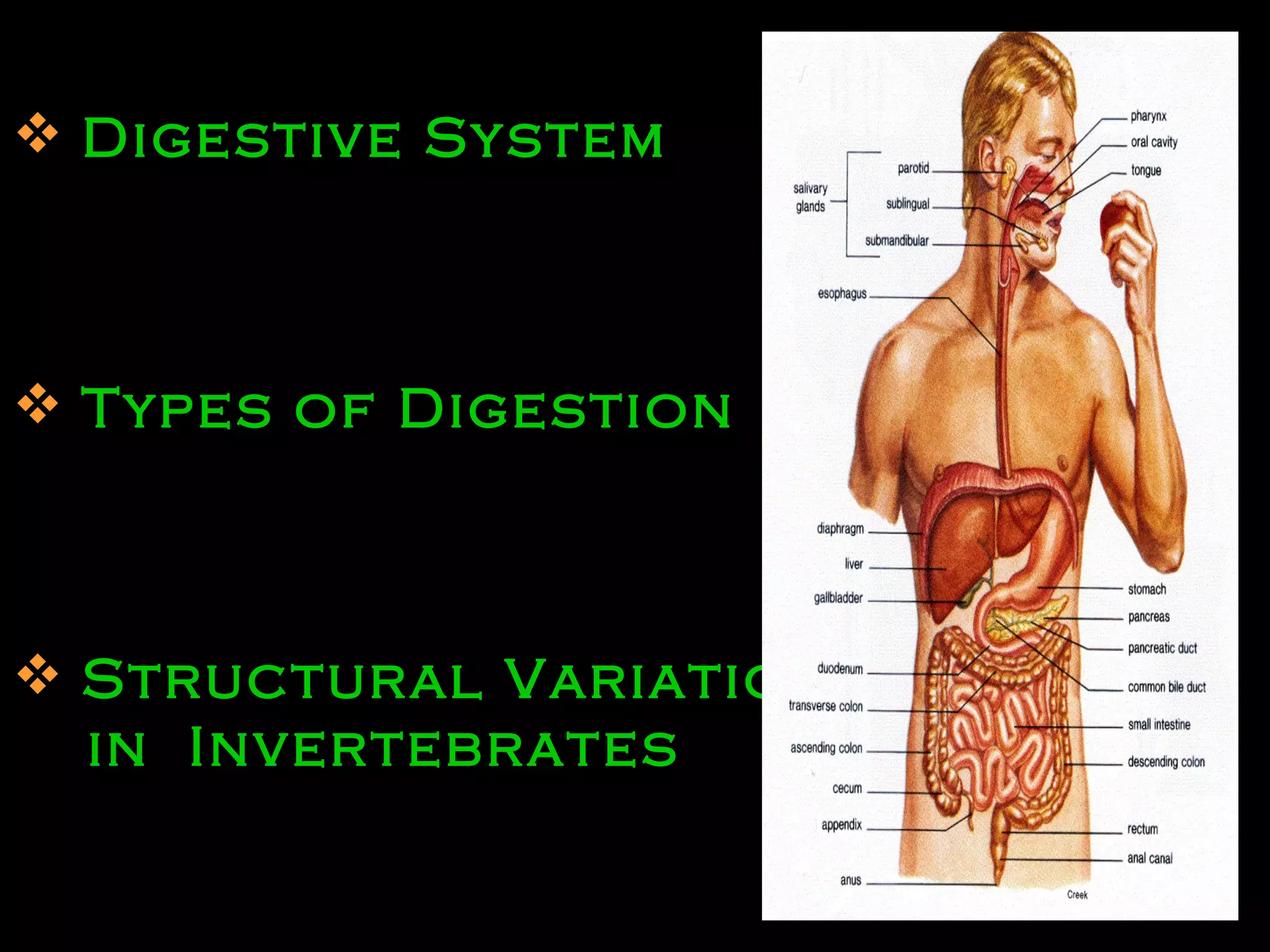
The digestive system of most animals consists mainly of a long, continuous tube called the  alimentary canal, or digestive tract . This canal has a  mouth  at one end, through which food is taken in, and an  anus  at the other end, through which digestive wastes are excreted. Muscles in the walls of the alimentary canal move the food along. Most digestive organs are part of the alimentary canal. However, two accessory digestive organs, the liver and pancreas, are located outside the alimentary canal. These organs contribute to chemical digestion by releasing digestive juices into the canal through tubes called ducts.
Types of Digestion Intracellular Digestion The simplest invertebrates  (animals without backbones)  do not have specialized  digestive organs. Single-celled  organisms, such as amoebas,  rely on  intracellular digestion   (digestion within the cell).
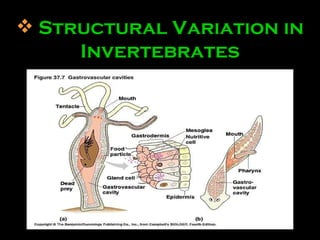
more complex organisms require systems that are more specialized. Animals such as jellyfish and nonparasitic flatworms combine the intracellular process with some specialized digestive organs. These animals have a definite mouth and a saclike cavity, which is lined with digestive cells that secrete enzymes. Digestion begins when the enzymes break down food inside the cavity in an extracellular process. Cells then engulf the partly digested food, and an intracellular completes digestion. Wastes are excreted through the mouth.
Extracellular Digestion Most of the more complex invertebrates and all  vertebrates  (animals with a backbone) digest food entirely through  extracellular  (digestion outside the cell)  processes.  Food moves in one direction, from mouth to anus, through the series of organs that make up the alimentary canal. Specialization of various parts of the alimentary canal improves the body’s ability to break down food and absorb various kinds of nutrients.
The mouth of many animals contains  teeth  or other structures to break up large lumps of food. Behind the mouth, the  pharynx  and  esophagus  swallow the food and move it to the stomach. The  stomach  temporarily stores the food, mixes it with digestive juices, and carries out some digestion. Digestion is completed in the  intestine . The liver and pancreas pour their digestive juices into the anterior end of this organ. After the anterior intestine absorbs the usable products of digestion, the walls of the posterior intestine absorb leftover water.
In vertebrates the anterior intestine is called the  small intestine ; the posterior intestine is the  large intestine .  Feces , composed of unabsorbed and indigestible food residues, form in the posterior intestine, where they are stored until they are excreted through the anus. Within this basic plan, the specific components of the digestive system vary enormously from one animal to another.
For example:  a fish’s pharynx contains gill slits for  breathing but has no digestive function.
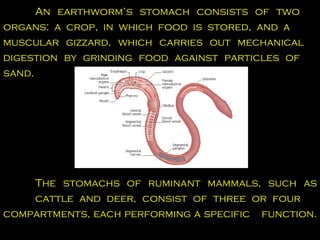
An earthworm’s stomach consists of two  organs: a crop, in which food is stored, and a  muscular gizzard, which carries out mechanical  digestion by grinding food against particles of  sand.  The stomachs of ruminant mammals, such as  cattle and deer, consist of three or four  compartments, each performing a specific  function.
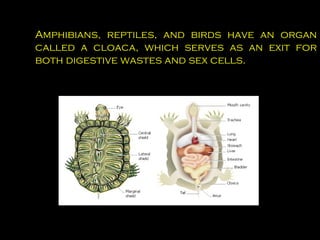
Amphibians, reptiles, and birds have an organ  called a cloaca, which serves as an exit for  both digestive wastes and sex cells.
Structural Variation in Invertebrates
Saclike Systems in Invertebrates   Sponges sort food particles out of sea water brought by  choanocytes (collar cells).   Particles caught in the mucus lined collar cells are phagocytized by the cells bellow for intracellular digestion and transported about by  amebocytes .  Coelenterates and flatworms begin digestion extracellularly in the  gastrovascular cavity , with food phagocytized ands digestion completed in intracellularly.
Feeding and Digestive Structures  in  Higher Invertebrates   Higher invertebrates have the tube-within-a-tube body plan digestion is mainly extracellular. Intracellular digestion occurs in the invertebrate liver, which is lined by phagocytic cells.  The earthworm gut contains specialized regions.  Food is swallowed by the  pharynx  and passes through the  esophagus  to the  crop  for storage. Grinding occurs in the  gizzard , and digestion and absorption occur in the long  intestine . 
The  typhlosole , a deep fold in the intestinal wall, increases surface area.   Chloragen  cells convert glucose to glycogen and deaminate amino acids to be used as fuels.  The grasshopper's chewing mouth parts include sensory palps, shearing mandibles and maxillae, the liplike labrum and labium, and salivary glands that secrete saliva.  The digestive system includes a  foregut  consisting of a pharynx, esophagus, and crop for swallowing and grinding, a  midgut  for digestion and absorption,  gastric cecae  for enzyme secretion, and a water-absorbing  hindgut .  Insect mouth parts are also adapted for piercing and sucking.

Digestive system ii

  • 1.
    Digestive System Typesof Digestion Structural Variation in Invertebrates
  • 2.
    Digestive System seriesof connected organs whose purpose is to break down, or digest, the food we eat. Food is made up of large, complex molecules, which the digestive system breaks down into smaller, simple molecules that can be absorbed into the bloodstream. The simple molecules travel through the bloodstream to all of the body's cells, which use them for growth, repair, and energy.
  • 3.
    All animals havea digestive system, a feature that distinguishes them from plants. But animals, including humans, must take in food in the form of organic matter, such as plants or other animals. Digestion generally involves two phases: In the mechanical phase , teeth or other structures physically break down large pieces of food into smaller pieces. In the chemical phase , digestive chemicals called enzymeS break apart individual molecules of food to yield molecules that can be absorbed and distributed throughout the body. These enzymes are secreted by glands in the body.
  • 4.
    The digestive systemof most animals consists mainly of a long, continuous tube called the alimentary canal, or digestive tract . This canal has a mouth at one end, through which food is taken in, and an anus at the other end, through which digestive wastes are excreted. Muscles in the walls of the alimentary canal move the food along. Most digestive organs are part of the alimentary canal. However, two accessory digestive organs, the liver and pancreas, are located outside the alimentary canal. These organs contribute to chemical digestion by releasing digestive juices into the canal through tubes called ducts.
  • 5.
    Types of DigestionIntracellular Digestion The simplest invertebrates (animals without backbones) do not have specialized digestive organs. Single-celled organisms, such as amoebas, rely on intracellular digestion (digestion within the cell).
  • 6.
    more complex organismsrequire systems that are more specialized. Animals such as jellyfish and nonparasitic flatworms combine the intracellular process with some specialized digestive organs. These animals have a definite mouth and a saclike cavity, which is lined with digestive cells that secrete enzymes. Digestion begins when the enzymes break down food inside the cavity in an extracellular process. Cells then engulf the partly digested food, and an intracellular completes digestion. Wastes are excreted through the mouth.
  • 7.
    Extracellular Digestion Mostof the more complex invertebrates and all vertebrates (animals with a backbone) digest food entirely through extracellular (digestion outside the cell) processes. Food moves in one direction, from mouth to anus, through the series of organs that make up the alimentary canal. Specialization of various parts of the alimentary canal improves the body’s ability to break down food and absorb various kinds of nutrients.
  • 8.
    The mouth ofmany animals contains teeth or other structures to break up large lumps of food. Behind the mouth, the pharynx and esophagus swallow the food and move it to the stomach. The stomach temporarily stores the food, mixes it with digestive juices, and carries out some digestion. Digestion is completed in the intestine . The liver and pancreas pour their digestive juices into the anterior end of this organ. After the anterior intestine absorbs the usable products of digestion, the walls of the posterior intestine absorb leftover water.
  • 9.
    In vertebrates theanterior intestine is called the small intestine ; the posterior intestine is the large intestine . Feces , composed of unabsorbed and indigestible food residues, form in the posterior intestine, where they are stored until they are excreted through the anus. Within this basic plan, the specific components of the digestive system vary enormously from one animal to another.
  • 10.
    For example: a fish’s pharynx contains gill slits for breathing but has no digestive function.
  • 11.
    An earthworm’s stomachconsists of two organs: a crop, in which food is stored, and a muscular gizzard, which carries out mechanical digestion by grinding food against particles of sand. The stomachs of ruminant mammals, such as cattle and deer, consist of three or four compartments, each performing a specific function.
  • 12.
    Amphibians, reptiles, andbirds have an organ called a cloaca, which serves as an exit for both digestive wastes and sex cells.
  • 13.
  • 14.
    Saclike Systems inInvertebrates Sponges sort food particles out of sea water brought by choanocytes (collar cells).   Particles caught in the mucus lined collar cells are phagocytized by the cells bellow for intracellular digestion and transported about by amebocytes . Coelenterates and flatworms begin digestion extracellularly in the gastrovascular cavity , with food phagocytized ands digestion completed in intracellularly.
  • 15.
    Feeding and DigestiveStructures in Higher Invertebrates Higher invertebrates have the tube-within-a-tube body plan digestion is mainly extracellular. Intracellular digestion occurs in the invertebrate liver, which is lined by phagocytic cells. The earthworm gut contains specialized regions.  Food is swallowed by the pharynx and passes through the esophagus to the crop for storage. Grinding occurs in the gizzard , and digestion and absorption occur in the long intestine . 
  • 16.
    The typhlosole, a deep fold in the intestinal wall, increases surface area.  Chloragen cells convert glucose to glycogen and deaminate amino acids to be used as fuels. The grasshopper's chewing mouth parts include sensory palps, shearing mandibles and maxillae, the liplike labrum and labium, and salivary glands that secrete saliva.  The digestive system includes a foregut consisting of a pharynx, esophagus, and crop for swallowing and grinding, a midgut for digestion and absorption, gastric cecae for enzyme secretion, and a water-absorbing hindgut .  Insect mouth parts are also adapted for piercing and sucking.