Vipin Singh PalPresenter :-
 What is IMRT
 Principle and goal of IMRT
 Why IMRT Used
 Intensity-Modulated Radiadiation Therapy
Planning
 IMRT Proceses
 Intensity –Modulated Radiation Therapy Delivery
 conclusion
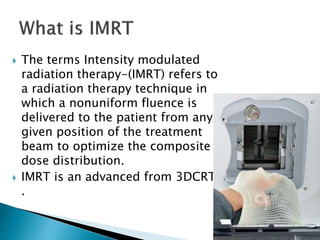
 The terms Intensity modulated
radiation therapy-(IMRT) refers to
a radiation therapy technique in
which a nonuniform fluence is
delivered to the patient from any
given position of the treatment
beam to optimize the composite
dose distribution.
 IMRT is an advanced from 3DCRT
.
 The principle of IMRT is to treat a patient
from a number of different directions with
beams of nonuniform fluence.
 The IMRT technique is currently the most
advanced from of conformal radiotherapy and
holds great promise for improving
radiotherapy both through increased tumour
control probability and decreased treatment
morbidity .i .e. decreased normal tissue
complication probability (NTCP).
 To improve target dose uniformity.
 To selectively avoided critical structure and
normal tissue.
 To create concave isodose surface of dose
area surrounded by high dose.
 Focal dose escalation to specific sub volume
in the target volume.
 Better sparing of critical structure specially
during reirradiation.
 Based on “Inverse planning”
1. Initially, a CT scan is performed on the
affected region.
2. A radiation oncologist defines the PTV
3. Enters the plan criteria: max dose, mini dose,
desired -limiting dose(for critical structures) and a
dose-volume histogram
4. Then, an optimisation program is run to find
the treatment plan which best matches all the
input criteria.
Intensity-Modulated Radiadiation Therapy
Planning
 Intensity modulated radiation therapy are
delivered by three technique.
 1-IMRT with fixed gantry angle
 2- IMRT with Tomotherapy based
 3 - IMRT With rotating cone beams
 For a given gantry angle ,a computer
controlled mulltileaf collimator is not only use
full in shaping beam apertures for
conventional radiotherapy.
 But ,it can also be programmed to deliver .
IMRT.
 This has been done in two different ways.
 A-segmental MLC Delivery
 B- Dynamic MLC Delivery
 In segmental MLC (SMLC) delivery the patients is
treated by multiple field and each field is
subdivided into a set of subfield with uniform
beam intensity level.
 The subfield are created by the MLC and
delivered in a stack arrangement one at a time in
sequence without operator intervention.
 The accelerator is turned off while the MLC
moves to create next subfield.
 This method of IMRT delivery is also called “step
and shoot OR stop and shoot
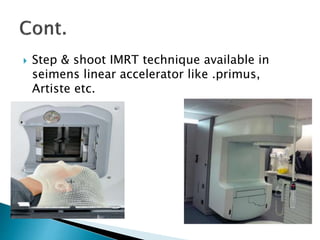
 Step & shoot IMRT technique available in
seimens linear accelerator like .primus,
Artiste etc.
 Advantage –
- Easy to plan ,delivery and to verify
- An interputted treatment is easy to resume
- Fewer MUs in comparison to DMLC
- Radiation leckage less as compare to DMLC
 Disadvantage-
- Slow dose delivery
- Treatment time is more (2-3 min/field)
 Unlike SMLC.
 In the dynamic OR sliding window mode ,the
leaves of MLC are moving during irradiation.
 Each pair of composing leaf sweeps across
target volumes under computer control.
 Advantage –
- Better dose homogeneity for target volume
- Shorter treatment time
 Disadvantage -
- Beams remains on through out –leakage
radiation increased
- Total MU required is more than that for SMLC
 Tomotherapy is an IMRT technique in which
the patients is treated by slice by slice by
intensity modulated beams in a manner
analogous to computer tomography (CT)
imaging.
 Tomotherapy is delivered in two ways
-slice based tomotherapy
-Helical tomotherapy
 The radiation is collimated to a
narrow fan beam defining a transaxial
slice of the patient.
 The multileaf intensity modulating
collimator (MIMiC) is retrofit to any
accelerator
 It consists of 2x20 finger attenuators
that can be driven into & out of the
field by electro pneumatic action for
variable dwell time to create spatial
modulation.
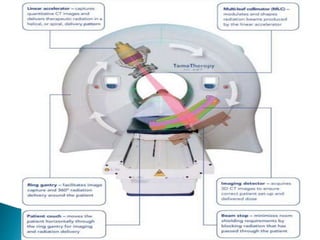
 This is a method of IMRT delivery in which the
linac head and gantry rotate with the patients
is translated through the doughnut – shaped
aperature in a manner analogous to helical ct
scanner.
 The tomotherapy unit also provides
megavoltage CT- scanning for image guided
radiation therapy.
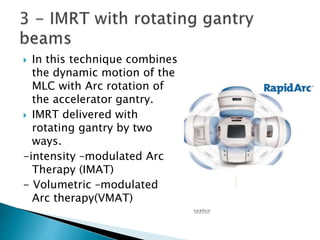
 In this technique combines
the dynamic motion of the
MLC with Arc rotation of
the accelerator gantry.
 IMRT delivered with
rotating gantry by two
ways.
-intensity –modulated Arc
Therapy (IMAT)
- Volumetric –modulated
Arc therapy(VMAT)
 Intensity-modulated arc therapy (IMAT) technique uses
MLC dynamically to shape fields as rotate gantry rotate
in an arc.
 IMAT, which uses five to seven overlapping concentric
arcs to deliver a conformal dose distribution
 Beam is ON all the time.
 VMAT is delivery of a rotational cone beam
with variable shape and intensity.
 In VMAT treatment gantry rotates
continuously with the MLC leaves and dose
rate varying throughout the arc.
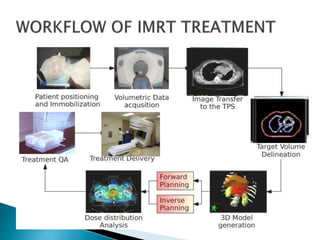
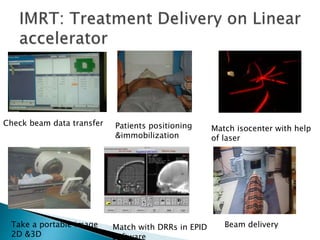
Check beam data transfer Patients positioning
&immobilization
Match isocenter with help
of laser
Take a portable image
2D &3D
Match with DRRs in EPID
Software
Beam delivery
 Dose distribution more homogenous within
PTV.
 Reduction of normal tissue dose.
 Radiobiological advantage.
 Selectively avoided critical structure and
tissue.
Imrt delivery

Imrt delivery

  • 1.
  • 2.
     What isIMRT  Principle and goal of IMRT  Why IMRT Used  Intensity-Modulated Radiadiation Therapy Planning  IMRT Proceses  Intensity –Modulated Radiation Therapy Delivery  conclusion
  • 3.
     The termsIntensity modulated radiation therapy-(IMRT) refers to a radiation therapy technique in which a nonuniform fluence is delivered to the patient from any given position of the treatment beam to optimize the composite dose distribution.  IMRT is an advanced from 3DCRT .
  • 4.
     The principleof IMRT is to treat a patient from a number of different directions with beams of nonuniform fluence.  The IMRT technique is currently the most advanced from of conformal radiotherapy and holds great promise for improving radiotherapy both through increased tumour control probability and decreased treatment morbidity .i .e. decreased normal tissue complication probability (NTCP).
  • 5.
     To improvetarget dose uniformity.  To selectively avoided critical structure and normal tissue.  To create concave isodose surface of dose area surrounded by high dose.  Focal dose escalation to specific sub volume in the target volume.  Better sparing of critical structure specially during reirradiation.
  • 6.
     Based on“Inverse planning” 1. Initially, a CT scan is performed on the affected region. 2. A radiation oncologist defines the PTV 3. Enters the plan criteria: max dose, mini dose, desired -limiting dose(for critical structures) and a dose-volume histogram 4. Then, an optimisation program is run to find the treatment plan which best matches all the input criteria. Intensity-Modulated Radiadiation Therapy Planning
  • 8.
     Intensity modulatedradiation therapy are delivered by three technique.  1-IMRT with fixed gantry angle  2- IMRT with Tomotherapy based  3 - IMRT With rotating cone beams
  • 9.
     For agiven gantry angle ,a computer controlled mulltileaf collimator is not only use full in shaping beam apertures for conventional radiotherapy.  But ,it can also be programmed to deliver . IMRT.  This has been done in two different ways.  A-segmental MLC Delivery  B- Dynamic MLC Delivery
  • 10.
     In segmentalMLC (SMLC) delivery the patients is treated by multiple field and each field is subdivided into a set of subfield with uniform beam intensity level.  The subfield are created by the MLC and delivered in a stack arrangement one at a time in sequence without operator intervention.  The accelerator is turned off while the MLC moves to create next subfield.  This method of IMRT delivery is also called “step and shoot OR stop and shoot
  • 11.
     Step &shoot IMRT technique available in seimens linear accelerator like .primus, Artiste etc.
  • 13.
     Advantage – -Easy to plan ,delivery and to verify - An interputted treatment is easy to resume - Fewer MUs in comparison to DMLC - Radiation leckage less as compare to DMLC  Disadvantage- - Slow dose delivery - Treatment time is more (2-3 min/field)
  • 14.
     Unlike SMLC. In the dynamic OR sliding window mode ,the leaves of MLC are moving during irradiation.  Each pair of composing leaf sweeps across target volumes under computer control.
  • 16.
     Advantage – -Better dose homogeneity for target volume - Shorter treatment time  Disadvantage - - Beams remains on through out –leakage radiation increased - Total MU required is more than that for SMLC
  • 17.
     Tomotherapy isan IMRT technique in which the patients is treated by slice by slice by intensity modulated beams in a manner analogous to computer tomography (CT) imaging.  Tomotherapy is delivered in two ways -slice based tomotherapy -Helical tomotherapy
  • 19.
     The radiationis collimated to a narrow fan beam defining a transaxial slice of the patient.  The multileaf intensity modulating collimator (MIMiC) is retrofit to any accelerator  It consists of 2x20 finger attenuators that can be driven into & out of the field by electro pneumatic action for variable dwell time to create spatial modulation.
  • 20.
     This isa method of IMRT delivery in which the linac head and gantry rotate with the patients is translated through the doughnut – shaped aperature in a manner analogous to helical ct scanner.  The tomotherapy unit also provides megavoltage CT- scanning for image guided radiation therapy.
  • 21.
     In thistechnique combines the dynamic motion of the MLC with Arc rotation of the accelerator gantry.  IMRT delivered with rotating gantry by two ways. -intensity –modulated Arc Therapy (IMAT) - Volumetric –modulated Arc therapy(VMAT)
  • 23.
     Intensity-modulated arctherapy (IMAT) technique uses MLC dynamically to shape fields as rotate gantry rotate in an arc.  IMAT, which uses five to seven overlapping concentric arcs to deliver a conformal dose distribution  Beam is ON all the time.
  • 24.
     VMAT isdelivery of a rotational cone beam with variable shape and intensity.  In VMAT treatment gantry rotates continuously with the MLC leaves and dose rate varying throughout the arc.
  • 25.
    Check beam datatransfer Patients positioning &immobilization Match isocenter with help of laser Take a portable image 2D &3D Match with DRRs in EPID Software Beam delivery
  • 26.
     Dose distributionmore homogenous within PTV.  Reduction of normal tissue dose.  Radiobiological advantage.  Selectively avoided critical structure and tissue.

Editor's Notes

  • #7 Dose volume histogram is to summarize 3D dose distributions in a graphical 2D format