Quality control and applications of
      Radiopharmaceuticals


                                Presented by
                                 Presented by
                                Savita patil
                                 Savita patil
                                M.Pharm IIIrd sem
                                 M.Pharm IIIrd sem
                                (Pharmaceutics)
                                 (Pharmaceutics)
                                Govt. college of pharmacy,
                                 Govt. college of pharmacy,
           Powerpoint Templates Aurangabad.
                                 Aurangabad.
                                                    Page 1
Snapshot
Snapshot


 Introduction

 QC of radiopharmaceuticals

 Applications

 References

                  Powerpoint Templates
                                         Page 2
Introduction


Radiopharmaceuticals are unique medicinal formulations
containing radioisotopes which are used in major clinical areas for
diagnosis and/or therapy.
A radiopharmaceutical contains a radioactive moiety with a
biodistribution moiety.
After administration radiophamaceutical localizes in a specific
organ/ tissue depending on biodistributing moiety.


                          Powerpoint Templates
                                                          Page 3
QC tests of
             QC tests of
       radiopharmaceuticals
        radiopharmaceuticals


QC of radiopharmaceuticals includes:
The purity
Potency
Biologic safety
Sterility and
Efficacy of the radiopharmaceuticals.
The tests should be faster and effective since
radionuclide
have short half life.
                           Powerpoint Templates
                                                  Page 4
The QC tests for most of the radiopharmaceuticals are

mentioned in pharmacopoeia (EP, BP, etc)

The quality control system should include a procedure which

describes measures to be taken if unsatisfactory test results are

obtained.


                         Powerpoint Templates
                                                             Page 5
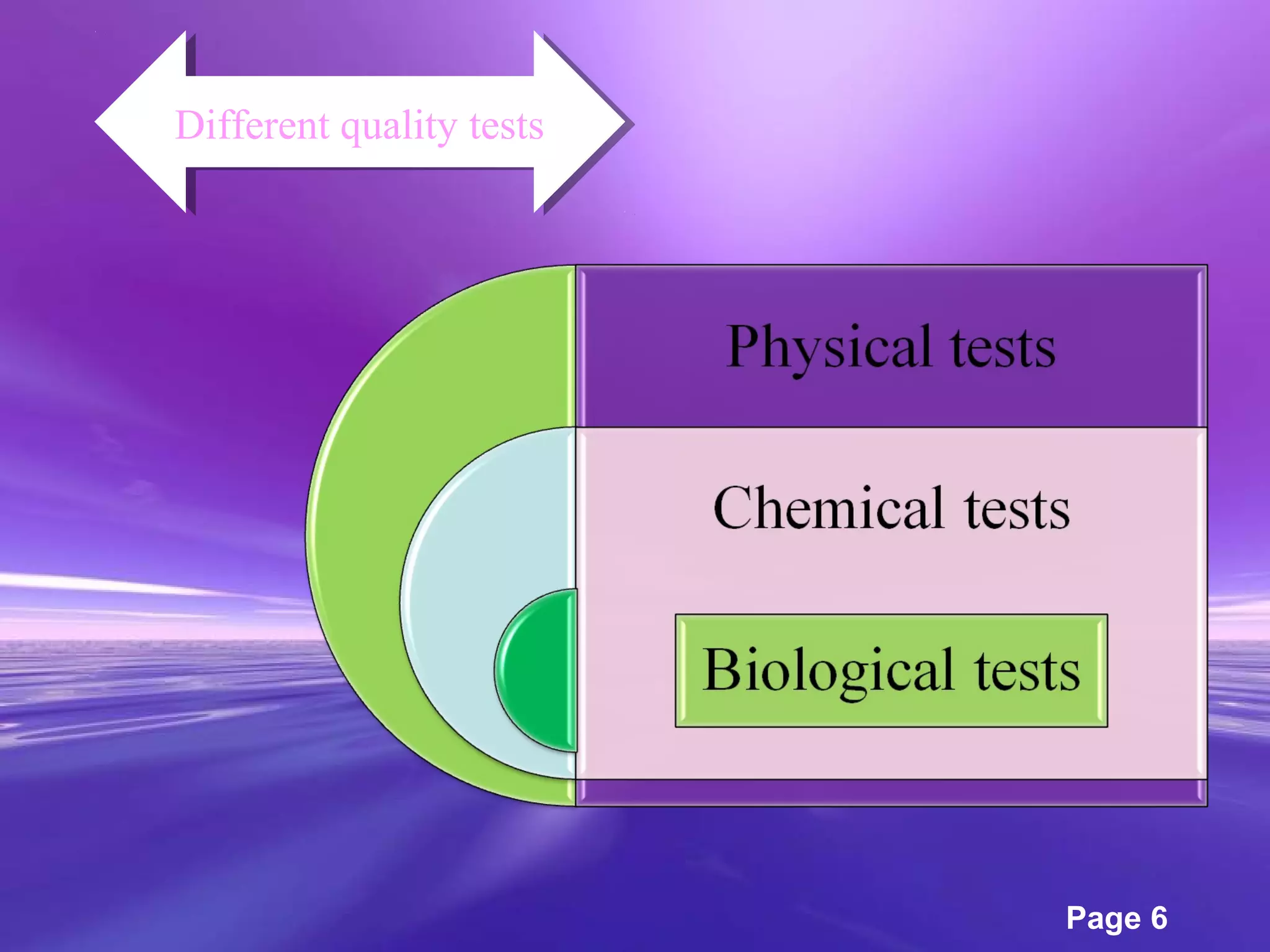
Different quality tests


                  Powerpoint Templates
                                         Page 6
Parameters of each test
 Parameters of each test


                           Powerpoint Templates
                                                  Page 7
A. Physical tests
      A. Physical tests


1.pH and ionic strength:
   Ideally pH should be 7.4, but it can vary from 2-9.
     Correct ionic strength achieved by addition of an acid or
    alkali.
2. Physical characteristics:
   Recognize the color and state of a radiopharmaceuticals
   Colloidal or aggregated preparations : Identify size by
    microscope with haemocytometer.
                          Powerpoint Templates
                                                              Page 8
Importance of particle size determination
 Importance of particle size determination


Size of particles will determine the site where the

radiopharmaceutical will get localized.

E.g. 99mTc MAA, Tc-labeled albumin microspheres : 10

to 100 µm

If>100µm: cause pulmonary embolism

If <10 µm: Deposits in the reticuloendothelial cells.
                           Powerpoint Templates
                                                         Page 9
B. Radiochemical tests


    1.   Radionuclidic Purity:
         % of the total radioactivity that is present in the
         form of the stated specified radionuclide
        Determined by measuring the half-lives and
         characteristic radiations emitted by individual
         radionuclides.
        γ-ray emission radionuclides : checked with
         multi-channel analyzer
        Pure β emission radionuclides : checked with β-
         spectrometer or a liquid scintillation counter


                         Powerpoint Templates
                                                                Page 10
2. Radiochemical purity:

It is the proportion of the radionuclide present in the stated chemical form.

Radiochemical purity can be determined any separation technique, and

measurement of radioactivity.
% RCP= radioactivity in the desired chemical/ radioactivity of total

radiopharmaceutical x 100
Radiochemical impurities may arise from decomposition due to:
  (1) action of solvent
 (2) change in temperature or pH
 (3) light
 (4) presence of oxidizing or reducing agents
 (5) radiolysis


                                Powerpoint Templates
                                                                                 Page 11
Powerpoint Templates
                       Page 12
TLC of radiopharmaceuticals

Radiopharmaceutical       Stationary phase   Mobile phase


14
     C-urea               cellulose          butanol-water-acetic acid (12:5:3)


123/131
        I-hippuran        Silica gel         chloroform-acetic acid (9:1)


131
      I-iodocholesterol   Silica gel         chloroform-ethanol (1:1)


111
      In-octreotide       Silica gel         0.1 M citrate buffer pH 5

123
      I-iomazenil         Silica gel        ethyl acetate-ammonia
                                            (200:1)
                            Powerpoint Templates
                                                                     Page 13
Radioactivity


Necessary to determine since radioactivity will determine the radiation
dose to each patient.
It is expressed in SI unit Bequrrels (Bq) or Curie, a non SI unit.
Where 1 Bq=1 disintegration/sec
Activity determinations are carried out by isotope dose calibrator.
Calibration of dose calibrator Should be done by a reference source,
e.g. Co 57,Ra-226 or Cs-137


                        Powerpoint Templates
                                                                  Page 14
Radioactivity Testing


                        Powerpoint Templates
                                               Page 15
1. Geiger Muller counter


Principle: Property to cause ionization of a gas,e.g. Argon.
Beta particles enter the G-M tube through Mica window


  Argon gas is ionized


 Argon ions are attracted to negative electrode.


  Process continues and net result is to ionize whole vol. of tube equivalent to
current


          Amplification          Digital/ audio output

                             Powerpoint Templates
                                                                            Page 16
Geiger Muller counter


               Powerpoint Templates
                                      Page 17
Conti……………….


Advantage:

             It provides a high output

Disadvantage:

             Efficiencies are low for low energy Beta emitters e.g. 3H.


                             Powerpoint Templates
                                                                          Page 18
2. Liquid scintillation counter


Principle: Property of radiation to cause fluorescence.

Advantage: can be used for low energy beta emitters, e.g. 3H and 14C.

Problem :

1. sample preparation: Requirement to have a clear solution or

dispersion in non aqueous solvent.

2. variable quenching: may reduce efficiency.


                      Powerpoint Templates
                                                                 Page 19
Method


Sample is dissolved in solvent with a scintillant material, e.g. Diphenyloxazole


Ionizing radiation(B particles) transfers energy from solvent to scintillant
molecule


Molecules are excited to higher state and latter on fluoresce with emission of
light


                   Detected by photomultiplier


                            Powerpoint Templates
                                                                         Page 20
Liquid Scintillaton Counter


                      Powerpoint Templates
                                             Page 21
Isotope dilution analysis:


• General two methods:

• 1.Direct method: Determination of an inactive compound by
  dilution with a radioactive compound.
• 2.Reverse method: Involves the estimation of radionuclide by
  dilution with an inactive nuclide


                           Powerpoint Templates
                                                        Page 22
C. Biological tests


  1. Sterility:
   1. Sterility:
      Sterility: It is complete absence of live micro organisms and its spores.
         Sterility: It is complete absence of live micro organisms and its spores.
      Methods used:
        Methods used:


   Procedure: incubate radiopharmaceutical with growth medium
   Procedure: incubate radiopharmaceutical with growth medium
        containing 14C glucose.
         containing 14C glucose.


       Bacteria (if any) will metabolize glucose releasing 14CO2.2.
       Bacteria (if any) will metabolize glucose releasing 14CO


       Detection of amounts of radioactivity greater than background indicates
       Detection of amounts of radioactivity greater than background indicates
        bacterial growth.
         bacterial growth.

                             Powerpoint Templates
                                                                            Page 23
Cont…


2. Incubate the radiopharmaceutical sample in fluid thioglycolate
 2. Incubate the radiopharmaceutical sample in fluid thioglycolate

medium at 30to 35ºC for 7 to 14 days For detection of anaerobic bacteria,

or
 or

3. Soyabean-casein digest medium for incubation at20 to 25ºC for 7 to 14
 3. Soyabean-casein digest medium for incubation at20 to 25ºC for 7 to 14

days. For detection of fungi and aerobic bacteria.
 days. For detection of fungi and aerobic bacteria.

  And growth of micro organisms is seen.
  And growth of micro organisms is seen.


                         Powerpoint Templates
                                                                 Page 24
2. Pyrogen testing


LAL(Limulus ambeocyte lysate) test can be used.
 LAL (Limulus ambeocyte lysate) test can be used.

Methodinvolves incubation of product with lysate of circulating ambeocytes
 Method involves incubation of product with lysate of circulating ambeocytes

of aahorseshoe crab (Limulus polyphenus) . .
 of horseshoe crab (Limulus polyphenus)


  Presence of pyrogens will cause the lysate to form the gel.
   Presence of pyrogens will cause the lysate to form the gel.


                        Powerpoint Templates
                                                                    Page 25
3. Biodistribution


Importantto determine that the agent does localize in the organ of
 Important to determine that the agent does localize in the organ of
interest.
 interest.
Procedure:
 Procedure:
  Administration of radiopharmaceutical in animals
  Administration of radiopharmaceutical in animals


  Ascertain the relative quantity of radioactivity in various organs.
  Ascertain the relative quantity of radioactivity in various organs.


                           Powerpoint Templates
                                                                        Page 26
Other QC tests


Apart from above mentioned tests the final product container should be
checked for proper labeling prior to release of product.
Written procedure should be for dealing with products failing to meet the
required standard.
 investigation         measures taken to prevent future events
                  documented.
Release can only be effected if:
The product complies with the specifications
 The product has been prepared according to Good Radiopharmacy Practice

                            Powerpoint Templates
                                                                             Page 27
Labelling :


                       •   the name of the product and the name of the radionuclide;
                       •   any product identification code;
                       •   the name of the manufacturer;
                       •   an identification number (batch number);
The label on the       •    for liquid preparations, the total radioactivity in the container, or the
outer package              radioactive
                       •   concentration per millilitre, at a stated date and, if necessary, hour,
should include :           and the volume of liquid in container;
                       •   for solid preparations, such as freeze-dried preparations, the total
                           radioactivity at a
                       •   stated date and, if necessary, hour;
                       •    for capsules, the radioactivity of each capsule at a stated date and, if
                           necessary, hour and the number of capsules in the container;
                       •    where relevant, the international symbol for radioactivity.


                           Powerpoint Templates
                                                                                   Page 28
Applications of Radiopharmaceuticals


                   Powerpoint Templates
                                          Page 29
Powerpoint Templates
                       Page 30
Therapeutic Applicatios
                                    Of
                            Radiopharmaceuticals


Radiolabelled Molecules                 Disease

Chromic Phosphate P32                   For Lung, Ovarian, Uterine, And
                                        Prostate Cancers

Sodium Iodide I 131                     Thyroid Cancer

Samarium Sm 153                         Cancerous Bone Tissue

Sodium Phosphate P 32                   Cancerous Bone Tissue And Other
                                        Types Of Cancers


Strontium Chloride Sr 89                Cancerous Bone Tissue

                           Powerpoint Templates
                                                                  Page 31
References


1.   www.scribd.com

2.   Beckett A.H., Stenlake J.B.; “Practical pharmaceutical chemistry”;4 th

     edition; CBS publication; pg. no. 509-511.

3.   IP 2007; vol 1.;2.2.12; , pg.no. 53-54.

4.   “The radiopharmacy-A technologist’s guide”; pg.no.22


                           Powerpoint Templates
                                                                     Page 32
Powerpoint Templates
                       Page 33

Qc of radiopharmaceuticals

  • 1.
    Quality control andapplications of Radiopharmaceuticals Presented by Presented by Savita patil Savita patil M.Pharm IIIrd sem M.Pharm IIIrd sem (Pharmaceutics) (Pharmaceutics) Govt. college of pharmacy, Govt. college of pharmacy, Powerpoint Templates Aurangabad. Aurangabad. Page 1
  • 2.
    Snapshot Snapshot Introduction QCof radiopharmaceuticals Applications References Powerpoint Templates Page 2
  • 3.
    Introduction Radiopharmaceuticals are uniquemedicinal formulations containing radioisotopes which are used in major clinical areas for diagnosis and/or therapy. A radiopharmaceutical contains a radioactive moiety with a biodistribution moiety. After administration radiophamaceutical localizes in a specific organ/ tissue depending on biodistributing moiety. Powerpoint Templates Page 3
  • 4.
    QC tests of QC tests of radiopharmaceuticals radiopharmaceuticals QC of radiopharmaceuticals includes: The purity Potency Biologic safety Sterility and Efficacy of the radiopharmaceuticals. The tests should be faster and effective since radionuclide have short half life. Powerpoint Templates Page 4
  • 5.
    The QC testsfor most of the radiopharmaceuticals are mentioned in pharmacopoeia (EP, BP, etc) The quality control system should include a procedure which describes measures to be taken if unsatisfactory test results are obtained. Powerpoint Templates Page 5
  • 6.
    Different quality tests Differentquality tests Powerpoint Templates Page 6
  • 7.
    Parameters of eachtest Parameters of each test Powerpoint Templates Page 7
  • 8.
    A. Physical tests A. Physical tests 1.pH and ionic strength:  Ideally pH should be 7.4, but it can vary from 2-9.  Correct ionic strength achieved by addition of an acid or alkali. 2. Physical characteristics:  Recognize the color and state of a radiopharmaceuticals  Colloidal or aggregated preparations : Identify size by microscope with haemocytometer. Powerpoint Templates Page 8
  • 9.
    Importance of particlesize determination Importance of particle size determination Size of particles will determine the site where the radiopharmaceutical will get localized. E.g. 99mTc MAA, Tc-labeled albumin microspheres : 10 to 100 µm If>100µm: cause pulmonary embolism If <10 µm: Deposits in the reticuloendothelial cells. Powerpoint Templates Page 9
  • 10.
    B. Radiochemical tests B.Radiochemical tests 1. Radionuclidic Purity:  % of the total radioactivity that is present in the form of the stated specified radionuclide  Determined by measuring the half-lives and characteristic radiations emitted by individual radionuclides.  γ-ray emission radionuclides : checked with multi-channel analyzer  Pure β emission radionuclides : checked with β- spectrometer or a liquid scintillation counter Powerpoint Templates Page 10
  • 11.
    2. Radiochemical purity: Itis the proportion of the radionuclide present in the stated chemical form. Radiochemical purity can be determined any separation technique, and measurement of radioactivity. % RCP= radioactivity in the desired chemical/ radioactivity of total radiopharmaceutical x 100 Radiochemical impurities may arise from decomposition due to: (1) action of solvent (2) change in temperature or pH (3) light (4) presence of oxidizing or reducing agents (5) radiolysis Powerpoint Templates Page 11
  • 12.
  • 13.
    TLC of radiopharmaceuticals Radiopharmaceutical Stationary phase Mobile phase 14 C-urea cellulose butanol-water-acetic acid (12:5:3) 123/131 I-hippuran Silica gel chloroform-acetic acid (9:1) 131 I-iodocholesterol Silica gel chloroform-ethanol (1:1) 111 In-octreotide Silica gel 0.1 M citrate buffer pH 5 123 I-iomazenil Silica gel ethyl acetate-ammonia (200:1) Powerpoint Templates Page 13
  • 14.
    Radioactivity Necessary to determinesince radioactivity will determine the radiation dose to each patient. It is expressed in SI unit Bequrrels (Bq) or Curie, a non SI unit. Where 1 Bq=1 disintegration/sec Activity determinations are carried out by isotope dose calibrator. Calibration of dose calibrator Should be done by a reference source, e.g. Co 57,Ra-226 or Cs-137 Powerpoint Templates Page 14
  • 15.
    Radioactivity Testing Powerpoint Templates Page 15
  • 16.
    1. Geiger Mullercounter Principle: Property to cause ionization of a gas,e.g. Argon. Beta particles enter the G-M tube through Mica window Argon gas is ionized Argon ions are attracted to negative electrode. Process continues and net result is to ionize whole vol. of tube equivalent to current Amplification Digital/ audio output Powerpoint Templates Page 16
  • 17.
    Geiger Muller counter Powerpoint Templates Page 17
  • 18.
    Conti………………. Advantage: It provides a high output Disadvantage: Efficiencies are low for low energy Beta emitters e.g. 3H. Powerpoint Templates Page 18
  • 19.
    2. Liquid scintillationcounter Principle: Property of radiation to cause fluorescence. Advantage: can be used for low energy beta emitters, e.g. 3H and 14C. Problem : 1. sample preparation: Requirement to have a clear solution or dispersion in non aqueous solvent. 2. variable quenching: may reduce efficiency. Powerpoint Templates Page 19
  • 20.
    Method Sample is dissolvedin solvent with a scintillant material, e.g. Diphenyloxazole Ionizing radiation(B particles) transfers energy from solvent to scintillant molecule Molecules are excited to higher state and latter on fluoresce with emission of light Detected by photomultiplier Powerpoint Templates Page 20
  • 21.
    Liquid Scintillaton Counter Powerpoint Templates Page 21
  • 22.
    Isotope dilution analysis: •General two methods: • 1.Direct method: Determination of an inactive compound by dilution with a radioactive compound. • 2.Reverse method: Involves the estimation of radionuclide by dilution with an inactive nuclide Powerpoint Templates Page 22
  • 23.
    C. Biological tests 1. Sterility: 1. Sterility:  Sterility: It is complete absence of live micro organisms and its spores. Sterility: It is complete absence of live micro organisms and its spores.  Methods used: Methods used:  Procedure: incubate radiopharmaceutical with growth medium  Procedure: incubate radiopharmaceutical with growth medium containing 14C glucose. containing 14C glucose. Bacteria (if any) will metabolize glucose releasing 14CO2.2. Bacteria (if any) will metabolize glucose releasing 14CO Detection of amounts of radioactivity greater than background indicates Detection of amounts of radioactivity greater than background indicates bacterial growth. bacterial growth. Powerpoint Templates Page 23
  • 24.
    Cont… 2. Incubate theradiopharmaceutical sample in fluid thioglycolate 2. Incubate the radiopharmaceutical sample in fluid thioglycolate medium at 30to 35ºC for 7 to 14 days For detection of anaerobic bacteria, medium at 30to 35ºC for 7 to 14 days For detection of anaerobic bacteria, or or 3. Soyabean-casein digest medium for incubation at20 to 25ºC for 7 to 14 3. Soyabean-casein digest medium for incubation at20 to 25ºC for 7 to 14 days. For detection of fungi and aerobic bacteria. days. For detection of fungi and aerobic bacteria. And growth of micro organisms is seen. And growth of micro organisms is seen. Powerpoint Templates Page 24
  • 25.
    2. Pyrogen testing LAL(Limulusambeocyte lysate) test can be used. LAL (Limulus ambeocyte lysate) test can be used. Methodinvolves incubation of product with lysate of circulating ambeocytes Method involves incubation of product with lysate of circulating ambeocytes of aahorseshoe crab (Limulus polyphenus) . . of horseshoe crab (Limulus polyphenus) Presence of pyrogens will cause the lysate to form the gel. Presence of pyrogens will cause the lysate to form the gel. Powerpoint Templates Page 25
  • 26.
    3. Biodistribution Importantto determinethat the agent does localize in the organ of Important to determine that the agent does localize in the organ of interest. interest. Procedure: Procedure: Administration of radiopharmaceutical in animals Administration of radiopharmaceutical in animals Ascertain the relative quantity of radioactivity in various organs. Ascertain the relative quantity of radioactivity in various organs. Powerpoint Templates Page 26
  • 27.
    Other QC tests Apartfrom above mentioned tests the final product container should be checked for proper labeling prior to release of product. Written procedure should be for dealing with products failing to meet the required standard.  investigation measures taken to prevent future events documented. Release can only be effected if: The product complies with the specifications  The product has been prepared according to Good Radiopharmacy Practice Powerpoint Templates Page 27
  • 28.
    Labelling : • the name of the product and the name of the radionuclide; • any product identification code; • the name of the manufacturer; • an identification number (batch number); The label on the • for liquid preparations, the total radioactivity in the container, or the outer package radioactive • concentration per millilitre, at a stated date and, if necessary, hour, should include : and the volume of liquid in container; • for solid preparations, such as freeze-dried preparations, the total radioactivity at a • stated date and, if necessary, hour; • for capsules, the radioactivity of each capsule at a stated date and, if necessary, hour and the number of capsules in the container; • where relevant, the international symbol for radioactivity. Powerpoint Templates Page 28
  • 29.
    Applications of Radiopharmaceuticals Powerpoint Templates Page 29
  • 30.
  • 31.
    Therapeutic Applicatios Of Radiopharmaceuticals Radiolabelled Molecules Disease Chromic Phosphate P32 For Lung, Ovarian, Uterine, And Prostate Cancers Sodium Iodide I 131 Thyroid Cancer Samarium Sm 153 Cancerous Bone Tissue Sodium Phosphate P 32 Cancerous Bone Tissue And Other Types Of Cancers Strontium Chloride Sr 89 Cancerous Bone Tissue Powerpoint Templates Page 31
  • 32.
    References 1. www.scribd.com 2. Beckett A.H., Stenlake J.B.; “Practical pharmaceutical chemistry”;4 th edition; CBS publication; pg. no. 509-511. 3. IP 2007; vol 1.;2.2.12; , pg.no. 53-54. 4. “The radiopharmacy-A technologist’s guide”; pg.no.22 Powerpoint Templates Page 32
  • 33.