capacify.wordpress.com
Contents 
Definitions 
Brandenberger and Nalebuff’s ‘Value Net’ 
Effective coopetition 
Supply chain coopetition 
Applying the Value Net 
capacify.wordpress.com
Coopetition defined 
Cooperation and competition. 
Based on the theory that in addition to businesses that 
compete for suppliers and customers, there are providers of 
complementary products and services. 
Relationships in business don’t have to be win-lose. 
Sometimes both parties can win. 
Coopetition occurs when companies collaborate in areas of 
their business where they do not believe they have 
competitive advantage and where they believe they can 
share common costs. 
Closely related to Game Theory. 
capacify.wordpress.com
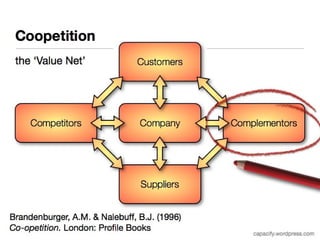
Coopetition 
the ‘Value Net’ 
Brandenburger, A.M. & Nalebuff, B.J. (1996) 
Co-opetition. London: Profile Books capacify.wordpress.com
Definitions 
A business is your complementor if customers value your 
product more when they have a product from the other 
business. 
A business is your competitor of customers value your 
product less when they have a product from the other 
business. 
Simple examples: 
Computer hardware and software; if you update one, you 
will find you have an incentive to update the other. 
Radios would be pointless without radio stations... and 
vice-versa. 
capacify.wordpress.com
War and Peace... 
Two airlines are rivals: they compete for the attention of 
customers, and they compete for ‘slots’ at busy airports. 
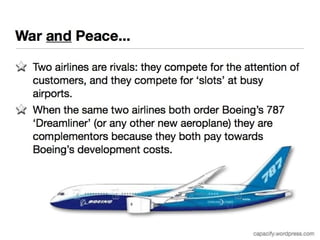
When the same two airlines both order Boeing’s 787 
‘Dreamliner’ (or any other new aeroplane) they are 
complementors because they both pay towards Boeing’s 
development costs. 
capacify.wordpress.com
Main principle 
capacify.wordpress.com 
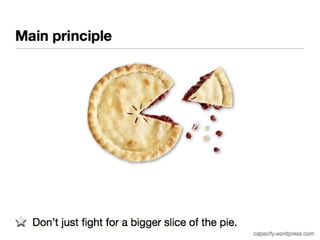
Don’t just fight for a bigger slice of the pie.
Main principle 
capacify.wordpress.com 
Work in partnership to make the pie bigger.
Main principle 
Then fight for a bigger slice. 
capacify.wordpress.com
Effective 
Coopetition 
Have a cooperative attitude. 
Be careful who you cooperate 
with, and the information you 
provide. 
Treat your partners like your 
customers. 
Get creative: be prepared to work 
in new ways. 
Be transparent: trust is a ‘two-way 
street’. 
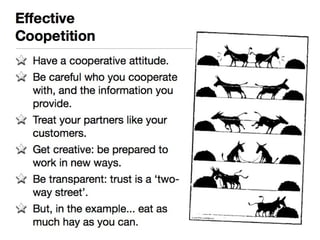
But, in the example... eat as much 
hay as you can.
Another airline example 
Competition between airlines offering internal flights in the 
USA was intense. The normal response to having empty 
seats on a flight is to slash fares. 
In a price war, everybody loses. 
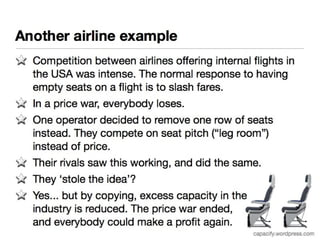
One operator decided to remove one row of seats instead. 
They compete on seat pitch (“leg room”) instead of price. 
Their rivals saw this working, and did the same. 
They ‘stole the idea’? 
Yes... but by copying, excess capacity in the 
industry is reduced. The price war ended, 
and everybody could make a profit again. 
capacify.wordpress.com
Supply Chain 
Coopetition 
Co-warehousing – make use of facilities that you share with 
another business. 
Load consolidation – transport your goods together with 
those of another business: 
Reduce costs for partial loads. 
Increase power in negotiations. 
Standardisation – make use of common components that 
you design in partnership with other businesses. 
Shared Research & Development costs. 
capacify.wordpress.com
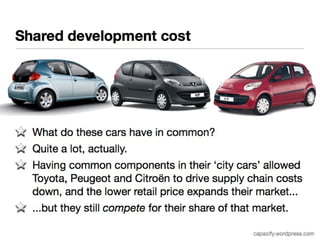
Shared development cost 
What do these cars have in common? 
Quite a lot, actually. 
Having common components in their ‘city cars’ allowed 
Toyota, Peugeot and Citroën to drive supply chain costs 
down, and the lower retail price expands their market... 
...but they still compete for their share of that market. 
capacify.wordpress.com
Applying the Value Net 
Think about the context of your own business... 
Who are your 
competitors? 
How might you 
turn them into 
complementors? 
Think of potential 
completementors 
as the ‘6th force’ 
in Porter’s Five 
Forces. 
capacify.wordpress.com
Want more? 
My blog: http://capacify.wordpress.com 
On Twitter: @Capacified

An Introduction to coopetition

  • 1.
  • 2.
    Contents Definitions Brandenbergerand Nalebuff’s ‘Value Net’ Effective coopetition Supply chain coopetition Applying the Value Net capacify.wordpress.com
  • 3.
    Coopetition defined Cooperationand competition. Based on the theory that in addition to businesses that compete for suppliers and customers, there are providers of complementary products and services. Relationships in business don’t have to be win-lose. Sometimes both parties can win. Coopetition occurs when companies collaborate in areas of their business where they do not believe they have competitive advantage and where they believe they can share common costs. Closely related to Game Theory. capacify.wordpress.com
  • 4.
    Coopetition the ‘ValueNet’ Brandenburger, A.M. & Nalebuff, B.J. (1996) Co-opetition. London: Profile Books capacify.wordpress.com
  • 5.
    Definitions A businessis your complementor if customers value your product more when they have a product from the other business. A business is your competitor of customers value your product less when they have a product from the other business. Simple examples: Computer hardware and software; if you update one, you will find you have an incentive to update the other. Radios would be pointless without radio stations... and vice-versa. capacify.wordpress.com
  • 6.
    War and Peace... Two airlines are rivals: they compete for the attention of customers, and they compete for ‘slots’ at busy airports. When the same two airlines both order Boeing’s 787 ‘Dreamliner’ (or any other new aeroplane) they are complementors because they both pay towards Boeing’s development costs. capacify.wordpress.com
  • 7.
    Main principle capacify.wordpress.com Don’t just fight for a bigger slice of the pie.
  • 8.
    Main principle capacify.wordpress.com Work in partnership to make the pie bigger.
  • 9.
    Main principle Thenfight for a bigger slice. capacify.wordpress.com
  • 10.
    Effective Coopetition Havea cooperative attitude. Be careful who you cooperate with, and the information you provide. Treat your partners like your customers. Get creative: be prepared to work in new ways. Be transparent: trust is a ‘two-way street’. But, in the example... eat as much hay as you can.
  • 11.
    Another airline example Competition between airlines offering internal flights in the USA was intense. The normal response to having empty seats on a flight is to slash fares. In a price war, everybody loses. One operator decided to remove one row of seats instead. They compete on seat pitch (“leg room”) instead of price. Their rivals saw this working, and did the same. They ‘stole the idea’? Yes... but by copying, excess capacity in the industry is reduced. The price war ended, and everybody could make a profit again. capacify.wordpress.com
  • 12.
    Supply Chain Coopetition Co-warehousing – make use of facilities that you share with another business. Load consolidation – transport your goods together with those of another business: Reduce costs for partial loads. Increase power in negotiations. Standardisation – make use of common components that you design in partnership with other businesses. Shared Research & Development costs. capacify.wordpress.com
  • 13.
    Shared development cost What do these cars have in common? Quite a lot, actually. Having common components in their ‘city cars’ allowed Toyota, Peugeot and Citroën to drive supply chain costs down, and the lower retail price expands their market... ...but they still compete for their share of that market. capacify.wordpress.com
  • 14.
    Applying the ValueNet Think about the context of your own business... Who are your competitors? How might you turn them into complementors? Think of potential completementors as the ‘6th force’ in Porter’s Five Forces. capacify.wordpress.com
  • 15.
    Want more? Myblog: http://capacify.wordpress.com On Twitter: @Capacified