Strategic Management:
Concepts and Cases 9e

        Part II: Strategic Actions:
             Strategy Formulation
  Chapter 9: Cooperative Strategy


      ©2011 Cengage Learning. All Rights Reserved. May not be scanned,
       copied or duplicated, or posted to a publicly accessible website, in
                                                          whole or in part.
Chapter 9: Cooperative Strategy

• Overview: Seven content areas
     – Cooperative strategies and why firms use them
     – Three types of strategic alliances
     – Business-level cooperative strategies & their use
     – Corporate-level strategies in diversified firms
     – Cross-border strategic alliances’ importance as an
       international cooperative strategy
     – Competitive risks with cooperative strategies
     – Two approaches to manage cooperative strategies


©2011 Cengage Learning. All Rights Reserved. May not be scanned, copied or duplicated, or posted to a publicly accessible website, in whole or in part.
Introduction

• Cooperative strategy
     – Firms work together to achieve a shared objective


©2011 Cengage Learning. All Rights Reserved. May not be scanned, copied or duplicated, or posted to a publicly accessible website, in whole or in part.
Primary Type of Cooperative Strategy:
Strategic Alliances

• Introduction: Strategic Alliance
     – Cooperative strategy in which firms combine resources
       and capabilities to create a competitive advantage


• Three types of strategic alliances
     – 1. Joint venture
     – 2. Equity strategic alliance
     – 3. Nonequity strategic alliances, which include
            • Licensing agreements
            • Distribution agreements
            • Supply contracts
            • Outsourcing commitments


©2011 Cengage Learning. All Rights Reserved. May not be scanned, copied or duplicated, or posted to a publicly accessible website, in whole or in part.
Primary Type of Cooperative Strategy:
Strategic Alliances                                                     (Cont’d)


• 1. Joint venture
     – Two or more firms create a legally independent
       company to share resources and capabilities to develop
       a competitive advantage


• 2. Equity strategic alliance
     – Two or more firms own a portion of the equity in the
       venture they have created


• 3. Nonequity strategic alliance
     – Two or more firms develop a contractual relationship to
       share some of their unique resources and capabilities
       to create a competitive advantage

©2011 Cengage Learning. All Rights Reserved. May not be scanned, copied or duplicated, or posted to a publicly accessible website, in whole or in part.
Primary Type of Cooperative Strategy:
Strategic Alliances                                                     (Cont’d)


• Why firms might develop strategic alliances
     – Most firms lack the full set of resources and capabilities
       needed to reach their objectives
     – Cooperative behavior allows partners to create value
       that they couldn't develop by acting independently
     – Aligning stakeholder interests (both inside and outside
       of the organization) can reduce environmental
       uncertainty
     – Alliances can …
            • provide a new source of revenue
            • be a vehicle for firm growth
            • enhance the speed of responding to market opportunities,
              technological changes, and global conditions
            • allow firms to gain new knowledge and experiences to
              increase competitiveness

©2011 Cengage Learning. All Rights Reserved. May not be scanned, copied or duplicated, or posted to a publicly accessible website, in whole or in part.
Primary Type of Cooperative Strategy:
Strategic Alliances                                                     (Cont’d)


• In summary, strategic alliances …
     – …can reduce competition and enhance a firm’s
       competitive capabilities and
     – …create avenue for firm to gain access to resources
     – …allows firm to take advantage of opportunities, build
       strategic flexibility and innovate


©2011 Cengage Learning. All Rights Reserved. May not be scanned, copied or duplicated, or posted to a publicly accessible website, in whole or in part.
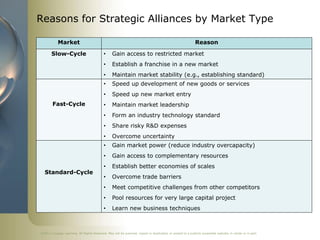
Reasons for Strategic Alliances by Market Type

           Market                                                                                          Reason

       Slow-Cycle                          •     Gain access to restricted market
                                           •     Establish a franchise in a new market
                                           •     Maintain market stability (e.g., establishing standard)
                                           •     Speed up development of new goods or services
                                           •     Speed up new market entry
        Fast-Cycle                         •     Maintain market leadership
                                           •     Form an industry technology standard
                                           •     Share risky R&D expenses
                                           •     Overcome uncertainty
                                           •     Gain market power (reduce industry overcapacity)
                                           •     Gain access to complementary resources
                                           •     Establish better economies of scales
  Standard-Cycle
                                           •     Overcome trade barriers
                                           •     Meet competitive challenges from other competitors
                                           •     Pool resources for very large capital project
                                           •     Learn new business techniques


©2011 Cengage Learning. All Rights Reserved. May not be scanned, copied or duplicated, or posted to a publicly accessible website, in whole or in part.
Business-Level Cooperative Strategy

• Business level cooperative strategies are used
  to grow and improve firm performance in
  individual product markets.

• Achieved through Complementary Strategic
  Alliances (CSA)


©2011 Cengage Learning. All Rights Reserved. May not be scanned, copied or duplicated, or posted to a publicly accessible website, in whole or in part.
Business-Level Cooperative Strategy                                                                                                             (Cont’d)


• Complementary Strategic Alliances (CSA)
     – Firms share some of their resources and capabilities in
       complementary ways to develop competitive
       advantages
     – Partners may have different
            • Learning rates
            • Capabilities to leverage complementary resources
            • Marketplace reputations
            • types of actions they can legitimately take
     – Some firms are more effective at managing alliances
       and deriving benefits from them
     – Two forms include vertical and horizontal


©2011 Cengage Learning. All Rights Reserved. May not be scanned, copied or duplicated, or posted to a publicly accessible website, in whole or in part.
Business-Level Cooperative Strategy                                                                                                             (Cont’d)


     –2 Types of CSA:
            •1. Vertical CSA
                    – partnering firms share resources & capabilities from
                      different stages of the value chain to create a competitive
                      advantage.


            •2. Horizontal CSA
                    – partnering firms share resources & capabilities from the
                      same stage of the value chain to create a competitive
                      advantage
                    – commonly used for long-term product development and
                      distribution opportunities


©2011 Cengage Learning. All Rights Reserved. May not be scanned, copied or duplicated, or posted to a publicly accessible website, in whole or in part.
Business-Level Cooperative Strategy                                                                                                             (Cont’d)


• Competition response strategy
     – Competitors
            • initiate competitive actions to attack rivals
            • launch competitive responses to their competitor’s actions


     – Strategic alliances (SA)
            • can be used at the business level to respond to competitor’s
              attacks
            • primarily formed to take strategic vs. tactical actions
            • can be difficult to reverse
            • expensive to operate


©2011 Cengage Learning. All Rights Reserved. May not be scanned, copied or duplicated, or posted to a publicly accessible website, in whole or in part.
Business-Level Cooperative Strategy                                                                                                             (Cont’d)


• Uncertainty-reducing strategy
     – For example, entering new product markets, emerging
       economies and establishing a technology standard are
       unknown areas so by partnering with a firm in the
       respective industry, a firm’s uncertainty (risk) is
       reduced
     – Uncertainty reduced by combining knowledge &
       capabilities


©2011 Cengage Learning. All Rights Reserved. May not be scanned, copied or duplicated, or posted to a publicly accessible website, in whole or in part.
Business-Level Cooperative Strategy                                                                                                             (Cont’d)


• Competition-reducing strategy: Two Collusive
  Strategies
     – Collusive strategies (CS) differ from strategic alliances in
       that CS are usually illegal

     –1. Explicit collusion
                    – Direct negotiation among firms to establish output levels and
                      pricing agreements that reduce industry competition

     –2. Tacit collusion
                    – Indirect coordination of production and pricing decisions by
                      several firms, which impacts the degree of competition faced
                      in the industry
                    – Mutual forbearance: firms do not take competitive actions
                      against rivals they meet in multiple markets

©2011 Cengage Learning. All Rights Reserved. May not be scanned, copied or duplicated, or posted to a publicly accessible website, in whole or in part.
Business-Level Cooperative Strategy                                                                                                             (Cont’d)


• Business-level cooperative strategy – assessment
     – Used to develop competitive advantages (CA) for contributing to
       successful positions & performance in individual product markets

     – Developing a CA using a strategic alliance, the integrated
       resources and capabilities must be valuable, rare, imperfectly
       imitable and nonsubstitutable

     – Vertical alliances have greatest probability of creating CA;
       horizontal are sometimes difficult to maintain since they are
       usually between competitors

     – SA’s designed to respond to competition and reduce uncertainty
       are more temporary than complementary (horizontal and
       vertical) strategic alliances

     – Competition-reducing has lowest probability of creating a
       sustainable CA


©2011 Cengage Learning. All Rights Reserved. May not be scanned, copied or duplicated, or posted to a publicly accessible website, in whole or in part.
Corporate-Level Cooperative Strategies

• Corporate-level cooperative strategies (CLCS) help firm
  to diversify itself in terms of products offered, markets
  served or both
• Common CLCS forms
  – 1. Diversifying strategic alliance
           • Firms share some of their resources & capabilities to diversify into
             new product or market areas
   – 2. Synergistic strategic alliance
           • Firms share some of their resources & capabilities to create
             economies of scope
   – 3. Franchising
           • Firm uses a franchise as a contractual relationship to describe and
             control the sharing of its resources and capabilities with partners
                   – Franchise: contractual agreement between two legally independent
                     companies whereby the franchisor grants the right to the franchisee to sell
                     the franchisor's product or do business under its trademarks in a given
                     location for a specified period of time


 ©2011 Cengage Learning. All Rights Reserved. May not be scanned, copied or duplicated, or posted to a publicly accessible website, in whole or in part.
Corporate-Level Cooperative Strategies                                                                                                                    (Cont’d)


• Assessment of corporate-level cooperative strategies
     – Costs incurred regardless of type selected
            • Important to monitor expenditures!
     – In comparison w/ business-level strategies
            • Usually broader in scope
            • More complex and therefore more costly
     – Can develop useful knowledge … and, in order to gain
       maximum value should organize and verify proper
       distribution with those involved in forming and using
       alliances


©2011 Cengage Learning. All Rights Reserved. May not be scanned, copied or duplicated, or posted to a publicly accessible website, in whole or in part.
International Cooperative Strategy

• Cross-Border Strategic Alliance
     – International cooperative strategy in which firms with
       headquarters in different nations combine some of their
       resources and capabilities to create a competitive
       advantage


• Why cross-border strategic alliances?
     – Multinational corporations outperform firms that
       operate only domestically
     – Due to limited domestic growth opportunities, firms
       look outside their national borders to expand business
     – Some foreign government policies require investing
       firms to partner with a local firm to enter their markets


©2011 Cengage Learning. All Rights Reserved. May not be scanned, copied or duplicated, or posted to a publicly accessible website, in whole or in part.
Competitive Risks in Cooperative Strategies

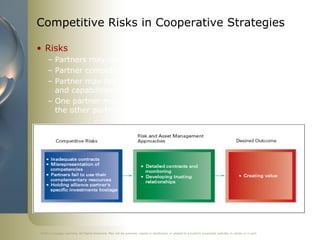
• Risks
     – Partners may choose to act opportunistically
     – Partner competencies may be misrepresented
     – Partner may fail to make available the complementary resources
       and capabilities that were committed
     – One partner may make investments specific to the alliance while
       the other partner may not


©2011 Cengage Learning. All Rights Reserved. May not be scanned, copied or duplicated, or posted to a publicly accessible website, in whole or in part.
Managing Cooperative Strategy

• Two primary approaches
     – 1. Cost minimization
     – 2. Opportunity maximization


©2011 Cengage Learning. All Rights Reserved. May not be scanned, copied or duplicated, or posted to a publicly accessible website, in whole or in part.
Managing Cooperative Strategy                                                                                               (Cont’d)


• 1. Cost minimization
     – Relationship with partner is formalized with contracts
     – Contracts specify how cooperative strategy is to be
       monitored and how partner behavior is to be controlled
     – Goal is to minimize costs and prevent opportunistic
       behaviors by partners
     – Costs of monitoring cooperative strategy are greater
     – Formalities tend to stifle partner efforts to gain
       maximum value from their participation


©2011 Cengage Learning. All Rights Reserved. May not be scanned, copied or duplicated, or posted to a publicly accessible website, in whole or in part.
Managing Cooperative Strategy                                                                                               (Cont’d)


• 2. Opportunity Maximization
     – Focus: maximizing partnership's value-creation
       opportunities
     – Informal relationships and fewer constraints allow
       partners to
            • take advantage of unexpected opportunities
            • learn from each other
            • explore additional marketplace possibilities
     – Partners need a high level of trust that each party will
       act in the partnership's best interest, which is more
       difficult in international situations


©2011 Cengage Learning. All Rights Reserved. May not be scanned, copied or duplicated, or posted to a publicly accessible website, in whole or in part.

Chapter 9 cooperative strategy

  • 1.
    Strategic Management: Concepts andCases 9e Part II: Strategic Actions: Strategy Formulation Chapter 9: Cooperative Strategy ©2011 Cengage Learning. All Rights Reserved. May not be scanned, copied or duplicated, or posted to a publicly accessible website, in whole or in part.
  • 2.
    Chapter 9: CooperativeStrategy • Overview: Seven content areas – Cooperative strategies and why firms use them – Three types of strategic alliances – Business-level cooperative strategies & their use – Corporate-level strategies in diversified firms – Cross-border strategic alliances’ importance as an international cooperative strategy – Competitive risks with cooperative strategies – Two approaches to manage cooperative strategies ©2011 Cengage Learning. All Rights Reserved. May not be scanned, copied or duplicated, or posted to a publicly accessible website, in whole or in part.
  • 3.
    Introduction • Cooperative strategy – Firms work together to achieve a shared objective ©2011 Cengage Learning. All Rights Reserved. May not be scanned, copied or duplicated, or posted to a publicly accessible website, in whole or in part.
  • 4.
    Primary Type ofCooperative Strategy: Strategic Alliances • Introduction: Strategic Alliance – Cooperative strategy in which firms combine resources and capabilities to create a competitive advantage • Three types of strategic alliances – 1. Joint venture – 2. Equity strategic alliance – 3. Nonequity strategic alliances, which include • Licensing agreements • Distribution agreements • Supply contracts • Outsourcing commitments ©2011 Cengage Learning. All Rights Reserved. May not be scanned, copied or duplicated, or posted to a publicly accessible website, in whole or in part.
  • 5.
    Primary Type ofCooperative Strategy: Strategic Alliances (Cont’d) • 1. Joint venture – Two or more firms create a legally independent company to share resources and capabilities to develop a competitive advantage • 2. Equity strategic alliance – Two or more firms own a portion of the equity in the venture they have created • 3. Nonequity strategic alliance – Two or more firms develop a contractual relationship to share some of their unique resources and capabilities to create a competitive advantage ©2011 Cengage Learning. All Rights Reserved. May not be scanned, copied or duplicated, or posted to a publicly accessible website, in whole or in part.
  • 6.
    Primary Type ofCooperative Strategy: Strategic Alliances (Cont’d) • Why firms might develop strategic alliances – Most firms lack the full set of resources and capabilities needed to reach their objectives – Cooperative behavior allows partners to create value that they couldn't develop by acting independently – Aligning stakeholder interests (both inside and outside of the organization) can reduce environmental uncertainty – Alliances can … • provide a new source of revenue • be a vehicle for firm growth • enhance the speed of responding to market opportunities, technological changes, and global conditions • allow firms to gain new knowledge and experiences to increase competitiveness ©2011 Cengage Learning. All Rights Reserved. May not be scanned, copied or duplicated, or posted to a publicly accessible website, in whole or in part.
  • 7.
    Primary Type ofCooperative Strategy: Strategic Alliances (Cont’d) • In summary, strategic alliances … – …can reduce competition and enhance a firm’s competitive capabilities and – …create avenue for firm to gain access to resources – …allows firm to take advantage of opportunities, build strategic flexibility and innovate ©2011 Cengage Learning. All Rights Reserved. May not be scanned, copied or duplicated, or posted to a publicly accessible website, in whole or in part.
  • 8.
    Reasons for StrategicAlliances by Market Type Market Reason Slow-Cycle • Gain access to restricted market • Establish a franchise in a new market • Maintain market stability (e.g., establishing standard) • Speed up development of new goods or services • Speed up new market entry Fast-Cycle • Maintain market leadership • Form an industry technology standard • Share risky R&D expenses • Overcome uncertainty • Gain market power (reduce industry overcapacity) • Gain access to complementary resources • Establish better economies of scales Standard-Cycle • Overcome trade barriers • Meet competitive challenges from other competitors • Pool resources for very large capital project • Learn new business techniques ©2011 Cengage Learning. All Rights Reserved. May not be scanned, copied or duplicated, or posted to a publicly accessible website, in whole or in part.
  • 9.
    Business-Level Cooperative Strategy •Business level cooperative strategies are used to grow and improve firm performance in individual product markets. • Achieved through Complementary Strategic Alliances (CSA) ©2011 Cengage Learning. All Rights Reserved. May not be scanned, copied or duplicated, or posted to a publicly accessible website, in whole or in part.
  • 10.
    Business-Level Cooperative Strategy (Cont’d) • Complementary Strategic Alliances (CSA) – Firms share some of their resources and capabilities in complementary ways to develop competitive advantages – Partners may have different • Learning rates • Capabilities to leverage complementary resources • Marketplace reputations • types of actions they can legitimately take – Some firms are more effective at managing alliances and deriving benefits from them – Two forms include vertical and horizontal ©2011 Cengage Learning. All Rights Reserved. May not be scanned, copied or duplicated, or posted to a publicly accessible website, in whole or in part.
  • 11.
    Business-Level Cooperative Strategy (Cont’d) –2 Types of CSA: •1. Vertical CSA – partnering firms share resources & capabilities from different stages of the value chain to create a competitive advantage. •2. Horizontal CSA – partnering firms share resources & capabilities from the same stage of the value chain to create a competitive advantage – commonly used for long-term product development and distribution opportunities ©2011 Cengage Learning. All Rights Reserved. May not be scanned, copied or duplicated, or posted to a publicly accessible website, in whole or in part.
  • 12.
    Business-Level Cooperative Strategy (Cont’d) • Competition response strategy – Competitors • initiate competitive actions to attack rivals • launch competitive responses to their competitor’s actions – Strategic alliances (SA) • can be used at the business level to respond to competitor’s attacks • primarily formed to take strategic vs. tactical actions • can be difficult to reverse • expensive to operate ©2011 Cengage Learning. All Rights Reserved. May not be scanned, copied or duplicated, or posted to a publicly accessible website, in whole or in part.
  • 13.
    Business-Level Cooperative Strategy (Cont’d) • Uncertainty-reducing strategy – For example, entering new product markets, emerging economies and establishing a technology standard are unknown areas so by partnering with a firm in the respective industry, a firm’s uncertainty (risk) is reduced – Uncertainty reduced by combining knowledge & capabilities ©2011 Cengage Learning. All Rights Reserved. May not be scanned, copied or duplicated, or posted to a publicly accessible website, in whole or in part.
  • 14.
    Business-Level Cooperative Strategy (Cont’d) • Competition-reducing strategy: Two Collusive Strategies – Collusive strategies (CS) differ from strategic alliances in that CS are usually illegal –1. Explicit collusion – Direct negotiation among firms to establish output levels and pricing agreements that reduce industry competition –2. Tacit collusion – Indirect coordination of production and pricing decisions by several firms, which impacts the degree of competition faced in the industry – Mutual forbearance: firms do not take competitive actions against rivals they meet in multiple markets ©2011 Cengage Learning. All Rights Reserved. May not be scanned, copied or duplicated, or posted to a publicly accessible website, in whole or in part.
  • 15.
    Business-Level Cooperative Strategy (Cont’d) • Business-level cooperative strategy – assessment – Used to develop competitive advantages (CA) for contributing to successful positions & performance in individual product markets – Developing a CA using a strategic alliance, the integrated resources and capabilities must be valuable, rare, imperfectly imitable and nonsubstitutable – Vertical alliances have greatest probability of creating CA; horizontal are sometimes difficult to maintain since they are usually between competitors – SA’s designed to respond to competition and reduce uncertainty are more temporary than complementary (horizontal and vertical) strategic alliances – Competition-reducing has lowest probability of creating a sustainable CA ©2011 Cengage Learning. All Rights Reserved. May not be scanned, copied or duplicated, or posted to a publicly accessible website, in whole or in part.
  • 16.
    Corporate-Level Cooperative Strategies •Corporate-level cooperative strategies (CLCS) help firm to diversify itself in terms of products offered, markets served or both • Common CLCS forms – 1. Diversifying strategic alliance • Firms share some of their resources & capabilities to diversify into new product or market areas – 2. Synergistic strategic alliance • Firms share some of their resources & capabilities to create economies of scope – 3. Franchising • Firm uses a franchise as a contractual relationship to describe and control the sharing of its resources and capabilities with partners – Franchise: contractual agreement between two legally independent companies whereby the franchisor grants the right to the franchisee to sell the franchisor's product or do business under its trademarks in a given location for a specified period of time ©2011 Cengage Learning. All Rights Reserved. May not be scanned, copied or duplicated, or posted to a publicly accessible website, in whole or in part.
  • 17.
    Corporate-Level Cooperative Strategies (Cont’d) • Assessment of corporate-level cooperative strategies – Costs incurred regardless of type selected • Important to monitor expenditures! – In comparison w/ business-level strategies • Usually broader in scope • More complex and therefore more costly – Can develop useful knowledge … and, in order to gain maximum value should organize and verify proper distribution with those involved in forming and using alliances ©2011 Cengage Learning. All Rights Reserved. May not be scanned, copied or duplicated, or posted to a publicly accessible website, in whole or in part.
  • 18.
    International Cooperative Strategy •Cross-Border Strategic Alliance – International cooperative strategy in which firms with headquarters in different nations combine some of their resources and capabilities to create a competitive advantage • Why cross-border strategic alliances? – Multinational corporations outperform firms that operate only domestically – Due to limited domestic growth opportunities, firms look outside their national borders to expand business – Some foreign government policies require investing firms to partner with a local firm to enter their markets ©2011 Cengage Learning. All Rights Reserved. May not be scanned, copied or duplicated, or posted to a publicly accessible website, in whole or in part.
  • 19.
    Competitive Risks inCooperative Strategies • Risks – Partners may choose to act opportunistically – Partner competencies may be misrepresented – Partner may fail to make available the complementary resources and capabilities that were committed – One partner may make investments specific to the alliance while the other partner may not ©2011 Cengage Learning. All Rights Reserved. May not be scanned, copied or duplicated, or posted to a publicly accessible website, in whole or in part.
  • 20.
    Managing Cooperative Strategy •Two primary approaches – 1. Cost minimization – 2. Opportunity maximization ©2011 Cengage Learning. All Rights Reserved. May not be scanned, copied or duplicated, or posted to a publicly accessible website, in whole or in part.
  • 21.
    Managing Cooperative Strategy (Cont’d) • 1. Cost minimization – Relationship with partner is formalized with contracts – Contracts specify how cooperative strategy is to be monitored and how partner behavior is to be controlled – Goal is to minimize costs and prevent opportunistic behaviors by partners – Costs of monitoring cooperative strategy are greater – Formalities tend to stifle partner efforts to gain maximum value from their participation ©2011 Cengage Learning. All Rights Reserved. May not be scanned, copied or duplicated, or posted to a publicly accessible website, in whole or in part.
  • 22.
    Managing Cooperative Strategy (Cont’d) • 2. Opportunity Maximization – Focus: maximizing partnership's value-creation opportunities – Informal relationships and fewer constraints allow partners to • take advantage of unexpected opportunities • learn from each other • explore additional marketplace possibilities – Partners need a high level of trust that each party will act in the partnership's best interest, which is more difficult in international situations ©2011 Cengage Learning. All Rights Reserved. May not be scanned, copied or duplicated, or posted to a publicly accessible website, in whole or in part.