Competing for Advantage 3rd Edition Hoskisson Solutions Manual
1.
Competing for Advantage3rd Edition Hoskisson
Solutions Manual download pdf
https://testbankdeal.com/product/competing-for-advantage-3rd-edition-
hoskisson-solutions-manual/
Visit testbankdeal.com today to download the complete set of
test banks or solution manuals!
2.
We have selectedsome products that you may be interested in
Click the link to download now or visit testbankdeal.com
for more options!.
Competing for Advantage 3rd Edition Hoskisson Test Bank
https://testbankdeal.com/product/competing-for-advantage-3rd-edition-
hoskisson-test-bank/
Competing for Advantage 2nd Edition Hoskisson Solutions
Manual
https://testbankdeal.com/product/competing-for-advantage-2nd-edition-
hoskisson-solutions-manual/
Project Management Achieving Competitive Advantage 3rd
Edition Pinto Solutions Manual
https://testbankdeal.com/product/project-management-achieving-
competitive-advantage-3rd-edition-pinto-solutions-manual/
CDN ED Biology Exploring the Diversity of Life 2nd Edition
Russell Solutions Manual
https://testbankdeal.com/product/cdn-ed-biology-exploring-the-
diversity-of-life-2nd-edition-russell-solutions-manual/
3.
Operations Management forMBAs 5th Edition Meredith Test
Bank
https://testbankdeal.com/product/operations-management-for-mbas-5th-
edition-meredith-test-bank/
Prentice Halls Federal Taxation 2015 Individuals 28th
Edition Pope Test Bank
https://testbankdeal.com/product/prentice-halls-federal-
taxation-2015-individuals-28th-edition-pope-test-bank/
Labor Economics 7th Edition Borjas Solutions Manual
https://testbankdeal.com/product/labor-economics-7th-edition-borjas-
solutions-manual/
Principles of Information Security 5th Edition Whitman
Test Bank
https://testbankdeal.com/product/principles-of-information-
security-5th-edition-whitman-test-bank/
Concepts in Federal Taxation 2013 20th Edition Murphy Test
Bank
https://testbankdeal.com/product/concepts-in-federal-
taxation-2013-20th-edition-murphy-test-bank/
4.
New Perspectives onComputer Concepts 2013 Comprehensive
15th Edition Parsons Test Bank
https://testbankdeal.com/product/new-perspectives-on-computer-
concepts-2013-comprehensive-15th-edition-parsons-test-bank/
5.
Chapter 7—Cooperative Strategy
7–1
CHAPTERSUMMARY
This chapter discusses the reasons cooperative strategies are important in the current
competitive environment. The topic is examined generally as well as by market type.
Examples of various cooperative strategy types are provided on the basis of their primary
strategic objectives, with strategic alliances highlighted as a frequently-used form of cooperative
strategy.
Associated risks and effective management to overcome risks are presented to complete
the discussion of cooperative strategies.
CHAPTER OUTLINE
The Importance of Cooperative Strategy
Strategic Alliances in Slow-Cycle Markets
Strategic Alliances in Fast-Cycle Markets
Strategic Alliances in Standard-Cycle Markets
Types of Alliances and Other Cooperative Strategies
Cooperative Strategies That Enhance Differentiation or Reduce Costs
Complementary Strategic Alliances
Network Cooperative Strategies
Cooperative Strategies That Address Forces in the External Environment
Competitive Response Alliances
Uncertainty-Reducing Alliances
Competition-Reducing Cooperative Strategies
Associations and Consortia
Cooperative Strategies That Promote Growth and/or Diversification
Diversifying Strategic Alliances
Franchising
International Cooperative Strategies
Competitive Risks of Cooperative Strategies
Implementing and Managing Cooperative Strategies
Summary
Ethics Questions
KNOWLEDGE OBJECTIVES
1. Define cooperative strategies and explain why they are important in the current competitive
environment.
2. Explain how the primary reasons for the use of cooperative strategy differ depending on
market context (fast-cycle, slow-cycle, or standard cycle).
3. Define and discuss equity and nonequity strategic alliances.
4. Discuss the types of cooperative strategies that are formed primarily to reduce costs or
increase differentiation.
5. Identify and describe cooperative strategies that help a firm address forces in the external
environment.
6. Explain the cooperative strategies that firms use primarily to foster growth.
6.
Chapter 7—Cooperative Strategy
7–2
7.Discuss the risks associated with cooperative strategies.
8. Describe how firms can effectively implement and manage their cooperative strategies.
LECTURE NOTES
Cooperative Strategy – This section describes how today’s business environment is conducive
to interorganizational cooperation and opens the discussion of forming cooperative relationships
with other firms for strategic purposes.
See slide 1.
Introduction
Competing for Advantage
PART III: CREATING COMPETITIVE ADVANTAGE
Chapter 7: Cooperative Strategy
See slide 2.
Figure 1.6
The Strategic Management Process – Overview
Creating Competitive Advantage
• Business-level strategy – competitive advantages the firm will
use to effectively compete in specific product markets
• Competitive rivalry and dynamics – analysis of competitor
actions and responses is relevant input for selecting and using
specific strategies
• Cooperative strategy – an important trend of forming
partnerships to share and develop competitive resources
• Corporate-level strategy – concerns the businesses in which the
company intends to compete and the allocation of resources in
diversified organizations
• Acquisition and restructuring strategies – primary means used
by diversified firms to create corporate-level competitive
advantages
• International strategy – significant sources of value creation and
above-average returns
See slide 3.
Key Terms
Key Terms
▪ Cooperative strategy - strategy in which firms work together to
achieve a shared objective
▪ Relational advantage - condition which exists when a firm’s
relationships with other firms put it at an advantage relative to
rival firms
▪ Strategic alliance - cooperative strategy in which firms combine
resources and capabilities to create a competitive advantage
7.
Chapter 7—Cooperative Strategy
7–3
CooperativeStrategy – Conditions in the competitive landscape have
created a business environment in which interorganizational cooperation
is required, because firms rarely possess all of the knowledge, abilities,
and resources needed for success.
Increasingly, firms form cooperative relationships with other
organizations to develop new sources of competitive advantage.
Discussion points:
- Firms that use cooperative strategies successfully gain
relational advantages that allow them to out-perform their
rivals in terms of strategic competitiveness and above-average
returns.
- Strategic alliances are the most common form of cooperative
strategy.
Importance of Cooperative Strategy – This section discusses how cooperative strategies have
become integral to the competitive landscape and central to the success of partnered companies.
See slides 4-5.
Discussion
The Importance of Cooperative Strategy – Cooperative strategies
have become integral to the competitive landscape and central to the
success of partnered companies.
Discussion points:
- They are used to leverage company resources and capabilities.
- They are used to develop new resources and capabilities.
- They enable companies to leverage or build resources and
capabilities more quickly than if they were acting
independently.
- They are a powerful mechanism for aligning interests and
reducing uncertainty in the external environment.
Example: Cooperative relationships of automobile
manufacturers and their suppliers
- They enhance strategic flexibility, as they tend to not be
permanent arrangements.
- Firms can enter and exit cooperative strategies more easily than
they can start up or shut down parts of their internal operations.
- Consistent with the stakeholder perspective (from Chapter 1),
organizations, as inherently cooperative systems, are inclined to
act with partners to achieve common objectives.
8.
Chapter 7—Cooperative Strategy
7–4
Seeslide 6.
Key Terms
Key Terms
▪ Co-opetition - condition that exists when firms that have formed
cooperative strategies also compete against one another in the
marketplace
The Importance of Cooperative Strategy – Increasingly, cooperative
strategies are formed by firms who also compete against one another.
Example: Samsung Electronics and Sony Corp.
Discussion points:
- Co-opetition between firms encourages co-opetition among
other firms in the same industry.
- Despite potential advantages, some research suggests that
cooperating with a competitor may be associated with lower
levels of ground-breaking innovation in the service sector.
Example: One study found that firms using their own R&D
produce more market innovations than those who rely on
information from competitors
- In some industries, alliance v. alliance competition is becoming
more common than firm v. firm competition.
Example: Global airline industry
1. Why might service firms that use information from their own
research and development processes as well as firms who are
involved in science-based product innovation collaborations be
more likely to introduce new-to-the-market innovations than
firms that rely on information coming from competitors?
Firms are probably unlikely to release genuinely novel ideas
and technologies to their biggest rivals.
See slide 7.
Table 7.1
Reasons for Strategic Alliances by Market Type – The individually
unique competitive conditions of slow-cycle, fast-cycle, and standard-
cycle markets (discussed in Chapter 6) lead to firms using cooperative
strategies for slightly different reasons. This chapter focuses
specifically on the most common form of cooperative strategy, strategic
alliances, to describe how purposes tend to vary across the three market
types.
9.
Chapter 7—Cooperative Strategy
7–5
2.What types of conditions in new markets might alliance partners
better understand than the firm entering the market for the first
time?
a. Sociocultural conditions
b. Legal and regulatory conditions
c. Economic conditions
d. Industry influences
e. Existing relationships among customers and suppliers
Strategic Alliances in Slow-Cycle Markets – This section discusses why firms use strategic
alliances in slow-cycle markets and how low-velocity environments affect business strategy.
See slide 8.
Discussion
Strategic Alliances in Slow-Cycle Markets
Discussion points:
- These markets have close to monopolistic conditions.
Examples: Railroads and, historically, telecommunications,
utilities, and financial services
- Strategic alliances are often used to enter restricted markets or
to establish franchises in new markets.
- Alliance allows quicker entry into these markets because the
partner firm has experience in the market of interest,
understands conditions in the new market, and can provide
knowledge of and relationships with key stakeholders.
Example: CSX access to Pacific ports
3. Why are slow-cycle markets becoming rare in the 21st
century
competitive landscape?
a. Privatization of industries and economies
b. Rapid expansion of the Internet's capabilities
c. Quick dissemination of information
d. Advancing technologies permit quick imitation of even
complex products
10.
Chapter 7—Cooperative Strategy
7–6
4.What are the implications of today’s competitive landscape on
firms competing in the few remaining slow-cycle markets?
a. It is important for firms competing in the few remaining
slow-cycle markets to recognize the future likelihood
that they will encounter less sustainable competitive
advantages than they have enjoyed in the past.
b. Cooperative strategies can be helpful to firms making
the transition from relatively sheltered markets to more
competitive ones.
Strategic Alliances in Fast-Cycle Markets – This section discusses why firms use strategic
alliances in fast-cycle markets and how high-velocity environments affect business strategy.
See slide 9.
Discussion
Strategic Alliances in Fast-Cycle Markets
Discussion points:
- Fast-cycle markets tend to be unstable, unpredictable, and
complex.
- Firms are forced to constantly seek new sources of competitive
advantage, while creating value by using current ones.
- Alliances between firms with excess resources and promising
capabilities aid in the transition required in evolving markets
and to gain rapid entry into new markets.
Example: IBM
5. How does focusing on a select few strategic partnerships help
businesses respond to the rapidly changing competitive
landscape in the IT industry?
a. Drives down costs
b. Integrates technologies that can provide significant
business advantages or productivity gains
c. Enables aggressive pursuit of applications that can be
shifted to more flexible and cost-effective platforms
11.
Chapter 7—Cooperative Strategy
7–7
StrategicAlliances in Standard-Cycle Markets – This section discusses why firms use strategic
alliances in standard-cycle markets and how medium-velocity environments affect business
strategy.
See slide 10.
Discussion
Strategic Alliances in Standard-Cycle Markets
Discussion points:
- These markets are often large and oriented toward economies of
scale.
Examples: Commercial aerospace and beverage industries
- Alliances are most likely to be made by partners with
complimentary resources and capabilities to gain market power.
Example: PepsiCo distribution in China
- Alliances allow firms to learn new business techniques and
technologies from partners.
Types of Alliances and Other Cooperative Strategies – This section discusses two basic types
of strategic alliance based on legal form and introduces other cooperative strategies as they relate
to the primary strategic objectives of firms.
See slides 11-12.
Key Terms
Key Terms
▪ Equity strategic alliance - alliance in which two or more firms
own a portion of the equity in the venture they have created
▪ Nonequity strategic alliance - alliance in which two or more
firms develop a contractual relationship to share some of their
unique resources and capabilities to create a competitive
advantage
▪ Joint venture - strategic alliance in which two or more firms
create a legally independent company to share resources and
capabilities to develop a competitive advantage
▪ Tacit knowledge - knowledge which is complex and difficult to
codify
Types of Alliances and Other Cooperative Strategies – There are two
basic types of strategic alliance based on legal form, depending on
whether they involve equity or not.
Other cooperative strategies relate to the primary strategic objectives of
firms.
12.
Chapter 7—Cooperative Strategy
7–8
Discussionpoints:
- Equity strategic alliances
o Many direct foreign investments are completed through
equity strategic alliances.
o Some equity strategic alliances take the form of purchasing
stock in an existing company.
Example: BMW AG purchase of 15% stake in SGL Carbon
SE
- Nonequity strategic alliances
o Firms in nonequity strategic alliances do not establish a
separate independent company.
o These alliances are less formal.
o These alliances demand fewer partner commitments.
o These alliances foster less intimate relationships between
partners.
o These alliances are not suitable for complex projects
requiring the transfer of tacit knowledge (see Slide 12)
between partners.
o Research indicates that, even under these constraints,
nonequity alliances still create value for participating
partners.
- Joint ventures
o Joint ventures also involve equity.
o Typically, partners in a joint venture own equal percentages
and contribute equally to operations.
Example: JV between Walter Energy and Peace River Coal
o Partners share resources, costs, and risks associated with the
venture.
o Joint ventures are an attractive way to deal with uncertain
competitive conditions, such as economic downturns.
o Joint ventures are effective mechanisms for establishing
long-term relationships and transferring tacit knowledge.
- Tacit knowledge
o It is learned through experience.
o It can be difficult to for rivals to duplicate, making it an
important source of competitive advantage.
6. Name some examples of contractual relationships which
exemplify nonequity strategic alliances.
a. Licensing agreements
b. Supply contracts
c. Outsourcing agreements
d. Distribution agreements
13.
Chapter 7—Cooperative Strategy
7–9
7.What are some other forms of cooperative strategies between
firms?
a. Coalitions
b. Trade groups
c. Associations
d. Industry panels
e. Labor panels
f. Research consortia
g. Cartels (keiretsu)
h. Collusion
Cooperative Strategies That Enhance Differentiation or Reduce Costs – This section
introduces a discussion of business level cooperative strategies used to combine resources and
capabilities to improve firm performance in individual product markets and create competitive
advantages that cannot be created by the individual firm.
See slide 13.
Figure 7.1
Strategic Objectives of Cooperative Strategies – Alliances and
cooperative strategies can be divided into categories based on their
primary strategic objectives. The most common types of cooperative
strategies are listed on Figure 7.1.
See slide 14.
Major Types
Cooperative Strategies That Enhance Differentiation or Reduce
Costs – introduces a discussion of business level cooperative strategies
used to combine resources and capabilities to improve firm performance
in individual product markets and create competitive advantages that
cannot be created by the individual firm
There are two general categories of cooperative strategies which are
used to enhance differentiation or reduce costs.
Complementary Strategic Alliances – This section introduces the two types of complementary
strategic alliances used to support differentiation and low cost objectives and discusses why the
benefits of such partnerships are not always balanced evenly across partnering firms.
See slide 15.
Key Terms
Key Terms
▪ Complementary strategic alliance - business-level alliance in
which firms share some of their resources and capabilities in
complementary ways to develop competitive advantages
▪ Vertical complementary strategic alliance - when firms share
resources and capabilities from different stages of the value
chain to create a competitive advantage
14.
Chapter 7—Cooperative Strategy
7–10
▪Horizontal complementary strategic alliance - when firms share
resources and capabilities from the same stage of the value
chain to create a competitive advantage
Complementary Strategic Alliances – There are two types of
complementary strategic alliances used to support differentiation and
low cost objectives.
Discussion points:
- Complementary
o Even with similar investment levels, the benefits are not
always balanced evenly across partnering firms
- Vertical
o Frequently created with either a current supplier or
customer
o Often an effort to innovate as a response to environmental
changes
Example: Dairy industry
- Horizontal
o Commonly used for long-term product development and
distribution opportunities
o More likely when resource requirements to develop new
products are great and the resources available for
development are limited
Example: Worldwide aircraft industry
8. What affects the different opportunity levels and benefits that
partnering firms are able to achieve through complementary
strategic alliances?
a. Partners may learn at different rates.
b. Partners may have different capabilities to leverage
complementary resources.
c. Some firms are more effective at managing alliances
and deriving benefits from them.
d. Partners may have different reputations in the
marketplace, differentiating the types of actions they
can legitimately take.
15.
Chapter 7—Cooperative Strategy
7–11
NetworkCooperative Strategies – This section discusses the effective use of network
cooperative strategies and the role that strategic center firms play in alliance networks.
See slide 16.
Key Terms
Key Terms
▪ Network cooperative strategy - cooperative strategy in which
multiple firms agree to form partnerships to achieve shared
objectives
Network Cooperative Strategies – More and more firms are engaging
in several cooperative strategies simultaneously, in both individual firm
alliances and multiple networks.
Discussion points:
- They are particularly effective when formed by geographically
clustered firms.
Examples: Silicon Valley and Singapore’s Silicon Island
- They facilitate the matching of firms with complementary
markets and compatible resources.
- Research suggests that the positive financial effects of network
cooperative strategies will continue to make these strategies
important to the success of both suppliers and buyers.
- However, one of the disadvantages to belonging to an alliance
network is that a firm can be locked into its partners, precluding
the development of alliances with others.
- Also, in certain types of networks, such as a Japanese keiretsu,
firms in the network are expected to help other firms in the
network whenever they need aid, which can become a burden to
the firm rendering assistance, thus reducing its performance.
See slide 17.
Discussion
Alliance Network – set of strategic alliance partnerships resulting from
the use of a network cooperative strategy
Discussion points:
- They provide information and knowledge from partners and
partners’ partners which can be used to produce more and better
innovation.
- Access to multiple collaborations increases the likelihood that
additional competitive advantages will be formed as the set of
resources and capabilities being shared expands.
- They stimulate development of product innovations that are
critical to value creation in the global economy.
Example: Lockheed Martin Cyber Security Alliance
16.
Chapter 7—Cooperative Strategy
7–12
Seeslide 18.
Discussion
Alliance Network Success – Effective strategic center firms and social
relationships and interactions achieved among partners while sharing
resources and capabilities make network cooperative strategy success
more likely.
See slide 19.
Figure 7.2
A Strategic Network – Cooperative relationships in alliance networks
revolve around an effective strategic center firm which is at the core or
center of the alliance network.
See slide 20.
Discussion
Strategic Center Firms – serve as the foundation for an alliance
network's structure
See slide 21.
Major Types
Types of Alliance Networks – Alliance networks vary by industry
condition and goal orientation.
See slide 22.
Discussion
Stable Alliance Networks – Through a stable alliance network, firms
try to extend their competitive advantages to other settings while
continuing to profit from operations in their core, relatively-mature
industry.
See slide 23.
Discussion
Dynamic Alliance Networks – tend to develop where the pace of
innovation is too fast for any one company to maintain success over
time
Discussion points:
- In some cases these networks even take the form of “open
innovation,” composed of collaborators and competitors who
share knowledge in the pursuit of co-development of new
technologies.
Example: Mobile phone industry
- Members of these alliances can come and go as they please.
Cooperative Strategies That Address Forces in the External Environment – This section
introduces a discussion of business-level cooperative strategies used to combine resources and
capabilities to meet the challenges of complex and ever-changing external environments.
See slide 24.
Major Types
Cooperative Strategies That Address Forces in the External
Environment – introduces a discussion of business-level cooperative
strategies that combine resources and capabilities to meet the challenges
of complex and ever-changing external environments
Four types of cooperative strategy serve to keep firms abreast of rapid
changes in their environments.
17.
Chapter 7—Cooperative Strategy
7–13
CompetitiveResponse Alliances – This section describes how competitive response alliances
are used to respond to competitors’ strategic attacks.
See slide 25.
Discussion
Competitive Response Alliances
Discussion points:
- Formed primarily to deal with major strategic actions of
competitors
- Difficult to reverse
- Expensive to operate
- Can be powerful mechanisms for responding to strategic actions
of competitors
Example: Nokia and Microsoft smartphone market alliance
Uncertainty-Reducing Alliances – This section describes how uncertainty-reducing alliances are
used to reduce environmental uncertainty.
See slide 26.
Discussion
Uncertainty-Reducing Alliances
Discussion points:
- Can be a powerful mechanism to hedge against risk
- Especially useful in fast-cycle markets where technology
changes rapidly and new products develop quickly
Example: Davies Arnold Cooper LLP alliance with Seguros
Lex
9. In what types of markets can uncertainty-reducing alliances be
effective?
a. Fast-cycle markets
b. New product markets
c. Emerging economies
d. New technologies
Competition-Reducing Alliances – This section describes how competition-reducing alliances
are used to reduce competition in an industry.
See slide 27.
Discussion
Competition-Reducing Alliances – Virtually all cooperative strategies
between or among competitors reduce competition.
18.
Chapter 7—Cooperative Strategy
7–14
Alliancenetworks, in particular, provide advantages to member firms
and make it harder for nonmember firms to compete.
Example: Groups of preferred suppliers in a pharmaceutical network
Discussion points:
- They give partnering firms differential advantages in their
markets.
- Collusive strategies are a more direct form of competition-
reducing strategy (see Slide 28).
See slide 28.
Discussion
Collusive Strategies – Often illegal, two types of collusion work to
reduce competition.
Discussion points:
- Explicit collusion
o Two or more competing firms negotiate directly to jointly
agree about the amount to produce as well as the prices that
will be charged for what is produced
o Illegal in the U.S. and most developed economies, where
firms can face litigation for noncompetitive actions
o Exception is regulated industries
- Tacit collusion
o Common to highly-concentrated industries
Examples: Cereal and airline industries
o When coordination of production and pricing results from
observing competitor actions and responses
o Firms recognize interdependence among industry
participants and that their competitive behavior significantly
affects each firm in the industry
o Results in less than fully competitive production levels and
prices that exceed competitive pricing models
o Mutual forebearance – one form of tacit collusion that
occurs because firms fear and avoid competitive attacks
against rivals who they compete with in multiple markets
Example: PC industry
- Governments in free market economies need to determine how
rivals can collaborate to increase competitiveness without
violating established regulations.
Examples: Global pharmaceutical and biotechnology industries
19.
Chapter 7—Cooperative Strategy
7–15
Associationsand Consortia – This section describes how associations and consortia are used to
form coalitions with stakeholders to achieve common objectives.
See slide 29.
Discussion
Associations and Consortia
Discussion points:
- Can strengthen dealings with external stakeholders
- Forms of coalition with stakeholders:
o Trade groups
o Associations
o Industry panels
o Labor panels
o Research consortia
- Can enhance creative efforts that lead to innovation
- Often used to provide a common voice when dealing with an
important external stakeholder
Example: Trade group employment of lobbyists
- Can help firms deal with changing environmental conditions
Example: Sustainability Consortium
10. What types of external stakeholders can be better managed with
the use of associations and consortia?
a. Legislators
b. Suppliers
c. Customers
11. Why do firms join associations?
a. To gain access to information
b. To obtain legitimacy
c. To gain acceptance
d. To obtain influence
Cooperative Strategies That Promote Growth and/or Diversification – This section
introduces a discussion of cooperative strategies used as an attractive alternative when the firm's
primary goal is growth and/or diversification.
See slide 30.
Major Types
Cooperative Strategies That Promote Growth and/or Diversification
– introduce a discussion of cooperative strategies that serve as an
attractive alternative when the firm's primary goal is growth and/or
diversification
decided to launchthe attack at noon, on the left (north) wing, and
try to turn the enemy’s flank. Goering’s detachment was to lead the
attack.
After we had eaten our midday meal undisturbed, I went at once
to the left wing, where Captain Goering had just begun his advance
with his two companies. When he had crossed a wide depression in
the ground, to my surprise he changed direction still further to the
left. The companies were soon in action. Only gradually I realized
the significance of this surprising move. Captain Goering had come
unexpectedly upon a new enemy who had come from Nahungu and
was now attacking from the north. The force consisted of several
battalions and two guns of the Nigerian Brigade who knew nothing
of our arrival at Mahiwa and were expecting to smash General
Wahle’s force by an attack on his left flank and rear, while his front,
facing east, was vigorously attacked by a division. The Nigerian
Brigade was as much taken by surprise as Captain Goering and was
not so quick to adapt itself to the new situation. Captain Goering,
closely supported by the reserves, threw himself so vigorously
against the enemy in the bush that he ran through some of his
detachments, threw them into confusion, and finally put them to
flight. An enemy officer in command of an ammunition column took
our men for his own, with the result that we captured about 150,000
rounds of ammunition. A gun with ammunition was taken by assault,
and the killed did not consist wholly of Nigerian Askari. On Captain
Goering’s right, where two companies under Lieutenant von
Ruckteschell and Lieutenant Brucker, wounded in this action, were
fighting, the enemy was also thrown back some way into the bush.
While this fighting was going on on the flank, and on the
following day also, the enemy attacked Wahle’s force with all his
strength. Here the enemy was in great superiority; wave after wave
of fresh troops were thrown against our front. There was a danger
that General Wahle’s front would give way, and the fighting was very
severe. There was also serious danger that our enveloping
movement, in the very difficult swampy ground of the bush, would
be held up so long by weak enemy forces that a defeat would be
22.
inflicted upon ourfront before it could make itself felt. In that case
the battle was lost. I thought it expedient to increase the
disadvantages that the enemy was bringing upon himself by his
costly frontal attack and used all my available strength in such a way
that the enemy by the increasing fierceness of his frontal attack was
bleeding himself to death.
The original intention of enveloping the enemy’s left wing was not
developed further on the following days, but, on the contrary, every
available company was withdrawn from the left wing to stiffen
General Wahle’s front. In this way we not only succeeded in holding
our ground, but, by immediately taking advantage of the enemy’s
moments of weakness to make heavy counter-attacks with our
reserves, we were able to inflict a real defeat. My, perhaps
surprising, tactics were prompted by the personality of the enemy
commander. I had learned in the engagement at Reata (11th March,
1916) that General Beves threw his men into action regardless of
loss of life and did not hesitate to try for a success, not by skilful
handling and small losses, but rather by repeated frontal attacks
which, if the defence held its ground and had anything like adequate
forces, led to severe losses for the attack. I guessed that here at
Mahiwa he was carrying out the same tactics. I think it was by taking
advantage of the enemy leader’s mistaken tactics in this way that we
were able to win this splendid victory. Until the 18th October, for four
days therefore, wave after wave of the attack broke on our front, but
my own observation told me that the weight of the attack here on
the right wing was diminishing and that the enemy’s defeat was
absolute.
On the evening of the 18th October we had, with some 1,500
men, completely defeated a whole enemy detachment at least 4,000,
and probably not less than 6,000, strong. With the exception of
Tanga, it was the most serious defeat he had suffered.
According to a high English officer the enemy lost 1,500 men; but
I have reason to believe that this estimate is much too low. Our
casualties were: 14 Europeans and 81 Askari killed, 55 Europeans
and 367 Askari wounded, 1 European and 1 Askari missing.
23.
Considering the smallnessof our forces these losses were for us very
considerable, and were felt all the more seriously because they could
not be replaced. We captured a gun, six heavy and three light
machine guns, and 200,000 rounds of ammunition.
The situation, unfortunately, did not allow us to take full
advantage of our victory; in our rear was the enemy who had
occupied Ruponda on the 10th October, advanced in strong force
further south and on 18th October attacked Major Kraut at Lukuledi.
It must be remarked in passing that our troops which had fought
under Lieutenant-Commander Jantzen near Tunduru had gradually
retired north-east to the upper Mbenkuru and had reached
Headquarters above Ruponda before the occupation of that place by
the enemy on the 10th October. Two of these companies had
reinforced the company which was guarding our supplies near
Lukuledi, and it was these three companies, under the command of
Major Kraut, which were attacked by a superior enemy from the
north on the 18th October.
The enemy, believed to be six companies of the Gold Coast
Regiment, was driven off, but in order to protect our supplies and
material lying at Chigugu and Chiwata, Major Kraut retired to the
first of these places. As well as Chigugu and Chiwata, Ndanda, where
we had large stores of war material, was also threatened by the
enemy, who had doubtless, in my opinion, been reinforced at
Lukuledi. The enemy from Lukuledi might at any moment attack our
lines of communication, capture our stores and supplies, and so put
us out of action. We had no means of protecting our lines of
communication locally, for the few thousand men we had were
required for fighting. As, however, the force had to be kept alive, the
danger had to be overcome in some other way.
There was only one way: to beat the enemy decisively at
Lukuledi. It was necessary therefore to lose no time at Mahiwa, and,
hard though it was, I had to abandon the idea of an annihilating
pursuit. When, early on the 19th October, a few scattered
detachments of the enemy were seen and fired on, I had already
begun my march with six companies and two guns. On the next day
24.
at two o’clockwe entered Lukuledi from the east, and on 21st of
October at dawn we attacked the enemy, who was apparently taken
completely by surprise. North of Lukuledi, on the Ruponda road,
Major Kraut’s column surprised the camp of the 25th Indian Cavalry
Regiment, which, with transport harnessed, stood ready for the
march on Massassi; the camp was taken by storm and the regiment
lost almost the whole of its transport horses, altogether 350. Whilst I
was engaged with the detachments of Koehl and Ruckteschell in a
fairly serious action against the enemy entrenched at Lukuledi, I
waited in vain for the intervention of Kraut’s force. An attack on the
camp without the advantage of surprise had little hope of success.
When the force began to come under the fire of the enemy’s mine-
throwers on the flank, I withdrew the greater part from the zone of
the effective cross-fire, after beating off a strong enemy attack, in
order to avoid unnecessary losses. A fresh enemy, in the shape of a
company of King’s African Rifles (English East African Askari), who
appeared unexpectedly from the bush, was quickly driven off. In this
engagement Lieutenant Kroeger fell at the head of his company. The
action was then broken off. No news came of Major Kraut until night;
thinking he could no longer attack successfully at Lukuledi, and
hearing no sounds of fighting, he had made a détour and then
approached Lukuledi from the south.
Owing to unfavourable circumstances we had not succeeded in
inflicting a decisive defeat on the enemy at Lukuledi, and the
operation had only in part gained its objective, but the enemy’s
losses must be regarded as serious. The impression made on him
was even greater than I had supposed. At any rate, it was reported
that he had evacuated Lukuledi and withdrawn to the north. Among
our casualties were three company-commanders killed. I can still see
Lieutenant Volkwein, severely wounded in the leg, limping through
the bush at the head of his company. I had also spoken with
Lieutenant Batzner and Lieutenant Kroeger shortly before they fell.
Sergeant-Major Klein also fell, who had so often led his patrol on the
Uganda railway. He was a capable machine gun leader. But our
losses were not in vain. Our patrols pursued the enemy and fired on
25.
his camp nearRuponda and also his lines of communication. The
impossibility of maintaining large bodies of troops in the
neighbourhood of Ruponda—our supplies collected there had fallen
into the enemy’s hands—forced me to give up all idea of pursuing
the enemy.
At that time I thought it possible that the enemy’s withdrawal
from Lukuledi might have been due to the movements of Captain
Tafel’s force, which was marching from Mahenge to join us. We had
lost touch with him since the beginning of October. He had received
orders to retire gradually before the strong enemy columns which
were advancing on Mahenge from the north (Ifakara), west and
south-west (Likuju, Mponda), and to try to get into touch with the
main force under my command. I thought it quite possible that he
had already arrived in the district of Nangano, or west of that place,
and that the enemy had turned about again out of anxiety for his
lines of communication.
26.
O
CHAPTER XII
THE LASTWEEKS IN GERMAN TERRITORY
N 24th October, the Governor of Chiwata, which had become the
centre of the Administration, arrived at my camp east of
Lukuledi for a conference. I firmly stated my opinion that, in
spite of all difficulties of supply which must shortly arise in
German East Africa, the war could and must be carried on. One
possibility that offered was to base the operations on Portuguese
territory. This could only be done by evacuating German East Africa
and invading Portuguese East Africa.
The question of supplies was becoming very serious; we had in
our stores only about 500,000 kg. of supplies. That would last us
about six weeks. But it had been found that these figures were
deceptive. The piled-up sacks had to a great extent lost weight and
the grain had been eaten by insects. The new harvest could not be
expected until March at the earliest. If the operations were to be
continued it was necessary from this point of view alone to move
south. I was still reckoning with the possibility that Captain Tafel’s
force might arrive in the neighbourhood of Massassi and Chiwata, in
which case I should hand over to him the supplies at Chiwata, while I
crossed the Makonda hills in the direction of Lindi with part of the
Chiwata force and attacked the enemy’s main line of communication
on the Lukuledi river. In whichever way the situation might develop,
the Chiwata district was, on account of its fertility, of the greatest
importance to us. Chiwata was, however, not protected and was
27.
further threatened bythe fact that enemy operations were taking
place in the north against Mnacho, and enemy mounted forces had
been seen on the Lukuledi-Lindi road in the neighbourhood of
Ndanda. Also enemy aircraft were paying our camp at Chiwata
increasing attention.
These were my reasons for withdrawing from Lukuledi at the end
of October with the main part of my forces. It could not be foreseen
whether another opportunity would offer of making another attack
from Chiwata on one of the enemy columns that would be passing
before long. For the next few weeks the enemy’s pressure was again
directed against Wahle. Quite fresh troops were appearing there,
among them the Cape Corps of South African half-castes. This corps
had been stationed along the Central railway and had been brought
up to reinforce General Beves’ troops, apparently via Dar-es-Salaam
and Lindi. Fortunately General Beves had not waited for this
reinforcement before his defeat at Mahiwa.
General Wahle was retiring step by step up the Lukuledi river. I
was, unfortunately, not able to send him any support, but even had to
draw on his forces to have troops in hand ready for a favourable
opportunity for an attack and to protect the supplies. In the almost
daily bush-fighting of General Wahle’s force heavy losses were
apparently inflicted on the enemy, and he was held severely in check.
There was, however, no defeat and no considerable capture of booty,
and meanwhile our supplies were getting lower and lower. On 6th
November, I rode from Chiwata to Nangoo, near Ndanda, where,
close behind Wahle’s force, I found a suitable point of attack for the
Chiwata troops. On 7th November I rode back from Nangoo to
Chiwata, making a détour south across the Makonde hills. On the
same day enemy troops were again reported at Lukuledi, and on 9th
November an affair of patrols took place at Chigugu, just west of
Chiwata.
At this critical time, when the heads of the enemy columns were
nearing Chiwata, it was urgently necessary for us to throw all our
strength against one of these columns as soon as possible before the
others could intervene. The first essential to make this blow effective
was to bring the whole strength of our all too weak forces to bear
28.
simultaneously. This dependedchiefly on the supply of ammunition.
Our whole supply had dwindled to about 400,000 rounds, a very
scanty allowance for our 25,000 rifles and 50 machine guns in a
serious engagement, after which it would only be possible to continue
the struggle if ammunition were captured. For this the nature of the
ground was unfavourable. In the thick bush there was a tendency for
each individual to fire many rounds and make few hits, so that the
supply of cartridges was quickly used up without producing the
decisive results we needed. What made a satisfactory solution of the
ammunition question still more impossible was that the cartridges
were for the most part the smoky ’71 type, whereas only about one-
third of the troops were armed with ’71 rifles; the other two-thirds
had modern German, English or Portuguese rifles, and for these the
supply of cartridges was very small. What there were were required
for our most important weapon, the machine gun. It was a difficult
position. There was nothing else for it but to make the attack with
only those troops who were armed with the ’71 rifle and to hold in
reserve the rest, who had only twenty rounds of ammunition suitable
for their modern rifles, the rest being the smoky ’71 type. The two
forces would then be interchanged so that the first, armed with the
’71 rifles, could hand them over to the relieving force, taking the
modern weapons in exchange. This meant that at the best only one-
third of the available strength could be in action at the same time and
even then would have to be very sparing with their ammunition.
Our artillery ammunition had already been exhausted with the
exception of a few rounds for the two mountain guns and some
Portuguese ammunition. Our last field-howitzer, as well as the English
gun captured at Mahiwa, had burst. The last two 10·5 cm. guns from
the Königsberg had been destroyed a few days before. On the day
after a German mountain gun had been destroyed and sunk at
Kitangari. We were thus left with one German and one Portuguese
mountain gun. During the last few months the lack of artillery
ammunition had been so serious that we had rarely more than three
hundred rounds all told. That was about the allowance per
engagement for one of the numerous English guns.
29.
Under such circumstancesan attack could only promise success if
the situation was exceptionally favourable. This was never the case.
The patrols were kept active, and the enemy harassed as much as
possible, but otherwise there was nothing left but for General Wahle’s
force and the 11th Field Company, which had been left at Mnacho to
bring away the supplies, gradually to give way before the pressure of
the enemy and retire to Chiwata. On 10th November the Ndanda
mission, immediately in the rear of General Wahle, who was at
Nangoo, was surprised by a strong enemy force and captured. The
field-hospital quartered there, and part of our stores, fell into the
enemy’s hands. Lieberman’s force, south of Ndanda, ensured the
retreat of General Wahle’s force, which ascended to the Makonda
plateau, by the road south-east of Nangoo, the road I had
reconnoitred on 7th November, and, by crossing the plateau
diagonally to Chiwata, escaped from the enemy’s trap. The 11th
Company also found its way to Chiwata from Mnacho, so that, with
the exception of Captain Tafel’s Detachment and some small bodies of
troops further south, the whole force was concentrated at Chiwata.
The gradual transport of our supplies from Chiwata east to
Nambindinga had begun, and with that our march to Kitangari.
Meanwhile I kept an anxious look-out for a vulnerable point in one of
the enemy columns. On the 14th November I thought I had
discovered one.
A strong enemy column, to which belonged the 10th South African
Mounted Infantry, had passed close to our position while marching
from Lukuledi via Massassi, and had attacked Mwiti, two hours’ march
south of Chiwata. In this place, which until then had been only weakly
held, Lieberman’s force (three companies) had arrived the day before.
In spite of the shortage of ammunition there was, I thought, a chance
that by unexpectedly throwing into the fight Koehl’s force from
Chiwata, this enemy might be defeated separately. I was, however,
very busy with the preparations for the withdrawal to Nambindinga
and unfortunately let the opportunity at Mwiti pass without taking
advantage of it.
There was nothing for it, then, but to retire gradually to
Nambindinga.
30.
Through the evacuationof Chiwata the European prisoners, as
well as the Indians, who had been carried to the hospital, and the
hospital itself, full for the most part of seriously wounded, fell into the
enemy’s hands. The march to Nambindinga was carried out under
continuous fighting between the 15th and 17th November. I wanted
to make the enemy complete the concentric march of his columns,
advancing north-west and south, so as to effect a junction; then,
when the enemy’s masses were helplessly crowded on a narrow area,
I could march where I liked. On November 17th I had to take a
fateful decision at Nambindinga. The continual bush-fighting was
threatening to consume all our ammunition. It would have been
madness to go on with this fighting, which could not bring about a
favourable decision. We had therefore to withdraw.
The supply question pointed the same way. Only by a drastic
reduction of strength could we carry on with the stores in hand. Our
supply area had been narrowed, fresh requisitioning had been
interfered with by the enemy, and the produce of the land exhausted.
The supply of quinine would last the Europeans a month longer. After
the consumption of this the Europeans would certainly fall victims to
malaria and its attendant evils; they would no longer be able to
contend with the rigours of a tropical campaign. Only by reducing the
number of Europeans to a minimum could enough quinine be ensured
for each man to enable us to carry on the operations for months.
At the same time we had to reduce our total strength. Our large
force with little ammunition was of less value in the field than a
smaller number of picked men with plenty of ammunition. It
amounted to the reduction of our strength to about 2,000 rifles,
including not more than 2,000 Europeans. All above this number had
to be left behind. It could not be helped that among the several
hundred Europeans and 600 Askari that we were compelled to leave
behind in the hospital at Nambindinga, there were men who would
have liked to go on fighting and were physically fit to do so.
Unfortunately, it must be admitted that among those who were left
behind at Nambindinga, even among the Europeans, there were
many who were not unwilling to lay down their arms. It is, however,
worthy of mention that not only the majority of the Europeans, but
31.
also many Askari,were bitterly disappointed at having to remain. We
had repeatedly to refuse the request of a brave Askari that he might
come and fight for us. But when, two days later, Lieutenant
Grundmann, though severely wounded and scarcely able to walk,
reported himself, saying that he could not, in spite of orders, bring
himself to surrender, I have seldom been so pleased as at this breach
of discipline. It may be mentioned here that in general the enemy, as
far as I am in a position to judge, treated our prisoners with
humanity, but it seems to me that he was anxious to convict us of
cruelty to English prisoners, perhaps in order to justify reprisals,
perhaps for other reasons. Lieutenant Cutsch had been left sick in
Nandanda, and fell into the enemy’s hands. On the totally unfounded
and unproved evidence of a negro that Lieutenant Cutsch had on one
occasion, when commanding a patrol, burned to death a wounded
Englishman, he was put in irons and sent by sea to Dar-es-Salaam,
being imprisoned during the voyage just outside the ship’s
roundhouse. At Dar-es-Salaam he was locked up for several weeks in
the prison without a trial. When at last he was tried, it came out that
the charge of senseless cruelty rested purely on the lying evidence of
the negro. Again, General Deventer informed me that Captain
Naumann, who had surrendered near Kilima Njaro, had been tried for
murder. He, too, as I heard later, was kept imprisoned for a long time
without a hearing, until his innocence was finally established. I find it
all the more difficult to understand this mockery of justice, as the
English prisoners were always humanely treated by us, and were
often better cared for materially than our own people.[5]
These decisions placed the conduct of the war on an entirely
different basis. Hitherto we had stored the supplies in dumps and for
the most part had been able to satisfy our demands from these; the
ammunition also had been maintained from stores. This system had
laid us more open to attack and offered the enemy points of attack
which we could not protect. But by the methods adopted hitherto it
had been possible to keep the troops in the field at great strength,
considering our position, and to employ a great part of them on a
small area for a considerable period. It had further been possible to
give a permanent character, at any rate to some of our hospitals,
32.
where sick andwounded could recuperate in peace, and in this way
we could fill the gaps in our front with refreshed and experienced
men. This system had made our operations dependent to a great
extent on the situation of the supplies and reinforcements, and had
hindered freedom of movement. The advantage, however, in our
position of being able to employ strong troops and with them
successfully to engage, and often defeat decisively, superior enemy
forces was so great that I held to this system as long as it was at all
possible.
It was now no longer possible, and the advantages I have
mentioned had to be sacrificed under the pressure of necessity. It
was certainly questionable whether the reduced force could be
maintained without supply dumps, and without reinforcements the
prospect of remaining, after twelve days in the plains, with five
thousand hungry negroes and without supplies was not attractive.
Should we succeed in satisfying those requirements of the force
which could not be obtained on the spot, especially ammunition and
arms, by means of capture from the enemy—for the only possibility of
renewing our supplies lay in capturing the enemy’s—in sufficient
quantities to make the continuation of the war possible? That was the
all-important question. If we succeeded, however, in maintaining the
force on the new territory the increased independence and mobility,
used with determination against the less mobile enemy, would give us
a local superiority in spite of the great numerical superiority of the
enemy. In the unlimited territory at our disposal it would be possible
to withdraw from unfavourable positions. The enemy would be
compelled to keep an enormous amount of men and material
continually on the move, and to exhaust his strength to a greater
extent proportionately than ourselves. There was also the prospect of
tying down strong enemy forces and protracting the operations
indefinitely if—my forecast proved correct. This was at that time
doubtful, but the risk had to be taken.
We did not stay long at Nambindinga; this place situated on the
plateau had no water and the springs in the valley were within range
of the enemy’s guns and machine guns. Under the protection of
patrols, which held back the enemy at Nambindinga, Headquarters
33.
and the mainpart of the forces arrived at Kitangari on 18th
November. The enemy did not follow, probably he could not. As had
been foreseen, he had strained every nerve to strike the so long
hoped-for knockout blow at Chiwata and had to re-form before
undertaking further operations. At Kitangari the old experience was
repeated of finding that the supplies stored there had been estimated
much too highly. The supplies at all serviceable would, all told, only
feed the force for about ten days; we could reckon on no appreciable
addition to these stores from the region south of Kitangari. The
question in which direction the march should be continued focussed
itself in the main on the prospect of again finding the means of
adequately feeding the force. There was no time to be lost.
I knew that in the area along the Rovuma the English and
Portuguese had systematically destroyed our supplies. Our small
dumps, requisitioning stations and supply columns had been attacked
and the supplies destroyed. The natives had been influenced against
us. The north and south banks of the middle Rovuma were only thinly
populated; at Tunduru, further up the Rovuma, strong forces of both
sides had been engaged and the supplies there were probably
exhausted. I could get no reliable information about the Mafia plateau
south of the lower Rovuma. Even if, as many reported, this had been
a richly-cultivated district before the war it was very doubtful whether
now, after strong Portuguese forces had been billeted there for years,
there would be any food left. The most probable place for finding
supplies seemed to me at that time to be the district where Major
Stuemer’s operations had taken place: the corner between the
Rovuma and the Ludjenda rivers and further south in the region of
Nangware and Mwembe. Even this was doubtful, for here, too, war
had interfered with the agriculture of the natives. Meanwhile, of the
various improbabilities this last seemed to me the least improbable,
and I decided to march at once up the Rovuma.
A determining factor in the choice of this direction was my wish to
equip my force for a prolonged period of action by a large capture of
ammunition and other war material. Previous observation and the
reports of the natives led me to believe that somewhere near the
Rovuma the enemy still possessed large stores. On 20th November
34.
we reached Nevale,where we were joined by the patrols which had
secured our southern flank, and the reorganization of the force was
finally carried through. At Nevale the last men unfit for marching were
left behind, and on 21st November we marched south to the Rovuma
with 300 Europeans, 1,700 Askari, and 3,000 bearers and other
natives. Every man was loaded to his full capacity. In general, as the
supplies were consumed, the bearers no longer required were left
behind, so as to keep the number of consumers as low as possible. In
many cases we had to refuse the urgent requests of our good old
bearers to remain with us, a large number offering to carry on
without pay, some even without either pay or rations; these were
ready to provide their own rations from what we threw away and Pori
fruit. The quartermaster at that time, Naval Lieutenant Besch,
reorganized the supplies and transport service very efficiently. He
deserves the chief credit for the force’s ability to carry on.
As was to be expected, only small detachments of the enemy
were reported in the neighbourhood of the Rovuma. On 21st
November we arrived at Mpili, on the bank of the river, and were
about to pitch our camp when several shots passed close to a hunting
party. On reconnoitring we found in front of us a large pond, on the
opposite side of which horses were being watered. Behind rose a
rocky mountain. Soon afterwards a native, apparently a spy,
appeared, bringing a written message: “We are English cavalry, and
we want to get into touch with Portuguese infantry regiments.”
Whether this was a ruse could not be ascertained. It was clear that
for the moment we had only to do with a small squadron of cavalry.
By a sharp attack the enemy was soon routed and in the pursuit
sustained several casualties: five European prisoners belonging to the
10th South African Mounted Infantry were, for reasons of supply, sent
back to the enemy. The captured horses were welcome as chargers
and as a possible addition to our rations.
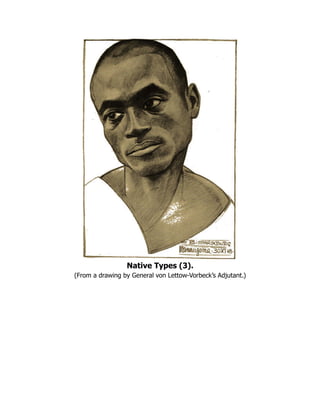
Native Types (4).
(Froma drawing by General von Lettow-Vorbeck’s Adjutant.)
The rest of the march up the Rovuma progressed very slowly. A
great part of the force were unaccustomed to long route-marches.
The columns straggled endlessly. The Askari women followed singly,
several hundred yards apart. It was some time before they learned to
keep to a regular marching order. Incidentally it became obvious that
in some companies the Askari who had come with us had not been
selected from the most suitable point of view. In the reorganization of
the companies which had had to be carried out during the fighting,
many good and reliable men had been left behind, and replaced by
37.
others, stronger perhaps,but less reliable. Many went into battle with
their children on their shoulders; it would have been better to choose
an equally reliable man who was not burdened by having to drag
about a wife and family.
But it was too late now to alter anything.
Apparently we had quite got outside the enemy’s range of
observation. The aircraft which usually followed our marches were
absent and no bombs fell on our camps. Once an enemy supply
column crossed the Rovuma right into our camp. It was a welcome
capture. Of grain we found practically none in this district, but on the
other hand, we shot plenty of game. Several buffaloes and quite a
number of antelopes, particularly Wasserbok, fell to our guns. But we
dared not delay; our shrinking supplies urged us continually forward.
Fortunately I had with me a few Europeans who knew the country,
and who, shortly before, had been working near the confluence of the
Ludjenda and the Rovuma. In peace time a Portuguese station had
been situated there, and even in war a more or less strong garrison
had been reported there. It might be assumed that even now we
should find some traces of the enemy. The few natives we came
across even spoke of a stronger garrison, amounting to two thousand
English or Portuguese. The natives’ figures could not, of course, be
relied on, but they strengthened my belief that in the neighbourhood
of Ngomano something might be done.
38.
PART III
FIGHTING ONFOREIGN SOIL
(From the Crossing into Portuguese East Africa to the
Armistice)
39.
E
CHAPTER I
ACROSS THEROVUMA
ARLY in the morning of November 25th, 1917, our advance
guard waded across the Rovuma, a little above the Ludjenda
confluence; the main force of nine companies followed in the
course of the forenoon, the rearguard about two days’ march in
the rear. Captain Goering with three companies had crossed much
further downstream to surprise a Portuguese camp reported there.
We had no news of Captain Tafel, and I thought it probable that he
would strike the Rovuma much further west.
The feeling that we were cut off from all support, as well as the
absolute uncertainty as to the fate before us, had produced what is
popularly known as “allgemeine Wurschtigkeit” (absolute
callousness). Undisturbed by the tactical situation, our hunting
parties went on with their work, and their shots were, as afterwards
transpired, distinctly heard by the enemy.
While crossing the river, many took a careful bath in full view of
the enemy; in many cases it required some effort to make clear the
requirements of the state of war.
On the south bank we soon came under fire. The company acting
as advance guard came upon enemy scouts, several of whom were
killed. I employed the next few hours, while the troops gradually
came up and covered the crossing of the rest, to reconnoitre. Not far
from our front, on the far bank of the Ludjenda river, signals could be
40.
heard and mencould be seen. We came close to the enemy camp
and saw men in white suits moving about, a few hundred yards
away. Others were building earthworks and a transport column was
also observed. The troops were certainly in great force.
While I was still considering whether, and in what way, a prospect
of attack offered, a column of Askari in khaki advanced from the
camp towards our troops. About a company of the enemy left the
camp. Guessing that the enemy was wisely about to attack our
troops with all his force while they were still occupied in crossing the
river, I ran back quickly and ordered those of our companies who had
crossed first to put themselves in a defensive position. The
favourable opportunity I had hoped for did not, however, materialize:
the enemy did not come. Thus I was again faced with the question
what to do. I was doubtful whether, in view of our large numbers of
bearers, it would not be more expedient to march past the enemy
stationed here at Ngomano and advance further up the Ludjenda
river. Either the enemy would not hinder us, or, if he did, he would
have to emerge from his entrenched positions and make up his mind
for a difficult attack.
On the other hand, it was not unlikely that an attack by us on the
enemy camp would be successful, for its defences were not yet
especially strong. Reconnaissance had established that on the far
bank of the Ludjenda river a belt of thick wood led right up to the
camp and offered the opportunity of surprising the enemy here in
strength, and bringing off a decisive attack. I had not yet fully made
up my mind when Captain Müller decided me to take that one of the
two decisions which, though very risky, offered a prospect of the long
awaited decisive success and the capture of ammunition and war
material which had become an urgent necessity. No time was to be
lost.
The attack was, therefore, made while part of the force was still
crossing the river. While our light mountain-gun fired on the enemy’s
entrenchments from the west, and while at the same time several
companies engaged the enemy on this side as also from the north,
Captain Koehl’s detachment crossed the Ludjenda half a mile above
41.
Ngomano, marched throughthe high wood on that bank and made a
determined attack on the enemy’s camp from the south. I took up
my position on a little hill west of the camp, near our guns.
Immediately behind me the last company of General Wahle’s force to
cross the river was advancing along a valley. In front I had a fairly
good view of the enemy’s entrenched positions. The enemy’s
machine guns were not shooting badly, and their fire was at times
directed upon our little sand hill, from which I had to send into cover
a number of Europeans and Askari, who had collected there
immediately and were visible to the enemy. The clear ring of the
enemy rifles, which we had heard before, and the absence of trench-
mortars, made it probable that the enemy were Portuguese. We had
already learned to distinguish clearly between the dull, full detonation
of our ’71, the sharp crack of our S-rifle, the double report of the
English rifle and the clear ring of the Portuguese rifle of a little over 6
mm. calibre. Even our Askari had noticed at once that in short
skirmishes the speed with which the enemy trench-mortars always
got the range of our positions had been very harassing.
Our ’71 rifles threw up so much smoke that it was impossible to
guard against this. To-day, however, there were no mine-throwers,
and the treacherous smoke of our good old rifles was not so bad. On
the other hand, when they did hit their target they made a very
considerable hole. Our Askari soon realized that to-day they were
able to bring their soldierly superiority to bear without being
handicapped by inferior weapons. “To-day is the day of the old rifles!”
they shouted to the German leaders, and from my hill I soon saw the
firing line of Koehl’s detachment storm the enemy’s entrenchments at
the double and capture them.
This was the signal for attack on the other fronts also. From all
sides they charged the enemy, who was badly shaken by the
concentrated fire. Scarcely more than 200 of the enemy force, about
1,000 strong, can have survived. Again and again our Askari troops,
in search of booty, threw themselves ruthlessly upon the enemy, who
was still firing; in addition, a crowd of bearers and boys, grasping the
situation, had quickly run up and were taking their choice of the pots
of lard and other supplies, opening cases of jam and throwing them
42.
away again whenthey thought they had found something more
attractive in other cases. It was a fearful mêlée. Even the Portuguese
Askari already taken prisoner, joined in the plunder of their own
stores. There was no alternative but to intervene vigorously. I
became very eloquent, and, to make an example, dashed at least
seven times at one bearer I knew, but each time he got away and
immediately joined in the looting somewhere else. At last I
succeeded in restoring discipline.
We buried about 200 enemy dead, and about 150 European
prisoners were released after taking an oath not to fight again during
this war against Germany or her Allies; several hundred Askari were
taken prisoner. Valuable medical stores, so necessary to us, and, as a
result of the Portuguese experience of centuries of colonial
campaigning, of excellent quality, were captured, as well as several
thousand kilos of European supplies, large numbers of rifles, six
machine-guns and about thirty horses. Unfortunately we captured no
native supplies. Almost half of our force was re-armed this time with
Portuguese rifles; and a plentiful supply of ammunition was served
out. A quarter of a million rounds of ammunition were captured, and
this number was increased in the course of December to nearly a
million. From captured dispatches we learned that the Portuguese-
European companies had only reached Ngomano a few days before,
in order to carry out the impossible English order to prevent a
German crossing of the Rovuma. It was really a perfect miracle that
these troops should have arrived so opportunely as to make the
capture of the place so profitable to us. With one blow we had freed
ourselves of a great part of our difficulties.
But yet another serious difficulty arose, which drove us
remorselessly on. This was the necessity of procuring food for our
large numbers of natives. Accordingly we advanced up the Ludjenda
river. Day after day our patrols searched for native guides and
supplies. During the next few days, however, they had little success.
The natives, never numerous in this district, had fled before the
advance of the Portuguese, fearing their ruthlessness and cruelty,
and had hidden what stores they possessed. One after another,
mules and horses found their way into our stew-pots. Fortunately this
43.
district is veryrich in game, and the hunter can always shoot one of
the numerous antelopes or guinea-fowl.
Though at first our marching columns were too long and
straggling, here again practice made perfect. Bearers, boys, women
and children, soon learned to keep pace and distance as exactly as
the Askari. Regularly and in good order, the expedition wound along
the narrow native paths, and even through the thick bush, into the
unknown land. Half an hour’s halt was called after every two hours’
march; the rule was six hours’ march a day, i.e., about fifteen to
twenty miles, and this was often exceeded. The force was for the
most part divided into detachments of three companies, each with
one supply train and one field hospital. The advance detachment was
a day’s march ahead of the main body, the last a day’s march behind.
At the head of each detachment marched the fighting companies
with their machine guns; they had with them only the necessary
ammunition and medical stores, and each European was allowed one
load of necessities. The Askari marched gaily forward, straight as
lances, and with their guns reversed over their shoulders, as has
always been the custom in the rifle regiments. Lively conversation
was kept up, and after the plundering of an enemy camp, which
often yielded rich booty, cigarette smoke rose on all sides. The little
signal recruits strode bravely forward, half-grown youths in Askari
uniform for the most part, carrying all their worldly goods in a bundle
on their heads. The Askari would call out their friendly, “Jambo
Bwana Obao,” or “Jambo Bwana Generals” (“Good-day, Colonel”), or
a little signalman would express his hope of coming some day to
Uleia (Europe) and Berlin. “Then the Kaiser will say to me, ‘Good-day,
my son,’ and I shall give him an exhibition of signalling. Then he will
give me roast meat and present me to the Empress. The Empress will
say, ‘Good-day, my child,’ and will give me cakes and show me the
shop-windows.” During all their talk the Askari kept a sharp look-out,
and no movement in the thick bush escaped their lynx eyes.
The head of the column investigated every trail, and from it gave
the number and the distance of the enemy. Equally soldierly were the
machine-gun bearers, mostly strapping Waniamwezi and Wazukuma.
The companies and detachments were followed by bearers with the
44.
loads of supplies,baggage, camp-kit and stretcher cases. The loads,
about 25 kg., were carried alternately on the head and shoulders.
The endurance of these men is enormous. They became more and
more attached to the troops. If ever the supplies were short and the
hunting parties unsuccessful, they would say, “Haiswu’b (it doesn’t
matter), we wait, get some another time.” Many marched barefoot
and often got thorns in their feet. Often one would promptly take his
knife and calmly cut out a piece of flesh from the wounded foot.
Then he would start off again. The bearers were followed by the
women and the Bibi. Many Askari had their wives and children with
them in the field, and many children were born during the march.
Each woman carried her own Mali (property), as well as that of her
lord, on her head. Often they carried on their backs a small child, his
woolly head peeping out of the cloth in which he was wound. The
women were kept in order and protected by a European or a
trustworthy old non-commissioned officer, assisted by a few Askari.
They all liked gay colours, and after an important capture, the whole
convoy stretching several miles would look like a carnival procession.
Even during the march the obtaining of supplies had to be
attended to. Hunting patrols marched ahead of the column or on the
flanks in the bush. Often they would remain behind near the old
camping sites, where game or traces of game had been observed.
Other patrols followed human tracks leading to settlements to
requisition supplies. On arriving at the camping-ground, four Askari
and my boy Serubiti would cut down branches and erect a frame for
the tent sections or for a grass-hut. Sometimes a raised bivouac of
branches was arranged and covered with grass. Soon afterwards the
bearded Baba, my cook, would arrive and give careful directions for
the arrangement of the kitchen. The bearers would come and fetch
water, cut grass and firewood with their bush knives. The hunting
patrols brought in what they had shot, and soon the smell of cooking
rose from the camp-fires on all sides. Meanwhile, parties of bearers
had been threshing in the villages, and brought back corn. In the
Kinos (thick wooden vessels) the corn was crushed by beating it with
thick clubs, the dull thuds sounding far into the bush. Messages,
reconnaissance reports, and captured dispatches were brought in; a
45.
box in ashady spot served as a desk. During the longer halts a table
was built of branches. The evening meal was eaten in company with
friends round the camp fire, the boys bringing cases to sit on. The
more lordly had deck-chairs. Then to bed under the mosquito-nets,
and in the early morning once more into the unknown. Should we
find supplies, and could we make what we had last out until we did?
These uncertainties cropped up every day afresh, and haunted us
week after week and month after month. The eternal marching was,
as will be understood, no mere pleasure. At—— I heard some
remarks about myself, such as: “Still further? The fellow must come
from a family of country postmen!”
When we reached the confluence of the Chiulezi, difficulties of
supplies had become so serious, and the district hitherto regarded as
fertile had so greatly altered, that I dropped my original intention of
keeping the force together. For the moment it seemed impossible,
from the tactical point of view also. From the English, who were
probably following us, we need not expect any strong pressure,
owing to the daily lengthening of their line of communication and the
consequent difficulty of bringing up supplies.
A written message from the British Commander-in-Chief, General
van Deventer, in which he summoned me to surrender, was brought
under protection of the white flag, and strengthened me in my belief
that our escape had taken him by surprise, and that our invasion of
Portuguese territory had put him at a loss. Neither he nor General
Smuts had ever thought of sending a summons to surrender when
the situation was favourable to the English. Why should they do so in
a situation like the present, or that of September, 1916, at Kissaki,
which was undoubtedly favourable to us? Only because they were at
their wits’ end. That was indeed not difficult to see through. The time
before the setting in of the rainy season, at the end of December,
was too short to prepare for a fresh operation, and after the rains
had begun the enemy transport of supplies, which depended largely
on motors, would be faced with new difficulties.
We had, therefore, plenty of time, and could divide ourselves into
several columns without hesitation. We had nothing to fear from
46.
temporary loss oftouch one with the other. Accordingly General
Wahle’s detachment was separated from the rest, and marched
through the Mkula mountains, while I marched further up the
Ludjenda.
The surrender of Captain Tafel, which I learned from General van
Deventer’s message, came as a severe and unexpected blow.
Captain Tafel had taken over the command at Mahenge from
General Wahle, when the latter left to take over the forces on the
Lindi front. He secured the fertile region of Mahenge to the north,
with Commander Schoenfeldt’s detachment of a few companies. The
latter succeeded in holding his ground with his weak force by skilful
use of his 10·5 gun from the Königsberg, and put his force in a very
favourable position materially by the cultivation of gardens and fields.
On the middle Ruhudje was a weak detachment under Captain
Aumann, and north-east of Ssongea Captain Lincke’s detachment
near Likuju. The latter engaged the enemy repeatedly, and in the
barren district suffered from lack of supplies. They therefore
gradually retired north to Mponda. There they were reinforced by two
companies and one gun from the main force. Captain Otto took over
the command. In August, 1917, strong English and Belgian forces
converged on Mahenge; Captain Tafel had foreseen this, and
withdrawn his supplies out of the Mahenge district to Mgangira. On
September 11th, Mahenge was evacuated. Even though the
individual engagements were often successful, the superiority of the
enemy made itself seriously felt, and the shortage of ammunition
handicapped more and more the Askari companies, mostly armed
with the smoky ’71 rifle.
I learned later through Captain Otto, who had fought his way
through to me with one of Captain Tafel’s patrols and joined me at
——, that Captain Tafel, from west of Livale, had marched south in
three columns, and on the upper Mbemkuru had fought several
partially successful actions, capturing large quantities of ammunition.
He had then marched further south to the Bangala river, and turned
east when he thought he was near Massassi. South of this place he
heard from the natives that the Germans had not been fighting north
47.
Welcome to ourwebsite – the perfect destination for book lovers and
knowledge seekers. We believe that every book holds a new world,
offering opportunities for learning, discovery, and personal growth.
That’s why we are dedicated to bringing you a diverse collection of
books, ranging from classic literature and specialized publications to
self-development guides and children's books.
More than just a book-buying platform, we strive to be a bridge
connecting you with timeless cultural and intellectual values. With an
elegant, user-friendly interface and a smart search system, you can
quickly find the books that best suit your interests. Additionally,
our special promotions and home delivery services help you save time
and fully enjoy the joy of reading.
Join us on a journey of knowledge exploration, passion nurturing, and
personal growth every day!
testbankdeal.com





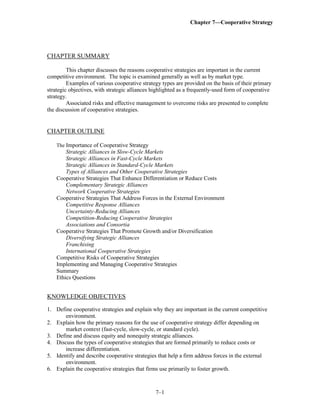

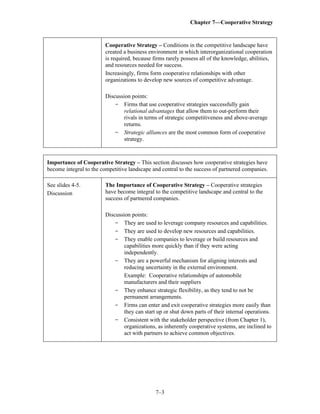


![also many Askari, were bitterly disappointed at having to remain. We
had repeatedly to refuse the request of a brave Askari that he might
come and fight for us. But when, two days later, Lieutenant
Grundmann, though severely wounded and scarcely able to walk,
reported himself, saying that he could not, in spite of orders, bring
himself to surrender, I have seldom been so pleased as at this breach
of discipline. It may be mentioned here that in general the enemy, as
far as I am in a position to judge, treated our prisoners with
humanity, but it seems to me that he was anxious to convict us of
cruelty to English prisoners, perhaps in order to justify reprisals,
perhaps for other reasons. Lieutenant Cutsch had been left sick in
Nandanda, and fell into the enemy’s hands. On the totally unfounded
and unproved evidence of a negro that Lieutenant Cutsch had on one
occasion, when commanding a patrol, burned to death a wounded
Englishman, he was put in irons and sent by sea to Dar-es-Salaam,
being imprisoned during the voyage just outside the ship’s
roundhouse. At Dar-es-Salaam he was locked up for several weeks in
the prison without a trial. When at last he was tried, it came out that
the charge of senseless cruelty rested purely on the lying evidence of
the negro. Again, General Deventer informed me that Captain
Naumann, who had surrendered near Kilima Njaro, had been tried for
murder. He, too, as I heard later, was kept imprisoned for a long time
without a hearing, until his innocence was finally established. I find it
all the more difficult to understand this mockery of justice, as the
English prisoners were always humanely treated by us, and were
often better cared for materially than our own people.[5]
These decisions placed the conduct of the war on an entirely
different basis. Hitherto we had stored the supplies in dumps and for
the most part had been able to satisfy our demands from these; the
ammunition also had been maintained from stores. This system had
laid us more open to attack and offered the enemy points of attack
which we could not protect. But by the methods adopted hitherto it
had been possible to keep the troops in the field at great strength,
considering our position, and to employ a great part of them on a
small area for a considerable period. It had further been possible to
give a permanent character, at any rate to some of our hospitals,](https://image.slidesharecdn.com/12453-250517221117-a099c6b8/85/Competing-for-Advantage-3rd-Edition-Hoskisson-Solutions-Manual-31-320.jpg)