PRINCIPLES OF
MARKETING
THE COMPETITIVE
ADVANTAGE
PRESENTATION BY
SHIRLENE GOMEZ
& NINA MARIE
COMPETITIVE
ADVANTAGE
• WHAT IS A COMPETITIVE
ADVANTAGE?
COMPETITIVE
ADVANTAGE
• A competitive advantage can be
described as what sets the
organization apart from others and
provides it with a distinctive edge
for meeting customer needs in the
market place
• For example, in the automotive
industry, Toyota is considered to be
a superior performer.
HOW IS IT ACHIEVED?
It is achieved either by means of
lower prices or by providing greater
benefits and service to the consumer.
COMPETITIVE
ADVANTAGE
To remain competitive companies often
focus on core competencies, develop
synergy, and create value for customers.
CORE COMPETENCE
• What is a Core Competence?
• A company’s core competence is
something the organization does
especially well in comparison to it’s
competitors.
• A core competence represents a
competitive advantage because the
company acquires expertise that
competitors do not have.
Core competence cont’d
• A core competence may be in the
area of superior research and
development (R&D), expert
technological know-how, process
efficiency, or exceptional
customer service.
• For example, Home Depot thrive
because of a strategy focused on
superior customer service
SYNERGY
• What is Synergy?
• When the output of some units can
be used as the input to other units,
or two organizations pool markets
and expertise, these relationships
lower cost, and generate profits.
• The organization may attain a
competitive advantage with respect
to cost, market power, technology,
or management skills.
SYNERGY Cont’d
• Examples exist in the merger of
banks and financial firms such
as JPMorgan Chase and Bank
One Corporation in the US
PORTER’S VIEW
• A competitive advantage exists
when the firm is able to deliver
the same benefits as
competitors but at a lower cost
(cost advantage), or deliver
benefits that exceed those of
competing products
(differentiation advantage).
PORTER’S COMPETITIVE
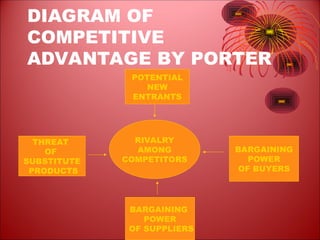
FORCE’S MODEL
Michael Porter identified five
types of competitive forces:
1. Potential new entrants.
2. Bargaining power of buyers.
3. Bargaining power of suppliers.
4. Threat of substitute products.
5. Rivalry among competitors.
POTENTIAL NEW
ENTRANTS.
• New companies are always
entering the market place. In some
industries, there are very low
barriers to entry, whereas in other
industries, entry is very difficult.
For example it is easier to start a
small retail business rather than a
computer chip business, which
would be more costly.
Cont’d
Advantages of new market entrants - :
• They are not limited by old plants,
equipment and tradition.
• They would hire younger workers,
more innovation, less expensive.
• More highly motivated than
traditional occupants of an industry.
DISADVANTAGES
• They depend on outside
financing for new plants and
equipment. This can be very
expensive.
• They have a less experienced
work force.
• They have little brand
recognition.
BARGAINING POWER OF
BUYERS
• Informed customers become
empowered customers. The
internet provides easy access
to information about products,
services, and competitors.
Thereby, greatly increasing the
bargaining power of end
consumers.
BARGAINING POWER OF
SUPPLIERS
• The concentration of suppliers
and the availability of substitute
suppliers are significant factors
in determining supplier power.
The sole supplier of a product
will have great negotiating
power.
THREAT OF SUBSTITUTE
PRODUCTS
• The power of alternatives and
substitutes for a company’s
product may be affected by
changes in cost or trends such
as increased health
consciousness that will deflect
buyer loyalty. Companies in the
sugar industry suffered from the
CONT’D
• Growth of sugar substitutes, and
manufacturer’s of aerosol spray cans
lost business as environmentally
conscious consumers choose other
products. The Internet has created a
greater threat of new substitutes by
enabling new approaches to meeting
consumer needs. For traditional
travel agents, low-cost online
purchases have hurt their business.
RIVALRY AMONG
COMPETITORS
• This is influenced by the preceding
four forces as well as cost and
product differentiation. With the
levelling force of the Internet and
Information Technology, many
companies are having trouble finding
ways to distinguish themselves from
their competitors, so the rivalry
between them would be intense.
CONT’D
• Famous examples include the
rivalry between PepsiCo and
Coca Cola, between UPS and
FEDEX, and between Home
Depot and Lowe’s
PORTER’S COMPETITIVE
STRATEGY
Porter suggested that a
company can adopt one of
three strategies -:
1. Differentiation
2. Cost Leadership
3. Focus
Differentiation
• Involves an attempt to distinguish
the firm’s product or services from
others in the industry.
• The organisation may use
advertising, distinctive product
features or exceptional service to
create the perception of uniqueness.
Examples of products that have
benefited from this type of strategy
include Mercedes Benz , Maytag
appliances.
COST LEADERSHIP
• This involves using cost reduction.
• Tight controls are used to produce
products more efficient than the
competitors.
• A low cost position means that the
company can undercut the
competitor’s price, still offer
comparable quality and earn a
reasonable profit. Example
Enterprise Rent a Car is a low-priced
alternative to Hertz
FOCUS STRATEGY
• A firm concentrates its attention on one or
more particular segments or niches of the
market.
• Advantages –
• A niche is more secure and a firm can
insulate itself from competition.
• The firm does not spread itself too thin.
• Disadvantages –
• Competitors can move into the segment eg
the Japanese moved into the American
luxury car market to compete with
Mercedes and BMW.
DIAGRAM OF
COMPETITIVE
ADVANTAGE BY PORTER
RIVALRY
AMONG
COMPETITORS
POTENTIAL
NEW
ENTRANTS
THREAT
OF
SUBSTITUTE
PRODUCTS
BARGAINING
POWER
OF BUYERS
BARGAINING
POWER
OF SUPPLIERS
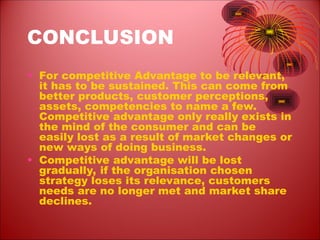
CONCLUSION
• For competitive Advantage to be relevant,
it has to be sustained. This can come from
better products, customer perceptions,
assets, competencies to name a few.
Competitive advantage only really exists in
the mind of the consumer and can be
easily lost as a result of market changes or
new ways of doing business.
• Competitive advantage will be lost
gradually, if the organisation chosen
strategy loses its relevance, customers
needs are no longer met and market share
declines.
SOURCE OF INFORMATION
• CHARTERED INSTITUTE OF
MARKETING(CIM)
• MANAGEMENT-THE NEW
WORKPLACE-DAFT/ MARCIC
• MANAGEMENT INFORMATION
SYSTEMS- LAUDON & LAUDON

THE END

MARKETING Presentation on competitive advantage

  • 1.
  • 2.
    COMPETITIVE ADVANTAGE • WHAT ISA COMPETITIVE ADVANTAGE?
  • 3.
    COMPETITIVE ADVANTAGE • A competitiveadvantage can be described as what sets the organization apart from others and provides it with a distinctive edge for meeting customer needs in the market place • For example, in the automotive industry, Toyota is considered to be a superior performer.
  • 4.
    HOW IS ITACHIEVED? It is achieved either by means of lower prices or by providing greater benefits and service to the consumer.
  • 5.
    COMPETITIVE ADVANTAGE To remain competitivecompanies often focus on core competencies, develop synergy, and create value for customers.
  • 6.
    CORE COMPETENCE • Whatis a Core Competence? • A company’s core competence is something the organization does especially well in comparison to it’s competitors. • A core competence represents a competitive advantage because the company acquires expertise that competitors do not have.
  • 7.
    Core competence cont’d •A core competence may be in the area of superior research and development (R&D), expert technological know-how, process efficiency, or exceptional customer service. • For example, Home Depot thrive because of a strategy focused on superior customer service
  • 8.
    SYNERGY • What isSynergy? • When the output of some units can be used as the input to other units, or two organizations pool markets and expertise, these relationships lower cost, and generate profits. • The organization may attain a competitive advantage with respect to cost, market power, technology, or management skills.
  • 9.
    SYNERGY Cont’d • Examplesexist in the merger of banks and financial firms such as JPMorgan Chase and Bank One Corporation in the US
  • 10.
    PORTER’S VIEW • Acompetitive advantage exists when the firm is able to deliver the same benefits as competitors but at a lower cost (cost advantage), or deliver benefits that exceed those of competing products (differentiation advantage).
  • 11.
    PORTER’S COMPETITIVE FORCE’S MODEL MichaelPorter identified five types of competitive forces: 1. Potential new entrants. 2. Bargaining power of buyers. 3. Bargaining power of suppliers. 4. Threat of substitute products. 5. Rivalry among competitors.
  • 12.
    POTENTIAL NEW ENTRANTS. • Newcompanies are always entering the market place. In some industries, there are very low barriers to entry, whereas in other industries, entry is very difficult. For example it is easier to start a small retail business rather than a computer chip business, which would be more costly.
  • 13.
    Cont’d Advantages of newmarket entrants - : • They are not limited by old plants, equipment and tradition. • They would hire younger workers, more innovation, less expensive. • More highly motivated than traditional occupants of an industry.
  • 14.
    DISADVANTAGES • They dependon outside financing for new plants and equipment. This can be very expensive. • They have a less experienced work force. • They have little brand recognition.
  • 15.
    BARGAINING POWER OF BUYERS •Informed customers become empowered customers. The internet provides easy access to information about products, services, and competitors. Thereby, greatly increasing the bargaining power of end consumers.
  • 16.
    BARGAINING POWER OF SUPPLIERS •The concentration of suppliers and the availability of substitute suppliers are significant factors in determining supplier power. The sole supplier of a product will have great negotiating power.
  • 17.
    THREAT OF SUBSTITUTE PRODUCTS •The power of alternatives and substitutes for a company’s product may be affected by changes in cost or trends such as increased health consciousness that will deflect buyer loyalty. Companies in the sugar industry suffered from the
  • 18.
    CONT’D • Growth ofsugar substitutes, and manufacturer’s of aerosol spray cans lost business as environmentally conscious consumers choose other products. The Internet has created a greater threat of new substitutes by enabling new approaches to meeting consumer needs. For traditional travel agents, low-cost online purchases have hurt their business.
  • 19.
    RIVALRY AMONG COMPETITORS • Thisis influenced by the preceding four forces as well as cost and product differentiation. With the levelling force of the Internet and Information Technology, many companies are having trouble finding ways to distinguish themselves from their competitors, so the rivalry between them would be intense.
  • 20.
    CONT’D • Famous examplesinclude the rivalry between PepsiCo and Coca Cola, between UPS and FEDEX, and between Home Depot and Lowe’s
  • 21.
    PORTER’S COMPETITIVE STRATEGY Porter suggestedthat a company can adopt one of three strategies -: 1. Differentiation 2. Cost Leadership 3. Focus
  • 22.
    Differentiation • Involves anattempt to distinguish the firm’s product or services from others in the industry. • The organisation may use advertising, distinctive product features or exceptional service to create the perception of uniqueness. Examples of products that have benefited from this type of strategy include Mercedes Benz , Maytag appliances.
  • 23.
    COST LEADERSHIP • Thisinvolves using cost reduction. • Tight controls are used to produce products more efficient than the competitors. • A low cost position means that the company can undercut the competitor’s price, still offer comparable quality and earn a reasonable profit. Example Enterprise Rent a Car is a low-priced alternative to Hertz
  • 24.
    FOCUS STRATEGY • Afirm concentrates its attention on one or more particular segments or niches of the market. • Advantages – • A niche is more secure and a firm can insulate itself from competition. • The firm does not spread itself too thin. • Disadvantages – • Competitors can move into the segment eg the Japanese moved into the American luxury car market to compete with Mercedes and BMW.
  • 25.
    DIAGRAM OF COMPETITIVE ADVANTAGE BYPORTER RIVALRY AMONG COMPETITORS POTENTIAL NEW ENTRANTS THREAT OF SUBSTITUTE PRODUCTS BARGAINING POWER OF BUYERS BARGAINING POWER OF SUPPLIERS
  • 26.
    CONCLUSION • For competitiveAdvantage to be relevant, it has to be sustained. This can come from better products, customer perceptions, assets, competencies to name a few. Competitive advantage only really exists in the mind of the consumer and can be easily lost as a result of market changes or new ways of doing business. • Competitive advantage will be lost gradually, if the organisation chosen strategy loses its relevance, customers needs are no longer met and market share declines.
  • 27.
    SOURCE OF INFORMATION •CHARTERED INSTITUTE OF MARKETING(CIM) • MANAGEMENT-THE NEW WORKPLACE-DAFT/ MARCIC • MANAGEMENT INFORMATION SYSTEMS- LAUDON & LAUDON
  • 28.