
Introduction to Real NumbersIntroduction to Real Numbers
andand
Their PropertiesTheir Properties
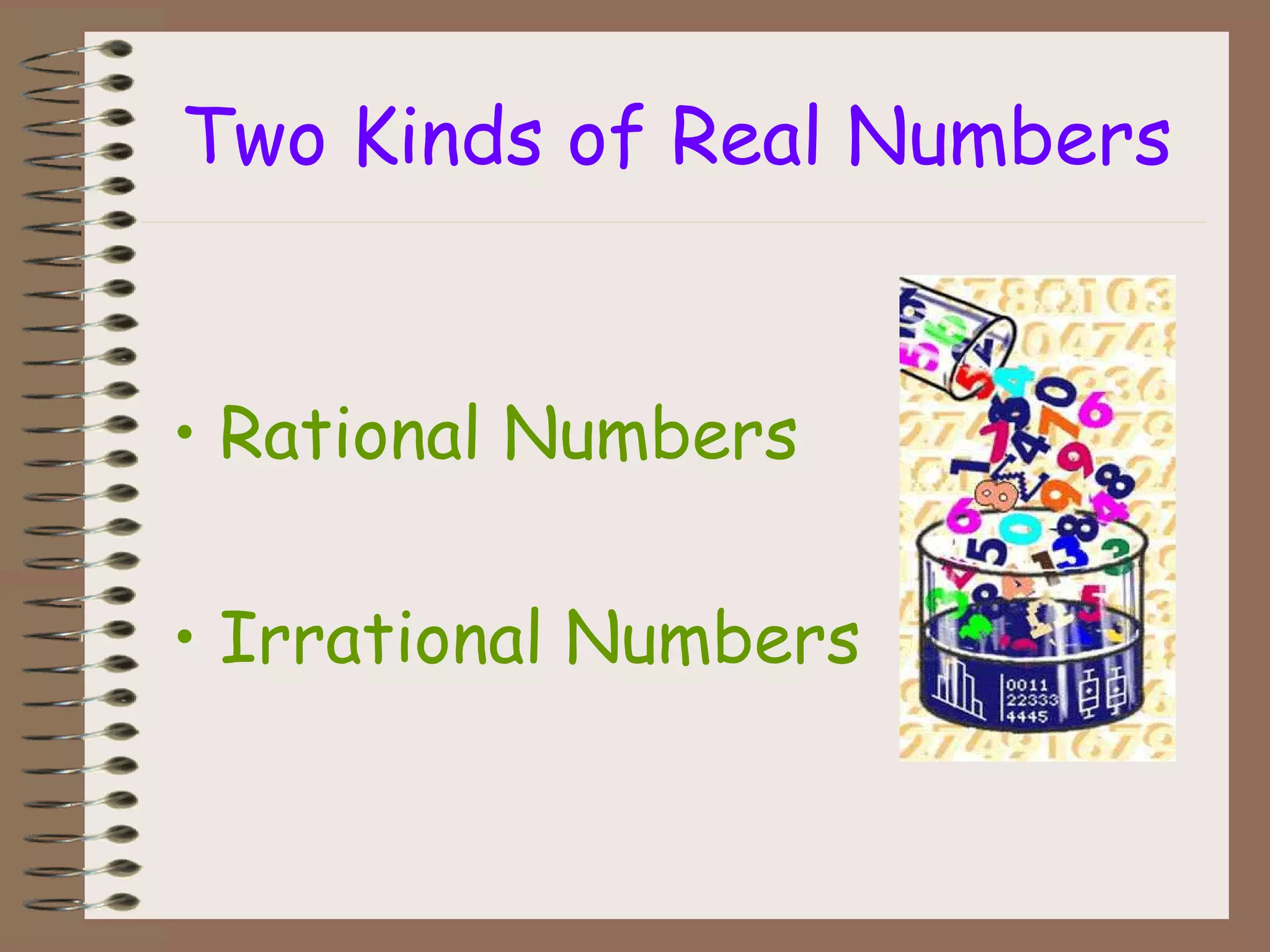
Two Kinds of Real Numbers
• Rational Numbers
• Irrational Numbers
Rational Numbers
• A rational number is a real
number that can be written
as a ratio of two integers.
• A rational number written in
decimal form is terminating
or repeating.
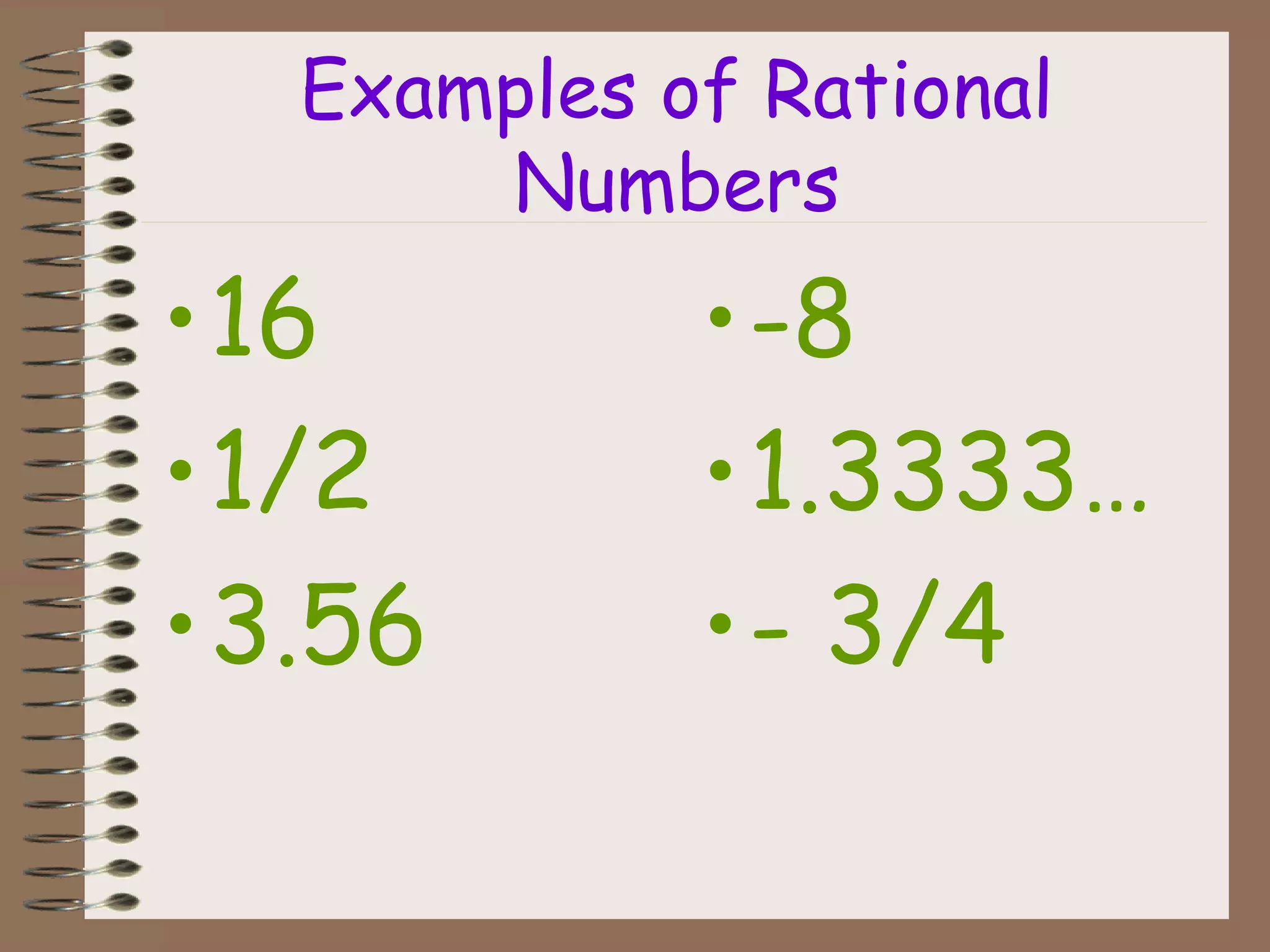
Examples of Rational
Numbers
•16
•1/2
•3.56
•-8
•1.3333…
•- 3/4
Irrational Numbers
• An irrational number is a
number that cannot be
written as a ratio of two
integers.
• Irrational numbers written as
decimals are non-terminating
and non-repeating.
Examples of Irrational
Numbers
• Square roots of
non-perfect
“squares”
• Pi
17
What are integers?
• Integers are the
whole numbers and
their opposites.
• Examples of integers
are
6
-12
0
186
-934
Using Exponents
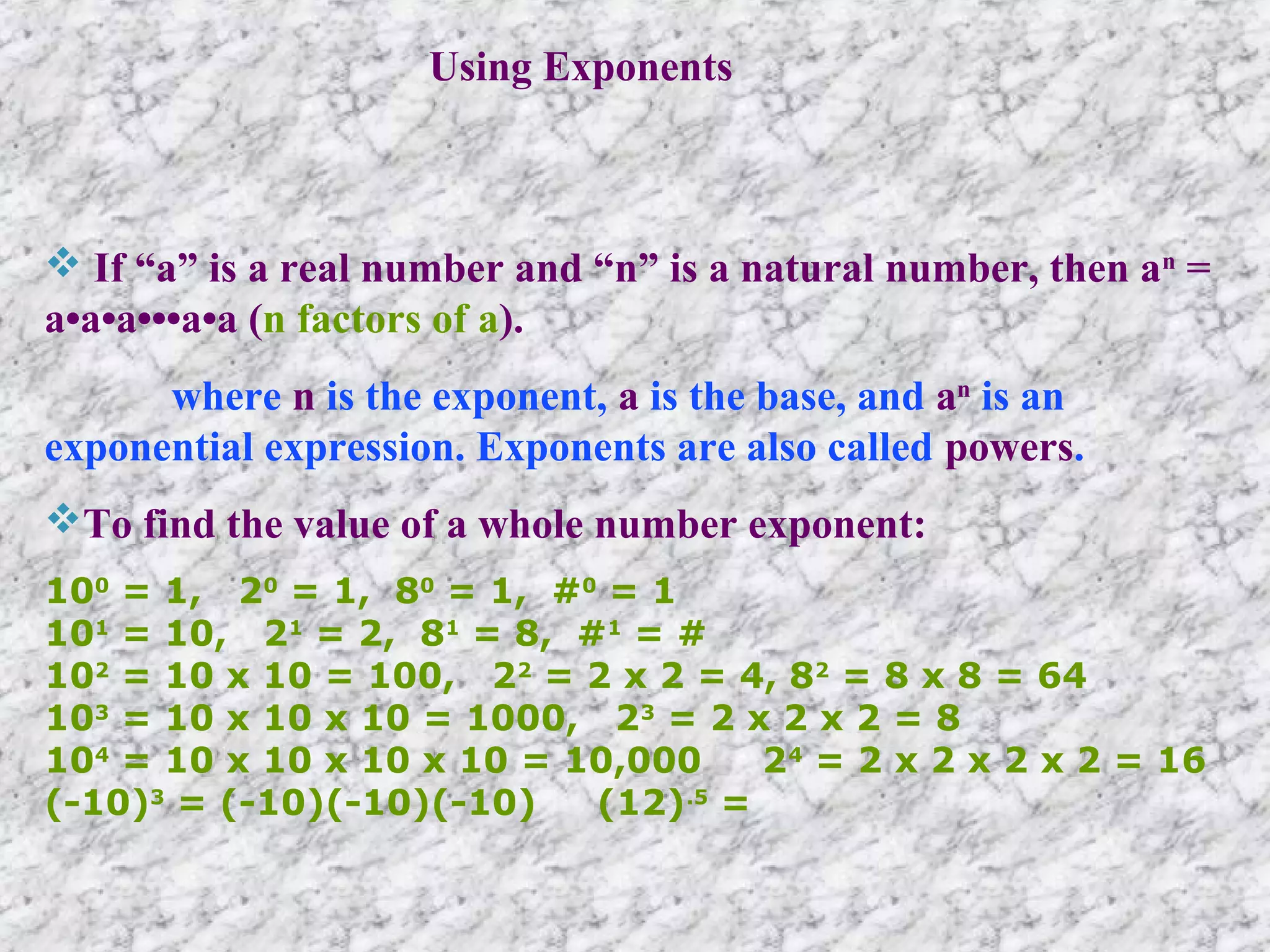
 If “a” is a real number and “n” is a natural number, then an
=
a•a•a•••a•a (n factors of a).
where n is the exponent, a is the base, and an
is an
exponential expression. Exponents are also called powers.
To find the value of a whole number exponent:
100
= 1, 20
= 1, 80
= 1, #0
= 1
101
= 10, 21
= 2, 81
= 8, #1
= #
102
= 10 x 10 = 100, 22
= 2 x 2 = 4, 82
= 8 x 8 = 64
103
= 10 x 10 x 10 = 1000, 23
= 2 x 2 x 2 = 8
104
= 10 x 10 x 10 x 10 = 10,000 24
= 2 x 2 x 2 x 2 = 16
(-10)3
= (-10)(-10)(-10) (12).5
=
Using the Identity Properties
“additive identity”
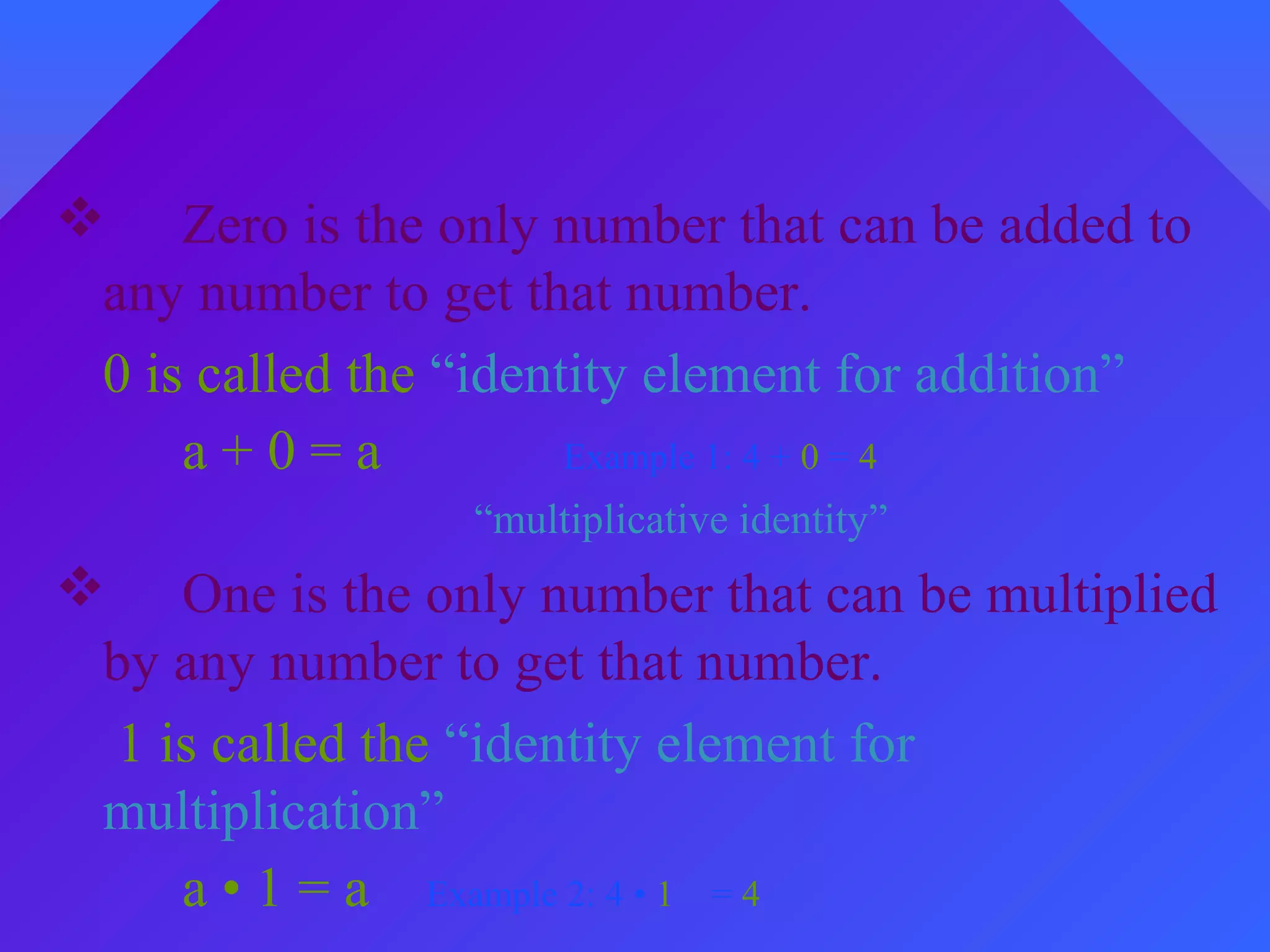
 Zero is the only number that can be added to
any number to get that number.
0 is called the “identity element for addition”
a + 0 = a Example 1: 4 + 0 = 4
“multiplicative identity”
 One is the only number that can be multiplied
by any number to get that number.
1 is called the “identity element for
multiplication”
a • 1 = a Example 2: 4 • 1 = 4
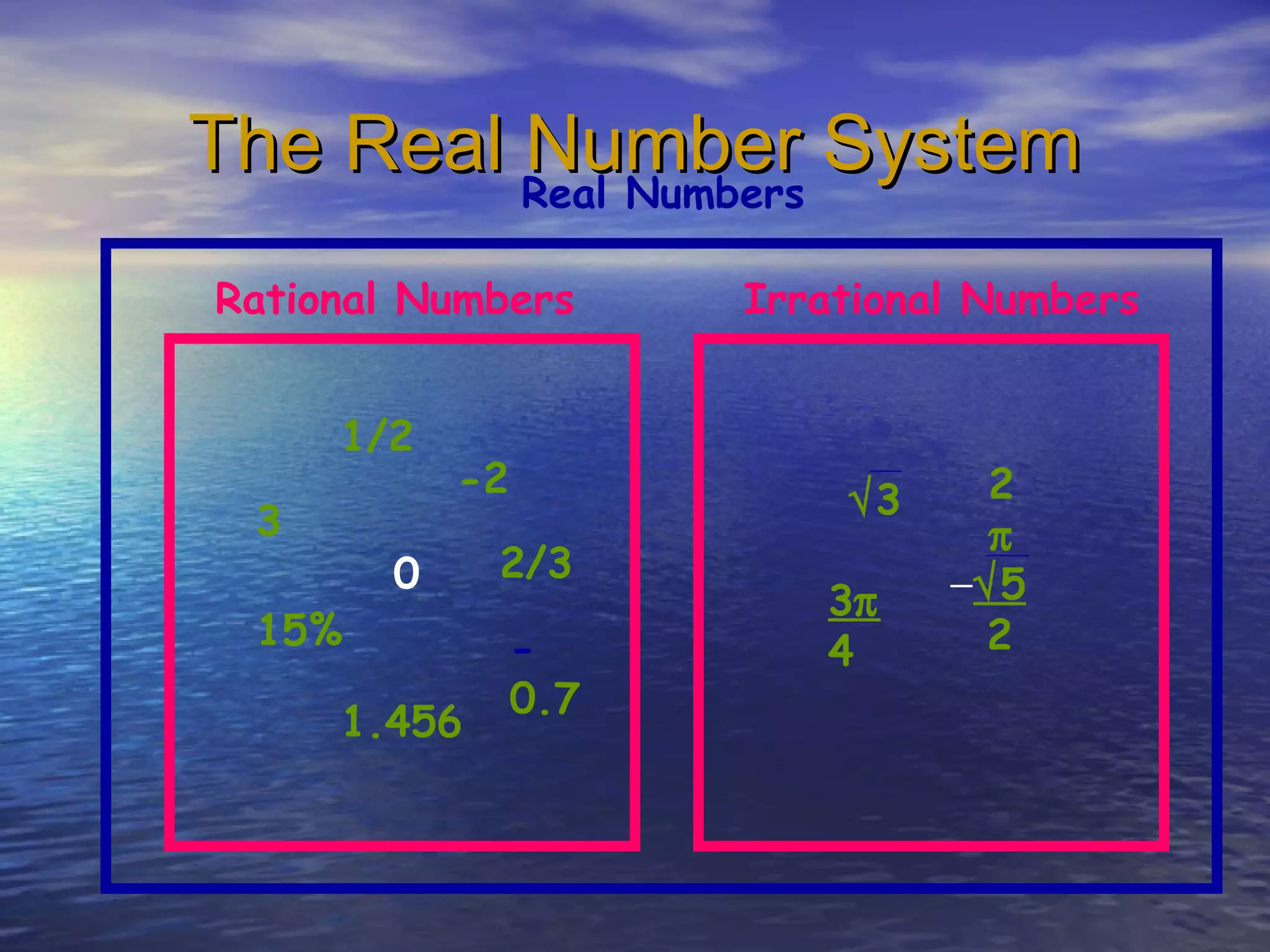
The Real Number SystemThe Real Number SystemReal Numbers
Rational Numbers Irrational Numbers
3
1/2
-2
15%
2/3
1.456
-
0.7
0
√3 2
π
−√5
2
3π
4
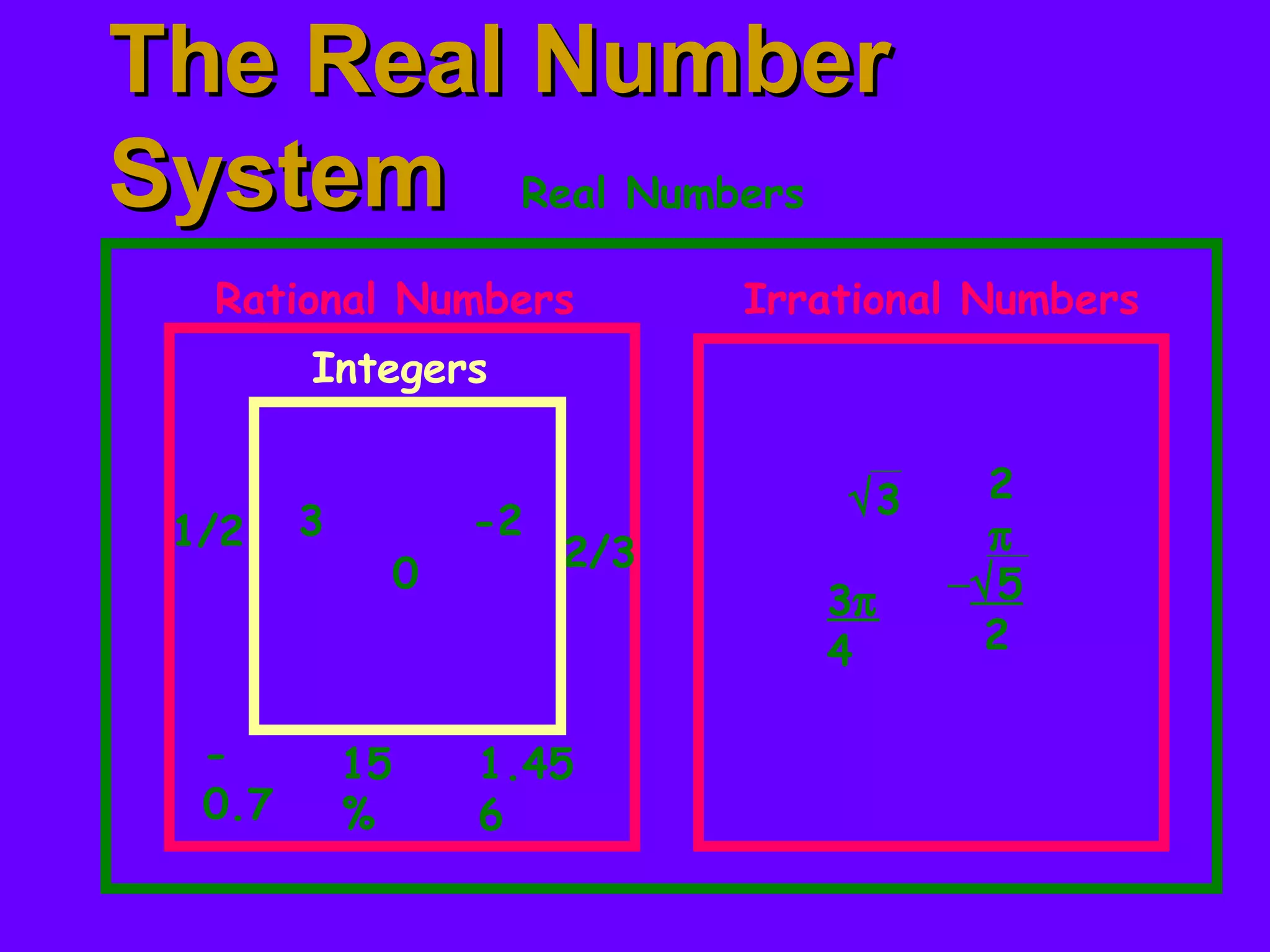
The Real NumberThe Real Number
SystemSystem Real Numbers
Rational Numbers Irrational Numbers
31/2 -2
15
%
2/3
1.45
6
-
0.7
0
√3 2
π
−√5
2
3π
4
Integers
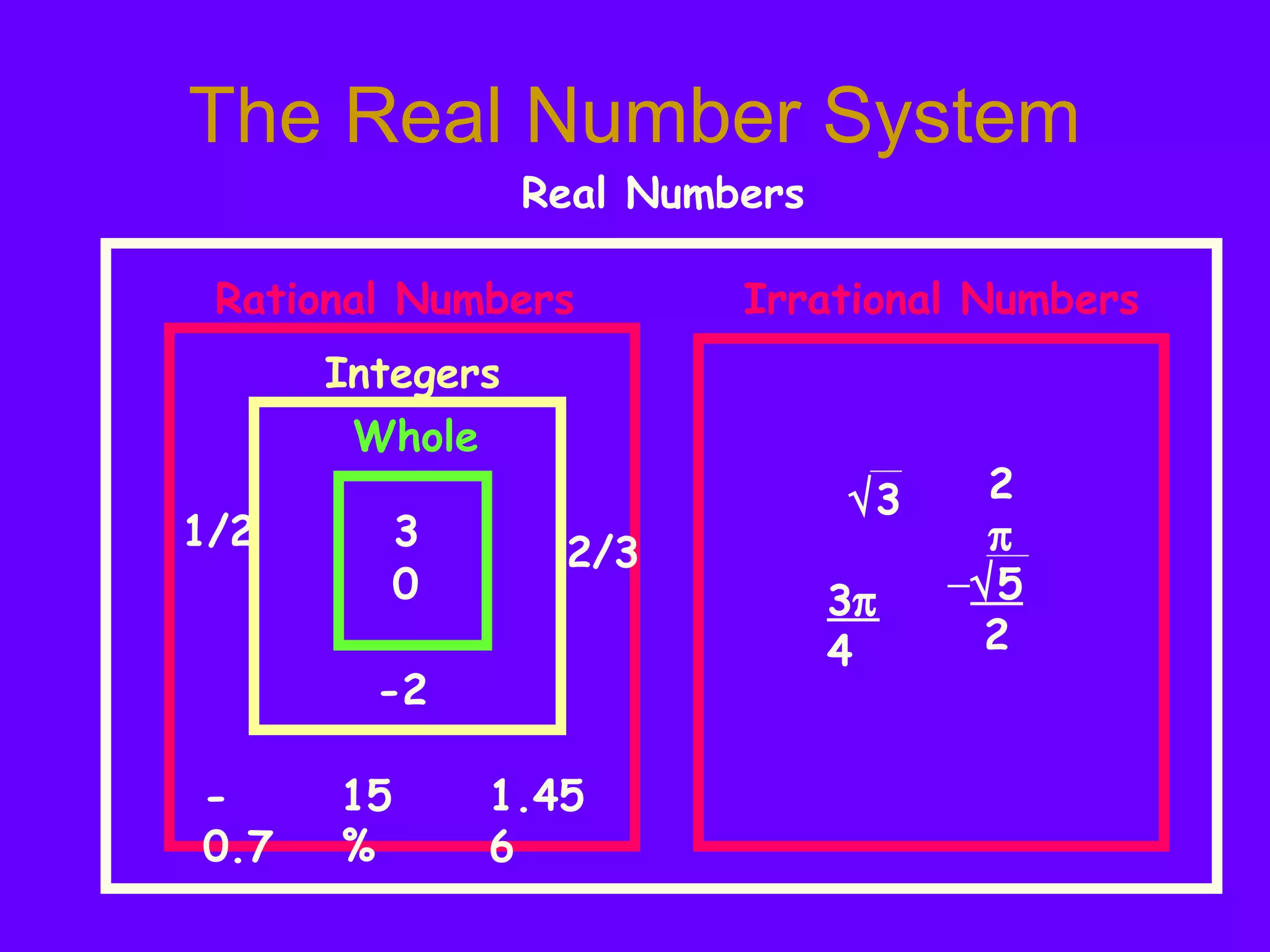
The Real Number System
Real Numbers
Rational Numbers Irrational Numbers
31/2
-2
15
%
2/3
1.45
6
-
0.7
0
√3 2
π
−√5
2
3π
4
Integers
Whole
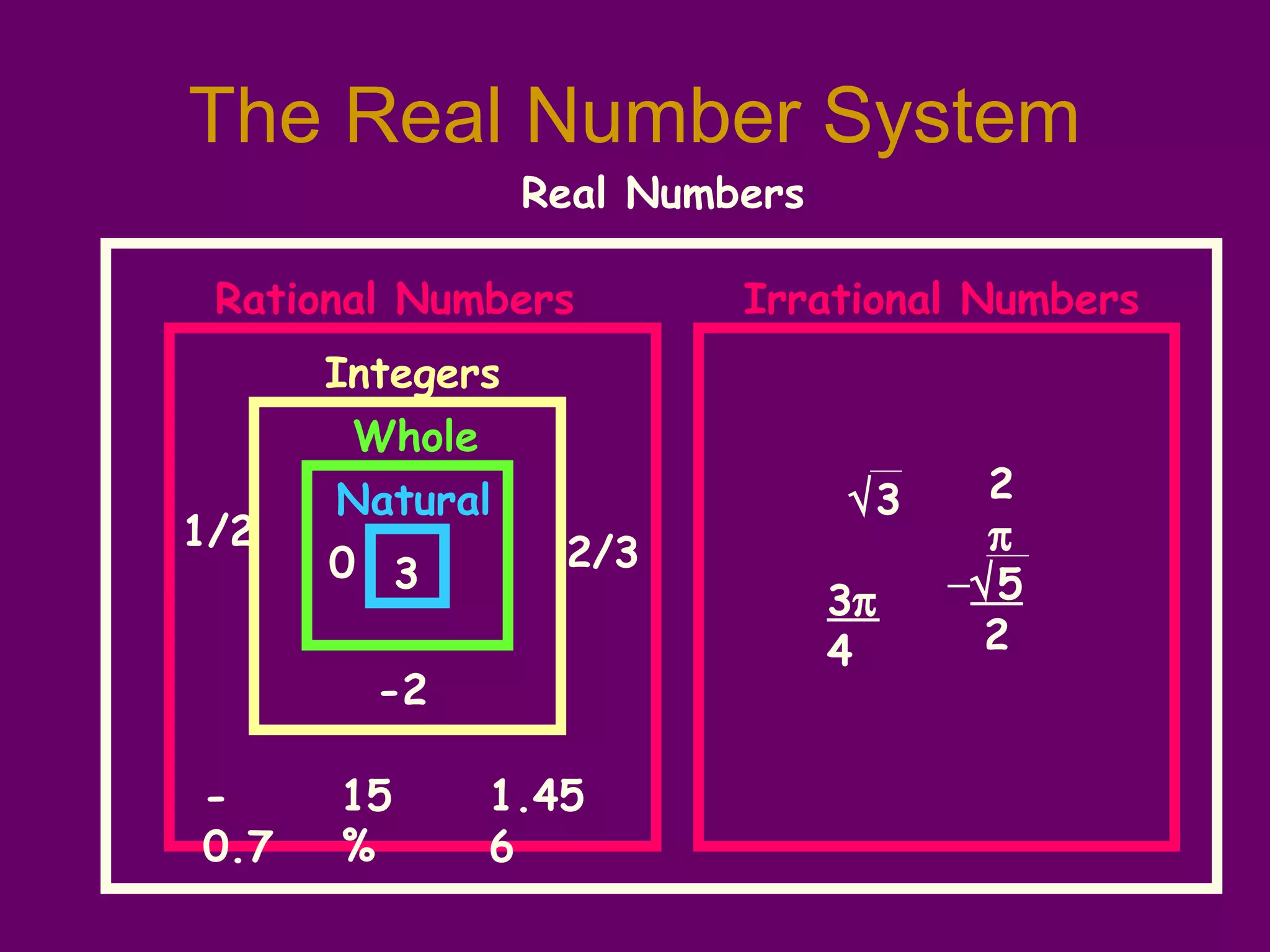
The Real Number System
Real Numbers
Rational Numbers Irrational Numbers
3
1/2
-2
15
%
2/3
1.45
6
-
0.7
0
√3 2
π
−√5
2
3π
4
Integers
Whole
Natural
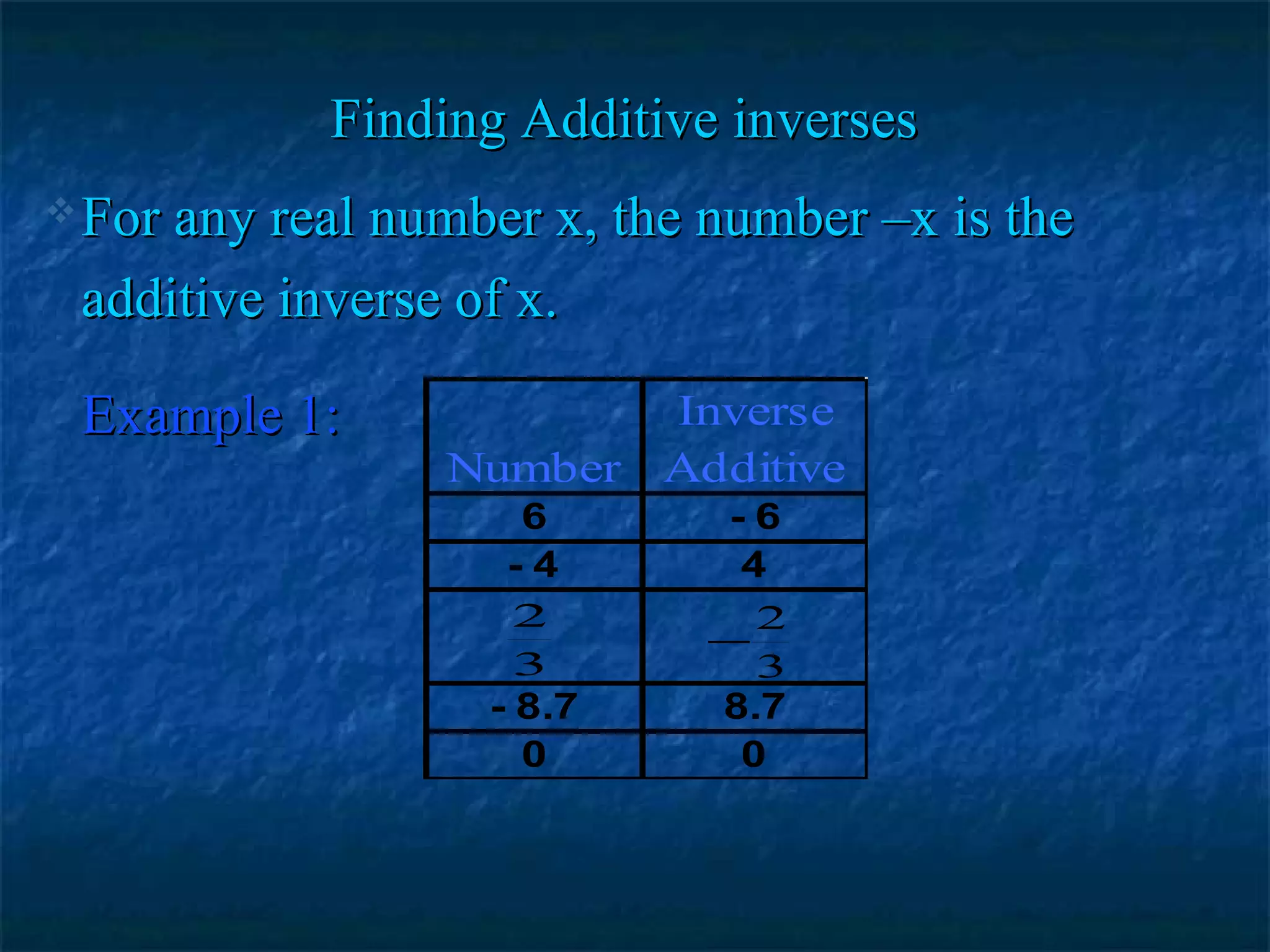
Finding Additive inversesFinding Additive inverses
 For any real number x, the number –x is theFor any real number x, the number –x is the
additive inverse of x.additive inverse of x.
Example 1:Example 1:
Number
Inverse
Additive
6 - 6
- 4 4
- 8.7 8.7
0 0
2
3
2
3
−
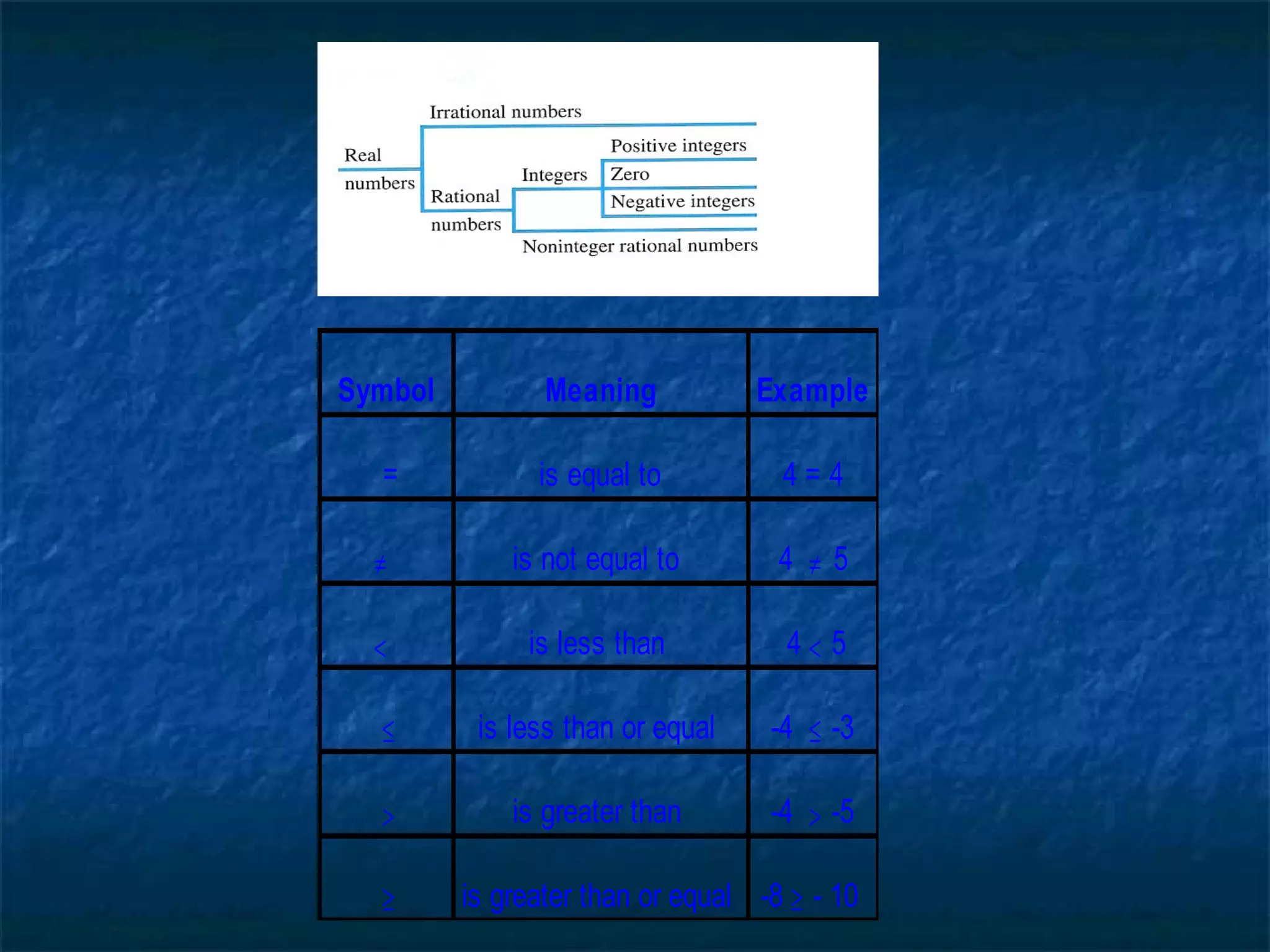
Symbol Meaning Example
= is equal to 4 = 4
≠ is not equal to 4 ≠ 5
< is less than 4 < 5
≤ is less than or equal -4 ≤ -3
> is greater than -4 > -5
≥ is greater than or equal -8 ≥ - 10
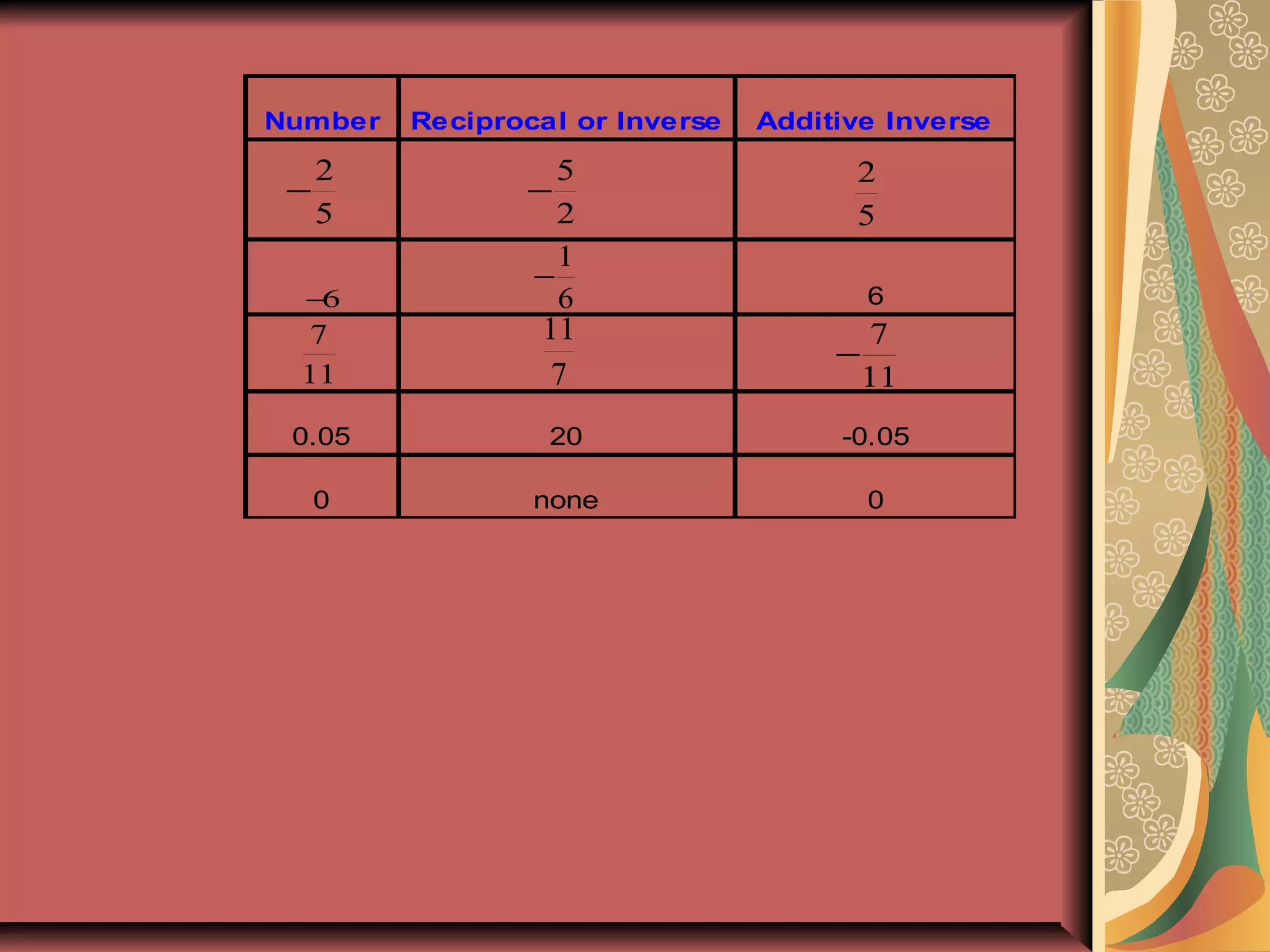
Number Reciprocal or Inverse Additive Inverse
−6 6
0.05 20 -0.05
0 none 0
2
5
−
5
2
−
2
5
1
6
−
11
7
7
11
7
11
−

Rational numbers

  • 1.
    Introduction to RealNumbersIntroduction to Real Numbers andand Their PropertiesTheir Properties
  • 2.
    Two Kinds ofReal Numbers • Rational Numbers • Irrational Numbers
  • 3.
    Rational Numbers • Arational number is a real number that can be written as a ratio of two integers. • A rational number written in decimal form is terminating or repeating.
  • 4.
  • 5.
    Irrational Numbers • Anirrational number is a number that cannot be written as a ratio of two integers. • Irrational numbers written as decimals are non-terminating and non-repeating.
  • 6.
    Examples of Irrational Numbers •Square roots of non-perfect “squares” • Pi 17
  • 7.
    What are integers? •Integers are the whole numbers and their opposites. • Examples of integers are 6 -12 0 186 -934
  • 8.
    Using Exponents  If“a” is a real number and “n” is a natural number, then an = a•a•a•••a•a (n factors of a). where n is the exponent, a is the base, and an is an exponential expression. Exponents are also called powers. To find the value of a whole number exponent: 100 = 1, 20 = 1, 80 = 1, #0 = 1 101 = 10, 21 = 2, 81 = 8, #1 = # 102 = 10 x 10 = 100, 22 = 2 x 2 = 4, 82 = 8 x 8 = 64 103 = 10 x 10 x 10 = 1000, 23 = 2 x 2 x 2 = 8 104 = 10 x 10 x 10 x 10 = 10,000 24 = 2 x 2 x 2 x 2 = 16 (-10)3 = (-10)(-10)(-10) (12).5 =
  • 9.
    Using the IdentityProperties “additive identity”  Zero is the only number that can be added to any number to get that number. 0 is called the “identity element for addition” a + 0 = a Example 1: 4 + 0 = 4 “multiplicative identity”  One is the only number that can be multiplied by any number to get that number. 1 is called the “identity element for multiplication” a • 1 = a Example 2: 4 • 1 = 4
  • 10.
    The Real NumberSystemThe Real Number SystemReal Numbers Rational Numbers Irrational Numbers 3 1/2 -2 15% 2/3 1.456 - 0.7 0 √3 2 π −√5 2 3π 4
  • 11.
    The Real NumberTheReal Number SystemSystem Real Numbers Rational Numbers Irrational Numbers 31/2 -2 15 % 2/3 1.45 6 - 0.7 0 √3 2 π −√5 2 3π 4 Integers
  • 12.
    The Real NumberSystem Real Numbers Rational Numbers Irrational Numbers 31/2 -2 15 % 2/3 1.45 6 - 0.7 0 √3 2 π −√5 2 3π 4 Integers Whole
  • 13.
    The Real NumberSystem Real Numbers Rational Numbers Irrational Numbers 3 1/2 -2 15 % 2/3 1.45 6 - 0.7 0 √3 2 π −√5 2 3π 4 Integers Whole Natural
  • 14.
    Finding Additive inversesFindingAdditive inverses  For any real number x, the number –x is theFor any real number x, the number –x is the additive inverse of x.additive inverse of x. Example 1:Example 1: Number Inverse Additive 6 - 6 - 4 4 - 8.7 8.7 0 0 2 3 2 3 −
  • 15.
    Symbol Meaning Example =is equal to 4 = 4 ≠ is not equal to 4 ≠ 5 < is less than 4 < 5 ≤ is less than or equal -4 ≤ -3 > is greater than -4 > -5 ≥ is greater than or equal -8 ≥ - 10
  • 16.
    Number Reciprocal orInverse Additive Inverse −6 6 0.05 20 -0.05 0 none 0 2 5 − 5 2 − 2 5 1 6 − 11 7 7 11 7 11 −