Nutrition
iGCSE Biology
Learning Outcome 1
• Explain in simple terms why food is
required by animals.
You are what you eat!!
• In this lesson you will
– Look at what is a balanced diet
– Carry out food tests on
• Starch
• Glucose
• Protein
• Fat

– Discuss what happens if you don’t eat
a balanced diet
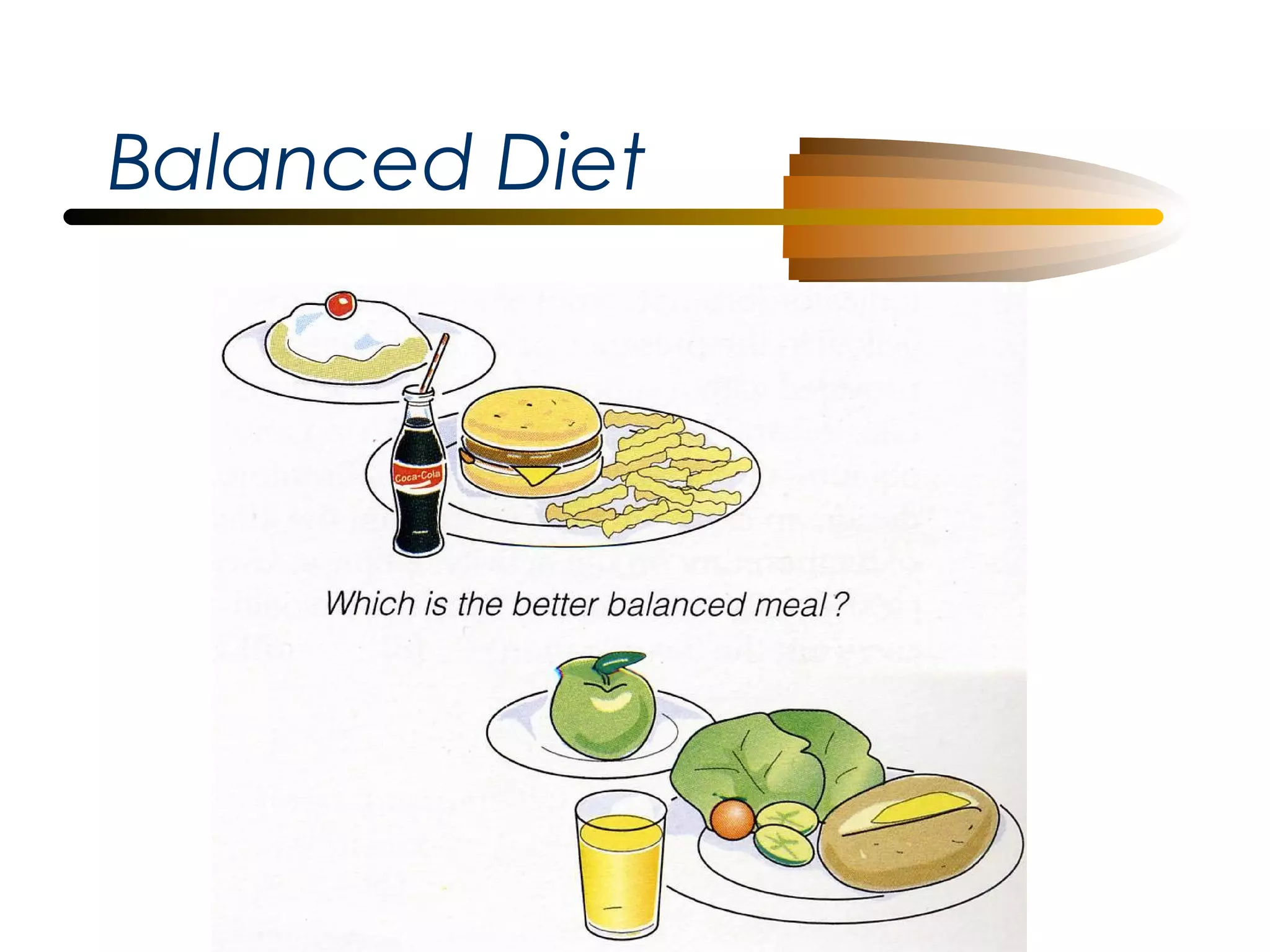
Balanced Diet
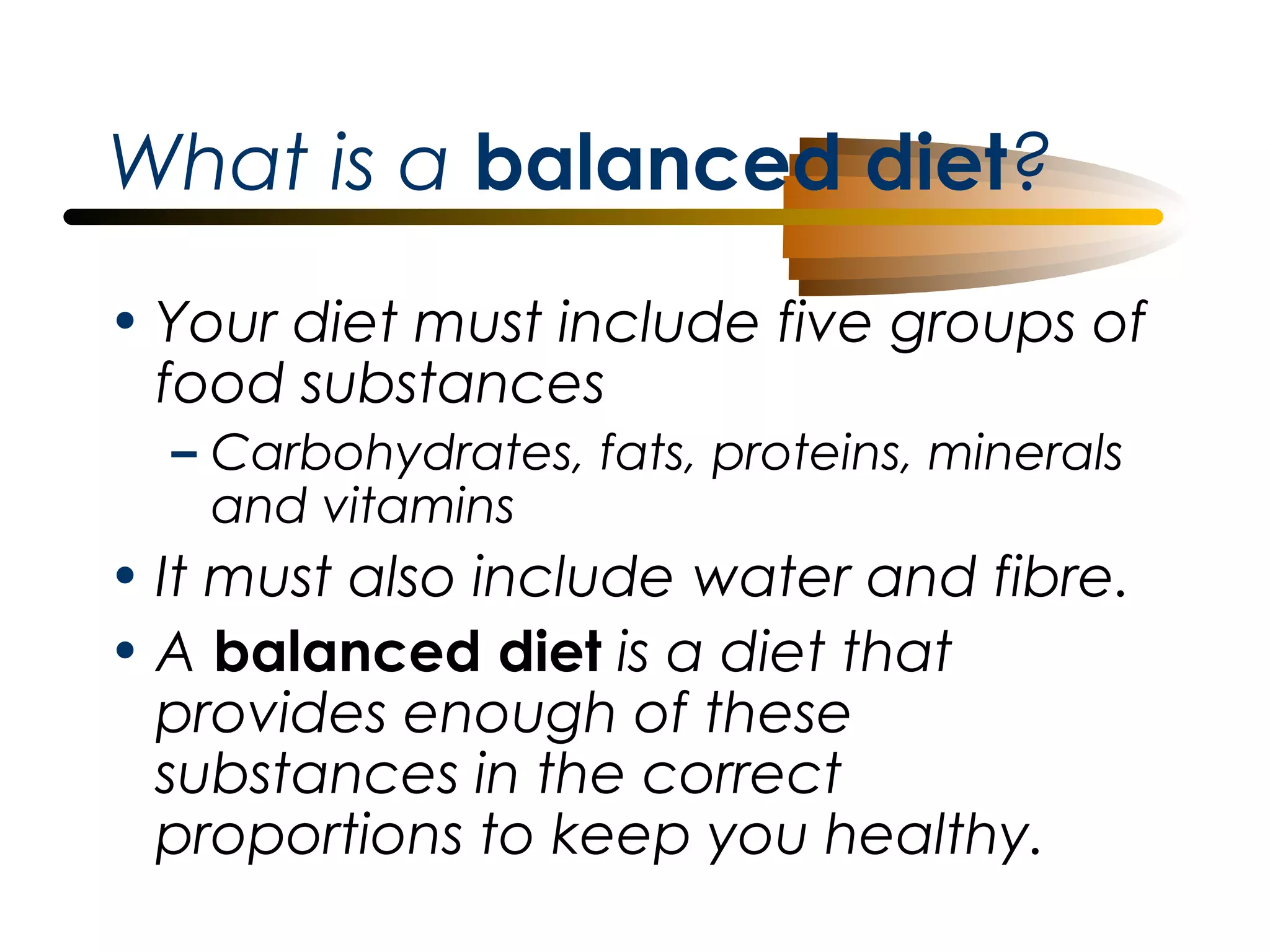
What is a balanced diet?
• Your diet must include five groups of
food substances
– Carbohydrates, fats, proteins, minerals
and vitamins

• It must also include water and fibre.
• A balanced diet is a diet that
provides enough of these
substances in the correct
proportions to keep you healthy.
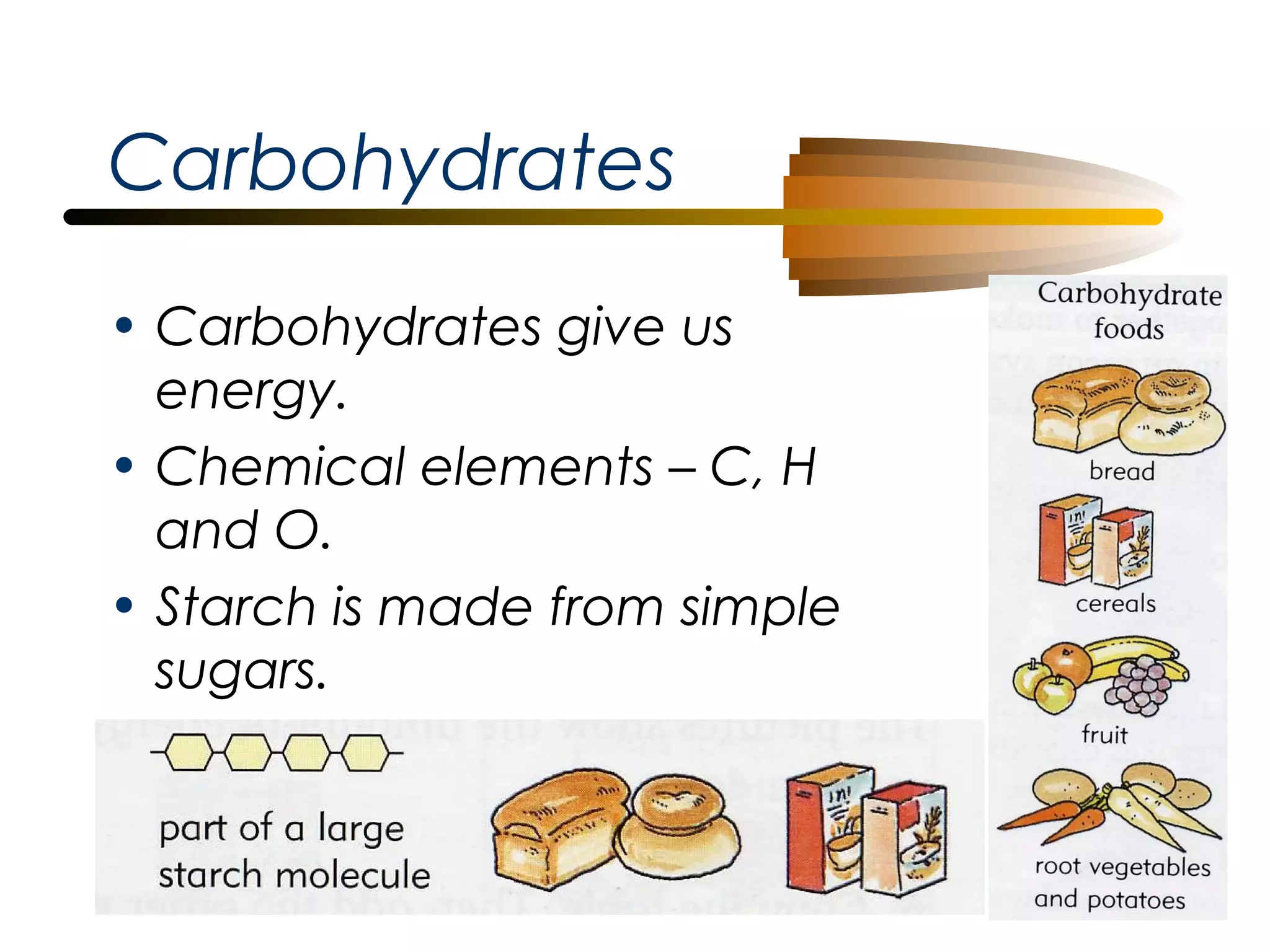
Carbohydrates
• Carbohydrates give us
energy.
• Chemical elements – C, H
and O.
• Starch is made from simple
sugars.
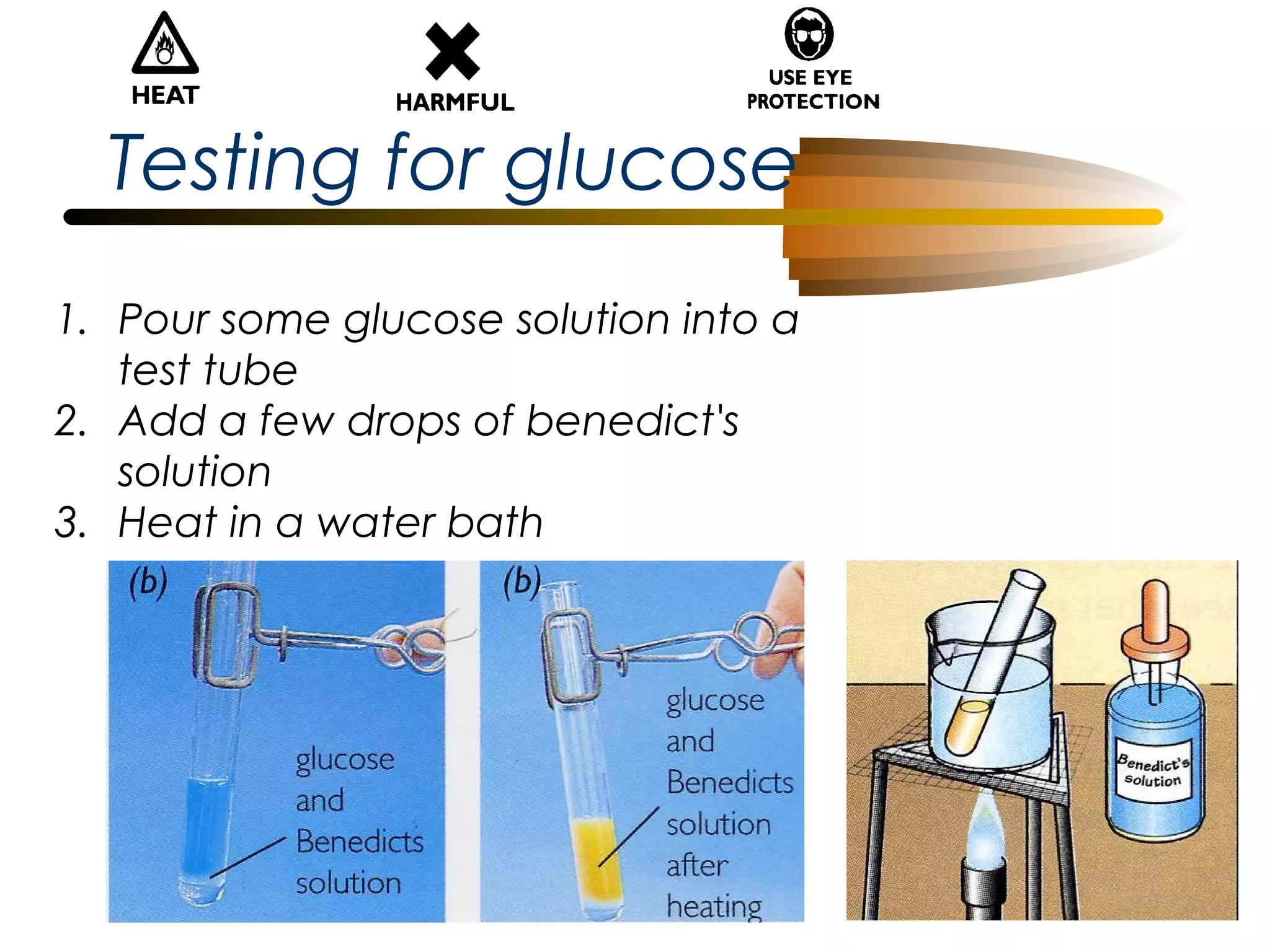
Testing for glucose
1. Pour some glucose solution into a
test tube
2. Add a few drops of benedict's
solution
3. Heat in a water bath
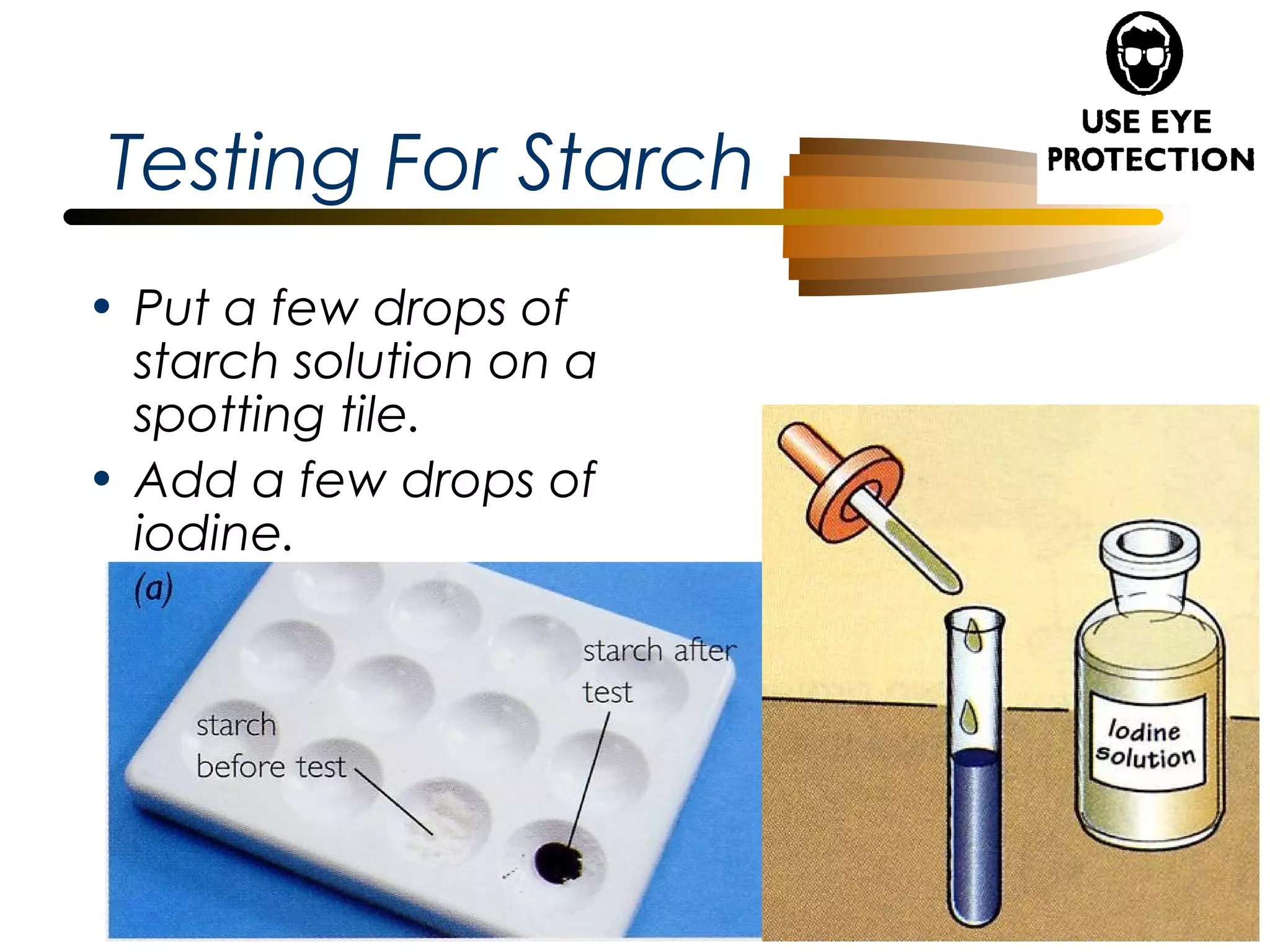
Testing For Starch
• Put a few drops of
starch solution on a
spotting tile.
• Add a few drops of
iodine.
Proteins
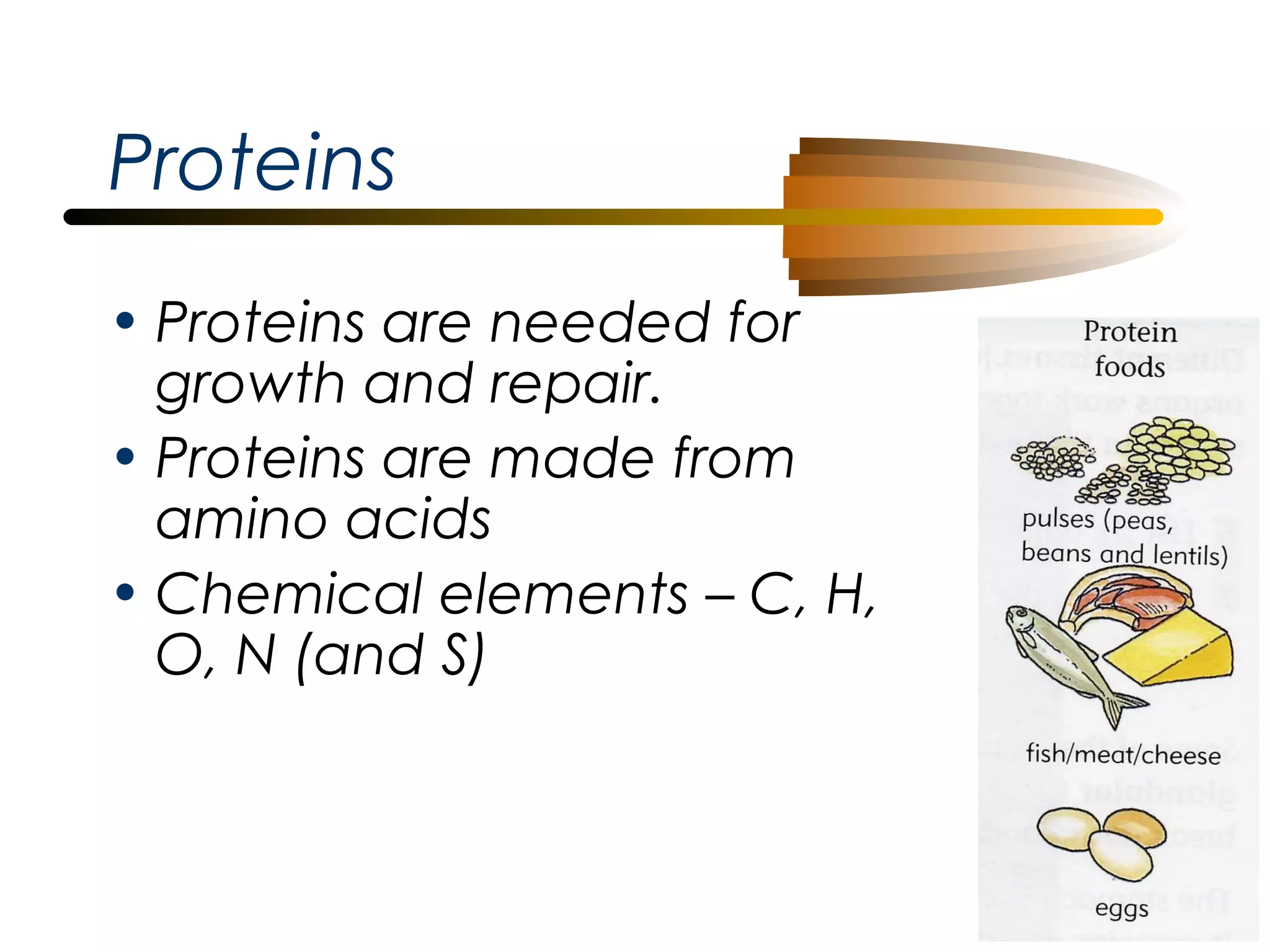
• Proteins are needed for
growth and repair.
• Proteins are made from
amino acids
• Chemical elements – C, H,
O, N (and S)
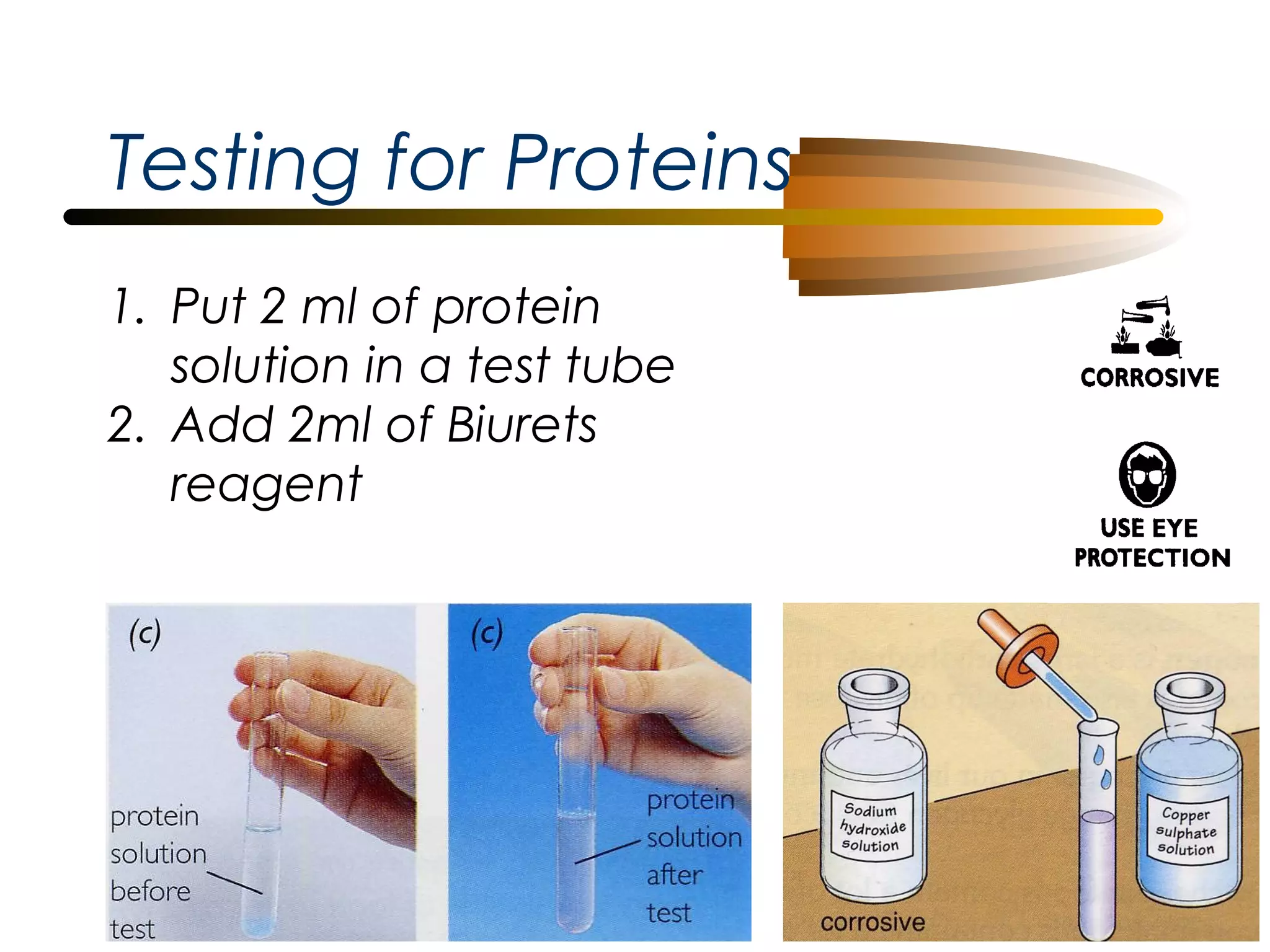
Testing for Proteins
1. Put 2 ml of protein
solution in a test tube
2. Add 2ml of Biurets
reagent
Fats
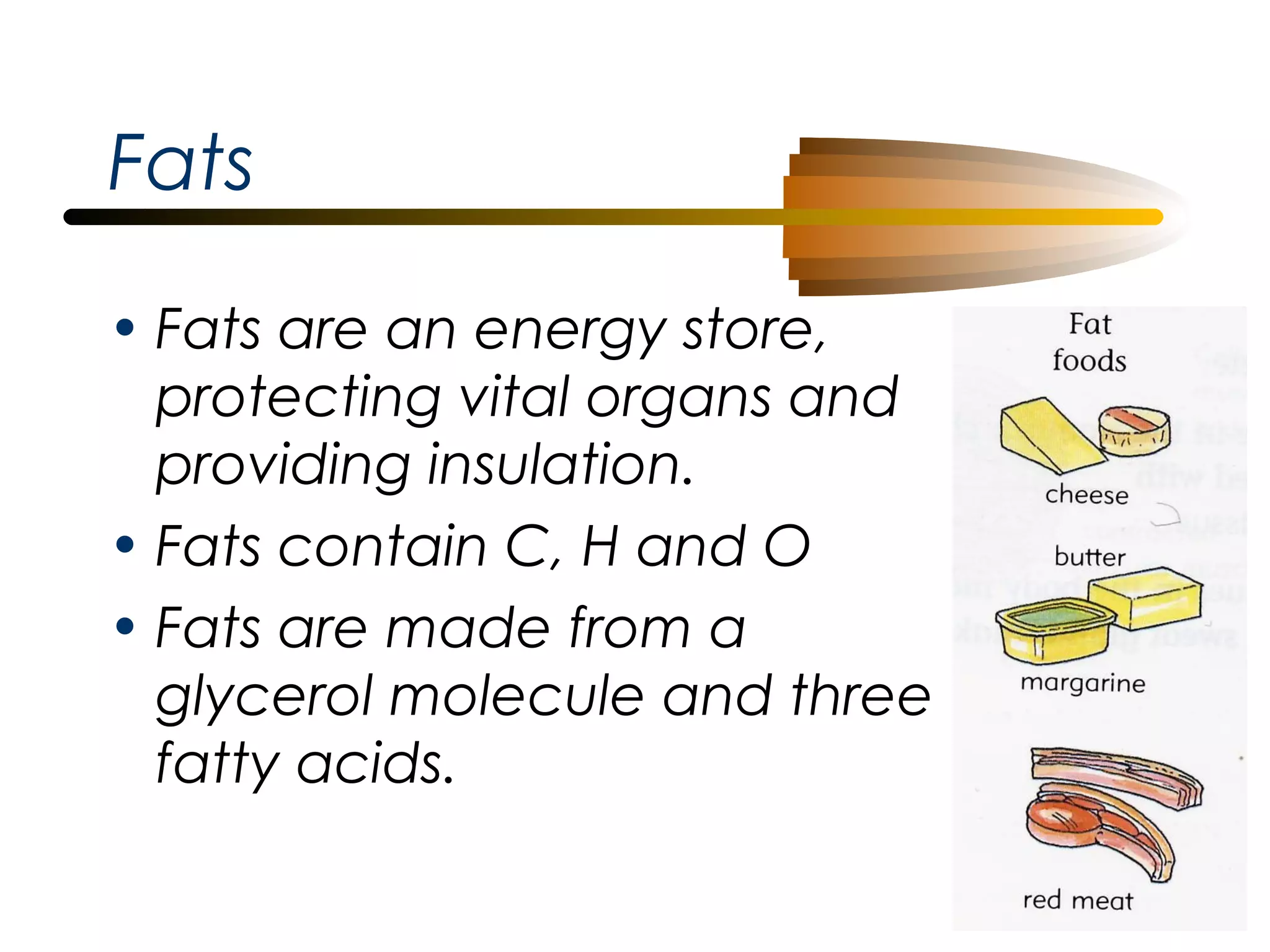
• Fats are an energy store,
protecting vital organs and
providing insulation.
• Fats contain C, H and O
• Fats are made from a
glycerol molecule and three
fatty acids.
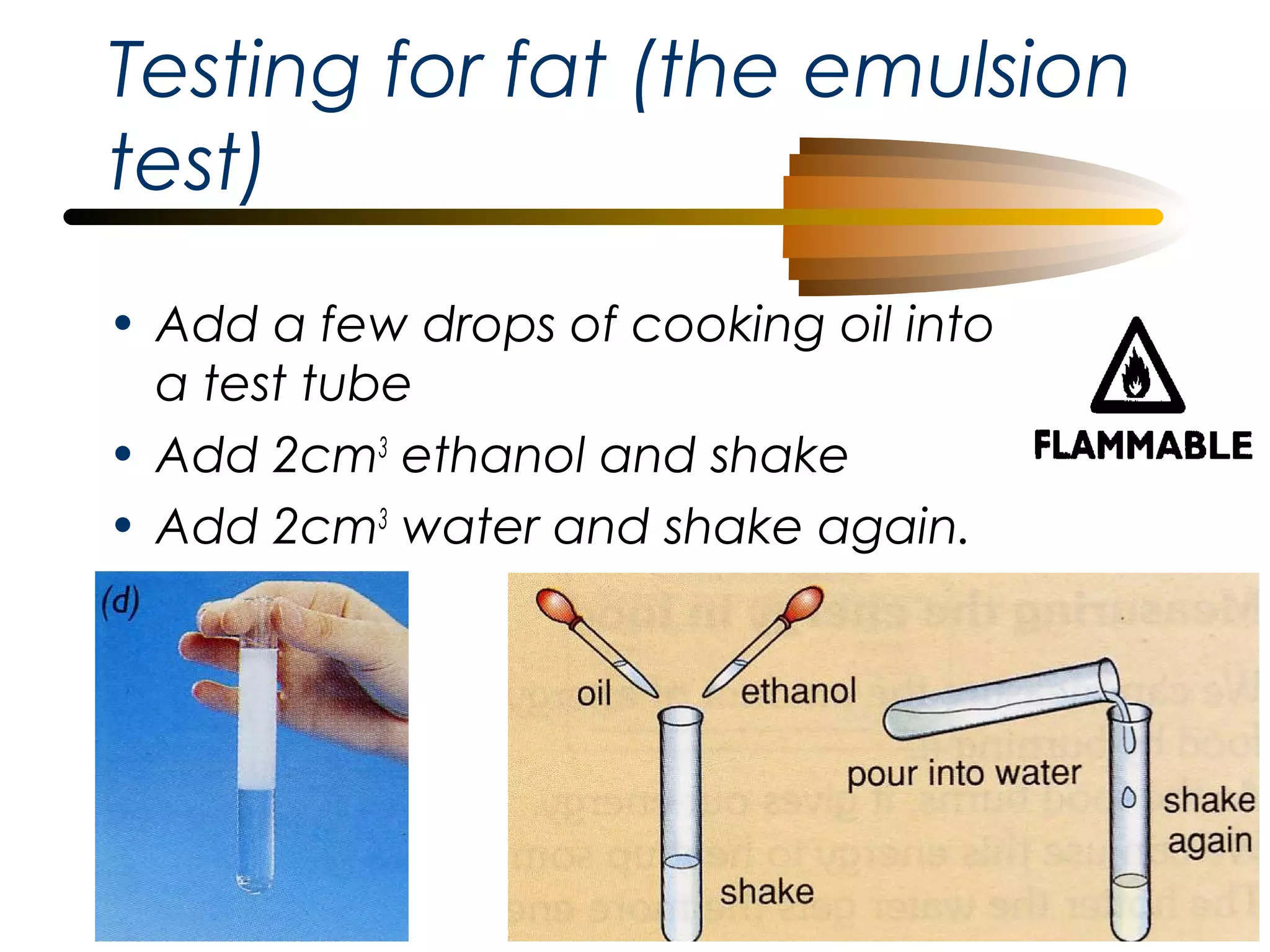
Testing for fat (the emulsion
test)
• Add a few drops of cooking oil into
a test tube
• Add 2cm3 ethanol and shake
• Add 2cm3 water and shake again.
Nutrients
Learning Outcomes
• list the chemical elements that make up:
– carbohydrates
– fats
– Proteins

• Describe the synthesis of large molecules
from smaller basic units
• list the principal sources of, and describe
the importance of carbohydrates, fats,
proteins,.
Quick Revision
• A balanced diet must contain all the
essential nutrients in the correct amounts
and proportions.
• The nutrients needed are
–
–
–
–
–
–
–

Carbohydrate
Fat
Protein
Vitamins
Minerals
Fibre
Water.
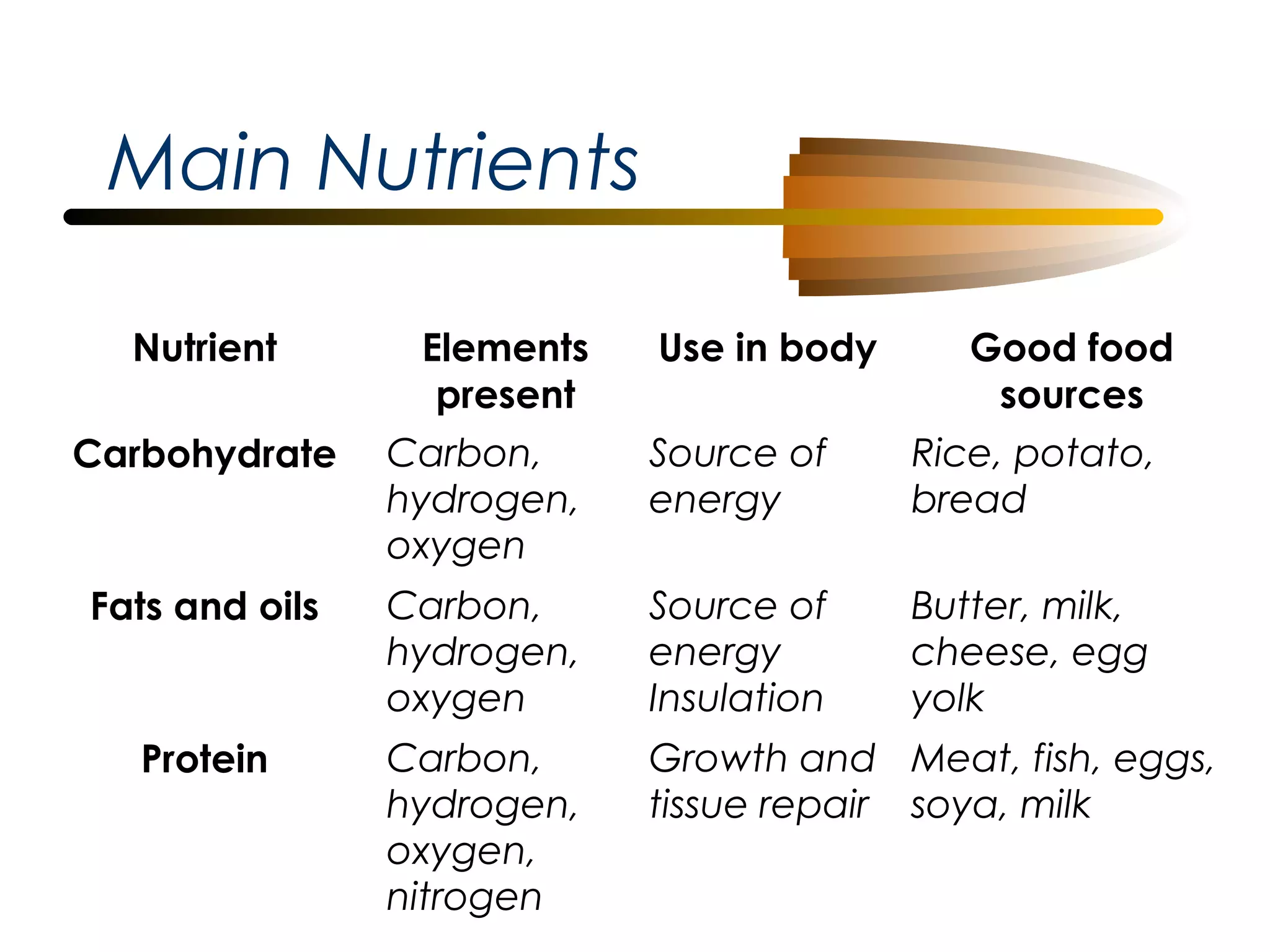
Main Nutrients
Nutrient

Elements
present

Use in body

Good food
sources

Carbohydrate

Carbon,
hydrogen,
oxygen

Source of
energy

Rice, potato,
bread

Fats and oils

Carbon,
hydrogen,
oxygen

Source of
energy
Insulation

Butter, milk,
cheese, egg
yolk

Protein

Carbon,
hydrogen,
oxygen,
nitrogen

Growth and Meat, fish, eggs,
tissue repair soya, milk
What you really need to
remember!!
• Carbohydrates, fats and proteins
are all made up of the elements
carbon, hydrogen and oxygen
• Proteins always contain nitrogen
and sometimes sulphur
• One way to remember this is
– Carb O Hydrate
Carbohydrates
• Large carbohydrates molecules
such as starch and glycogen are
made up of long chains of smaller
units, e.g. monosaccharides
(glucose), which are held together
by chemical bonds
Fats
• Fats are made up of three fatty
acids and a glycerol
Proteins
• Proteins are made up of long chains
of amino acids
Food Tests
• What is the test for starch?
• What is the test for glucose?
• What is the test for protein?
• What is the test for fats?
• What does a positive result look like?
Learning Outcomes
• list the principal sources of, and describe
the importance of:
–
–
–
–

vitamins (C and D only)
mineral salts (calcium and iron only)
fibre (roughage)
water

• describe the deficiency symptoms for:
– vitamins (C and D only)
– mineral salts (calcium and iron only)
Vitamin C
• Function
– Maintain healthy skin and gums

• Good Food Source
– Citrus fruits, black currants, cabbage,
tomato, guava, mango

• Effect of deficiency
– Scurvy
• Bleeding under skin
• Bleeding gums
Vitamin D
• Function
– Needed to maintain hard bones
– Helps absorb calcium from small
intestine

• Good Food Source
– Milk, cheese, egg yolk, fish liver oil
– Made in skin when exposed to sunlight

• Effect of deficiency
– rickets
Calcium
• Function
– Healthy teeth and bones
– Normal blood clotting

• Good Food Source
– Milk, cheese, fish

• Effect of deficiency
– Rickets
– Slow blood clotting
Iron
• Function
– Formation of haemoglobin in red blood cells

• Good Food Source
– Red meat, liver, kidney, eggs, green
vegetables (spinach), chocolate

• Effect of deficiency
– Anaemia
• Constant tiredness
• Lack of energy
Fibre
• Function
– This is cellulose which we can not digest
– It adds bulk to the undigested food in the
intestines, maintaining peristalsis

• Good Food Source
– Vegetables, fruit, wholemeal bread

• Effect of deficiency
– Constipation
– Long term deficiency may lead to bowel
cancer
Water
• Function
– Formation of blood, cytoplasm
– Solvent for transport of nutrients and
removal of waste
– Enzymes only work in solution

• Good Food Source
– Drinks, fruits, vegetables

• Effect of deficiency
– dehydration
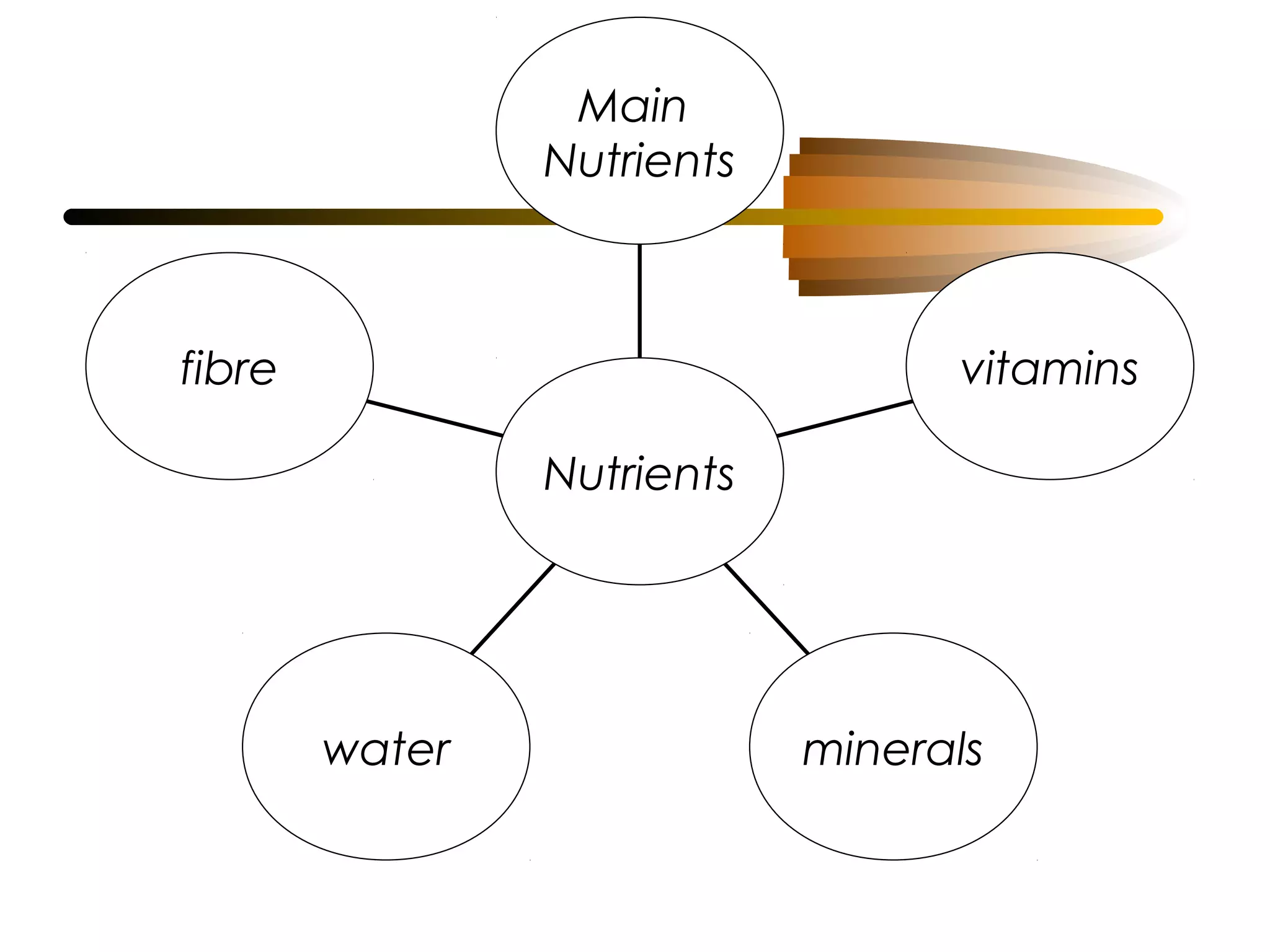
Pupil activity
• Design a mind map to summarise
the information you have been
taught so far on Nutrients.
Main
Nutrients

fibre

vitamins
Nutrients

water

minerals
Learning Outcomes
• describe the use of microorganisms
in the food industry, with reference
to yoghurt, bread and single cell
protein
• describe the uses, benefits and
health hazards associated with food
additives, including colourings
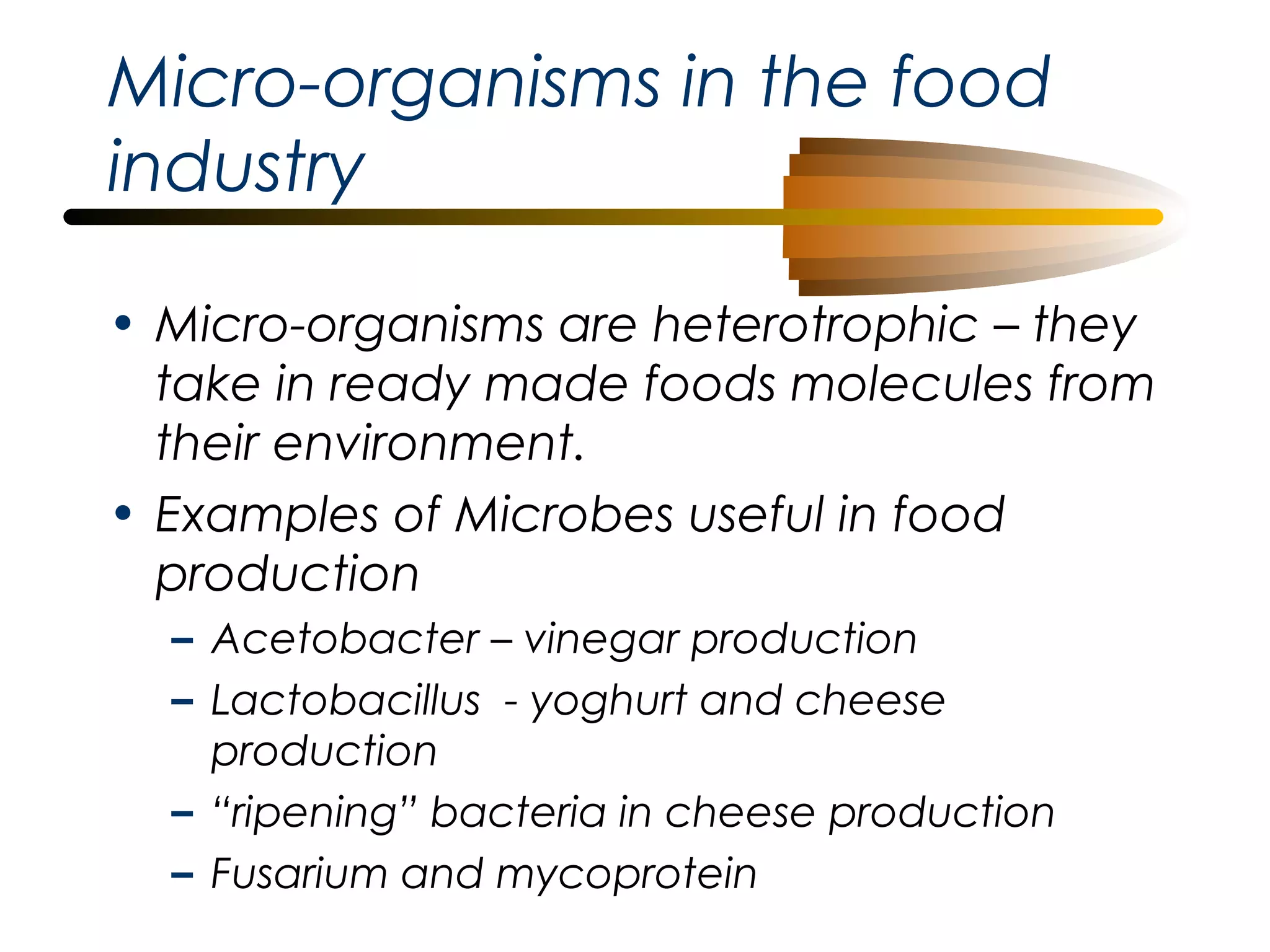
Micro-organisms in the food
industry
• Micro-organisms are heterotrophic – they
take in ready made foods molecules from
their environment.
• Examples of Microbes useful in food
production
– Acetobacter – vinegar production
– Lactobacillus - yoghurt and cheese
production
– “ripening” bacteria in cheese production
– Fusarium and mycoprotein
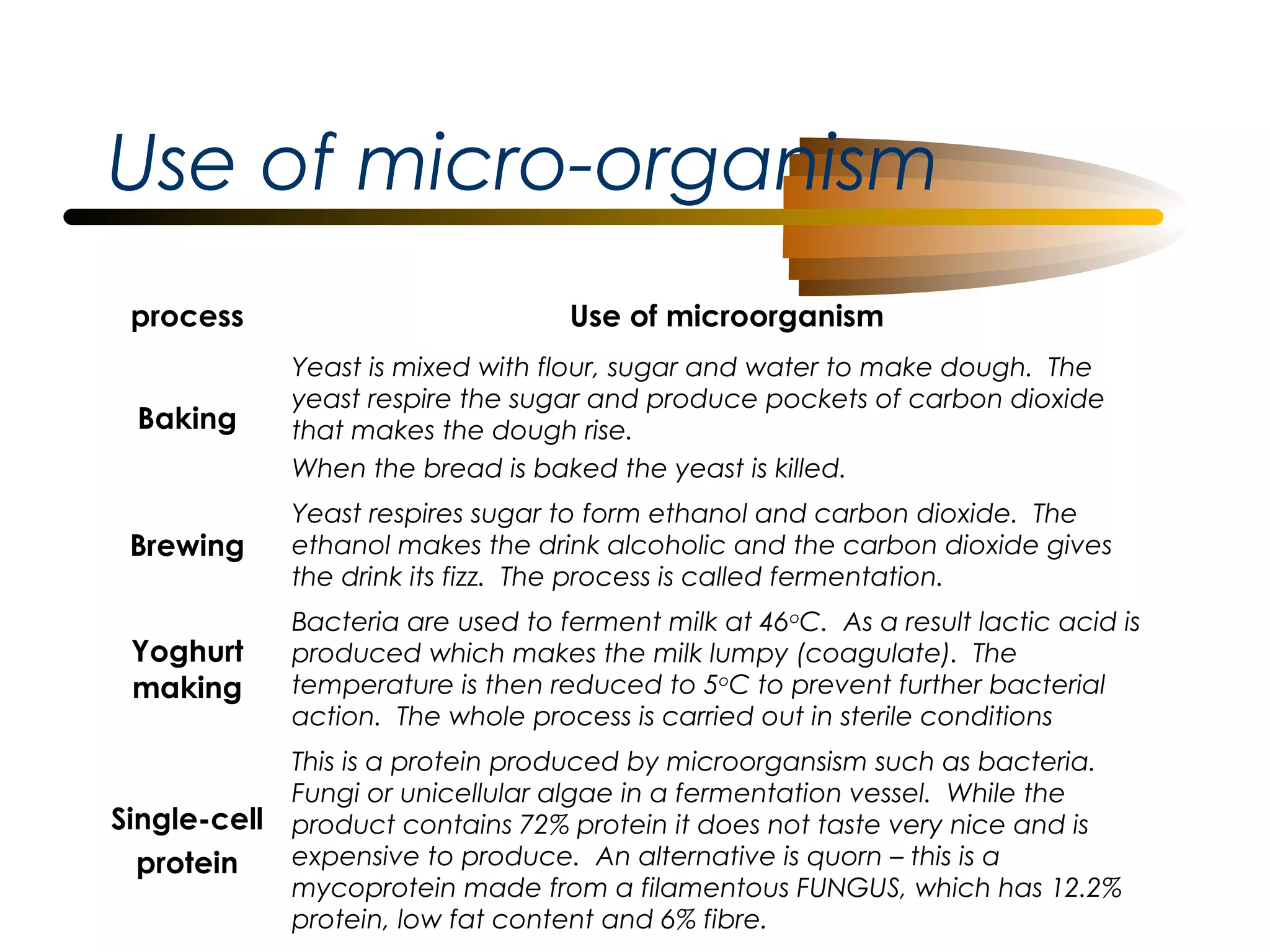
Use of micro-organism
process

Use of microorganism

Baking

Yeast is mixed with flour, sugar and water to make dough. The
yeast respire the sugar and produce pockets of carbon dioxide
that makes the dough rise.
When the bread is baked the yeast is killed.

Brewing

Yeast respires sugar to form ethanol and carbon dioxide. The
ethanol makes the drink alcoholic and the carbon dioxide gives
the drink its fizz. The process is called fermentation.

Yoghurt
making

Bacteria are used to ferment milk at 46oC. As a result lactic acid is
produced which makes the milk lumpy (coagulate). The
temperature is then reduced to 5oC to prevent further bacterial
action. The whole process is carried out in sterile conditions

Single-cell
protein

This is a protein produced by microorgansism such as bacteria.
Fungi or unicellular algae in a fermentation vessel. While the
product contains 72% protein it does not taste very nice and is
expensive to produce. An alternative is quorn – this is a
mycoprotein made from a filamentous FUNGUS, which has 12.2%
protein, low fat content and 6% fibre.
Food Additives
• Food Additives are substances with
no nutritional value
• They are added to improve the
–
–
–
–

Appearance
Flavour
Texture
Storage properties of food
antioxidants
• Stop food reacting with oxygen,
which may spoil the taste of the
food or change it’s colour
Colourings
• Improve the appearance of food
• Some colourings can be hazardous
– Sunset yellow
• Hyperactivity
• Allergic reactions and asthma
Flavourings
• Enhance the taste of the food
– MSG – monosodium glutamate in
processed food
– Sugar
– Artificial sweetners e.g. aspartame
Preservatives
• Give processed foods a longer shelf
life by preventing the growth of
micro-organisms
• Disadvantages of preservatives
– Sulphur dioxide - destroys vitamin B1
– Sodium nitrite - carcinogen
Progress Question
• Learn the groups of food preservatives listed
below.
•
•
•
•

Antioxidants
Colourings
Flavourings
Preservatives

• For each group state:

– Its function in processed food
– One advantage of its use
– One disadvantage of its use

• Use page 46 and 47 in your textbooks to help
you
Learning Outcomes
• describe tests for:
–
–
–
–

starch (iodine solution)
reducing sugars (Benedict's solution)
protein (biuret test)
fats (ethanol)

• Applying knowledge on food tests
to identify unknown liquids
Activity
• Use your knowledge of food tests
from last week to identify the food
groups found in solutions A, B C and
D.
Learning Outcomes
• understand the concept of a
balanced diet
• describe:
– a balanced diet related to age, sex
and activity of an individual
– the effects of malnutrition in relation to
starvation, coronary heart disease,
constipation and obesity
What happens if you don’t
eat a balanced diet.
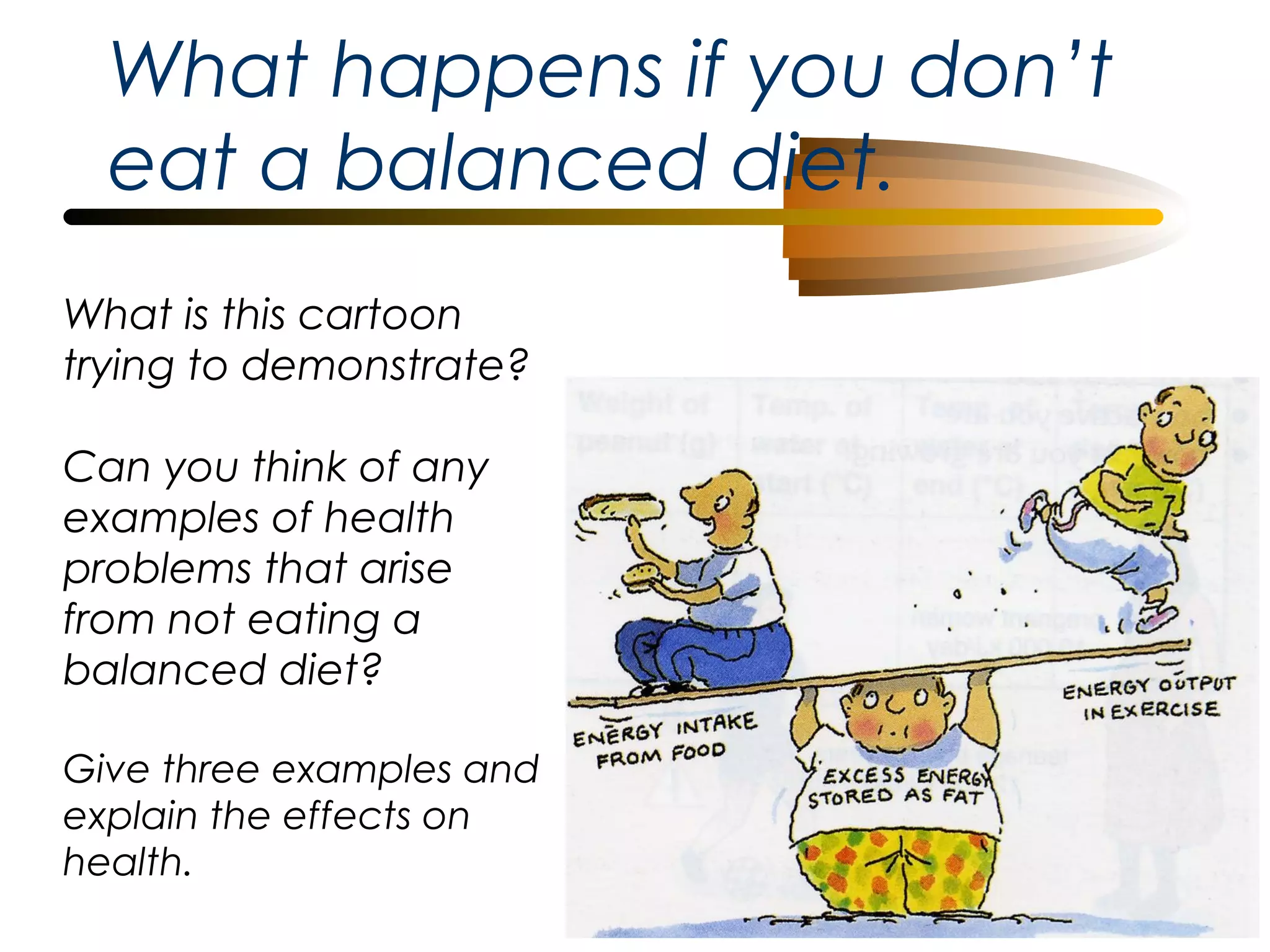
What is this cartoon
trying to demonstrate?
Can you think of any
examples of health
problems that arise
from not eating a
balanced diet?
Give three examples and
explain the effects on
health.
Dietary requirements
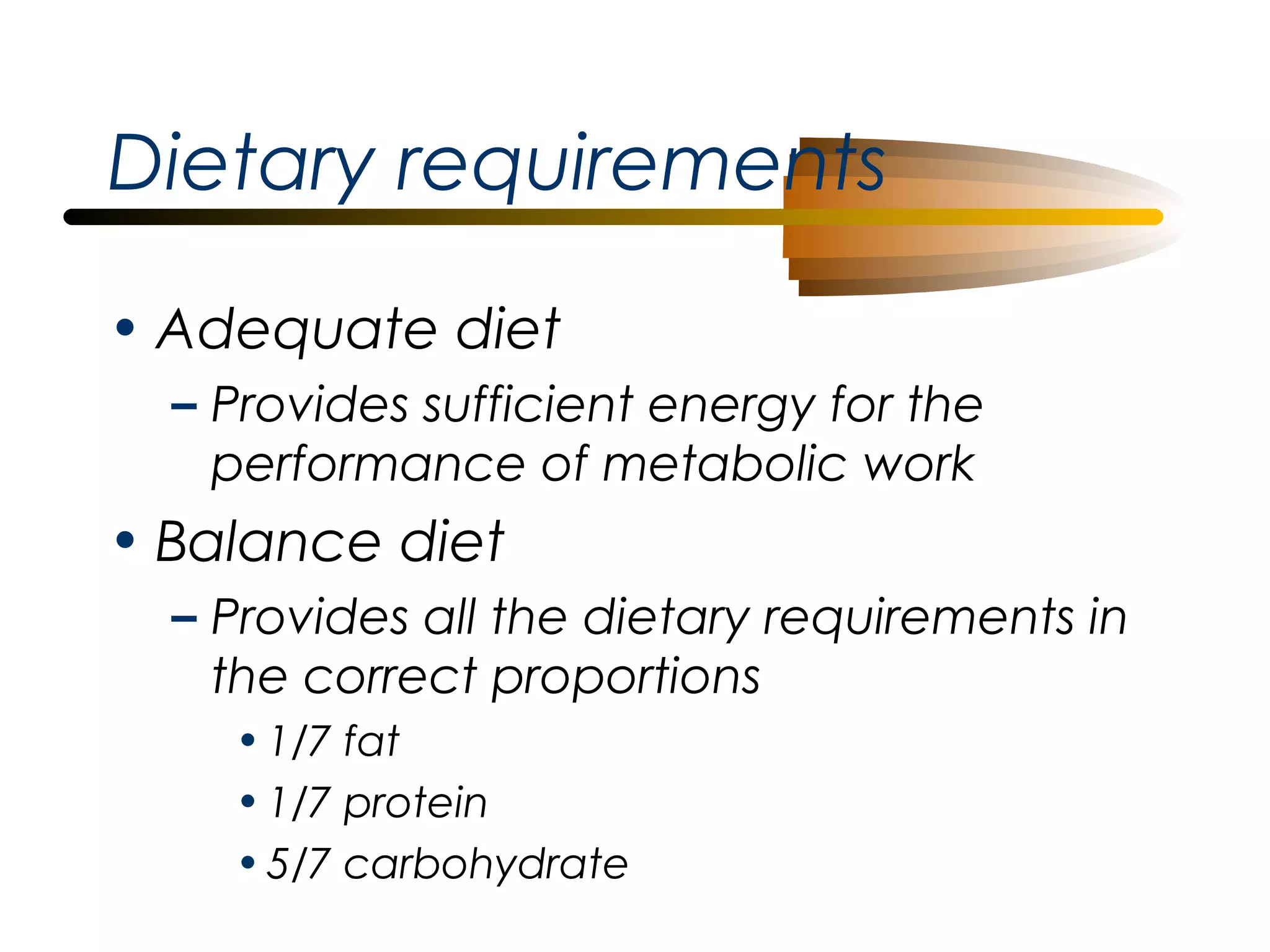
• Adequate diet
– Provides sufficient energy for the
performance of metabolic work

• Balance diet
– Provides all the dietary requirements in
the correct proportions
• 1/7 fat
• 1/7 protein
• 5/7 carbohydrate
Dietary requirements
• Energy is provided by fat and carbohydrate
intake
• Dietary requirements depend on
– Age
• Energy demand increases until we stop growing

– Sex
• Males use up more energy than females

– Activity
• Physical work will use up more energy than office work.
An Unbalanced diet
Malnutrition
• An unbalanced diet could lead to
– Obesity
• Risks include coronary heart disease and diabetes

– Too much animal fat can lead to high
cholesterol
• Risks include coronary heart disease and angina

– Lack of protein in diet can lead to kwashiorkor
– Lack of fibre can lead to constipation and
bowel cancer
– Vitamin and mineral deficiencies
Pupil Activity
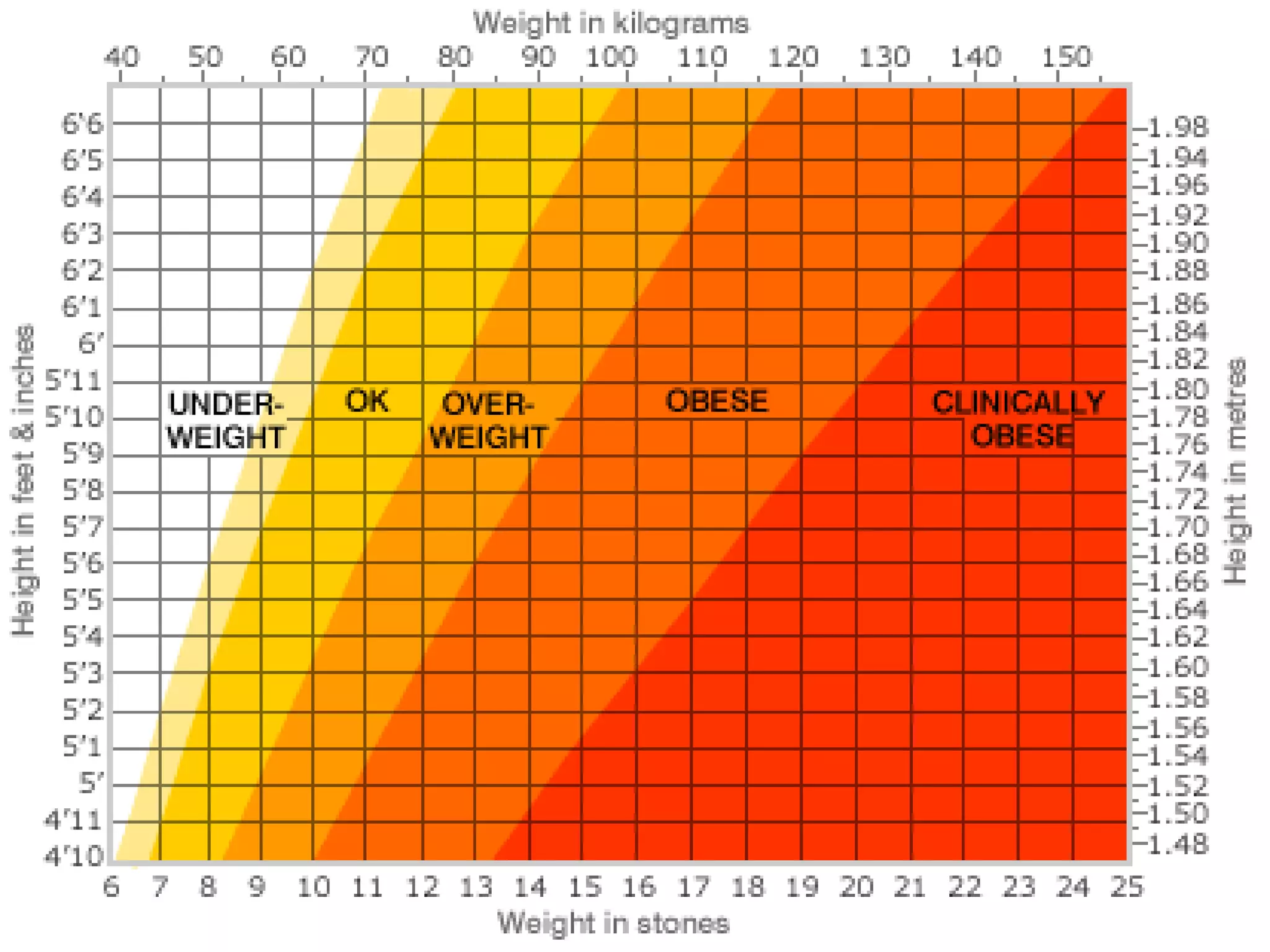
• Calculating BMI
• Follow the instructions on the sheet
to calculate your own BMI
• Answer the questions
Learning Outcomes
• Describe the effects of alcohol and
the dangers of its misuse
Effects of alcohol
• Alcohol is a drug
– It affects the nervous system
– Depressant
– Affects judgement and reaction time
Effects of Alcohol
• In small amounts
– Feeling of relaxation

• In larger amounts
–
–
–
–
–

Affects balance
Dizziness
Slurred speech
Problems with vision
unconsciousness
Alcohol
• Long term effects
–
–
–
–
–

Addiction – alcoholism
Cirrhosis of the liver
Stomach ulcers
Cancers of the digestive system
Heart disease

• Drinking during pregnancy
– Can affects the fetus
– Increasing risk of miscarriage
– Decreasing the average birth weight
Pupil Activity - BINGE
• Read through the information provided
• Should pubs stop cutting prices
– Write a paragraph on what you think
– Write a paragraph from the point of view from
one of the six characters.

• Remember whether or not you are for the
scheme or against it you must give
reasons.
Learning outcomes
• discuss:
– the problems of world food supplies
– the problems which contribute to
famine
Famine
• A severe shortage of food can lead to
famine.
• Malnutrition
– Suffer from deficiency disease
– weakened immune system

• Results in
– Adults too ill to work
– Children become ill, adults care for them
– People die and society lacks experience and
knowledge
Problems that lead to famine
• unequal distribution of food
– Some areas produce more food
• environment is more suitable
• More advanced agriculture

– Food surpluses can not always be moved to
areas where food is limited

• Drought
– Water is essential for plant growth and for
healthy animals
– Low rainfall reduces crop yield.
Problems that lead to famine
• Flooding
– Unpredictable flooding can reduce crop yield
– Plants are damaged
– Fertile soil can be washed away

• increasing population
– Need for food increases
– More buildings reduces land available
– More domestic animals reduces land
available for food production
Prep - Questions on Energy
• For Wednesday
– Question 1

• For Friday
– Questions 2, 3 and 4
Digestion
Learning Outcomes
• identify the gross structure of the
alimentary canal and associated
organs (mouth, oesophagus,
stomach, small intestine: duodenum
and ileum, large intestine: colon and
rectum, anus, pancreas, liver)
• define ingestion, digestion,
absorption, assimilation and
egestion
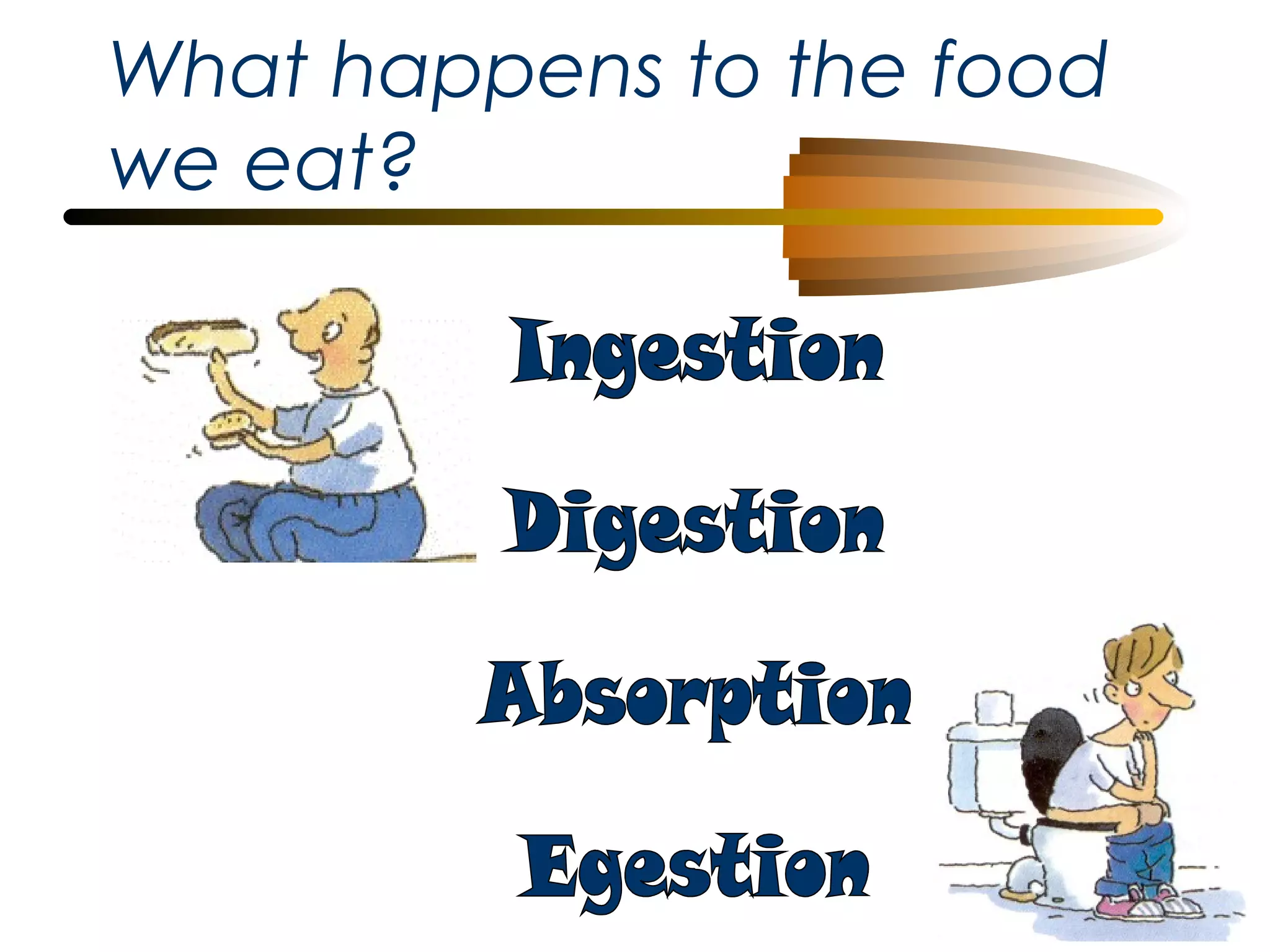
What happens to the food
we eat?
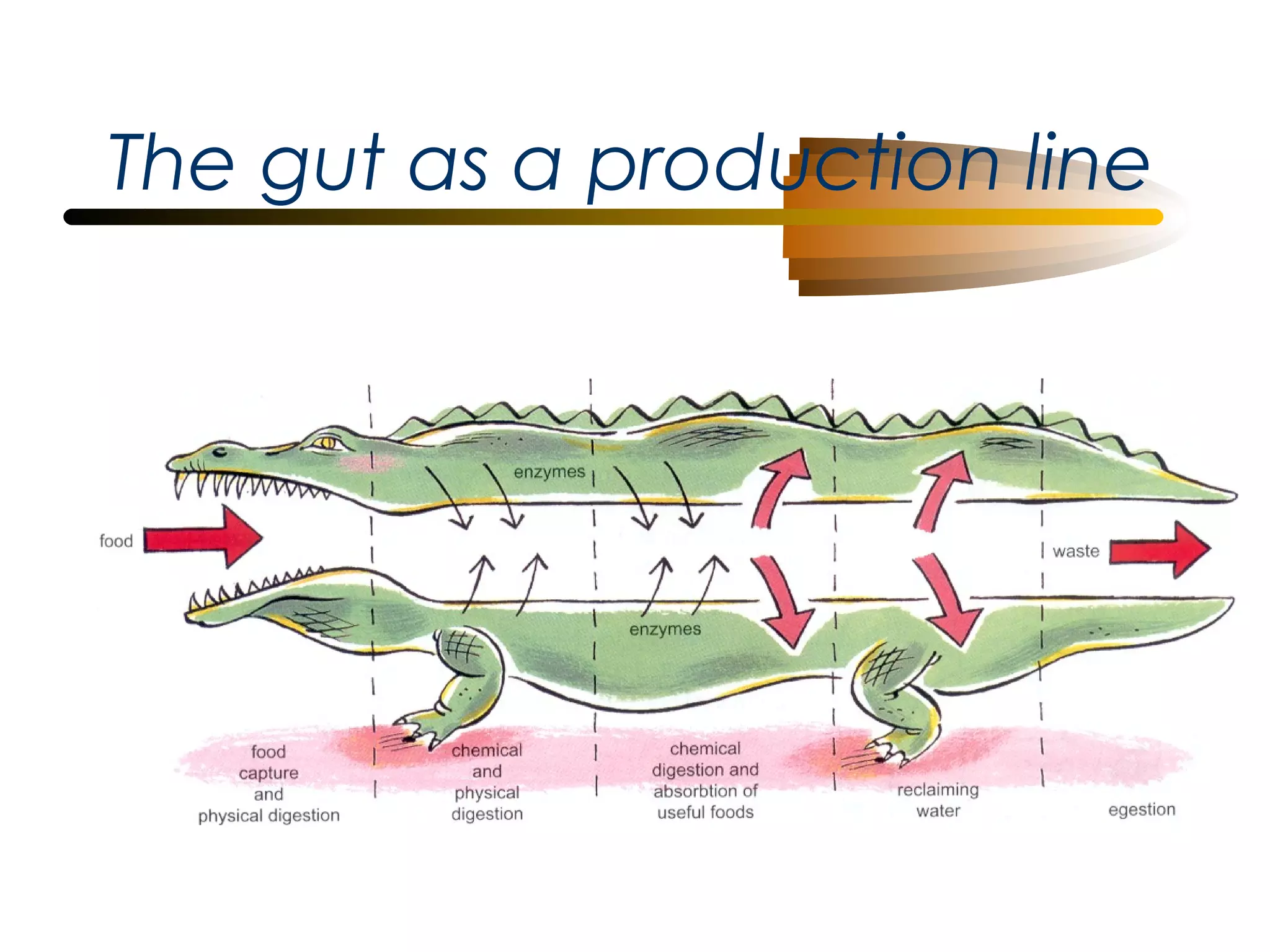
The gut as a production line
What happens to the food we
eat?
• Ingestion
– Intake of food into the mouth

• Digestion
– Breaking down large, insoluble food
molecules into smaller soluble ones
using enzymes
• Absorption
– Digested food molecules pass across
the wall of the small intestine into the
blood or the lymph

• Assimilation
– Uptake of food molecules by cells
• Egestion
– Passing out of undigested food, in the
form of faeces, from the anus

• Deamination
– Removal of nitrogen containing part of
an amino acid as urea.
Pupil Activity
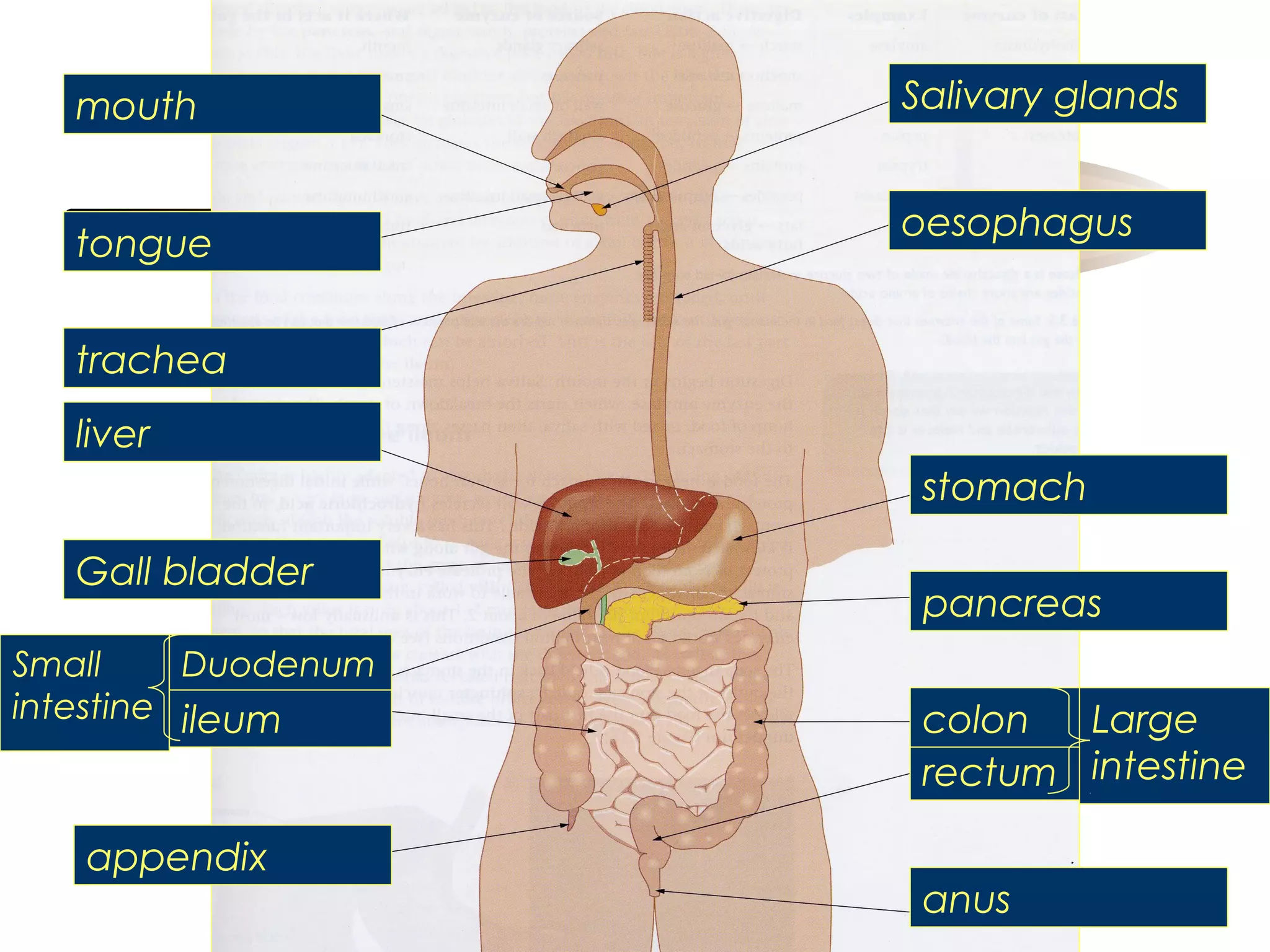
• Label the diagram of the digestive
system.
– Use the textbook supplied to help if
needed
– Design a table to link the structure and
function of different parts of the
digestive system.
mouth
tongue

Salivary glands
oesophagus

trachea
liver
stomach
Gall bladder
Small
Duodenum
intestine ileum

appendix

pancreas
Large
colon
rectum intestine
anus
Learning Outcomes
• define ingestion, digestion,
absorption, assimilation and
egestion
• describe the functions of the
alimentary canal's various parts in
relation to ingestion, digestion,
absorption, assimilation and
egestion of food
Learning Outcomes
• identify the types of human teeth
and describe their functions
• state the causes of dental decay
and describe the proper care of
teeth
Digestion
• Digestion is the breakdown
of large, insoluble food
molecules into small,
soluble food molecules so
that they can be absorbed
into the blood stream.
Feeding in mammals
• Mechanical digestion
– teeth are used to bite pieces of food
and to chew it into smaller pieces

• The shapes of teeth are suited to
their function.
– Incisors and canines are used for biting
– Premolars and molars are used for
chewing and crushing food.
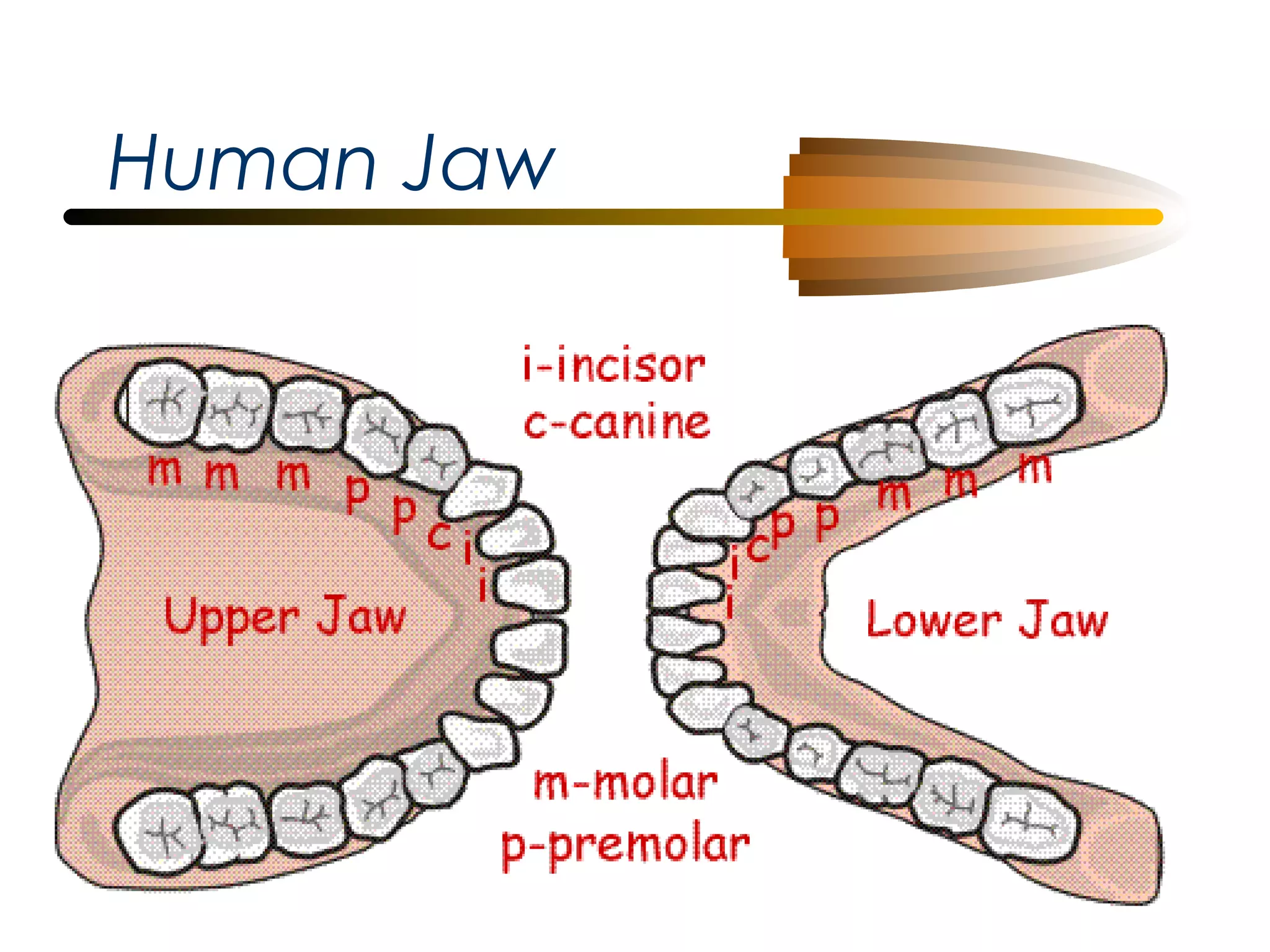
Human Jaw
teeth
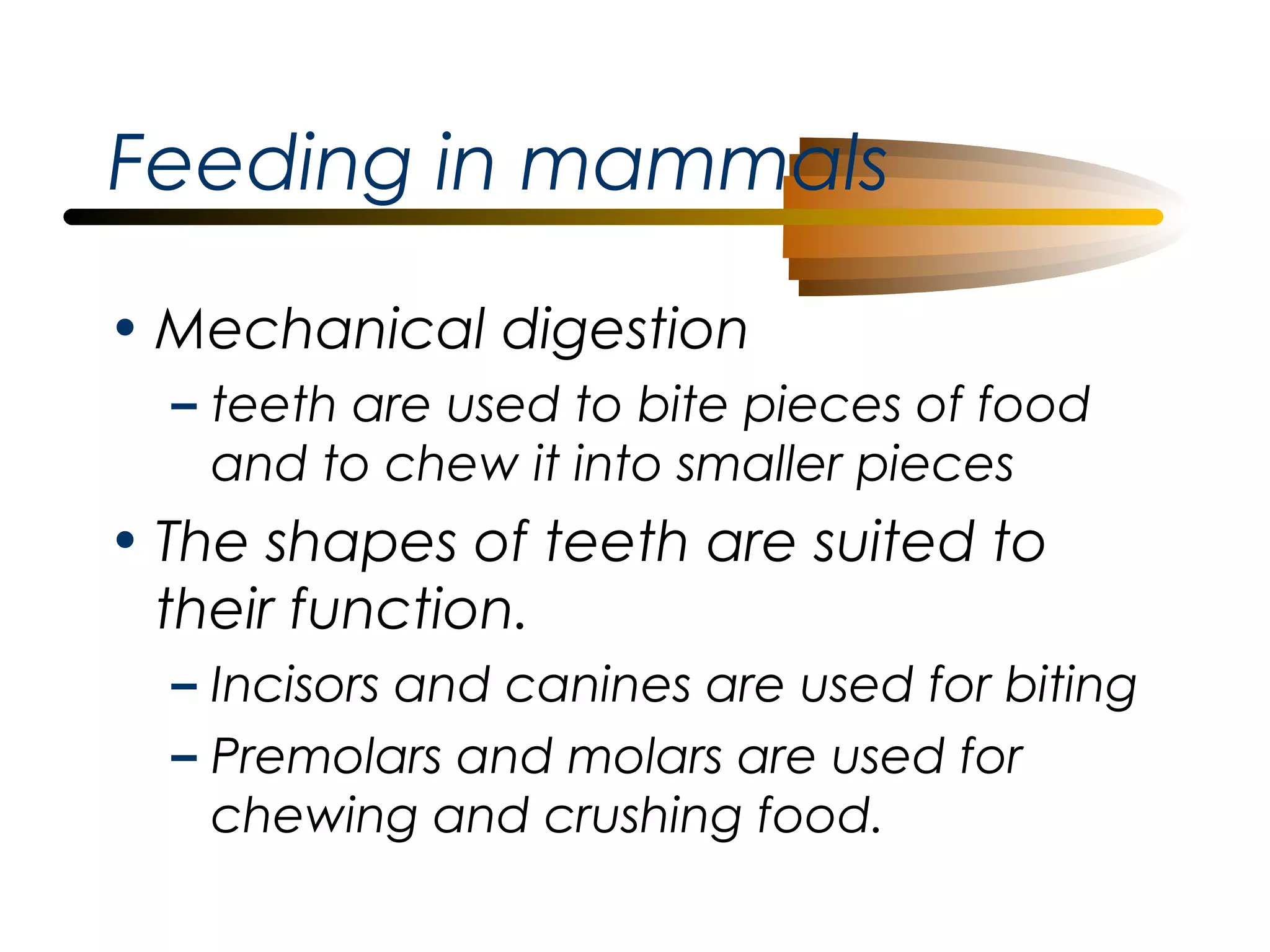
• There are different types of teeth, each
specially shaped to perform a particular
job.
– Incisor
• A broad flat sharp tooth found at the front of the
mouth. Designed for biting and cutting food.

– Canine
• A sharp pointed tooth for piercing flesh and tearing.

– Pre-molar & molar
• A broad flat tooth with many cusps. Its rough
surface is used for crushing, grinding and chewing
food
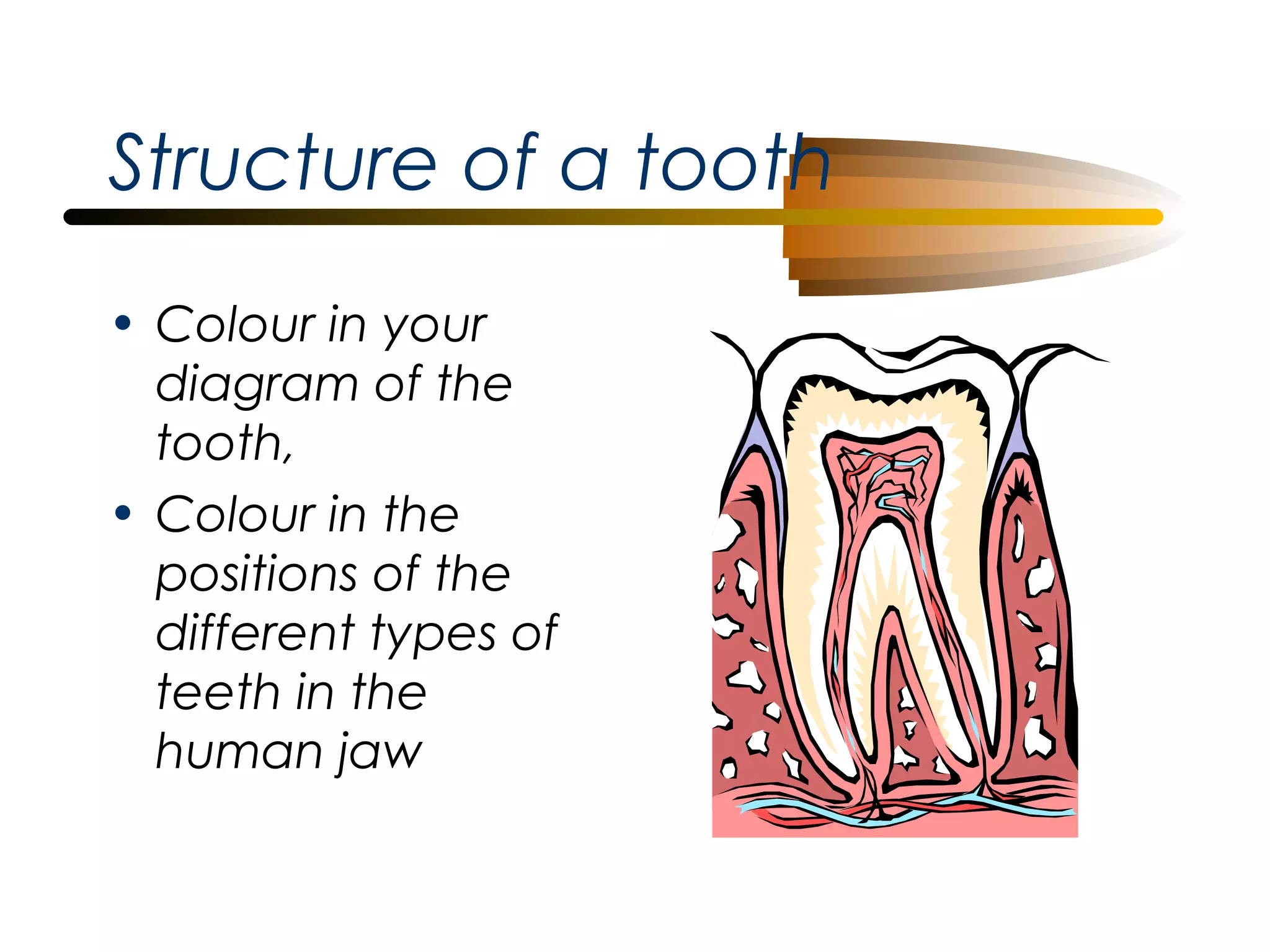
Structure of a tooth
• Colour in your
diagram of the
tooth,
• Colour in the
positions of the
different types of
teeth in the
human jaw
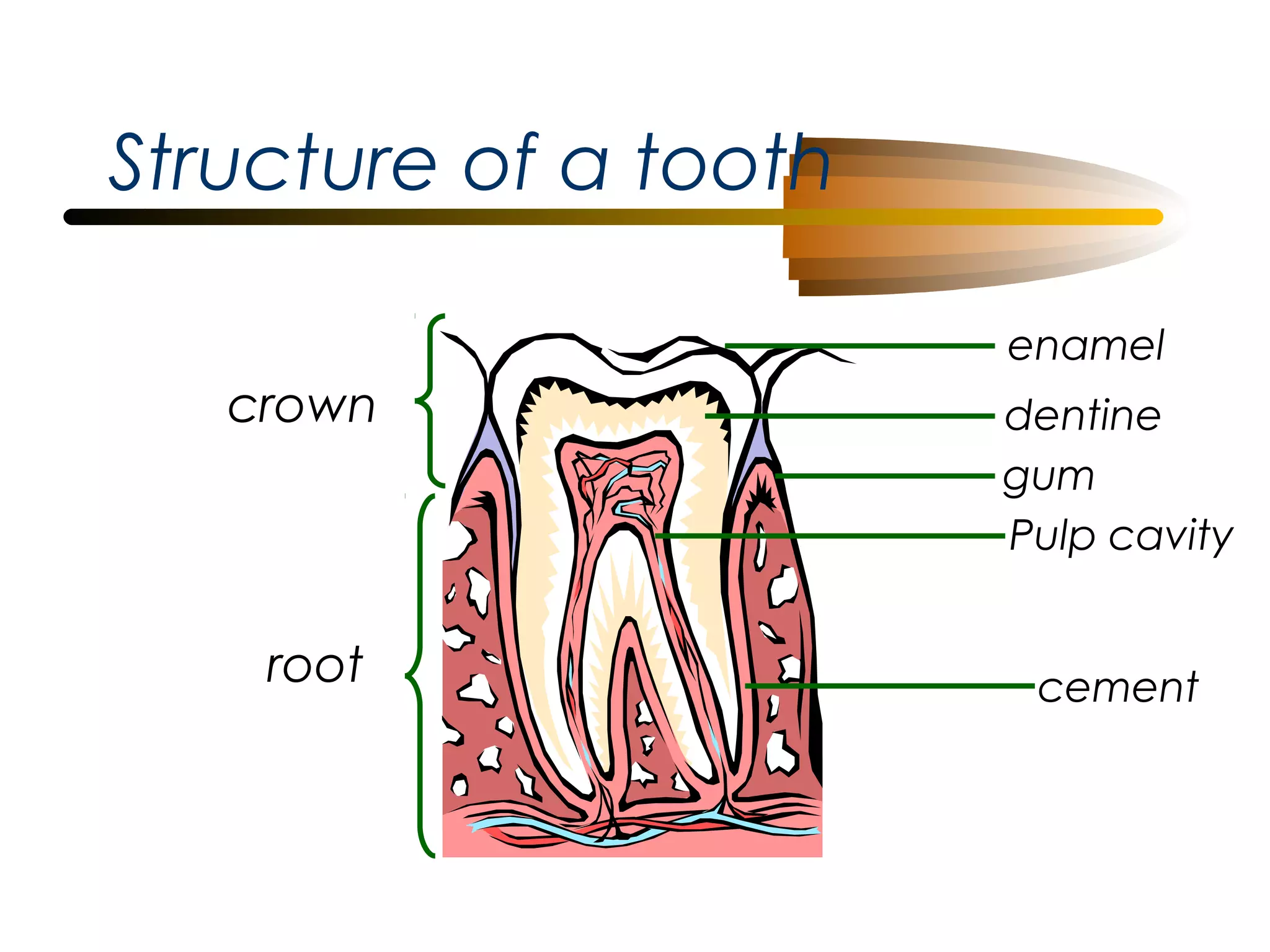
Structure of a tooth
enamel

crown

root

dentine
gum
Pulp cavity
cement
Causes of dental decay
• Bacteria and food deposits form plaque
• Bacteria feed on sugars and produce
acid
• Acid dissolves the enamel forming a hole
• Dentine dissolves more rapidly
• If hole reaches pulp cavity can lead to
bacterial infection, toothache and
abscess
Proper care of teeth
• Avoid sugary foods
• Use dental floss or a tooth pick
• Use a fluoride toothpaste
• Visit dentist regularly
Fluoride
• Growing children absorb fluoride
from their diet
• It becomes part of enamel of
developing teeth
• Enamel becomes more resistant to
tooth decay
Adding fluoride to public
water supplies
• Advantages
– Tooth decay in
children
decreases
– No need to
buy fluoridated
toothpaste

• Disadvantages
– Form of mass medication
– Fluoride can cause
mottling (white patches)
of teeth
– Only benefits growing
children
– Unnecessary if proper
care of teeth is taken
– Side effects (bone
cancer?)
Learning Outcome
• describe the processes of chewing
and peristalsis
Digestion of Food
• The digestion of food can either be
mechanical or chemical.
• Mechanical digestion includes
– Chewing
– Action of muscles in oesophagus, stomach and
small intestine

• In chemical digestion enzymes catalyse the
breakdown of larger food molecules into
smaller food molecules.
Digestion in the mouth and
oesophagus
• Chewed food is mixed with saliva in the
mouth
• Saliva contains
– Amylase is an enzyme which starts to digest
starch into sugars (maltose)
– Mucus helps soften the food making it easier
to swallow

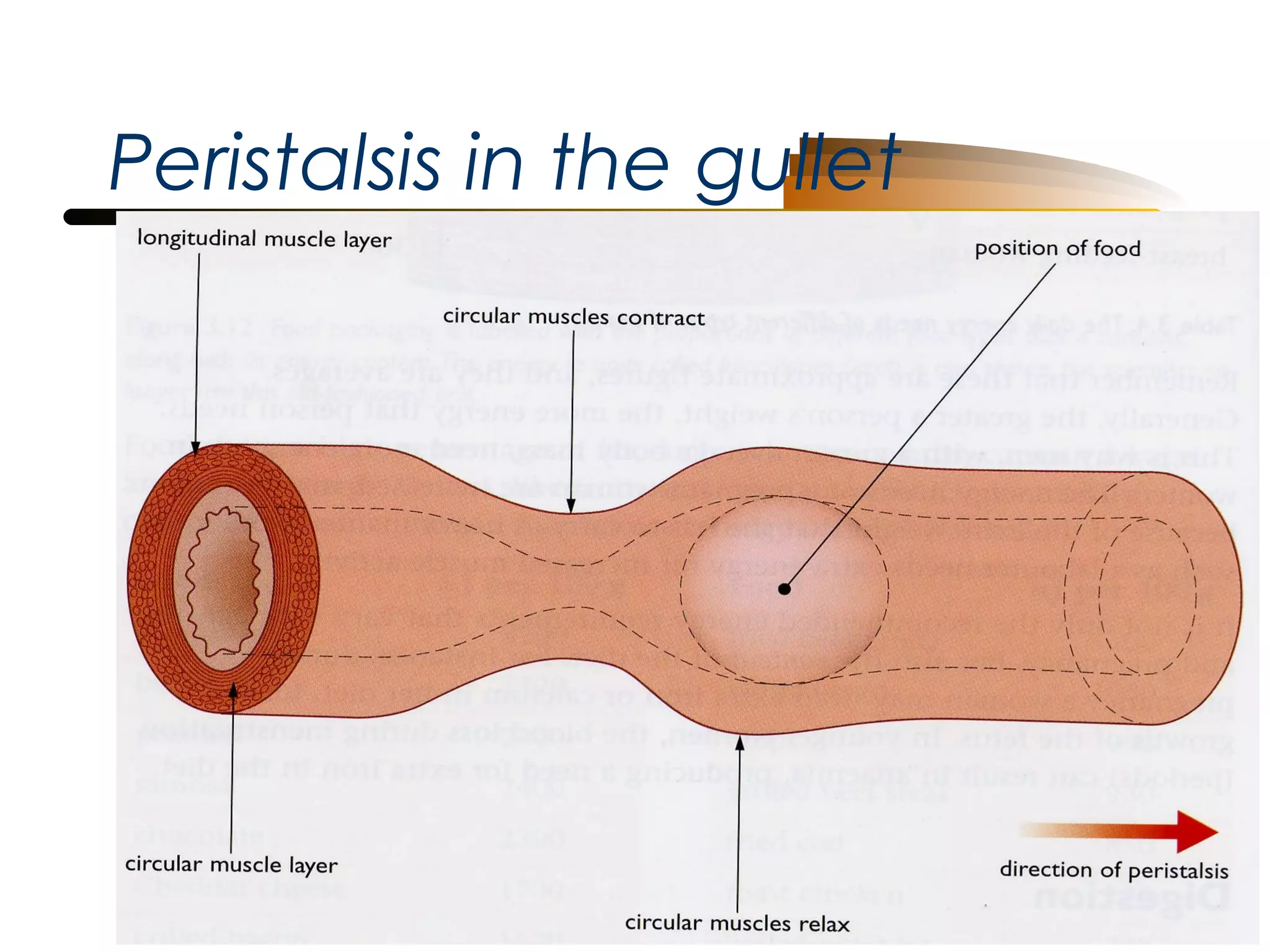
• The bolus travels down the oesophagus
with the aid of peristalsis
Peristalsis in the gullet
Digestion of Starch
• Take 10ml of 1% starch solution
– Test for starch
– Test for sugars
Action of amylase on
starch
• Put a drop of iodine solution into all the
wells on a white spotting tile
• Add 10ml 1% starch solution and 10ml 1%
amylase solution to a test tube.
• Every minute, test the contents of the test
tube for starch.
• After 15 minutes – test the solution for the
presence of sugars
• Write a conclusion on your results
Learning Outcomes
• The significance of producing small,
soluble molecules
• describe:
– digestion in the alimentary canal
– the functions of a typical amylase,
protease and lipase, listing the
substrate and end-products
Digestion
• Digestion is the breakdown
of large, insoluble food
molecules into small,
soluble food molecules so
that they can be absorbed
into the blood stream.
Digestion in Alimentary Canal
• Physical Digestion
– Increases the surface area of food
• Chewing in the mouth
• Churning food in stomach and small
intestine
• Bile emulsifies fats – turns them into smaller
droplets with a larger surface area
Digestion in Alimentary Canal
• Chemical Digestion
– Breakdown of large insoluble molecules
into smaller soluble ones
– Enzymes act as biological catalysts –
they speed up the process
– They work efficiently at body
temperature (37OC) and at a suitable
pH
Digestive enzymes
• There are different types of digestive
enzyme

– Proteases break down proteins into amino acids
– Lipases break down fats into fatty acids and
glycerol
– Amylase breaks down starch into maltose
(sugar)
• Maltose is then broken down by maltase to form
glucose
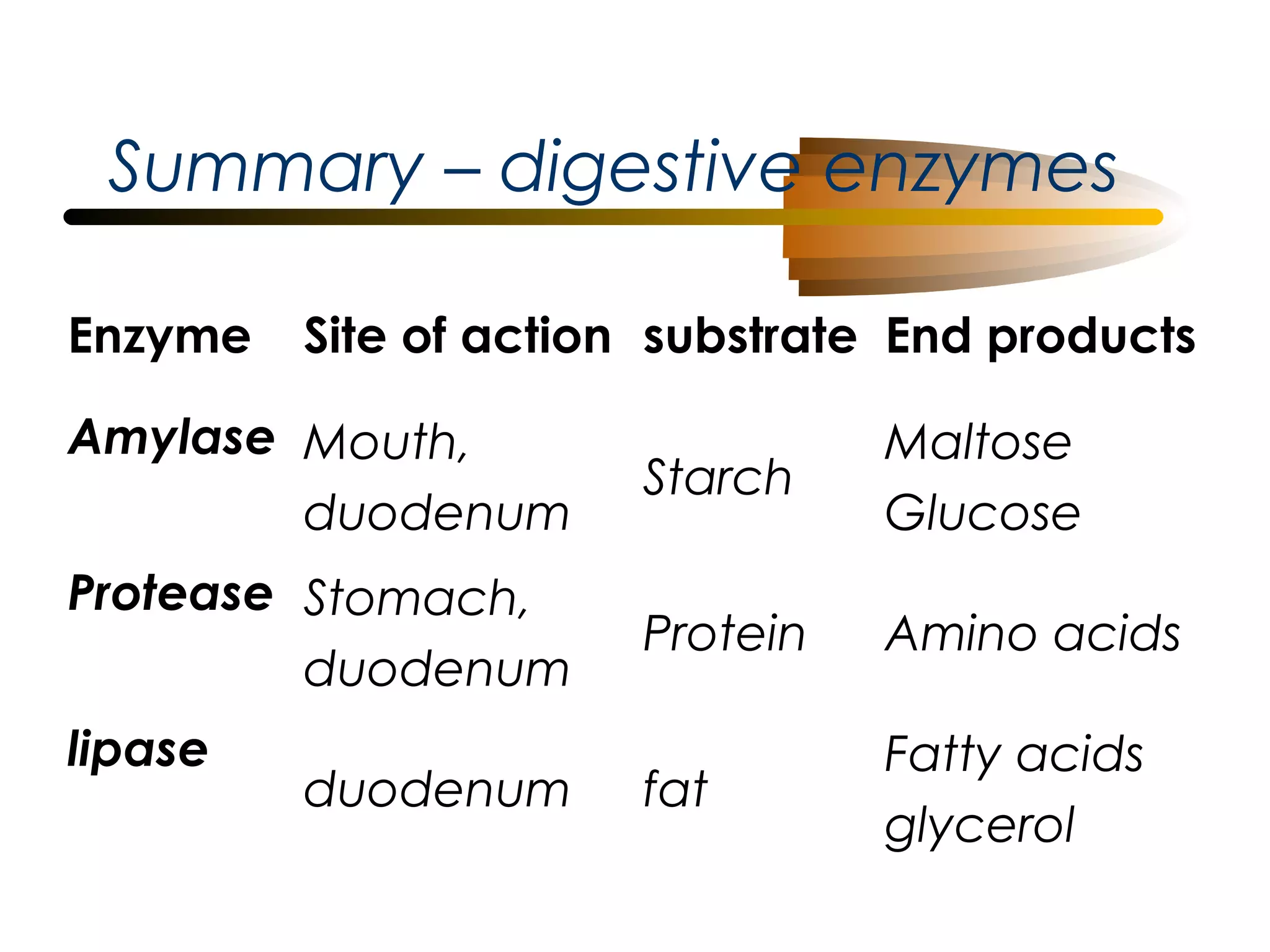
Summary – digestive enzymes
Enzyme

Site of action substrate End products

Amylase Mouth,
duodenum

Starch

Maltose
Glucose

Protease Stomach,
duodenum

Protein

Amino acids

fat

Fatty acids
glycerol

lipase

duodenum
Chemical Digestion
• Hydrogen carbonate ions
– Secreted by pancreas
– Neutralises acid, enabling enzymes in small
intestine to work 

• Bile
– Produced by liver, stored in gall bladder,
secreted into small intestine
– Emulsifies fats (Larger surface area for
enzymes to work on)
Prep
• Surface area and digestion
– Read the information
– Answer questions 1- 3
– Answer question Ho2
• A snake swallowed a mouse whole. Explain
why it took several days to digest it.
Learning Outcomes
• define the term catalyst
• define enzymes as proteins that
function as biological catalysts
• describe the effect of changes in
temperature and pH on enzyme
activity
Enzymes
• Are proteins
• Are produced by cells
• Change chemical substances into new
products
• Are “specific” to one substance
• Work best at their “optimum
temperature” (around 30 – 40oC)
• Work best at an optimum pH
Protein Digestion
• Protein digestion occurs in the stomach
and small intestine.
• Protease enzymes are produced by the
gastric pits in the stomach lining or by the
pancreas.
• In the stomach, hydrochloric acid is also
produced which provides the optimum
pH for trypsin to work
Protein Digestion
• Add 2ml of protein solution to three
test tubes.
• Number the test tubes 1, 2 and 3
1. Add 1ml HCl
2. Add 1ml Water
3. Add 1ml HCl

• Do not add the trypsin until last
1. Add 0.5ml water
2. Add 0.5ml trypsin
3. Add 0.5ml trypsin
Protein digestion
• Leave for 10 minutes
• Test each of the test tubes for the
presence of protein using Biurets
reagent.
• Explain your results.
Fat Digestion
• Milk does not dissolve in water, in the
digestive system, bile produce by the liver
(stored in the gall bladder) emulsifies fats
to give a larger surface area for enzymes
to work on.
• You are going to use phenolphthalein to
investigate the effect of bile on the
digestion of fat.
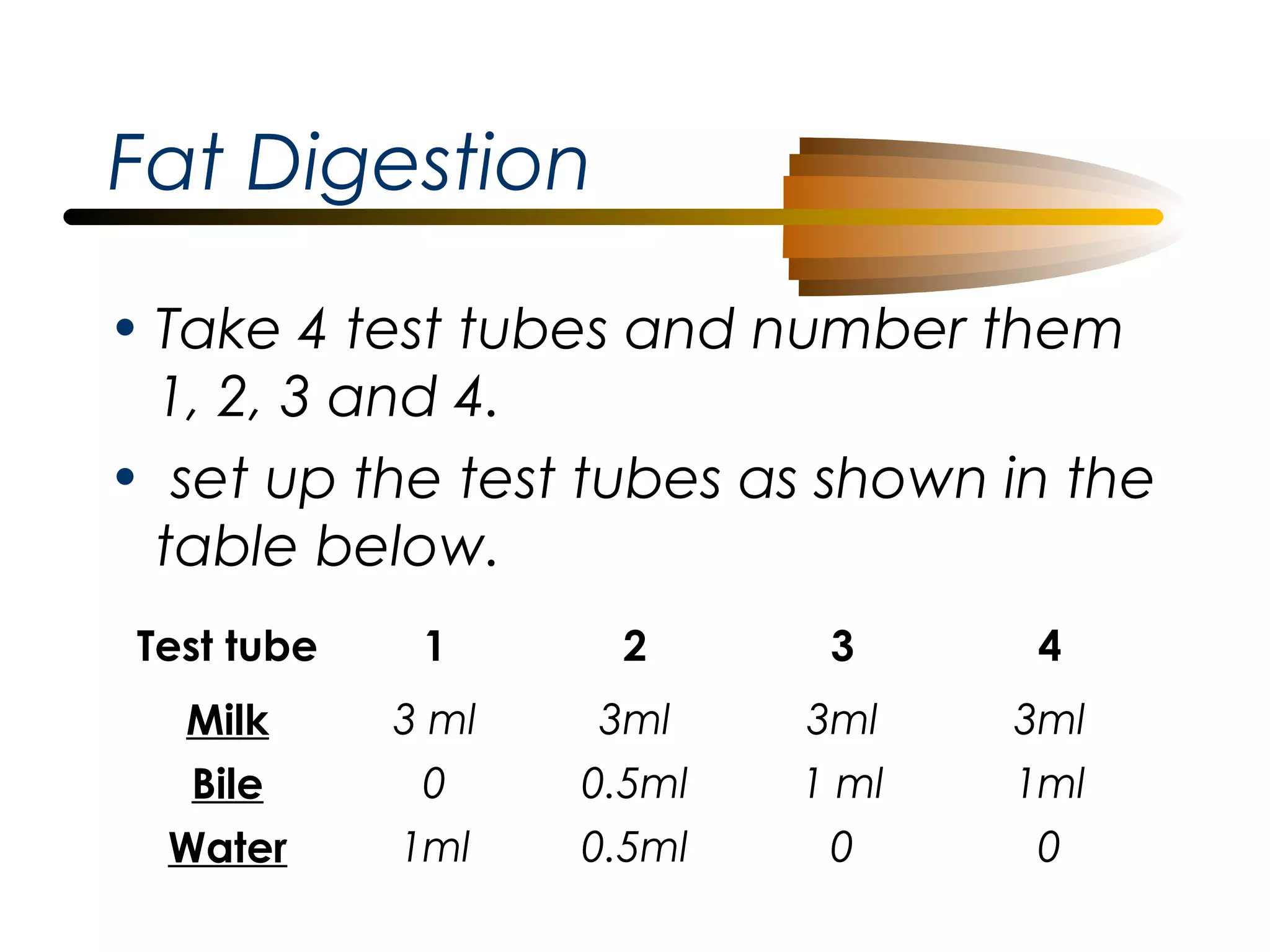
Fat Digestion
• Take 4 test tubes and number them
1, 2, 3 and 4.
• set up the test tubes as shown in the
table below.
Test tube

1

2

3

4

Milk

3 ml

3ml

3ml

3ml

Bile

0

0.5ml

1 ml

1ml

Water

1ml

0.5ml

0

0
Fat Digestion
• Add 5 drops of phenolphthalein to each
test tube
• Add sodium carbonate to each test tube
until the solution goes pink.
• Add 0.5ml of lipase to test tubes 1, 2 and
3.
• Add 0.5 ml water to test tubes 4.
• Observe your results. Try to explain what
you are observing.
Learning Outcomes
• define enzymes as proteins that
function as biological catalysts
• describe the effect of changes in
temperature and pH on enzyme
activity
Effect of temperature on
enzymes
• The optimum temperature for enzyme
controlled reactions is around 37oC
– Above optimum
• Slows reaction down
• Enzyme becomes denatured – enzyme loses it shape,
deforming the active site so that the substrate no
longer fits.

– Below optimum
• Slower reaction – lack of energy in molecules
Graph – effect of temperature
on the rate of enzyme activity
Effect of pH on enzymes
• pH of a solution is how acid or alkaline it is
• Most enzymes have optimum pH 7
• Exceptions
–
–
–
–

Pepsin
Salivary amylase
Catalase
Pancreatic amylase

pH2.0
pH 6.8
pH 7.6
pH 9.0

stomach
mouth
plants
duodenum
Effect of pH on enzymes
• An extreme pH can denature
enzymes – permanently altering the
active site
Graph - Effect of pH on
enzyme activity
Pupil Activity
• Question sheet on enzymes
Learning Outcomes
• identify the small intestine as the
region for the absorption of digested
food
• describe the significance of villi in
increasing the internal surface area
• describe the structure of a villus,
including the role of capillaries and
lacteals
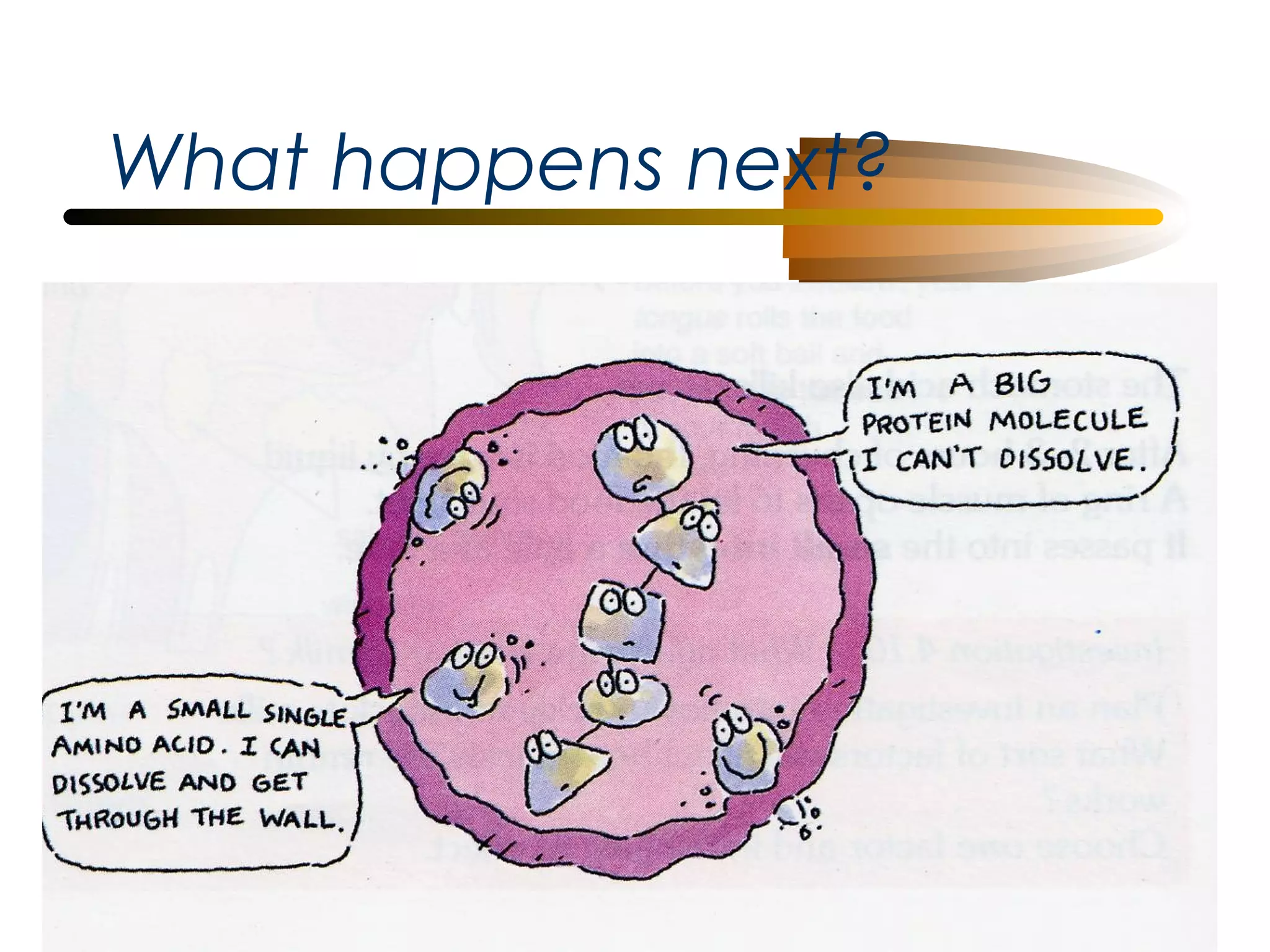
What happens next?
Absorption in the ileum
• The small intestine is well designed
for absorption, it has
– Thin lining
– A good blood supply
– A very large surface area (about 9m2)
Villi
• Increase the surface area for absorption
• Each villus contains
– Blood capillaries that absorb glucose and
amino acids
– Lacteals which absorb fatty acids and
glycerol

• Absorption is by

– Diffusion – thin lining only 1 cell thick
– Active transport – cells contain mitochondria
to provide energy
Absorption in the Villi
The Model Gut
A model of absorption
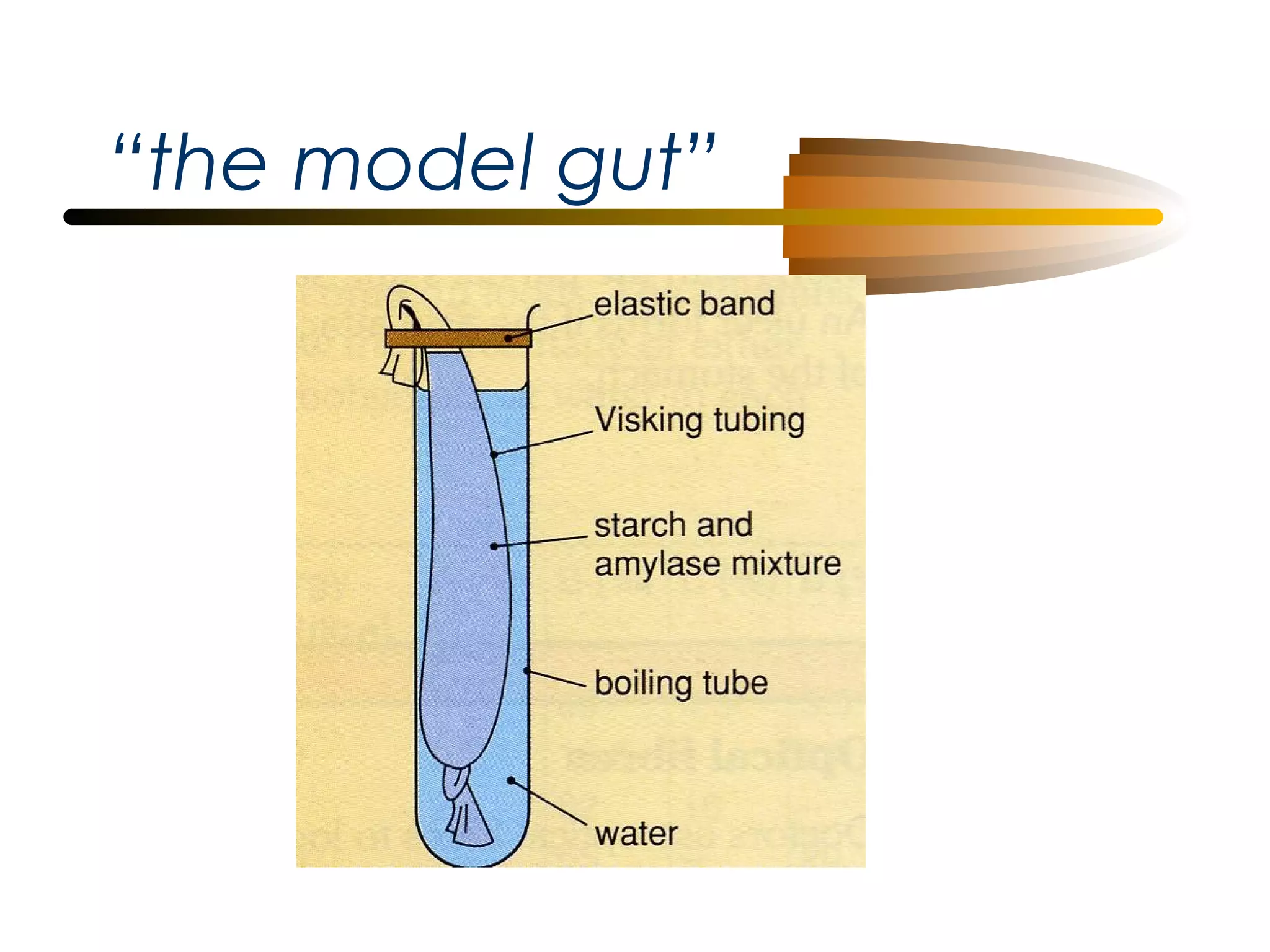
“the model gut”
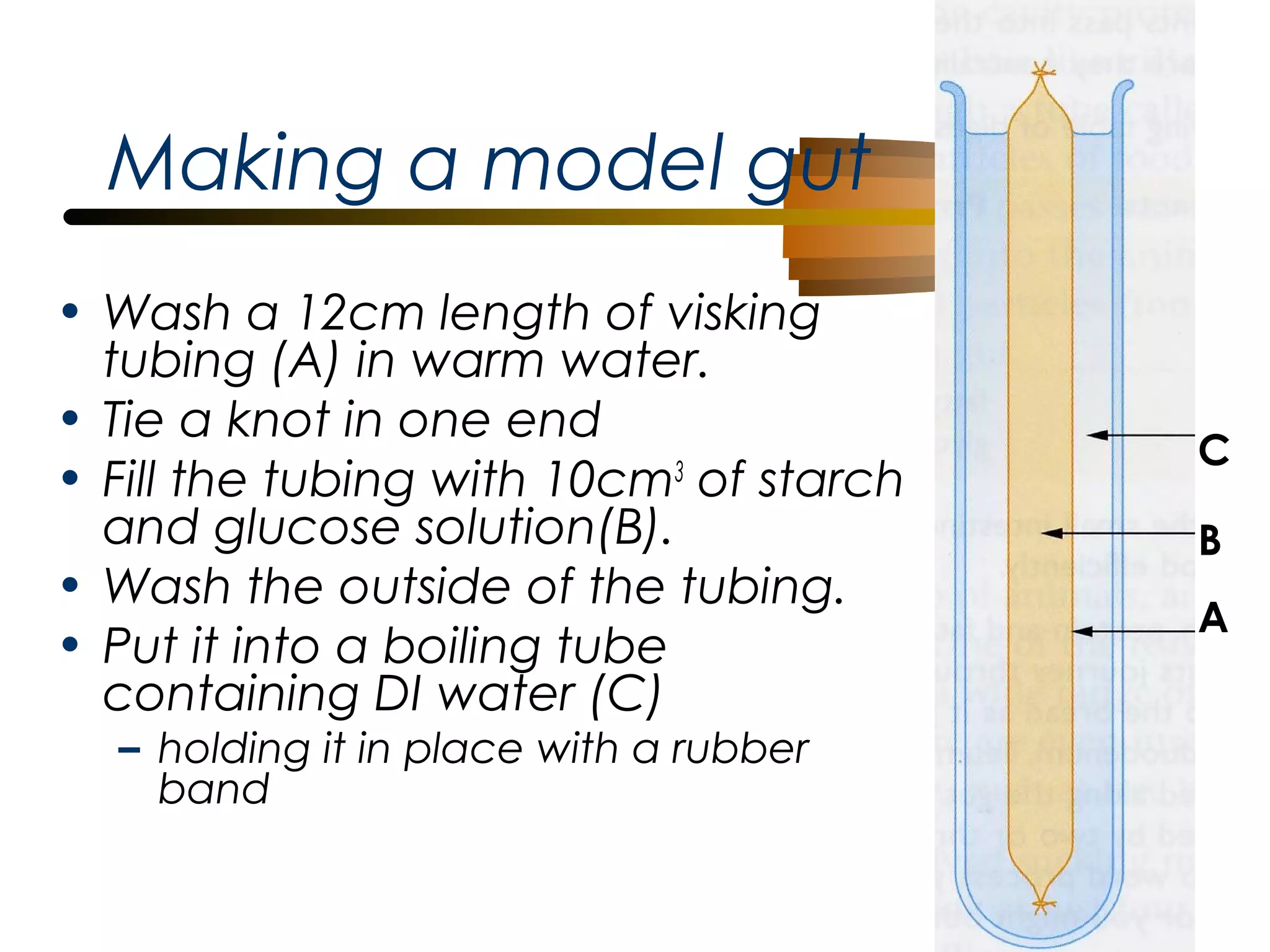
Making a model gut
• Wash a 12cm length of visking
tubing (A) in warm water.
• Tie a knot in one end
• Fill the tubing with 10cm3 of starch
and glucose solution(B).
• Wash the outside of the tubing.
• Put it into a boiling tube
containing DI water (C)
– holding it in place with a rubber
band

C
B
A
Model Gut Results
• In the next lesson
– Take a sample of the water in the
boiling tube
• Test the water for glucose
• Test the water for starch
Conclusions of the
experiment
• Draw conclusions from the
experiment, explaining what the
results were, and how the model gut
represents the real situation
• E.g. what does the water represent,
what does the Visking tubing
represent, etc.
Learning Outcomes
• indicate the role of the hepatic
portal vein in the transport of
absorbed food to the liver
Hepatic portal vein
• Transports absorbed food from the
small intestine to the liver
• After a meal, high concentrations of
glucose and amino acids are in the
blood
– The liver reduces the levels back to
normal
The liver
• Excess glucose arriving in the liver is
converted to glycogen for storage
• Excess amino acids can not be
stored in the body
– The liver removes these from the blood
and breaks them down to form an
energy source and urea.
Fat
• Fatty acids and glycerol are
absorbed into the lacteals
• Body cells take up the re-formed fat
molecules
– Used in respiration as a source of
energy
– Stored
Large intestine and the
elimination of waste.
• A watery mix of enzymes and
undigested food (mainly fibre)
moves into the colon.
• Water is absorbed back into the
blood stream.
• Faeces are compacted in the
rectum and egested through the
anus.
Pupil Activity - Diagrams
• Use your notes and your textbooks
to help you label the diagrams.
• Complete for prep.
• There are key words and phrases in
the boxes beside the diagrams to
help you.
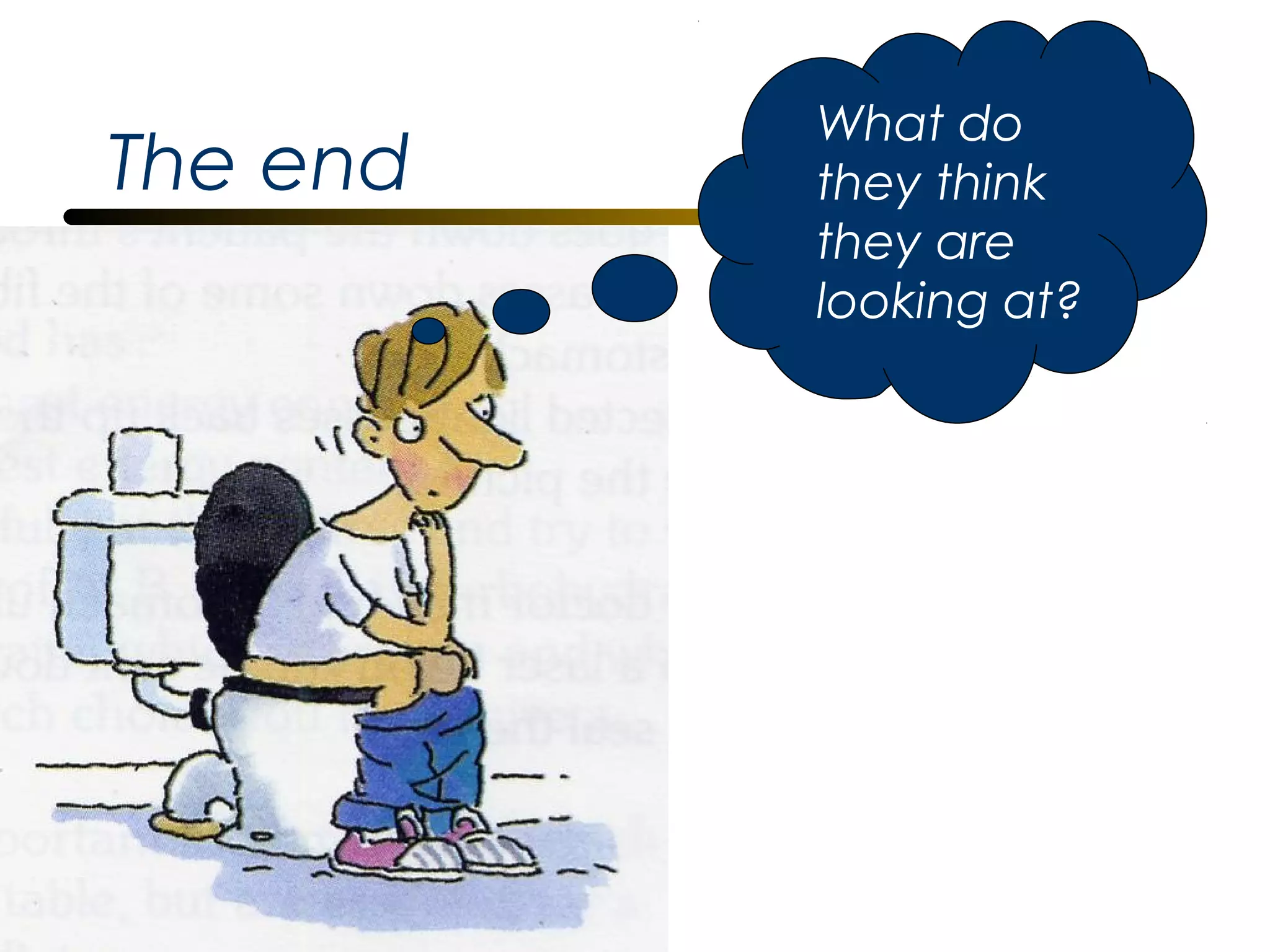
The end

What do
they think
they are
looking at?

IGCSE Nutrition Revision

  • 1.
  • 2.
    Learning Outcome 1 •Explain in simple terms why food is required by animals.
  • 3.
    You are whatyou eat!! • In this lesson you will – Look at what is a balanced diet – Carry out food tests on • Starch • Glucose • Protein • Fat – Discuss what happens if you don’t eat a balanced diet
  • 4.
  • 5.
    What is abalanced diet? • Your diet must include five groups of food substances – Carbohydrates, fats, proteins, minerals and vitamins • It must also include water and fibre. • A balanced diet is a diet that provides enough of these substances in the correct proportions to keep you healthy.
  • 6.
    Carbohydrates • Carbohydrates giveus energy. • Chemical elements – C, H and O. • Starch is made from simple sugars.
  • 7.
    Testing for glucose 1.Pour some glucose solution into a test tube 2. Add a few drops of benedict's solution 3. Heat in a water bath
  • 8.
    Testing For Starch •Put a few drops of starch solution on a spotting tile. • Add a few drops of iodine.
  • 9.
    Proteins • Proteins areneeded for growth and repair. • Proteins are made from amino acids • Chemical elements – C, H, O, N (and S)
  • 10.
    Testing for Proteins 1.Put 2 ml of protein solution in a test tube 2. Add 2ml of Biurets reagent
  • 11.
    Fats • Fats arean energy store, protecting vital organs and providing insulation. • Fats contain C, H and O • Fats are made from a glycerol molecule and three fatty acids.
  • 12.
    Testing for fat(the emulsion test) • Add a few drops of cooking oil into a test tube • Add 2cm3 ethanol and shake • Add 2cm3 water and shake again.
  • 13.
  • 14.
    Learning Outcomes • listthe chemical elements that make up: – carbohydrates – fats – Proteins • Describe the synthesis of large molecules from smaller basic units • list the principal sources of, and describe the importance of carbohydrates, fats, proteins,.
  • 15.
    Quick Revision • Abalanced diet must contain all the essential nutrients in the correct amounts and proportions. • The nutrients needed are – – – – – – – Carbohydrate Fat Protein Vitamins Minerals Fibre Water.
  • 16.
    Main Nutrients Nutrient Elements present Use inbody Good food sources Carbohydrate Carbon, hydrogen, oxygen Source of energy Rice, potato, bread Fats and oils Carbon, hydrogen, oxygen Source of energy Insulation Butter, milk, cheese, egg yolk Protein Carbon, hydrogen, oxygen, nitrogen Growth and Meat, fish, eggs, tissue repair soya, milk
  • 17.
    What you reallyneed to remember!! • Carbohydrates, fats and proteins are all made up of the elements carbon, hydrogen and oxygen • Proteins always contain nitrogen and sometimes sulphur • One way to remember this is – Carb O Hydrate
  • 18.
    Carbohydrates • Large carbohydratesmolecules such as starch and glycogen are made up of long chains of smaller units, e.g. monosaccharides (glucose), which are held together by chemical bonds
  • 19.
    Fats • Fats aremade up of three fatty acids and a glycerol
  • 20.
    Proteins • Proteins aremade up of long chains of amino acids
  • 21.
    Food Tests • Whatis the test for starch? • What is the test for glucose? • What is the test for protein? • What is the test for fats? • What does a positive result look like?
  • 22.
    Learning Outcomes • listthe principal sources of, and describe the importance of: – – – – vitamins (C and D only) mineral salts (calcium and iron only) fibre (roughage) water • describe the deficiency symptoms for: – vitamins (C and D only) – mineral salts (calcium and iron only)
  • 23.
    Vitamin C • Function –Maintain healthy skin and gums • Good Food Source – Citrus fruits, black currants, cabbage, tomato, guava, mango • Effect of deficiency – Scurvy • Bleeding under skin • Bleeding gums
  • 24.
    Vitamin D • Function –Needed to maintain hard bones – Helps absorb calcium from small intestine • Good Food Source – Milk, cheese, egg yolk, fish liver oil – Made in skin when exposed to sunlight • Effect of deficiency – rickets
  • 25.
    Calcium • Function – Healthyteeth and bones – Normal blood clotting • Good Food Source – Milk, cheese, fish • Effect of deficiency – Rickets – Slow blood clotting
  • 26.
    Iron • Function – Formationof haemoglobin in red blood cells • Good Food Source – Red meat, liver, kidney, eggs, green vegetables (spinach), chocolate • Effect of deficiency – Anaemia • Constant tiredness • Lack of energy
  • 27.
    Fibre • Function – Thisis cellulose which we can not digest – It adds bulk to the undigested food in the intestines, maintaining peristalsis • Good Food Source – Vegetables, fruit, wholemeal bread • Effect of deficiency – Constipation – Long term deficiency may lead to bowel cancer
  • 28.
    Water • Function – Formationof blood, cytoplasm – Solvent for transport of nutrients and removal of waste – Enzymes only work in solution • Good Food Source – Drinks, fruits, vegetables • Effect of deficiency – dehydration
  • 29.
    Pupil activity • Designa mind map to summarise the information you have been taught so far on Nutrients.
  • 30.
  • 31.
    Learning Outcomes • describethe use of microorganisms in the food industry, with reference to yoghurt, bread and single cell protein • describe the uses, benefits and health hazards associated with food additives, including colourings
  • 32.
    Micro-organisms in thefood industry • Micro-organisms are heterotrophic – they take in ready made foods molecules from their environment. • Examples of Microbes useful in food production – Acetobacter – vinegar production – Lactobacillus - yoghurt and cheese production – “ripening” bacteria in cheese production – Fusarium and mycoprotein
  • 33.
    Use of micro-organism process Useof microorganism Baking Yeast is mixed with flour, sugar and water to make dough. The yeast respire the sugar and produce pockets of carbon dioxide that makes the dough rise. When the bread is baked the yeast is killed. Brewing Yeast respires sugar to form ethanol and carbon dioxide. The ethanol makes the drink alcoholic and the carbon dioxide gives the drink its fizz. The process is called fermentation. Yoghurt making Bacteria are used to ferment milk at 46oC. As a result lactic acid is produced which makes the milk lumpy (coagulate). The temperature is then reduced to 5oC to prevent further bacterial action. The whole process is carried out in sterile conditions Single-cell protein This is a protein produced by microorgansism such as bacteria. Fungi or unicellular algae in a fermentation vessel. While the product contains 72% protein it does not taste very nice and is expensive to produce. An alternative is quorn – this is a mycoprotein made from a filamentous FUNGUS, which has 12.2% protein, low fat content and 6% fibre.
  • 34.
    Food Additives • FoodAdditives are substances with no nutritional value • They are added to improve the – – – – Appearance Flavour Texture Storage properties of food
  • 35.
    antioxidants • Stop foodreacting with oxygen, which may spoil the taste of the food or change it’s colour
  • 36.
    Colourings • Improve theappearance of food • Some colourings can be hazardous – Sunset yellow • Hyperactivity • Allergic reactions and asthma
  • 37.
    Flavourings • Enhance thetaste of the food – MSG – monosodium glutamate in processed food – Sugar – Artificial sweetners e.g. aspartame
  • 38.
    Preservatives • Give processedfoods a longer shelf life by preventing the growth of micro-organisms • Disadvantages of preservatives – Sulphur dioxide - destroys vitamin B1 – Sodium nitrite - carcinogen
  • 39.
    Progress Question • Learnthe groups of food preservatives listed below. • • • • Antioxidants Colourings Flavourings Preservatives • For each group state: – Its function in processed food – One advantage of its use – One disadvantage of its use • Use page 46 and 47 in your textbooks to help you
  • 40.
    Learning Outcomes • describetests for: – – – – starch (iodine solution) reducing sugars (Benedict's solution) protein (biuret test) fats (ethanol) • Applying knowledge on food tests to identify unknown liquids
  • 41.
    Activity • Use yourknowledge of food tests from last week to identify the food groups found in solutions A, B C and D.
  • 42.
    Learning Outcomes • understandthe concept of a balanced diet • describe: – a balanced diet related to age, sex and activity of an individual – the effects of malnutrition in relation to starvation, coronary heart disease, constipation and obesity
  • 43.
    What happens ifyou don’t eat a balanced diet. What is this cartoon trying to demonstrate? Can you think of any examples of health problems that arise from not eating a balanced diet? Give three examples and explain the effects on health.
  • 44.
    Dietary requirements • Adequatediet – Provides sufficient energy for the performance of metabolic work • Balance diet – Provides all the dietary requirements in the correct proportions • 1/7 fat • 1/7 protein • 5/7 carbohydrate
  • 45.
    Dietary requirements • Energyis provided by fat and carbohydrate intake • Dietary requirements depend on – Age • Energy demand increases until we stop growing – Sex • Males use up more energy than females – Activity • Physical work will use up more energy than office work.
  • 46.
    An Unbalanced diet Malnutrition •An unbalanced diet could lead to – Obesity • Risks include coronary heart disease and diabetes – Too much animal fat can lead to high cholesterol • Risks include coronary heart disease and angina – Lack of protein in diet can lead to kwashiorkor – Lack of fibre can lead to constipation and bowel cancer – Vitamin and mineral deficiencies
  • 48.
    Pupil Activity • CalculatingBMI • Follow the instructions on the sheet to calculate your own BMI • Answer the questions
  • 49.
    Learning Outcomes • Describethe effects of alcohol and the dangers of its misuse
  • 50.
    Effects of alcohol •Alcohol is a drug – It affects the nervous system – Depressant – Affects judgement and reaction time
  • 51.
    Effects of Alcohol •In small amounts – Feeling of relaxation • In larger amounts – – – – – Affects balance Dizziness Slurred speech Problems with vision unconsciousness
  • 52.
    Alcohol • Long termeffects – – – – – Addiction – alcoholism Cirrhosis of the liver Stomach ulcers Cancers of the digestive system Heart disease • Drinking during pregnancy – Can affects the fetus – Increasing risk of miscarriage – Decreasing the average birth weight
  • 53.
    Pupil Activity -BINGE • Read through the information provided • Should pubs stop cutting prices – Write a paragraph on what you think – Write a paragraph from the point of view from one of the six characters. • Remember whether or not you are for the scheme or against it you must give reasons.
  • 54.
    Learning outcomes • discuss: –the problems of world food supplies – the problems which contribute to famine
  • 55.
    Famine • A severeshortage of food can lead to famine. • Malnutrition – Suffer from deficiency disease – weakened immune system • Results in – Adults too ill to work – Children become ill, adults care for them – People die and society lacks experience and knowledge
  • 56.
    Problems that leadto famine • unequal distribution of food – Some areas produce more food • environment is more suitable • More advanced agriculture – Food surpluses can not always be moved to areas where food is limited • Drought – Water is essential for plant growth and for healthy animals – Low rainfall reduces crop yield.
  • 57.
    Problems that leadto famine • Flooding – Unpredictable flooding can reduce crop yield – Plants are damaged – Fertile soil can be washed away • increasing population – Need for food increases – More buildings reduces land available – More domestic animals reduces land available for food production
  • 58.
    Prep - Questionson Energy • For Wednesday – Question 1 • For Friday – Questions 2, 3 and 4
  • 59.
  • 60.
    Learning Outcomes • identifythe gross structure of the alimentary canal and associated organs (mouth, oesophagus, stomach, small intestine: duodenum and ileum, large intestine: colon and rectum, anus, pancreas, liver) • define ingestion, digestion, absorption, assimilation and egestion
  • 61.
    What happens tothe food we eat?
  • 62.
    The gut asa production line
  • 63.
    What happens tothe food we eat? • Ingestion – Intake of food into the mouth • Digestion – Breaking down large, insoluble food molecules into smaller soluble ones using enzymes
  • 64.
    • Absorption – Digestedfood molecules pass across the wall of the small intestine into the blood or the lymph • Assimilation – Uptake of food molecules by cells
  • 65.
    • Egestion – Passingout of undigested food, in the form of faeces, from the anus • Deamination – Removal of nitrogen containing part of an amino acid as urea.
  • 66.
    Pupil Activity • Labelthe diagram of the digestive system. – Use the textbook supplied to help if needed – Design a table to link the structure and function of different parts of the digestive system.
  • 67.
  • 68.
    Learning Outcomes • defineingestion, digestion, absorption, assimilation and egestion • describe the functions of the alimentary canal's various parts in relation to ingestion, digestion, absorption, assimilation and egestion of food
  • 69.
    Learning Outcomes • identifythe types of human teeth and describe their functions • state the causes of dental decay and describe the proper care of teeth
  • 70.
    Digestion • Digestion isthe breakdown of large, insoluble food molecules into small, soluble food molecules so that they can be absorbed into the blood stream.
  • 71.
    Feeding in mammals •Mechanical digestion – teeth are used to bite pieces of food and to chew it into smaller pieces • The shapes of teeth are suited to their function. – Incisors and canines are used for biting – Premolars and molars are used for chewing and crushing food.
  • 72.
  • 73.
    teeth • There aredifferent types of teeth, each specially shaped to perform a particular job. – Incisor • A broad flat sharp tooth found at the front of the mouth. Designed for biting and cutting food. – Canine • A sharp pointed tooth for piercing flesh and tearing. – Pre-molar & molar • A broad flat tooth with many cusps. Its rough surface is used for crushing, grinding and chewing food
  • 74.
    Structure of atooth • Colour in your diagram of the tooth, • Colour in the positions of the different types of teeth in the human jaw
  • 75.
    Structure of atooth enamel crown root dentine gum Pulp cavity cement
  • 76.
    Causes of dentaldecay • Bacteria and food deposits form plaque • Bacteria feed on sugars and produce acid • Acid dissolves the enamel forming a hole • Dentine dissolves more rapidly • If hole reaches pulp cavity can lead to bacterial infection, toothache and abscess
  • 77.
    Proper care ofteeth • Avoid sugary foods • Use dental floss or a tooth pick • Use a fluoride toothpaste • Visit dentist regularly
  • 78.
    Fluoride • Growing childrenabsorb fluoride from their diet • It becomes part of enamel of developing teeth • Enamel becomes more resistant to tooth decay
  • 79.
    Adding fluoride topublic water supplies • Advantages – Tooth decay in children decreases – No need to buy fluoridated toothpaste • Disadvantages – Form of mass medication – Fluoride can cause mottling (white patches) of teeth – Only benefits growing children – Unnecessary if proper care of teeth is taken – Side effects (bone cancer?)
  • 80.
    Learning Outcome • describethe processes of chewing and peristalsis
  • 81.
    Digestion of Food •The digestion of food can either be mechanical or chemical. • Mechanical digestion includes – Chewing – Action of muscles in oesophagus, stomach and small intestine • In chemical digestion enzymes catalyse the breakdown of larger food molecules into smaller food molecules.
  • 82.
    Digestion in themouth and oesophagus • Chewed food is mixed with saliva in the mouth • Saliva contains – Amylase is an enzyme which starts to digest starch into sugars (maltose) – Mucus helps soften the food making it easier to swallow • The bolus travels down the oesophagus with the aid of peristalsis
  • 83.
  • 84.
    Digestion of Starch •Take 10ml of 1% starch solution – Test for starch – Test for sugars
  • 85.
    Action of amylaseon starch • Put a drop of iodine solution into all the wells on a white spotting tile • Add 10ml 1% starch solution and 10ml 1% amylase solution to a test tube. • Every minute, test the contents of the test tube for starch. • After 15 minutes – test the solution for the presence of sugars • Write a conclusion on your results
  • 86.
    Learning Outcomes • Thesignificance of producing small, soluble molecules • describe: – digestion in the alimentary canal – the functions of a typical amylase, protease and lipase, listing the substrate and end-products
  • 87.
    Digestion • Digestion isthe breakdown of large, insoluble food molecules into small, soluble food molecules so that they can be absorbed into the blood stream.
  • 88.
    Digestion in AlimentaryCanal • Physical Digestion – Increases the surface area of food • Chewing in the mouth • Churning food in stomach and small intestine • Bile emulsifies fats – turns them into smaller droplets with a larger surface area
  • 89.
    Digestion in AlimentaryCanal • Chemical Digestion – Breakdown of large insoluble molecules into smaller soluble ones – Enzymes act as biological catalysts – they speed up the process – They work efficiently at body temperature (37OC) and at a suitable pH
  • 90.
    Digestive enzymes • Thereare different types of digestive enzyme – Proteases break down proteins into amino acids – Lipases break down fats into fatty acids and glycerol – Amylase breaks down starch into maltose (sugar) • Maltose is then broken down by maltase to form glucose
  • 91.
    Summary – digestiveenzymes Enzyme Site of action substrate End products Amylase Mouth, duodenum Starch Maltose Glucose Protease Stomach, duodenum Protein Amino acids fat Fatty acids glycerol lipase duodenum
  • 92.
    Chemical Digestion • Hydrogencarbonate ions – Secreted by pancreas – Neutralises acid, enabling enzymes in small intestine to work  • Bile – Produced by liver, stored in gall bladder, secreted into small intestine – Emulsifies fats (Larger surface area for enzymes to work on)
  • 93.
    Prep • Surface areaand digestion – Read the information – Answer questions 1- 3 – Answer question Ho2 • A snake swallowed a mouse whole. Explain why it took several days to digest it.
  • 94.
    Learning Outcomes • definethe term catalyst • define enzymes as proteins that function as biological catalysts • describe the effect of changes in temperature and pH on enzyme activity
  • 95.
    Enzymes • Are proteins •Are produced by cells • Change chemical substances into new products • Are “specific” to one substance • Work best at their “optimum temperature” (around 30 – 40oC) • Work best at an optimum pH
  • 96.
    Protein Digestion • Proteindigestion occurs in the stomach and small intestine. • Protease enzymes are produced by the gastric pits in the stomach lining or by the pancreas. • In the stomach, hydrochloric acid is also produced which provides the optimum pH for trypsin to work
  • 97.
    Protein Digestion • Add2ml of protein solution to three test tubes. • Number the test tubes 1, 2 and 3 1. Add 1ml HCl 2. Add 1ml Water 3. Add 1ml HCl • Do not add the trypsin until last 1. Add 0.5ml water 2. Add 0.5ml trypsin 3. Add 0.5ml trypsin
  • 98.
    Protein digestion • Leavefor 10 minutes • Test each of the test tubes for the presence of protein using Biurets reagent. • Explain your results.
  • 99.
    Fat Digestion • Milkdoes not dissolve in water, in the digestive system, bile produce by the liver (stored in the gall bladder) emulsifies fats to give a larger surface area for enzymes to work on. • You are going to use phenolphthalein to investigate the effect of bile on the digestion of fat.
  • 100.
    Fat Digestion • Take4 test tubes and number them 1, 2, 3 and 4. • set up the test tubes as shown in the table below. Test tube 1 2 3 4 Milk 3 ml 3ml 3ml 3ml Bile 0 0.5ml 1 ml 1ml Water 1ml 0.5ml 0 0
  • 101.
    Fat Digestion • Add5 drops of phenolphthalein to each test tube • Add sodium carbonate to each test tube until the solution goes pink. • Add 0.5ml of lipase to test tubes 1, 2 and 3. • Add 0.5 ml water to test tubes 4. • Observe your results. Try to explain what you are observing.
  • 102.
    Learning Outcomes • defineenzymes as proteins that function as biological catalysts • describe the effect of changes in temperature and pH on enzyme activity
  • 103.
    Effect of temperatureon enzymes • The optimum temperature for enzyme controlled reactions is around 37oC – Above optimum • Slows reaction down • Enzyme becomes denatured – enzyme loses it shape, deforming the active site so that the substrate no longer fits. – Below optimum • Slower reaction – lack of energy in molecules
  • 104.
    Graph – effectof temperature on the rate of enzyme activity
  • 105.
    Effect of pHon enzymes • pH of a solution is how acid or alkaline it is • Most enzymes have optimum pH 7 • Exceptions – – – – Pepsin Salivary amylase Catalase Pancreatic amylase pH2.0 pH 6.8 pH 7.6 pH 9.0 stomach mouth plants duodenum
  • 106.
    Effect of pHon enzymes • An extreme pH can denature enzymes – permanently altering the active site
  • 107.
    Graph - Effectof pH on enzyme activity
  • 108.
  • 109.
    Learning Outcomes • identifythe small intestine as the region for the absorption of digested food • describe the significance of villi in increasing the internal surface area • describe the structure of a villus, including the role of capillaries and lacteals
  • 110.
  • 111.
    Absorption in theileum • The small intestine is well designed for absorption, it has – Thin lining – A good blood supply – A very large surface area (about 9m2)
  • 112.
    Villi • Increase thesurface area for absorption • Each villus contains – Blood capillaries that absorb glucose and amino acids – Lacteals which absorb fatty acids and glycerol • Absorption is by – Diffusion – thin lining only 1 cell thick – Active transport – cells contain mitochondria to provide energy
  • 113.
  • 114.
    The Model Gut Amodel of absorption
  • 115.
  • 116.
    Making a modelgut • Wash a 12cm length of visking tubing (A) in warm water. • Tie a knot in one end • Fill the tubing with 10cm3 of starch and glucose solution(B). • Wash the outside of the tubing. • Put it into a boiling tube containing DI water (C) – holding it in place with a rubber band C B A
  • 117.
    Model Gut Results •In the next lesson – Take a sample of the water in the boiling tube • Test the water for glucose • Test the water for starch
  • 118.
    Conclusions of the experiment •Draw conclusions from the experiment, explaining what the results were, and how the model gut represents the real situation • E.g. what does the water represent, what does the Visking tubing represent, etc.
  • 119.
    Learning Outcomes • indicatethe role of the hepatic portal vein in the transport of absorbed food to the liver
  • 120.
    Hepatic portal vein •Transports absorbed food from the small intestine to the liver • After a meal, high concentrations of glucose and amino acids are in the blood – The liver reduces the levels back to normal
  • 121.
    The liver • Excessglucose arriving in the liver is converted to glycogen for storage • Excess amino acids can not be stored in the body – The liver removes these from the blood and breaks them down to form an energy source and urea.
  • 122.
    Fat • Fatty acidsand glycerol are absorbed into the lacteals • Body cells take up the re-formed fat molecules – Used in respiration as a source of energy – Stored
  • 123.
    Large intestine andthe elimination of waste. • A watery mix of enzymes and undigested food (mainly fibre) moves into the colon. • Water is absorbed back into the blood stream. • Faeces are compacted in the rectum and egested through the anus.
  • 124.
    Pupil Activity -Diagrams • Use your notes and your textbooks to help you label the diagrams. • Complete for prep. • There are key words and phrases in the boxes beside the diagrams to help you.
  • 125.
    The end What do theythink they are looking at?