Constant Coordinate Surfaces
and
Differential Length, Area and Volume
CONSTANT COORDINATE SURFACES
Surfaces in Cartesian, cylindrical, or spherical coordinate systems are easily
generated by keeping one of the coordinate variables constant and allowing the
other two to vary.
Cartesian Coordinate system
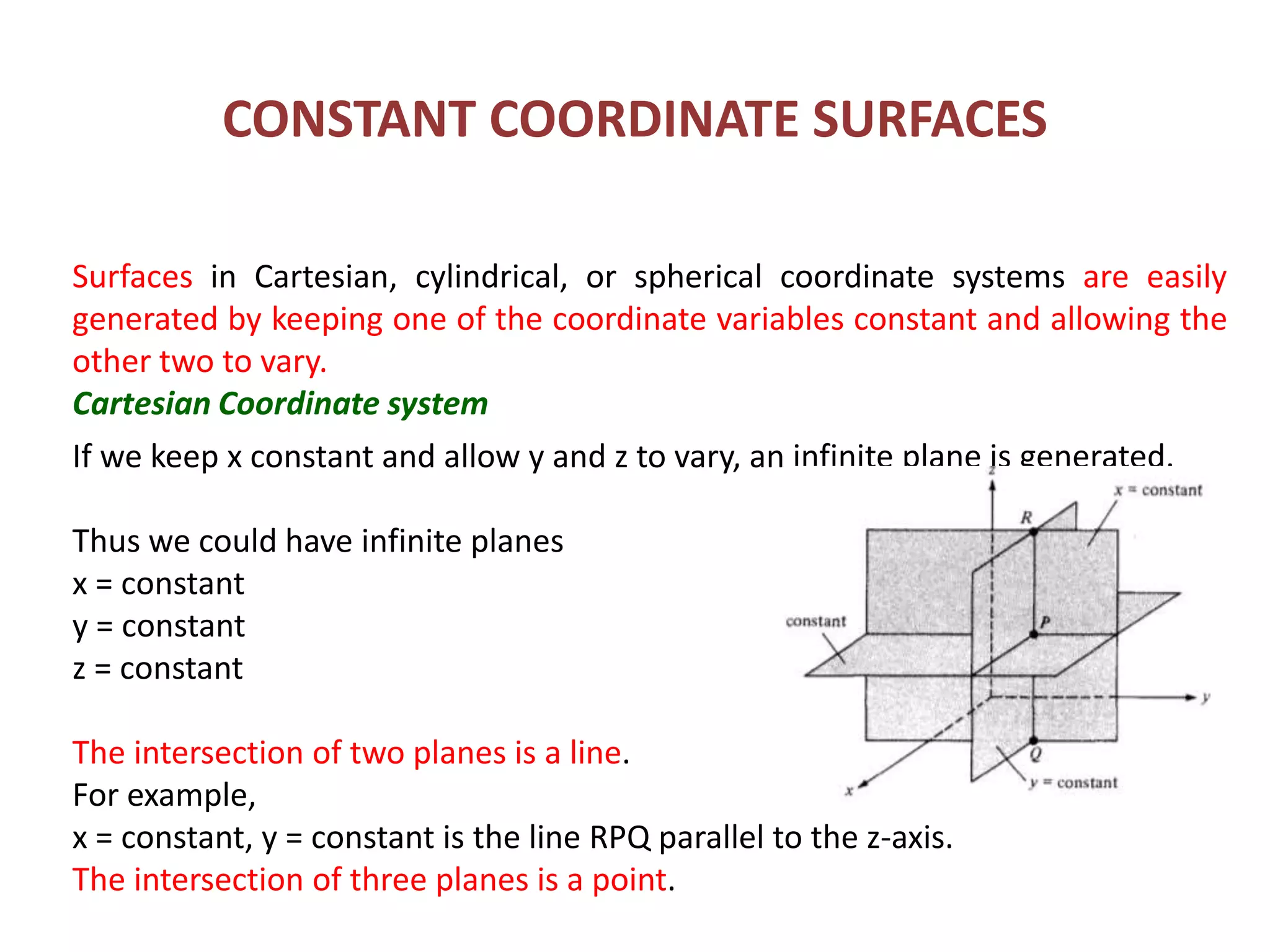
If we keep x constant and allow y and z to vary, an infinite plane is generated.
Thus we could have infinite planes
x = constant
y = constant
z = constant
The intersection of two planes is a line.
For example,
x = constant, y = constant is the line RPQ parallel to the z-axis.
The intersection of three planes is a point.
Cylindrical Coordinate system
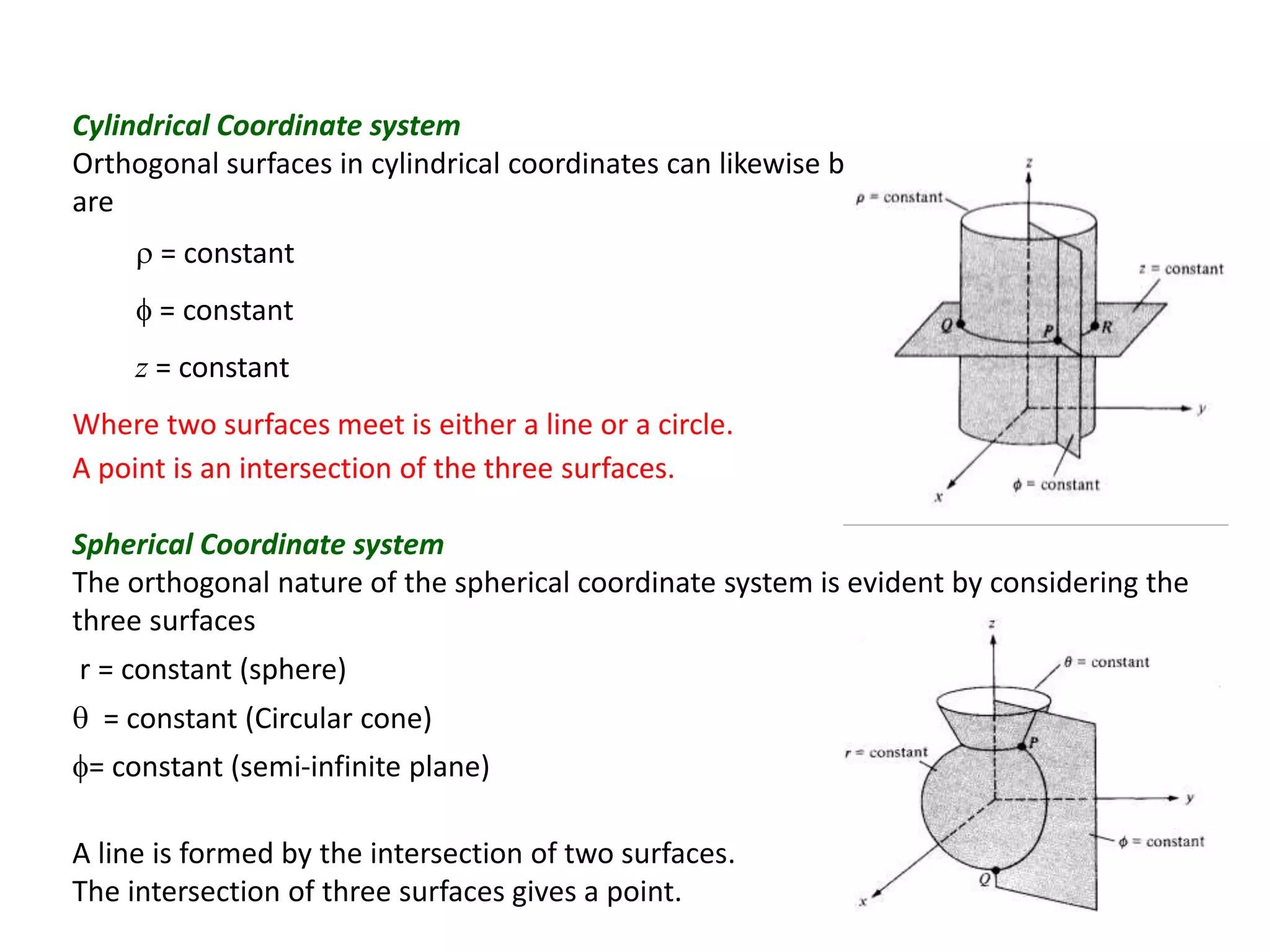
Orthogonal surfaces in cylindrical coordinates can likewise be generated. The surfaces
are
 = constant
 = constant
z = constant
Where two surfaces meet is either a line or a circle.
A point is an intersection of the three surfaces.
Spherical Coordinate system
The orthogonal nature of the spherical coordinate system is evident by considering the
three surfaces
r = constant (sphere)
 = constant (Circular cone)
= constant (semi-infinite plane)
A line is formed by the intersection of two surfaces.
The intersection of three surfaces gives a point.
DIFFERENTIAL LENGTH, AREA, AND VOLUME
Cartesian Coordinate system
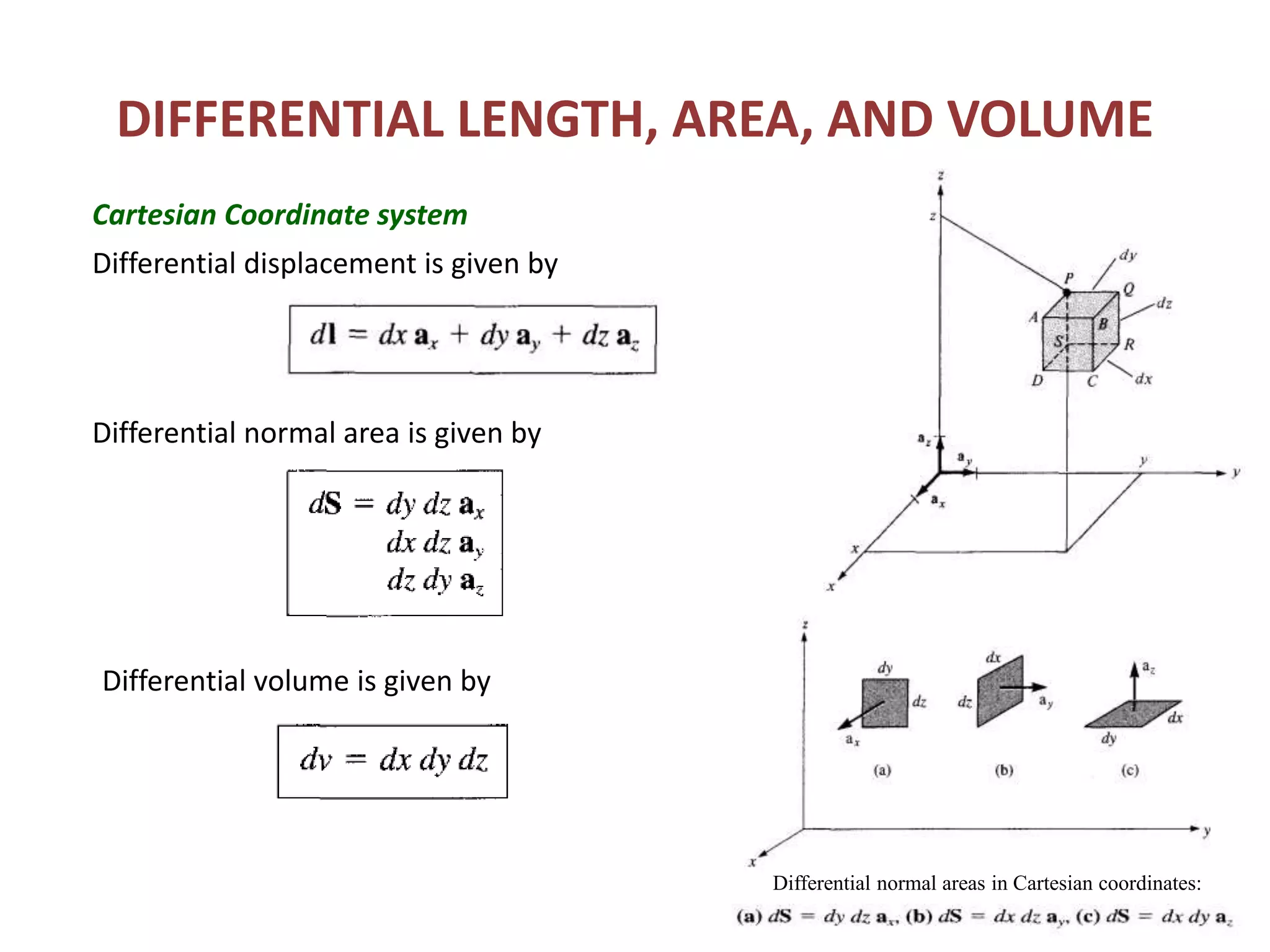
Differential displacement is given by
Differential normal area is given by
Differential volume is given by
Differential normal areas in Cartesian coordinates:
DIFFERENTIAL LENGTH, AREA, AND VOLUME
Cylindrical Coordinate system
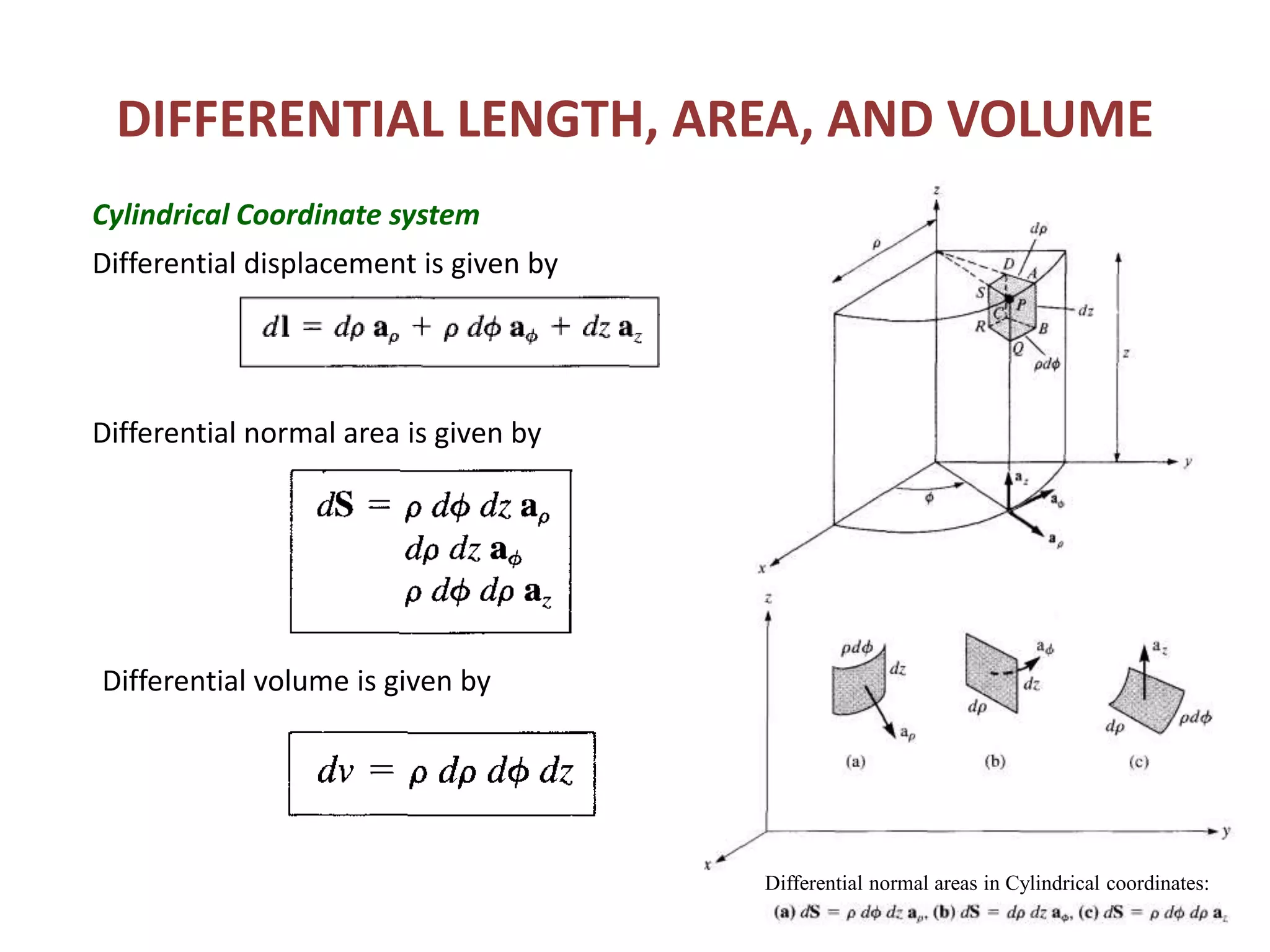
Differential displacement is given by
Differential normal area is given by
Differential volume is given by
Differential normal areas in Cylindrical coordinates:
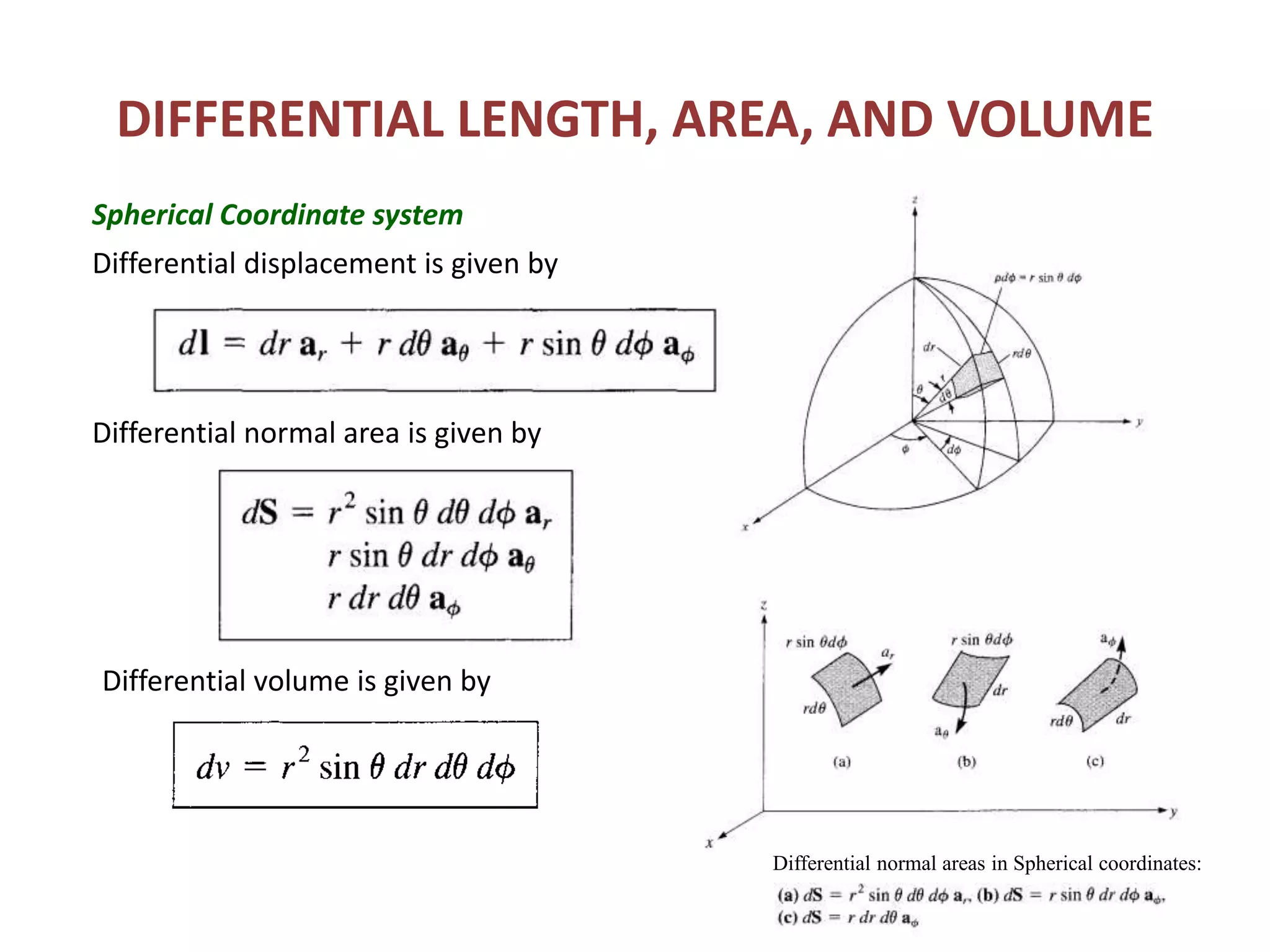
DIFFERENTIAL LENGTH, AREA, AND VOLUME
Spherical Coordinate system
Differential displacement is given by
Differential normal area is given by
Differential volume is given by
Differential normal areas in Spherical coordinates:

Constant Coordinate Surfaces.pptx

  • 1.
  • 2.
    CONSTANT COORDINATE SURFACES Surfacesin Cartesian, cylindrical, or spherical coordinate systems are easily generated by keeping one of the coordinate variables constant and allowing the other two to vary. Cartesian Coordinate system If we keep x constant and allow y and z to vary, an infinite plane is generated. Thus we could have infinite planes x = constant y = constant z = constant The intersection of two planes is a line. For example, x = constant, y = constant is the line RPQ parallel to the z-axis. The intersection of three planes is a point.
  • 3.
    Cylindrical Coordinate system Orthogonalsurfaces in cylindrical coordinates can likewise be generated. The surfaces are  = constant  = constant z = constant Where two surfaces meet is either a line or a circle. A point is an intersection of the three surfaces. Spherical Coordinate system The orthogonal nature of the spherical coordinate system is evident by considering the three surfaces r = constant (sphere)  = constant (Circular cone) = constant (semi-infinite plane) A line is formed by the intersection of two surfaces. The intersection of three surfaces gives a point.
  • 4.
    DIFFERENTIAL LENGTH, AREA,AND VOLUME Cartesian Coordinate system Differential displacement is given by Differential normal area is given by Differential volume is given by Differential normal areas in Cartesian coordinates:
  • 5.
    DIFFERENTIAL LENGTH, AREA,AND VOLUME Cylindrical Coordinate system Differential displacement is given by Differential normal area is given by Differential volume is given by Differential normal areas in Cylindrical coordinates:
  • 6.
    DIFFERENTIAL LENGTH, AREA,AND VOLUME Spherical Coordinate system Differential displacement is given by Differential normal area is given by Differential volume is given by Differential normal areas in Spherical coordinates: